Even the editors at Paluma.org can’t resist the odd attention grabbing headline (or click bait as it is now called) …….
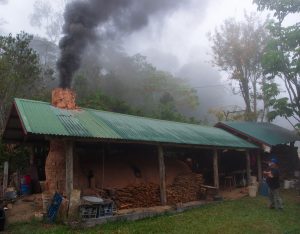
Last week saw the famous Anagama wood-fired kiln blaze into life at the Paluma Pottery on Lennox Crescent. Len Cook, our local award-winning Pottter, spent the last several months making hundreds of pots of various sizes and shapes, in preparation for the annual wood firing.

The process started last Monday evening (October 29) at 8pm and finished exactly 100 hours later at midnight on Friday. Prior to the start of the firing the lower part of the shelter that houses the kiln was chocked full of firewood, mostly pine and black wattle from the blocks at Hussey Road. By Friday most of the wood had been fed into the kiln, producing temperatures in excess of 2,000 degrees in the front part of the kiln. Continuous stoking of the fire was needed to maintain the temperatures that allow the wood ash that constantly flows over the pots to melt and form a wonderfully variable glaze on the pots. Len, together with Kelly Davis and Jamie Oliver worked shifts feeding the kiln, monitoring temperatures and making the odd adjustment to airflow vents and shutters.
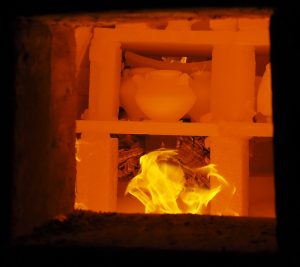
Each time new wood was added (about every 15 min, 24 hours a day) the chimney would produce billows of smoke and fire, which was particularly impressive at night.
The kiln is currently in cool-down mode and Len will not know what the results of this year’s efforts have been until later this week. But given the wonderful results from previous firings, there should be some spectacular pieces.
More pictures:
 Paluma has an entry in the latest issue of the RACQ Road Ahead magazine in the “My Town” section.
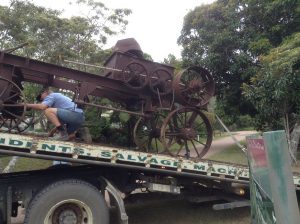 On Friday 12th October, two new arrivals appeared on the lawns adjoining Lennox Crescent and Mount Spec Road. They emerged from a dense cloud mist which enveloped Paluma that day, like visitors from the mists of time. The ambience seemed fitting, as these new arrivals are relics of a bygone era; a timber hauler, which was used to haul timber on Mt Spec and a bitumen mixer used in surfacing the Range Road during the 1950’s. The large, solid steel machines are well preserved and represent the epitome of engineering design and workmanship of their day.
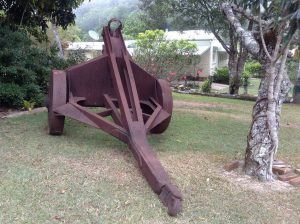 towed behind a small bulldozer. A steel rope from the winch on the dozer ran over the pulley on the bob-tail. By retracting the winch rope the heavy end of the log would be lifted off the ground and dragged out of the scrub to the loading ramps. The logs would then be loaded onto trucks towing timber jinkers for transport to saw mills or the rail siding at Moongobulla.
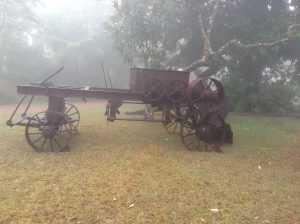 Until then the road was unsealed. The bitumen mixer carried a drum that had two sets of paddles running through it which mixed the liquid hot tar with sand and gravel to produce bitumen for sealing the road. Unfortunately the engine driving the mixer via two leather belts, is missing. Possibly it was a Southern Cross engine, one of which may eventually be obtained and set in place.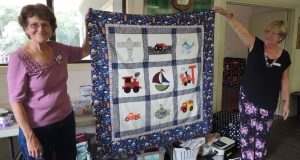
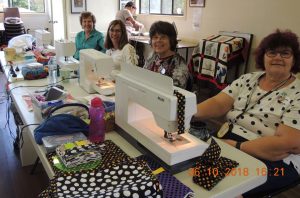
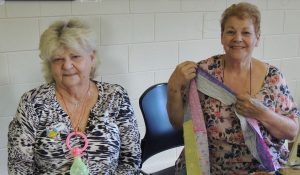
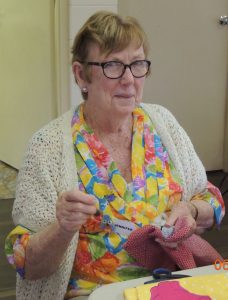 The Townsville Blankets of Love group formed in 2000 after a founding member suffered the devastating loss of a grandchild. Out of this hardship, was formed a truly dedicated and remarkable group of women. Their most important role is to make and provide small quilts which are passed on to social workers at hospitals. The quilts are given to parents suffering the loss of a baby and the hope is that the quilts will assist in the process of saying goodbye to the loved one.