Rainforest Tree of the Month, October 2018 – Alphitonia petriei

Pink Ash – Alphitonia petriei

 Around the world there are 20 species of this distinctive tree, mostly in tropical Asia, while in Australia there are seven or eight species, found in eastern  northern Australia.  Alphitonias are known by several popular names which can cause some confusion in identifying a particular species. Pink Almond, White-leaf, White Ash, Soap Tree, Sarsaparilla, Red Ash, Red Almond, Foam-bark and Pink Ash are those names most commonly used.
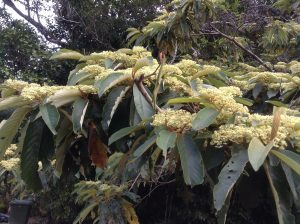
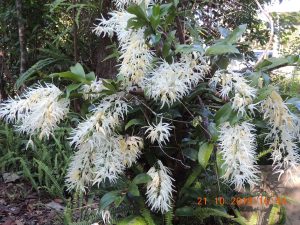
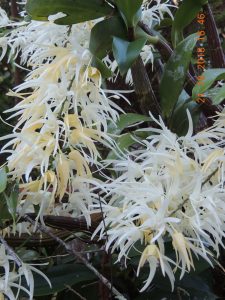
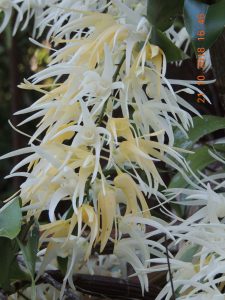
Alphitonia petriei is a pioneer species which grows rapidly on the edge of the forest or in a gap where sunlight can reach.  Trees can grow to a height of 40 meters and sometimes look grotesque with gnarled and twisted limbs and branches which reach out impossible distances laterally from the trunk.  At present trees around Paluma are particularly eye-catching as most are densely covered in white flowers, often with a tiered effect and, from a distance, appear like snow-laden Christmas trees.
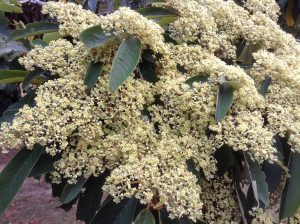
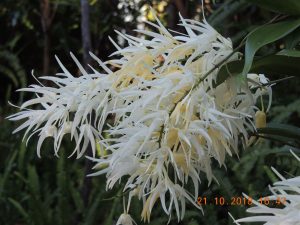
The flowers which grow in dense panicles at the ends of branchlets and between leaves are white, cream or pale green. They have five petals, only 1.5 mm long which envelop the stamens. Flowering is usually from September through to March. Pollination is by beetles. Butterflies are also attracted to Alphitonia. The fruit is produced from February to July; globular, dark capsules, which ripen to reveal three orange to red seeds surrounded by a powdery flesh.  Many birds, including King Parrots and Crimson Rosellas, feast on these while fallen fruit is eaten by cassowaries.

Leaves of the Alphitonia are simple, lanceolate and can be 65 to 180 mm long.  The upper surface is glabrous and a dull grey-green in colour while the undersurface is whitish and slightly hairy.  In some species of Alphitonia, notably A. excelsa, the leaves when rubbed in water will produce a soapy froth, hence the popular name Soap Tree.   This species is more commonly found at a lower altitude than that of Paluma.

The bark on the trunk and limbs of this tree is grey, flaky, almost tessellated and if torn gives off a liniment-like odour.  This is a distinctive feature of the tree.  The strong liniment smell of broken twigs and leaves is methyl salicylate, produced in the cambial layers of the limbs.  Some people liken the smell to sarsaparilla, hence another popular name for this tree.  Rainforest Aborigines used the Alphitonia petriei medicinally, probably as a liniment.
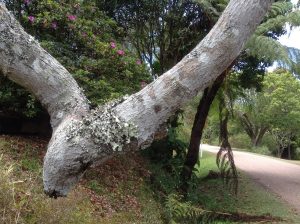
Alphitonia petriei is one of the many rainforest trees that contain bio-active chemicals which could potentially produce valuable medicinal drugs.  In his book ‘Plants of Tropical North Queensland’, John Beasley says that “research at Paluma found that more than half the trees tested showed marked bioactivity.”

There are many of these interesting trees growing in and around Paluma.  Particularly good specimens may be seen outside No 62 Mount Spec Road and at the corner of the western entry to Lennox Crescent from Mount Spec Road.

Text and photos by Colwyn Campbell

Platypus sighted on Village Weir

While Platypus are apparently regularly seen by some residents on the creeks behind Hussey Road, reports of these elusive but iconic Australian animals in the pond above the weir near the village green are pretty rare. Last month (September 14) there was a confirmed sighting in the middle of the weir pond by Eridani Mulder.  I went down to the weir twice during the subsequent week (once at dawn and once at dusk) and searched quietly for about 30 minutes without any luck, but I encourage others to do the same and post any further sightings to this message. It would be great if we could determine if we now have a resident Platypus on the weir! It would also provide a strong argument in support of our proposal to the city council for the construction of a nature walk and viewing platform around the weir.

Jamie Oliver

Paluma Range Road – Fire to Flourish

Most Paluma residents will tell you that they never tire of driving the Paluma Range Road. While the road often invokes fear and trepidation for new visitors and tourists, you will very often hear the locals talking animatedly about their observations and encounters along the road, whether it be with native fauna and flora, other road-users, fallen trees, floods and fire. Some long-time residents know the road culvert by culvert – from top to bottom.

Driving the Range Road in the warmer months of the year and during the wet season is always special. Very often there is water cascading down the rock faces adjacent to the road and beautiful waterfalls at the creek crossings. Sometimes the water is even streaming down the middle of the road! If you are lucky you might encounter reptiles such as large pythons, water dragons and freshwater turtles during your drive. In certain months of the year, it is possible to spot migratory bird species such as the paradise kingfisher in particular locations along the road.

Being on the Range Road in the dry season is just as remarkable. With the recent prolonged dry spell in the region, just a few short weeks ago an intense bushfire ravaged the terrain on the lower slopes and foothills of the Paluma Range. Following the fire it was difficult to spot any greenery in the bush and hardly a blade of grass was left intact. It was hard to imagine how the bush would recover from such a devastating blaze.

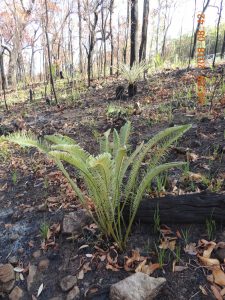
Less than one month later and the bush is regenerating with a vengeance. Driving the Range Road at the present time is an absolute joy. There are green shoots and new growth everywhere as the bush springs back to life. It is well known that the Australian bush needs fire for regeneration and there are many species of native plants reliant on regular firing regimes to promote new growth and for seed germination. The resilience of the bush and its adaptability to fire is well evident on the Paluma Range at the present time.

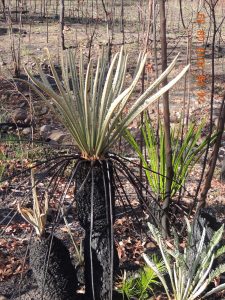
Cycads with fresh new growth

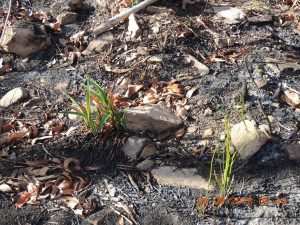
Among the many plants springing back to life are Eucalypts of various species, cycads (probably Cycas media) and grass trees (Xanthorrhoea sp.). The cycads are especially beautiful with their new, soft grey-green foliage unfurling from blackened stumps. Understory plants such as pandanus palms (Pandanus sp.), wombat berry (Eustrephus latifolius) and flax lily (Dianella sp.) are rampant with new growth on the charred, hard-baked clay soils and amongst the granitic outcrops.

Flax lily and wombat berry emerge from charred ground

Next time you drive the Range Road make sure you look for the ever-advancing tinges of green as the woodland forest springs back to life. This is ‘mother nature’ at her very best.

Cycad regrowth sprouts from burnt stumps

Text & Photos by Michele Bird

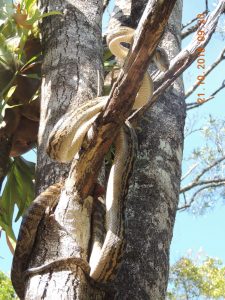
A Scaly Squatter – Common Tree Snake

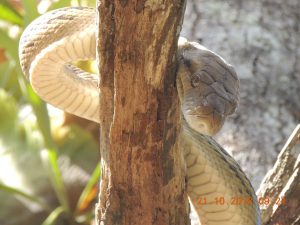
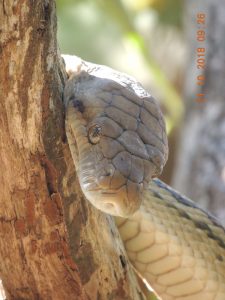
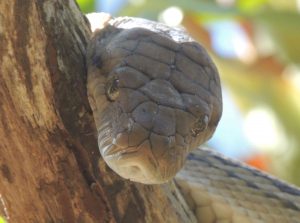
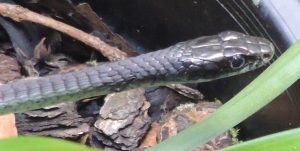
Common Tree Snake (Dendrelaphis punctulata)

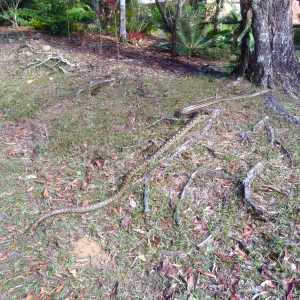
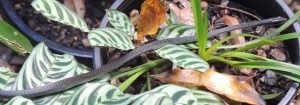
After having been absent from Paluma for a short while, I returned home to find a very scaly squatter had taken up residence on my back verandah. A common tree snake was resting comfortably, having wrapped itself around the wooden beam of the verandah above my back door!

This new resident was not particularly impressed with me and was  perturbed by the movement and vibration associated with my homecoming. It soon moved off into the pot plants and then back to the rainforest, being harangued by several honeyeaters during its return to the forest.

Common tree snakes are regular visitors to Paluma gardens and homes. This specimen was grey-blue in colour and was probably a young snake, being about 70cm in length. Adult snakes can grow up to 1.8m in length. Common tree snakes are very agile climbers and are usually active during the day. They range in colour from black, grey, green and blue, usually with yellow or paler-coloured bellies. They have excellent vision, which is not surprising considering the large shiny black eyes on this individual. Common tree snakes are non-venomous and they feed mainly on frogs and small lizards. This might explain why the green frog that usually lives on my verandah has disappeared!

         Text & Photos by Michele Bird


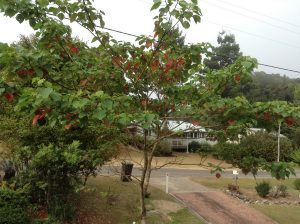
Rainforest Tree of the Month, September 2018 – Tropical Bleeding Heart

Tropical Bleeding Heart     Homolanthus novoguineensis

It is hard to ignore this attractive, graceful tree which is also known as Native Poplar. Its leaves are simple with a smooth, glossy upper surface and glaucous (pale bloom) underside. The stems exude a milky sap when broken. But the striking feature of this tree is the scattering of brilliant red and orange leaves among the heart-shaped green leaves. Leaves can be quite big, up to 14 cm long and 12 cm at their widest breadth and as they age, rather than a mass seasonal colouration change, a few at a time turn bright red before dropping.

The leaves actually do not turn red. As the leaf ages it ceases photosynthesizing, the green chlorophyll is taken back into the tree as stored energy. Gradually the green pigment is reduced, leaving the brilliant red and orange colouration seen in expended and dropped leaves.

The tiny flowers occur in clusters in leaf axils. They are white or cream, have no petals and are only 1 to 2 mm diameter so are often difficult to detect. Flowering can occur in any month. The fruits which follow are small green to purplish capsules about 8 to 10 mm in size which contain 2 brown seeds enclosed in yellow or orange arils. The fruit is eaten by many bird species, notably Rifle-birds, Bower-birds and Pigeons. Possums eat the leaves.

The Bleeding Heart is also the host tree for the Hercules Moth which is the largest moth in the World.

Bleeding Heart trees grow over a large area of rainforests, swamp forests and sclerophyll forests in North Queensland, NT, WA, Solomon Islands and New Guinea. They are fast growing and can grow to a height of 25 meters when buttresses may form. The tree is a forest pioneer, one of the first to re-establish after a disturbance or devastation such as a cyclone. Its presence provides shelter for other rainforest species to germinate and become established.

As you take a stroll through the village, you will see many of these trees, from seedlings only a few centimeters high to slender trees of 3 or 4 meters.  After cyclone Yassi in  2011, a large number of seedlings sprung up in newly open areas around some village gardens.  A good example of the tree can be seen along the McClelland’s Lookout path.

Closely related is Native Bleeding Heart, Homolanthus nutans, also known as Native Poplar. This remains usually as a shrub or small tree, growing to about 8 meters. In every other respect, including distribution, it is very similar to the Tropical Bleeding Heart.

For more information, see: Plants of Tropical North Queensland: John Beasley

Text and Photos by Colwyn Campbell

A Garden Visitor – Echidna (Spiny Ant-Eater)

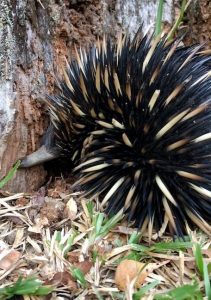
Paluma gardeners are quite accustomed to regular visits from the local wildlife, be it birdlife, bandicoots, wallabies, lizards and snakes. However, over the past two weeks an echidna or spiny ant-eater (Tachyglossus aculeatus) has been spotted in several gardens along the eastern end of Mt Spec Road. This spiky character has been seen digging for termites, ants and other invertebrate goodies to eat.

Photo by Clancy Swan

Echidna’s occur over most of Australia from cool temperate climes to tropical forests and desert. Mating occurs in July and August which might account for this individual being very active at present. It  seems to be particularly fond of the gardens at No’s 15, 16, 17 and 18 Mt Spec Road. Keep an eye out for this welcome garden visitor next time you take a walk through the eastern end of the village.

Birdwatcher’s Flock to Paluma

With the superb winter weather at Paluma, every week sees a ‘flock’ of birdwatchers visiting the village and surrounds to search out and photograph our birdlife. Last week, Murray and Dawn Frick spent time at Paluma and were hosted by Don Battersby at Hussey Road. Don provided some free mealworms and the birds arrived.

Murray and Dawn are sugarcane farmers from Bundaberg and this is their fourth trip to Paluma for birdwatching. When they are not working on the farm they love to travel around Australia. They are on their way home after seven weeks on the road, traveling some 10,000 kilometres throughout Queensland and the Northern Territory.

They first came to Paluma some years ago in search of the golden bowerbird. This trip they have photographed the golden whistler, satin bowerbird, rifle bird and many other species. Murray and Dawn say they are never disappointed when they come to Paluma as they know “we will always get good birds here”. We wish Murray and Dawn a safe trip home to Bundaberg and we hope to see you next year!

Searching for Rainforest Birds

Paluma is regularly visited by bird watcher’s from all over Australia and from around the world. This weekend (11 August) Ken Russell spent the day in the village, walking many of the local tracks. Ken lives in Victoria and he is a Member of Birdlife East Gippsland.

Ken Russell at Paluma

This was Ken’s second trip to Paluma and he spent the day searching for and photographing a variety of rainforest birds. He was especially keen on capturing images of the catbird, chowchilla, riflebird, noisy pitta, regent bowerbird and wompoo pigeon.

By all accounts, Ken had a very successful day, capturing some great images of a brazen catbird, riflebirds, satin bowerbirds and numerous other species. The chowchilla remained elusive and is still on Ken’s list of rainforest birds to photograph. 


Rainforest Tree of the Month – August 2018 Gympi Gympi (Stinging Tree)

Gympi Gympi (Dendrocnide moroides)

 The Gympi Gympi is also known as the Stinging Tree, and is said to be one of the world’s most venomous plants.  Those unlucky enough to have suffered a major sting claim the pain is the most excruciating of any they have endured.

A small stinging tree with ripe berries found beside Chicks Rd. Photo by Charlie Allen

World-wide there are 37 species of stinging tree with 6 in Australia.  The Dendrocnide moroides has the worst sting. The tree is often described as a shrub but can grow to a height of 4 to 5 meters.  It tends to grow in open, disturbed sites such as a cyclone damaged area or in a clearing where a tree has fallen.  They like sunny, but sheltered areas and are often found along walking tracks or the edges of streams.  The Gympi Gympi is found from Gympie in Southern Queensland to Cape York Peninsular and is very common in the Atherton Tablelands.  It is generally not common along any of the Paluma walking tracks that have a complete rainforest canopy, but small plants can spring up quite rapidly in damaged areas exposed to sunlight.

The leaves of the Gympi Gympi, carried on long, hairy stalks are finely serrated and heart-shaped.  They are covered in fine stinging hairs which give the leaves a furry appearance. The fine silica hairs break off when touched and embed in the skin.  They act like syringes and continue to inject venom for several days. Even dead leaves are capable of inflicting a sting.  The pain experience depends on the amount of contact with the leaves but also varies between people. A brief brush with a leaf can lead to significant but bearable localized (surface) pain, but extensive contact (especially in sensitive areas of thin skin) can be excruciating, often with extreme reactions like swelling and profuse sweating. The pain reduces over time but can linger for over a month.  Rubbing the skin exacerbates the situation as it breaks the hairs, leaving the points embedded in the skin. Also, contact with cool water leads to recurrence of pain days or weeks after the event. Unfortunately for those stung, there is no truly effective treatment although shaving the affected area and then daubing it with a weak solution of hydrochloric acid or  full strength house-hold vinegar can help to alleviate the worst of the pain. This treatment is only for the strong-minded since it causes the pain to significantly increase for several minutes before acting to reduce it.

The chemicals contained in the venom are not completely understood but it is suggested that a peptide called moroidin could be responsible for the pain.  Some birds, mammals and insects appear to be immune to the venom as many eat the fruit and leaves without harm.  The fruit is edible to humans brave enough to sample them and are quite pleasant in flavor – just be careful not to touch the leaves or stem when picking the berries!

The fruit of the Gympi Gympi is actually a small nut enclosed within a fleshy sac.  Several sacs are clustered together to form a mulberry-like fruit which hangs from a stem.  The stems and fruit are also covered in fine hair.

Looking for Spotted-tailed Quoll scat

Alberto Vale, from the Australian Quoll Conservancy (www.quolls.org.au) is looking for help in determining if the Spotted-tailed Quoll, which was once fairly common in Paluma, is still in the area. Sadly, quolls were hunted as pests by the original settlers.

For the past 9 months, the Australian Quoll Conservancy has been  surveying the Paluma area in search of Spotted-tailed Quolls, presumed extinct in the area since the 1930’s however confirmed sighting reports have floated in the 60’s as well in 1984.

While direct sightings of the animal would be most exciting, a more likely observation (if they are here) would be scat (Quoll poo) on the walking tracks or on top of adjacent rocks and bolders around the Dam or even near the village. If you see anything resembling the images below please take a picture as close-up as possible (or even collect a specimen) and contact Alberto on 0412 632 328 or aqc@quolls.org.au