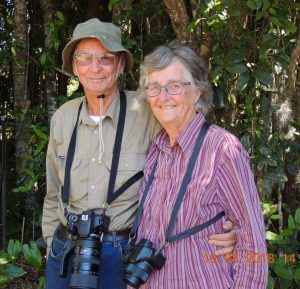
With the superb winter weather at Paluma, every week sees a ‘flock’ of birdwatchers visiting the village and surrounds to search out and photograph our birdlife. Last week, Murray and Dawn Frick spent time at Paluma and were hosted by Don Battersby at Hussey Road. Don provided some free mealworms and the birds arrived.
Murray and Dawn are sugarcane farmers from Bundaberg and this is their fourth trip to Paluma for birdwatching. When they are not working on the farm they love to travel around Australia. They are on their way home after seven weeks on the road, traveling some 10,000 kilometres throughout Queensland and the Northern Territory.
They first came to Paluma some years ago in search of the golden bowerbird. This trip they have photographed the golden whistler, satin bowerbird, rifle bird and many other species. Murray and Dawn say they are never disappointed when they come to Paluma as they know “we will always get good birds here”. We wish Murray and Dawn a safe trip home to Bundaberg and we hope to see you next year!
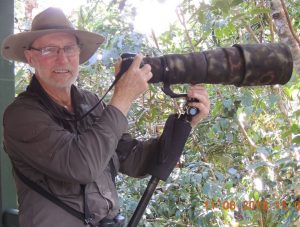
Paluma is regularly visited by bird watcher’s from all over Australia and from around the world. This weekend (11 August) Ken Russell spent the day in the village, walking many of the local tracks. Ken lives in Victoria and he is a Member of Birdlife East Gippsland.
Ken Russell at Paluma
This was Ken’s second trip to Paluma and he spent the day searching for and photographing a variety of rainforest birds. He was especially keen on capturing images of the catbird, chowchilla, riflebird, noisy pitta, regent bowerbird and wompoo pigeon.
By all accounts, Ken had a very successful day, capturing some great images of a brazen catbird, riflebirds, satin bowerbirds and numerous other species. The chowchilla remained elusive and is still on Ken’s list of rainforest birds to photograph.
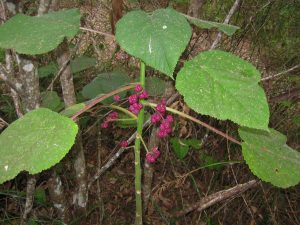
The Gympi Gympi is also known as the Stinging Tree, and is said to be one of the world’s most venomous plants. Those unlucky enough to have suffered a major sting claim the pain is the most excruciating of any they have endured.
A small stinging tree with ripe berries found beside Chicks Rd. Photo by Charlie Allen
World-wide there are 37 species of stinging tree with 6 in Australia. The Dendrocnide moroides has the worst sting. The tree is often described as a shrub but can grow to a height of 4 to 5 meters. It tends to grow in open, disturbed sites such as a cyclone damaged area or in a clearing where a tree has fallen. They like sunny, but sheltered areas and are often found along walking tracks or the edges of streams. The Gympi Gympi is found from Gympie in Southern Queensland to Cape York Peninsular and is very common in the Atherton Tablelands. It is generally not common along any of the Paluma walking tracks that have a complete rainforest canopy, but small plants can spring up quite rapidly in damaged areas exposed to sunlight.
The leaves of the Gympi Gympi, carried on long, hairy stalks are finely serrated and heart-shaped. They are covered in fine stinging hairs which give the leaves a furry appearance. The fine silica hairs break off when touched and embed in the skin. They act like syringes and continue to inject venom for several days. Even dead leaves are capable of inflicting a sting. The pain experience depends on the amount of contact with the leaves but also varies between people. A brief brush with a leaf can lead to significant but bearable localized (surface) pain, but extensive contact (especially in sensitive areas of thin skin) can be excruciating, often with extreme reactions like swelling and profuse sweating. The pain reduces over time but can linger for over a month. Rubbing the skin exacerbates the situation as it breaks the hairs, leaving the points embedded in the skin. Also, contact with cool water leads to recurrence of pain days or weeks after the event. Unfortunately for those stung, there is no truly effective treatment although shaving the affected area and then daubing it with a weak solution of hydrochloric acid or full strength house-hold vinegar can help to alleviate the worst of the pain. This treatment is only for the strong-minded since it causes the pain to significantly increase for several minutes before acting to reduce it.
The chemicals contained in the venom are not completely understood but it is suggested that a peptide called moroidin could be responsible for the pain. Some birds, mammals and insects appear to be immune to the venom as many eat the fruit and leaves without harm. The fruit is edible to humans brave enough to sample them and are quite pleasant in flavor – just be careful not to touch the leaves or stem when picking the berries!
The fruit of the Gympi Gympi is actually a small nut enclosed within a fleshy sac. Several sacs are clustered together to form a mulberry-like fruit which hangs from a stem. The stems and fruit are also covered in fine hair.
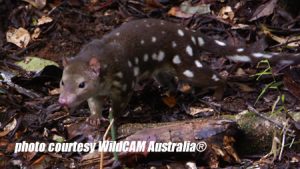
Alberto Vale, from the Australian Quoll Conservancy (www.quolls.org.au) is looking for help in determining if the Spotted-tailed Quoll, which was once fairly common in Paluma, is still in the area. Sadly, quolls were hunted as pests by the original settlers.
For the past 9 months, the Australian Quoll Conservancy has been surveying the Paluma area in search of Spotted-tailed Quolls, presumed extinct in the area since the 1930’s however confirmed sighting reports have floated in the 60’s as well in 1984.
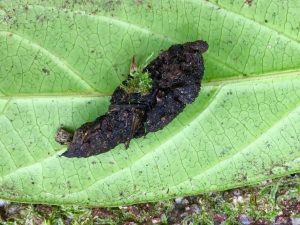
While direct sightings of the animal would be most exciting, a more likely observation (if they are here) would be scat (Quoll poo) on the walking tracks or on top of adjacent rocks and bolders around the Dam or even near the village. If you see anything resembling the images below please take a picture as close-up as possible (or even collect a specimen) and contact Alberto on 0412 632 328 or aqc@quolls.org.au
The satin bowerbird is common at Paluma and quite easy to spot around many of the village gardens and along the numerous walking tracks.
The population of satin bowerbirds at Paluma is quite unique in that it is reported to be an isolated population in the Wet Tropics of North Queensland.
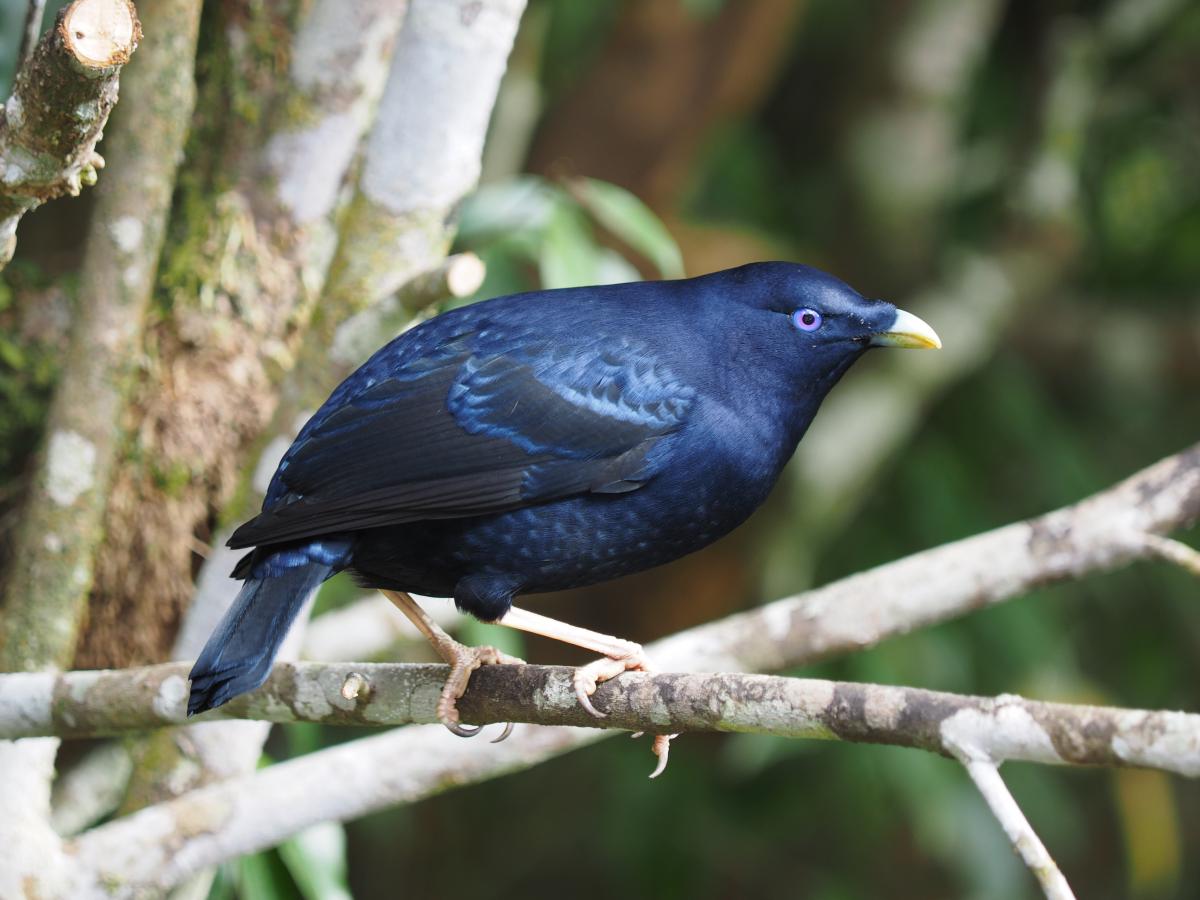
The male birds are black in colour, but the rich dark gloss of their feathers gives the birds an almost metallic sheen, so that they appear to be a deep shiny blue colour. They are quite breathtaking to see in the varying shades of light in the rainforest.
Satin Bowerbird male (top) and female (bottom). Photos by Jamie Oliver
The female birds are green and brown in colour, but with a distinctive scalloped pattern down the body. Both male and female birds have striking blue eyes.
If these birds are not spectacular enough, like most bowerbirds they have a very complex courtship behaviour that involves the male birds building elaborately woven stick structures, or ‘bowers’.
The intention of the bower is to lure females for mating. The female birds will visit the bowers and based on their inspection, will then choose which male they will allow to mate with them.
Male satin bowerbirds go to great lengths to decorate their bower with shiny and coloured objects to impress the ladies. As the males mature they favour blue objects in particular.
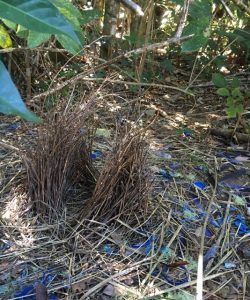
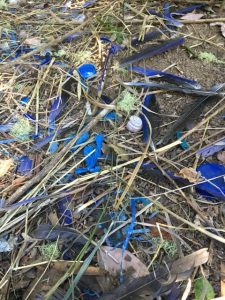
Satin Bowerbird bower. Photos by Michele Bird
Some lucky Paluma locals have a resident satin bowerbird and bower in their garden, or on their bush block. The bower here was recently sighted in the Hussey Road area.
This bower is decorated with an array of natural objects. This bird has collected blue bird feathers (probably from a crimson rosella), land snails, brightly coloured pebbles and bright-green moss or lichen. However, the majority of the items are non-natural materials including fragments of plastic, surveyor’s tape, pieces of tarpaulin, pegs, bottle lids, the rings from milk bottles and pieces of aluminium foil.
To me, this bower shows how remarkably innovative and adaptive these birds are to the modern world, in sourcing and using a vast array of treasured blue finds. But, it also shows that even in a small village such as Paluma, which is nestled on the very margins of the Wet Tropics World Heritage Area, the birds are able to find a great deal of plastic material. For me it serves as a timely reminder that we could all do a little bit better in managing our waste and taking care of our environment and native fauna.
This is one rainforest tree that can be unmistakably recognised by its bark. The bright red/orange papery bark stands out like a glowing beacon in the surrounding greens of the forest. The flakes of bark are thin, soft and translucent.
The tree grows to a height of 20 to 30 metres and often has buttresses. The small, filamentous flowers are out of sight, high in the canopy but their faint citron scent wafts in the air. The fleshy fruits when they drop to the ground from December to February, are readily identifiable.
These are purple, round to obovoid in shape, and about 30 mm long, holding one seed. Cassowaries, Bush Rats, White-tailed Rats and Musky Rat Kangaroos eat the fruit.
Leaves are glossy dark green obovate, 60 to 130 mm long.
These beautiful trees can be seen along the walking tracks in Paluma and particularly along the Andre Griffin track you will see several at close hand.
When in bloom, usually any time from April through June, the White Hazelwood tree (Simplocoschinchinensis,) is eye-catching crowned with a dense display of fluffy, white flower panicles. The flowers have a delicate fragrance and attract insects and birds. One of these trees is at present (early June) in full bloom and may be seen at the southern gate of the High Ropes course. There are several of these trees scattered around the village and along the sides of the Ridge Road near Paluma. Not all are yet in bloom.
Symplocos is one genus with approximately 250 species around the world and in Australia, there are 15 to 20. Wendy Cooper, in “Fruits of the Australian Tropical Rainforest’ lists 17 species which occur in tropical Queensland. The tree can grow to about 30 meters high.
The tree is not easily identifiable by its trunk and lower branches which have lightly textured bark. Like so many rainforest trees, the bark is mottled with lichen, camouflaging the surface with splotches of white, tan and green. The leaves however are distinctive. Mature leaves are elliptic in shape, are leathery and a dark, almost black, green and can be 70 -200 mm long and 7 -25 mm wide. Veins are well defined, giving the leaf an almost quilted appearance and the underside has a prominent purple mid-rib.
The flowers are tiny, with 5 white petals and many long filamentous stamens which when clustered in panicles, give a soft fluffy appearance. Unfortunately their beauty can be appreciated for only a few weeks – usually rain and wind dash them from the tree to form a carpet of white on the ground below.
The fruits of White Hazelwood are small, fleshy, olive-shaped blue/black drupes, 6 -10 mm long containing one or two seeds within a woody endocarp. The fruit ripens between November and March and is eaten by many bird species.
Keep an eye open over the next month or two for these lovely trees.
The Scrub Ironwood is a member of the Myrtaceae family; Genus – Gossia, Species – bidwillii.
Schoolchildren often call this tree the Refrigerator Tree because its trunk, when compared with other surrounding trees, is very cold to touch. It is also known as the Python Tree, perhaps because its mottled green and tan colouring and slightly twisting trunk resemble the marking and sinuous form of a large python.
The Scrub Ironwood is an attractive, slender tree growing to a height of about 25 metres. Its bark is smooth with blotchy patterning in green, tan, brown and orange colours but its most distinguishing feature is its coldness to the touch when compared with surrounding trees. On a cold morning the dense wood remains cold and water will condense and run off the trunk while surrounding trees remain dry. Sometimes a tree will form buttress roots. Branchlets on this tree are smooth and brown. The opposite, simple leaves are about 80 to 105 mm in length and elliptical or ovate in shape. When crushed they have a slightly eucalyptus smell.
Flowering occurs between August and March: small 2 to 5 mm sweetly scented white flowers with 4 but mostly 5 petals. They are often high in the tree and difficult to see. The fruit usually appears between October and May. It is a purple/black berry, about 4 to 10 mm in size, containing cream to brown coloured seeds. Many birds, including the lovely Rose-crowned Fruit Doves, feast on the fruit of this tree.
There are several Scrub Ironwood trees to be seen along the Paluma Rainforest Track – some of them quite close to the entrance of the track. See if you can spot them, growing among trees similar in appearance. The smooth, cold bark is the distinctive feature.

 For the past 9 months, the Australian Quoll Conservancy has been surveying the Paluma area in search of Spotted-tailed Quolls, presumed extinct in the area since the 1930’s however confirmed sighting reports have floated in the 60’s as well in 1984.
.jpg)
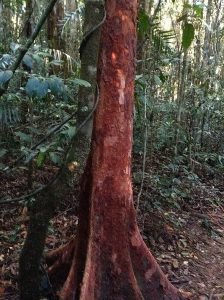 is one rainforest tree that can be unmistakably recognised by its bark. The bright red/orange papery bark stands out like a glowing beacon in the surrounding greens of the forest. The flakes of bark are thin, soft and translucent.
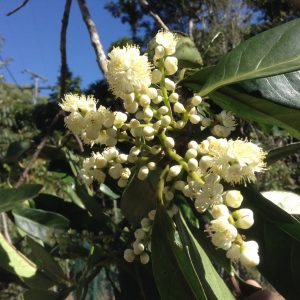 When in bloom, usually any time from April through June, the White Hazelwood tree (Simplocos chinchinensis,) is eye-catching crowned with a dense display of fluffy, white flower panicles. The flowers have a delicate fragrance and attract insects and birds. One of these trees is at present (early June) in full bloom and may be seen at the southern gate of the High Ropes course. There are several of these trees scattered around the village and along the sides of the Ridge Road near Paluma. Not all are yet in bloom.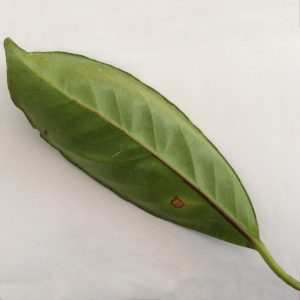

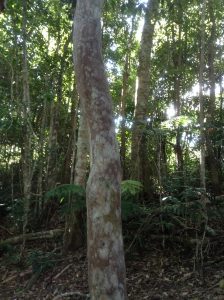 The Scrub Ironwood is a member of the Myrtaceae family; Genus – Gossia, Species – bidwillii.