
The grey fantail (Rhipidura albiscapa) has a wide Australian distribution but is also found in the Solomon Islands, Vanuatu and New Caledonia.
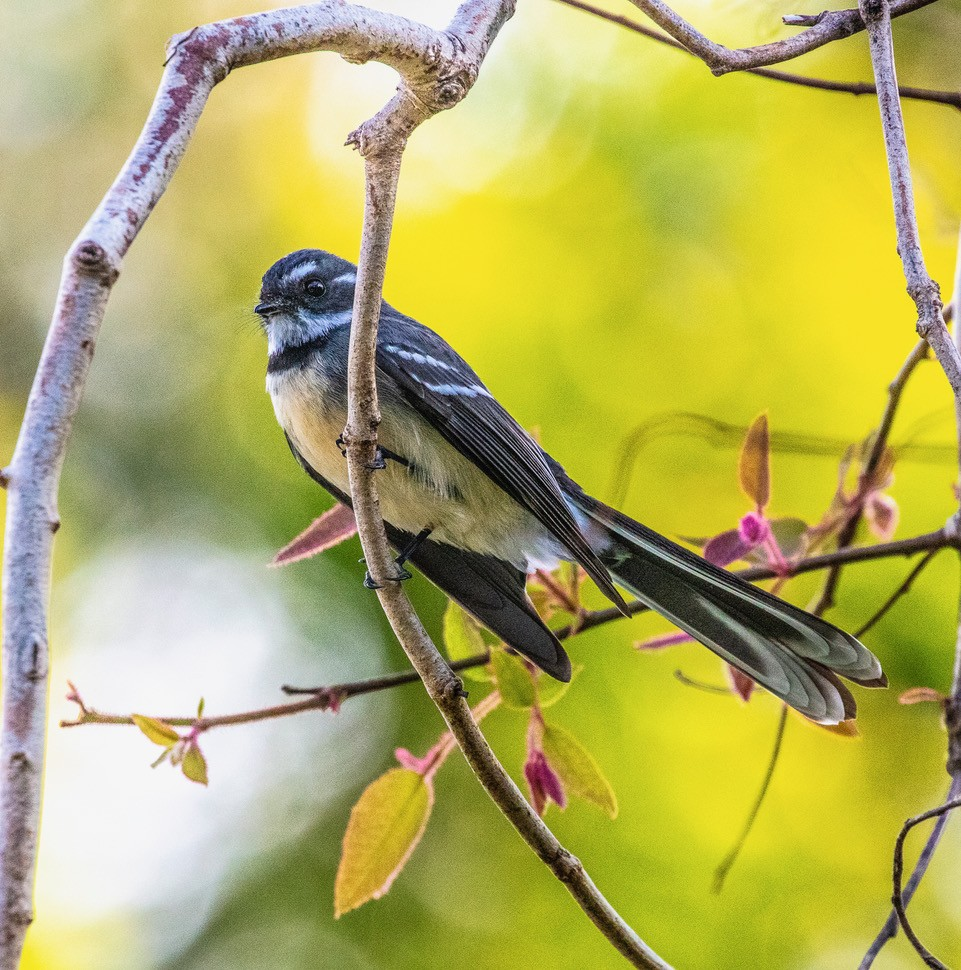
There are five named subpopulations in Australia. At Paluma, we have the eastern Australian subspecies Rhipidura albiscapa keasti, most commonly found along the coast and ranges to our north and south. This population is regarded as sedentary, while most others are migratory or nomadic.
P. a. keasti is distinguished by having the darkest plumage of the grey fantails.
During waking hours, the grey fantails are almost never still. They flit from perch to perch, sometimes on the ground but mostly on the twigs of a tree or any other convenient object, looking out for flying insects. They are able to catch flying insects using intricate acrobatic chases.
The birds are not shy, and will often flit within a few metres of people, especially in forested areas and suburban gardens. In doing so, it is able to catch any small flying insects that may have been disturbed by human activities such as walking or digging.

Most bird species typically build one nest in a breeding season, but grey fantails commonly build more than one nest before egg-laying, and seven nests have been recorded as the highest number in a breeding season.
There is a hypothesis explaining nest abandonment in this species. Abandoned nests could be used to confuse predators. In fact, a large number of abandoned nests exposed on trees are significantly less concealed than nests that eventually received eggs. Grey fantail eggs and fledglings are a favored prey of pied currawongs.
Some of the materials from decoy nests may be used to construct the subsequent breeding nest. They raise several broods per season, usually each of three or four cream eggs, spotted grey and brown. The incubation period is around two weeks, with incubation and feeding duties shared by both parents.
Photographs taken by Peter Cooke in Smith Crescent.
Text is largely an edited version of a Wikipedia entry.