
One of several ubiquitous yet relatively unassuming birds in Paluma gardens, the Little Shrike-Thrush (Colluricincla megarhyncha) has understated pastel-brown plumage and a quiet demeanour as it flits through the shrubs and understory in search of insects. But its charming and melodious call makes it one of my favourite companions as I walk through our garden or along the village road.
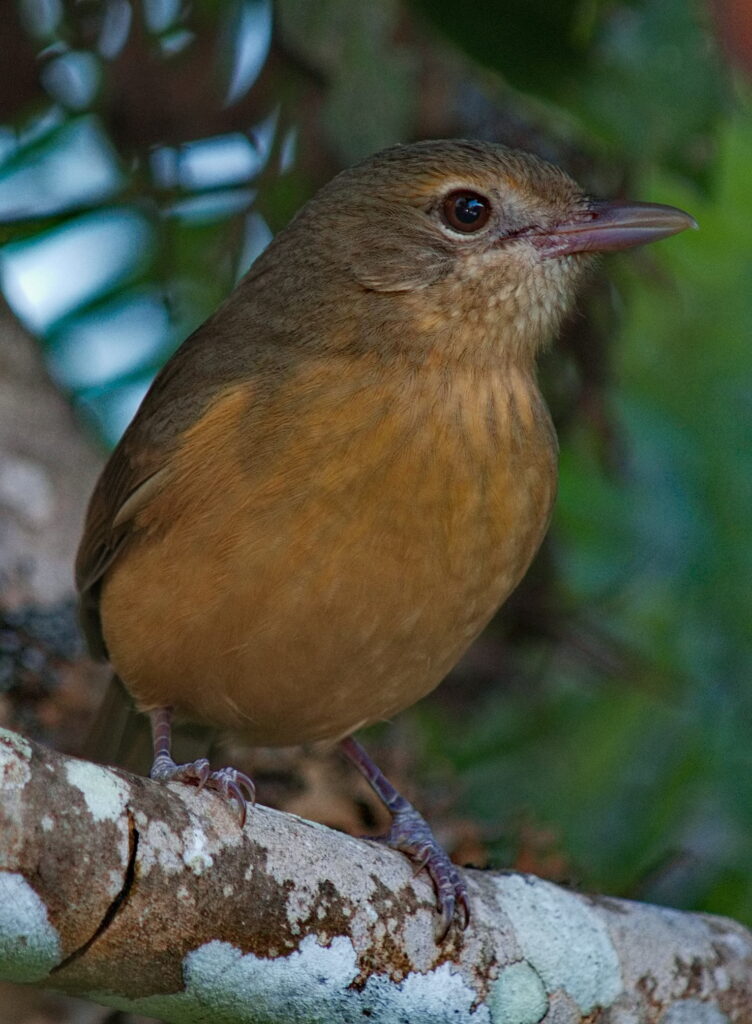
The Little Shirke-thrush has a long and storied history when it comes to its taxonomic status (see below), but currently Colluricincla megarhyncha is considered to be widely distributed throughout northern and eastern Australia, as well as mainland New Guinea and adjacent islands. It favours rainforest habitats (tropical and sub-tropical) but can occasionally be found in mangroves, paperbark swamps and regrowth forests. It occurs mainly in lowlands, although it is also found at altitudes up to 1800m.
On the birding leaderboards, the Little Shrike-thrush is overshadowed by its close relative, Bower’s Shrike-thrush (Colluricincla boweri), whose claim to fame has nothing to do with its physical attributes – it’s even plainer than the Little Shrike-thrush. Rather, its rarity is what makes it special. It can be found in upland rainforests of NE Australia between Townsville and Cooktown, and nowhere else. There are many records of Bower’s Shrike-thrush around Paluma on the Atlas of Living Australia and iNaturalist, although (to my shame) I have never seen one that I could confidently identify. It is distinguished from the Little Shrike-thrush by its dark grey head and back, and all-black bill, so good lighting and a fairly close proximity are needed. The photo below, from Ethel Creek, clearly shows the difference.
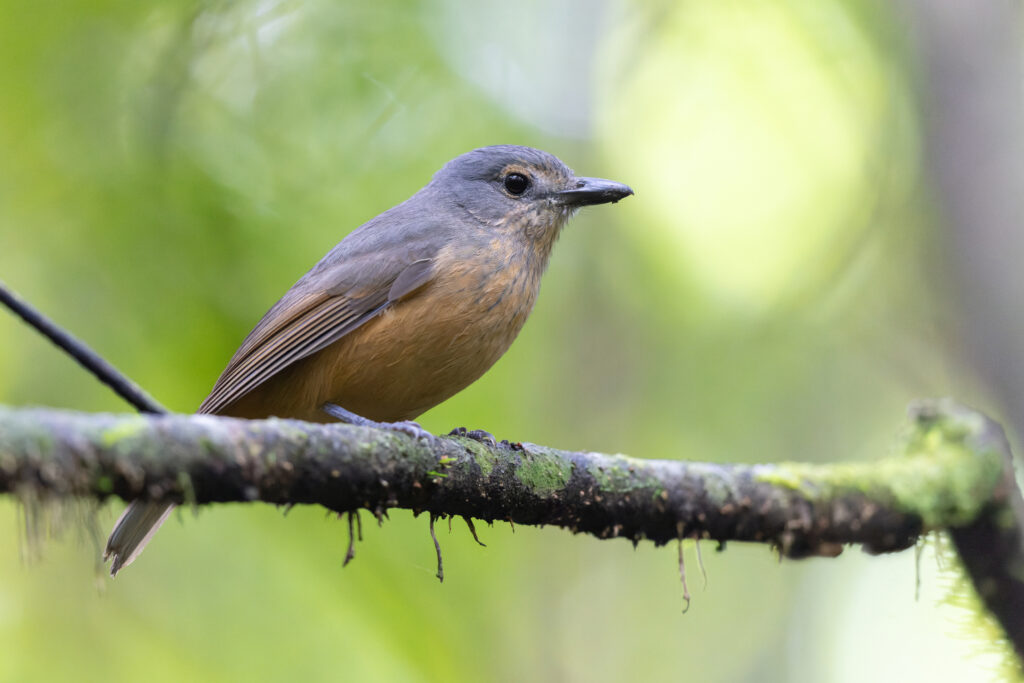
The bill of the Little Shrike-thrush is paler with a slightly pink base on the lower part. Photo by Jono Dashper, iNaturalist
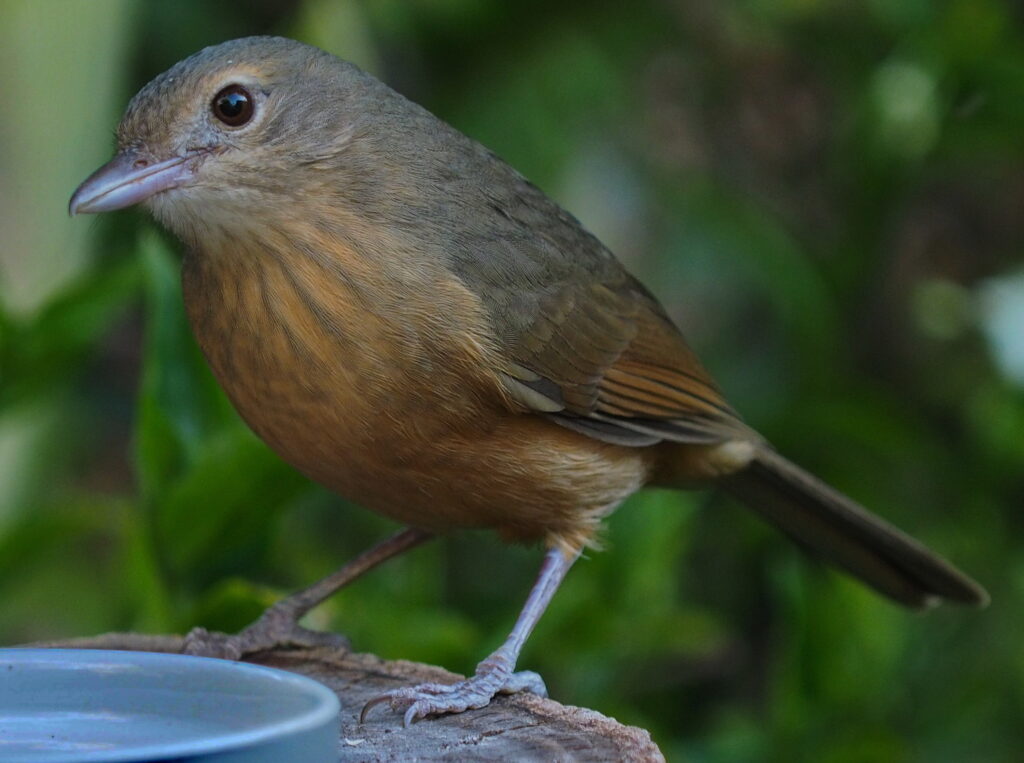
Insects make up the bulk of the Little Shrike-thrush’s diet. A plate of mealworms in our garden, once discovered, is rapidly consumed on the spot, except during breeding season, when I have seen one bird stuff up to five mealworms in its beak and then fly off to a nest hidden somewhere in the trees. While I have never seen it at our bird seed dispenser or our parrot and honeyeater buffet of fruit and date syrup, Little Shrike-thrushes are known to occasionally consume both.
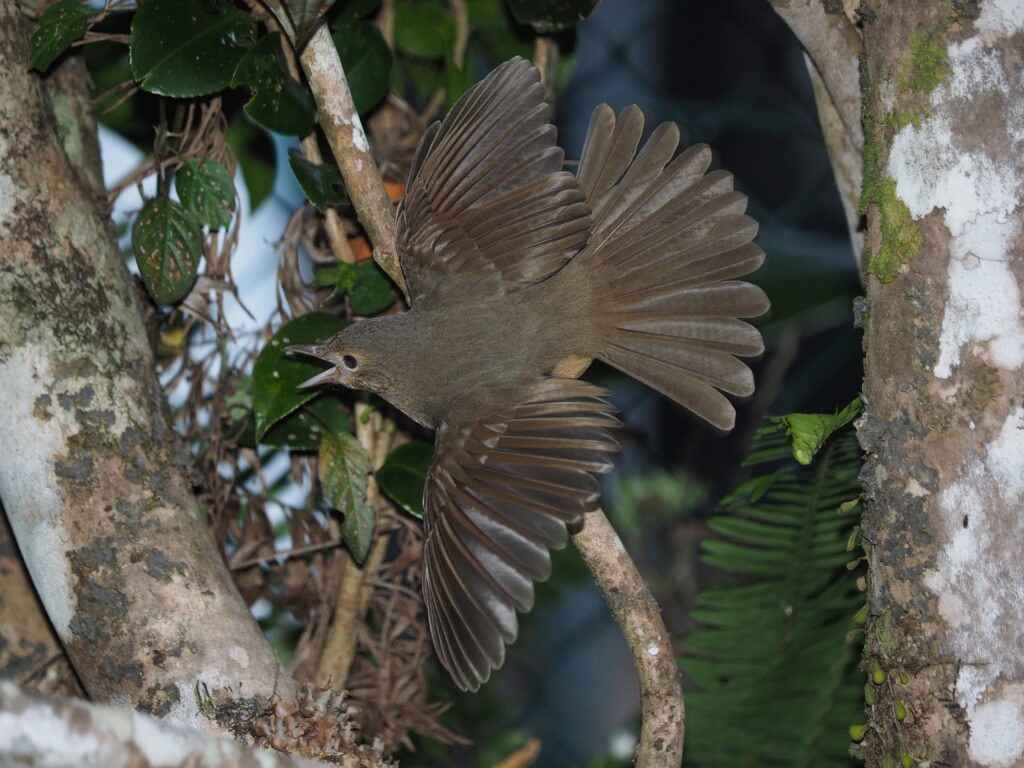
Breeding occurs from August to February and pairs of birds have been recorded to attempt up to five broods per season. Nests are about head-height in a tree fork, hidden amongst foliage. Incubation is mostly by the female, but both parents participate in feeding the young, which take about 10 days to fledge. Choice of nesting sites is flexible, as discovered by Colwyn Campbell several years ago when she noticed that her clothespeg basket on her clothesline had been commandeered by what appears to be a Little Shrike-thrush.
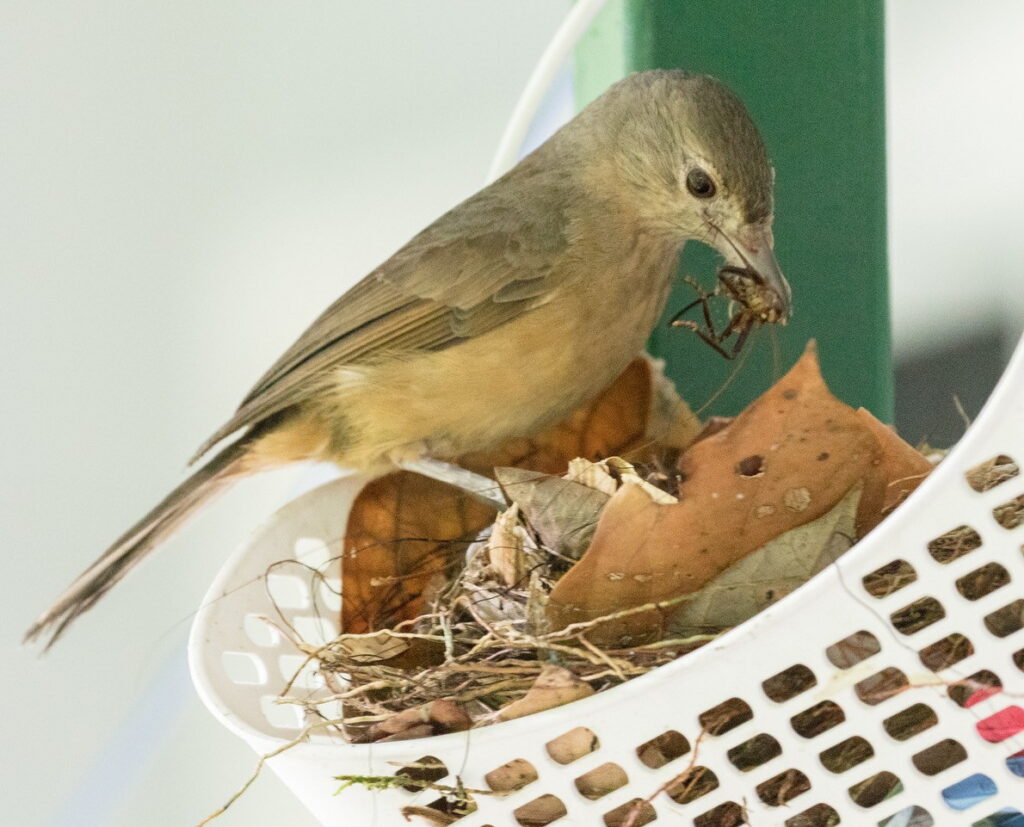
Photo by Peter Coke
Text and photos (unless indicated) by Jamie Oliver
Additional optional reading ……
Why is it called a Shrike-thrush?
Common names are often derived from the names used by the public for animals and plants that were sufficiently common or important to come up repeatedly in conversations. These common names often had obscure origins and did not necessarily reflect the nature of the animal or its affiliations to other related species. Scientific names are divided into two parts, first the genus, then the species. The species part of the name can be quite arbitrary and refer to a famous scientist or patron, or to some fairly inconsequential feature. But naturalists of old, as well as current taxonomists, tend to think more carefully when choosing names for the genus so as to reflect some important feature or affiliation shared by all the species in the genus.
So who came up with the name Shrike-thrush? It doesn’t have much scientific credibility since the genus is not related to either Shrikes or Thrushes. I had assumed that Shrike-thrush was coined by early European birdwatchers who found the scientific name Colluricincla a bit of a mouthful to pronounce, and since these birds were really like nothing they had seen before back home, but to their untrained eye looked a wee bit “thrushy” and also a wee bit “shrikey”, the name Shrike-thrush would do in a pinch. After consulting Chat GPT and giving it the benefit of the doubt in relation to accuracy, I found I was right that early birdo’s seem to have come up with this name. But took a much more conservative approach to choosing the name – they simply translated the Greek roots used in the scientific name Colluricincla: “collurio” meaning Shrike and “cinclos” meaning Thrush.
It was actually two very distinguished naturalists, Nicholas Vigors (founder of the Zoological Society of London) and Thomas Horsfield (founder of the Royal Entomological Society) who proposed the genus in 1827. They worked together on a description of the Australian Birds in the collection of the Linnaen Society. Describing birds based on preserved skins in the dusty bowels of a British museum, having never seen these birds in the wild, is not the best way to understand their form and affiliations but on reading their original 1827 manuscript it became clear that the authors used features they could see and measure (bill shape, wing shape etc) to conclude that the closest relatives to the Shrike-thrushes were indeed Shrikes and Thrushes.
We now know this was not the case, but hindsight is not a fair way to judge the quality of scientific enquiry, and there are no formal taxonomic rules about choice of scientific names (except that they be latinised), and thus no reason for the scientific name to be changed. In fact, once a name has been published, it remains forever. It can be removed from use for a particular group or reassigned to another group. But the name itself is immutable. This is not the case for common names (although there have been many efforts to voluntarily standardise common names) so a change in the common name for a genus is theoretically possible.
Peter Slater, the author of the first truly comprehensive Australian field guide for birds, was not a fan of the name Shrike-thrush. In his introduction to the genus, he suggests that the Aboriginal name “Gudilang” might be an appropriate replacement. This is probably a reference to the word referred to by Google AI as “Koodelong”, used by the Noongaar people of southwest WA. This suggestion from 1974 appears never to have been taken up, but it was a good one.
There are great examples of Aboriginal words for place names and fauna adopted into the Australian vocabulary. It’s fortunate that Joseph Banks, the naturalist aboard Captain Cook’s first voyage to Australia, thought to consult the local people of what later became Cooktown about the Aboriginal name for one of the mammals he had just discovered. Otherwise, he might have sent it back as a pelt to England for description and naming. We might then have had something called a “rabbit-deer” on our national coat of arms!
A game of names
The Little Shrike-thrush from Paluma has suffered the indignity of having had both its common and scientific names, as well as the identity of its relatives, changed repeatedly in field guides over the last few decades. When I first arrived in Australia, armed with the first edition of the only authoritative field guide to Australian birds by Peter Slater (1974), I was able to identify it as the Rufous Shrike-thrush (Colluricincla megarhyncha). By 1980 when I got a copy of the newly published field guide by Graham Pizzey it still retained the same common and scientific names but now included a new population of birds from the Northern Territory, formerly the Little Shrike-thrush (C. parvula), that, through no fault of its own, had been deemed unworthy of the status of a separate species and got demoted to a race of C. megarhyncha .
Fast forward to around 2010 when the first digital (iPhone) bird guide by Morcombe and Stewart came out based on taxonomy from 2008. Our Paluma bird had the same scientific species name but was assigned to a new race: rufogaster. It also acquired the common name from the NT population (Little Shrike-thrush).
Some time after 2018. The Pizzey and Knight digital edition had changed the common name of our Paluma bird back to the Rufous Shrike-thrush and elevated its race as a new species: C. rufogaster. The previously demoted Little Shrike-thrush had been rehabilitated as a full species in the Northern Territory and awarded the scientific name previously owned by our Paluma bird as well as all the others on the east coast: C. megarhyncha. with the common name Arafura Shrike-thrush. Our Paluma bird suddenly acquired an enormous extended family!
Most recently, all the populations of the east and northern coasts, together with numerous species and races from New Guinea, have been amalgamated into a single species (C megarhyncha) with a whopping 28 subspecies.
Taxonomists are often categorised as being either lumpers (who tend to merge previously identified species into a single one) and splitters, who do the opposite. This latest revision of C. megarhyncha was a huge win for the “lumpers”. It is very unusual for a species to have so many formally recognised subspecies. The island thrush had nearly fifty subspecies a while ago, but has now been split up. Currently, there are only two other species that have approximately the same number as the Little Shrike thrush. There is now speculation that, as more genetically based studies are conducted on the various subspecies, a similar decimation may occur for the Little Shrike-thrush. It will be interesting to see if any future split affects the naming of our Paluma bird. It seems that it has succumbed to the curse of “living in interesting times”.