
The Eastern Yellow Robin (Eopsaltria australis) is the least common of the three robins that are regularly recorded around Paluma village, but it is the most widely distributed. It occurs from Cape York to southeast Victoria in rainforests, eucalyptus forests and a variety of adjacent habitats, as well as parks and gardens. As with many of our Australian robins, it has a bold plumage. It’s not quite as spectacular as the scarlet or red-capped robins (a different genus) found further south and west, but its brilliant yellow and grey attire easily attracts the eye as it perches on a low branch surveying the ground for edible fare.
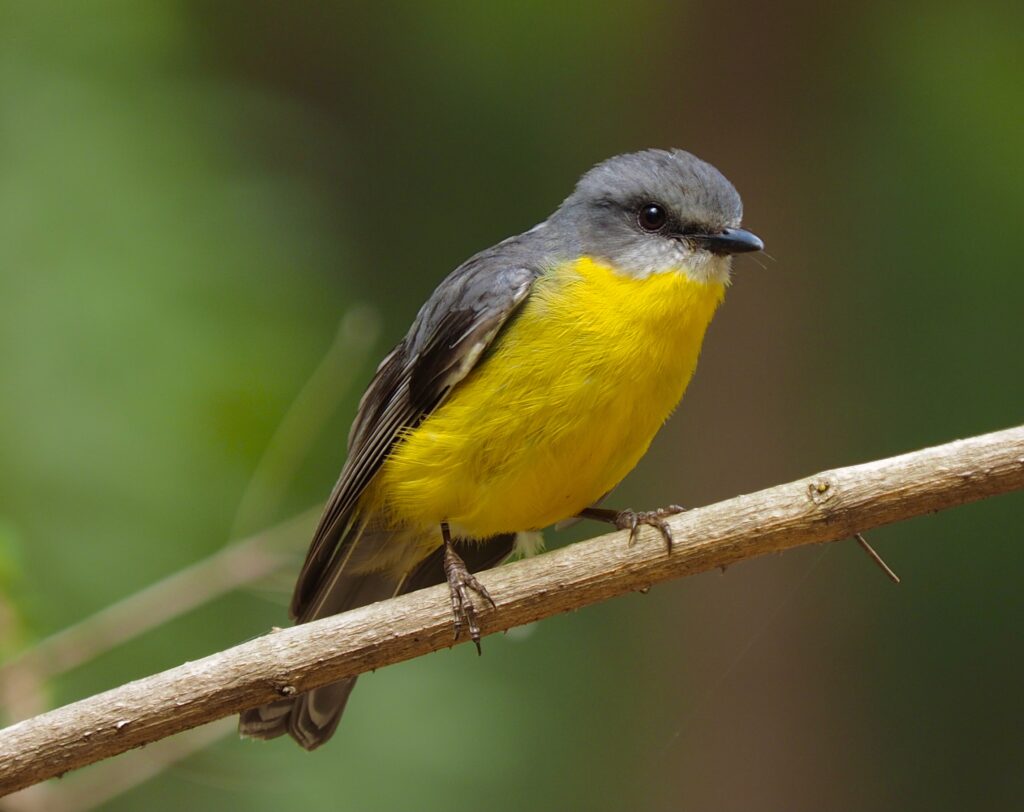
Two subspecies of the Eastern Yellow Robin are currently recognised. Our Paluma residents belong to the subspecies E. a. chrysorrhos, and we ancient birdos called them Northern Yellow Robins back when they enjoyed full species status. Now they are called Eastern Yellow Robin (Wet Tropics).
Eastern Yellow Robins are mostly sedentary. They feed on insects and spiders, and while they sometimes hunt on the ground, glean prey from bark or foliage, or make aerial sallies after flying insects, they most often pounce from a branch perch 1-1.5m above ground.
My most recent encounter with an Eastern Yellow Robin came while manning a Paluma Push checkpoint on the road behind Paluma Dam. While madly swatting March flies, Juanita and I were tasked with ensuring the exhausted riders didn’t stray off the track when it crossed the road. I kept seeing movement at the edge of my vision and finally discovered that a robin had positioned itself on a branch just behind me, waiting for slapped flies to fall writhing to the ground, and then swooping down for a free snack.
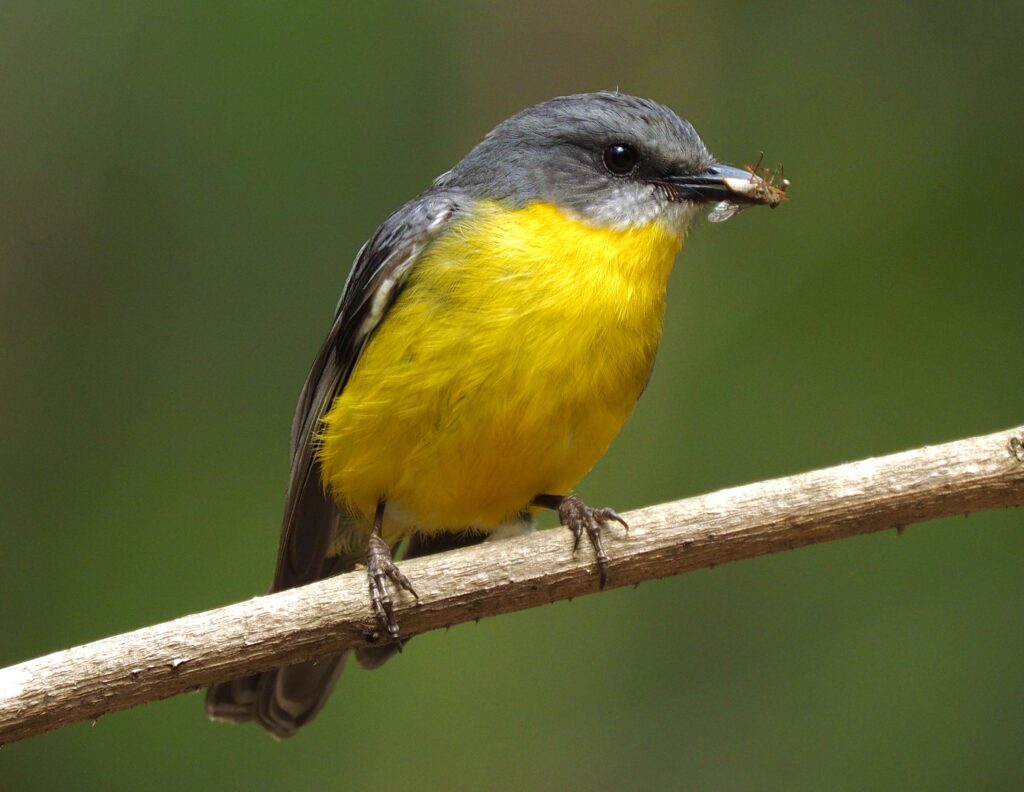
I’d brought my digital camera with me to photograph bike riders, but this proved to be my best photo of the day.
The common name Robin applied to the European Robin has an interesting origin.
Robin Redbreast
During the 15th century, the English had an endearing practice of granting common human names to the birds that lived among them. Virtually every bird in that era had a name, and most of them, like Will Wagtail and Philip Sparrow have been long forgotten.[1] Polly Parrot has stuck around, and Tom Tit and Jenny Wren, personable companions of the English countryside, are names still sometimes found in children’s rhymes. …
The English also gave their ubiquitous and beloved orange-bellied, orb-shaped, wren-sized bird a human name. The first recorded Anglo-Saxon name for the Eurasian Robin was ruddoc, meaning “little red one.” By the medieval period, its name evolved to redbreast (the more accurate term orange only entered the English language when the fruit of the same name reached Great Britain in the 16th century). The English chose the satisfyingly alliterative name Robert for the redbreast, which they then changed to the popular Tudor nickname Robin. Soon enough, the name Robin Redbreast became so identified with the bird that Redbreast was dropped because it seemed so redundant.
From Bird History by Robert Francis
While Robins were first named in England, as European naturalists started exploring and collecting around the world they applied this name to several unrelated groups of birds. Thus we now have:
Old World Robins (Europe, Africa, Asia)
– These include the English robin and relatives
– They are related to Flycatchers and share the same family (Muscicapidae)
American Robins (Americas)
– These include the American Robin
– They are actually thrushes (Family Turdidae)
Australasian Robins (Australia, New Guinea, New Zealand, SW Pacific Islands)
– These all belong to the Family Petroicidae and include all three Paluma robins
– They are an ancient offshoot from the original Passerine (perching birds) lineage, unrelated to either of the above groups.
Text and Photos by Jamie Oliver
Key Sources: