
Powder-Puff Lillypilly (Syzygium wilsonii)
This beautiful small tree or shrub, also known as Plum Satin-Ash, may be seen in several Paluma gardens and also in the forest understory along the upper reaches of the Range Road. A modest, dainty tree, almost spindly in growth, it is easily overlooked until the emergence of new leaves. These cascade in pendant clusters of brilliant crimson, flame-like against the dark green of older leaves.
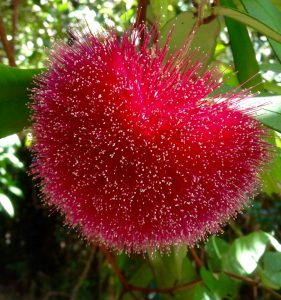
Flowering occurs between June and December, but here in Paluma the months of August and September see the most prolific blooming. At present there are many flowers to be seen, hanging demurely beneath long, dark green leaves. The gorgeous flowers are made up of dense clusters of filaments which form a delicate red pompon, about the size of an orange. They attract many birds, mostly honey-eaters. Clusters of cherry-sized creamy white fruit follow flowering. It is not recorded whether they are edible, but most fruits of the Syzygium species are edible.
Syzygium wilsonii is usually seen as a shrub growing to about 3 metres, but it can occasionally grow to 9 metres. Its timber is fine-textured and moderately hard. It is resistant to fungi and termites, but susceptible to dry wood borers. The wood can be used for making musical instruments, tool handles and furniture.
See if you can spot some of these gorgeous flowers hanging shyly beneath long leaves in Paluma gardens.
Text & Photo by Colwyn Campbell
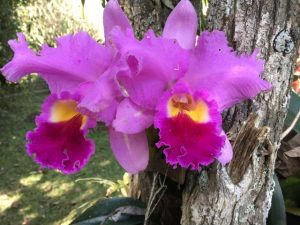 This superb specimen of Cattleya orchid belongs to Paluma residents Michael and Donna Drew. The beautiful mauve, deep purple and yellow blooms are long lasting and Michael says that these flowers first opened in early July.
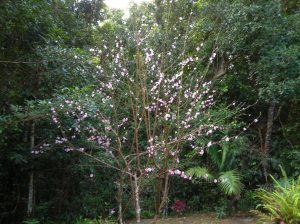 Several gardens in Paluma have peach trees which are at present coming into bloom. Buds are swelling along the slender branchlets, with many flowers already open. Another week, (it is 12 July at the time of writing), should see the trees densely covered in delicate pink blossoms. Unless heavy rain washes the blossom off, the tree will display its beauty for up to three weeks. Tiny fruit will begin forming which will swell and ripen in the summer months but Bush Rats and White-tailed Rats will have eaten most of them well before then.
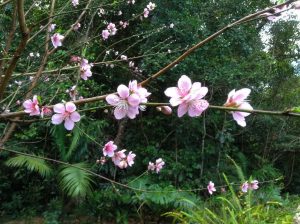 The peach is a deciduous tree and looks bare and straggly for a few months during the year, until mid- winter, but is worth growing for its sheer beauty during the flowering period.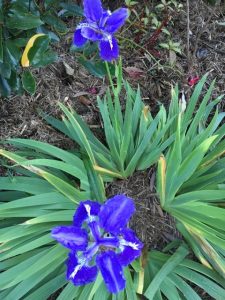
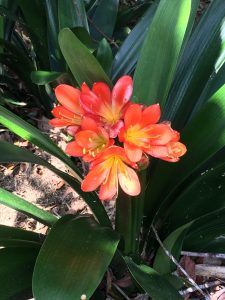
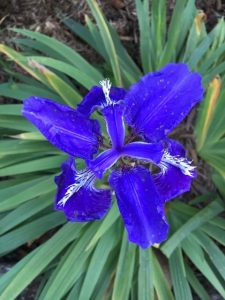 The leaves are light-green in colour and sword-shaped. The flowers attract bees and other insects which are important for pollination. Iris plants flower between June and August and after flowering they produce an ellipsoid seed capsule with black-brown seeds.
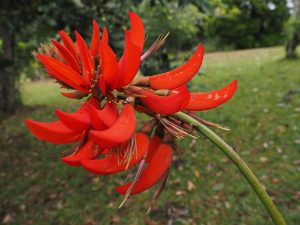
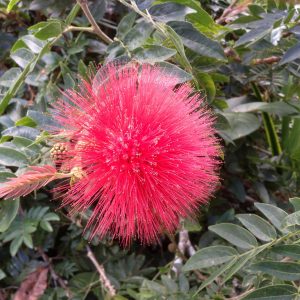 Calliandra haematocephala is a species of the Genus Calliandra, in the Fabaceae Family (pea family) and came originally from South America. It is sometimes called the Fairy Duster or the Tassel Flower. The tree grows to about 3 metres high and has rather a straggly appearance. However when it blooms it is a beautiful sight, covered with soft red powder-puff flowers which attract insects and birds. The Eastern Spinebill is a regular visitor to the flowers.
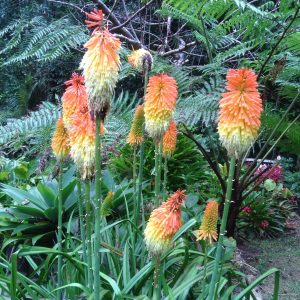 Red Hot Poker
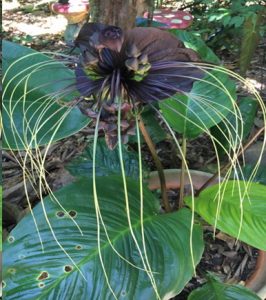 The black bat plant (Tacca chantrieri) is an unusual exotic plant that is native to tropical Asia. It grows well at Paluma, most often as a pot plant in a protected shaded position away from direct sunlight. The large flowers are striking and resemble a bat in flight. The flowers are black to deep purple with ruffled edges and long, hanging filaments. Large bright green leaves surround the bloom. Several gardeners at Paluma have spectacular specimens of the black bat plant. It flowers all year round, but seems to produce most flowers during the summer months.
 The White Bat Plant (Tacca integrifolia) is a member of the yam family Dioscoreaceae. It is native to hilly regions of tropical and subtropical Asia where it thrives in the in the shady and humid understorey of the rainforest. The long, flowing ‘whiskers’ of this flower can grow to 30 cm long.