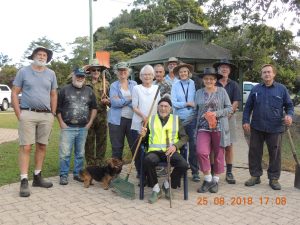
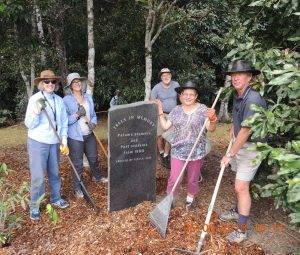
A very successful Working Bee was held on Saturday (25 August) at the Village Green at Paluma. Fifteen very enthusiastic volunteers congregated at the Green to spread some mulch and topsoil around the Green and at the Trees In Memory. A very big ‘THANK YOU’ to all those attended to lend a hand and make light work of the tasks to be done.
The band of volunteers included:- Don Battersby, Graham & Judy Malpass, Len Cook, Wilfred and Suzanne Karnoll, Graham Pope, Jamie Oliver, Juanita Poletto, Peter Klumpp, Beth Snewin, Colwyn Campbell, Roy Mackay, Wayne Pellow and Michele Bird.
Volunteers at the Working Bee
Special mention goes to Graham Pope for bringing along his tractor!. Roy Mackay kept a close eye on operations and thanks to Suzanne for the tasty sausage rolls. The generosity and community spirit that exists in Paluma makes this village a very special place indeed!
The annual trail run at Paluma, organized by Outer Limits Adventure Fitness, will be held on October 28 this year.
This is the 6th run in the Outer Limits Trail Run Series 2018.
Race HQ, start and finish for all distances will be at the village green in the Paluma township. There is an array of trails around the village crossing creeks, passing water falls and lookouts. Paluma is cooler then the coastal region and it makes for great trail running in October.
We have $2000 worth of great prizes for our top 3 winners for each distance and first place in each age group. This includes some new trail running shoes and hydration vests from Salomon!
Outerlimits Adventure is sponsoring a 3-day accredited Remote and Wilderness First Aid Course in Paluma
October 19-22, 2018
at the Paluma Adventure Centre (High Ropes Facility) $670 pp incl. meals, accommodation
Jason Taylor from Category 5 Emergency Care is coming to Paluma to teach a Standard Wilderness and Remote First Aid course.
Sam and Aline have done multiple courses with Jason already and highly recommend them to anyone who likes to adventure and maybe even works outdoors, especially in remote areas. So we have teamed up with Jason and we are bringing you the Standard R.A.W First Aid course to Paluma.
We will spend the weekend at the Adventure Centre in Paluma and stay at the Adventure House. Meals will be provided, please let us know if you have any dietary requirements.
What is R.A.W First Aid?
Category 5 offers a unique training course specific to North Queensland and is delivered under our remote area training division SOS (Specialised Outsdoor Survival). Remote and Wilderness First Aid designed for those who work and play in the outdoors. While “Senior” First Aid Courses give you great basic skills and knowledge, they don’t account for being a long way from help.
RAW First Aid differs significantly from standard first aid courses that are oriented toward the urban environment. RAW first aid will give you extended knowledge and skills to deal with situations that may occur whilst in a remote location. We prepare students for emergency situations that involve prolonged patient care, severe environments and improvised equipment. Our courses are scenario based which means you get hands on experience to prepare you for the real thing. They are fun, practical and very comprehensive. We use stage makeup and blood to give the realistic effect and a true outdoor experience.
These courses are perfect for Outdoor Professionals, Mine sites, Camping, Scuba Diving Professionals and anyone who works or plays in the outdoors.
Topics include:
Introduction & Medical Legal Issues
Patient Assessment & Basic Life support
Traumatic Injuries
Spinal Injury (including clearing a spinal injury in the field)
Head Injury
Bleeding and Wound Management
Musculoskeletal Injuries (including relocating dislocations and angulated fractures)
Environmental Injuries
Bites & Stings
Medical Emergencies
Common problems
Adult CPR/EAR Urban and Remote Specific
AED – Defibrillation
For bookings please call Sam 0421484211 or send us an email info@outerlimitsadventure.com.au
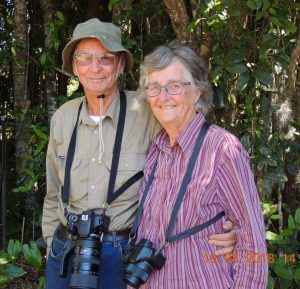
With the superb winter weather at Paluma, every week sees a ‘flock’ of birdwatchers visiting the village and surrounds to search out and photograph our birdlife. Last week, Murray and Dawn Frick spent time at Paluma and were hosted by Don Battersby at Hussey Road. Don provided some free mealworms and the birds arrived.
Murray and Dawn are sugarcane farmers from Bundaberg and this is their fourth trip to Paluma for birdwatching. When they are not working on the farm they love to travel around Australia. They are on their way home after seven weeks on the road, traveling some 10,000 kilometres throughout Queensland and the Northern Territory.
They first came to Paluma some years ago in search of the golden bowerbird. This trip they have photographed the golden whistler, satin bowerbird, rifle bird and many other species. Murray and Dawn say they are never disappointed when they come to Paluma as they know “we will always get good birds here”. We wish Murray and Dawn a safe trip home to Bundaberg and we hope to see you next year!
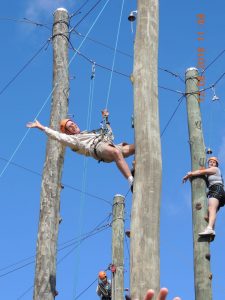
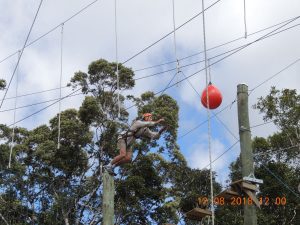
Paluma resident Wilfred Karnoll joined other adventure-seekers last Sunday (12 August) at the Outer Limits High Ropes course at Paluma. Wilfred proved to be a natural at great altitude, taking all obstacles in his stride, whether it be scaling poles, climbing nets or tackling wooden bridges high above ‘terra firma’.
Look, no hands!!
Wilfred even took the ‘Leap of Faith’ which involves launching one’s self from the top of a wooden pole at great height to touch a large red buoy. This proved to be no challenge to Wilfred who accomplished the feat with ease.
Taking the ‘Leap of Faith’
Wilfred is 66 years old and he has just recently recovered from a broken foot, proving that there is no excuse for not having a go at the High Ropes course. Wilfred’s mid-air skills were so impressive, his friends and neighbours at Paluma now call him Wilfred (‘Sugar Glider’) Karnoll!
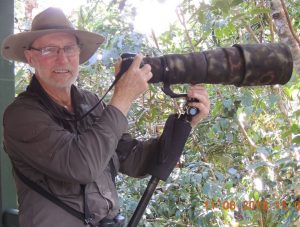
Paluma is regularly visited by bird watcher’s from all over Australia and from around the world. This weekend (11 August) Ken Russell spent the day in the village, walking many of the local tracks. Ken lives in Victoria and he is a Member of Birdlife East Gippsland.
Ken Russell at Paluma
This was Ken’s second trip to Paluma and he spent the day searching for and photographing a variety of rainforest birds. He was especially keen on capturing images of the catbird, chowchilla, riflebird, noisy pitta, regent bowerbird and wompoo pigeon.
By all accounts, Ken had a very successful day, capturing some great images of a brazen catbird, riflebirds, satin bowerbirds and numerous other species. The chowchilla remained elusive and is still on Ken’s list of rainforest birds to photograph.
There will be a Working Bee at the Village Green on Saturday 25th August 2018, commencing at 3.30 PM.
The Working Bee is to complete the spreading of wood-chip mulch around the Trees in Memory garden bed and also to complete the spreading of topsoil on the Village Green.
The Working Bee is to assist and complete the great work already undertaken by Michael Drew in attending to the Village Green.
All are welcome to attend and lend a hand. Please bring:-
Your gardening expertise, prowess and enthusiasm
Your favourite rake, spade, wheelbarrow, bucket or other garden tools
“Many hands make light work”, so please come along for some fresh air and exercise.
The Village Green and the Trees in Memory will love you for it………and so will the scrub turkeys!!
For more information contact Michele on 0417 767 099.
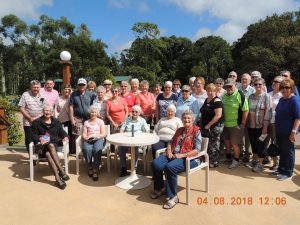
Last Saturday (4th August) Paluma was part of a ‘Mystery Tour’ run by the Sunshine Coast company, Sinclair Tour and Travel. A group of 31 happy travellers stopped in at the Rainforest Inn for morning tea which included scones, caramel tarts and other treats made by Jennie and Neil. The group is enjoying a 5-day tour of North Queensland having visited Mackay, Airlie Beach, Townsville and now Paluma.
Happy travellers at the Rainforest Inn. Can you spot the Paluma local in the photo?
Peter Sinclair, the organiser and owner of the tour company, admitted that this was his first visit to Paluma after having driven past the turn-off on the Bruce Highway many times since the 1970’s. The group enjoyed their visit and noted that the highlights were the beautiful drive up the Range Road, the cool mountain air and the delicious caramel tarts! Peter says that now he has discovered Paluma he will certainly come back.
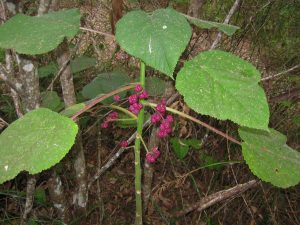
The Gympi Gympi is also known as the Stinging Tree, and is said to be one of the world’s most venomous plants. Those unlucky enough to have suffered a major sting claim the pain is the most excruciating of any they have endured.
A small stinging tree with ripe berries found beside Chicks Rd. Photo by Charlie Allen
World-wide there are 37 species of stinging tree with 6 in Australia. The Dendrocnide moroides has the worst sting. The tree is often described as a shrub but can grow to a height of 4 to 5 meters. It tends to grow in open, disturbed sites such as a cyclone damaged area or in a clearing where a tree has fallen. They like sunny, but sheltered areas and are often found along walking tracks or the edges of streams. The Gympi Gympi is found from Gympie in Southern Queensland to Cape York Peninsular and is very common in the Atherton Tablelands. It is generally not common along any of the Paluma walking tracks that have a complete rainforest canopy, but small plants can spring up quite rapidly in damaged areas exposed to sunlight.
The leaves of the Gympi Gympi, carried on long, hairy stalks are finely serrated and heart-shaped. They are covered in fine stinging hairs which give the leaves a furry appearance. The fine silica hairs break off when touched and embed in the skin. They act like syringes and continue to inject venom for several days. Even dead leaves are capable of inflicting a sting. The pain experience depends on the amount of contact with the leaves but also varies between people. A brief brush with a leaf can lead to significant but bearable localized (surface) pain, but extensive contact (especially in sensitive areas of thin skin) can be excruciating, often with extreme reactions like swelling and profuse sweating. The pain reduces over time but can linger for over a month. Rubbing the skin exacerbates the situation as it breaks the hairs, leaving the points embedded in the skin. Also, contact with cool water leads to recurrence of pain days or weeks after the event. Unfortunately for those stung, there is no truly effective treatment although shaving the affected area and then daubing it with a weak solution of hydrochloric acid or full strength house-hold vinegar can help to alleviate the worst of the pain. This treatment is only for the strong-minded since it causes the pain to significantly increase for several minutes before acting to reduce it.
The chemicals contained in the venom are not completely understood but it is suggested that a peptide called moroidin could be responsible for the pain. Some birds, mammals and insects appear to be immune to the venom as many eat the fruit and leaves without harm. The fruit is edible to humans brave enough to sample them and are quite pleasant in flavor – just be careful not to touch the leaves or stem when picking the berries!
The fruit of the Gympi Gympi is actually a small nut enclosed within a fleshy sac. Several sacs are clustered together to form a mulberry-like fruit which hangs from a stem. The stems and fruit are also covered in fine hair.
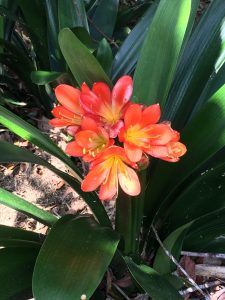
Clivias are native to South Africa and they grow in most areas of Australia from temperate to tropical climates. Clivias love the shade and they make excellent understory plants, especially in rainforest gardens at Paluma.
Clivias have clusters of brightly coloured trumpet-shaped flowers which range from bright orange, red, yellow and cream shades. The orange flowering variety tends to be most common. The flowers are held on sturdy stalks above dark strap-like leaves. Clivias flower during late winter to early spring. They love the filtered light of the forest floor, mulch and moist soils, making them an ideal garden plant in the misty village of Paluma.