From Ross Murray, who has been in contact with TMR regarding length restrictions.
Hi All,
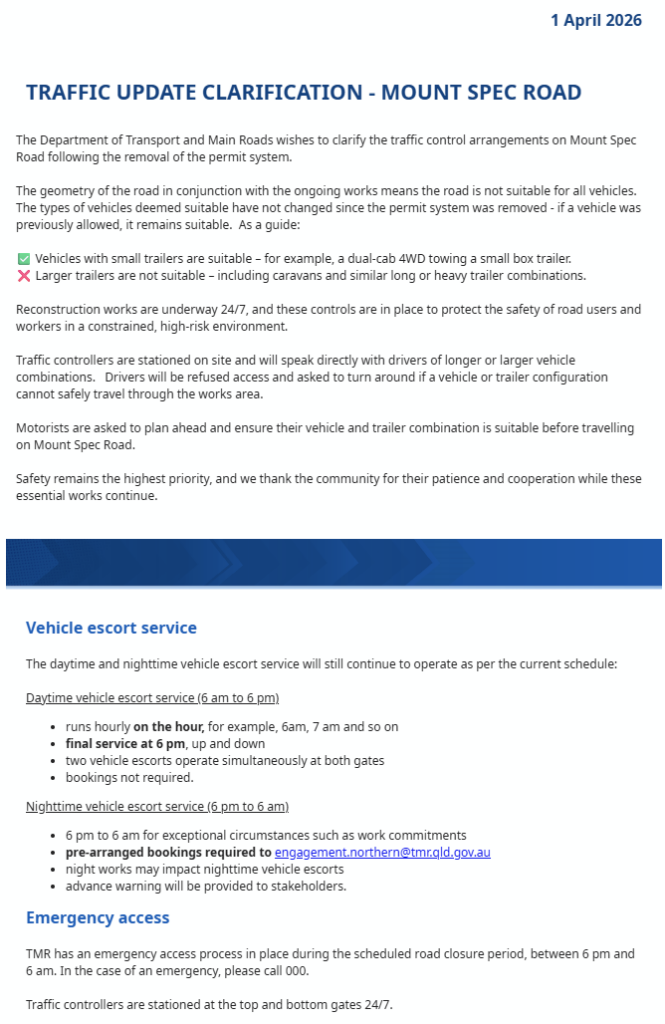
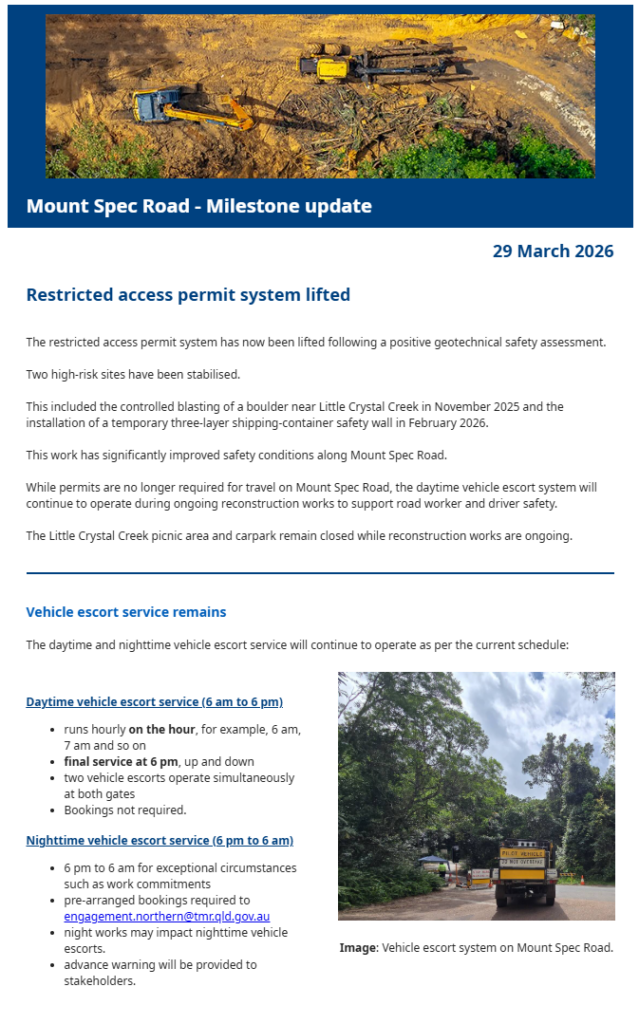
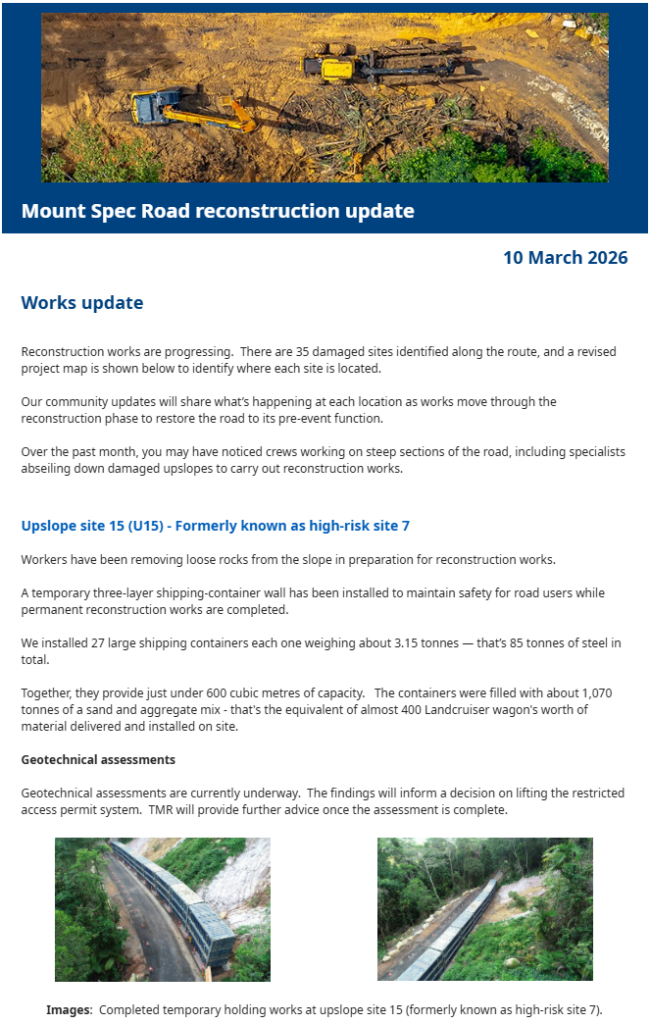
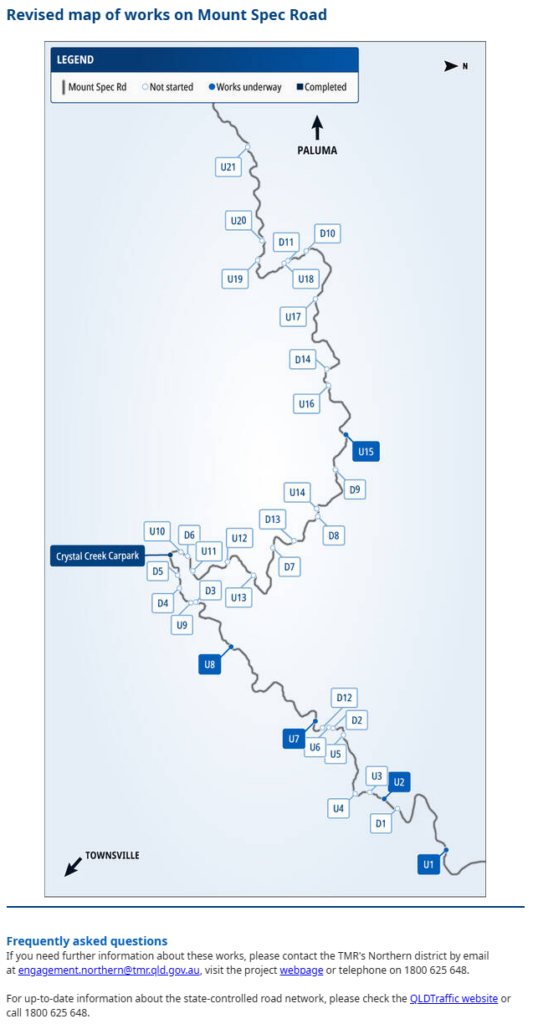
I have been advised of the clarification for larger vehicle/trailer configurations requesting access on the Paluma Range road. Any resident or contractor seeking access with a vehicle/trailer combo which is longer then a 4×4 + box trailer requires prior approval from the Northern Engagement Engineers. We have been advised that an email to the Northern Engagement Team (engagement.northern@tmr.qld.gov.au) is required, which will be forwarded to the TMR Engineers for approval.
We are to provide the dimension of the vehicle plus trailer combined. The length x width; weight of trailer including the equipment being carried. The least disruptive times for transporting of equipment will be advised during the approval process. This is due to the varying tasks and restrictions each day carried out by CMC contractors.
TMR are recommending that those seeking access should have prior experience or skills in navigating the Range Road. The approval will be determined by TMR Engineers, though email contact will be provided from the Northern Engagement Staff.
It was brought to my attention that there are a number of residents (including myself) wishing to hire High-Lift Tree Pruning Equipment. This equipment hire will definitely require prior approval for Range Road access, due to a trailer being 5.5 m in length, and weighing over 3 tonnes. It was suggested the back road access to Paluma maybe required or considered with this equipment. I advised that it would not be a viable option due to the varying conditions of the road, and the extra costs for fuel and equipment hire.
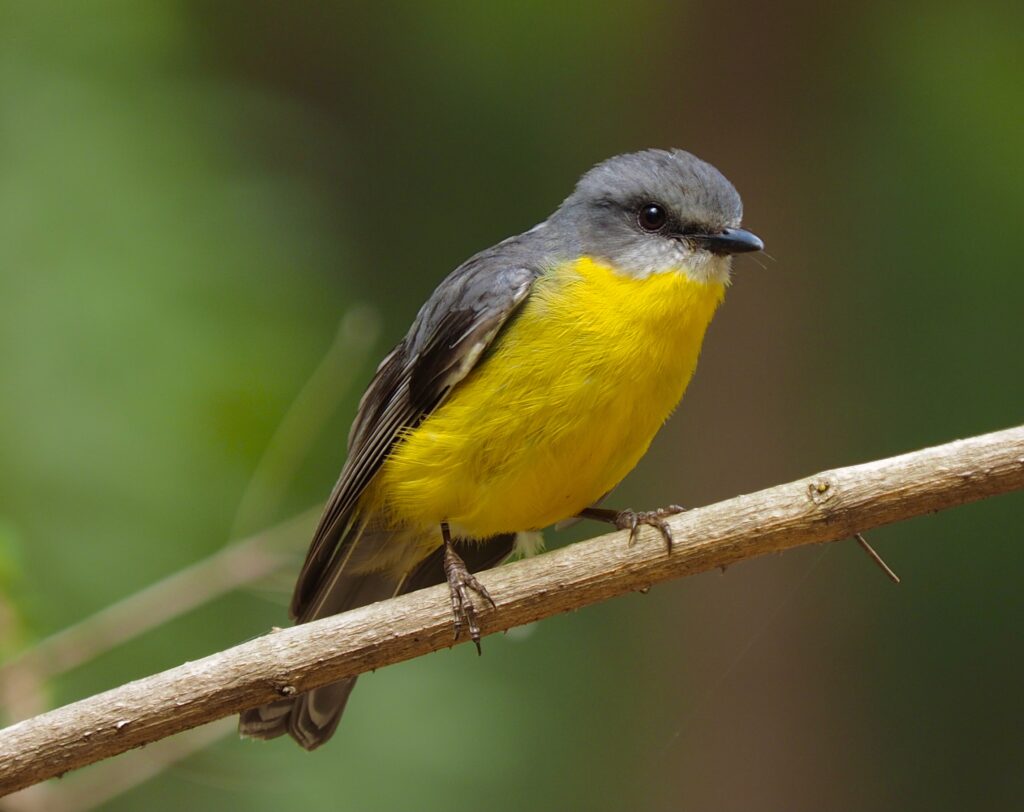
The Eastern Yellow Robin (Eopsaltria australis) is the least common of the three robins that are regularly recorded around Paluma village, but it is the most widely distributed. It occurs from Cape York to southeast Victoria in rainforests, eucalyptus forests and a variety of adjacent habitats, as well as parks and gardens. As with many of our Australian robins, it has a bold plumage. It’s not quite as spectacular as the scarlet or red-capped robins (a different genus) found further south and west, but its brilliant yellow and grey attire easily attracts the eye as it perches on a low branch surveying the ground for edible fare.
Two subspecies of the Eastern Yellow Robin are currently recognised. Our Paluma residents belong to the subspecies E. a. chrysorrhos, and we ancient birdos called them Northern Yellow Robins back when they enjoyed full species status. Now they are called Eastern Yellow Robin (Wet Tropics).
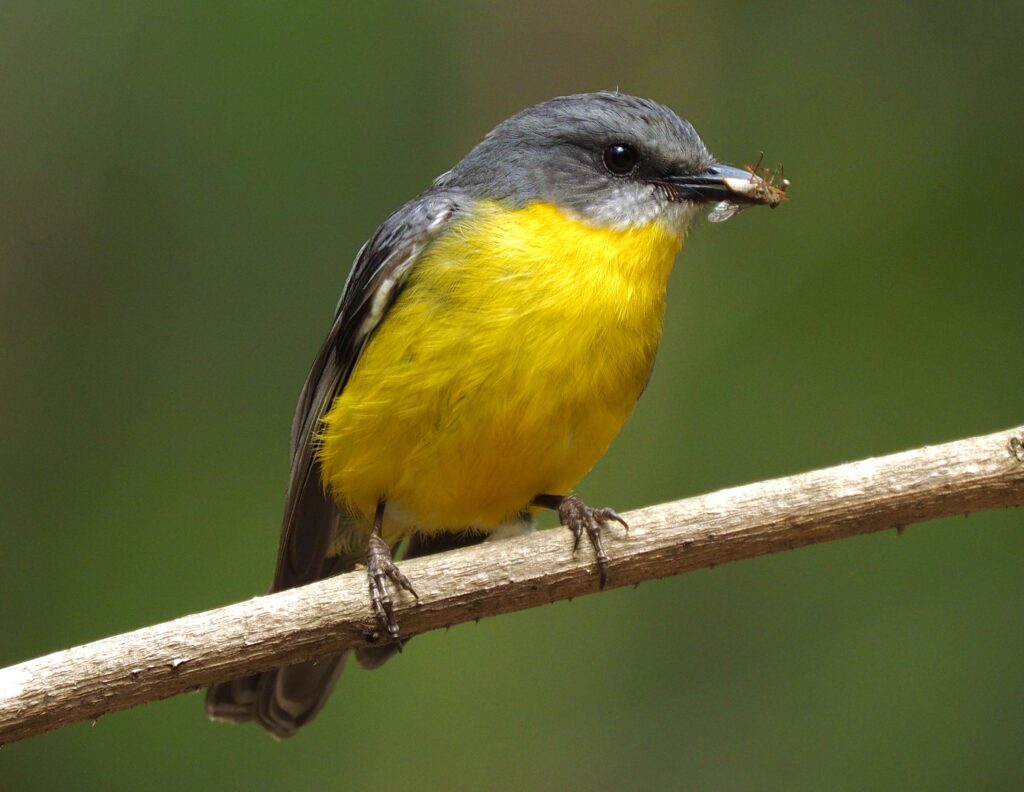
Eastern Yellow Robins are mostly sedentary. They feed on insects and spiders, and while they sometimes hunt on the ground, glean prey from bark or foliage, or make aerial sallies after flying insects, they most often pounce from a branch perch 1-1.5m above ground.
My most recent encounter with an Eastern Yellow Robin came while manning a Paluma Push checkpoint on the road behind Paluma Dam. While madly swatting March flies, Juanita and I were tasked with ensuring the exhausted riders didn’t stray off the track when it crossed the road. I kept seeing movement at the edge of my vision and finally discovered that a robin had positioned itself on a branch just behind me, waiting for slapped flies to fall writhing to the ground, and then swooping down for a free snack.
I’d brought my digital camera with me to photograph bike riders, but this proved to be my best photo of the day.
The common name Robin applied to the European Robin has an interesting origin.
Robin Redbreast
During the 15th century, the English had an endearing practice of granting common human names to the birds that lived among them. Virtually every bird in that era had a name, and most of them, like Will Wagtail and Philip Sparrow have been long forgotten.[1] Polly Parrot has stuck around, and Tom Tit and Jenny Wren, personable companions of the English countryside, are names still sometimes found in children’s rhymes. …
The English also gave their ubiquitous and beloved orange-bellied, orb-shaped, wren-sized bird a human name. The first recorded Anglo-Saxon name for the Eurasian Robin was ruddoc, meaning “little red one.” By the medieval period, its name evolved to redbreast (the more accurate term orange only entered the English language when the fruit of the same name reached Great Britain in the 16th century). The English chose the satisfyingly alliterative name Robert for the redbreast, which they then changed to the popular Tudor nickname Robin. Soon enough, the name Robin Redbreast became so identified with the bird that Redbreast was dropped because it seemed so redundant.
While Robins were first named in England, as European naturalists started exploring and collecting around the world they applied this name to several unrelated groups of birds. Thus we now have:
Old World Robins (Europe, Africa, Asia) – These include the English robin and relatives – They are related to Flycatchers and share the same family (Muscicapidae)
American Robins (Americas) – These include the American Robin – They are actually thrushes (Family Turdidae)
Australasian Robins (Australia, New Guinea, New Zealand, SW Pacific Islands) – These all belong to the Family Petroicidae and include all three Paluma robins – They are an ancient offshoot from the original Passerine (perching birds) lineage, unrelated to either of the above groups.
Firstly, thank you for the update of the Paluma Range Road permit access. On behalf of the PDCA, we find it very disappointing to see the new length limits announced in the latest update (March 29,2026). This amounts to very significant restrictions for residents needing to bring equipment up the mountain for maintenance purposes. A large proportion of Paluma residents use 4wd vehicles and trailers to bring gear up the range road for repairs, regular maintenance to dwellings and transport of green waste to the local depository etc. Most 4wds are approximately 6m long and a medium sized (8×5) box trailer adds another 6m. If tradies are asked to come up to carry out work in the village, a typical tradie’s set up would be a 4wd (6m) + medium to large trailer (6-12m).
It is disappointing that no prior consultation was attempted with the community through a local meeting, or via correspondence with the Paluma and District Community Association (PDCA). Unfortunately, there was no reasonable explanation regarding the issues created by continuing to allow such vehicles to join the piloted convoy up the range during scheduled times. Given that two of the worst affected sections of the road have been successfully stabilised during the current permit system we are surprised that the restriction was deemed necessary.
We ask that as a matter of urgency, the TMR:
Provisionally recalls the announced vehicle length limit on the Range Road;
Provides details of the specific problems that would be caused by longer vehicles and the impacts these have on: a) public safety; b) worker safety; c) timelines; d) costs; and
Meet with the community in Paluma to explore ways to minimize the impact on the road restoration project while also minimizing impact on residents.
Many in our community are frustrated with the way restrictions have been imposed on the Paluma and Hidden Valley residents and commercial operators. The Community as a whole, through the PDCA is keen to work proactively and in good faith with TMR to find reasoned and balanced solution to the issues raised above.
If reverting to the length restriction is not feasible, there might be options that would help to reduce or compartmentalize the risks, such as:
Nomination of one or more timeslots when oversized vehicles are least likely to create problems to the contractors or road users;
Nominating specific days/timeslots when roadwork would stop any activities that are affected by oversized vehicles and allow such vehicles up only on those times; and
Allowing individuals to ring up traffic control officers to determine if there is a time slot during the day when an oversized vehicle would not cause any problems.
We look forward to your response to this matter by Thursday, April 2nd.
Early mornings around Paluma are invariably accompanied by a wide range of bird songs. The most distinctive and noisy of these is produced by the Chowchilla (Orthonyx spaldingii), although the whipbird and the catbird run a close second.
Chowchilla calls recorded by Andreé Griffin
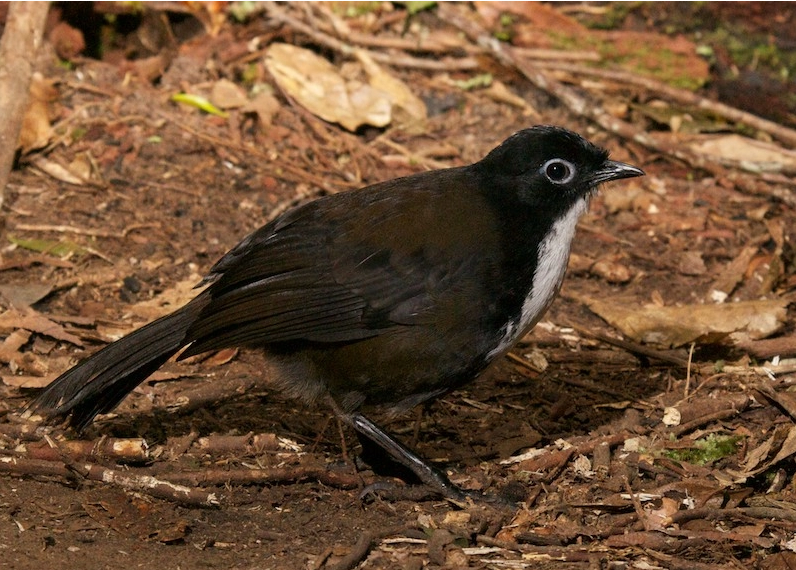
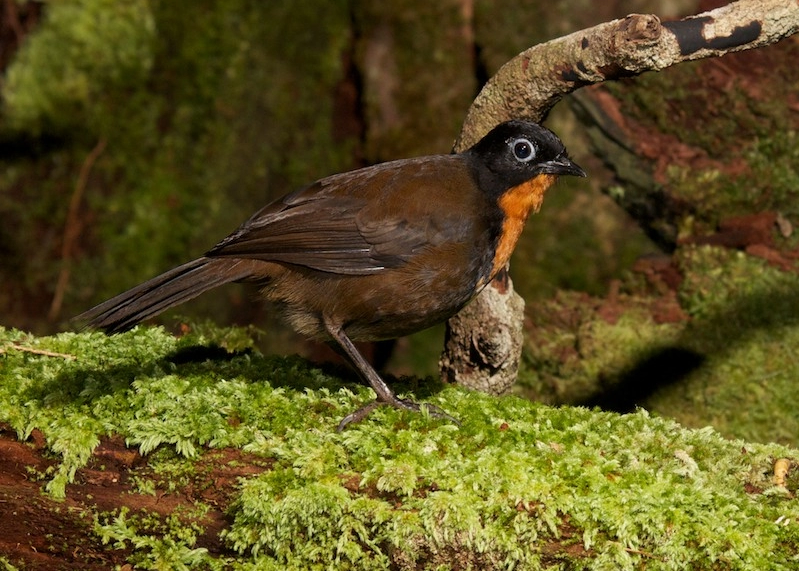
Chowchillas are endemic to north Queensland, with two subspecies: O. spaldingii melasmenus occurring from near Cooktown to the Daintree, and O. spaldingii spaldingii ocurring south of the Daintree to the Paluma ranges. They are found in rainforests mostly above 450m. Chowchillas don’t vocalise much during full daylight hours, but its not hard to spot them as they run along the ground across, or next to village tracks, or reveal themsleves as the rustle through the leaf litter. Male and females both have handsome plumage, with the rich rufous throat of the female being particularly striking.
Male (top) and Female (bottom) Chowchilla. Photos taken by Brian O’Leary at Paluma in 2012.
Chowchillas forage on the forest floor, scratching leaves and debris to expose small insects and other invertebrates in the leaf litter, as well as the odd small lizard or frog. They are sometimes joined by other bird species such as the Grey-headed roobin, Whipbird and Yellow-throated scrub-wren who will take advantage of the disturbed litter to find food for themselves.
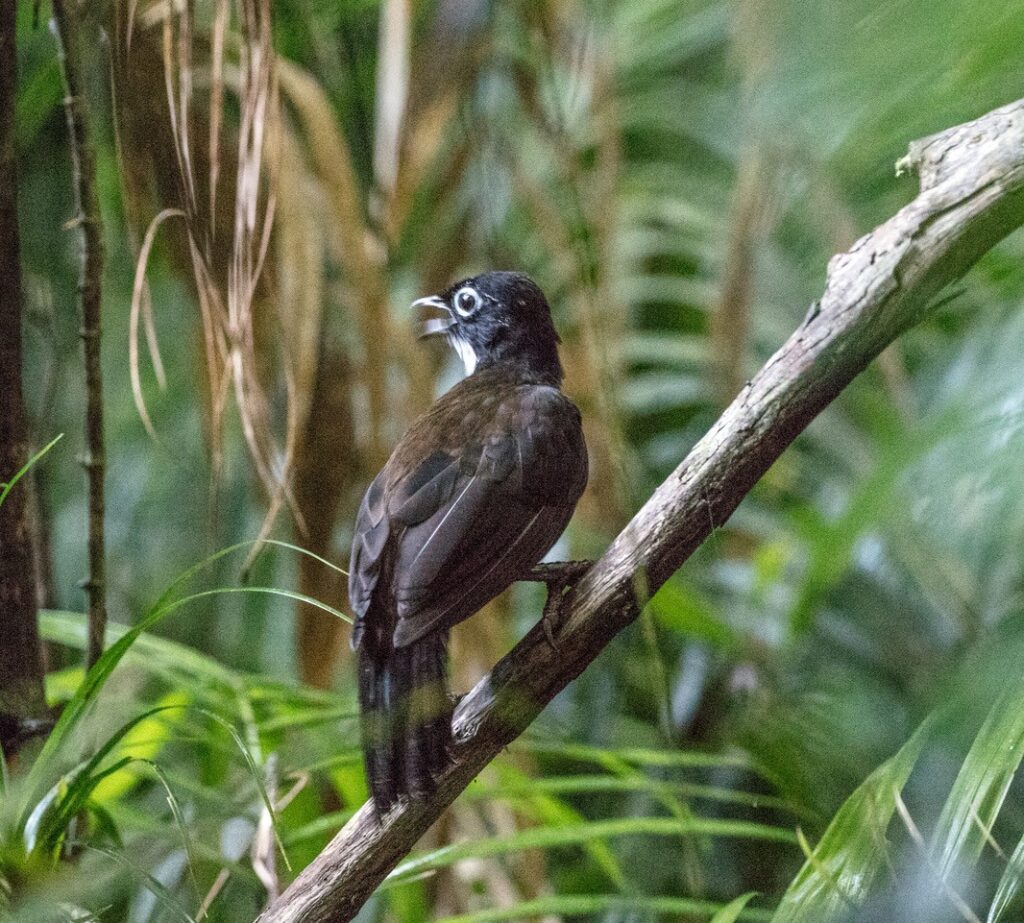
Male Chowchilla calling. Photo by Peter Cooke
Chowchillas are well known to form social groups, usually comprised of a mating pair accompanied by male offspring from the last few nesting years. Occasionally unrelated maies will also occasionally join the group. The group jointly defends a territory with all individualls participating in the well-known vocal chorus of rythmic warbles to warn off adjacent family groups. Each group has its own distinct song dialect. The status of the Chowchilla social behaviour is somewhat controversial. Group territoriality is not uncommon in Australian birds (eg Babblers), but in most cases it has been shown that they assist in rearing offspring of the main breeding pair that they are usually related to (cooperative breeding). However in Chowchillas no direct assistance in rearing has been observed in any of the non-breeding group members. An alternative explanation for the evolution of group formation and persistence in Chowchillas is that by assisting in defending the group territory, they enhance the security of food resources that the breeding pair will use to raise offspring.
Chowchillas are one of three species in the genus Orthonyx (log-runners). The other two are found in southeastern Australia and New Guinea.
The name Chowchilla was used by the Dyirbal Aboriginal group and is presumably onomatopoeic. Many local settlers adopted this name, although it was more frequently named the northern Log-runner in early bird guides. (See here for a short article on some other rainforest birds whose aboriginal names have been rediscovered)
Text by Jamie Oliver, Photos by Brian O’Leary and Peter Cooke
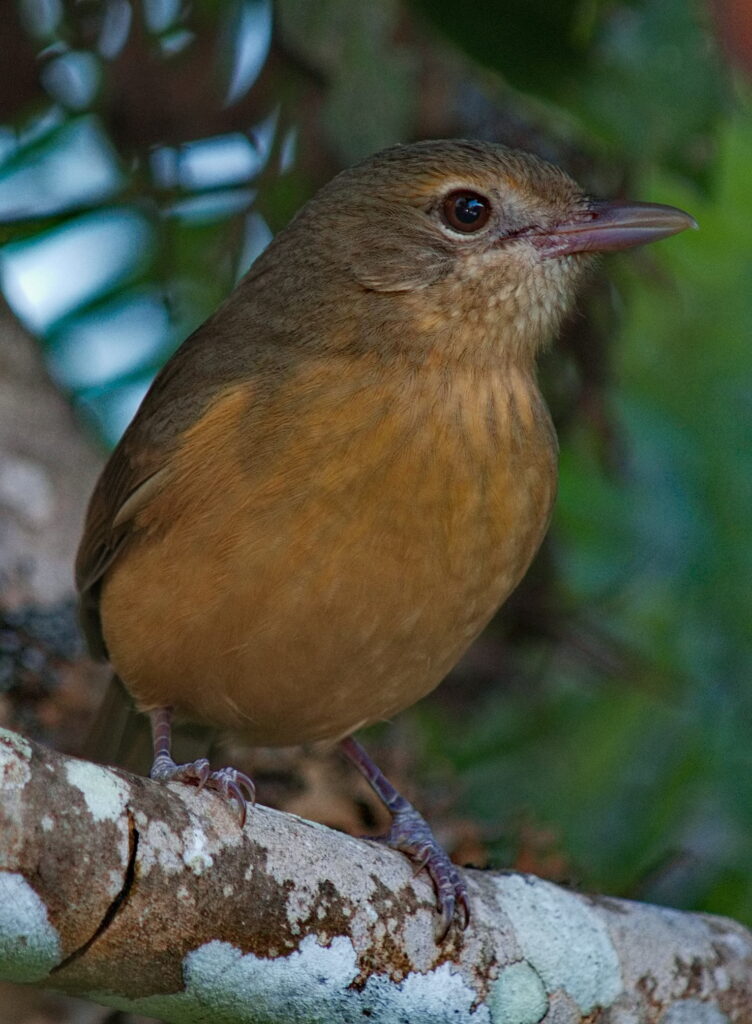
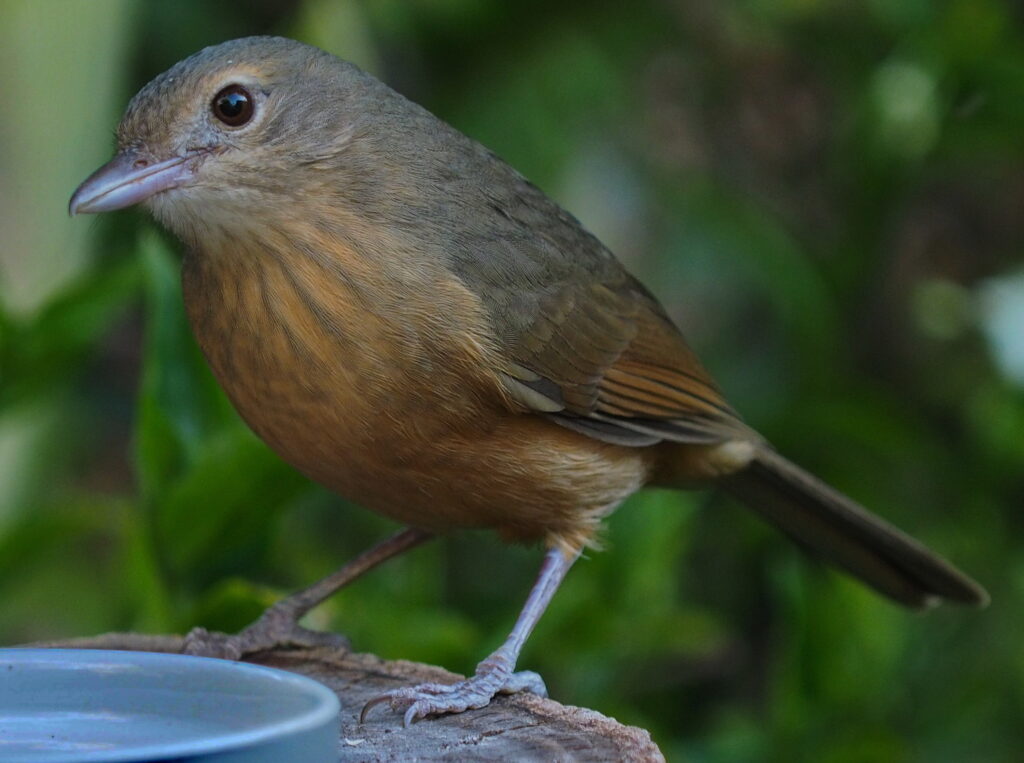
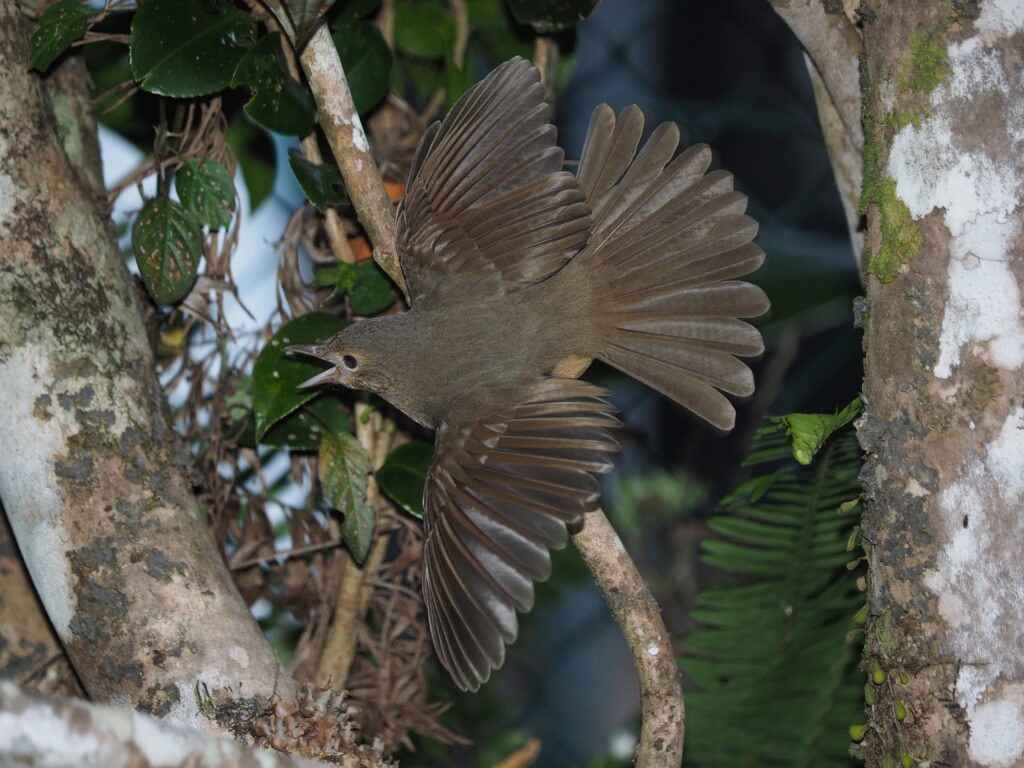
One of several ubiquitous yet relatively unassuming birds in Paluma gardens, the Little Shrike-Thrush (Colluricincla megarhyncha) has understated pastel-brown plumage and a quiet demeanour as it flits through the shrubs and understory in search of insects. But its charming and melodious call makes it one of my favourite companions as I walk through our garden or along the village road.
The Little Shirke-thrush has a long and storied history when it comes to its taxonomic status (see below), but currently Colluricincla megarhyncha is considered to be widely distributed throughout northern and eastern Australia, as well as mainland New Guinea and adjacent islands. It favours rainforest habitats (tropical and sub-tropical) but can occasionally be found in mangroves, paperbark swamps and regrowth forests. It occurs mainly in lowlands, although it is also found at altitudes up to 1800m.
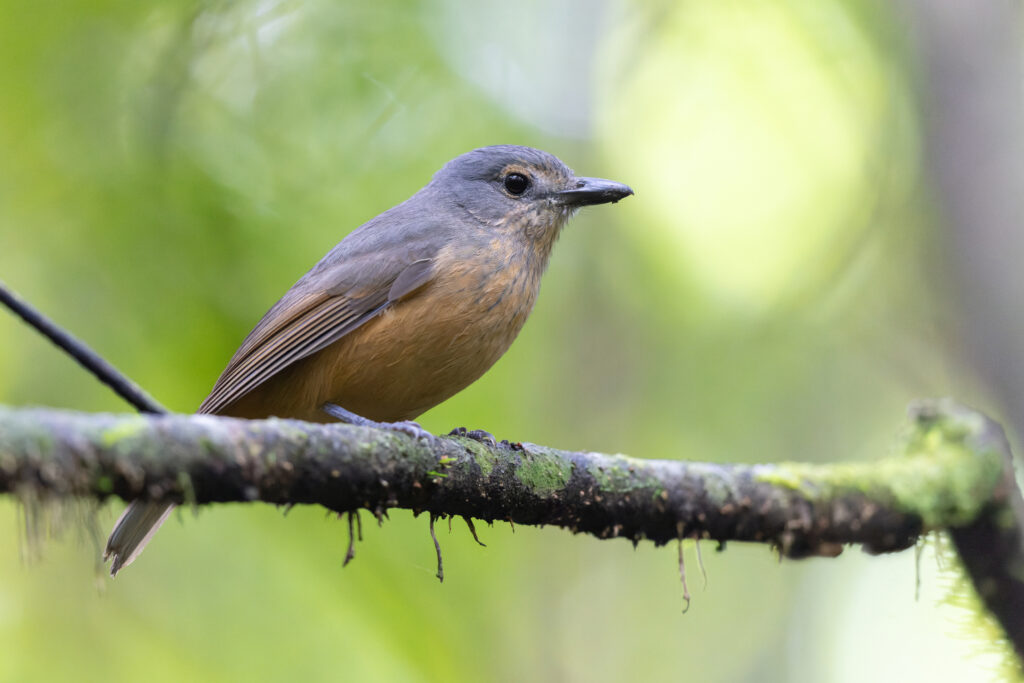
On the birding leaderboards, the Little Shrike-thrush is overshadowed by its close relative, Bower’s Shrike-thrush (Colluricincla boweri), whose claim to fame has nothing to do with its physical attributes – it’s even plainer than the Little Shrike-thrush. Rather, its rarity is what makes it special. It can be found in upland rainforests of NE Australia between Townsville and Cooktown, and nowhere else. There are many records of Bower’s Shrike-thrush around Paluma on the Atlas of Living Australia and iNaturalist, although (to my shame) I have never seen one that I could confidently identify. It is distinguished from the Little Shrike-thrush by its dark grey head and back, and all-black bill, so good lighting and a fairly close proximity are needed. The photo below, from Ethel Creek, clearly shows the difference.
The bill of the Little Shrike-thrush is paler with a slightly pink base on the lower part. Photo by Jono Dashper, iNaturalist
Insects make up the bulk of the Little Shrike-thrush’s diet. A plate of mealworms in our garden, once discovered, is rapidly consumed on the spot, except during breeding season, when I have seen one bird stuff up to five mealworms in its beak and then fly off to a nest hidden somewhere in the trees. While I have never seen it at our bird seed dispenser or our parrot and honeyeater buffet of fruit and date syrup, Little Shrike-thrushes are known to occasionally consume both.
OLYMPUS DIGITAL CAMERA
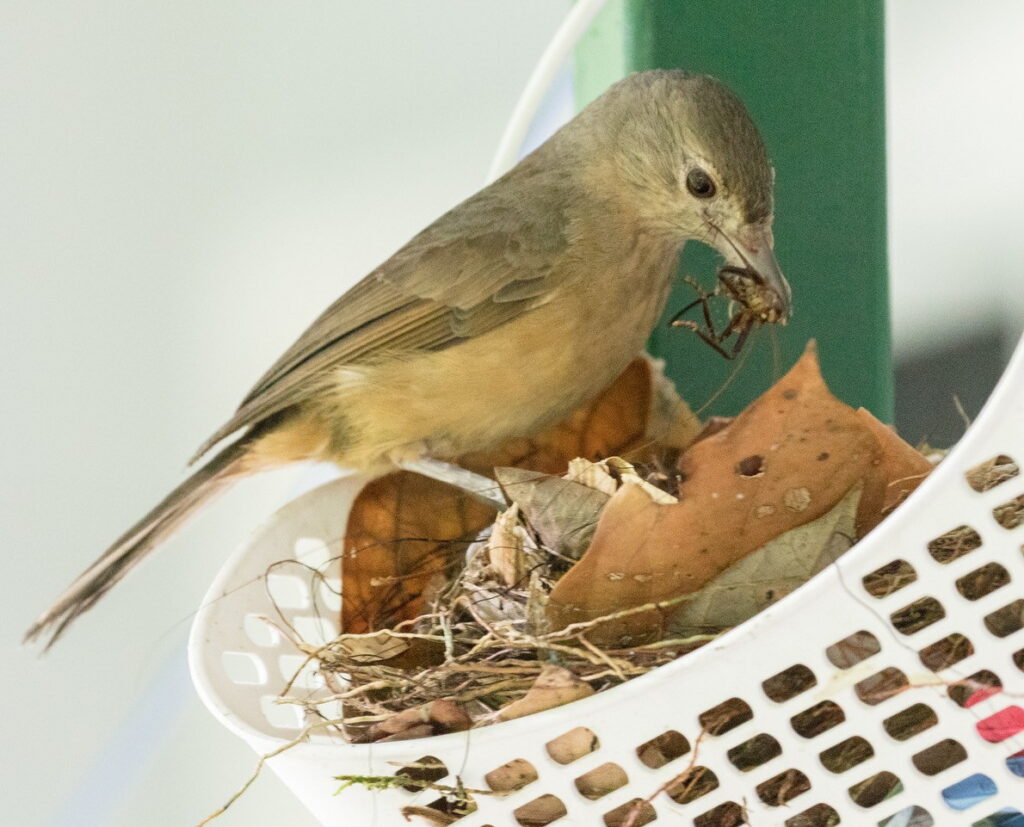
Breeding occurs from August to February and pairs of birds have been recorded to attempt up to five broods per season. Nests are about head-height in a tree fork, hidden amongst foliage. Incubation is mostly by the female, but both parents participate in feeding the young, which take about 10 days to fledge. Choice of nesting sites is flexible, as discovered by Colwyn Campbell several years ago when she noticed that her clothespeg basket on her clothesline had been commandeered by what appears to be a Little Shrike-thrush.
Photo by Peter Coke
Text and photos (unless indicated) by Jamie Oliver
Additional optional reading ……
Why is it called a Shrike-thrush?
Common names are often derived from the names used by the public for animals and plants that were sufficiently common or important to come up repeatedly in conversations. These common names often had obscure origins and did not necessarily reflect the nature of the animal or its affiliations to other related species. Scientific names are divided into two parts, first the genus, then the species. The species part of the name can be quite arbitrary and refer to a famous scientist or patron, or to some fairly inconsequential feature. But naturalists of old, as well as current taxonomists, tend to think more carefully when choosing names for the genus so as to reflect some important feature or affiliation shared by all the species in the genus.
So who came up with the name Shrike-thrush? It doesn’t have much scientific credibility since the genus is not related to either Shrikes or Thrushes. I had assumed that Shrike-thrush was coined by early European birdwatchers who found the scientific name Colluricincla a bit of a mouthful to pronounce, and since these birds were really like nothing they had seen before back home, but to their untrained eye looked a wee bit “thrushy” and also a wee bit “shrikey”, the name Shrike-thrush would do in a pinch. After consulting Chat GPT and giving it the benefit of the doubt in relation to accuracy, I found I was right that early birdo’s seem to have come up with this name. But took a much more conservative approach to choosing the name – they simply translated the Greek roots used in the scientific name Colluricincla: “collurio” meaning Shrike and “cinclos” meaning Thrush.
It was actually two very distinguished naturalists, Nicholas Vigors (founder of the Zoological Society of London) and Thomas Horsfield (founder of the Royal Entomological Society) who proposed the genus in 1827. They worked together on a description of the Australian Birds in the collection of the Linnaen Society. Describing birds based on preserved skins in the dusty bowels of a British museum, having never seen these birds in the wild, is not the best way to understand their form and affiliations but on reading their original 1827 manuscript it became clear that the authors used features they could see and measure (bill shape, wing shape etc) to conclude that the closest relatives to the Shrike-thrushes were indeed Shrikes and Thrushes.
We now know this was not the case, but hindsight is not a fair way to judge the quality of scientific enquiry, and there are no formal taxonomic rules about choice of scientific names (except that they be latinised), and thus no reason for the scientific name to be changed. In fact, once a name has been published, it remains forever. It can be removed from use for a particular group or reassigned to another group. But the name itself is immutable. This is not the case for common names (although there have been many efforts to voluntarily standardise common names) so a change in the common name for a genus is theoretically possible.
Peter Slater, the author of the first truly comprehensive Australian field guide for birds, was not a fan of the name Shrike-thrush. In his introduction to the genus, he suggests that the Aboriginal name “Gudilang” might be an appropriate replacement. This is probably a reference to the word referred to by Google AI as “Koodelong”, used by the Noongaar people of southwest WA. This suggestion from 1974 appears never to have been taken up, but it was a good one.
There are great examples of Aboriginal words for place names and fauna adopted into the Australian vocabulary. It’s fortunate that Joseph Banks, the naturalist aboard Captain Cook’s first voyage to Australia, thought to consult the local people of what later became Cooktown about the Aboriginal name for one of the mammals he had just discovered. Otherwise, he might have sent it back as a pelt to England for description and naming. We might then have had something called a “rabbit-deer” on our national coat of arms!
A game of names
The Little Shrike-thrush from Paluma has suffered the indignity of having had both its common and scientific names, as well as the identity of its relatives, changed repeatedly in field guides over the last few decades. When I first arrived in Australia, armed with the first edition of the only authoritative field guide to Australian birds by Peter Slater (1974), I was able to identify it as the Rufous Shrike-thrush (Colluricincla megarhyncha). By 1980 when I got a copy of the newly published field guide by Graham Pizzey it still retained the same common and scientific names but now included a new population of birds from the Northern Territory, formerly the Little Shrike-thrush (C. parvula), that, through no fault of its own, had been deemed unworthy of the status of a separate species and got demoted to a race of C. megarhyncha .
Fast forward to around 2010 when the first digital (iPhone) bird guide by Morcombe and Stewart came out based on taxonomy from 2008. Our Paluma bird had the same scientific species name but was assigned to a new race: rufogaster. It also acquired the common name from the NT population (Little Shrike-thrush).
Some time after 2018. The Pizzey and Knight digital edition had changed the common name of our Paluma bird back to the Rufous Shrike-thrush and elevated its race as a new species: C. rufogaster. The previously demoted Little Shrike-thrush had been rehabilitated as a full species in the Northern Territory and awarded the scientific name previously owned by our Paluma bird as well as all the others on the east coast: C. megarhyncha. with the common name Arafura Shrike-thrush. Our Paluma bird suddenly acquired an enormous extended family!
Most recently, all the populations of the east and northern coasts, together with numerous species and races from New Guinea, have been amalgamated into a single species (C megarhyncha) with a whopping 28 subspecies.
Taxonomists are often categorised as being either lumpers (who tend to merge previously identified species into a single one) and splitters, who do the opposite. This latest revision of C. megarhyncha was a huge win for the “lumpers”. It is very unusual for a species to have so many formally recognised subspecies. The island thrush had nearly fifty subspecies a while ago, but has now been split up. Currently, there are only two other species that have approximately the same number as the Little Shrike thrush. There is now speculation that, as more genetically based studies are conducted on the various subspecies, a similar decimation may occur for the Little Shrike-thrush. It will be interesting to see if any future split affects the naming of our Paluma bird. It seems that it has succumbed to the curse of “living in interesting times”.