Cyclone Season Preparation

Memories of the 2019 February inundation and the subsequent isolation of Paluma and communities to the west will be with us for years. These memories should prompt all of us living in the area to consider carefully how we prepare for the coming wet season.

The best way to start this years’ preparation is to visit the Queensland Government website www.getready.qld.gov.au. The site addresses preparation for a range of disasters that could affect Queensland. Cyclone, storm damage & fires are the most relevant to our area.  It also lists a number of disaster related apps. Another useful website is www.disaster.townsville.qld.gov.au

Cyclones & extreme rainfall events

The get ready website suggests being prepared for 3 days of self-sufficiency. This may be adequate for the lowlands, but may prove inadequate for Paluma to Hidden Valley communities.  If a high category cyclone crosses the coast anywhere near Townsville, Paluma to Hidden Valley problems are likely to be well down the priority list.

Plan for the worst – what if.

  1. All access roads to the area closed for ten (?) plus days
  2. Prolonged loss of the electricity grid supply.
  3. Eventual loss of landline & mobile phone communication due loss of power to the Telstra site.
  4. Damage to Townsville Water infrastructure resulting in unreliable water supply.
  5. Structural damage to your private residences forcing evacuation to temporary accommodation.

If you work through the three steps of the Have a Plan section of the get ready website you should be covered for most things. However they don’t mention backup generators & standby gas cooking equipment or the associated fuel & gas.

For anyone without internet access the following checklist covers some of the things to consider.

Insurance

Check currency & adequacy.

Basic supplies

  1. Enough food for the whole household including pets. If you have no generator backup for you refrigerator then stick mainly to non-perishable food. (dried or tinned)
  2. Adequate supplies of prescription medication plus cold & flu tablets, pain killers etc.
  3. Toiletries.
  4. Adequate clothing for everyone for the duration.
  5. Extra bed linen & towels.
  6. Sturdy gloves.
  7. Wet weather gear.
  8. Allow 3 litres of bottled water per person per day. Alternatively a small rainwater tank with water purification tablets from chemist/camping stores. Without power electrical appliances will not be able to boil water for safety.
  9. Important documents & a backup hard drive.
  10. Up to date first aid kit.
  11. Adequate generator fuel & gas for backup cooking equipment. Those on solar off grid systems should consider how much fuel they may need if the solar array is damaged.
  12. Spare batteries for torches/radios.
  13. Sturdy waterproof containers for food, clothes, medication, phones etc.

Communications

  1. The Telstra site has a backup generator but no external fuel tank suggesting it is only designed for short term power interruptions. There may also be batteries in the equipment hut. So landline & mobile phones may continue to work for some time after a power failure & then shut down. Suggest it wise to make any important phone calls or emails as soon as possible after the event.
  2. For landline phones a non 240v phone is best.
  3. Have an alternate way of charging mobile phones & tablets without mains power.
  4. Will your mobile phone work at the Star Valley or McClelland’s’ lookouts.
  5. Battery radio.

Equipment

  1. Generator –tested/serviced.
  2. Backup gas cooking equipment (BBQ) if you only have an electric stove.
  3. Alternative lighting.

Evacuating you house due structural damage.

Extra things that should be considered for an evacuation kit include bedding (sleeping bags, inflatable mattresses & pillows), reading material & games, cash.

If you are not going to be in the Paluma area.

  1.  Ensure anyone occupying your house is aware of the above suggestions.
  2. Clean out your fridge & freezer
  3. Consider supplying a neighbour with a key & your contact details so they can access your property to check for damage & report to you.

Charlie Allen, Mt Spec SES
Wet Season Pop-ups

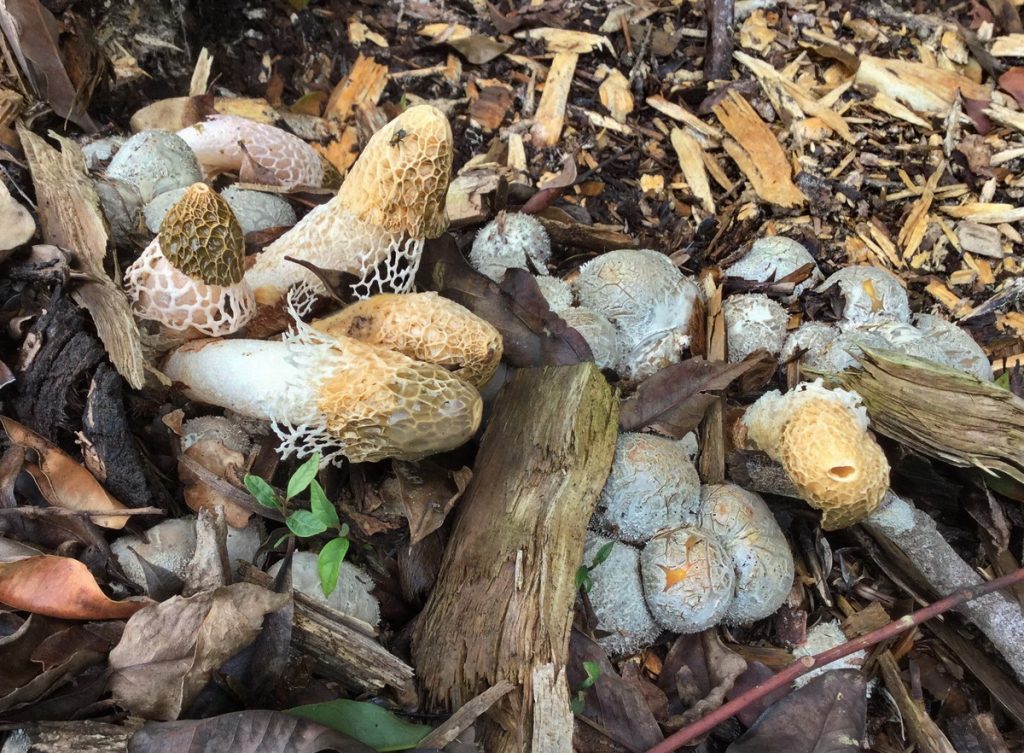
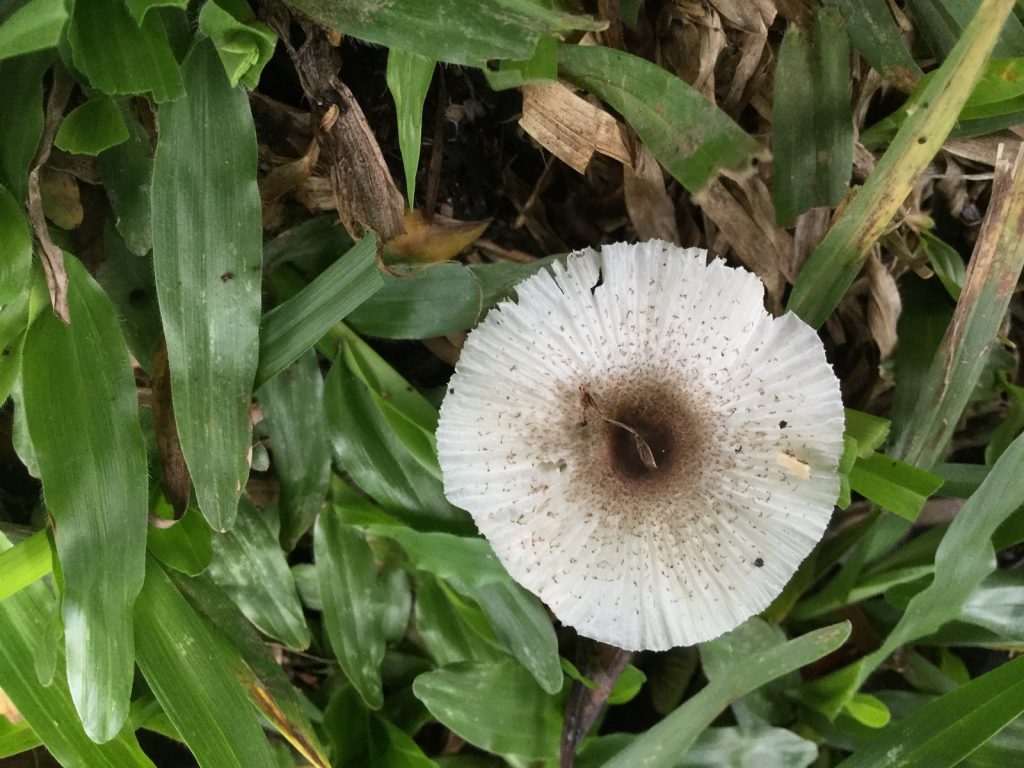
Fairy rings of pale, slightly frilled fungi have grown in a dark part of my garden overhung with coleus plants.  They formed a dense colony and looked quite magical.  Unfortunately, I was not able to get a good photograph of them.  However, their appearance prompted me to search for more of what I call ‘pop-ups’ – the little fungi that, encouraged by the warm, humid weather, pop up all over the lawns, in pot-plants and beneath shrubbery throughout the village.

I would need the help of a mycologist to identify the different species of fungus but am fairly sure that the lacy-cowled fungus collapsing over the mulch pile near PEEC, is a species of Phallus fungus. It is commonly known as a ‘stink-horn’ as it has an unpleasant smell of decaying flesh.

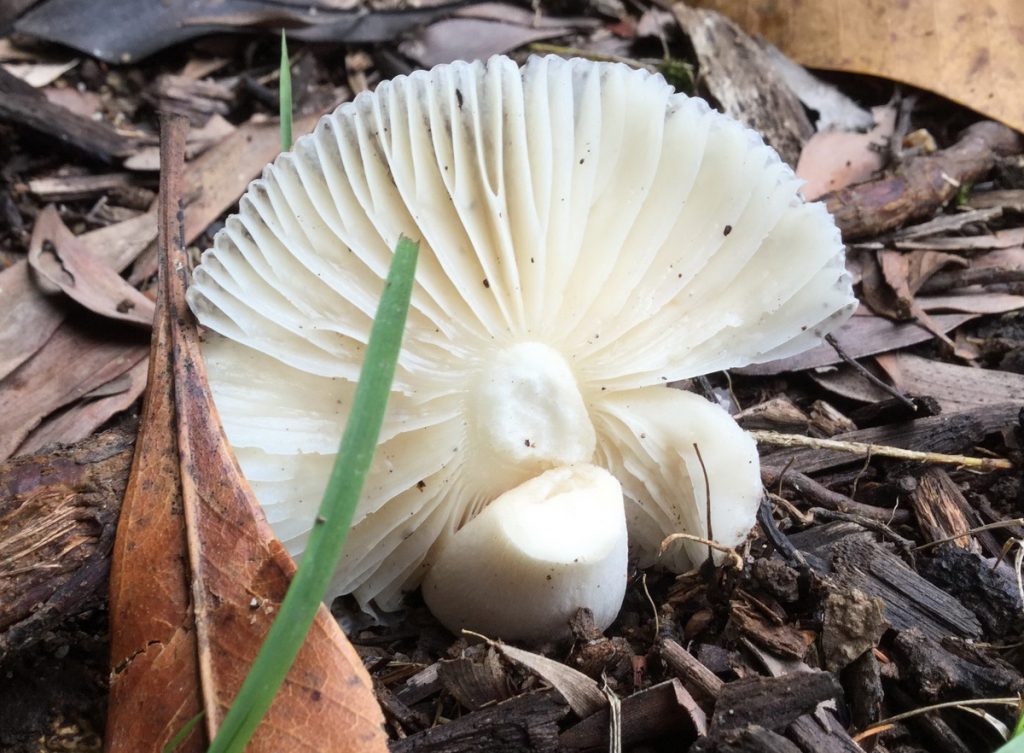
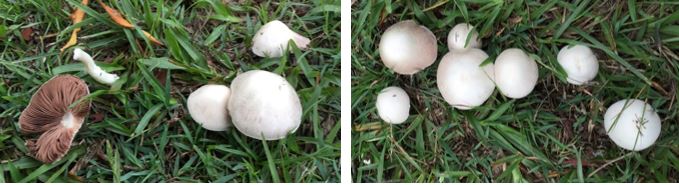
A small white toadstool on the Village Green had been tipped over, giving a good glimpse of the ‘gills’.  On the lawn outside No 24, and again on the opposite side of the road, several clusters of pale ‘mushrooms;’ have popped up.  They have the distinctive ‘mushroom brown’ gills and easily peeled skin that identifies an edible mushroom but I am not prepared to take the risk of sampling one.

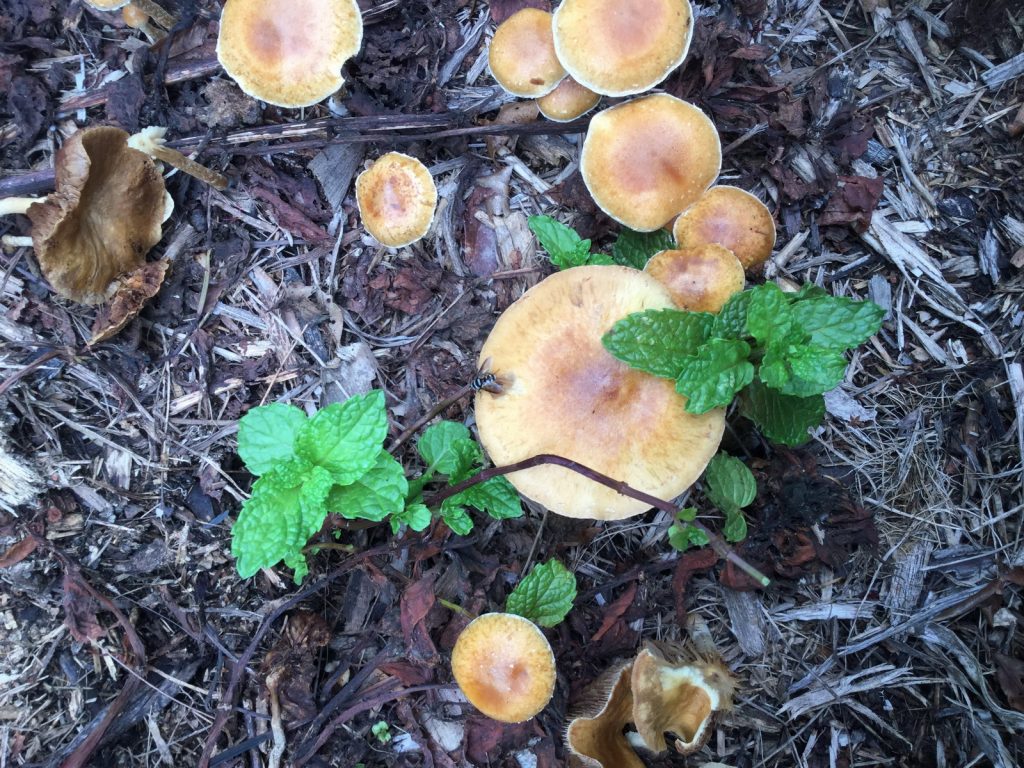
A cluster of tiny orange coloured fungi is growing under the mint.  I wonder if it could be a species of Hypholoma.  

Over the next few weeks we should expect to see many more pop-ups erupting.  Have fun finding them – many will be more spectacular than these early samples.

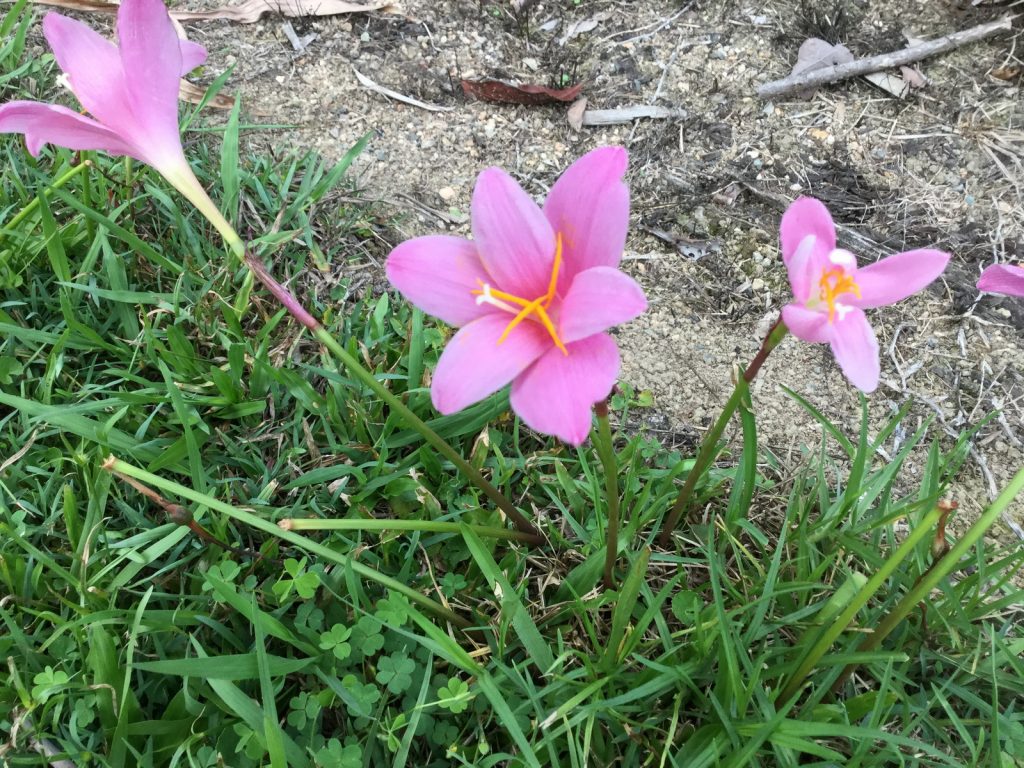
Another pop-up we all know and welcome with the early rains, is the dainty, pink flowered Rain Lily, (Zephyranthes species) which blooms in little clumps throughout Paluma.

Text and photos by Colwyn Campbell

Nature Notes from Paluma

Many of you will have enjoyed reading the informative ‘Nature Notes’ contributed by Paluma’s resident naturalist Roy Mackay over a great many years. Roy’s passion was to educate people about the natural world and to foster interest and respect for our native flora and fauna. In the spirit of continuing Roy’s great work and his legacy of reporting on nature’s treasures in and around Paluma Village, we present the following notes, observations and musings contributed by long-time residents and fellow naturalists Linda Venn and Colwyn Campbell.

Linda Venn writes:-

You already know (from previous postings) about our Northern Leaf-Tailed Gecko which made an appearance at Summerhouse (No. 16) over Christmas. Well, in the same time period, we had a common Green Tree Frog trying to get in the pet flap on the back screen door. We can hear several Green Tree Frogs calling when it rains, which is unusual. When we first came to Paluma, conventional wisdom was that the only Green Tree Frogs here had been inadvertently imported in goods brought up the hill, as it was too cold for them. Well, now we have at least three just at our end of the Crescent. Maybe Paluma is warmer now than it was 30 years ago? It’s certainly drier.

Another unusual visitor is the Pallid Cuckoo. There’s been a pair around for the last few weeks. These are not often seen in Paluma, though Andree Griffin recorded one at the dam in 1971 and Roy Mackay saw one in Paluma more recently. Their flight is very falcon-like, but whether or not they are a bird of prey was not confirmed by the smaller birds – who couldn’t care less about their presence and gave no alarm calls. This is interesting, considering that the Pallids parasitise honeyeater nests.

Talking of the cuckoo group, I heard a Koel calling one night, but not since (Phew! Noisy buggers!). Must have been just passing through, as were the family group of Black Cockatoos. Also got a good look at a Shining Bronze-Cuckoo this morning; usually heard but not seen. They’re quite small and delicately barred on the chest.

Another interesting one is the Red-necked Rail/ Crake that was calling outside our bedroom window one morning, in the regrowth forest at the rear of Fatima Cottage. This lovely little “chook” was first seen in Paluma by my brother, in the backyard of Ivy Cottage in 1982. Seems to stay close to creeks and is more likely to be heard than seen. Its call is a maniacal laugh, quite disconcerting at close range before dawn!

Yesterday, we had a solitary Metallic Starling in our rusty fig (now fruiting, so we’ve had a Figbird or two as well). To see just one starling is unusual, as they usually travel in flocks. Well, this morning a small flock arrived and spent time in the fig and the regrowth between Summerhouse and Mt Spec Cottage. Their fluttering flight is distinctive. 

We also have a shy resident Tooth-billed Bowerbird who enjoys both the figs and the fruit of the walking-stick palm. He was giving his repertoire of mimicked bird calls the other evening, quite disconcerting until you realise that all those different birds are highly unlikely to be in the one tree at the same time!

Another bird that usually travels in a group is the Silvereye. We’d only seen a pair, then this morning a small flock arrived in the regrowth on the footpath.


Colwyn Campbell penned the following response:-

A few years ago, (I’d have to trawl through old diaries for the date), Linda Venn called me over to look at a bird feasting on the fruit of a rhodomyrtus in the front garden. It had been there all the previous day and it was the scolding of smaller birds that drew attention to it. It was unfazed by our presence and just kept eating, seeming determined to strip the tree.  We were puzzled because it had the distinctive markings of a cuckoo. Roy Mackay came up and identified it as a young Pallid Cuckoo. We were puzzled as its presence was unusual here; also Linda wondered what local bird would have a nest big enough to have hosted the cuckoo. 

The Red Necked Rail/Crake makes its way in the evenings along the creek area behind my house. Only twice in all the years I have been here have I seen one venture onto the back lawn. Last year I saw one at the edge of the shrubbery across from Manali. Coincidentally, that afternoon, two birdwatchers had the Rail/Crake on their ‘to see’ list and it emerged from the scrub long enough for them to take some good photos. Seven years ago near Roy Mackay’s house I found one dead on the road verge. It had evidently been hit by a car, but was almost unmarked and still warm. Roy stuffed it and it now is in the museum.

The Koel – yes, I was surprised to hear it too.

What’s Blooming at Paluma: Christmas Orchid

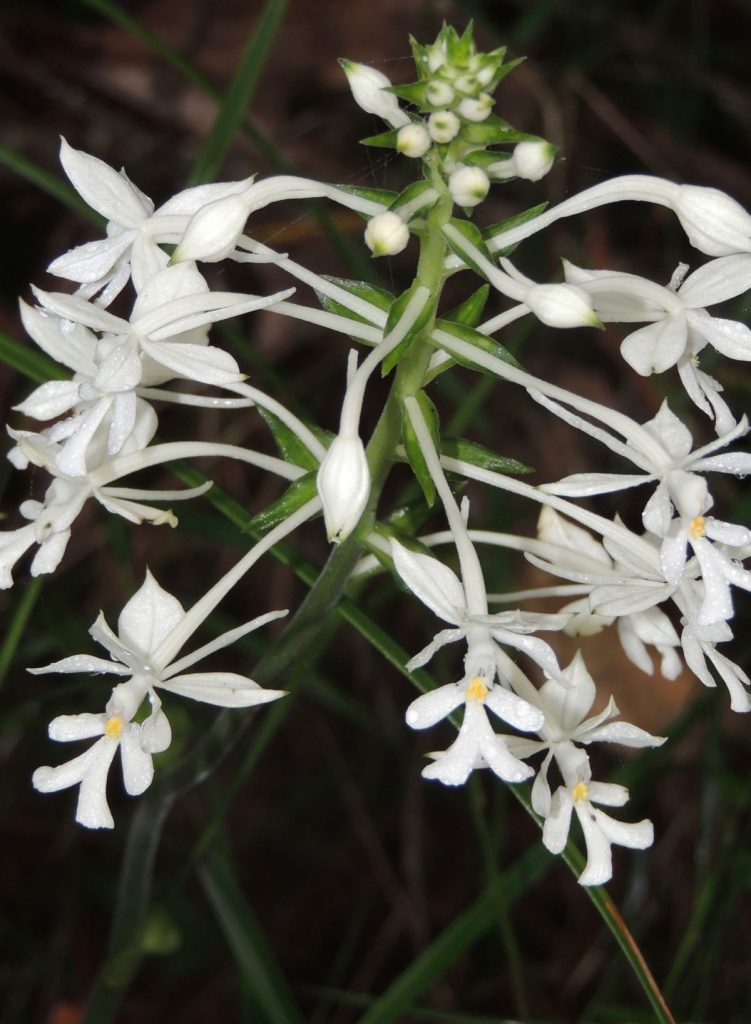
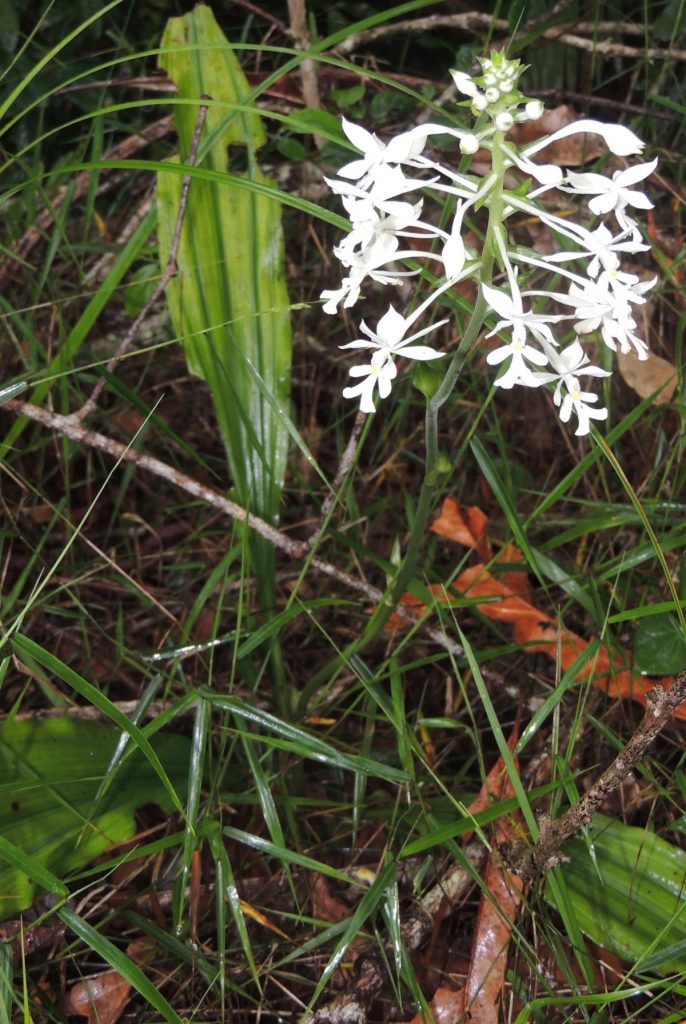
Calanthe triplicata (Common Christmas Orchid)

There is nothing ‘common’ about the beautiful ground orchid Calanthe triplicata currently flowering along some of the rainforest walking tracks around Paluma. Flowering specimens have recently been observed near the track to McClelland’s Lookout (off the Loop Road) and along the H-Track.

This evergreen terrestrial orchid generally grows in clumps from fleshy pseudobulbs. The plant has dark-green lance-shaped leaves with prominent parallel leaf veins. It can grown to 1 metre tall, but all of the specimens observed at Paluma are smaller, between 30 to 40 cm in height. The white flowers are borne on erect racemes at the top of the flowering stem. Flowering occurs from October to February.

The Christmas Orchid occurs in Cape York Peninsula and North East Queensland, usually in mountain rainforest at high altitude from about 700 metres to 1250 metres.

Article by Michele Bird & Lynda Radbone.

Paluma Rainfall (2019)

Over many years Don Battersby has been vigilant in recording the annual rainfall statistics at his property on Hussey Road on the western outskirts of Paluma Village.

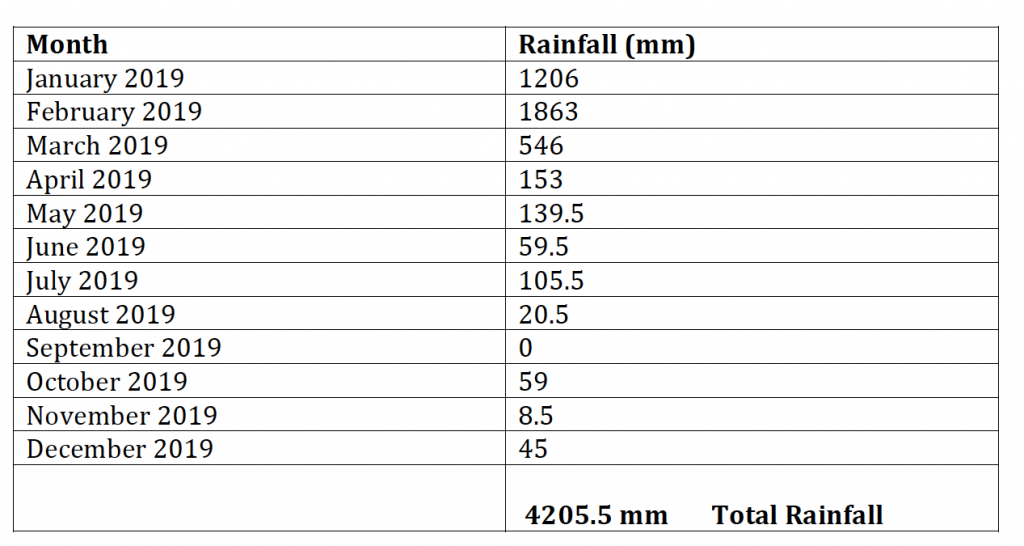
Don has kindly contributed the following rainfall statistics for Hussey Road for 2019. The total rainfall recorded by Don for 2019 was 4205.5 mm with rain falling on 99 days of the year.

The stand-out months for rainfall were January and February with a total of 3069 mm of rain falling in these two months (equivalent to 73% of the total rainfall for 2019). In the latter part of 2019, the stand-out month for the lack of rainfall was September with not a drop of rain recorded at Hussey Road!

Are there other rainfall recordings for Paluma and surrounds?. If you have been recording rainfall at your property we would love to have your statistics!

Rainfall recordings by Don Battersby. Text by Michele Bird.

Geckoes Galore

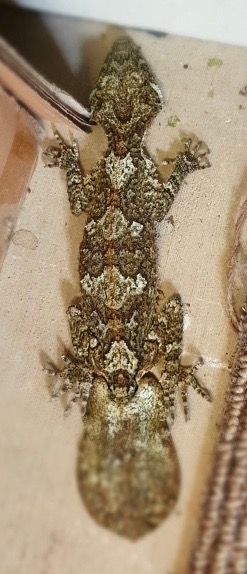
It is certainly the season for the Northern Leaf-Tailed Gecko (Saltuarius cornutus) at Paluma.

My previous posts during December 2019 have reported the movements of a rather superb specimen at the eastern end of the village between the residences of 13 and 17 Mount Spec Road.

Linda Venn has now contributed a photograph of her resident Gecko, also at the eastern end of the village. Linda reports that this specimen has been sighted regularly at her home over a period of some years. She describes this individual as about 7 to 8 inches in length (or about 20 cm).

Don Battersby says that he has numerous specimens living at this property on Hussey Road. They favour the shed walls and appear nightly to forage for food.

Text by Michele Bird. Photo by Linda Venn.

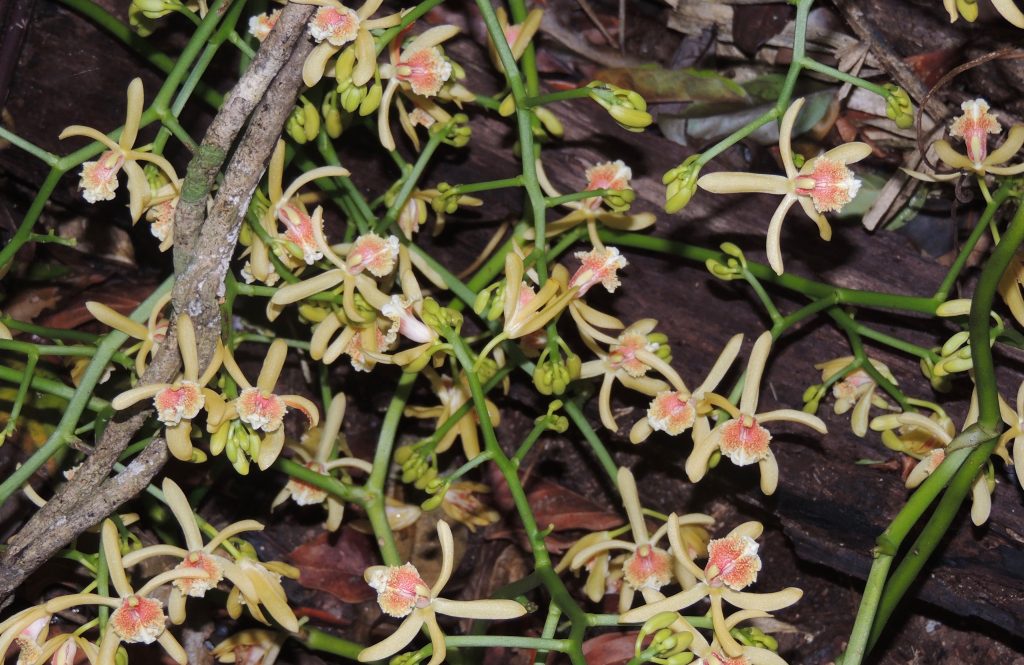
What’s Blooming at Paluma – Giant Climbing Orchid

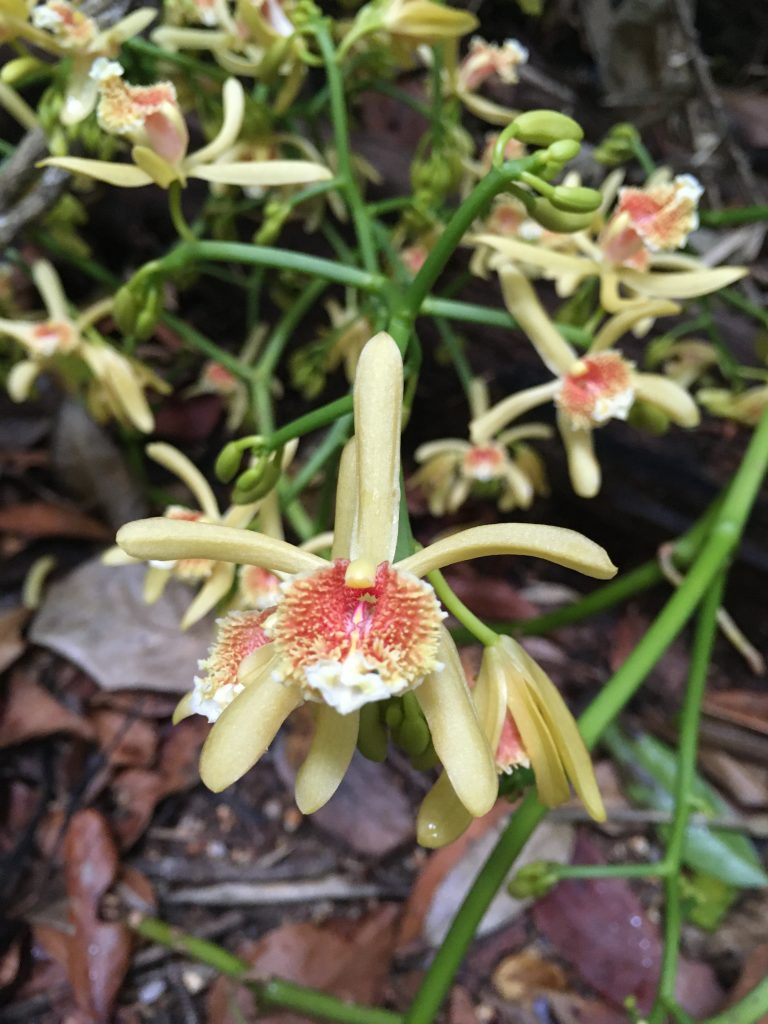
A spray of flowers – Giant Climbing Orchid

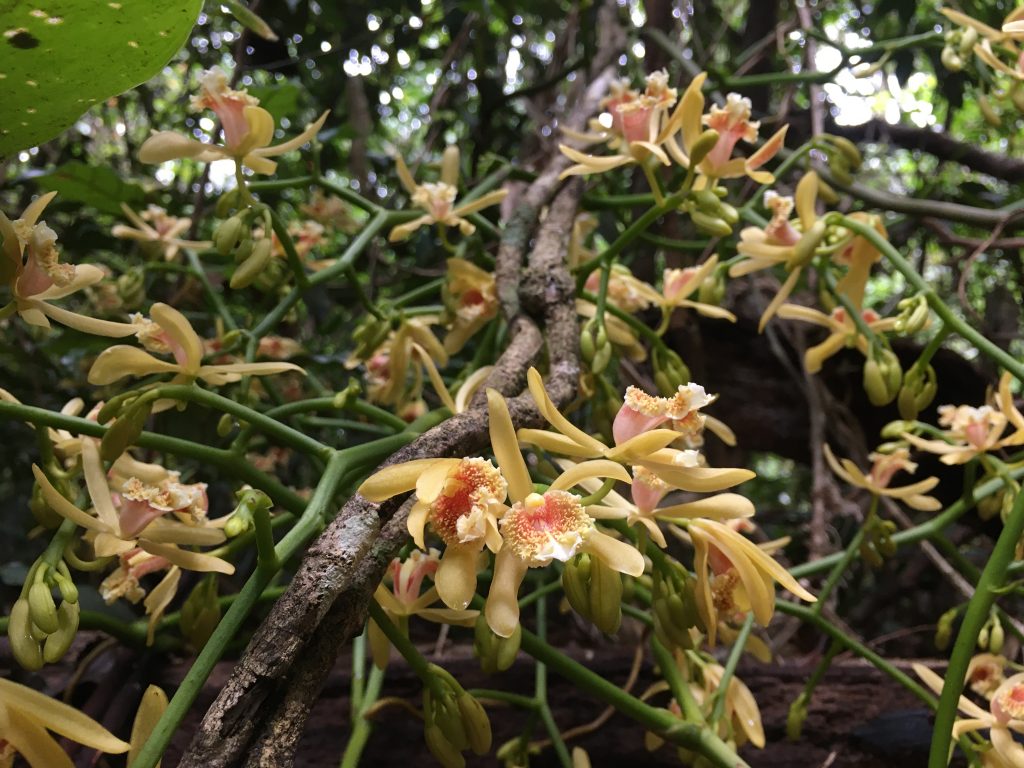
As mentioned by Michele a couple of days ago, there is currently a rather spectacular orchid flowering on the H-Track. It is the Giant Climbing Orchid (Pseudovanilla foliata) Apart from its beautiful flowers (in copious quantity), this orchid is also special in that it has no leaves. It is one of several species of saprophytic orchid that derives its food from rotting wood rather than from photosynthesis. This particular species is not often seen around Paluma since it spends most of its life as an inconspicuous tangle of stems climbing up dead trees – it flowers only briefly. Once the logs and dead trees that it feeds off have fully rotted away it dies off. Wilfred Karnoll informs me that after cyclone Yasi these orchids made a brief appearance in a few locations along the walking tracks near the village.

Flowers are produced in great numbers for a limited period. they have a faint but pleasant scent.
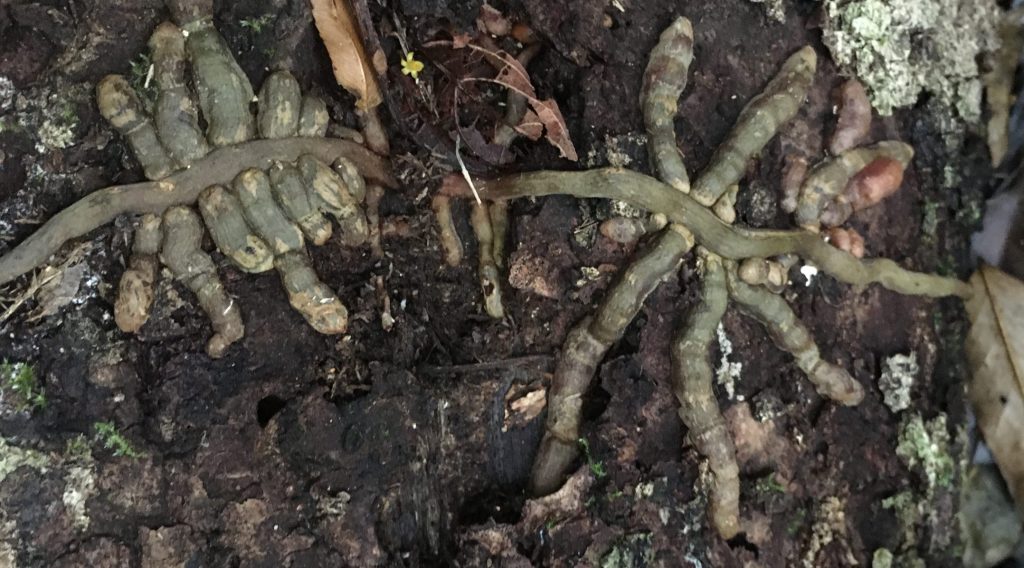
The roots penetrate rotting wood

While this orchid has green stems and may be able to make a small amount of food for itself, it is unlikely to able to grow and produce masses of flowers on this energy source alone. Most saprophytic orchid lack any green colour, and thus do not need (and cannot use) sunlight to obtain food. One group of these orchids has completely forsaken sunlight and spends its entire life, growing, flowering and fruiting underground – never seeing the light of day!

Technically saprophytic orchids do not directly feed off decaying wood and vegetation, but derive their food from a close symbiotic relationship with fungi that do all the hard work of breaking down the fairly indigestible wood and then provide it directly to the roots of the orchid. Whether this is a mutualistic relationship (with both obtaining benefit from the exchange) or a parasitic one (with the fungi being robbed of fuel it would prefer to use for its own growth) is not fully understood. So far, research on this matter appears to have failed to show any clear benefit to the fungi.

After reading a bit more about orchids on the web I discovered that the relationship between fungi and orchids is widespread and devilishly complex. Virtually all orchids rely on fungi for seed germination. Orchids produce seeds that are microscopic in size (they make up for this by producing prodigious numbers in each seed capsule). These seeds are so small that they do not have the energy reserves that all other seeds use to fuel the cell division needed for germination and subsequent growth of the first green leaves that will manufacture new fuel from photosynthesis. These tiny seeds rely entirely on fungi for that germination energy. Some orchids have been shown to have an ongoing obligate relationship with fungi, while others shrug off this reliance once fully developed. A further twist in the orchid-fungi story occurs in some species, where the fungi that the orchid derives its food from, is itself deriving its fuel from the roots of certain tree species. Thus we have sunlight being turned into food high up in the forest canopy and then being transferred down to the forest floor, into fungi and then into the saprophytic orchid!

Text and Photos by Jamie Oliver

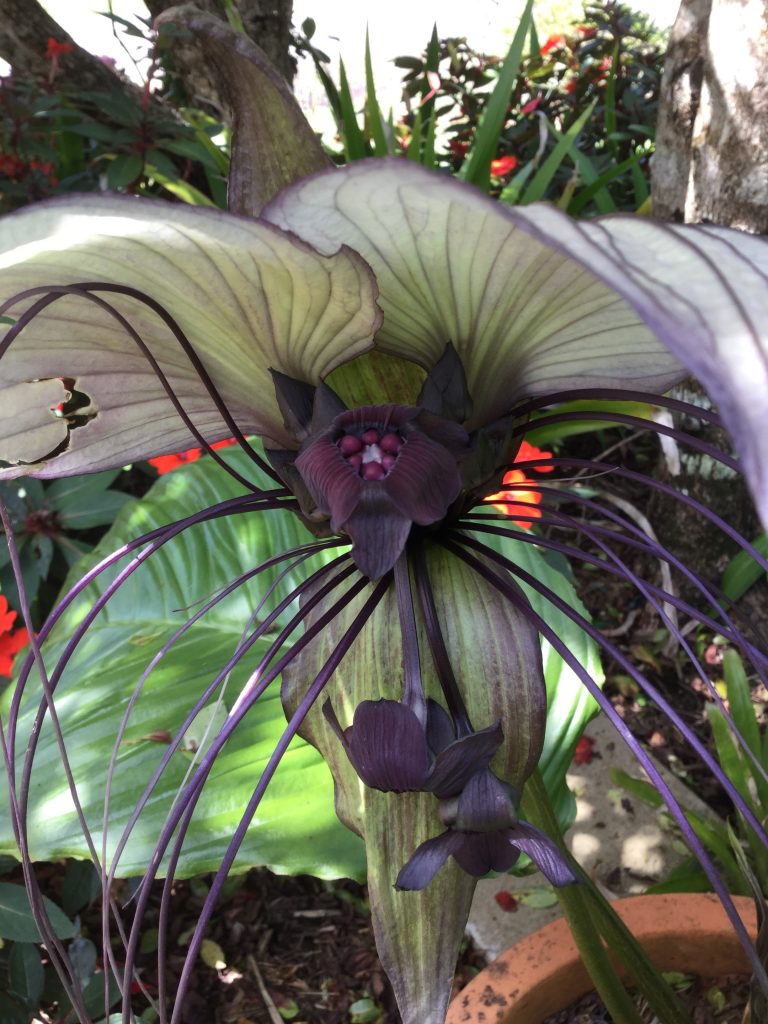
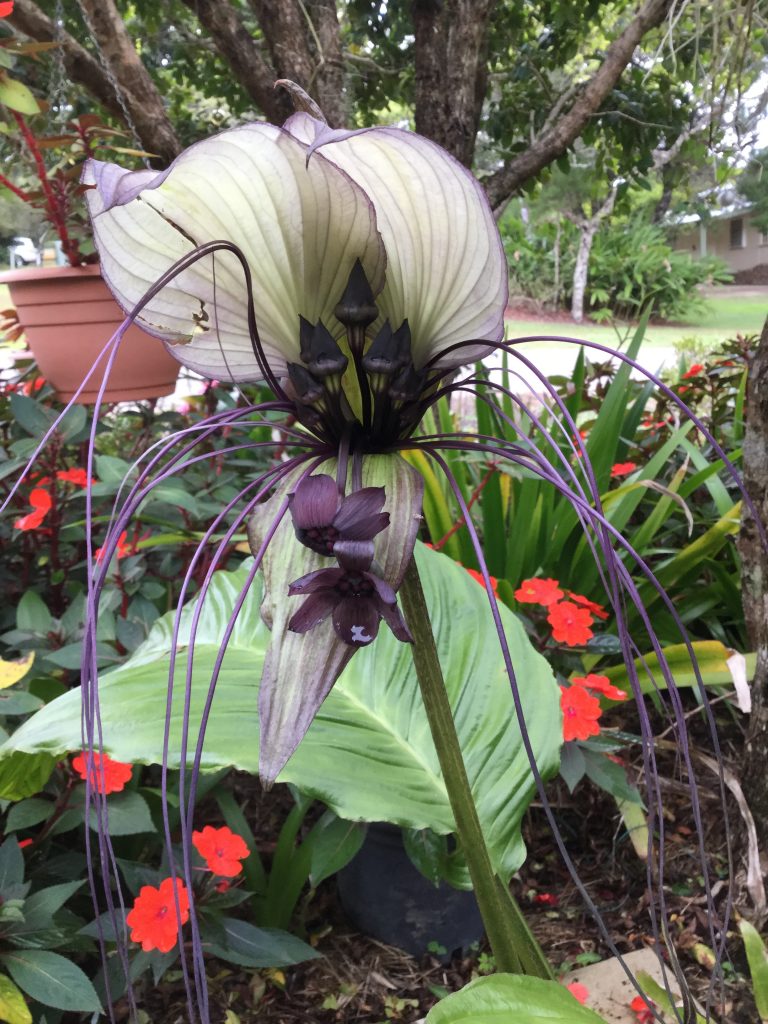
What’s Blooming at Paluma: White Bat Plant

White Bat Plant (Tacca integrifolia)

This weird flower is blooming in my garden, in a semi-shaded spot near the letter box. The bat flower is a member of the yam family. Species of Tacca are found in tropical regions of South America, Africa, Australia and South East Asia. Difficult to see in my photo is the cluster of tiny, dark flowers at the centre. The ‘whiskers’ are between 40 cm and 60 cm long.


Text & Photos by Colwyn Campbell

A Walk Along the H-Track

On Saturday afternoon (28 December 2019) we decided to take a stroll along Paluma’s H-Track. The main impetus for the walk was a tip-off from Jan Cooke that the giant climbing orchid, the ‘Pseudo Vanilla Orchid’ (Pseudovanilla foliata) was in flower along the track. Having never seen this orchid in bloom I was keen to observe and photograph it.

The Pseudo Vanilla Orchid in full bloom.

More information and photographs of this spectacular and unique orchid will appear in a future post by Jamie Oliver.

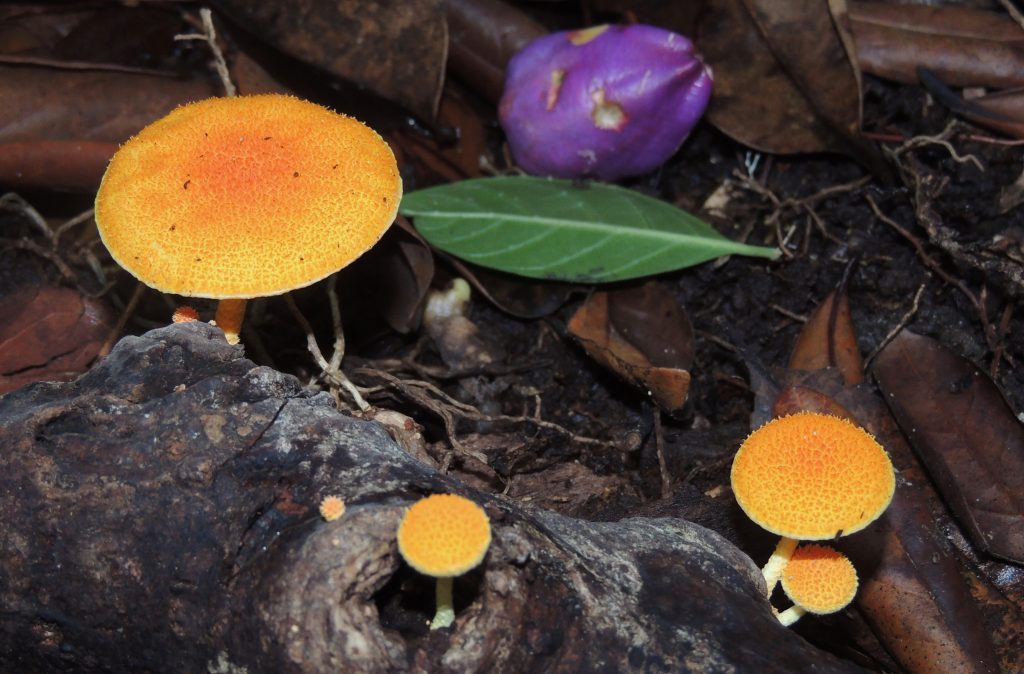
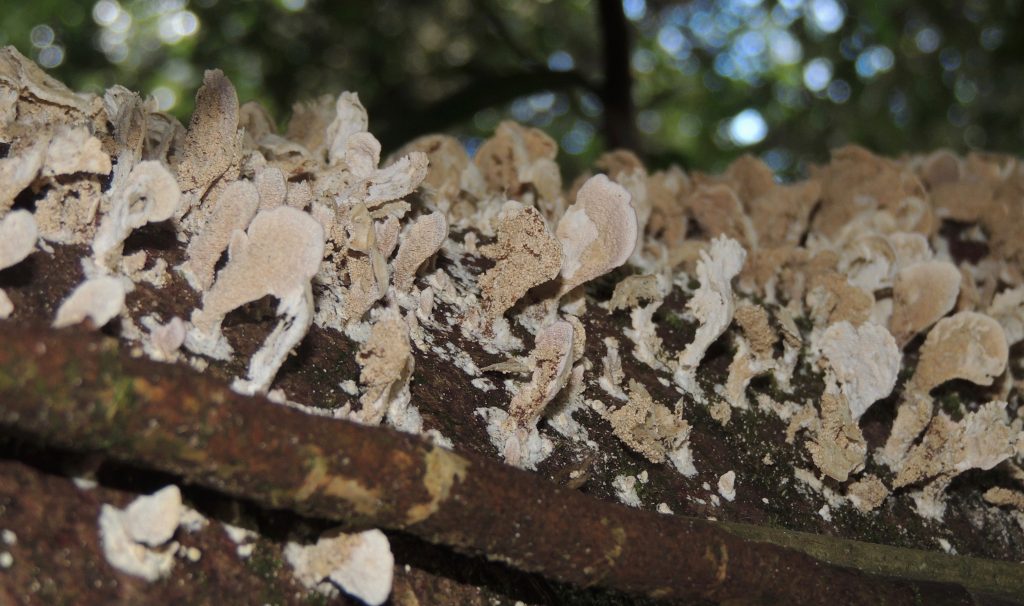
We started our walk at the eastern end of the H-Track off Lennox Crescent. After some showers of rain in recent days the rainforest appears refreshed and revitalised after the long dry spell. Fungi of several colours, shapes and sizes has sprung from decaying wood along the track.

Brilliant orange fungi growing from decaying wood on the forest floor.
Fascinating fungi growing on a tree trunk.

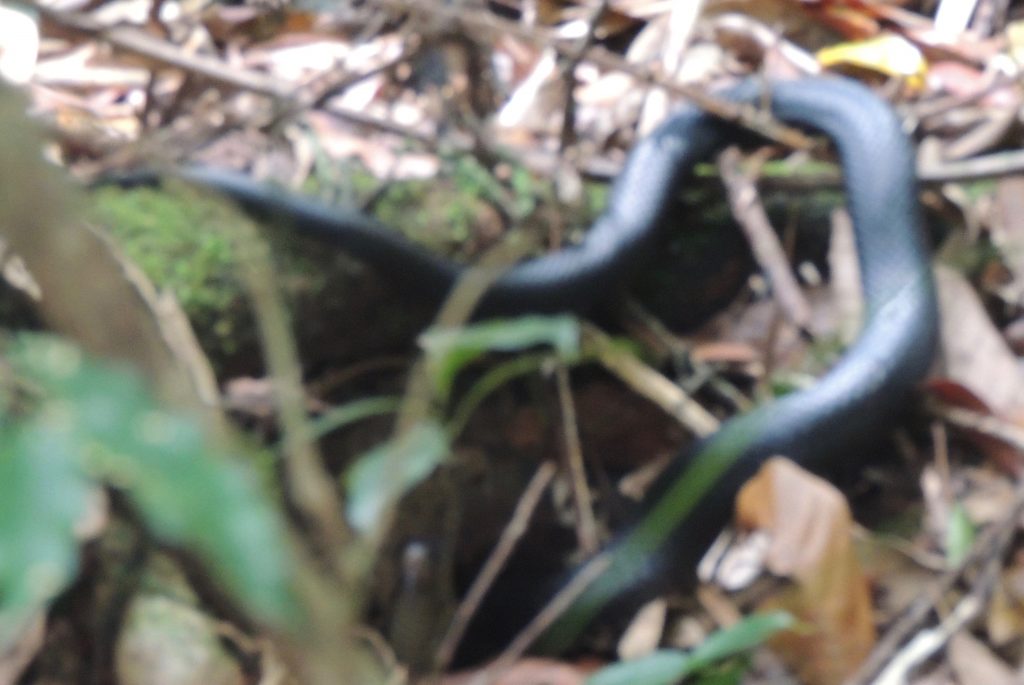
It wasn’t long before we encountered a sizeable red-bellied black snake, actively foraging for food amongst the leaf litter. Upon detecting our presence it appeared quite agitated and retreated into a hole at the base of the buttress roots of a large tree. It immediately reappeared, head first, raised and in defensive mode. We quickly moved on, leaving it to its foraging.

My very blurry and unfocused photo of the red-bellied black snake. I have to admit to being more ‘focused’ on the movements of this snake, than on focusing the camera!

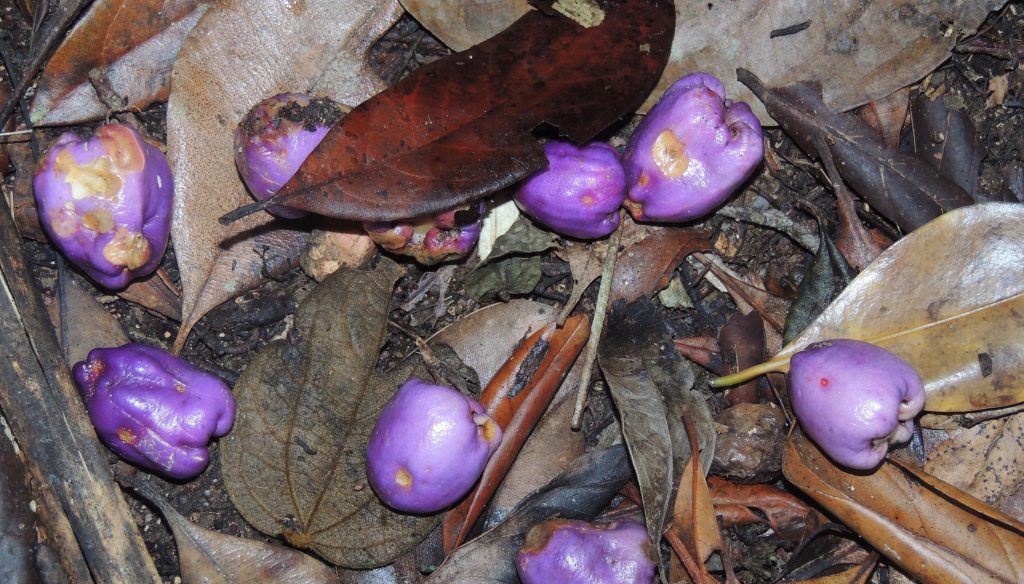
The walking track and surrounding forest floor is littered with numerous fruits and flowers at the present time. We observed the fruit of quandongs (Elaeocarpus sp.) and the brilliant purple fruits of the Paperbark Satinash (Syzygium papyraceum). Many of these fruits showed the distinctive nibble marks of rainforest marsupials and birds.

The bright purple fruits of the Paperbark Satinash.

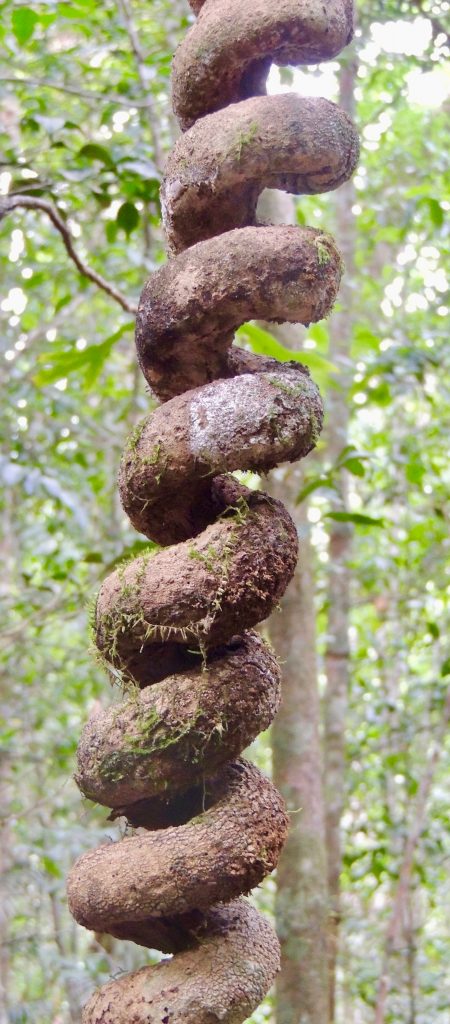
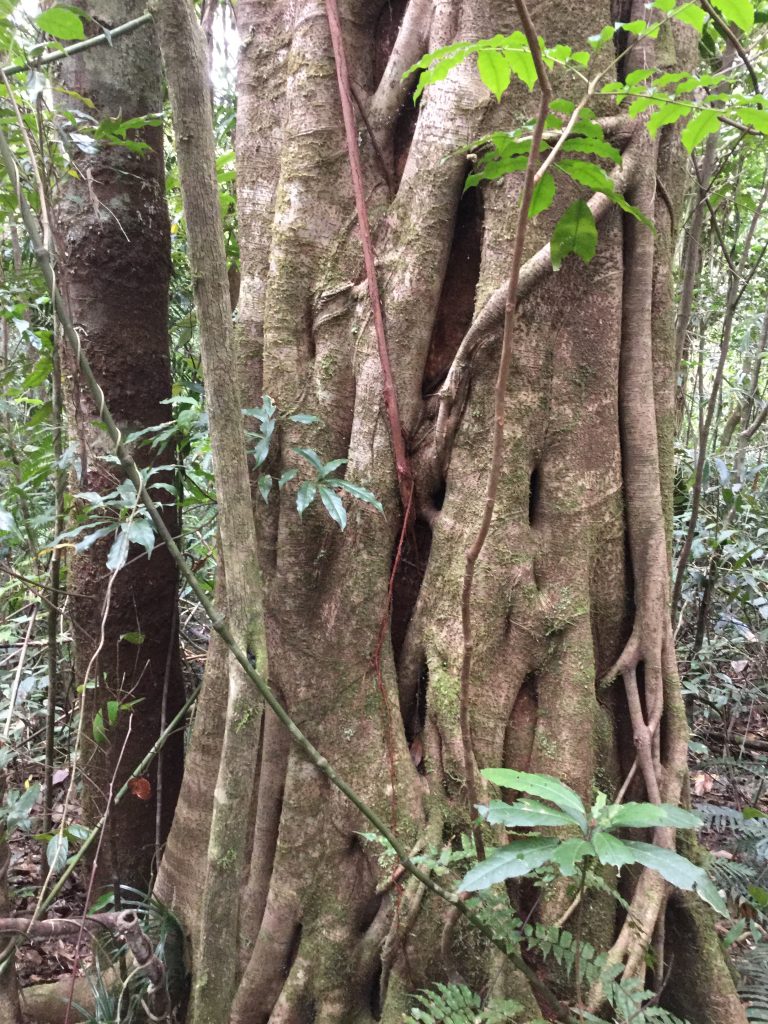
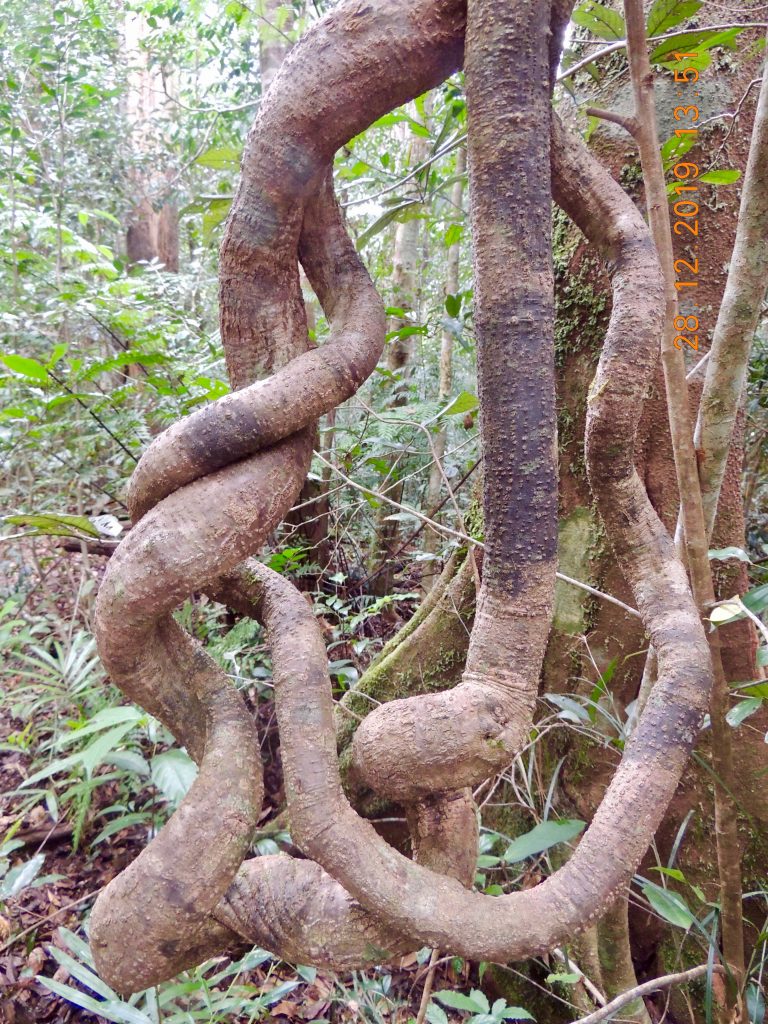
There are some spectacular trees to see along the H-Track including many large specimens with distinctive buttress roots. There are also some splendid climbing vines weaving their way high into the rainforest canopy.

A stroll along the H-Track is always a pleasure with so much to see and absorb. Take the time for a wander along this short rainforest track and you are sure to be rewarded with many interesting sights, sounds and the wonders of the tropical rainforest. The bird calls alone are worth taking the walk! During our stroll we had the pleasure of listening in on numerous conversations high in the canopy, courtesy of the shrike thrushes, cat birds and whip birds.

Text by Michele Bird, Photos by Michele Bird & Colwyn Campbell.

What’s Blooming at Paluma: Oriental Lily

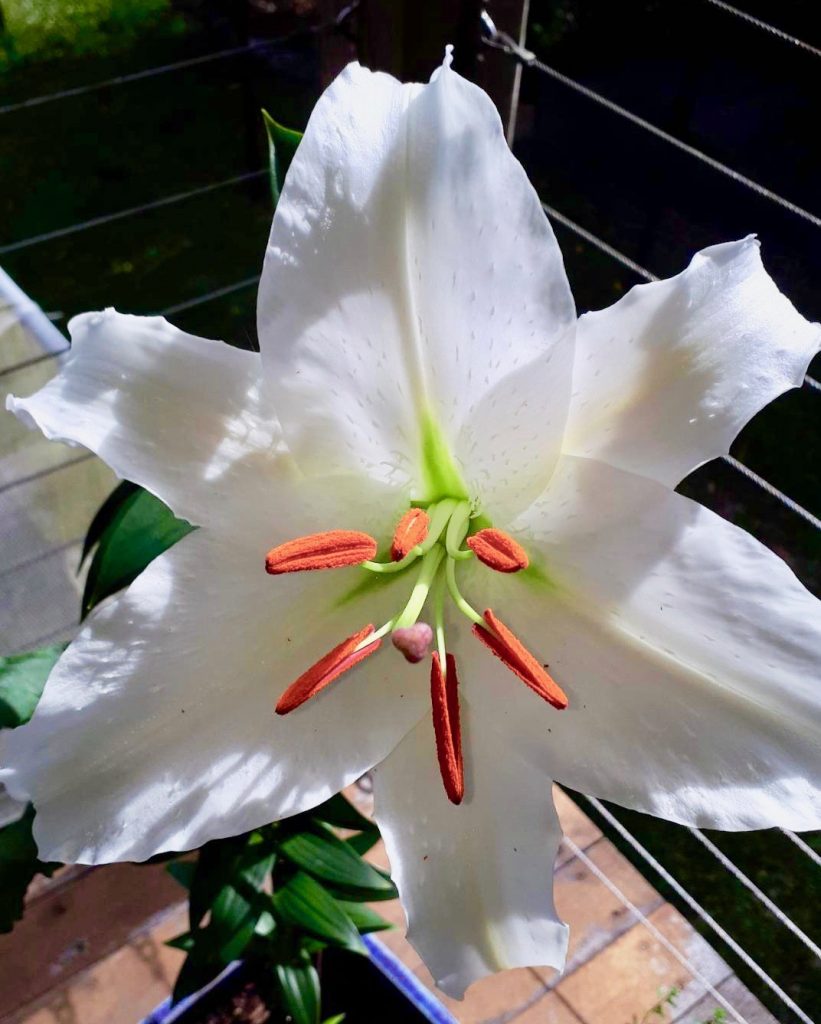
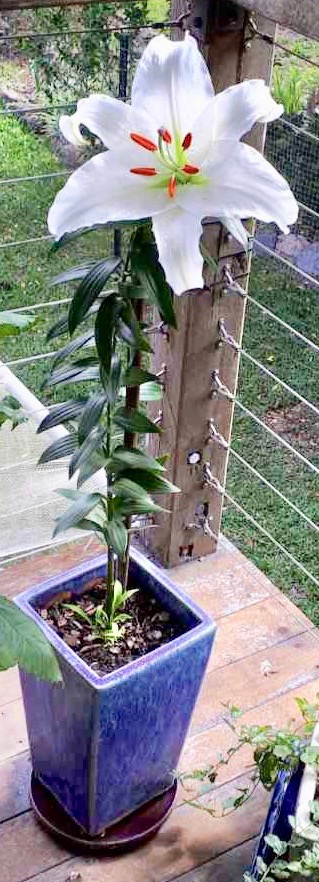
Lilium ‘ Casa Blanca ‘ (Oriental Lily)

This young Lily is almost 1 metre tall and  boasting a 24 cm heavenly scented bloom. When she matures, she will produce 4-6 flowers on a single stem. Loved by the bees and butterflies, this beauty has won the prestigious ‘Award of Garden Merit ‘of the Royal Horticulture Society in 1993 for best White Oriental Lily ever. Reliable and easy to grow in any moist soil with good drainage. I’m hoping my thumbs stay green enough to bring her to full maturity and be rewarded with multiple blooms every Christmas.

Text & Photos by Lynda Radbone.