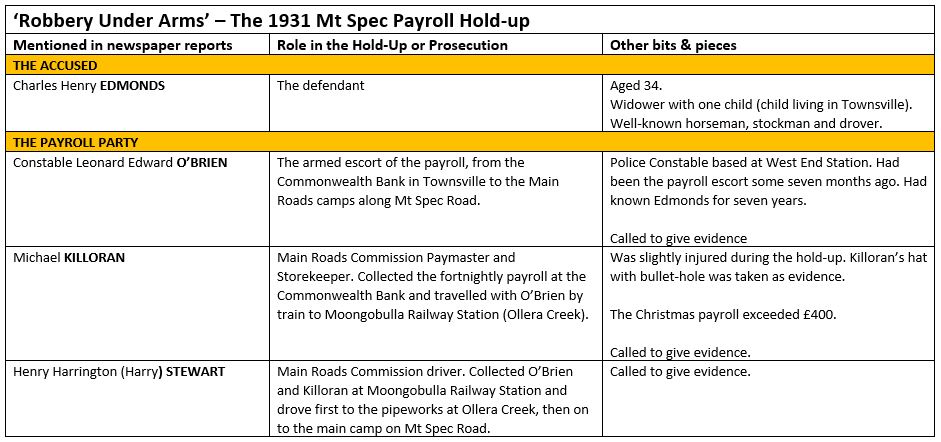
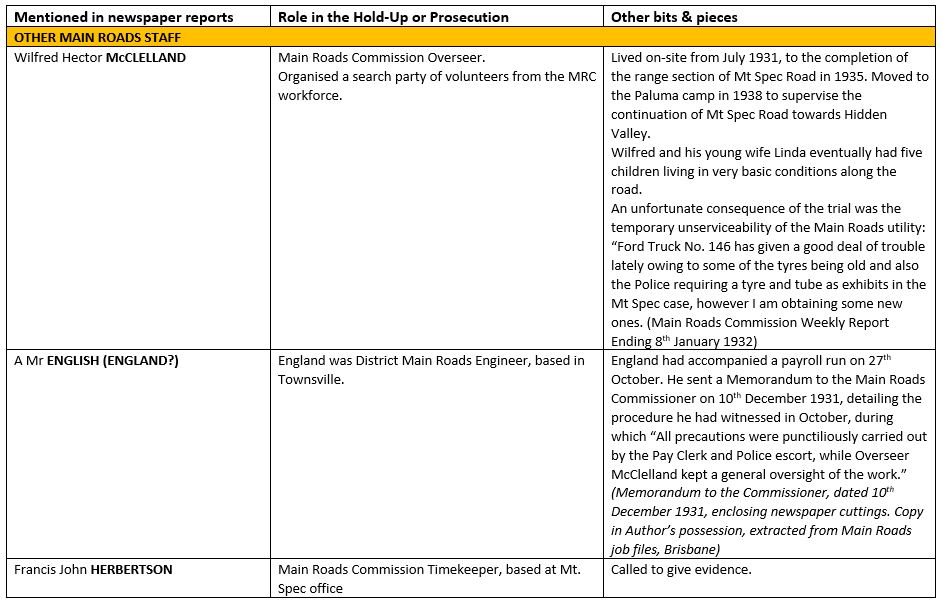
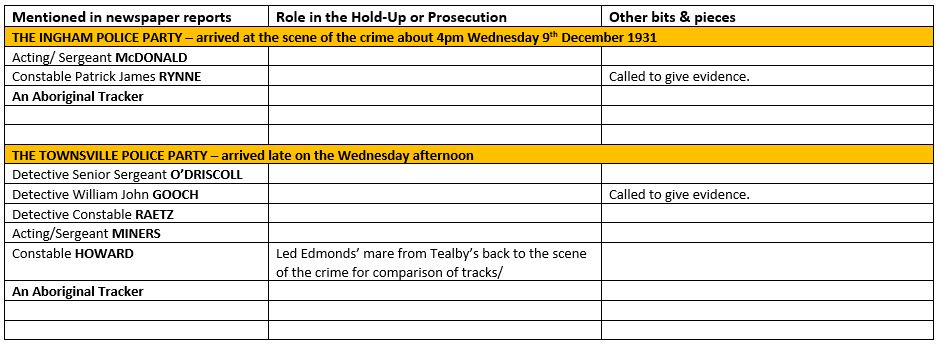
Click here for a list of key characters in this story
The evidence given by Constable Rynne, Monday 28th December
Constable Rynne was now called to give
evidence. He had arrived at Mt Spec Road about 4pm on the day of the hold-up,
meeting up with “a number of men, and they made an investigation of the
surroundings.” Rynne saw the log (about 15 feet long) and the pile of bushes on
the left hand side going up the road. He “also found on two trees marks made by
pellets from a gun, and found a pellet embedded in a tree on the right hand
side looking at Mt Spec, and about three feet from the road and about 18 yards
from the clump of bushes.” With Acting Sergeant McDonald and a tracker, Rynne
conducted a search of the area for footprints. The tracker showed him hoof
marks and also “barely distinct footprints of a size 7 or 8 boot” in a gully
about 130 yards away. There were “a number of hoof marks there but rain which
had come down the gully and partly obliterated them”. Rynne believed the tracks
to be new. As with Gooch, Roberts challenged Rynne on his competency to
conclude this; “he was not an expert to say so”, and besides, “the rain had
covered them.”
Rynne continued. He stated that there were
“two distinct tracks going out of the gully which he followed along the side of
the mountain to Tealby’s fence and up the side of the mountain for about a
chain.” Rynne estimated the length of tracks followed to be approximately half
a mile. The tracks “appeared to have been freshly made, and made by a horse
travelling at a fairly fast gallop.” The rain fell after these tracks had been
made. Rynne then went back to the crime scene, where he met up with the police
from Townsville.
The next day, the police again looked for
the tracks, but now found that sections were under water. Rynne found some
tracks similar to those he had found the previous afternoon, and these were
also followed for about a quarter of a mile in the direction of Tealby’s yard.
Rynne later went to Tealby’s yard, where Gooch showed him the chestnut mare.
The mare was led through the yard, and Rynne thought “the tracks appeared
similar to those he had followed from the gully. He formed the conclusions that
the tracks found on the previous day were those of the chestnut mare.” However,
when a comparison was made with the tracks in the gully, Edmonds had said they
were not of the mare’s. Edmonds picked up the tracks about a chain from
Tealby’s gate and followed them to within six feet of the gate. At the gate,
“Detective Gooch told defendant that the tracker considered the tracks were
made by the chestnut mare, and that he must have come down the track, but
defendant stated he had come down the track from the direction of his hut”,
adding “he would not pull a gun on a man for a few pounds.” Edmonds lived about
a mile and a quarter from Tealby’s, but Tealby’s was admittedly closer to the
scene of the hold-up. At this point, Roberts requested that Rynne prepare “a
plan of the country he traversed from the scene of the hold-up”, in readiness
for Tuesday morning’s session. The court then adjourned until 11 o’clock the
next day.
Rynne continued giving evidence on Tuesday
morning (Townsville Daily Bulletin, Wednesday 30th December 1931,
p. 11). He stated that O’Brien was not the first person he met at the scene
of the hold-up. “There were a number of civilians there, the majority of whom
had guns. He did not know there were other men searching the district. The
country was rather thickly timbered.” Rynne first met Edmonds the next day [Thursday]
at Tealby’s yard, then at Edmonds’ hut on the Friday, and again on Sunday. On
Sunday, in company with O’Brien and the tracker, they obtained a statement from
Tier. Rynne confirmed that Edmonds referred “to other tracks, alleging they
were not the tracks of his mare.” Rynne stated he was not equipped to take
plaster casts of the tracks or any sample of them “owing to the nature of the
ground.” Rynne agreed “it would have been very material for the prosecution if
he had been able to take the tracks in the soil.” However, Rynne did not hear
Gooch point out to Edmonds “another place where a horse had been tied up.”
Rynne recalled only one gap in the tracks, of about 150 yards, and did not know
what Gooch meant when he said they “followed the tracks intermittently.” Rynne
had not told Edmonds he had followed the tracks all around the yard the
previous afternoon and “had lost them.” Rynne did not agree with Edmonds’
suggestion “that horses had been galloping all over the country.” Rynne was
“quite satisfied that the tracks they followed on December 10, with defendant
were the tracks witness [Rynne] had followed the previous day.” Where
the tracks were lost, they were leading to Edmonds’ hut, so they had searched
in a circle of between 150 and 300 yards. Edmonds denied the tracks were of his
horse. At Edmonds’ request, Rynne had measured some tracks near Tealby’s. He
had not told Edmonds these tracks were not those of the mare.
Rynne was present at the dress rehearsal, “but
he did not hear Detective Gooch say to Constable O’Brien that they would dress
defendant up.” Rynne saw Edmonds shake hands with O’Brien and heard him tell
O’Brien “he was making a mistake, as he would not hold a cobber up for the
pay.” O’Brien has replied “he would be the sorriest man in the world if he were
making a mistake.” Rynne saw no more of Edmonds, as he had then gone on to the
Main Roads camp.
Rynne was questioned about the tracks by
both Roberts and the police prosecutor, Sub-Inspector Blackmore. Rynne confirmed
that the tracks from the scene of the hold-up did not go directly to Tealby’s,
but took about a mile to cover. Blackmore endeavoured to establish that only
one horse, not two, and therefore only one man, not two, had been involved in
the hold-up. Rynne had seen “nothing to indicate that more than one horse had
been tied up in the gully, or that one horse had been tied up in two places,
nor did he find indications that more than one horse had been ridden out of the
gully, or that a horse had been ridden down into the gully.”
Members (and prospective members) are advised that the Annual General Meeting of the Paluma & District Community Association Inc. will be held on:
Saturday March 21, 2020 at 12pm for a BBQ lunch followed by the AGM at 1pm in the Community Hall
Nominations are open for all Executive Committee positions. Nominations should be forwarded to the Secretary to arrive no later than Friday, March 6th 2020. Please use the nomination forms, which can be downloaded here.
Positions are:
President,
1 or 2 Vice-Presidents
Secretary
Treasurer
General Committee members (numbers flexible)
Members are reminded that Annual Subscriptions are now due and should be paid prior to the commencement of the AGM. Membership is available in two classes, these being Ordinary & Family. All classes attract the same subscription fee of $40.00 Please use the subscription form here to submit your dues. New members are more than welcome and should use the same form.
Please note that you must be a PDCA member to nominate someone to the Committee or vote for any Committee member.
The AGM will be followed immediately by a normal General Meeting with with the new Committee.
Click here for a list of key characters in this story
The evidence given by Detective Gooch, Monday 28th December (after lunch)
Roberts continued his cross-examination of
Detective Gooch after lunch. Robert’s probing questioning and frustration sets
the tone of the newspaper report. Gooch stated that the distance between the
log across the road and the bush barricade was 15 yards. The vehicle would have
driven past the offender, “and any of the occupants in the car would have had
to turn around to see defendant.” Given the slight fall of the land between the
bushes and the gully, Gooch was not suggesting that the occupants of the
utility would have been able to see the offender at 150 yards distance, but
they would have been able to at 45 yards.
Gooch agreed that Edmonds had pointed out
“two or three tracks to the tracker. He [Gooch] understood Edmonds was
an expert bushman, but he (witness) had sense enough to know an old track from
a new one….Edmonds drew attention to a lot of other tracks which he said were
fresh, but he (witness) did not agree with him. He understood there were horses
running on that country.” These tracks were not traced to Edmonds’ hut. Edmonds
had suggested they should look at the tracks where he had been moving the
horses over the creek, “but they did not go because there was no reason to go.”
Gooch did not remember the tracker saying the tracks went along the foot of the
hill, nor did he hear discussion between the tracker and Constable Rynne “as to
whether the track they followed on the previous night was the one they were
following on December 10.” Gooch knew the track was only followed for about 200
yards on the day of the hold-up, but they “continued to pick it up after the
heavy rain of the night before.” The tracks were picked up again near Tealby’s
and Rynne “was quite confident they were the tracks they had followed the
previous day.”
Roberts now turned his attention to “the
dress rehearsal”. Edmonds was not within hearing distance of the conversation
between Gooch, Detective Senior Sergeant O’Driscoll and Constable O’Brien at
the crime scene. Gooch did not suggest to O’Brien that Edmonds put on the coat
and hat in an attempt to clear himself. Apparently, “the defendant did it
willingly himself”. This was the first time Edmonds had been asked to try the
hat on. Edmonds denied it was his, as it was too big for him. Gooch did not
suggest to O’Brien that they dress Edmonds up and “stand him where the hold-up
occurred”. Gooch certainly “did not say to Constable O’Brien that they had
nothing on this ‘bird’”.
On the truck bringing Edmonds and some of the
volunteers back to Rollingstone, one of the men commented that “the bandit was
a bad shot, with which Edmonds said the bandit might have known the constable.”
Gooch was certain “that no one said that they had nothing on defendant; neither
did he say that the fact of Edmonds saying that the man did not want to shoot
O’Brien was alone sufficient proof that Edmonds did it.” Gooch had not
suggested to Edmonds that more than one man was involved in the hold-up. He had
however, spoken to both Gill and Searle about Edmonds’ movements. While they
waited overnight at Rollingstone, Gooch did not discuss the case with anyone,
and Edmonds was closely watched. Gooch did admit that, although both Stewart
and Killoran were at Rollingstone on the following morning, “he never
confronted Stewart and Killoran with the defendant”.
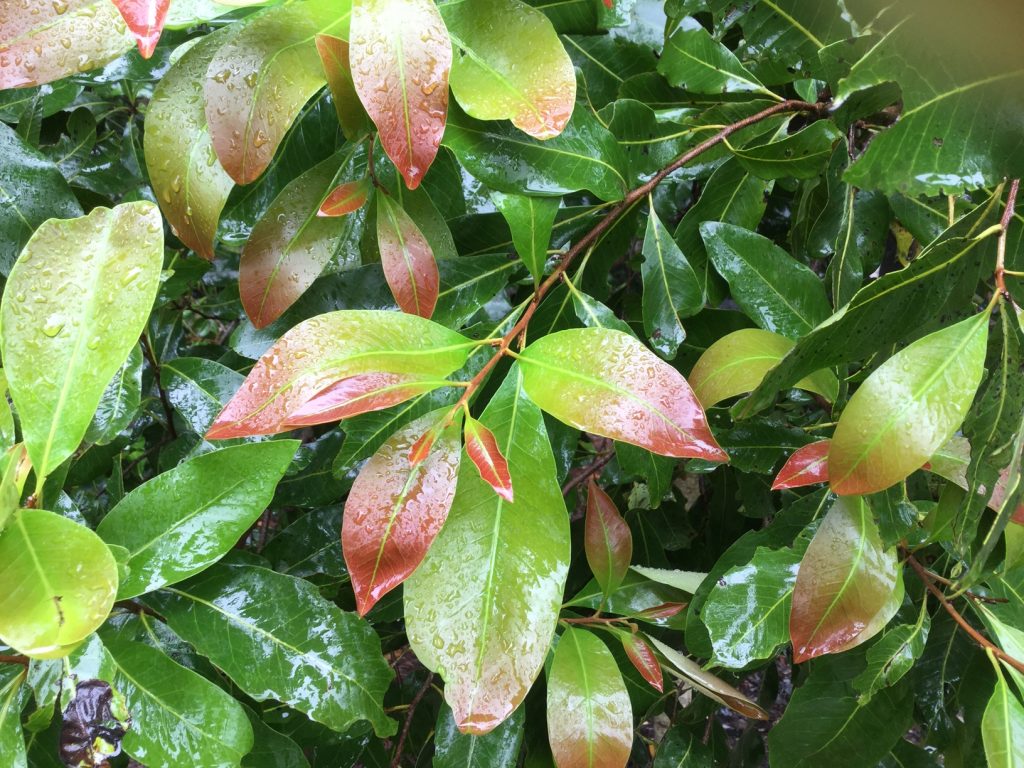
Also known as Ivory Curl Flower and Spotted Silky Oak
Buckinghamia celsissima belongs to
the plant family Proteaceae and is endemic to the wet tropical rainforests of
North Queensland from near Cooktown to the Paluma Range. The species was described by Ferdinand von
Mueller in honour of his friend Richard Granville, 3rd Duke of
Buckingham from a collection made by John Dallachy in 1865.
It is a handsome tree, growing to about 30 metres and
may be buttressed. Foliage is dense with
glossy, dark green simple leaves, 8 to 16 cm long by 3 to 7 cm wide. The leaf
underside is whitish. Juvenile leaves
can have one or two lobes and foliage may be flushed with red during periods of
new growth.
Flowering shows the Buckinghamia celsisima in
its full glory as masses of fragrant white to cream drooping spikes cover the
tree. (A magnificent specimen is located
in the Trees of Memory grove at the foot of the Village Green). The flowers, up to 20 cm long, grow in
terminal racemes and are visited from dawn to dusk by bees and birds. The
flowering period is usually between January and May.
The green to brown fruit is a woody follicle or
capsule, 15 -30 mm by 12 -18 mm, which splits open along one side to release
three to six flat, narrowly winged seeds. Crimson Rosellas feast on the seeds.
Capsules are 15-30 mm long x 13-20 mm . Seads are 12-18 mm long
The tree is popular with gardeners as propagation from
cuttings is usually successful though slow but the seed is easy to germinate
and produces plants which will flower in three years. The tree is also grown as an attractive
street tree as it seldom reaches the same height as in its natural environment
and is also amenable to pruning.
Footnote: The
Village Green specimen, so glorious in mid-February, has suffered a battering from
the heavy rain over the weekend of 22/23 Feb, its blooms now rather bedraggled
but still beauriful..
Please find
below the Department of Transport and Main Roads finalised program for the
investigation and surveying works occurring on Mount Spec Road from Monday 24
February to Friday 6 March 2020. TMR have consulted with businesses and
residents to develop a schedule that best reflects the needs of the community
while still allowing for these works to be undertaken safely.
Geotechnical Investigations (Drilling works):
Monday 24
February to Thursday 27 February 2020
Work hours: 7pm – 5am (Night Works).
Traffic
changes: A full road closure is required during works (Emergency vehicles
excepted).
Surveying works: Monday 24 February to Friday 6 March 2020
Weekdays
only (Monday to Friday)
Work hours – 6am to 5pm (see breakdown below).
6am – 9am:
Stop/go traffic
controllers will be on site to direct traffic through the works site. Maximum
wait time for motorists < 30 seconds.
9am – 3pm:
Changed Traffic Conditions. Speed restrictions in place. Traffic Controllers in
place. Delays of up to 90 minutes.
TMR has
liaised with businesses in the Paluma area to confirm anticipated times of
travel through the works site. The consultant conducting the works has been
provided this timetable to ensure minimal delays to motorists travelling at
these times. Any unscheduled trips can expect delays of up to 90 minutes.
Businesses and residents should contact TMR on the details below for further
information.
3pm – 5pm:
Stop/go traffic
controllers will be on site to direct traffic. Maximum wait time for travellers
< 30 seconds.
Little Crystal Creek will remain open during the works.
TMR thanks
you for your patience and understanding while these works are being completed.
Should you have any further queries or would like to discuss any aspect of
these works, please do not hesitate to contact me on 1800 625 648.
Kind
Regards
Meghan
Customer
and Stakeholder Management (Northern) | North Queensland Region Program Delivery And Operations | Infrastructure Management &
Delivery Division |
Department of Transport and Main Roads
Floor 6 | Townsville Government Office
Building | 445 Flinders Street | Townsville Qld 4810
PO Box 1089 | Townsville Qld 4810
P: 1800 625 648 | F: (07) 4421 8711
E: engagement.northern@tmr.qld.gov.au
W: www.tmr.qld.gov.au
The evidence given by Detective Gooch, Monday 28th December (before lunch)
As an aid to keeping track of the key characters in this drama see the table at the end of this post
Gooch, O’Driscoll and Raetz left Townsville
at 1:30pm on 9th December and travelled to Moongabulla Railway
Station, where they were met by a Main Roads employee with a vehicle. They were
driven to the scene of the crime, where they met O’Brien. Gooch and O’Brien had
a conversation. “Shortly after their arrival there was a heavy downpour of
rain”. Before leaving for Rollingstone, Gooch “made an inspection of the
locality”. O’Brien showed Gooch the uprooted tree and the barricade made of “a
number of green freshly-cut bough bushes”.
The next day, Gooch, O’Driscoll, Raetz and O’Brien
proceeded to Ollera Gorge, where Edmonds lived. There they met Edmonds, Edward
Gill, James Tier (“a half-caste”) and William Searle. Gooch told them all he
was making inquiries about the hold-up. When he told Edmonds “they had reason
to believe he knew something about it”, Edmonds laughed. When asked if he had
any guns, Edmonds answered in the affirmative, and produced a rifle, a
revolver, and a single barrel shot gun “which he stated belonged to a lady
friend of his in Townsville.” Gooch took possession of the firearms and 13
cartridges. Gooch also “took possession of a pair of dungaree trousers, a white
shirt, and a big-brimmed cowboy hat, which defendant admitted he had been
wearing on December 9. He also took possession of the coat shirt which was
damp.” [Author’s note: If there were two hats, was more than one person
involved in the hold-up? If only one bandit, wearing the brown hat, did it fit
Edmonds?] The clothes were tendered in court as Exhibit One. Gooch had
walked over to O’Driscoll and Raetz, who were “examining a motor car”. Raetz picked
up “a dirty white handkerchief in the back seat” with blood on it. Edmonds
admitted the handkerchief was his. He had hurt his finger and used the
handkerchief to bind it.
From Edmonds’ residence, they left to go to
Tealby’s, where Edmonds said he had left the horse he was riding on December 9th.
He had left home at 9:30am that morning, ridden the boundary fence and “put a
couple of mobs of horses across the creek”, changing horses at Tealby’s on the
way home. As they left for Tealby’s, Edmonds asked Tier “Is that mare of mine
shod?”, but Tier didn’t reply. At Tealby’s Edmonds identified his “baldy
chestnut mare” as the horse he’d been riding on the morning of December 9th.
Edmonds “led the mare around the yard, and also in the [addock, after which he
showed her tracks to Constable Rynne and the tracker”. From Tealby’s, Gooch, Raetz,
O’Driscoll, McDonald, Rynne, O’Brien, Miners, Edmonds and Sergeant Howard (who
was leading the mare) all proceeded to the scene of the crime on Mt. Spec Road.
Gooch told Edmonds that tracks had been
found in the gully and that Rynne and one the trackers had followed them to
Tealby’s gate. A broken twig showed where a horse had been led up the gully. Tracks
led out of the gully. The mare was walked alongside the tracks. “Defendant wanted
to have a look at the tracks, saying he was a better tracker than any nigger.
Defendant broke off a small twig and measured both tracks.” Gooch lifted the
mare’s hind foot and compared both sets of tracks, coming to the conclusion
that they were both made by the mare. Here defence counsel Roberts challenged
Gooch’s expertise in tracking. Gooch’s response is not recorded in the Bulletin’s
report.
Gooch continued his testimony, stating that
he had followed the tracks intermittently to Tealby’s house and then on to
Edmonds’ house. Returning to the scene of the ambush, Gooch informed Edmonds that
the hold-up had taken place at 10:45am on December 9th. O’Brien then
informed Edmonds that he had identified him as the person involved, which
Edmonds denied. Gooch reminded Edmonds that O’Brien had called out that it was
“Charlie Edmonds” as he was running away. Gooch told O’Brien Edmonds said he
was making a mistake about the identity of the perpetrator, but Constable
O’Brien did not agree. Gooch told Edmonds that the offender had been wearing a
coat shirt. Gooch asked Edmonds “to put it on and let Constable O’Brien have a
look at him. Defendant agreed to do so [Author’s note: under duress?], and
with witness [Gooch], walked into the bush, O’Brien staying on the road.
Constable O’Brien then came over and said there was no mistake and he was the
man all right”. Edmonds was escorted to Rollingstone, where the party stayed
overnight, arriving in Townsville on 11th December where Edmonds was
formally charged.
On the train south, Edmonds told Gooch he
could prove where he was on Wednesday morning. “He had been rounding up horses with
two girls”, but “he refused to disclose the identity of the girls”. Gooch had
asked Edmonds who had ridden the horse to Mutarnee, to which Edmonds replied
that one of the girls did “and he later took her home in his car”. Gooch had
seen a girl called Pearl Davies riding past the crime scene on the afternoon of
9th December, so returned to Mutarnee on the 16th to
interview both Pearl and Grace Davies. Gooch told Edmonds that if he had in
fact been out mustering horses at the time of the hold-up, he should not have
been arrested. However, the two Misses Davies denied mustering with Edmonds,
but Pearl did indeed ride Edmonds horse home. Edmonds had stated “there were
two other young women whom witness [Gooch] could interview, but he would
not disclose their names.”
At this point, Roberts stressed that “The
identification of the defendant is a very material thing. There were three men
in the car. Why didn’t you take Stewart out to this dress rehearsal?” Gooch
denied it was “a dress rehearsal”, adding that he had not involved the other
two men because they had said they could not identify him. Gooch took offence at
the suggestion there was any “underhand work in the case”, to which Roberts
replied, “I don’t say there was, but I am going to criticise your methods. At
Rollingstone on December 11, wasn’t Stewart asked to identify him?” Gooch was
unaware if this had happened and it was not in his presence. Roberts then
proceeded to challenge the necessity for identification to be made by a police
constable. Roberts noted that “The night they arrived at Mt Spec it rained
about one and a half to two inches. No plaster casts were taken of the horses’ [Author’s
note: plural?] as he did not think it was advisable.” Gooch admitted that
Edmonds was the first “suspect” he spoke to, and that Constable O’Brien had
given him a description of the man involved, “but definitely told witness [Gooch]
it was Charlie Edmonds.” Gooch was unaware that when O’Brien was first
making enquiries, he had “described the man as being of short build and wearing
a long khaki coat.”
Roberts continued his cross-examination of
Gooch. Edmonds “offered no resistance in searching his hut” on the Thursday
morning. The hut was half unroofed, a consequence of the storm the night
before, leaving everything wet inside. The hat found at the crime scene was not
tried on Edmonds. Edmonds did not give Gooch the revolver. Presumably Gooch was
also talking of Edmonds when the report continues “He did not suggest the gun
in his possession was the one that fired the shot and would not be tendered as
an exhibit”? Gooch did state that no cartridges of a shot gun were picked up [Author’s
note: Where and when? And by whom? Cartridges as compared to wads?]
Regarding the clothes in Exhibit One,
O’Brien had asked Edmonds how long it was since Edmonds had worn them, as they
were wet, but Gooch did not hear Edmonds’ reply. The trousers were hanging on a
line. Regarding the handkerchief, Gooch stated that Edmonds said it had been
used to wipe the windscreen of his car.
When they arrived on scene on December 10th,
Gooch “did not see any foot tracks up to where the horse was tied.” Gooch had
indicated to Edmonds the direction in which the man had fled – from the
barricade to the gully. Gooch claimed that Edmonds “did not tell him there were
no indications of a horse being tied to a tree in the gully.” Edmonds had asked
the tracker if two horses had gone up the gully, to which the tracker replied
in the negative. Gooch “did not have an argument with defendant regarding the
horse tracks.” Furthermore, “he [defendant, Edmonds] did not tell
witness [Gooch] there were two sets of tracks down the gully, and that
neither corresponded”. The court then adjourned for lunch.
This email is to advise that the Department of Transport and Main Roads (TMR) will be undertaking geotechnical investigations on Mount Spec Road from Monday 17 February through to Friday 6 March 2020.
Traffic changes and road closures will be in place during these works. Please see details below.
Services Location works:
Monday 17 February 2020
Work hours: 10.30am to 3pm.
Traffic changes: Stop/go traffic controllers will be in place on either end of the work zone to allow traffic through works site – all traffic (including visitors) will be allowed through the works zone.
Geotechnical Investigations (Drilling works):
Sunday 23 February to Thursday 27 February
Work hours: 7pm – 5am (Night Works).
Traffic changes: A full road closure is required during works. No traffic will be allowed through the works zone during these times (Emergency vehicles expected).
Surveying works: Monday 24 February to Friday 6 March
Weekdays only (Monday to Friday)
Work hours – 6am to 5pm (see breakdown below).
6am – 9am: Stop/go traffic controllers will be on site to direct traffic. Maximum wait time for travellers < 30 seconds.
Tour group bookings and local residents only will be allowed through the works zone.
9am – 3pm: Full Road Closure – Tour groups, buses and residents ONLY will be let through, timing based on information provided. Residents should contact TMR on the details below for further information.
3pm – 5pm: Stop/go traffic controllers will be on site to direct traffic. Maximum wait time for travellers < 30 seconds.
Tour group bookings and local residents only will be allowed through the works zone.
A full road closure will be in place for all other visitors. Visitors will be directed to turn around at Little Crystal Creek bridge. Little Crystal Creek will remain open during the works.
Should you have any questions regarding the above information, please do not hesitate to contact me on the details below.
Meghan
Customer and Stakeholder Management (Northern) | North Queensland Region Program Delivery And Operations | Infrastructure Management & Delivery Division |
Department of Transport and Main Roads
Floor 6 | Townsville Government Office Building | 445 Flinders Street | Townsville Qld 4810 PO Box 1089 | Townsville Qld 4810 P: 1800 625 648 | F: (07) 4421 8711 E: engagement.northern@tmr.qld.gov.au W: www.tmr.qld.gov.au
It should be noted here that I have not accessed court documents but have reconstructed the arguments as best I can from the lengthy and detailed newspaper reports of the day. Accessing the court records is another project altogether.
This
instalment focuses on the first day of the court case against Charles Henry
Edmonds, “charged with having attempted to steal £391 19s. 5d, and with having
at the time being armed with a dangerous weapon – a shot gun”. (Daily
Standard, Brisbane, Wednesday 30th December 1931, p. 15) Plain Clothes
Detective, William John Gooch, was first to give evidence on Day One of the
hearing (Monday 28th December), followed by Patrick James Rynne, a
police Constable stationed at Ingham. We will come back to their evidence
later. First, let us hear some of the testimony of Constable Leonard Edward
O’Brien, who gave evidence on Day 2 (Tuesday 29th December).
O’Brien
was based at West End Police Station. He had been the armed escort to Mt Spec
once before and had known Edmonds for seven years. On 9th December,
O’Brien had met the Main Roads Paymaster, Michael Killoran, at the Commonwealth
Bank of Australia in Townsville, presumably in Flinders Street. At 8:30am, they
left for Mt Spec via rail motor. O’Brien was armed with a Police service
revolver and rifle, both loaded. Killoran was also loaded with a revolver. When
they arrived at Moongabulla Railway Station (Ollera Creek) at 10:30am, they
were met by a Main Roads driver, Harry Stewart in a utility truck. The bag
containing the money was placed in the bottom of the truck. The three men sat
in the seat of the ute, Stewart as driver, Killoran in the middle and O’Brien
on the passenger side. They called first at the pipeworks on Ollera Creek,
where Killoran paid two employees.
Continuing
along Mt. Spec Road, they passed through Tealby’s yard, then on for a further
mile and a half where a log lay across the road at a bend. The log was later
measured at thirteen feet. The tree looked as if it fallen over in recent wet
weather. Stewart drove up close to the log and O’Brien jumped out to inspect
it. They had not seen anyone up until then. O’Brien had holstered his revolver,
but the rifle was still in the truck. He didn’t have time to move the log,
being distracted by “a voice in the distance”, which called out “Put them up!”
O’Brien then noticed a man hiding “in some bushes about 15 yards off the road,
and slightly to the rear.” Much of the prosecuation’s case relied on O’Brien’s
description and identification of the perpetrator. This man was wearing “an old
brown coloured hat” and his face was covered “with a piece of material similar
to a handkerchief”. He was also wearing “a dirty jacket, similar to a shirt
coat or pyjama coat, which was hanging outside his trousers. There appeared to
be a bulk in the breast of his coat”.
Immediately after calling out for the armed
party to surrender, the bandit fired a shot. Stewart got out on the driver’s
side, while Killoran fell out of the other side, slightly wounded to the head.
O’Brien could not see what kind of gun it was. O’Brien “took cover from behind
the right hand mud guard and fired at the man with his revolver, at which the
man returned fire, the shot hitting the car.” O’Brien then fired two more shots
in quick succession, after which the bandit left the cover of the bushes and
headed for the hills. Grabbing his rifle from the ute, O’Brien fired three more
shots at the man, none of which appeared to have any effect, and followed him
for about 20 yards before Stewart called him back. The bandit was running away
from the Mt Spec Road, through thick undergrowth, and was making for a gully
that ran between the crime scene and the mountain. A total of eight shots had
been fired, two by the bandit and six by Constable O’Brien. Returning to the
truck, he found Killoran wounded, “a fresh wound on his head which was bleeding
and also found a hole in his hat which corresponded with the wound in his head.
The wound appeared to have been made by a pellet.” O’Brien did not examine the
utility truck for any damage. After he removed the log from the track, they
proceeded to the Main Roads camp at the bottom of the range. Camp No. 1 had
telephone communications, so contact was quickly made with Main Roads and
Police Inspector Loch in Townsville. Having handed over the payroll, O’Brien organised
a search party and travelled back to the scene of the crime in another Main
Roads vehicle, “arriving there shortly after mid-day and remaining there till
dark.” Following the course taken by the bandit, he found an old brown hat
which he later gave to Detective Gooch. O’Brien also found some wads from shot
gun cartridges. He was able to track where the bandit had run through the
undergrowth and stated that he had had “a clear view of the defendant when he
was running away for a couple of yards” and again when he left his barricade,
“in full view for at least 22 yards.” (Townsville Daily Bulletin, Wednesday
30th December 1931, p. 11)
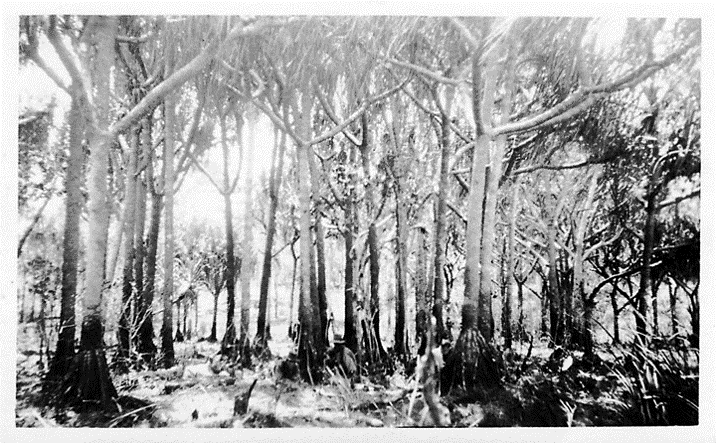
“Bog Hollow”, the scene of the hold-up
Later in the afternoon, Police reinforcements arrived. Detective Senior-Sergeant O’Driscoll, Detective Gooch and Plain Clothes Constable Raetz arrived from Townsville; Constable Rynne and Acting-Sergeant McDonald arrived from Ingham. Two Aboriginal trackers came too. Before continuing with O’Brien’s testimony, we will look next at the evidence given by Gooch and Rynne. (See Townsville Daily Bulletin, Tuesday 29th December 1931, p. 5)