Paluma Bird of the Month, May 2026 – Scarlet Honeyeater

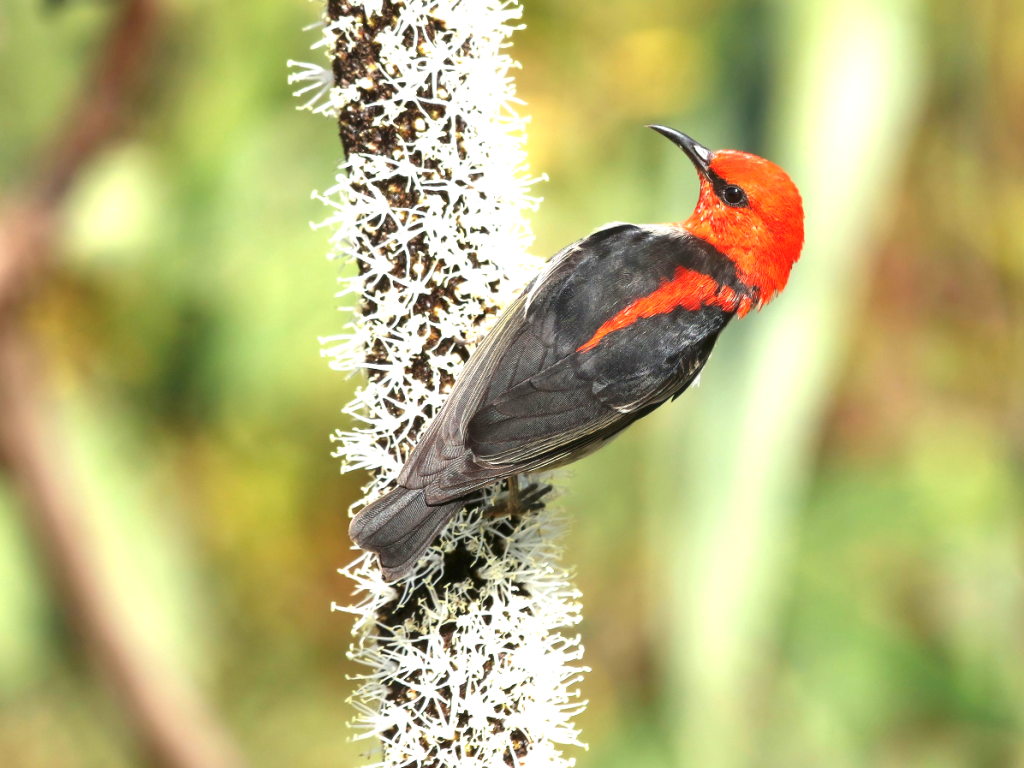
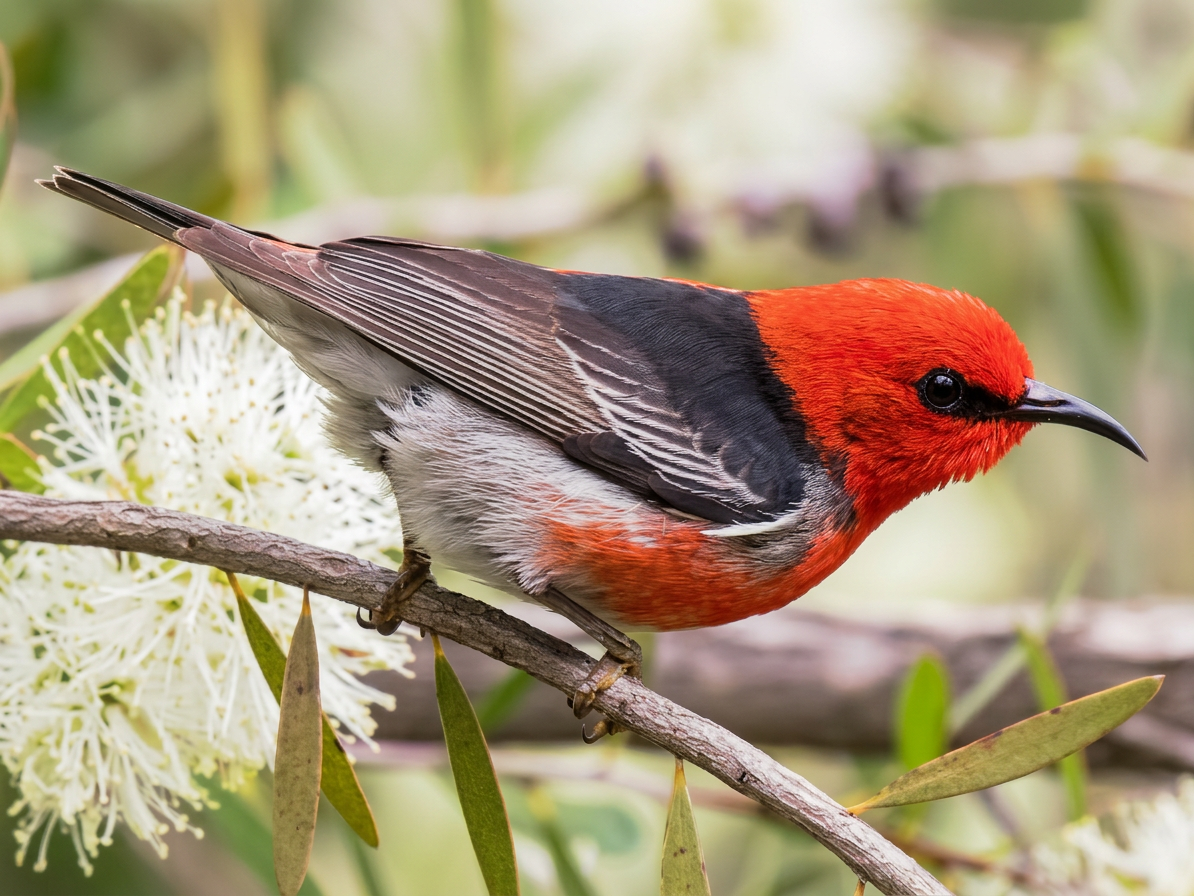
During the last two weeks, I have been hearing the faint, high-pitched, wispy warble of the Scarlet Honeyeater (Myzomela sanguinolenta), a consistent but relatively rare visitor that feeds on flowering trees, often high up in the canopy. Houses that offer a view of tree canopies in flower may provide a glimpse of this strikingly coloured little bird. Len Cook’s front verandah is one of the few places I have been able to get a good view in the past, but so far this year it has been heard but not seen. It is the male that catches the attention of birdwatchers, with it brilliant red head and neck, set off by black back and whitish underparts.

Photo by David Ongley, Birds of the World

Scarlet Honeyeater call recorded by Krzysztof Deoniziak at Barron Gorge NP
Male Scarlet Honeyeater Photo by Julie Clark, eBird

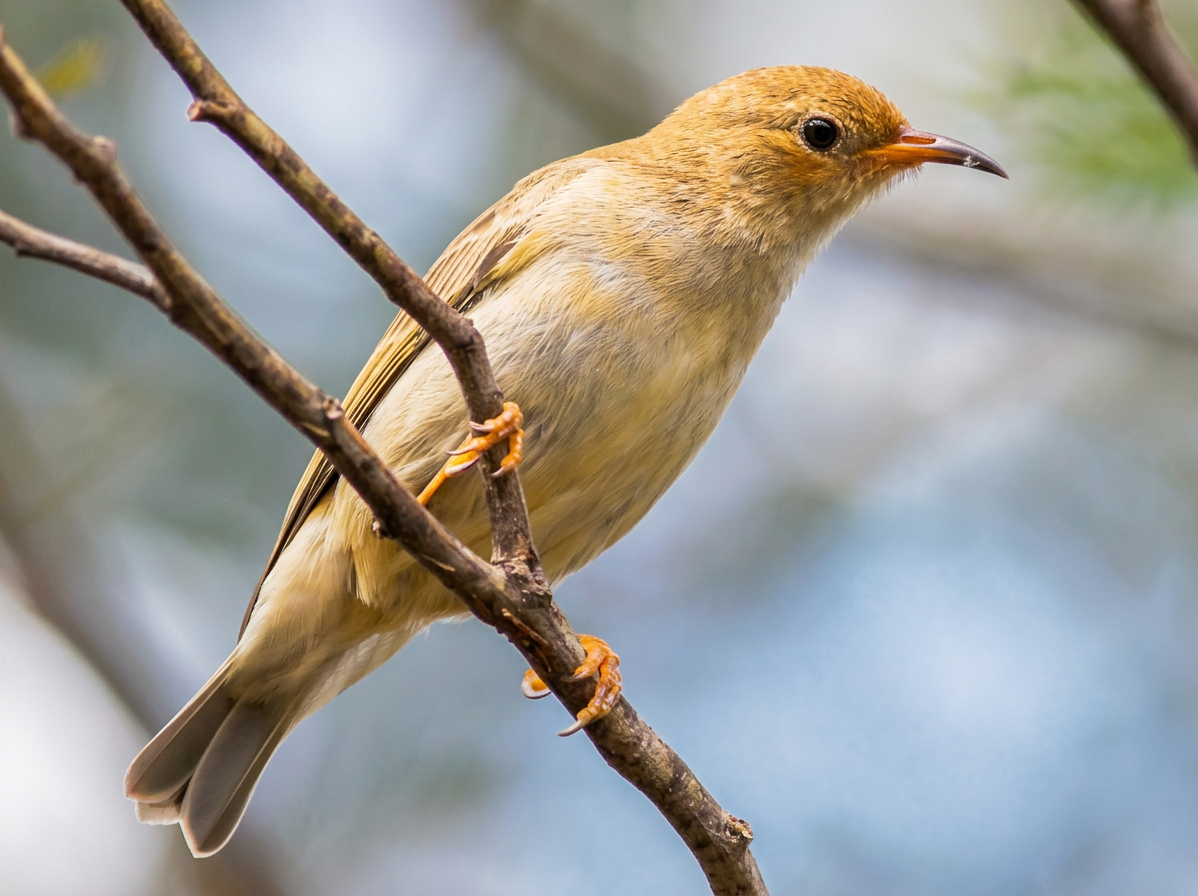
The female is rather drab and brown with a cream belly and sometimes a reddish flush around the face.

Female Scarlet Honeyeater photo by Chris Wiley eBird

The Scarlet Honeyeater is the smallest Australian honeyeater (Family Meliphagidae) and can be found in open eucalypt woodlands, wet sclerophyl forests and riverine Melaleuca habitats. It feeds predominantly on nectar from flowering trees, with insects and fruit only occasionally eaten. Most feeding occurs above 10m in the canopy. It occurs along eastern Australia from Cooktown to northeastern Victoria. In the far north, its range overlaps with the quite similarly coloured Red-headed Myzomela, which is mainly found across northern Australia.

The brilliant plumage of the Scarlet Honeyeater has made it a well-recognised bird to many Australians. Early colonists gave it various names, including Bloodbird and Little Soldier (in reference to its similarity to English redcoat soldiers). The officially recognised common name, used predominantly outside Australia, is Scarlet Myzomela.

The genus Myzomela is the largest in the honeyeater Family, containing 41 species distributed from Indonesia to Australia and the Pacific Islands. Australia has only 3 species, and two occur in Paluma: the Dusky Honeyeater and Scarlet Honeyeater. The name refers to this group’s feeding method of sipping or “sucking” honey-rich nectar from flowers. It is derived from two old Greek words: “myzo”, meaning to suck or suckle; and “meli”, meaning honey.

Text by Jamie Oliver; Photos and recording as indicated in the text

References used:
Birds of the World
Wikipedia
Google search for the etymology of Myzomela

Call for Volunteers for Bush Dance and Markets in June

In preparation for the Wattle n Gum Bush Dance (June 27) and the Paluma Winter Market (June 28), we require help to prepare food, cook and serve at the two sausage sizzles.

Any donations of baked items, cakes, biscuits, scones, whatever your signature dish, and preserves for the PDCA run stall would be appreciated. We’ve had some wonderful and delicious creations at previous markets that sold very well. Please let someone on the PDCA committee know if you can help out in any way at these two events.

Paluma Winter Market – June 28

Following the bush dance, the PDCA will host the Paluma Winter Market on Sunday, 28th June from 9 am till 1 pm.

Sausage sizzle, produce, plants, home-made preserves and baked items, books, needle crafts, tea, coffee and cake will be available on the day.

Any enquiries about having your own stall, please contact Wilfred on 0447 822 626.

Wattle n Gum Bush Dance Returns to Paluma in June

With the opening of the range road, the annual Wattle n Gum Winter Solstice Bush Dance and BBQ is back on the Paluma Calendar. 

It will be held at the Paluma Community Hall on Saturday, June 27th.  This is one of our most popular events of the year, and there is always an eager group of dancers and bush music enthusiasts to encourage the band.  It will be great to see all the locals come along to enjoy an afternoon of dancing and laughter. The band will have a caller to teach everybody the dance steps – so no excuses about not knowing the dance steps or having two left feet, everybody, young and old can have a great time! The BBQ will start at 12 noon with the band commencing at 1pm.

Range Road Update on length restrictions

From Ross Murray, who has been in contact with TMR regarding length restrictions.

Hi All,

I have been advised of the clarification for larger vehicle/trailer configurations requesting access on the Paluma Range road. Any resident or contractor seeking access with a vehicle/trailer combo which is longer then a 4×4 + box trailer requires prior approval from the Northern Engagement Engineers. We have been advised that an email to the Northern Engagement Team (engagement.northern@tmr.qld.gov.au) is required, which will be forwarded to the TMR Engineers for approval.

We are to provide the dimension of the vehicle plus trailer combined. The length x width; weight of trailer including the equipment being carried. The least disruptive times for transporting of equipment will be advised during the approval process. This is due to the varying tasks and restrictions each day carried out by CMC contractors.        

TMR are recommending that those seeking access should have prior experience or skills in navigating the Range Road. The approval will be determined by TMR Engineers, though email contact will be provided from the Northern Engagement Staff.

It was brought to my attention that there are a number of residents (including myself) wishing to hire High-Lift Tree Pruning Equipment. This equipment hire will definitely require prior approval for Range Road access, due to a trailer being 5.5 m in length, and weighing over 3 tonnes. It was suggested the back road access to Paluma maybe required or considered with this equipment. I advised that it would not be a viable option due to the varying conditions of the road, and the extra costs for fuel and equipment hire.

Kind Regards,

Ross 

Paluma Rainforest Bird of the Month, March 2026 – Eastern Yellow Robin

The Eastern Yellow Robin (Eopsaltria australis) is the least common of the three robins that are regularly recorded around Paluma village, but it is the most widely distributed. It occurs from Cape York to southeast Victoria in rainforests, eucalyptus forests and a variety of adjacent habitats, as well as parks and gardens. As with many of our Australian robins, it has a bold plumage. It’s not quite as spectacular as the scarlet or red-capped robins (a different genus) found further south and west, but its brilliant yellow and grey attire easily attracts the eye as it perches on a low branch surveying the ground for edible fare.

Two subspecies of the Eastern Yellow Robin are currently recognised. Our Paluma residents belong to the subspecies E. a. chrysorrhos, and we ancient birdos called them Northern Yellow Robins back when they enjoyed full species status. Now they are called Eastern Yellow Robin (Wet Tropics).

Eastern Yellow Robins are mostly sedentary. They feed on insects and spiders, and while they sometimes hunt on the ground, glean prey from bark or foliage, or make aerial sallies after flying insects, they most often pounce from a branch perch 1-1.5m above ground.

My most recent encounter with an Eastern Yellow Robin came while manning a Paluma Push checkpoint on the road behind Paluma Dam. While madly swatting March flies, Juanita and I were tasked with ensuring the exhausted riders didn’t stray off the track when it crossed the road. I kept seeing movement at the edge of my vision and finally discovered that a robin had positioned itself on a branch just behind me, waiting for slapped flies to fall writhing to the ground, and then swooping down for a free snack.

I’d brought my digital camera with me to photograph bike riders, but this proved to be my best photo of the day.

The common name Robin applied to the European Robin has an interesting origin.

Robin Redbreast

During the 15th century, the English had an endearing practice of granting common human names to the birds that lived among them. Virtually every bird in that era had a name, and most of them, like Will Wagtail and Philip Sparrow have been long forgotten.[1] Polly Parrot has stuck around, and Tom Tit and Jenny Wren, personable companions of the English countryside, are names still sometimes found in children’s rhymes. …

The English also gave their ubiquitous and beloved orange-bellied, orb-shaped, wren-sized bird a human name. The first recorded Anglo-Saxon name for the Eurasian Robin was ruddoc, meaning “little red one.” By the medieval period, its name evolved to redbreast (the more accurate term orange only entered the English language when the fruit of the same name reached Great Britain in the 16th century). The English chose the satisfyingly alliterative name Robert for the redbreast, which they then changed to the popular Tudor nickname Robin. Soon enough, the name Robin Redbreast became so identified with the bird that Redbreast was dropped because it seemed so redundant. 

From Bird History by Robert Francis

While Robins were first named in England, as European naturalists started exploring and collecting around the world they applied this name to several unrelated groups of birds. Thus we now have:

Old World Robins (Europe, Africa, Asia)
– These include the English robin and relatives
– They are related to Flycatchers and share the same family (Muscicapidae)

American Robins (Americas)
– These include the American Robin
– They are actually thrushes (Family Turdidae)

Australasian Robins (Australia, New Guinea, New Zealand, SW Pacific Islands)
– These all belong to the Family Petroicidae and include all three Paluma robins
– They are an ancient offshoot from the original Passerine (perching birds) lineage, unrelated to either of the above groups.

Text and Photos by Jamie Oliver

Key Sources:

Wikkipedia

Birds of the World

New Vehicle Length Limits to the Paluma Range Road


In response to the announcement of new length restrictions for vehicles on the range road, the PDCA has written the following letter to TMR.

From: Ross Murray <ross.murray23@gmail.com>
Date: Mon, 30 Mar 2026, 5:52 pm
Subject: New Vehicle Length Limits to the Paluma Range Road
To: Department of Transport and Main Roads <engagement.northern@tmr.qld.gov.au>, director-general@tmr.qld.gov.au<director-general@tmr.qld.gov.au>, Julie.Mitchell@tmr.qld.gov.au<Julie.Mitchell@tmr.qld.gov.au>, brendan.j.clancy@tmr.qld.qov.au<brendan.j.clancy@tmr.qld.qov.au>

Dear TMR

 Firstly, thank you for the update of the Paluma Range Road permit access.  On behalf of the PDCA, we find it very disappointing to see the new length limits announced in the latest update (March 29,2026). This amounts to very significant restrictions for residents needing to bring equipment up the mountain for maintenance purposes.  A large proportion of Paluma residents use 4wd vehicles and trailers to bring gear up the range road for repairs, regular maintenance to dwellings and transport of green waste to the local depository etc. Most 4wds are approximately 6m long and a medium sized (8×5) box trailer adds another 6m.  If tradies are asked to come up to carry out work in the village, a typical tradie’s set up would be a 4wd (6m) + medium to large trailer (6-12m).  

 It is disappointing that no prior consultation was attempted with the community through a local meeting, or via correspondence with the Paluma and District Community Association (PDCA).  Unfortunately, there was no reasonable explanation regarding the issues created by continuing to allow such vehicles to join the piloted convoy up the range during scheduled times. Given that two of the worst affected sections of the road have been successfully stabilised during the current permit system we are surprised that the restriction was deemed necessary.

We ask that as a matter of urgency, the TMR:

  1. Provisionally recalls the announced vehicle length limit on the Range Road;
  2. Provides details of the specific problems that would be caused by longer vehicles and the impacts these have on: a) public safety; b) worker safety; c) timelines; d) costs; and
  3. Meet with the community in Paluma to explore ways to minimize the impact on the road restoration project while also minimizing impact on residents.

Many in our community are frustrated with the way restrictions have been imposed on the Paluma and Hidden Valley residents and commercial operators.  The Community as a whole, through the PDCA is keen to work proactively and in good faith with TMR to find reasoned and balanced solution to the issues raised above. 

 If reverting to the length restriction is not feasible, there might be options that would help to reduce or compartmentalize the risks, such as:

  • Nomination of one or more timeslots when oversized vehicles are least likely to create problems to the contractors or road users;
  • Nominating specific days/timeslots when roadwork would stop any activities that are affected by oversized vehicles and allow such vehicles up only on those times; and
  • Allowing individuals to ring up traffic control officers to determine if there is a time slot during the day when an oversized vehicle would not cause any problems.

We look forward to your response to this matter by Thursday, April 2nd.

 Yours sincerely,

PDCA

President 

Ross Murray