
For some months now we have had a Pale Yellow Robin resident close to our house on the five acre blocks. He [or very possibly, she] perches in the Murraya tree close to our kitchen window and mounts an attack on the window pane on the left hand side from our perspective looking out. His claws land on the glass and he drops down onto the lintel at the base of the window. He usually pauses for a few seconds before repeating the attack two panes to the right and again usually pauses looking quizzically at you if you happen to be at the sink, totally unfazed by the sight of humans. He then proceeds to circle the house, usually anti-clockwise but not invariably so, attacking windows randomly before returning to the tree and repeating the antics over and over for maybe an hour or more before going off duty for a period. We think he must be eating during this gap as he has an annoying habit of leaving a calling card on or below the windows in the kitchen.
More recently he has discovered that the car has mirrors and he is fascinated by the second bird and spits at the reflection in the mirror and leaves copious deposits on the curve above the door handle which have to be washed off frequently to avoid damage to the paintwork. You may deduce that we are a bit cheesed off with this behaviour and have taken to thwarting the car attacks with our car cover which is pretty successful as he can’t even get at the windows. He still looks for the now covered car windows but has more or less given them up as a lost cause.
But he still does the house daily – we don’t know if our presence engenders his behaviour as we can’t see what happens when we are not there ! He is extremely hard to photograph but the photograph below is at the kitchen window by the sink.
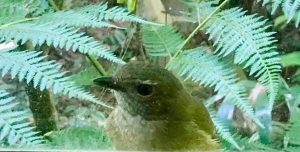
Text & Photo by Les Hyland

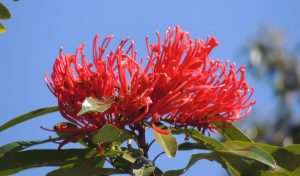
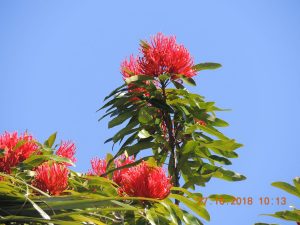
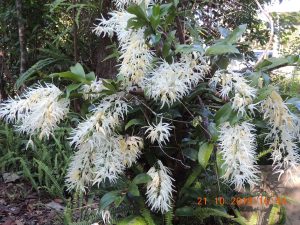
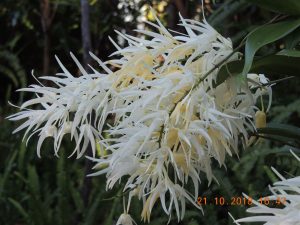
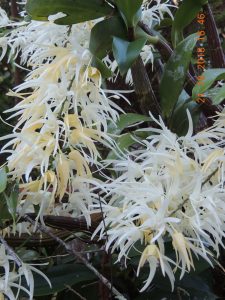
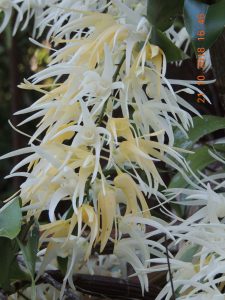
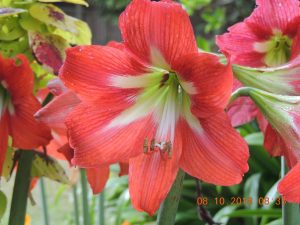
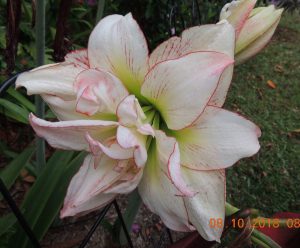
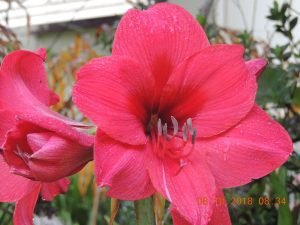
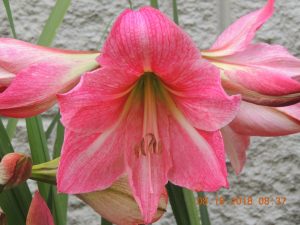
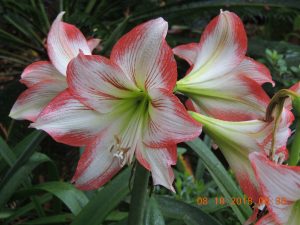
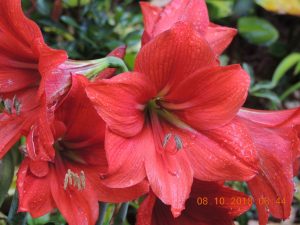
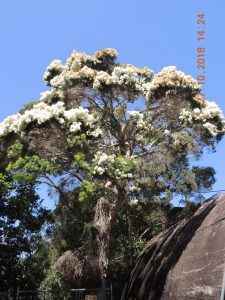 This small evergreen tree grows to a height of 6m to 10m. It is from the myrtle family and is endemic to New South Wales and Queensland. This particular specimen was planted in the early 1990’s (in 1993 or 1994) by long-time Paluma resident Kelly Davis. The trunk of this tree has thick sheets of papery bark. The flowers are a major attractant for bees, butterflies and birds.Unfortunately, the spectacular display of the ‘Snow in Summer’ will not last long; already some of the blooms are browning in the tropical heat.

 Paluma has an entry in the latest issue of the RACQ Road Ahead magazine in the “My Town” section.
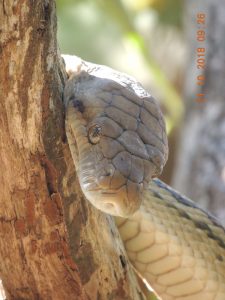
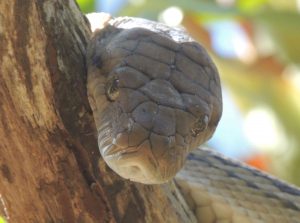
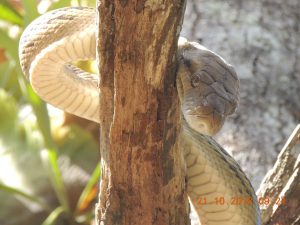 Taking a walk through the village of Paluma and surrounds often leads to encounters with the local wildlife. Last Sunday (21 October) during a stroll through the village on a beautiful sunny morning, we were lucky enough to come across a superb Amethystine Python (Morelia amethistina).
 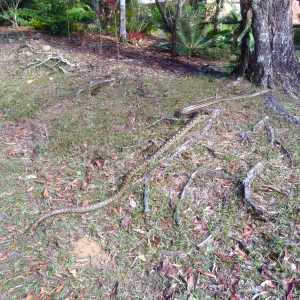 From a distance, we noticed what appeared to be a rather large tree branch extending onto Mt Spec Road at the eastern end of the cutting. Before long it became obvious that the ‘large branch’ was moving and that it was a snake that had settled quite comfortably on the road for a spot of sun baking. This sizeable snake extended across the entire width of the road and more. Fearing a vehicle might soon come along, we swiftly encouraged the snake to move off the road and it ascended a nearby tree. It was not too pleased about being disturbed from its lazy Sunday morning warm-up!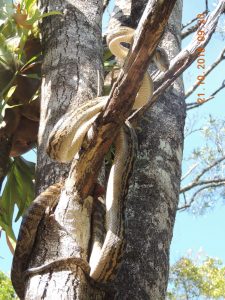
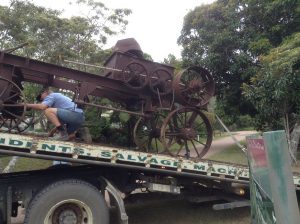 On Friday 12th October, two new arrivals appeared on the lawns adjoining Lennox Crescent and Mount Spec Road. They emerged from a dense cloud mist which enveloped Paluma that day, like visitors from the mists of time. The ambience seemed fitting, as these new arrivals are relics of a bygone era; a timber hauler, which was used to haul timber on Mt Spec and a bitumen mixer used in surfacing the Range Road during the 1950’s. The large, solid steel machines are well preserved and represent the epitome of engineering design and workmanship of their day.
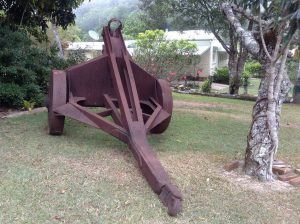 towed behind a small bulldozer. A steel rope from the winch on the dozer ran over the pulley on the bob-tail. By retracting the winch rope the heavy end of the log would be lifted off the ground and dragged out of the scrub to the loading ramps. The logs would then be loaded onto trucks towing timber jinkers for transport to saw mills or the rail siding at Moongobulla.
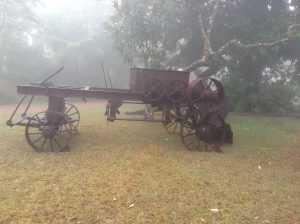 Until then the road was unsealed. The bitumen mixer carried a drum that had two sets of paddles running through it which mixed the liquid hot tar with sand and gravel to produce bitumen for sealing the road. Unfortunately the engine driving the mixer via two leather belts, is missing. Possibly it was a Southern Cross engine, one of which may eventually be obtained and set in place.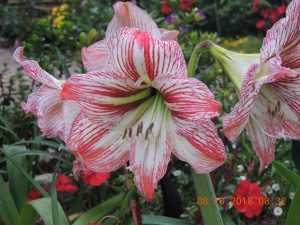
 Text & Photos by Michele Bird