February Rainfall Update

Here’s the latest rainfall figures for Paluma from the BOM recording site at the Village Green, courtesy of Barry Smith (weekday recorder) and Peter Cooke (weekend recorder). Ponder this….

561 mm of rain for the month of February

23 days of rain in the month of February

A total of 1,166.6 mm of rain since 1 January

Reminder: Working Bee at Paluma this Saturday 4th March

A timely reminder that there will be a Working Bee this coming Saturday 4th March to continue with repair and upgrading works on the Rainforest Walking Track (opposite the Community Hall).

Please meet at the Community Hall at 2 pm and bring your wheel barrow and shovel. Wilfred says there is a couple of hours of work to do and there will be refreshments afterwards!

The monthly Working Bee is now a regular event on the first Saturday of every month. So please mark your calendars as there are always plenty of jobs to carry out around the village. Many hands make light work…!

St. Patrick’s Day Community Social

Put the date in your diary…..On Saturday night the 18th March, Paluma will celebrate St. Patrick’s Day with a Social at the Community Hall commencing at 6.30 pm.

St. Patrick’s Day actually falls on Friday 17th March, but we will hold off on celebrating until Saturday evening.

Please bring a plate of food to share – Irish inspired if you wish – the more tatties the better as far as I am concerned!

The Bar will be open for low cost beverages.

And don’t forget to embrace the theme and wear emerald GREEN.

See you there!

Yet another wet season mushroom

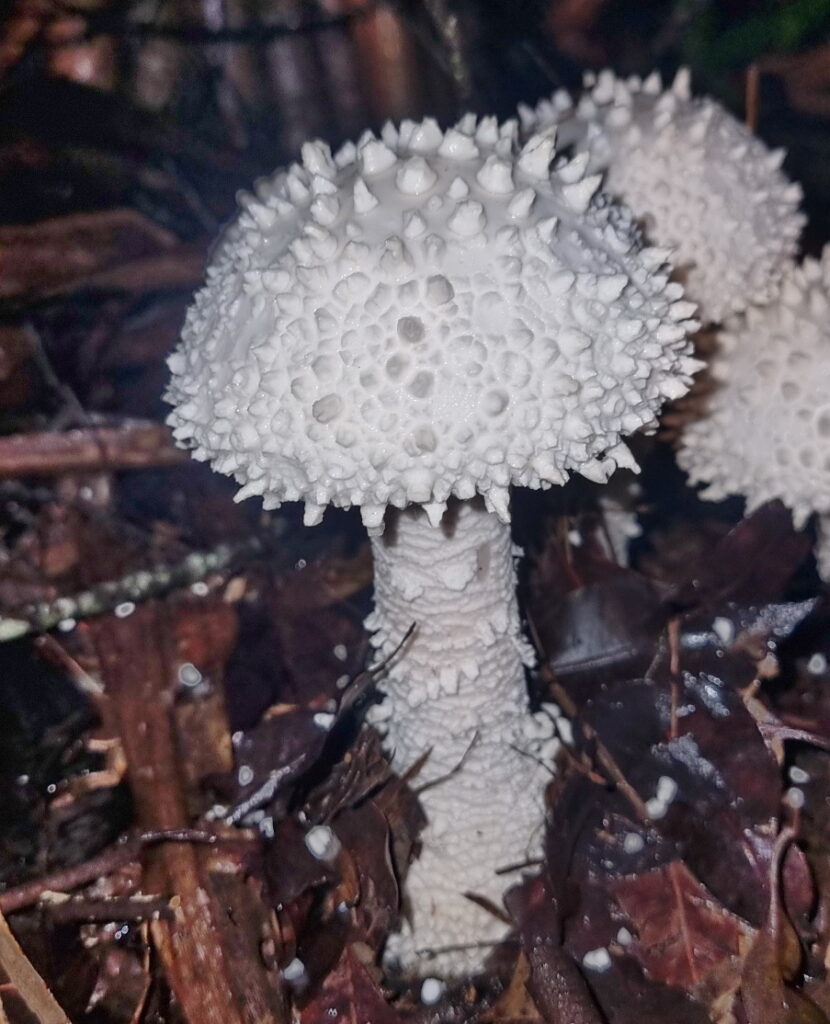
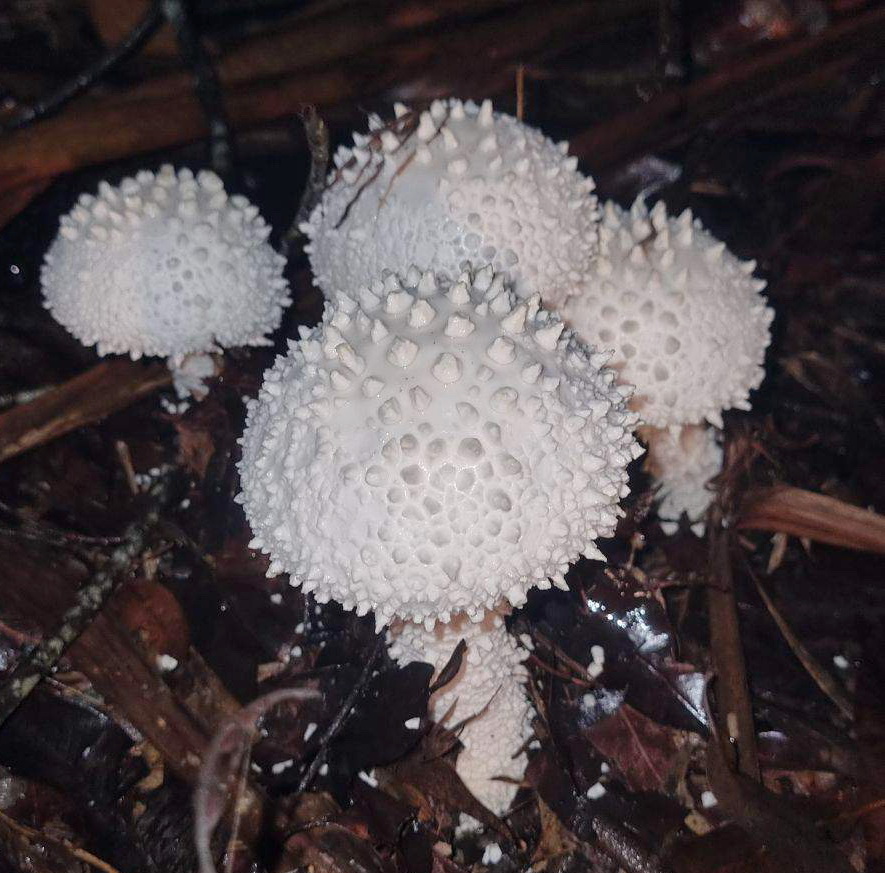
As the wet season rain continues to soak the forest around Paluma, new and interesting mushrooms just keep appearing! Rosie Gillespie recently found this striking white and warty mushroom on the range road and its distinctive ornamentation certainly makes it worth sharing. This particular mushroom proved relatively easy to identify. It is Amanita pyramidifera – or the Pyramid Builder Lepidella. It is found in eastern Australia in moist sites associated with eucalyptus forests or rainforest.

If you see any more interesting mushrooms that you would like to share or identify please feel free to send them to me.

Photo by Rosie Gillespie, text by Jamie Oliver

An Important Message from Mt Spec SES – Cyclone Season Preparation

CYCLONE SEASON PREPARATION – Paluma/Hidden Valley (2022/2023)

Memories of the 2019 February inundation and the subsequent isolation of Paluma and communities to the west will be with us for years. These memories should prompt all of us living in the area to consider carefully how we prepare for this wet season. 

The best way to start this years’ preparation is to visit the Queensland Government website www.getready.qld.gov.au. The site addresses preparation for a range of disasters that could affect Queensland. Cyclone, storm damage & fires are the most relevant to our area.  It also lists a number of disaster related apps. Another useful website is http://disaster.townsville.qld.gov.au

Cyclones & extreme rainfall events

The getready website suggests being prepared for 3 days of self-sufficiency. This may be adequate for the lowlands, but could easily prove inadequate for Paluma to Hidden Valley communities.  If a high category cyclone crosses the coast anywhere near Townsville, Paluma to Hidden Valley problems are likely to be well down government priority lists, if they are not life threatening.

Plan for the worst – what if?

  1. All access roads to the area closed for seven (?) plus days
  2. Prolonged loss of the electricity grid supply.
  3. Eventual loss of landline, mobile phone & internet communication due to loss of power to Telstra sites.
  4. Damage to Townsville Water infrastructure resulting in unreliable water supply.
  5. Structural damage to your private residences forcing evacuation to temporary accommodation.
  6. For those living west of Paluma & not dependant on town water & the electricity grid – consider consequences of damage to satellite dishes & solar panel arrays. Ensure water tanks contain enough water to resist cyclone strength winds.

If you work through the three steps of the Have a Plan section of the get ready website you should be covered for most things. But there are local considerations.

THE FOLLOWING CHECKLIST COVERS SOME OF THE THINGS TO CONSIDER.

Clearing around you residence to remove anything with the potential of becoming an airborne projectile.

Insurance – Check currency & adequacy.

Basic supplies

  1. Enough food for the whole household including pets. If you have no generator backup for your refrigerator then stick mainly to non-perishable food (dried or tinned).
  2. Adequate supplies of prescription medication plus cold & flu tablets, pain killers etc.
  3. Toiletries.
  4. Adequate clothing for everyone for the duration.
  5. Extra bed linen & towels.
  6. Sturdy gloves.
  7. Wet weather gear.
  8. Allow 3 litres of bottled water per person per day. Alternatively a small rainwater tank with water purification tablets from chemist/camping stores. Without power electrical appliances will not be able to boil water for safety.
  9. Important documents & a backup hard drive.
  10. Up to date first aid kit.
  11. Adequate fuel for vehicles & generators plus gas for backup cooking equipment. Those on solar off grid systems should consider how much fuel they may need if the solar array is damaged.
  12. Spare batteries for torches/radios.
  13. Sturdy waterproof containers for food, clothes, medication, phones etc.

Communications

  1. The Telstra site in Paluma has backup batteries & a generator but when the fuel  runs out Telstra will be unable to refuel, if access roads to Paluma are closed. So the phones & internet may continue to work for some time after a power failure & then shut down. Suggest it wise to make any important phone calls or emails as soon as possible after the event. West of Paluma landline phones may also eventually fail due to loss of power or damage to Telstra facilities.
  2. For landline phones a non 240v dependant phone is best.
  3. Have an alternate way of charging mobile phones & tablets without mains power.
  4. Will your mobile phone work at the Star Valley or McClelland’s’ lookouts.
  5. Battery radio.

Equipment

  1. Generator –tested/serviced.
  2. Backup gas cooking equipment (BBQ) if you only have an electric stove.
  3. Alternative lighting.
  4. Fire extinguishers are always cheap insurance.

Rental properties.  If you have any form of rental property in the area, consider the need to advise potential tenants of the risk of isolation after extreme weather events.

If you are not going to be in the Paluma area.

  1.  Ensure anyone occupying your house is aware of the above suggestions.
  2. Clean out your fridge & freezer
  3. Consider supplying a neighbour with a key & your contact details so they can access your property to check for damage & report to you.

Evacuating your house due structural damage. Extra things that should be considered for an evacuation kit include bedding (sleeping bags, inflatable mattresses & pillows), reading material & games, cash.

 Fallen Power Lines.  Assume live & maintain an exclusion zone of 8 meters. Report to Ergon Energy – Ph 131670. Warn others.

Mt Spec SES

Notice of PDCA Annual General Meeting

Members (and prospective members) are advised that the Annual General Meeting of the Paluma & District Community Association Inc. will be held on:

Saturday, April 1, 2023, at 12pm for a BBQ lunch followed by the AGM at 1:15pm in the Community Hall

Nominations are open for all Executive Committee positions. Nominations should be forwarded to any member of the Executive Committee or by email to PalumaPDCA@gmail.com. Please use the nomination forms, which can be downloaded here.

Positions are:

  • President, 
  • 1 or 2 Vice-Presidents
  • Secretary
  • Treasurer
  • General Committee members (numbers flexible)  

Members are reminded that Annual Subscriptions are now due and should be paid prior to the commencement of the AGM.   Membership is $45.00 Please use the subscription form here to submit your dues. New members are more than welcome and should use the same form.

Please note that you must be a PDCA member to nominate someone to the Committee or vote for any Committee member.

The AGM will be followed immediately by a normal General Meeting with the new Committee.

AGM AGENDA

  1. Opening – circulation of attendance sheet
  2. Apologies
  3. Minutes of previous AGM April 24th, 2021
  4. President’s Report
  5. Treasurer’s report
  6. Election of Officers for 2021-2022
  7. Election of Auditor for 2021-2022
  8. Close of Annual General Meeting

Normal General Meeting Agenda

Normal General Meeting Agenda

  1. Open General Meeting
  2. Proposed Events/Fund-raising for the coming year
  3. Any other business
  4. Close of General Meeting

More Wet Season Mushrooms……

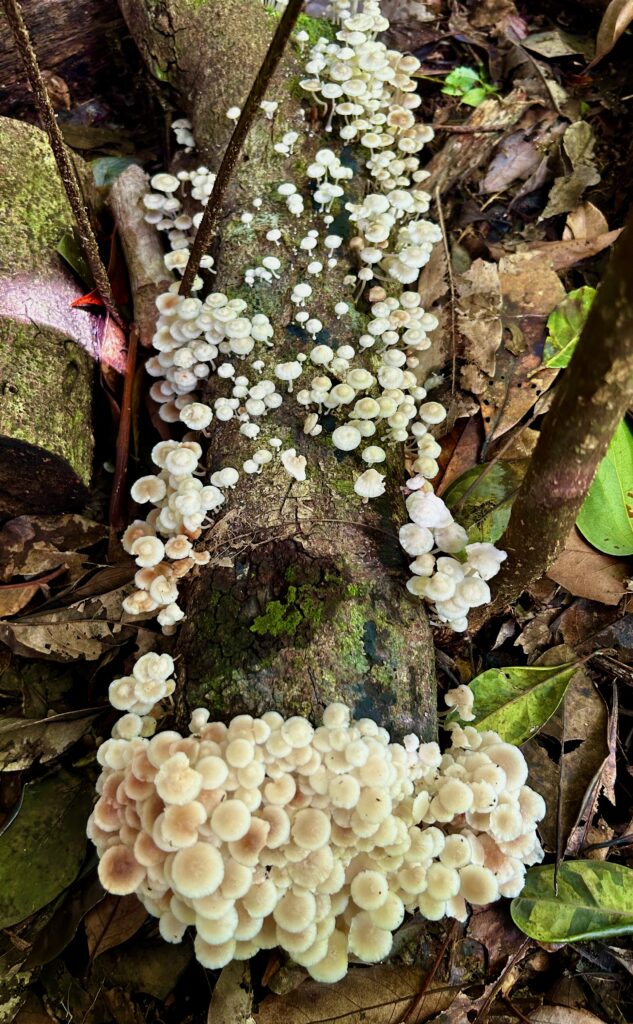
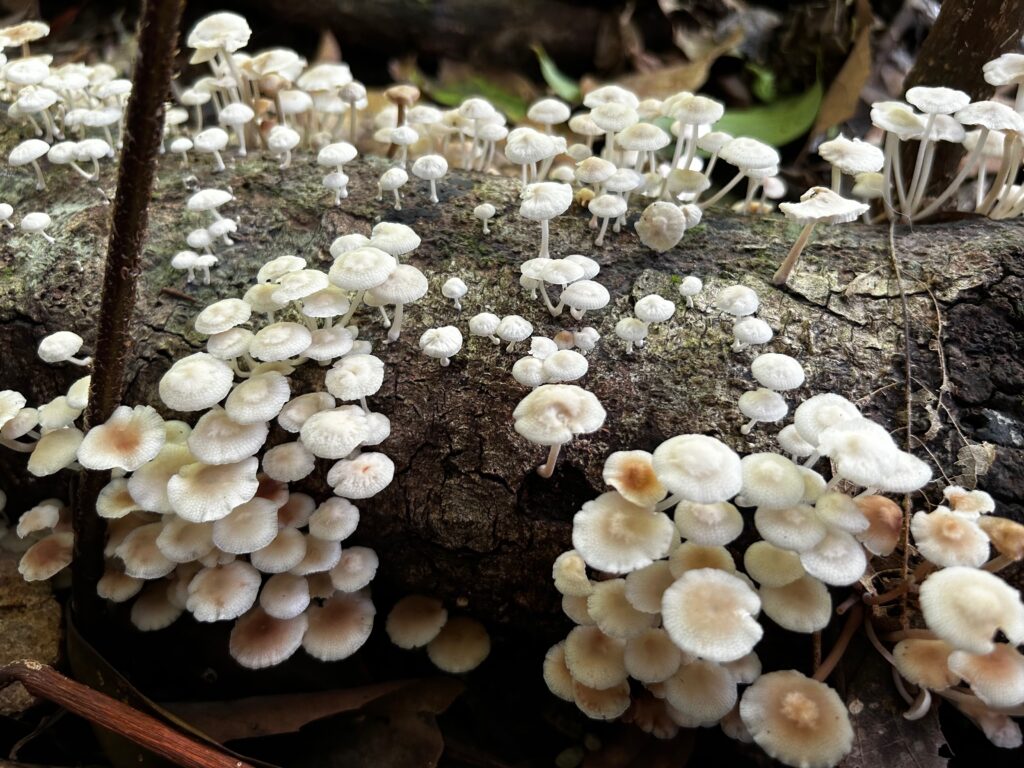
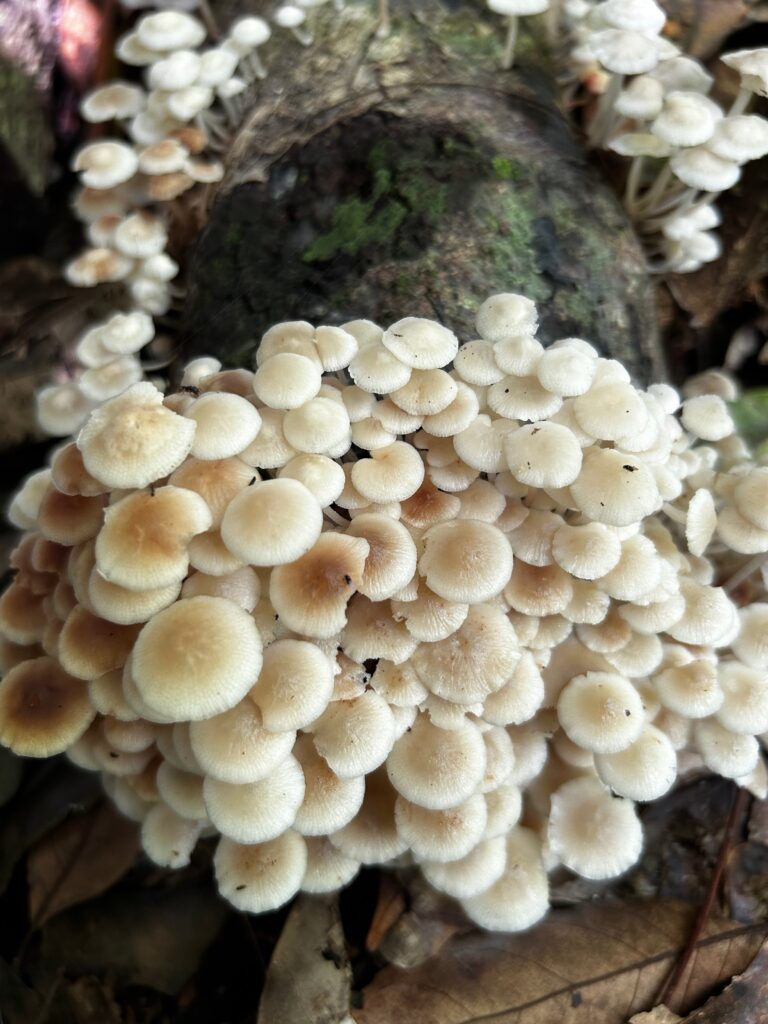
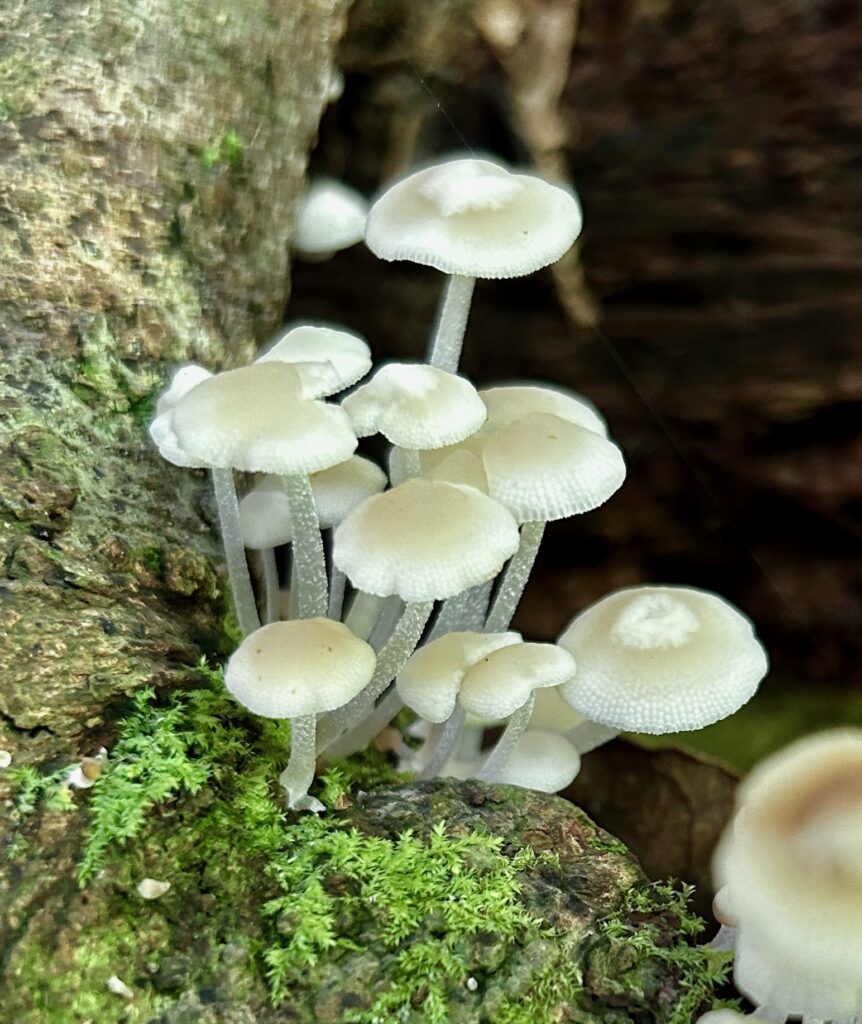
Inspired by Jamie’s recent post on ‘Wet Season Mushrooms’ (9 February 2023) I kept my eyes peeled last weekend for interesting specimens whilst walking around the village. I didn’t have far to go to find an array of amazing fungi after the recent rain. Right there in my own garden was a rotting log flushed with small, delicate creamy-brown mushrooms in large numbers. I haven’t attempted to identify these as yet, but someone with more knowledge of tropical fungi may be able to do so quite readily? I did check at night for fluorescence and fairies under the mushroom caps, but neither were found!

Text & Photos by Michele Bird

More nocturnal fun with UV torches

A couple of weeks ago, Juanita and I decided to go out for a quick night walk around Lennox Cr. The rain put a bit of a dampener on our plans, so we just walked around the house shining our UV torches. We weren’t expecting to see much wildlife but the visual display just from shining torches on our house walls and doors was still amazing. Here’s a sample that looks like it could be on display in a museum of abstract art …

or a display of images from the Hubble or Webb telescope.

After rounding the corner to the other side of the house, we encountered a house gecko, which would normally not be much to get excited about. But the combination of this lizard’s nearly transparent skin, and the fact that bones fluoresce under UV meant that we were treated to an eerie but fascinating x-ray view.

Never a dull moment in Paluma at night if you have a UV torch!

Text and Photos by Jamie Oliver

Wet Season Mushrooms 2023

After several seasons of reporting (by various authors) on interesting mushrooms that pop up around Paluma each season, I would have thought there would be fewer new varieties to report on this year, but so far my mushrooming efforts have not suffered the fate of diminishing returns.

Here is a selection of some of my new finds this year.

Hygrocybe cf miniata

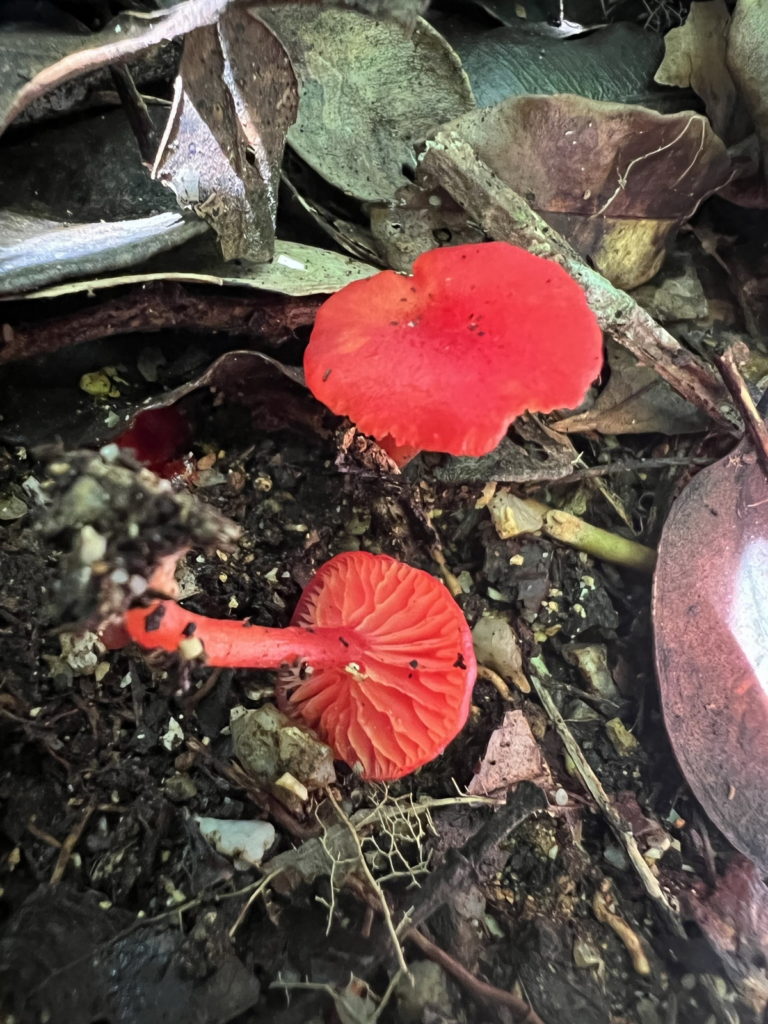
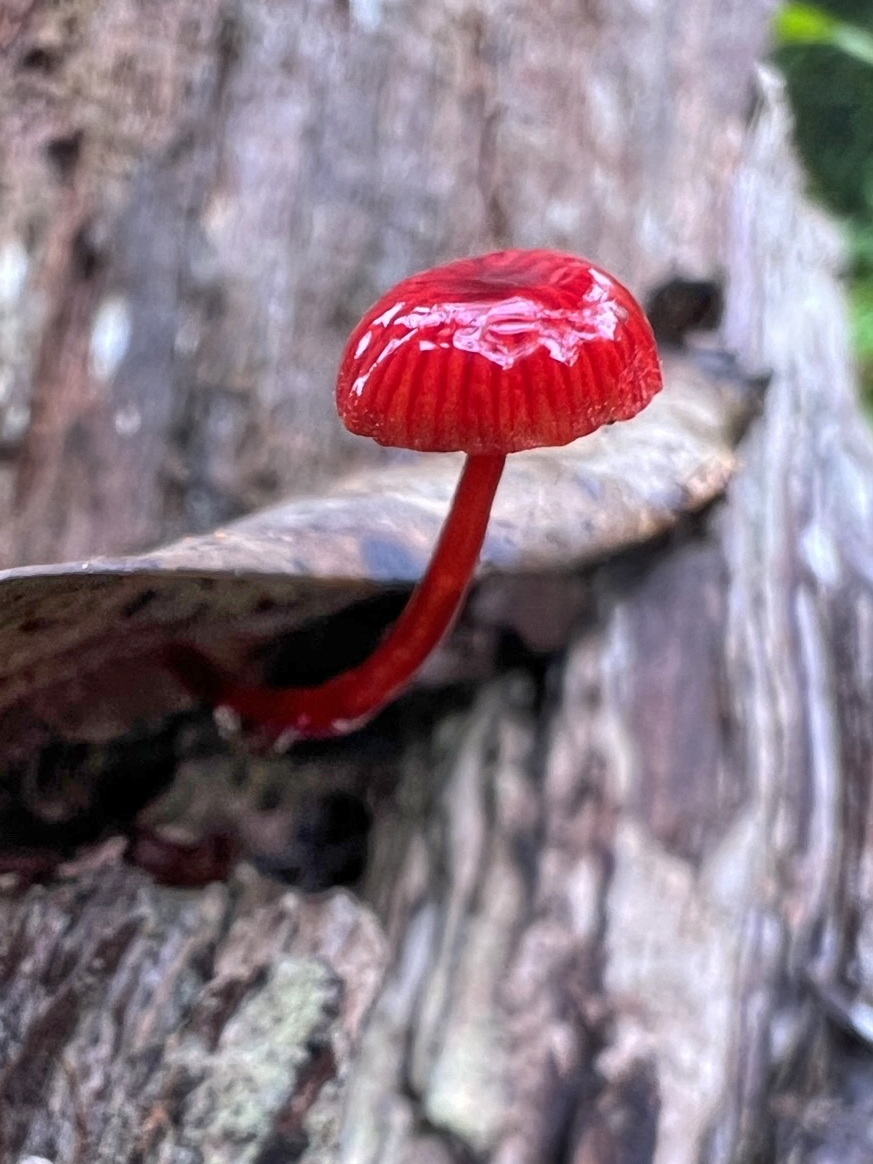
Every year with out fail one of the more common mushrooms along the rainforest tracks is the small Vermillion waxcaps (Hygrocybe sp – possibly H. miniata). I have published pictures of these before. But there are other beautiful red species that can be found if you look carefully. One of my favourites is the tiny Redbonnet, with a delicate shiny viscous cap and slender stem. Often overlooked because of its size, it is common in many gardens as well as along the tracks.

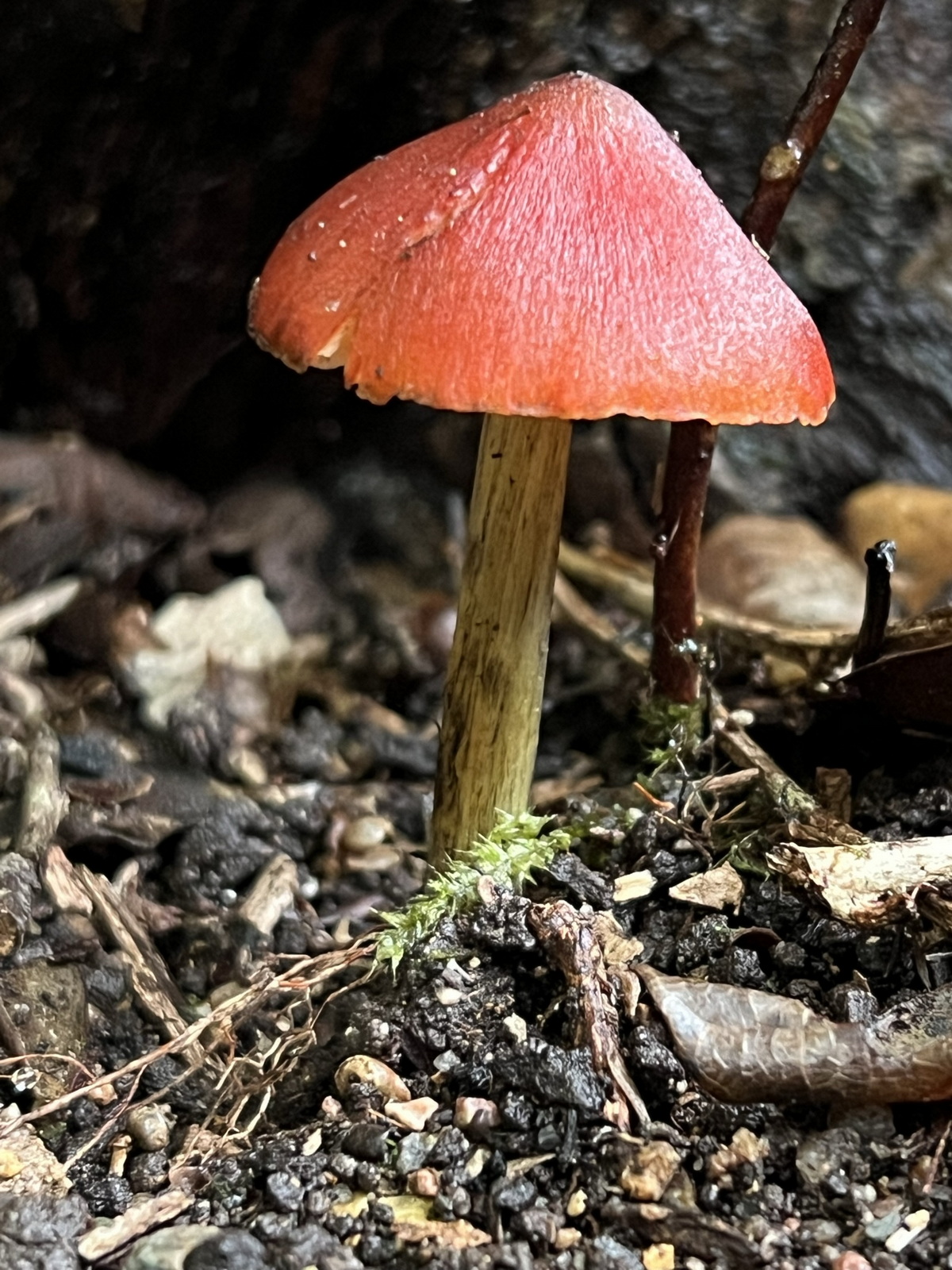
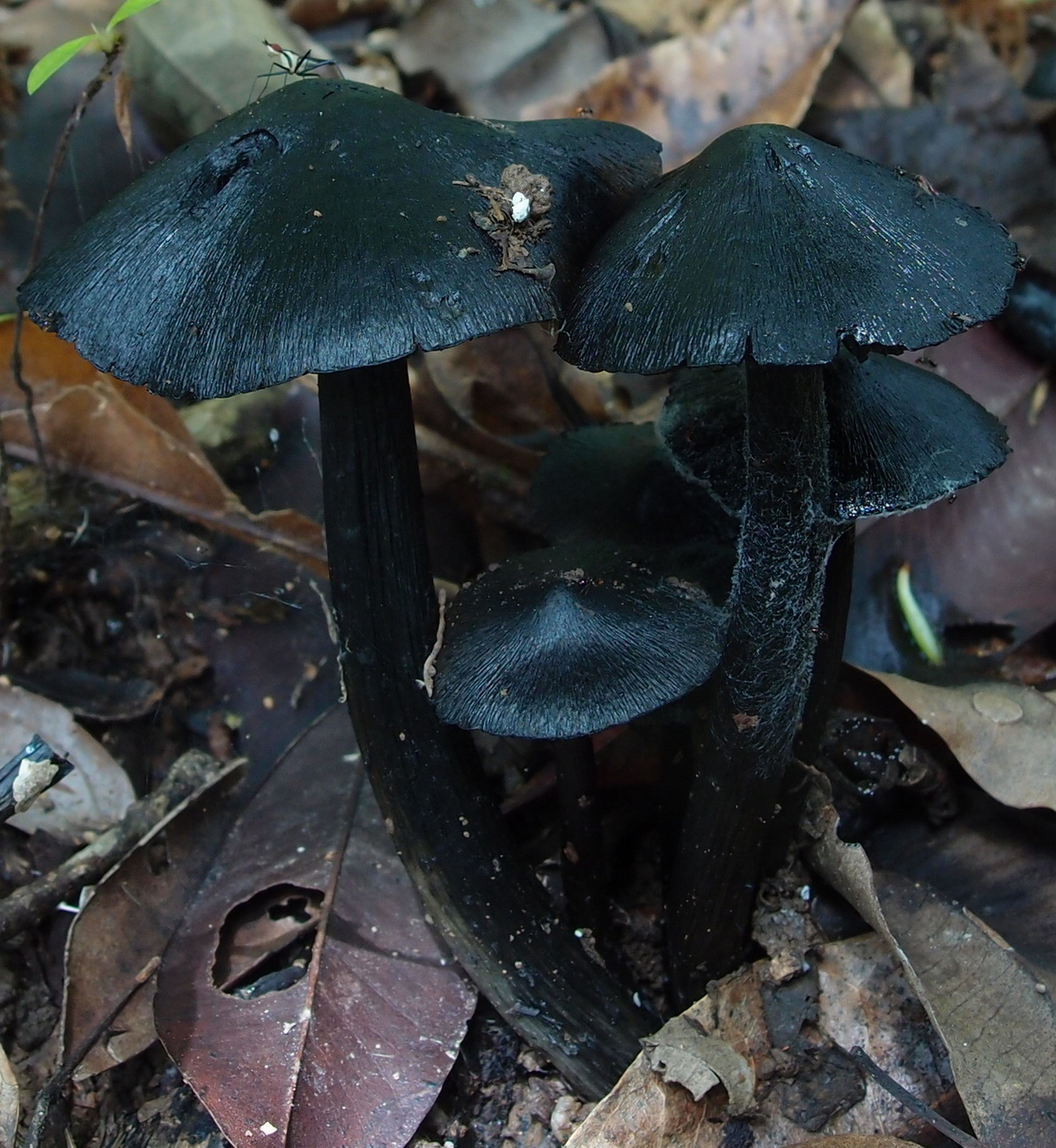
Another less common but striking red mushroom is the Blackening waxcap (Hygrocybe astatogala). It gets its common name from the fact that it turns increasingly black with age. The bottom left hand photo is a fairly fresh specimen found by Juanita at McClelland’s lookout, with a stem showing faint black streaks. After a few days it can turn entirely jet black as shown in the adjacent image by Ray Palmer from a specimen near Cairns. Both phases are strikingly beautiful.

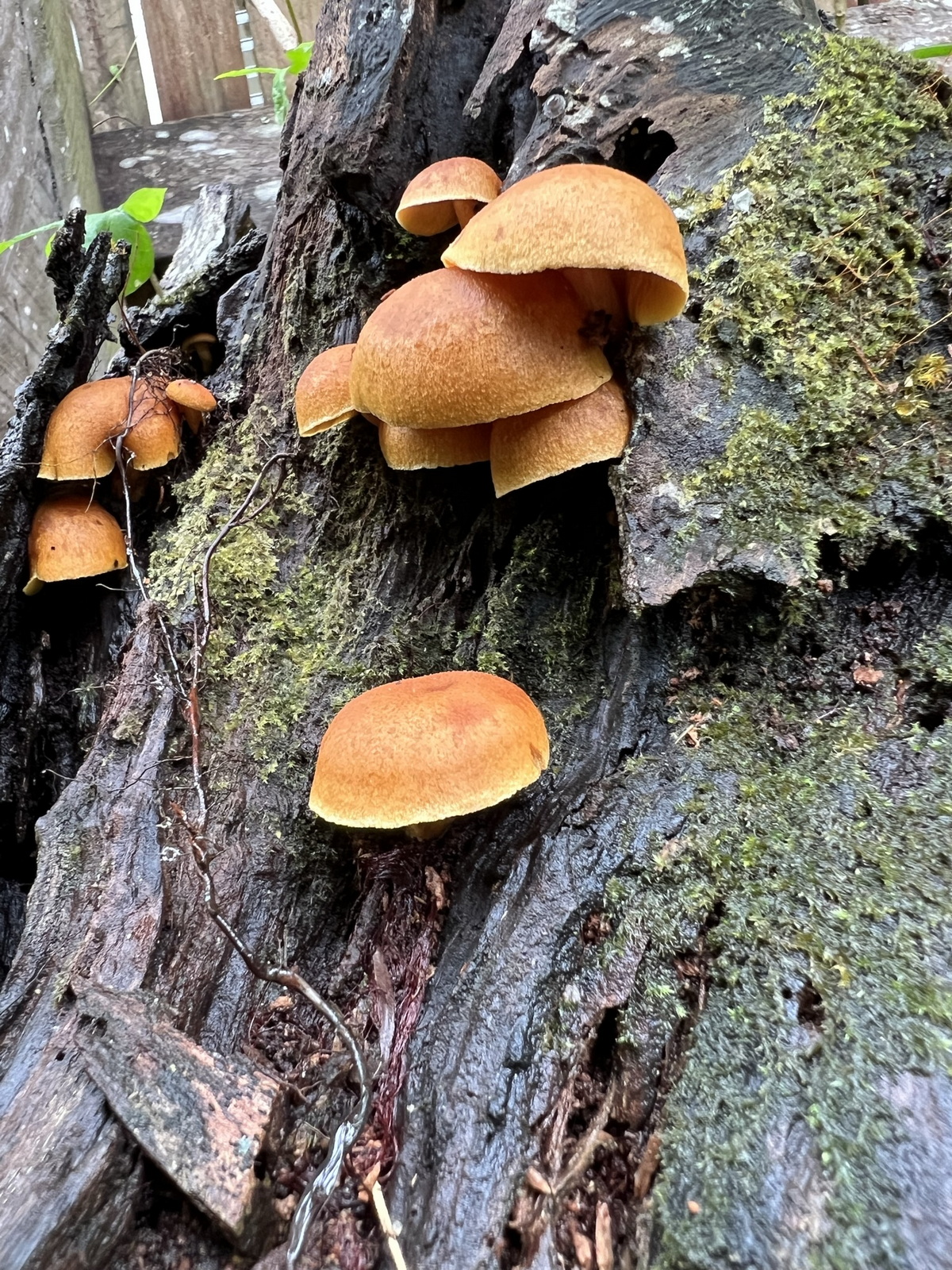
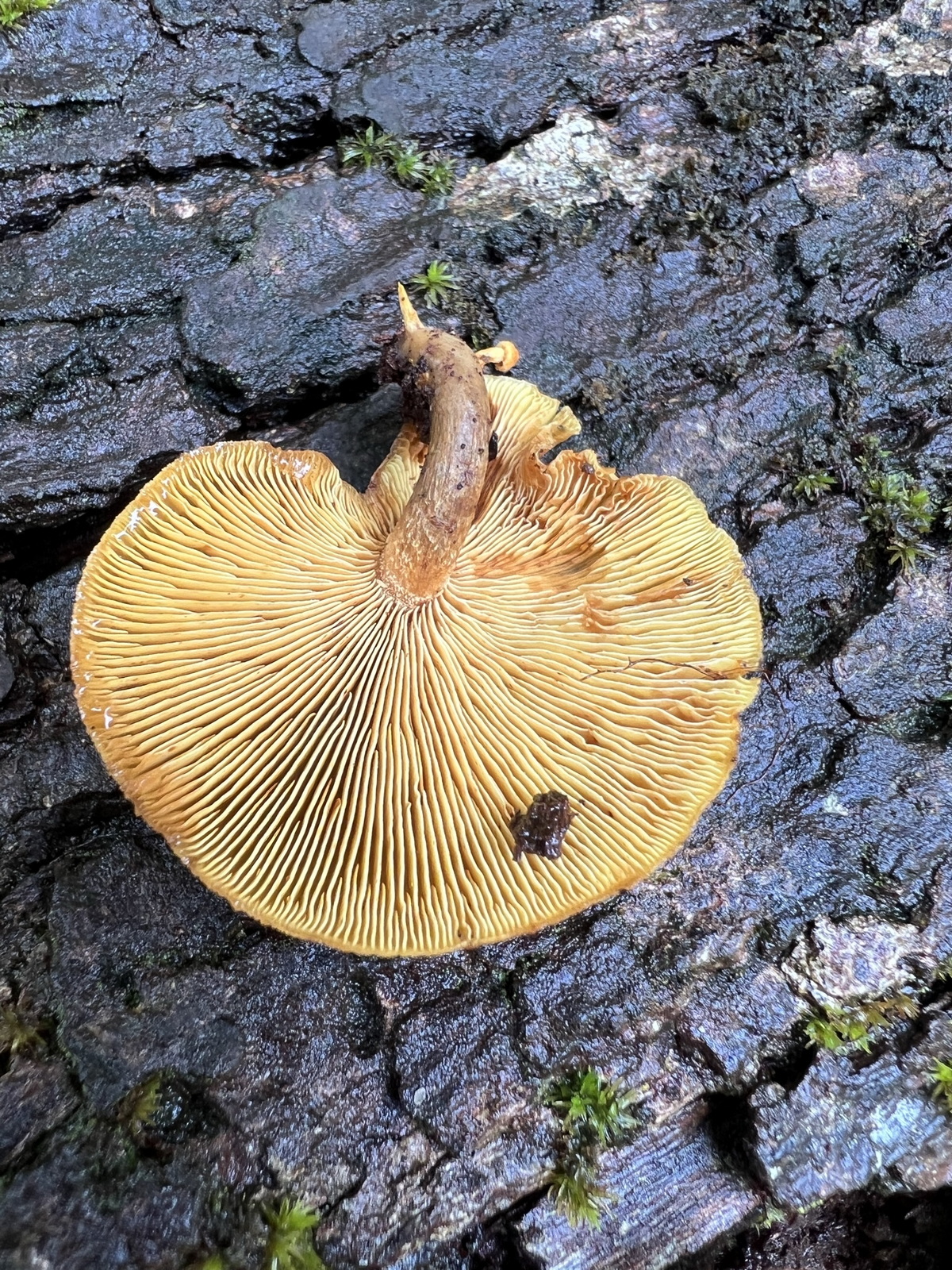
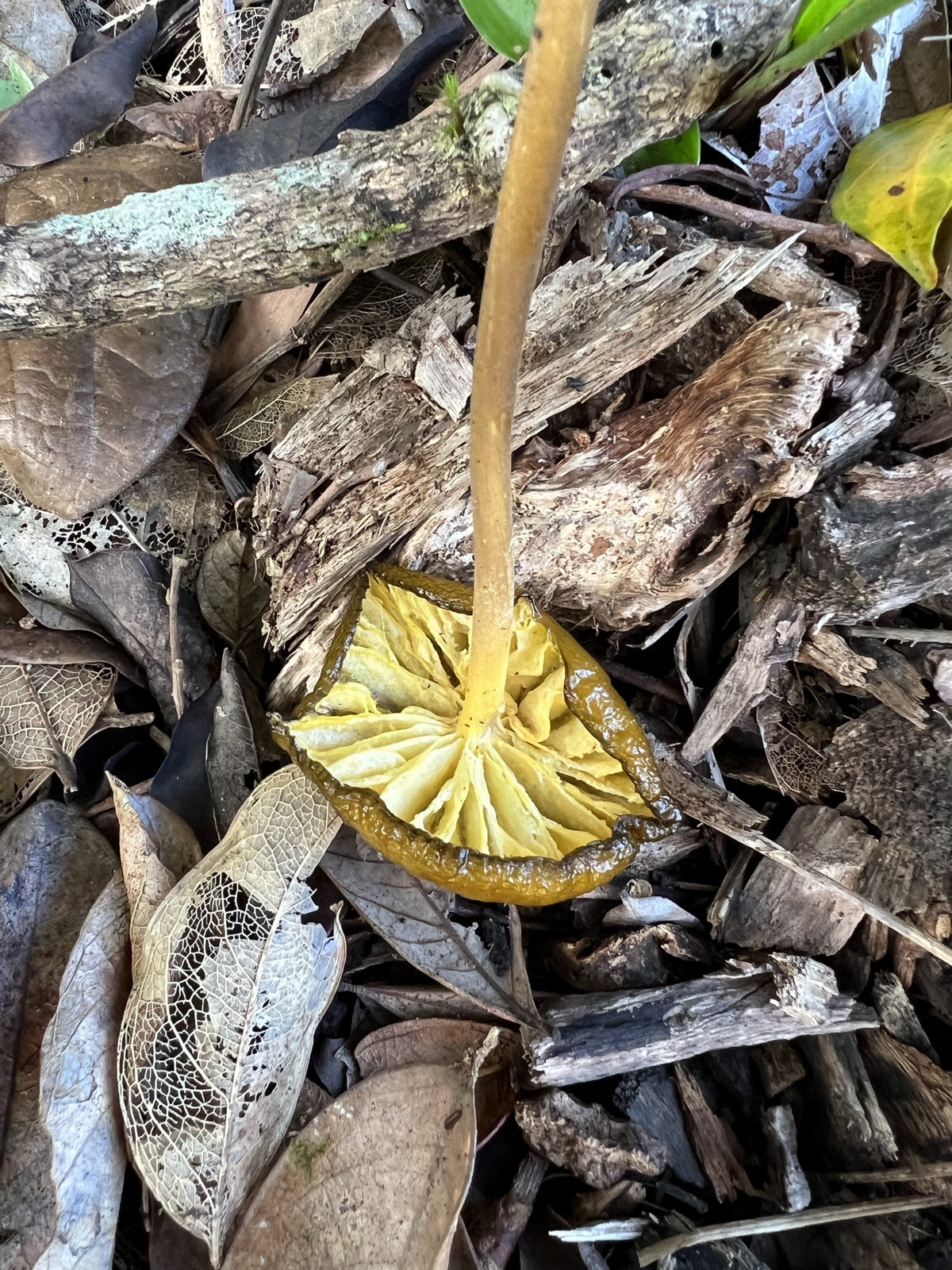
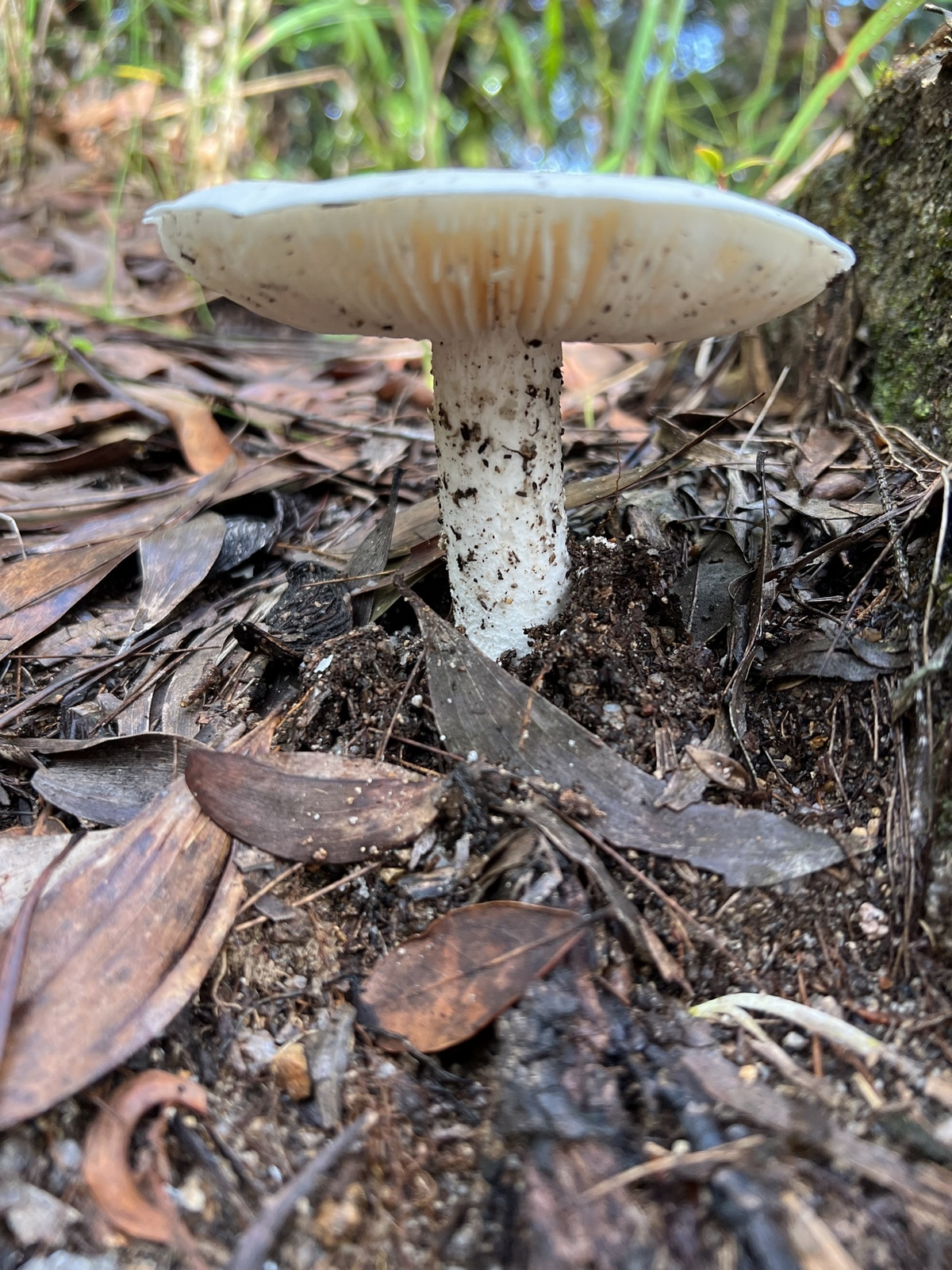
Some other classic gilled mushrooms (Agarics) I’ve found in the last few weeks are shown below. The orange Gymnopilis was growing on a log in my garden, while the unusual burnt yellow mushroom (Oudemansiella flavo-olivacea) was growing on the roadside next to the High Ropes Course. The last mushroom in this group is an Amanita found in the Banksi/Casuarina forest near Witts Lookout.

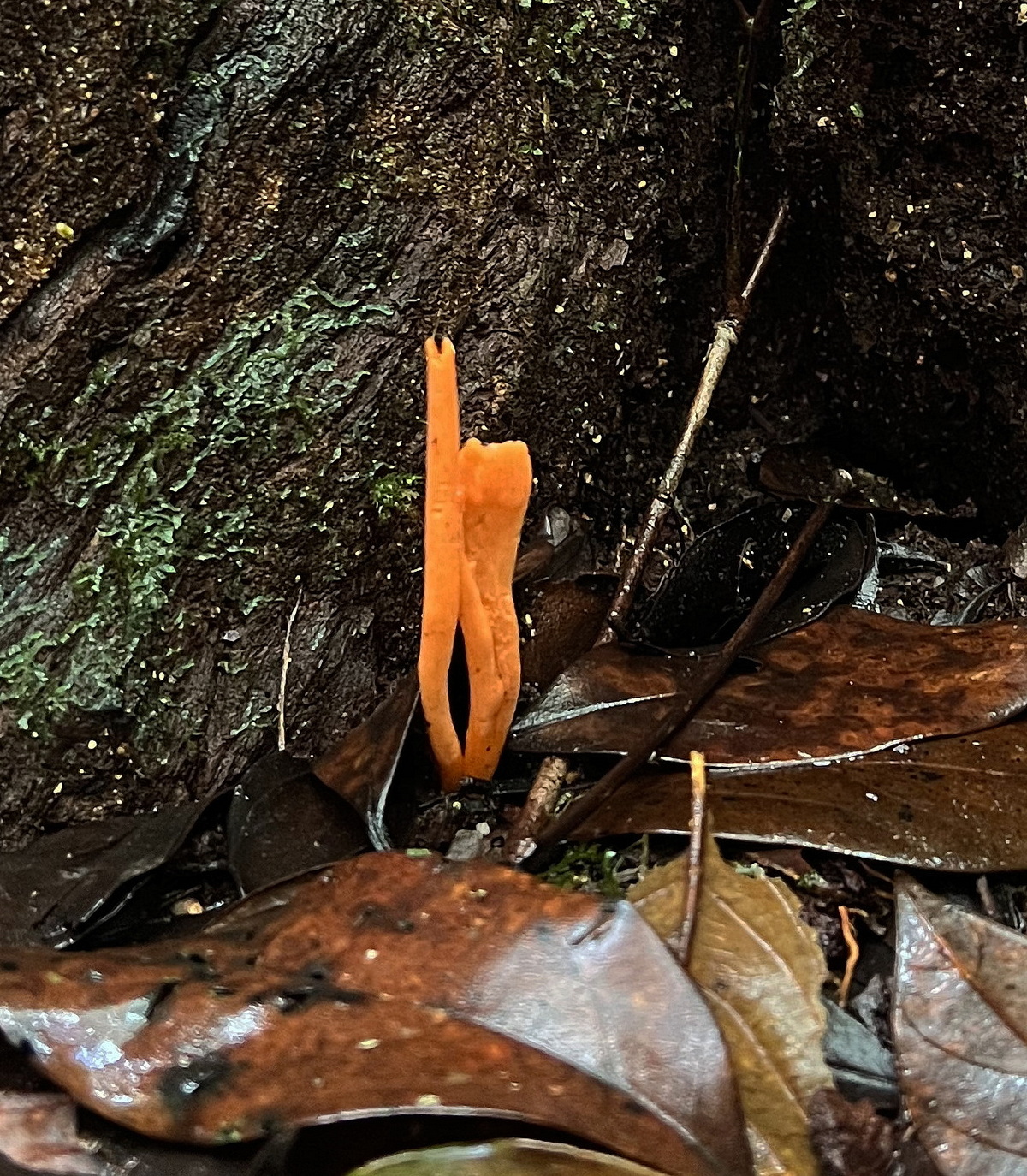
The last two fungi for this article both share the common name coral fungi based on their shape, which is similar to some corals, but they are not in any way related. The large white bushy specimen is Artomyces sp growing on a log behind Potters Park. It belongs to the order Russulales along with the very different False Turkey tail (Stereum ostrea) that I have previously written about in the 5 easy species series. The red club-shaped fungi is Clavulinopsis sp (probably the sulcata group) which is in the family Clavariaceae in the order Agaricales, which is the group that contains mostly gilled fungi.

If you come across any interesting Fungi that you would like to identify I would be happy to give it a try, or refer it back to some of the facebook experts that have helped me for this article. Just take a picture from the top and side, as well as one of the underside of the cap. I am sure that there are dozens more spectacular fungi to be found around Paluma and it would be great to share them with others through this website.

Text and photos (unless indicated) by Jamie Oliver

Recycling in Paluma

When Townsville City Council decided years ago to introduce a recycling system,  outlying suburbs such as Paluma and Alligator Creek were not included as it was considered that community support in these areas was not sufficient to warrant their trucks to travel that far.

The Paluma Environmental Education Centre, therefore, decided to set up and incorporate a recycling system into their environmental education curriculum, organizing a recycling station at the Catholic Education Centre (Gumbaroo) with yellow-lidded bins provided by the Townsville City Council. A council truck would travel to Paluma to empty these eight bins, with the cost for this service being charged to PEEC. Over the years the charge for this service has risen annually and last stood at $400, making it very expensive with council indicating another increase on the way. This also caused occasions where all the bins were full and recyclables were left on the ground.

Part-time resident, Wilfred Karnoll volunteered in mid 2022 to transport any full bins to and empty them at the council-operated recycling depot at the Stuart dump free of charge on his way home to his other residence at Alligator Creek. As the bins are the large 300 liter type they have to be emptied manually at the site and the recycled material has to be placed into the standard 200liter yellow lid bins and paper/cardboard containers. The Paluma bins are regularly monitored to ensure there is always space available, all bins full to overflowing should therefore be a thing of the past. He’s asking all residents to read and adhere to the list of Do’s and Don’t’s outlined below to make his job as easy as possible.

DO’S and DON’T’S for PALUMA RECYCLING

  1. All recyclables are to be placed into bins loose, not bagged or in cartons.
  2. Fill bins completely in order from left to right, that way we don’t end up with 8 bins half full.
  3. Do not overfill bins, lids have to sit flat to keep rain out, any moisture in the bins causes soggy paper/cardboard, as well as mould, smell and rust.
  4. All food containers must be rinsed out and drained of any liquid.
  5. All lids must be removed from all bottles and plastic containers and discarded, as they are considered a contaminant.
  6. Place glass bottles into the bins gently, if dropped from height they may break any glass containers already in the bins.
  7. Paper should be a minimum size of A5, (half the size of a standard A4) and should be flat, not scrunched up. No small arts and crafts remnants, please.
  8. All cartons must be flattened by undoing the glued flaps at top and bottom or by removing the sticky tape, don’t try to flatten them by crushing them, as it doesn’t work and only creates a bulky mess.
  9. Any items smaller than a credit card or fist should not be recycled as they have very little recycling value but create a lot of extra work.

Happy recycling!