This coming Friday, the Perc Tucker Gallery will be opening a retrospective exhibition of 4 decades of works from our local award-winning ceramic artist, Len Cook.
The exhibition will open this Friday, May 12 and run until August 2023. On Saturday, May 13, Len will give a talk at the Gallery about his work
Len Cook is one of Australia’s foremost woodfired potters. The exhibition FIRE AND RAIN draws together nearly 80 artworks created over 40 years Of ceramic practice with loans from public and private collections, as well as key works from the artist’s own collection.
The exhibition highlights the artists lifelong passion for wood-fired kilns and pots that are glazed by natural ash deposits over extended firing in traditional Japanese anagama (cave) kilns. Len Cook’s practice encompasses domestic ware, ceramic sculpture inspired by the coral forms Of the Great Barrier Reef, and his anagama- fired work.
Join artist Len Cook and curator Ross Searle as they discuss the works on display in Cook’s exhibition FIRE AND RAIN. Floor Talk Saturday 13 May 10.30am
A reminder to Paluma residents that the monthly Village Working Bee will take place this coming Saturday 6th May. The weather is beautiful so it’s a great time to get out in the fresh air to help with all those maintenance jobs around our village.
Please meet at the Community Hall at 2 pm and from there tasks will be assigned to team members. Refreshments will be provided after the work is done. If you have some garden tools (shovel, wheelbarrow, pruners, secateurs, etc) bring them along with you.
If you have any questions, Wilfred is the man to see.
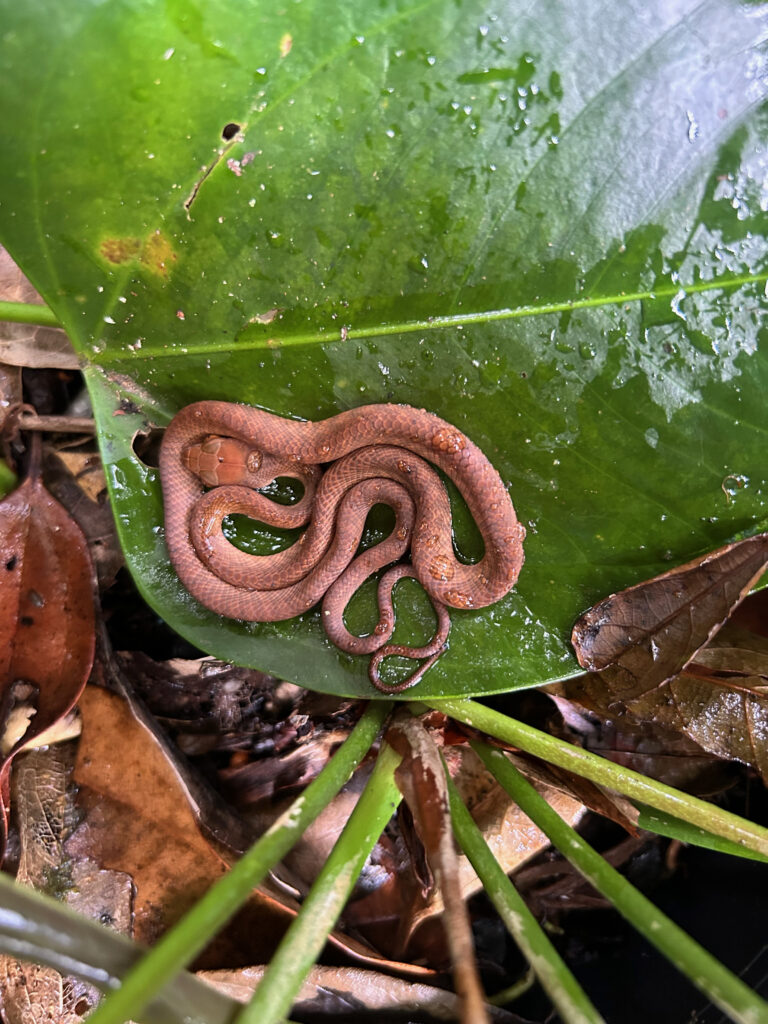
I have previously posted (bragged) about the haven my garden provides for brown tree snakes of all sizes (Boiga irregularis). In October 2022 I posted a photograph of a rather cute baby brown tree snake amongst the foliage in my bromeliad patch. Today I encountered another baby resting on the broad leaves of one of my anthuriums amongst the pot plants. I couldn’t resist sharing this photograph of this very handsome specimen. Check out those huge eyes….!
Plantings of the native vine Aristolochia tagala (aka Aristolochia acuminata) have now wrapped a sizable section of the railings at the Paluma Village Hall deck in a thick mass of large green leaves.
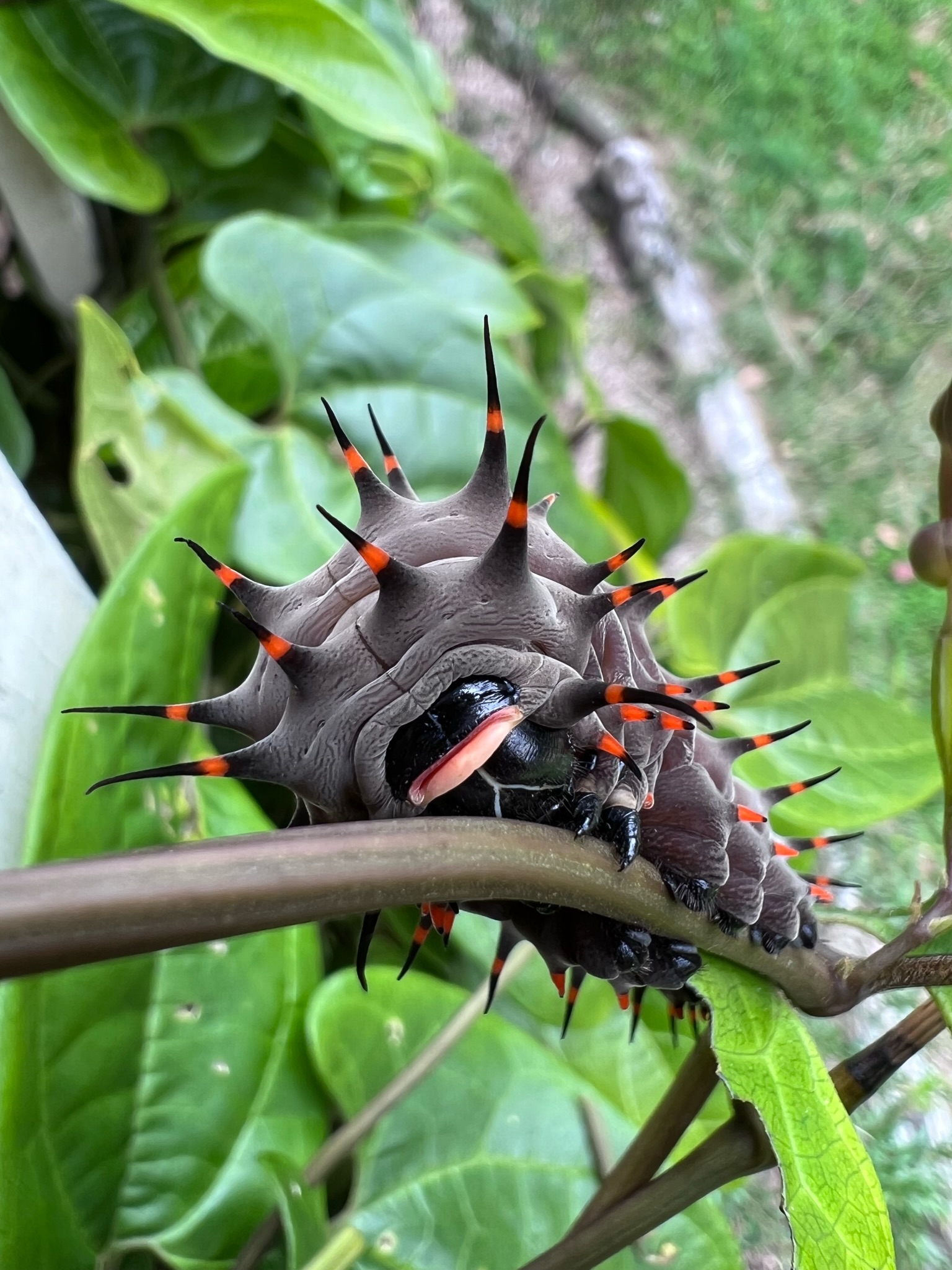
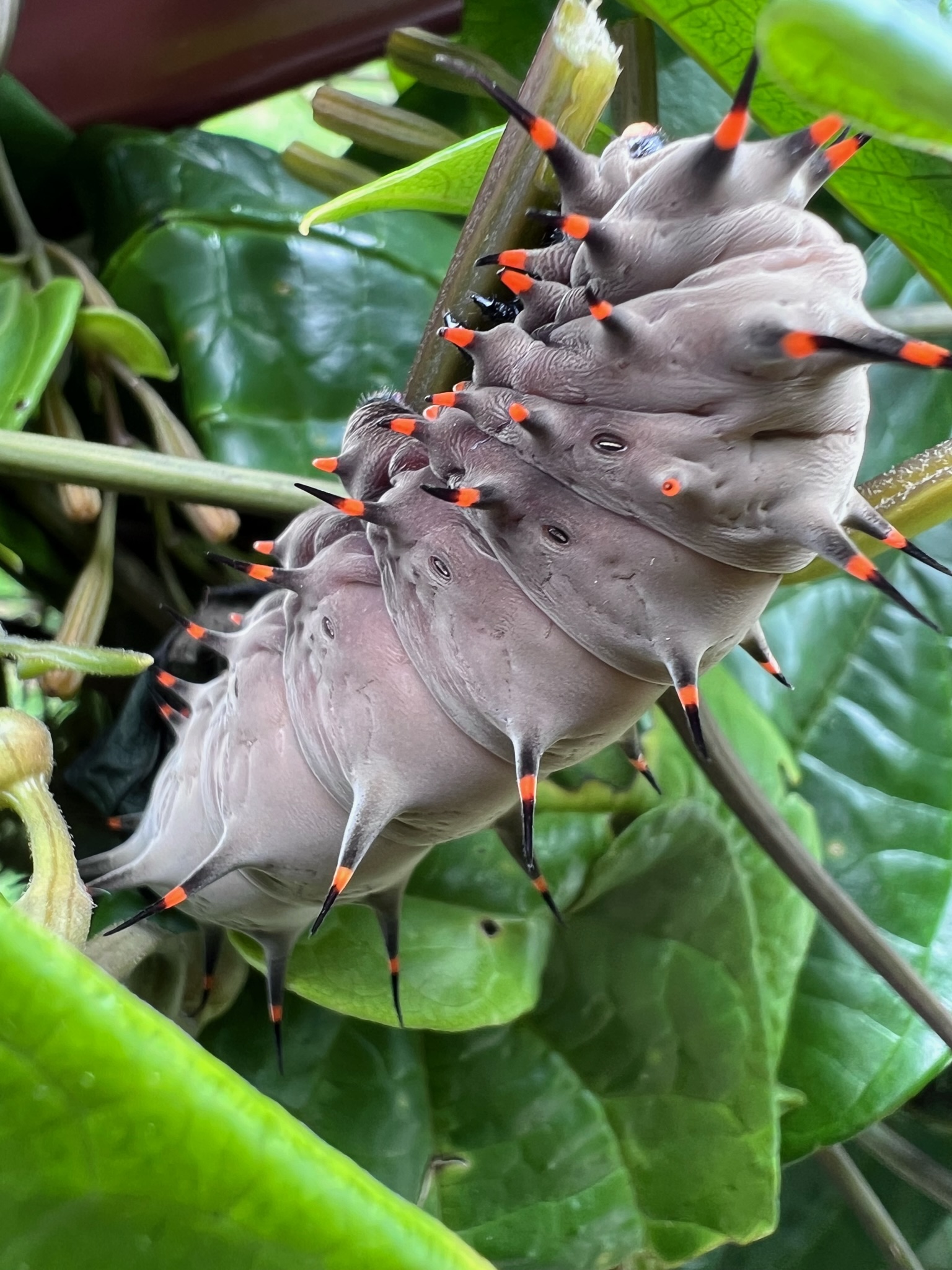
Somewhat hidden amongst the foliage and emerging flowers and fruit, the larvae of the Cairns Birdwing butterfly (Ornithoptera euphorion) are happily munching their way towards the time they will leave the dense vines behind and move to a more open position before transforming into their chrysalis form. By the time the caterpillars are ready to pupate they have grown to about the size of a human adult’s thumb.
They need to move out of the dense foliage so they have plenty of space to unfold their damp and soft wings when they emerge in their final form as Australia’s largest endemic butterfly.
The Birdwings and some other Swallowtail species rely exclusively on the native vines Aristolochia tagala(aka Aristolochia acuminata) and Pararistolochia deltantha as the food sources for their caterpillars.
Using chemical receptors on her forelegs the female Birdwing butterfly is able to tell by “tasting” various leaves with chemical receptors on her forelegs that she has found an Aristolochia vine. At the end of her abdomen are other sense organs that help her then locate tender young leaves suitable as caterpillar food.
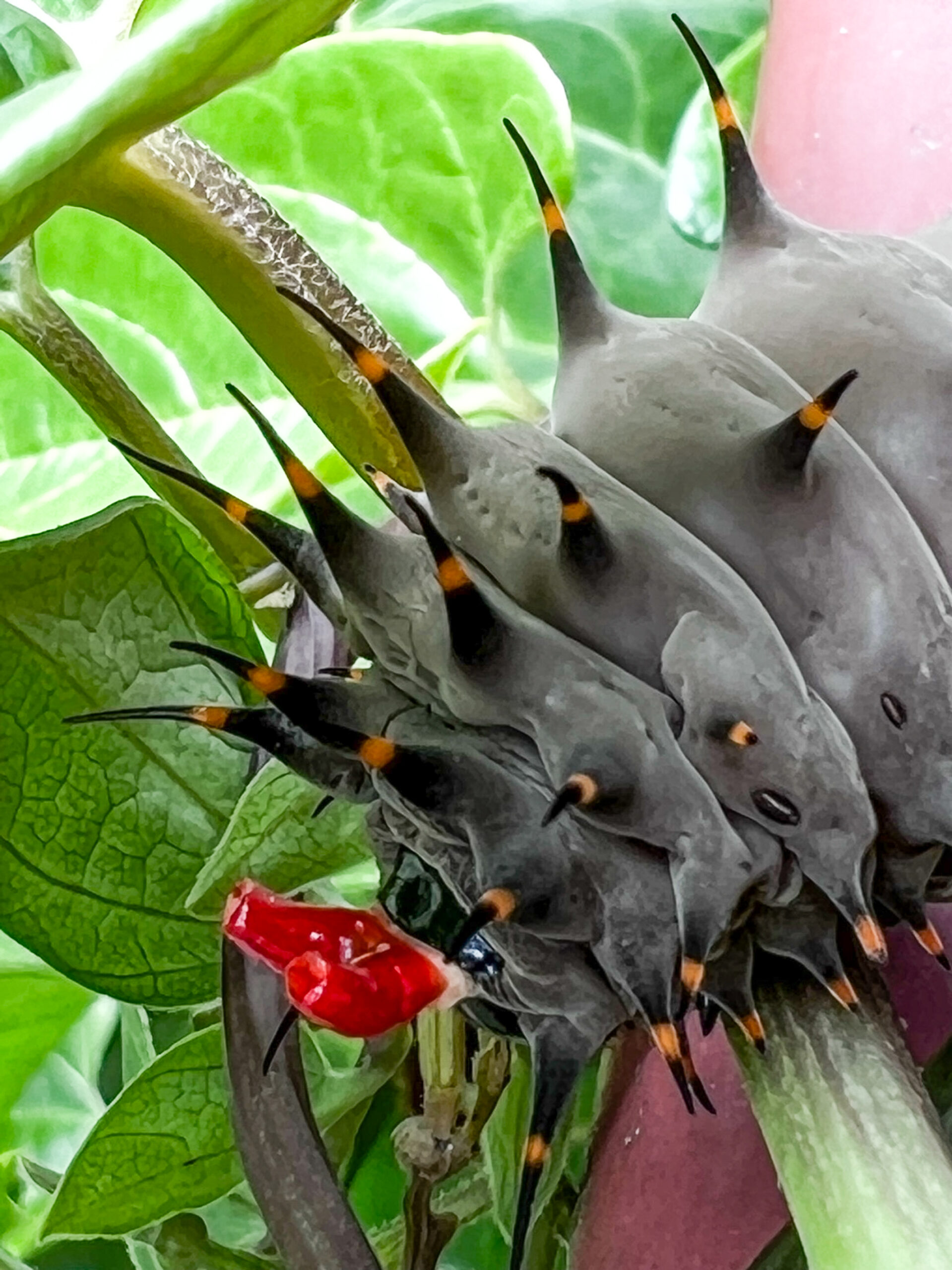
Aristolochia vines are poisonous, but the caterpillars of Birdwings (and other Swallowtail species) are able to use the plant poison in our native species for their own protection and so store the toxins in prominent fleshy orange-red spines on their backs.
When threatened by hungry birds (or curious humans at the village hall) the Birdwings and other members of the Swallowtail butterfly family turn toxins to their defence using an inbuilt defence mechanism anatomically referred to as the Osmeterium
The Osmeterium is an organ above the head of the caterpillar in the first body segment. If the caterpillar feels threatened, two bright red or orange horns pop out, as well as a very smelly, bitter fluid utilising the stored Aristolochia toxin.
All our Swallowtail butterfly caterpillars — the big butterflies like Cairns Birdwings, Orchards and Ulysses — have this defence mechanism.
Because of the shape of the flowers, the common name for various species of Aristolochia and Pararistolochiais Dutchman’s Pipe.
But while the Swallowtails thrive on the Australian species of these vines, a foreign species (Aristolochia elegans) is deadly for them.
The deadly form of Dutchman’s pipe imported from South America for ornamental plantings sends out the same chemical signals to the female swallowtails as our native species. They are fooled into laying their eggs on it. But the emerging caterpillars cannot cope with the stronger toxins of Aristolochia elegans and are eventually poisoned and killed.
Aristolochia elegans plants are spreading from gardens into the natural environment and are endangering the future of the beautiful Birdwings and the other Swallowtails.
Do plant native Aristolochia and help the swallowtails fill the summer skies with colour and movement …but check labels carefully to make sure you don’t accidentally purchase and plant the deadly foreign invaders.
Photos by Jan Cooke and text largely plagiarised from Google sources by Peter Cooke.
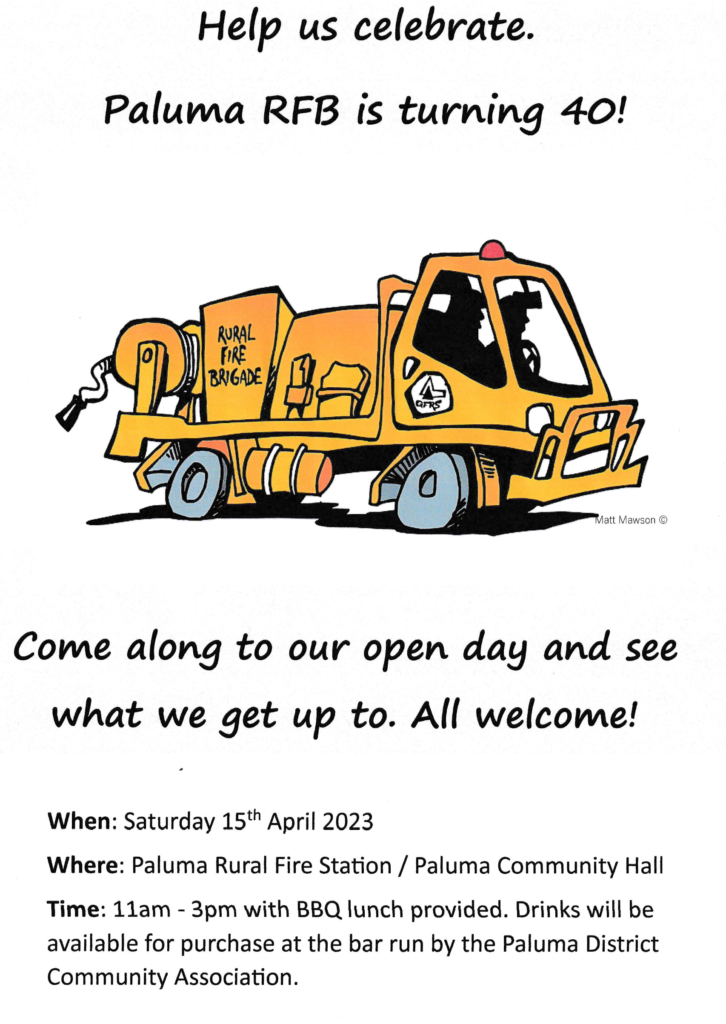
Serving the Community for 40 years – Happy Birthday Paluma RFB!
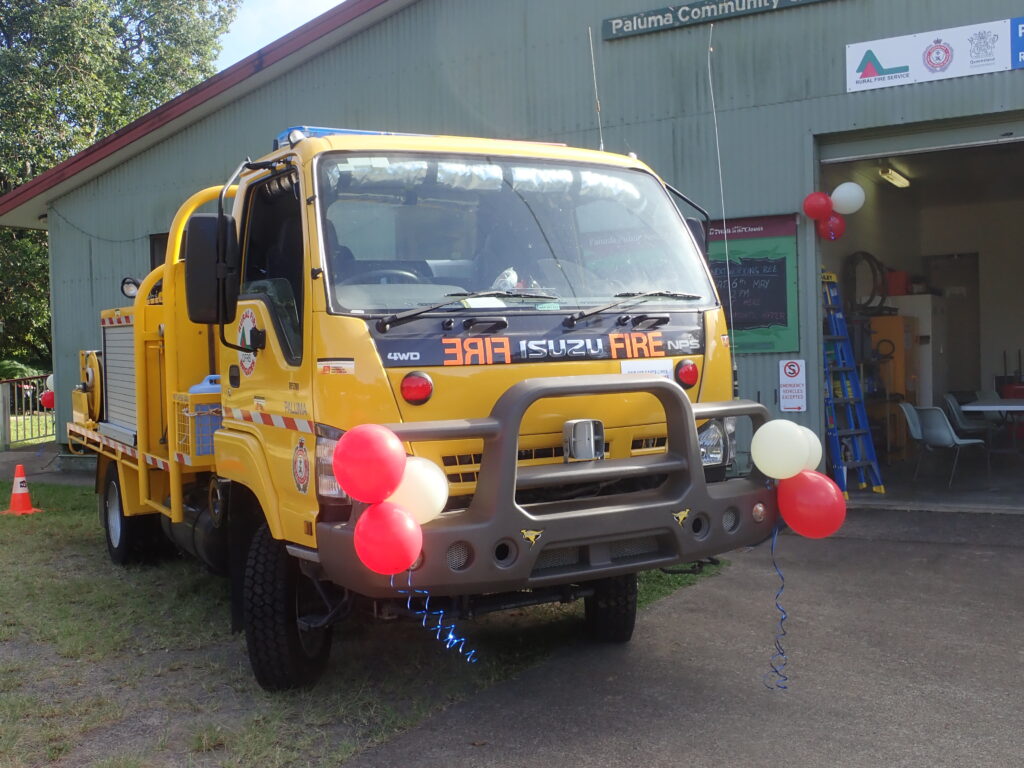
Last Saturday the fire gods were shining down on the Paluma Community Centre and our beloved fire truck ‘Paluma 51’ was adorned with yellow and red balloons to give thanks to past members of the Paluma Rural Fire Brigade.
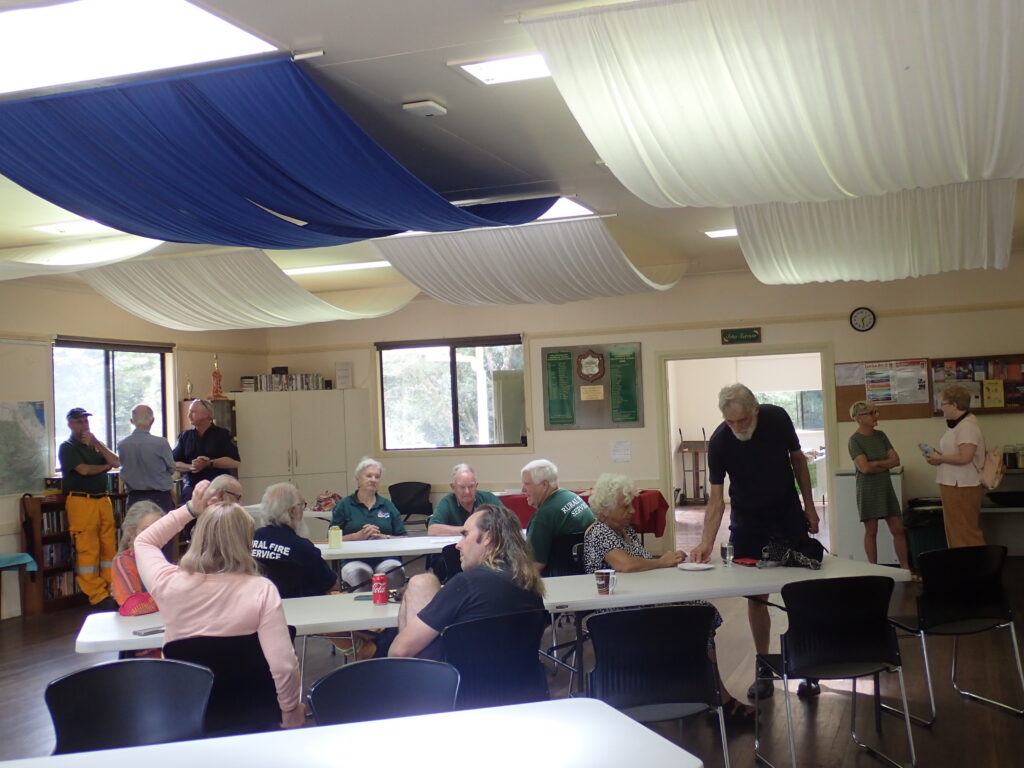
A modest but jubilant crowd of 30 people gathered to raise their glasses and help celebrate the 40th Anniversary, including a couple of visiting families. Paluma 51 as always was popular with the children. Don kindly manned the BBQ to cook an array of BBQ meats to perfection which was accompanied by gourmet salads of the exceptional Paluma standard.
Following lunch, 1st Officer Ross Hyne thanked those who had made the Brigade what it is today, still here after 40 years and to others for helping celebrate this auspicious occasion. Lynn Hyland provided some early historical narrative on the very beginnings of the Brigade which humbly started in April 1983 with a small loan from the Paluma Progress Association to purchase a trailer for housing firefighting equipment.
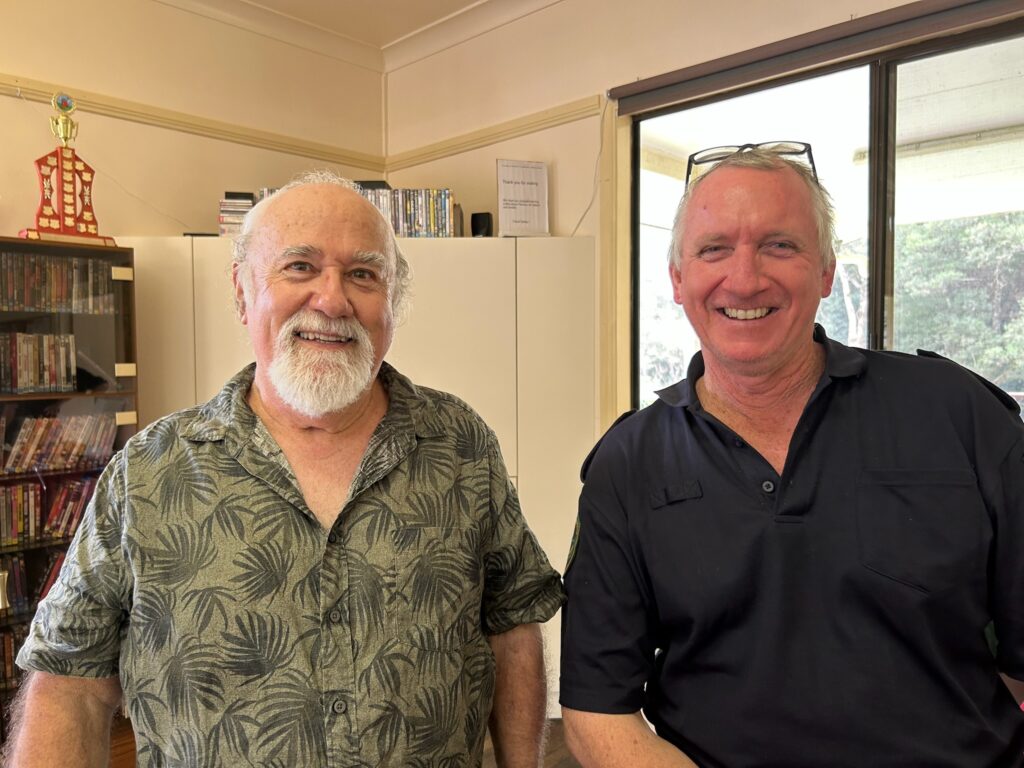
Following the speeches, the cutting of the cake was undertaken by some of the longest serving members of the Brigade, founding member and former 1st Officer Len Cook and Lynn and Les Hyland who have been active members for 36 years.
May the Brigade be here for another 40 years!
Interested in joining the Brigade or wondering how you can get involved? New members are always welcome. For more information, please contact Sonya on (0474) 324 153.
Text by Sonya Bryce, Secretary/Treasurer, Paluma Rural Fire Brigade.Photos by Sonya Bryce and Michele Bird.
Paluma residents are advised that there was an attempted break-in at the Rainforest Inn early this week, sometime between Sunday night and Tuesday morning. Screens were removed and/or cut from windows on the laundry and toilet. Fortunately, the would-be thieves did not gain entry.
This is a timely reminder to residents to lock up and stay vigilant for suspicious people and/or activity around our village. We can all become complacent in assuming the village is safe from criminal activity, but it appears not to be the case.
Sincere thanks to those treasured friends and neighbours such as Don and Lynda who mobilised today to check on properties around the village.
This notice has also been posted to the Paluma Community Alert on What’s App. If you are not signed up to receive community alerts, please contact Sonya, Lynda or Michele (the administrators of What’s App Paluma) and they can invite you to join the group. The Alerts are used for important community messages and ‘need to know’ information such as Range Road information (trees down and road issues), Bruce Highway closures, safety issues and other urgent community messages and information.
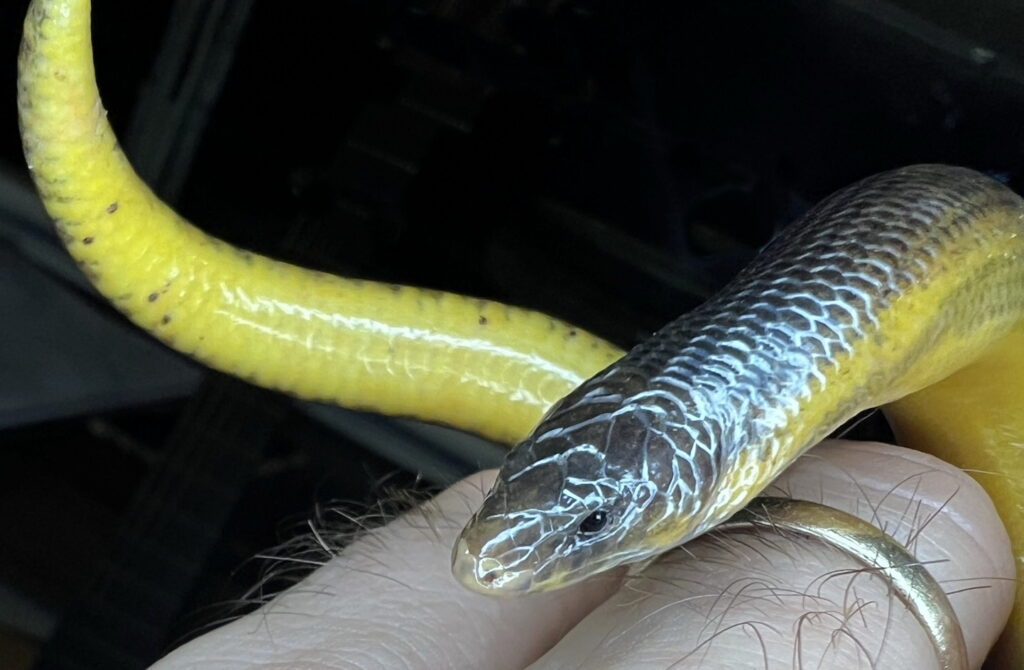
Over the recent Easter weekend, Juanita and I went for an evening walk around Lennox Crescent. We discovered one of our local residents trying to cross the road in an utterly legless state. However, an excess of Easter cheer was not a factor in its slow progress. This particular resident was born legless, and when not trying to cross smooth packed surfaces like roads, its apodal state is a big advantage for its chosen lifestyle.
Our struggling neighbour was, in fact, one of two species of legless lizards that can be found in the rainforests around Paluma. While snakes have adapted well to rapid progress on open ground, legless lizards are mostly burrowing animals and their form is ideally suited to digging and pushing their way through soil and leaf litter, and hiding under logs and rocks. Legless lizards may sometimes be mistaken for snakes, but careful inspection shows that compared to snakes, they have: earholes (or covered depressions); long tails that are a significant proportion of their overall length; and no forked tongue.
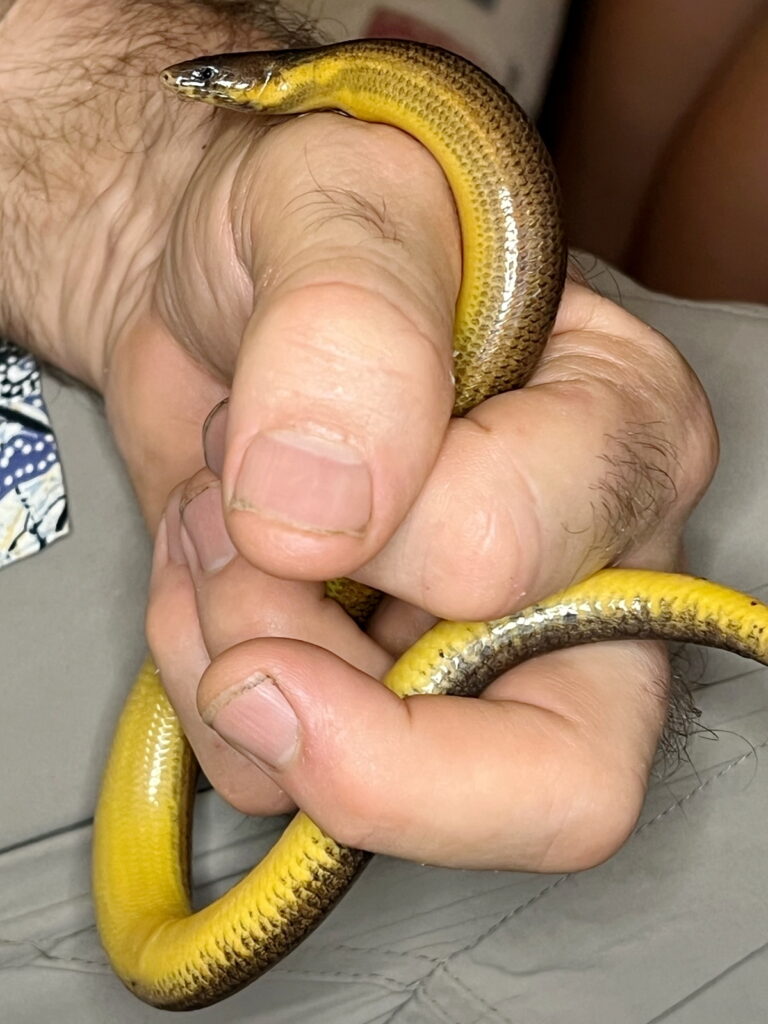
I took several pictures of this beautifully coloured lizard once back at home and hoped to get further close-ups and naturalistic shots the next morning but it managed to escape its temporary home early the next morning, so I am left with these hand-held images. They were enough for me to be pretty confident in identifying it as the limbless snake-tooth skink (Coeranoscincus frontalis).
Photo by Juanita Poletto
This species is fairly common (but infrequently encountered) in the wet tropics. It is thought to be nocturnal and is commonly found in rotten logs or in the soil under logs and rocks. As suggested by its common name, members of the genus have relatively large recurved snake-like teeth and in a related species (C. reticulatis) stomach contents suggest it eats earthworms, beetle larvae and other insects. The sharp recurved teeth may be an adaptation to capturing and holding the large, muscular writhing earthworms that are commonly found in our rainforests and local gardens.
Photo by Jamie Oliver
Leglessness has independently evolved in at least 7 different families of lizards (and one clade of six closely related families). Most of our commonly found legless lizards in Queensland belong to the family Pygopodidae (related to geckos), however, C. frontalis is actually a member of the skink family.
A recent publication in the Australasian Journal of Herpetology has suggested that C. frontalis is actually 3 separate species that have distinct geographic distributions. The individuals that are found between Paluma and Mt Elliot have been recognized as a new species: Coeranoscincus pailsei. In case you were under the misapprehension that taxonomists are humourless nerds with no social life, check out the note from this publication on the derivation of this new species name:
The new species C. pailsei sp. nov. is named in honour of Roy Pails of Ballarat, Victoria, Australia in recognition of his many contributions to herpetology spanning many decades. Quite appropriately, I note his love of alcohol and his regular habit of drinking himself “legless” with Peter Whybrow (see above) and others, including at my wedding in year 1999, which is appropriate and relevant when naming a legless skink in his honour.
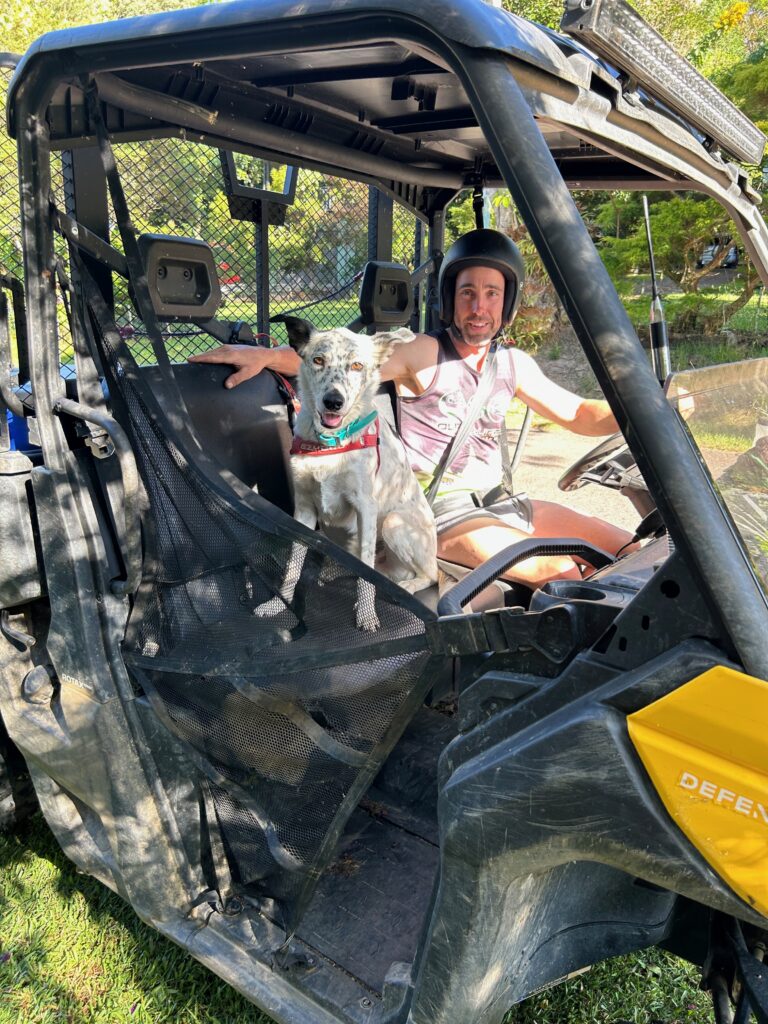
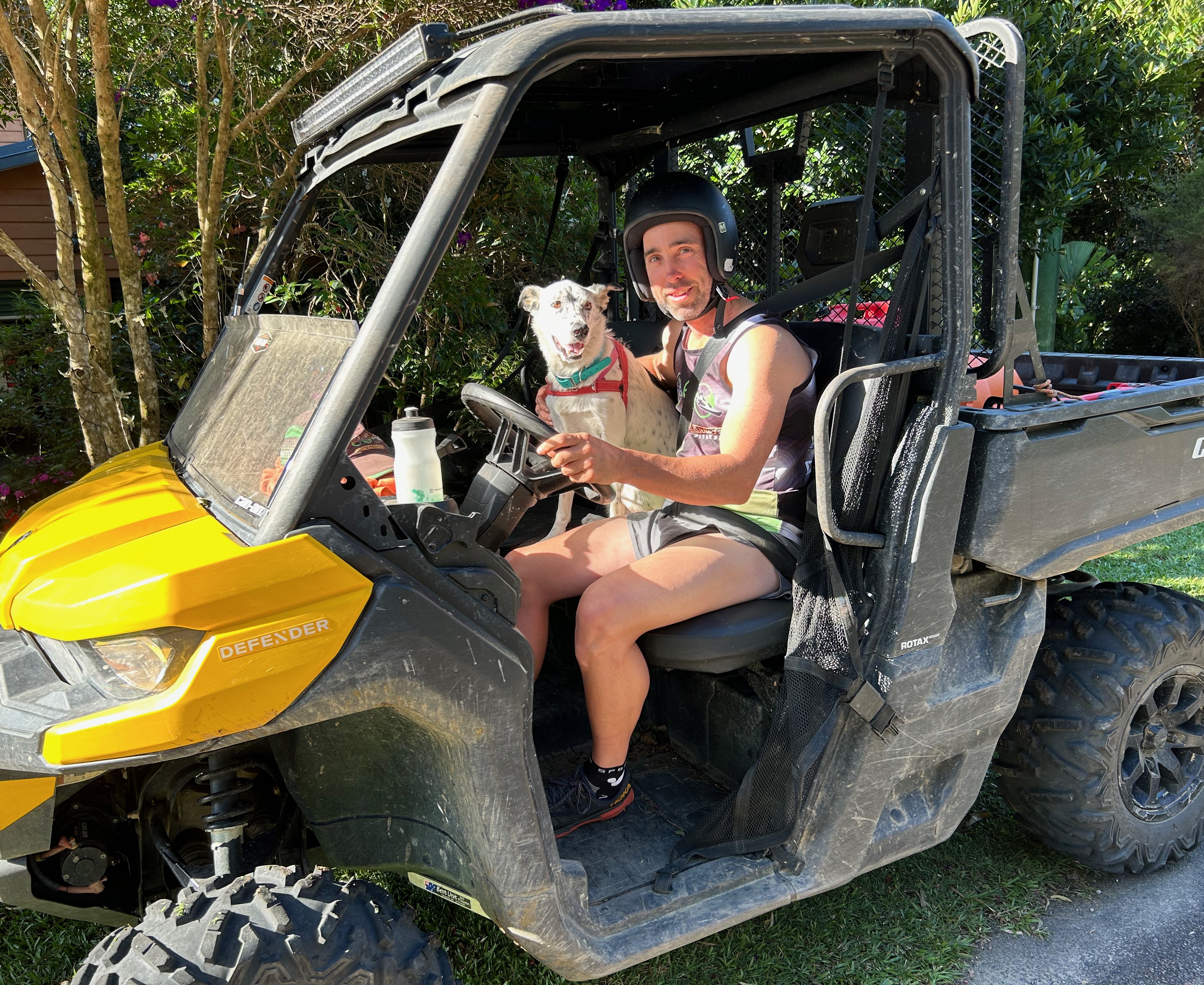
Whenever you see Sam and Aline from Outer Limits Adventure around the village of Paluma, the chances are that their canine companion Harley is not too far away. Harley loves nothing better than to accompany his humans on a walk, run or cycle. In fact, most times Harley is leading the way with a big grin on his freckly face. Harley has been pretty busy just lately with lots happening at the Outer Limits Centre with training programs, renovations to install an ablutions block and the preparation work is in full swing for the upcoming Paluma Push in July.
Sam says that one of Harley’s favourite activities is to join him in the all-terrain vehicle for track surveillance and maintenance works. Sam just has to think about taking out the all-terrain vehicle and Harley is by his side, ready to roll on paw patrol. Strapped in securely in his canine harness, Harley looks extremely pleased with himself. Sam and Harley stopped briefly for a chat and photograph last weekend, but Harley was keen to keep moving. Harley is clearly living the (canine) dream and every day is an adventure for a busy Outer Limits action dog.