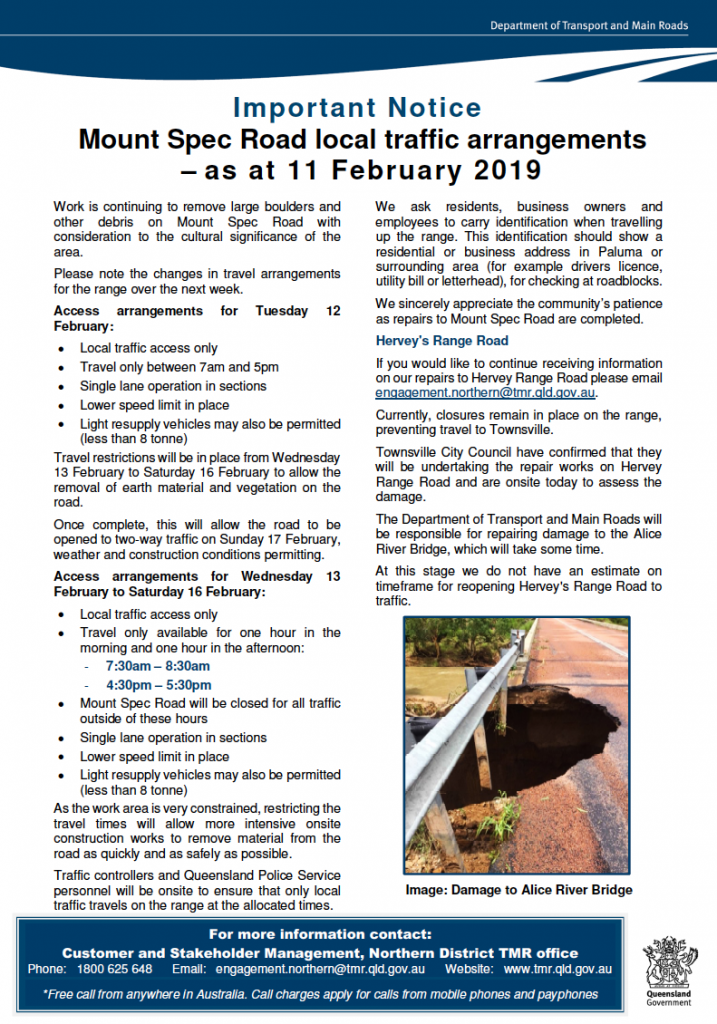
TMR Range Road Update, For Week of 11 February

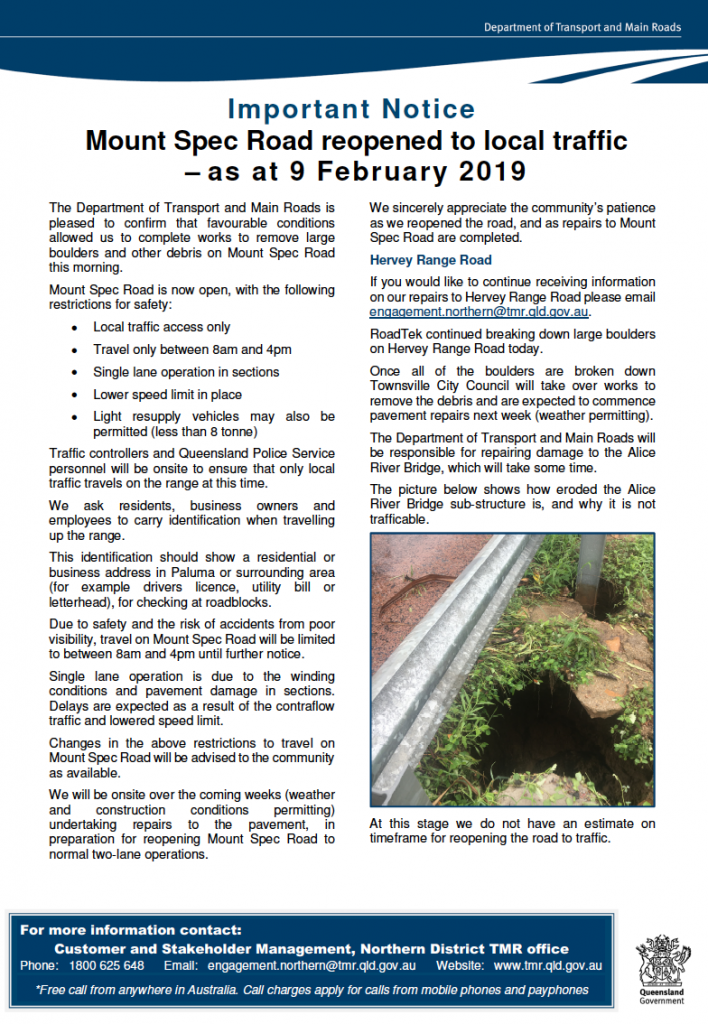
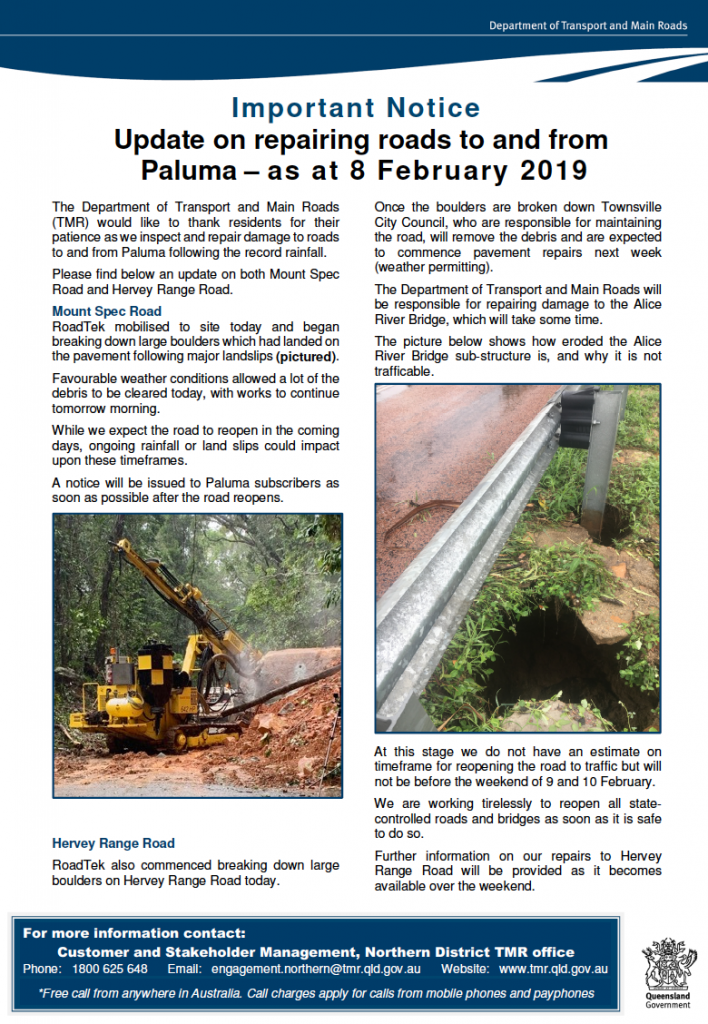
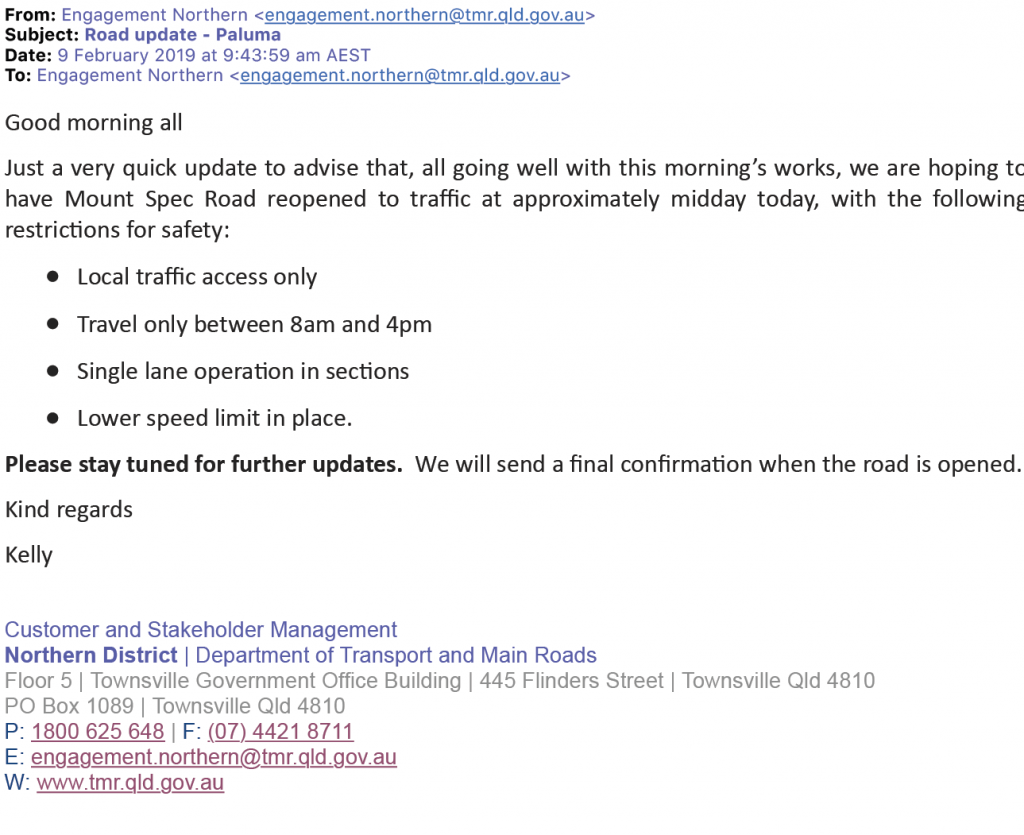
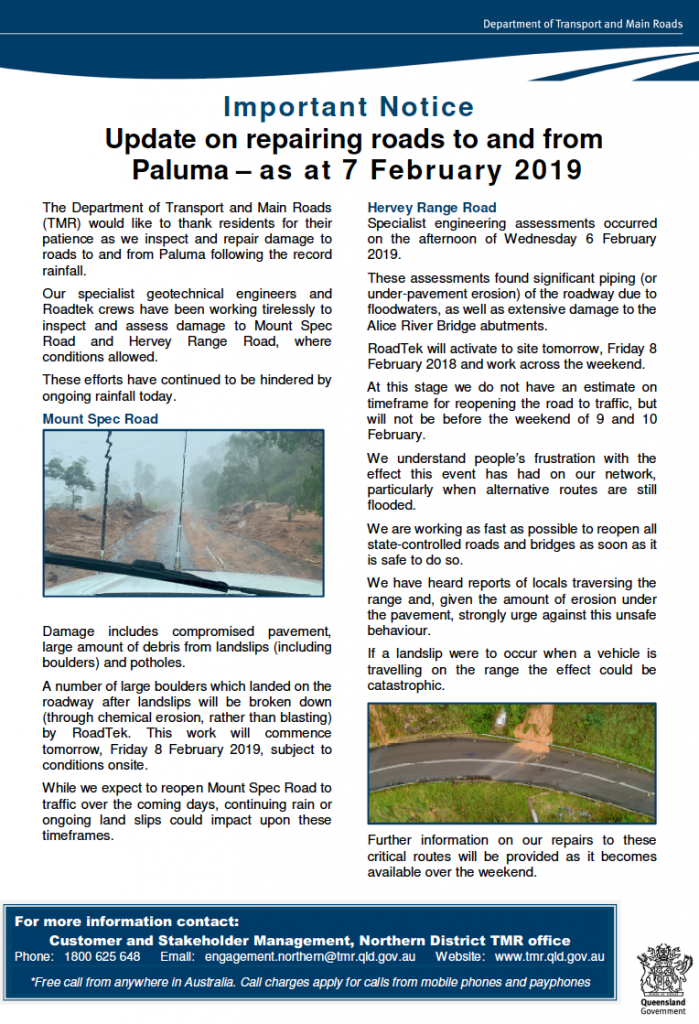
Please be advised that the Department of Transport & Main Roads (TMR) will be providing regular updates on the status of the Range Road via email.
To register for the updates please do one of the following:-
IMPORTANT: In your email, please mention that you want information about Paluma and the Range Road.
Even if you are already registered with TMR on this email address, you MUST RE-REGISTER NOW. This is because TMR are setting up a new and specific email list and dedicated service for Paluma residents regarding the Range Road.
2. As advised by Len Cook today, you can also register by phoning:-
1800 625 648
I have registered to receive information and will also post notices as and when received to this website.
Stay safe everyone!
Michele Bird, Secretary, PDCA
Update Bulletin for Wednesday 6 February 2019
Well, it continues to pour rain here with little prospect of relief until the weekend at soonest, but after seeing the news footage of the catastrophic flooding in Townsville and some surrounding districts, we realise how very lightly Paluma has been affected by this extreme weather event. So far at least, there are no reports here of serious damage to property. Our hearts go out to those whose homes have been flooded and who have lost irreplaceable personal items.
In houses and in the community hall, pools of water lie on some floors, due to leaks in the roof, or ground-water seepage. Where possible, tarpaulins have been used to cover leaky roofs. These inconveniences occur to a greater or lesser degree every wet season; it is just lasting longer this time. A tree fell and smashed the gate at Gumburu and several small trees have fallen in and around the village. The ground is water-logged and rivulets and streams course over the road and down the slopes to join up with Benham’s Creek. Some driveways and sections of the road have been gouged out by the force of water. The official Bureau of Meteorology (BOM) website rainfall readings advise that 2521 mm of rain has fallen since Australia Day (26 January). Len Cook has kindly provided the BOM rainfall figures at the end of this bulletin (below).
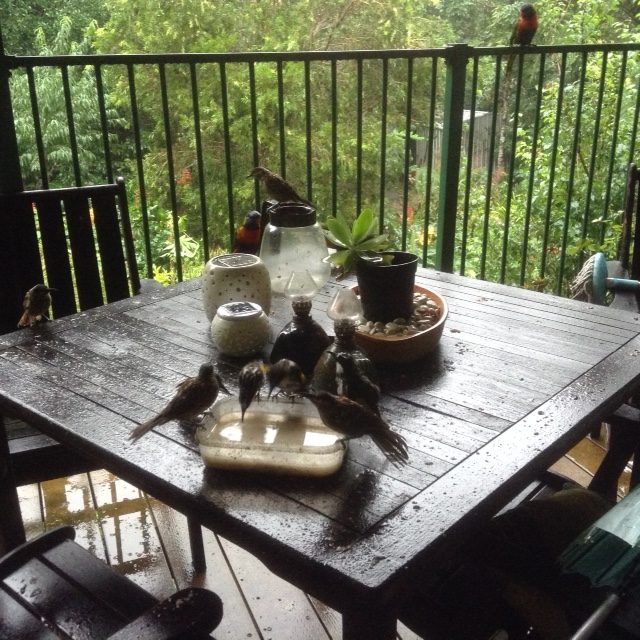
Birds are starving and those of us who are feeding them have what seems like an open aviary from dawn to dark with literally scores of birds on the back decks and verandas, seeking food and shelter. Coming to my table are White-cheeked Honey-eaters, Macleay’s and Lewin’s Honey-eaters, Lorikeets, Satin Bower-birds, Cat-birds and Rifle-birds. Hunger overcomes their fear and the birds cling to my arms and shoulders as I fill the feeder trays. Unusually too, there is no fighting for supremacy at the feeder: all species are happy to share.
A few days ago the worst crisis was for the several smokers who had run out of cigarettes and/or tobacco. Suggestions that this was a good opportunity to give up smoking, or to roll tea leaves were greeted with disdain. Someone managed to procure tobacco so the situation was saved, temporarily.
Yesterday, some people from the Running River area, armed with shopping lists, ventured to Ingham via the Mt Fox Road. Their return was prevented by a land-slip on the Mt Fox Road.
I am very grateful to the number of absent Paluma residents who have rung, generously offering the contents of their pantries to those of us here, should our food supplies run out. We thank you all so much for your concern and generosity but hope, of course, that things will not drag on to that extent.
As has already been reported, engineers are trying to decide on the best way to remove a huge rock blocking the road about 1.5 km from the village. Two more giant rocks are poised on the up-slope ready to fall and as fast as one slip is cleared, another occurs elsewhere. Conditions are terribly dangerous for those attempting to clear the road, but they are trying to keep a narrow way open for use of emergency vehicles only. Otherwise the road remains closed.
So, we are here for the time being: keeping our sanity by taking long walks in the pouring rain, and getting together for coffee and gossip. Neil Appleton’s birthday offered an excellent opportunity for a very happy such gathering.
Update Bulletin by Colwyn Campbell
BOM Rainfall Figures for Paluma (Courtesy of Len Cook)
Saturday 26 January 2019…………………..93 mm
Sunday 27 January 2019……………………160 mm
Monday 28 January 2019………………….230 mm
Tuesday 29 January 2019………………….370 mm
Wednesday 30 January 2019…………….143 mm
Thursday 31 January 2019………………. 222 mm
Friday 1 February 2019…………………….261 mm
Saturday 2 February 2019……………….303 mm
Sunday 3 February 2019………………….175 mm
Monday 4 February 2019………………..384 mm
Tuesday 5 February 2019………………..180 mm
Total……………………………………………….2521 mm
The village of Paluma remains isolated with the Range Road still closed following the unprecedented rainfall . Locals report today that there are numerous landslides and trees blocking the Range Road and it appears it may be some time before the road will open. Paluma continues to receive astounding rainfall totals.
Don Battersby has been recording rainfall at his place on Hussey Road and has logged the following readings:-
Rainfall overnight (4-5 February 2019) was 344 mm.
Rainfall between 1 to 5 February 2019 is 1294 mm.
Rainfall total for January 2019 is 1206 mm.
Jennie Robinson from the Rainforest Inn reports that there are currently about 23 people in the village and surrounds. Everyone seems to be doing well. The community spirit is certainly alive and well. Yesterday (4 February) was Neil Appleton’s birthday and everyone gathered together at ‘Cloud Cottage’ to celebrate with afternoon tea. Happy Birthday Neil!
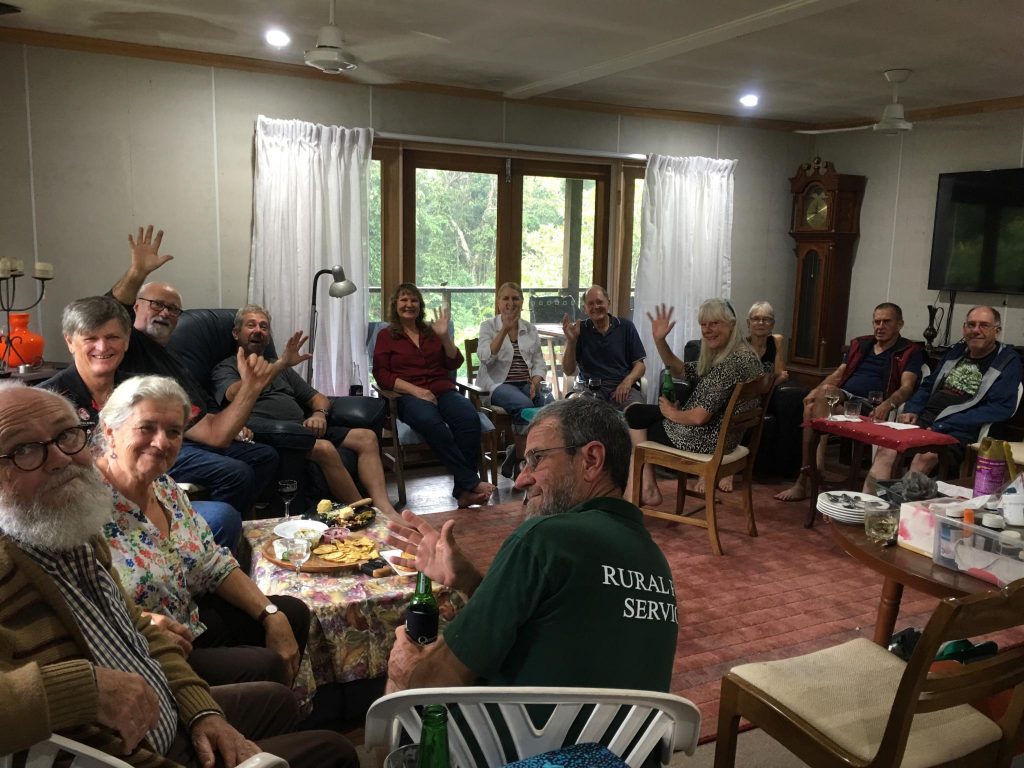
Photo courtesy of Jennie Robinson
You will all have seen on the television broadcasts, the widespread flooding around the Townsville – Ingham areas that unprecedented rainfall has caused. Our thoughts and sympathy go to those people in Bluewater and other areas where homes and property have been destroyed or damaged.
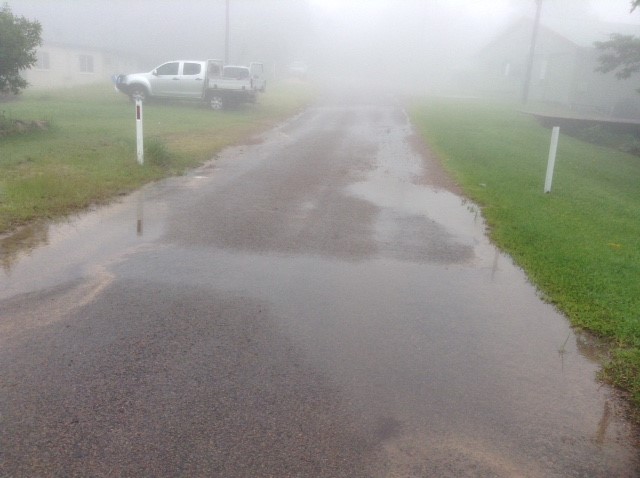
How has Paluma fared so far during this extreme weather event?
Paluma residents are used to receiving heavy rains during the Monsoon season but the rainfall over the past few weeks has been exceptionally heavy and unremitting with very heavy falls over the last five days of January. The total for the month was 1208 mm. Many long-term residents say that while heavy rainfall over a period of a few days is not unusual, the duration of this wet weather event is. Nothing like it has been seen for at least 30 years.
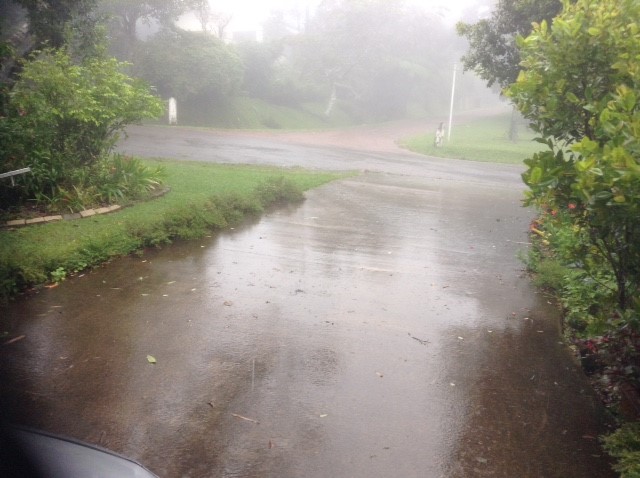
Since Wednesday morning the Range Road has been closed due to fallen trees and land slips. TMR are working at restoring the road but are hampered by the continuing wild weather. Predictions are that we will experience at least another week of wet weather, so it possible that Paluma could remain isolated for several more days. Maybe it is time to launch the Ark from Noah’s Ark Creek.
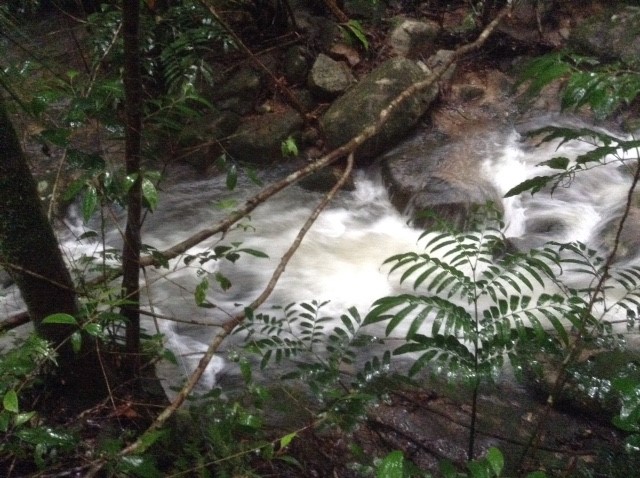
Along the Range Road (when it was still possible to travel to see the sights), the waterfalls were spectacular, the seething water plunging through clefts and grottoes and cascading out and over the road. Twin Falls gushed out like a huge fountain forcing cars through a natural car-wash. Sheets of water hung to rock faces, reflecting light like vast mirrors while rivulets of water coursed across the road. The road surface was littered with leaves and small broken branches. Every so often a very bedraggled brush turkey would make a suicidal dash across the road.
In the village, channels of water rush alongside and over the road, lawns are water-logged, trees have fallen, others hang their limbs low weighed down with the burden of water in their foliage and inconveniently, water has seeped into the lower levels of several houses having forced its way through cracks in brickwork. Birds are ravenous and flock in great numbers to wherever they can find a feed tray; Lorikeets and the smaller honey-eaters happy to share the same dining-room.
It will be time soon, if some have not already done so, to light fires to dry out the houses and our sodden shoes and raincoats.
Text and Photos by Colwyn Campbell
Written on 1st February
A landslide and fallen trees near the top of the Range Road has closed the Paluma Range Road to all traffic. Transport and Main Roads will be working to clear the obstruction today (January 31).
LATEST UPDATE: TMR worked on the road on Thursday but were not able to finish the job. They will continue work on Friday morning, so the road will remain closed for at least part of Friday.
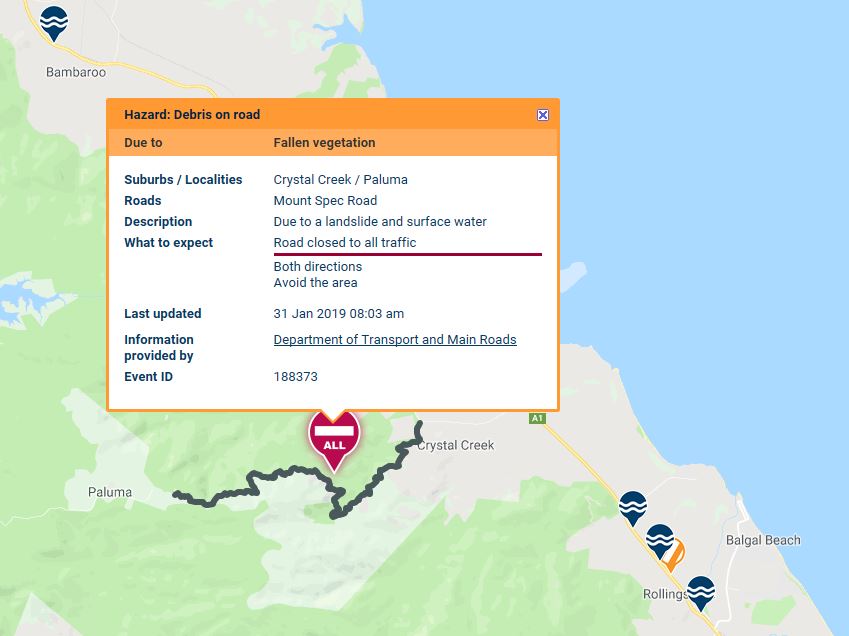
For further updates on the status of the road, visit the TMR website at https://qldtraffic.qld.gov.au/