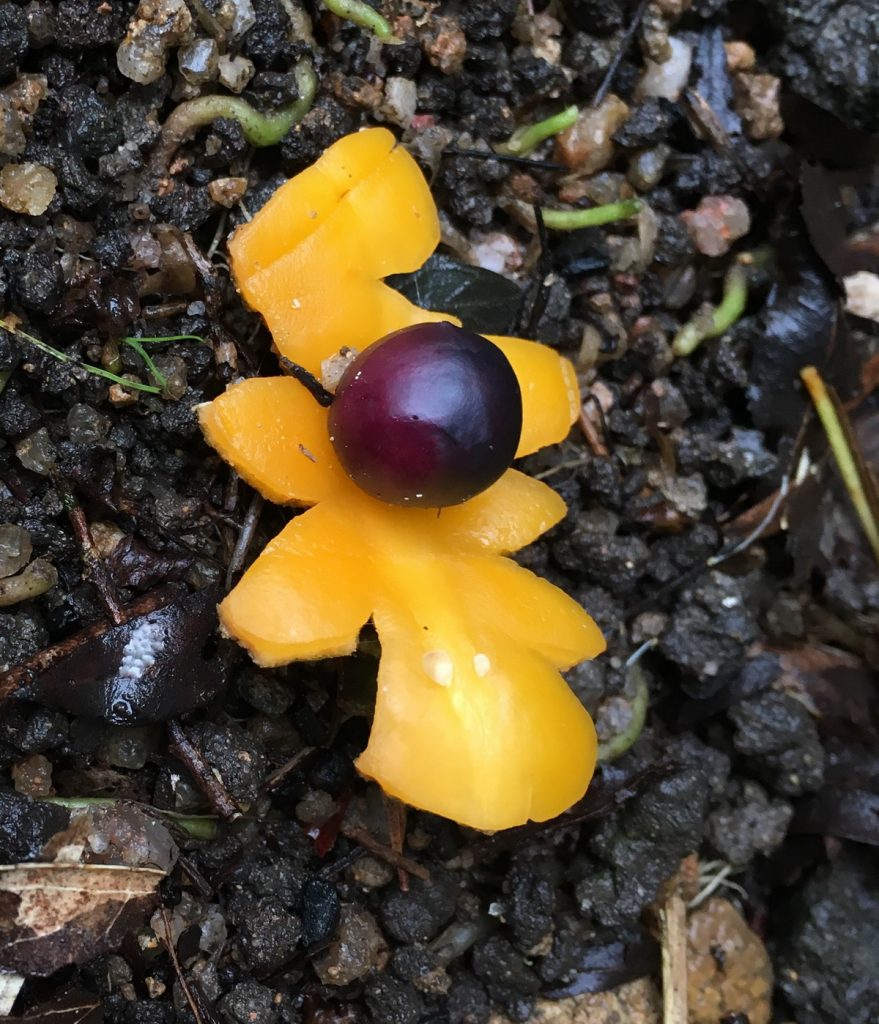
Beginning around the middle of last month (May) some of the tracks around the village had patches of colourful but strangely shaped fruit on the ground. These flattened orange to yellow fruit often have a single seed stuck in the middle. While most rainforest trees are difficult to distinguish based solely on the trunk or leaves, their fruit and flowers can often be distinctive and render them easily identified. Such is the case with McIntyre’s Boxwood (Xanthophyllum octandrum). The best example I have found (although it may now be finished fruiting) is on the H-track just uphill (towards Lennox Crescent) from the old mining test pit and creek lookout. Two mature trees stand near the track (on the left as you face uphill).
MacIntyre’s Boxwood is endemic (i.e restricted to) Queensland, occurring in rainforests from Cape York to the central Qld coast1. Flowering occurs in early summer but the flowers are fairly inconspicuous. The fruit are round, marble-sized and green to pale yellow. When ripe they split open (dehisce) while still attached to the tree to reveal a dark seed attached to the now flattened internal yellow flesh. At this stage the fruit are fairly conspicuous on the tree, and even more so on the dark leaf litter of the forest floor once they have fallen.
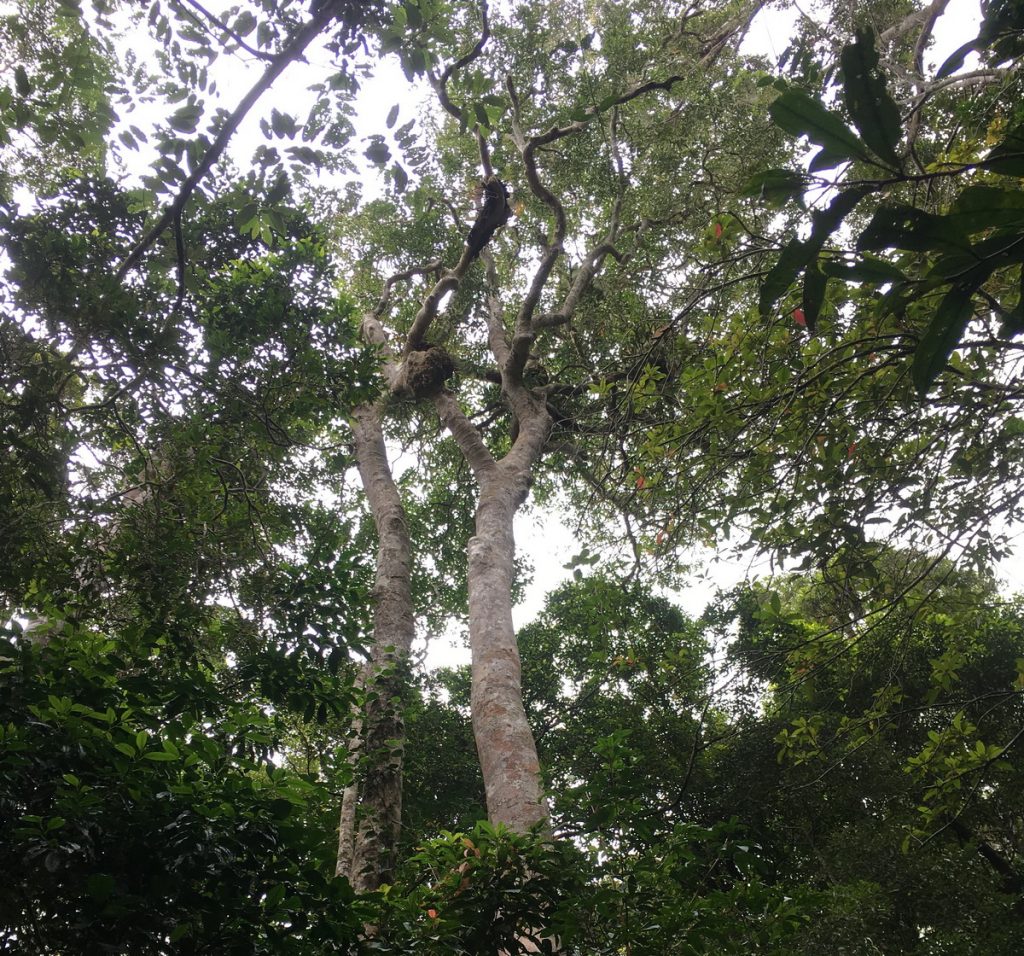
Two mature trees on the H-track. The trunk is relatively smooth with no buttress.
Ripe fruit are just discernible in the canopy of the two trees
The fruit is eaten by Cassowaries. The trees are slow growing and large specimens are likely to be very old. The timber has been used commercially and was commonly used to make wooden rulers.
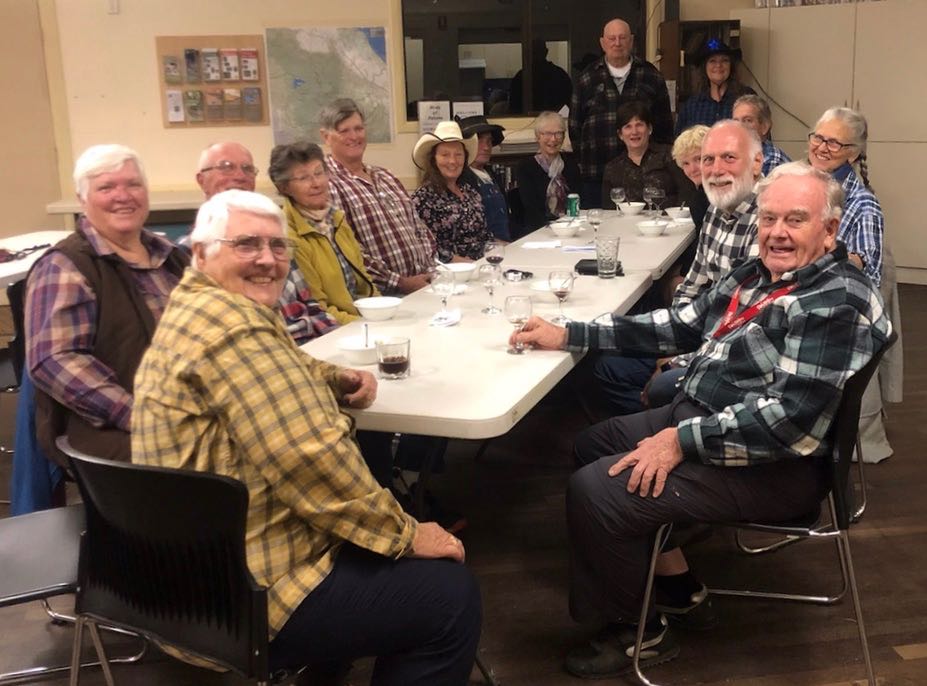
Denim jeans, western checked shirts and cowboy hats were the fashion at the Country & Western & Casserole Night on Saturday 8th June at the Community Hall. Whilst only a small crowd of some 17 people attended this latest event on the Paluma Social Calendar, they made up for the small contingent by having a rowdy good time.
A sumptuous feast of hot and hearty home-cooked dishes meant that everyone had their fill of soups, casseroles, warm fruity desserts and carbs. The bar saw a brisk and lively trade as the guests warmed up on beer, wine and spirits of their choice.
The impromptu “Guess the Country & Western Song Competition” was blitzed by Michele who proved beyond any doubt that she is the biggest country bumpkin in the village!
Major thanks go to Jamie and Juanita for providing the music on the night and to Les and Lynn for their usual exceptional skills in organising the event.
Look at all those country & western checked shirts……..!
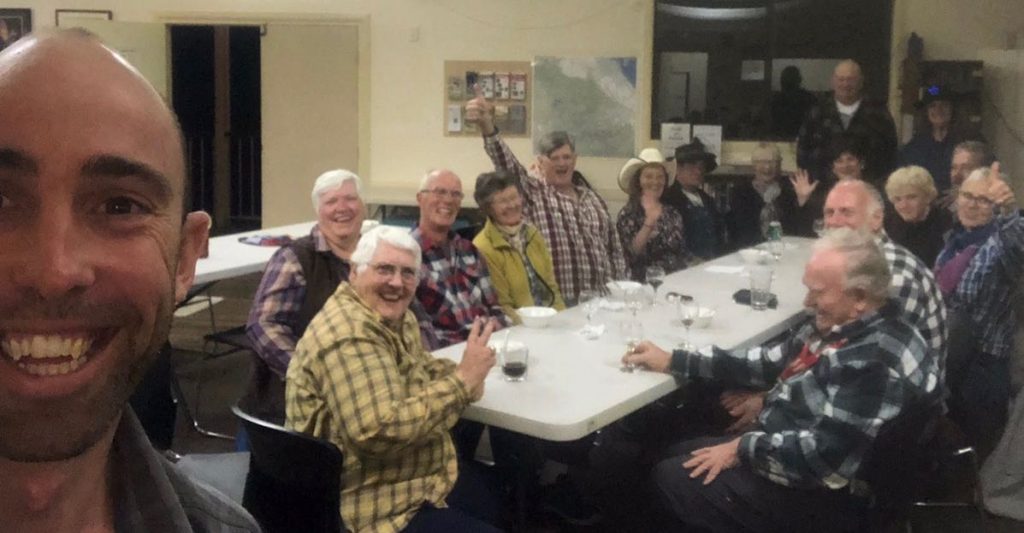
Photographer on the night, Sam Stedman, gets in on the action with a selfie!
The Rollingstone Community Association hosted its annual “Pioneer’s Luncheon” on Friday 7th June 2019 in their Community Hall. This was an extremely well organised function with a splendid lunch provided for those over 65 years of age. Some 70 people were present for the luncheon. Also in attendance was the Local Member Nick Dametto and Councillor Margie Ryder. The proceedings were ably chaired by the President of the Rollingstone Community Association, Sue Von Wald.
In previous years there was a gift for the oldest man and oldest lady, but this year the recognition was quite different. Each of the groups from the Townsville Northern Beaches (TNB) from Saunders Beach, Toolakea, Toomulla, Rollingstone and Paluma were asked to nominate someone from their community who had made a substantial contribution within their area. The nominees for each area were given an award in recognition of their community work. However, it was also intended that one person would be the overall winner to be provided with an engraved trophy.
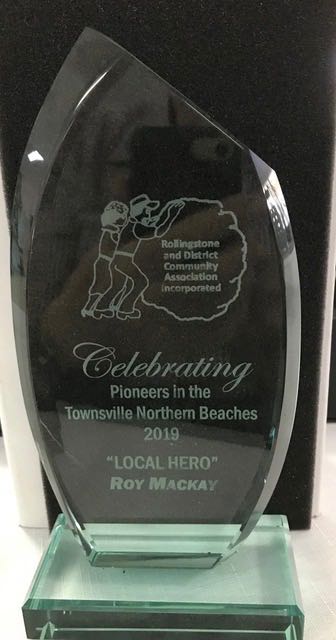
Wonderful to relate the news that the overall winner and trophy was awarded, albeit posthumously, to the Paluma nominee – Roy Mackay.
This award for Roy Mackay was met with considerable acclamation from all those present and celebrated with great delight at Paluma by Roy’s friends and extended family. Colwyn Campbell was called on to accept the trophy on behalf of Roy. In her acceptance speech Colwyn said:-
“It gives me great pleasure and great pride to accept this award on behalf of Roy Mackay. Roy was a humble man, very modest, who would never have sought honours or awards for himself. He was a tremendously generous man. Generous with his time and in sharing his vast knowledge. It was sufficient reward for him to know that through his own passion for the world of nature he had enthused others to love and care for the environment. Roy was certainly a hero to the people of Paluma”.
Roy’s Local Hero Award will be placed in our Paluma Community Hall in the near future for all to admire and treasure.
Article & Photos by Les Hyland, Colwyn Campbell & Michele Bird
The Local Hero Award 2019 – Roy Mackay
Colwyn Campbell accepting the Local Hero Award on behalf of Roy.
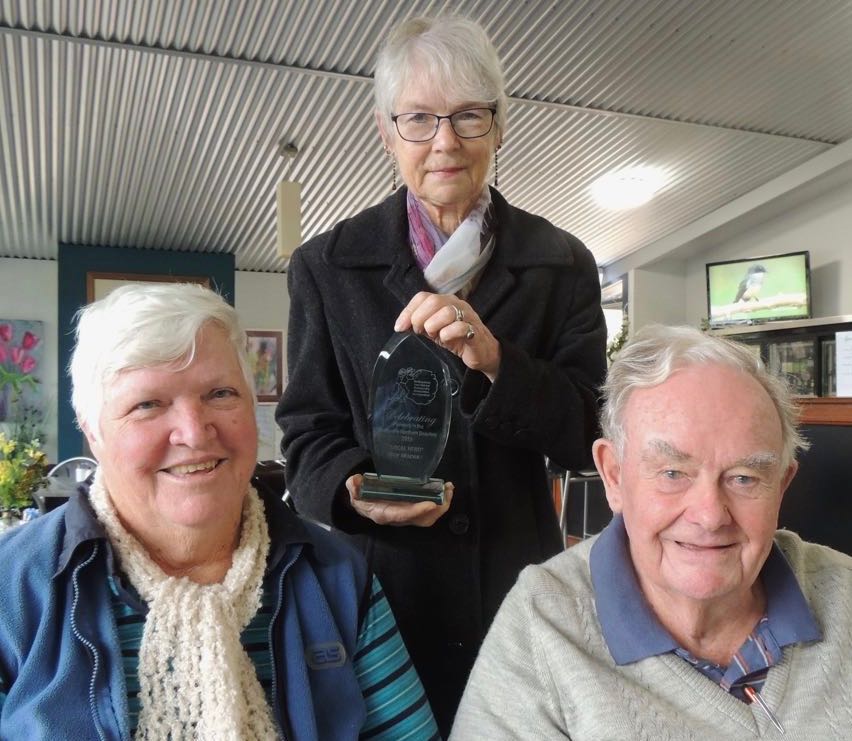
Our Paluma attendees for the Local Awards Luncheon proudly displaying the award after the event – Lynn Hyland, Colwyn Campbell and Les Hyland.
The following is a copy of the nomination submitted for Roy Mackay for the Local Hero Award 2019.
Nomination for Local Hero Award – Paluma Section – Roy Mackay
Roy Mackay passed away in February 2019, just a few weeks short of his 91stbirthday. For a long time, he held the position in our little village community of being Paluma’s esteemed Elder, as well as the oldest permanent resident.
Roy Mackay made Paluma his home for over 30 years after moving to the village with his wife Margaret after they had lived and worked in Papua New Guinea for many years. Roy was a world renowned and respected naturalist, taxidermist and scientist. His list of work achievements and his contribution to science and the natural world is well documented, admired and respected by his colleagues.
But, it is Roy’s contribution to the village of Paluma which earns him this nomination.
While making Paluma his home he dedicated much of his time to observing, recording and documenting Paluma’s natural attributes. His life’s passion to the very end of his existence in this world was nature. At Paluma he immersed himself in the rainforest and he studied its birds, animals, plants and multitude of creatures. He encouraged others to do the same – to quietly observe, notice and foremost, to appreciate, protect and treasure nature.
Roy never tired of learning and recording, but also passing on his vast knowledge and appreciation for the natural world. He always gave freely of his time and knowledge. Roy always had time to talk about nature, to help both residents and visitors identify their specimens, or chat about their finds. He was ever ready with his field guides and his notebook to jot down for prosperity the latest scientific observations and discoveries at Paluma. His diligence for recording the natural world was most evident in his personal library, which included floor to ceiling shelves of his hand-written diaries and field notes. He was indeed a remarkable scientist, acknowledged as such by the very best, including Sir David Attenborough himself.
Roy’s work contributed to many of the greatest attributes that Paluma has to offer. Along with others he helped to establish and record some of the major walking tracks in the area, as well as lists of endemic birds, reptiles, mammals and plants. He made regular contributions over many years to local newsletters and publications with his ‘Nature Notes’ in Paluma’s Turkey Talk and the Rollingstone Rag.
Roy was ever-present as a volunteer and worker at every local community event. He was a volunteer Check Point Officer for the Paluma Push bike race from its very inception. He was there in July 2018 for the last time at Checkpoint 1, taking down those bicycle numbers with stern concentration and complete dedication.
We hosted two memorial events at Paluma after Roy’s passing to honour and remember his life, his work and his contributions to the village. His friends and admirers came in droves to pay homage and respect, and to lament his great loss.
Overwhelmingly, the one true trait that everyone who knew Roy Mackay recalls is that he was a ‘true gentlemen’. Quiet, observant, patient, attentive, kind and devoted to his life’s work, family and friends.
Roy Mackay is greatly missed each day, but especially at those times when a new specimen or natural discovery is made. Those words……”Let’s go ask Roy!”are now hollow and echo around the village of Paluma.
But, Roy’s legacy lives on in the hearts and minds of all those who knew him, loved and admired him. In this village he is considered not only a Local Hero, but we call him our own National Treasure.
In this year of his passing, we nominate Roy Mackay as a Local Hero, a true gentleman and an astounding human being.
The PDCA would like to remind Paluma residents, friends, family and visitors that the next Social will be held this coming Saturday night 8th June at the Community Hall, commencing at 6.30 PM. ALL WELCOME.
Come along to enjoy a night of good company, country & western music and hearty home-cooked tucker.
Wear your best (or worst) country & western gear and please bring along a casserole, soup or other dish to share. The Bar will be open with low-cost beverages as usual.
See Ya’all up the Misty Mountain – Be There or Be Square.