Posts

What’s Blooming at Paluma: Magnolia variety

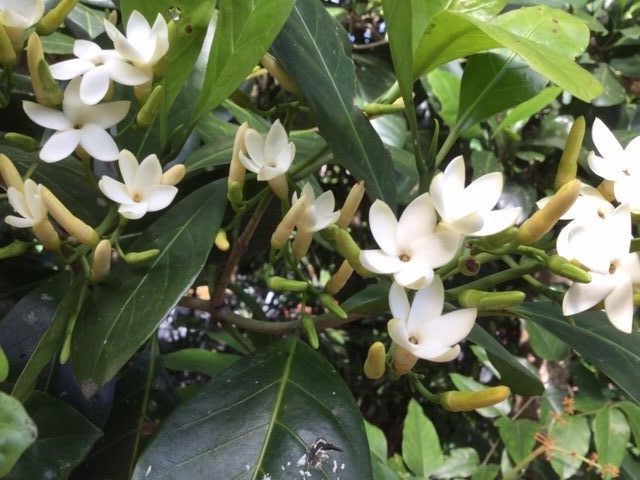
Len Cook planted this magnificent Magnolia more than thirty years ago.  Every winter since then, he has enjoyed the classical beauty and subtle, sweet perfume of the glorious, goblet-shaped flowers.

The Magnolia is a large genus of about 210 flowering plant species in the sub-family Magnolioidaceae of the family Magnoliaceae. It was named after the French botanist, Pierre Magnol.  It is an ancient genus, appearing before bees did and it is believed the plants evolved to encourage pollination by beetles.

The Magnolia has such an interesting history that it deserves a more detailed article devoted to it.  I shall endeavour to do this soon.

Text & Photos by Colwyn Campbell

Rainforest Tree of the Month, July 2020 – Davidson’s Plum

I have chosen Davidson’s Plum (Davidsonia pruriens) as the July Rainforest Tree of the Month because my attention was drawn to this tree by the abundant litter of large, purple fallen fruit on the ground beneath a tree near the Paluma Environmental Education Centre’s fire pit.  Investigating, I saw that the tree was well laden with bunches of fruit, some ripe and ready to fall while small green fruits were also strewn along the branches.  It was early in June when I saw the fruit but fruiting can occur at any time of year.

Although it is a rainforest tree, Davidson’s Plum is not endemic to Paluma.  It grows to about 18 metres high and is found from sea level to altitudes of up to 1095 metres from near the Big Table-land near Cooktown to Cardwell.  There are three species of this genus endemic to Australia, one occurring in Tropical North Queensland.

The name Davidsonia, named after a pioneer sugar-cane grower, J E Davidson is ironic given that so much of the lower level rainforest where this tree occurs, has been lost to cane-fields.  Pruriens, means itching or stinging and applies to Davidson’s Plum because there are irritant hairs on leaves and young fruit.

The large, hairy compound leaves of this tree are distinctive with deeply serrated edges to the leaflets and little leaf-like protrusions between the leaflets.  Both sides of the leaf are covered with fine hairs.

Flowering can occur at any time.  Flowers are tiny, with no petals but have four or five green or pink sepals.  The grow in panicles (bunches) from leaf axils or are cauliflorous (along the trunk) or ramiflorous (on the branches).

The fruit is a drupe, (fleshy), with two seeds   The developing green fruit is well covered in fine hairs which can cause considerable irritation and itching.  Ripe fruit is roughly oval to round, about five centimetres long, and is dark purple to almost black with a fine powdery, whitish bloom on the surface.   The flesh is dark pink.  Of the two seeds, usually only one is fertile.  The fruit is highly acidic, too tart to eat raw, although it was eaten by Aboriginal people, but It can be made into a delicious wine, jam or jelly. Cassowaries, Sulphur-crested Cockatoos and Double-eyed Fig-parrots eat the fruit.

A good example of the Davidson’s Plum can be seen at the forest edge behind Paluma Environmental Education Centre, near the fire pit.

Colwyn Campbell

In rememberance of Sue Rimington (1923-2020)

Sue Rimington passed away in May this year. She and her husband (Dr. Ron Rimington) owned the  house opposite the old police station, which they built around 1984 using the same local builder (John Grail)  who built Nick and Glenda Van Rynswood’s house. The Rimington family used to come up to relax on weekends occasionally and to enjoy the cooler weather. They loved nature and gardening.  Dr. Rimington’s association with Paluma possibly began with his Army Reserves service in the 60’s -70’s exercising in Paluma area.

Sue was a gentle, quietly spoken lady who dearly loved flowers and gardening.  Her interest in flowers got her involved in fund raising charity events and became a key person in the flower fantasies these fundraising events required. After Ron’s death in 1998, Sue moved to Brisbane.

The Rimingtons were members of the Paluma Progress Association and well known in the Community.  Their daughter and husband (Robyne and David Maguire) owned a block of land at the end of Hussey Road opposite Browne’s property .  Doc as we called him used to go out there and plant cardamom and they had some fruit trees.

One story I was told was that Doc one day went out on the block to pick a box fruit, stopping to go home for lunch. On returning he found the fruit out of the boxes onto ground.  He was quite puzzled by this but did not have to wait long before out came the culprit – a cassowary.

Sue’s early life was spent in the suburb of Camberwell in Melbourne and then Camperdown Victoria where her father was in a furniture business.  She went to primary and early secondary school in Camperdown before going to boarding school at Methodist Ladies College in Melbourne for her senior years.

Sue’s career was in nursing at the Royal Melbourne Hospital.  Melbourne was where she met and married her husband Ron and from here they both moved to Townsville so Ron could take up a medical position at the Townsville General Hospital.  Townsville is where they based their next 50 years.  They had three children, Scott, Robyne and Mignonne.

Sue had many interests  too numerous to mention but a couple come to mind one being how she  started a home decorating business and her logo was a large snail with the wording “Is your home getting on your back”.   The other one was later in life turning to painting and developed a style which seemed to be an extension of her real flair for colour.

She  spent her last 20 years in Brisbane surrounded by a large and loving family whom she adored.  Her  grandchildren and great grandchild have many wonderful memories to pass onto their children in the future.

I gathered some of this information from family and what I knew myself of Ron and Sue as Ron was my boss at the Commonwealth Pathology Laboratory and James and I became very close friends with them over many years. 

Always remembered,

Trish and James Jackson

An Early Bird Not So Lucky When She Swipes Left!

Jan and I are leaving in two weeks to head back to Northern Territory for a few months and have been expecting that this would mean we would miss the mating rituals of the Victoria’s Rifle Bird (Ptiloris victoriae) …..yet again.

But we got lucky on Friday when we came back from shopping in Ingham and barely had time to sit down before a different call from a male VRB made us check out the feed tray and tree fern post out on the verandah. 

And there he was, getting right into it … a very early bird by the entries in bird books which list the VRB breeding season as September to January, obviously with male competition for female partners pretty much done and dusted before our usual return to Paluma in late October. 

We got lucky, but Mr Riflebird wasn’t so lucky, despite a very intense performance on top of the tree fern.  

He started calling with wings upswept while facing the bushes off the verandah where VRBs, Honeyeaters, Catbirds and Satin Bowerbirds queue for the fruit buffet. 

Still photos unfortunately don’t show the movements that go with each pose … with wings up, he kept in constant up and down motion by bending his legs while at the same time opening and closing his beak to get the bright yellow gape into the display. 

Things were looking good when a female landed on the tree fern just below him and looked up, at which point he dropped his left wing and played some peek-a-boo by hiding his head behind the right wing. 

Then the day’s ration of watermelon caught her attention and she dropped to the food tray. While he kept on with his performance she looked up, looked right but eventually swiped left, preferring watermelon to his advances. 

He was so intensely focused and hormonal that he paid no attention to me moving around on the verandah to get better camera angles. Light was fading and I had to crank up the ISO to 3000 to get a workable shutter speed. 

This morning I went looking for more information about VRB courting and couldn’t find much…except what would seem to be the seminal document on this subject written by Harry Frith and William Cooper and published in Emu, the journal of Birds Australia, now published by CSIRO. 

Great abstract online at:- https://www.tandfonline.com/doi/abs/10.1071/MU9960102, but if you want to read the whole article online it’ll cost you 50 bucks American… if you want to download that whole issue of Emu that’ll cost you $230 AUD. Universities usually have deals that get their people open access to academic publications but my university contacts couldn’t get free access via JCU or Monash. The hegemony of the ‘big boys’ in academic publishing is a very vexed issue, even for those working in the academy.  For the rest of us, bad luck. 

But back to the joyful experience of watching this display of unbridled avian lust.  In wings-up display, we get to see mauve feathers at the base of the wings and a mauve streak running back from the eye alongside the blue spangled cap.  Wow, I said!

What we didn’t get to hear was what Frith and Cooper describe as “a vigorous alternate wing clap display that all but embraces the female with rapidly alternating wing extensions and synchronous jerking of the stiffly rigid head and neck between them at a progressively rapid tempo until copulation.”

Clearly once she swiped left that wasn’t going to happen!

Here’s hoping we get to see a few more displays before we disappear towards the north west for a few months. 

Talking with other villagers today the question was asked about the apparently unseasonal courting behaviour … is this just a precocious individual bird or is this another sign of the “new normal” as we see more unseasonal animal behaviour and plant flowering and fruiting? 

Love to hear what unusual biological phenomena others are seeing??

Text & Photos by Peter Cooke, with Jan Cooke 

Footnote: For those unfamiliar with  the phrase “swiping left” Dictionary.com offers this definition: (On the online dating app Tinder) indicates that one finds someone attractive (or unattractive) by moving one’s finger to the right (or left) across an image of them on a touch screen. “I swiped right, but sadly for me, she swiped left”.

Further Information:-

Courtship Display and Mating of Victoria’s Riflebird (Ptiloris victoriae) with Notes on the Courtship Displays of Congeneric Species

Clifford B. Frith & William T. Cooper

“The courtship display and mating of Victoria’s Riflebird (Ptiloris victoriae) are described from numerous hours of direct observations and 117 minutes of videotape. Courtship display is typically performed on the apex of a vertical dead tree trunk stump and consists of three discrete components: Calling with the associated exposure of a bright mouth, a circular wings and gape display and a vigorous alternate wing clap display that all but embraces the female with rapidly alternating wing extensions and synchronous jerking of the stiffly rigid head and neck between them at a progressively rapid tempo until copulation. Subjective observations indicate that in immature, female- and sub-adult male-plumaged males the advertisement call is inferior in power and the courtship displays lacking in synchronisation and coordination of postures and movements. Victoria’s Riflebird courtship is compared with that of congeneric riflebirds and with other sexually dimorphic polygynous birds of paradise and similarities discussed. Contrary to previous views, the courtship display of Victoria’s Riflebird involves a progressive series of specific postures and movements increasing in tempo and leading to copulation. Some of its courtship behaviour is similar to that of other genera in the Paradisaeinae”.

Paluma Push 2020

After delays and uncertainties resulting from COVID-19  the Paluma Push for 2020 is now confirmed and scheduled for October 11.  

Visit the Paluma Push website for more information and bookings.

This year the event is being coordinated by Outer Limits Adventure, and Sam Stedman is keen to tap into the dedicated volunteers from Paluma who have manned the checkpoints in previous years. So please put this important date in your calendar if you would like to help out. More information will follow in due course.

More Winter Bird Watching at Paluma…..

Birdwatchers at Paluma continue to be delighted by the hive of activity amongst the local birdlife during these fine, sunny winter days. Here’s a further selection of birds seen and out and about in the village over recent days by Peter and Jan Cooke.

Golden whistler at Smith Crescent this morning.

Female Satin Bowerbird. When the light’s right the Satin Bowerbirds’ plumage shows such subtle variation. 
Male Satin Bowerbird.
Female Riflebird or young male?
Tooth-billed Bowerbird also spotted at Smith’s Crescent today.

All Photos by Peter Cooke.

Kelly Davis remembered

Kelly Davis was a good friend of Dorothy’s  and mine. His cheerful, friendly, generous nature was infectious.  

We had many wonderful holidays and fun times together; trekking, skiing, fishing, golfing, and playing  snooker, all of that Kelly excelled at, leaving me in his wake  despite my baulking and razzing.                                

Kelly’s extensive knowledge of fauna and flora enlightened and enthused our interest in the natural wonderland around Paluma.

Strong physically and in character, Kelly approached all difficulties pragmatically, applying his many skills and practical knowledge to problem solving, and generously helping others with advice and assistance when required.  Building many verandas in Paluma, including ours, Kelly started “veranda envy” in Paluma.

At Paluma Dorothy and I will sit at our “Kelly made” beautiful red stringy bark table on our “Kelly made” veranda and sadly, but fondly reflect the wonderful, inspiring impact Kelly has had on our lives.                      

                                   Dorothy and Peter Klumpp

Vale Kelly Davis – (a more detailed tribute)

Kelvin John “Kelly” Davis                           6 May 1945 to 5 June 2020

It is with sorrow that we report the passing of long time Paluma resident, Kelly Davis.  He died on 5th June after battling an aggressive illness.

Kelly was an active member of the Paluma community, generous with his help and expertise in many areas, from repairing a broken rocking chair to building a veranda, clearing fallen trees and debris from properties after cyclone damage, to helping dig a garden bed.  He was tireless in his assistance to Len at the annual Anagama kiln firing: cutting and stacking timber for the fire and helping to monitor the kiln temperature for the four or five days of the operation.  In everything he did, Kelly was attentive and thorough.  There are very few gardens that do not have bulbs donated from Kelly’s garden and many of us benefitted from the produce from his very successful fruit and vegetable plots.

Before coming to Paluma Kelly had lived in Mount Isa where he was employed by Mt Isa Mines and worked as a powder monkey, deep underground.  He and his family moved to Forest Beach where Kelly worked on line maintenance for Victoria Sugar Mill in Ingham. 

Kelly came to Paluma in 1987, where with his then wife Carol, he owned and operated the very popular Ivy Cottage tea room.  The business was sold in 1989 to Ann and Andy Bishop.  Kelly worked in a variety of roles for Townsville City Council and then for National Parks until his retirement.

Retirement did not slow him down however: he just spent more time helping people with various projects, and indulging in his passions for gardening, traveling, wood-turning, (many will have seen his beautiful wooden bowls), and fossicking.  Kelly also had an interest in quality wines and over the years built quite a collection, stored in the cellar he built beneath his house.

Kelly was a keen traveller, always interested in other countries and other cultures and learning about their history.  As well as travelling extensively within Australia, his many travels included voyages to Antarctica and the Arctic Circle, Europe, USA, the Scandinavian countries and most recently France, in late 2019.

The Paluma community will greatly miss Kelly.  Our condolences go to Kelly’s family and to Elizabeth and Marilyn in the loss of a person so dear to them all.

Colwyn Campbell

Seeking the Bridled Honeyeater !!

Honeyeaters are probably the most seen and most numerous birds in the Paluma village. Lewin’s Honeyeater, Macleay’s Honeyeater and the White-Cheeked Honeyeater are commonly seen. The Yellow Spotted Honeyeater is here also, but it is difficult to distinguish from the look-alike Lewin’s, other than by call. Paluma is also said to be at the southern edge of the range for the Bridled Honeyeater (Bolemoreus frenatus). 

Wikipedia says the Bridled Honeyeater is a North Queensland endemic with a range that extends from the Bloomfield-Mt Amos area, south to Mt Spec. Its favoured habitat is subtropical or tropical moist upland forests and subtropical or tropical rainforests, usually above 300 metres. But in winter, it descends to lower forests including mangroves, and can sometimes be seen in more open habitats. It’s said to be mostly solitary and elusive, but when trees are fruiting or flowering they may gather in large, quarrelsome flocks. 

Over the past four years of bird watching, Jan and I have seen the Bridled Honeyeater only twice, and not in down-town Paluma. Our observations have been recorded at Paluma Dam and out on Don Battersby’s little rainforest patch on his Hussey Road acreage block. The photographs below were taken at Don’s place in February 2017. 

So, although Bridled Honeyeaters are unlikely to be here in winter, it’s surprising we haven’t seen them over four successive wet seasons in and around the village.

We’re wondering what observations others can share about this interesting bird with its bi-coloured beak, bright blue eyes and distinctive white eye  markings. Have you seen the Bridled Honeyeater at Paluma?

Text and Photos by Peter Cooke

Rainforest Biodiversity: 5 Easy Species Part 9- Vines & Climbers

By Jamie Oliver

Vines (as well as woody lianas) are a common and defining feature of tropical rainforests. Because they rely on rapid overgrowth of other plants for support, they are most frequently found in disturbed areas where there is ample light for rapid growth. 

Vines and climbers share a growth form but (like animals that swim or fly) belong to many different and unrelated groups. They use a variety of methods to grow up from the forest floor and into the light near the canopy without having to invest in growing their own heavy and rigid trunks. Some climbers use thorns that catch on to adjacent leaves and branches, others use tendrils to clasp or twine around other plants, and others use modified roots to cling on to tree trunks.


1.    Climbing Pandan (Freycinetia excelsa)

The climbing pandan is a very common leafy climber found growing up trees in the rainforest and is easy to see along Paluma walking tracks. It is related to the large Pandanus palm-like trees seen in open forests along the coast. Leaves are narrow and pointed with fine teeth along the margin near the base. Some stems can also be found growing along the ground near the base of their host tree.

Fruit are rarely seen but are red to orange elongate clusters of seeds. Flowers are surrounded by orange leaf-like bracts.

A second species of Freycinetia (F. scandens) also occurs around Paluma. It can be distinguished by its much broader leaves, which have a more uniform length.


2.     Pothos or Candle Vine  (Pothos longipes)

Pothos is another very common climbing plant found growing up tree trunks along the village tracks. The distinctive leaves provide the inspiration for its other common name – candle vine. The leaves have a constriction near the apex, with the remaining apical leaf portion shaped a bit like a flame. No other climber has this leaf shape. Pothos are another very common climbing plant found growing up tree trunks along the village tracks.

The leaves get progressively bigger as plant grows and change from upright and pressed against the tree trunk to long pendulous and downward-pointing. Larger stems can also be found growing along the ground near the bases of trees.


3.     Yellow Lawyer Cane (Calamus moti)

 This is one of a group of climbing palms variously referred to as Lawyer Vine, Wait-a-while, or rattan. They are most frequently found in forest openings and gaps caused by fallen trees or cyclones.

 Several species of lawyer vine or wait-awhile can be found around Paluma. The most readily identified is the Yellow Lawyer Cane with its distinctive, robust, yellowish spines arranged in diagonal spiral rows along the cane stems below the leaves. The canes are often noticeably thicker than in other species. 

The other common species along the tracks is the Hairy Mary (Calamus australis), which has finer brown spines and a frond with broader leaflets.

Hairy Mary (Calamus australis

All species have palm-like leaves and spines growing from a sheath that covers the stem (cane). They also all have tendrils with vicious hooks emerging from the leaf bases. These tendrils hook on to adjacent trees which provide the support needed to climb up to the forest canopy.  In older plants the lower part of the cane loses its leaves and spines and becomes a tangle of smooth flexible canes winding along the ground and up into the trees. In this form they clearly reveal rattan cane – the material that is widely used to make cane furniture.


4.     White Supple Jack (Ripogonum album)

While this common vine has large bright green leaves, it is most easily identified by the leafless matt-green stems with irregular curved green spines that wind their way through the foliage at eye-level. The stems can be up to 3cm in diameter.

They are more common in areas that have been opened up to the light by a tree fall or along the margins of the rainforest around the village where there is ample light. There are some good examples of this vine along Lennox Crescent opposite the Paluma Pottery, and around the edge of the adjacent car park. Ripogonum has small white flowers and globular red fruit.


5.     Atherton Raspberry (Rubus probus)
Atherton Raspberry fruit

This rambling climber favours open areas and can be found in rainforest openings and at the start of the H-track on Whalley Crescent. There is another patch on the other side of the H-Track near the old fenced-off miner’s test pit and viewpoint over the adjacent creek.   It usually grows no more than a few metres high and tends to lean over adjacent plants rather than growing up tree trunks towards the canopy. 

R. probus has compound ovate leaves with 5-9 leaflets and the stems have widely-spaced fine thorns that are exceedingly sharp. The fruit looks like a small commercial raspberry.

There are 3 other species of native raspberry which can occur around Paluma and one of these (R. queenslandicus) is very similar, with slightly narrower and more pointed leaves. Based on leaf width,  most of the raspberry patches around the village appear to be R. probus, but it’s possible that some are R. queenslandicus. To be perfectly safe when casually encountering a raspberry around Paluma you can have a bet each way and refer to it as Rubus probus/queenslandica.   The fruit of both species is edible