The Yellow-Breasted Boatbill (Machaerirhynchus flaviventer) is a small flycatcher restricted to rainforest habitats in North Queensland. They are found from the Paluma Range north to Cape York. They tend to inhabit the middle storey of rainforests where they forage for food, mostly catching insects whilst in flight. They have a broad bill with long distinctive ‘whiskers’. The male bird has brilliant yellow and black plumage while the female is duller in colour.
From my recent conversations with some of our local bird watchers at Paluma it seems the Yellow-Breasted Boatbill is not commonly sighted at Paluma. This might be because this small bird tends to frequent the mid-high canopy in its search for food, or perhaps they are not locally common in the village?
On Sunday (11 July) I was lucky enough to come across some keen bird watchers and friends (Greg and Michael) who were eagerly photographing this male Boatbill (below) at the Village Green. The bird was flitting in and out of the canopy in the large trees at the western end of the Green. Greg has kindly shared the photographs below. If you haven’t yet seen the Yellow-Breasted Boatbill, keep your eye out next time you visit the Village Green. Just look for a flash of brilliant yellow way up high in the canopy!
Check out that broad bill…..!
Text by Michele Bird and Photographs kindly shared by Greg Calvert
On Saturday (10 July) I came across some rather spectacular bright purple fungi at the Village Green. There was only a small patch of these amazing fungi, poking up through the grass in deep shade. I can only suppose that the fungi might have popped up over night, because when I saw them in the early morning they looked fresh, bright and were vibrant in colour. They were easily spotted amongst the green grass. By next day and some 24 hours later, the fungi had faded to a dull brown-beige colour with only the merest hint of purple remaining around the very edge of the cap.
Bright purple fungi when first spotted on the Village Green last Saturday (10 July).
This website has featured many previous posts on the amazing diversity of fungi growing in and around the village – in various habitats from local gardens, along walking tracks and in deep rainforest. Checking these previous posts I can’t see any other examples of ‘purple fungi’ resembling those recently spotted on the Village Green. I did do a bit of googling in the attempt to identify these fungi, but being far from an expert, I gave up before too long. Can anyone help to identify these rather brilliant mauve mushrooms…..?
The first photo shows the bright purple colouring when the fungi was fresh. The second photo shows the same fungi the next day, with all the brilliant purple colouring now faded to dull brown-beige.
Jill Meads is currently fund-raising for the Children’s Cancer Institute.
She is collecting all recyclable cans, tins and plastic bottles – all those recyclables eligible for the 10 cent refund. If you have any recyclables to donate please drop them at 26 Mt Spec Road, or give Jill a call and she can pick them up.
It was a very busy weekend at Paluma (26 & 27 June) with a hive of activity going on around the place. The rather cool winter weather and the thick veil of mist that failed to lift for several days did nothing to dampen the enthusiasm for the range of activities on offer – from bush dancing, bike riding, bushwalking and shopping.
It all started on Saturday with the annual Paluma Bush Dance hosted by Wattle ‘n’ Gum. While the Dance this year was moved to the earlier time slot of 1 to 4 pm, a good crowd of more than 50 people gathered at the Community Hall to dance the afternoon away. Lynda and Don fed the hungry patrons with a pre-dance tasty sausage sizzle, which was a sell-out. From the hokey-pokey to the heel-to-toe, everyone had a great time dancing with their friends and family. We even had a visit from Sergeant Tony from Rollingstone who dropped in to say hello and sample the sausage sizzle. Barman Les was worked off his feet to keep everyone hydrated with their favourite beverages. The PDCA did a roaring trade with the sausage sizzle, bar takings and tea/coffee sales. Well done to all the Paluma community volunteers and a big thank you to Wattle ‘n’ Gum for the fantastic entertainment. Special mention goes to Jill, Suzanne and Anne who didn’t miss a single dance all afternoon!
After a good sleep on Saturday night, the action was on again first thing Sunday morning!
Sam and a very keen crew of bike riders left the village early and rode off into the mist to make a practice run for the upcoming Paluma Push. Other visitors to the village took off on bush walks and bird-finding expeditions.
At 9 am the Paluma Market opened with Lynda and Don firing up the BBQ yet again for another sausage sizzle. Stallholders at the market reported steady trade for the day. There was a range of goods on offer to buy from plants, books, cards, jewellery, spices and condiments, handmade arts and crafts, fruit and veggies and home-baked sweet treats. Tea/coffee sales went well, boosted by Jill’s delicious fruit and nut slice (many of us ate more than our fair share!). Jill’s fund-raising for the Children’s Cancer Institute was a success and raised important funds for the charity. The winner of the ‘pick the numbers’ competition on the day was Catherine (the Spice Lady from Ingham).
All in all a very busy and action-packed weekend was had in the not-so-sleepy little village of Paluma. I don’t know about everyone else, but I need to go back to work for a rest after the weekend!
Check out these photos of some of the action over the two days…………
Roy Bird really enjoyed the sausage sizzle at the Market.
So did Colwyn and Sonya!
Text by Michele Bird. Photos by Michele, Sonya and Gail.
Don’t forget to come along to the Bush Dance at the Community Hall this Saturday afternoon. There will be a sausage sizzle starting at 12pm and the music will start up at 1 pm. Bring a gold coin donation in lieu of admission and extra cash for food and drinks.
Wilfried is having his septic tank pumped out next Wednesday morning. If you would like yours done at the same time and share the costs, please contact Wilfried direct on 0447 822 626.
It is with sorrow we report the passing on Saturday, of Bill White after a courageous battle with an aggressive form of cancer.
Bill was the former owner of No 8 Mount Spec Road and was a regular weekend visitor. It was always a pleasure to be in his company, enjoying his good humour and interesting anecdotes. He will be sadly missed by his many friends in and around the village.
Our condolences and loving thoughts go out to Carol and the family.
The species name “glomulifer” refers to the flowers and derives from glomulus (little ball) and -fer (bearing). Turpentines can refer to any member of the genus Syncarpia, which is a member of the Myrtaceae family
There are three Syncarpia species all of which are endemic to Australia. S. glomulifera is the most widespread as is simply referred to as Turpentine, while the other two, S. hillii (Satinay or Fraser Island Turpentine, and S. verecunda (Red Turpentine) have more limited distributions. The habitat most commonly associated with Turpentine is a transitional forest between rainforest and wet sclerophyll forest and woodland, in altitudes between 40 to 1100 metres. It is found from the Big Table-land near Cooktown to southern NSW. It grows as an emergent tree among other popular timber trees such as grey ironbark, tallow-wood, brush box, grey gum, red ironbark, mountain mahogany, spotted gum and various rainforest trees. Here, Turpentine can be seen in the vicinity of the rose gum forest west of Paluma.
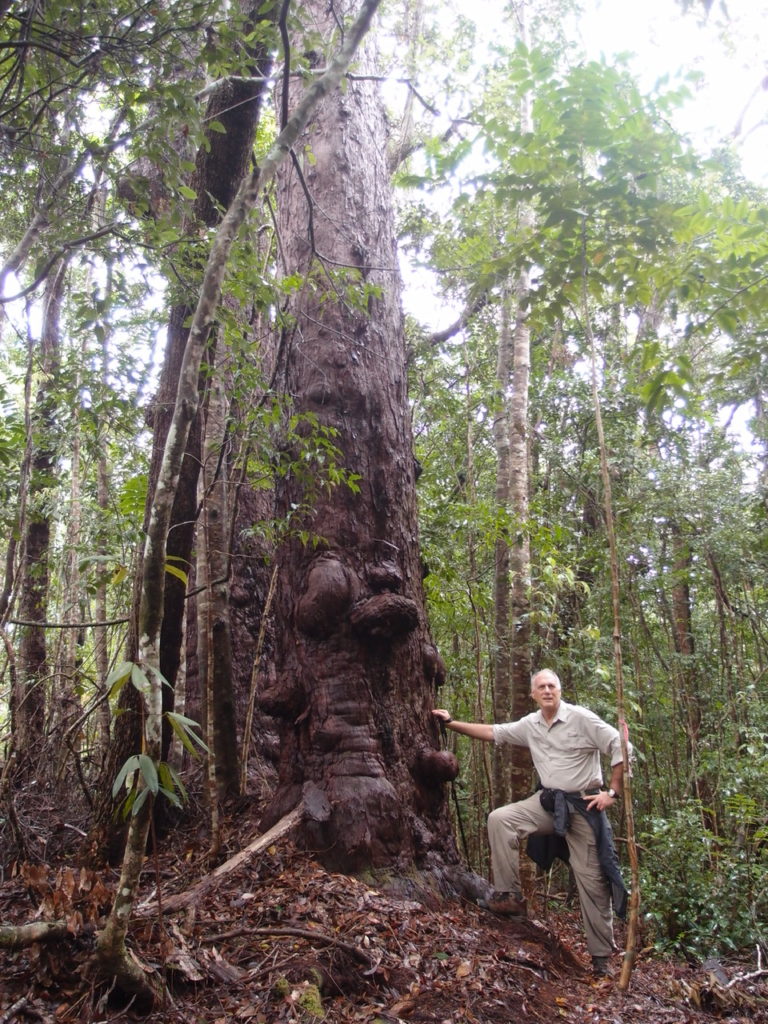
Tall and straight trunked, Turpentine is a vigorous grower and can reach a height of 25 to 60 metres in tropical areas. The trunk can attain a diameter of 1.5 metres. Its bark is coarse, fibrous and deeply furrowed; new twigs are hairy. It is also a long-lived tree and some specimens are said to have reached 300 years.
The elliptic leaves are simple, opposite or whorled. 30 – 110 x 14 – 45 mm in size. The upper side is glabrous or minutely hairy while the under-surface is covered in white hair, with brownish oil dots visible with a lens. The leaves are mid green, red when young, with wavy margins. They are aromatic when crushed and this aroma reminded early settlers of turpentine, hence the common name.
Syncarpia glomifera flowers photo by Casliber CC by SA 3.0
Syncarpia seed capsule (about the size of a marble)
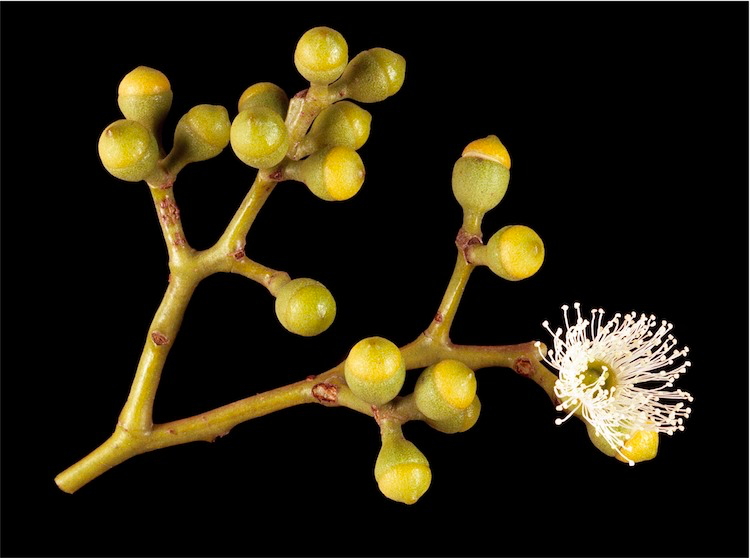
Flowering occurs from August to February. The fragrant flowers are clustered in axillary or terminal heads. The flower has four or five white or cream petals and fine filamentous white or cream stamens, similar in appearance to many Australian native flowers. They are very popular with pollinators like European honey bees, native bees, grey flying fox, little red flying fox and birds such as lorikeets.
Fruiting occurs between November and July. The grey or brown fruit is an aggregate capsule 10 – 12 mm long and 12 – 22 mm wide. There are usually seven valves containing numerous orange/brown seeds about 2 mm long.
Turpentine was much sought after as a hardwood with its reddish-brown colour ranging to a deep chocolate brown and its coarse even texture with a straight grain. It is an excellent timber for dance floors. It is also used in the construction of plywood, laminated beams, bench tops, joinery and parquetry, boat building and wine casks. Because the timber is fire resistant and highly resistant to termites, marine invertebrates and borers, it was much in demand for piers and building foundations. During the War years, Archie Taylor cut two turpentine logs over 100 ft long (one was 128 ft) for an American Radar station. It took several days to get the logs down the Range to Moongoobulla.
The area around Paluma was heavily logged, especially during the War-time years. So much so, that there are not even any relict trees known on the H Track or surrounding area. There are however, several fine living specimens in the vicinity of Hussey Road and around the Blackfriars district. Around Taravale there are many young trees.
Although the IUCN Red List status of this species is the lowest category (Least Concern), in NSW, the Turpentine-Ironbark forest of the Sydney Basin Bioregion is now listed as endangered or critically endangered in the Threatened Special Species Conservation Act, NSW, 1995 as are all the communities with which the Turpentine-Ironbark forest vegetation intergrades. The Commonwealth also lists the Community as critically endangered under the Environmental Protection and Biodiversity Conservation Act, (Commonwealth) 1999. The fate of these trees is an example of how easily and quickly human activity can change an environment and the habitats of many insects, birds and animals.
Turpentine trees have been introduced into Hawaii, Africa, New Zealand, and the Cook Islands and the species is considered an invasive weed in most of these areas.
For detailed information on the timber industry around Paluma, I recommend Linda Venn’s book ‘Paluma: the First Eighty Years 1870’s to 1950’s.’
Next time you drive out to the rose gum forest, see if you can identify the turpentine among the gums, stringy barks she-oaks and other trees.
Text and photos (unless indicated) by Colwyn Campbell
After some fears that the Bush Dance might have to be cancelled this year due to lack of accommodation, we have rescheduled the event to earlier in the afternoon (1-4pm) so that people can come up for the day and still get back to town before dark.
There will be a sausage sizzle before the band starts up (12pm) and the bar in the hall will be open so you will be able to enjoy a drink and a snack while listening to some great bush music or join in the dancing.