Paluma Bird of the Month, April 2025 – Pale Yellow Robin

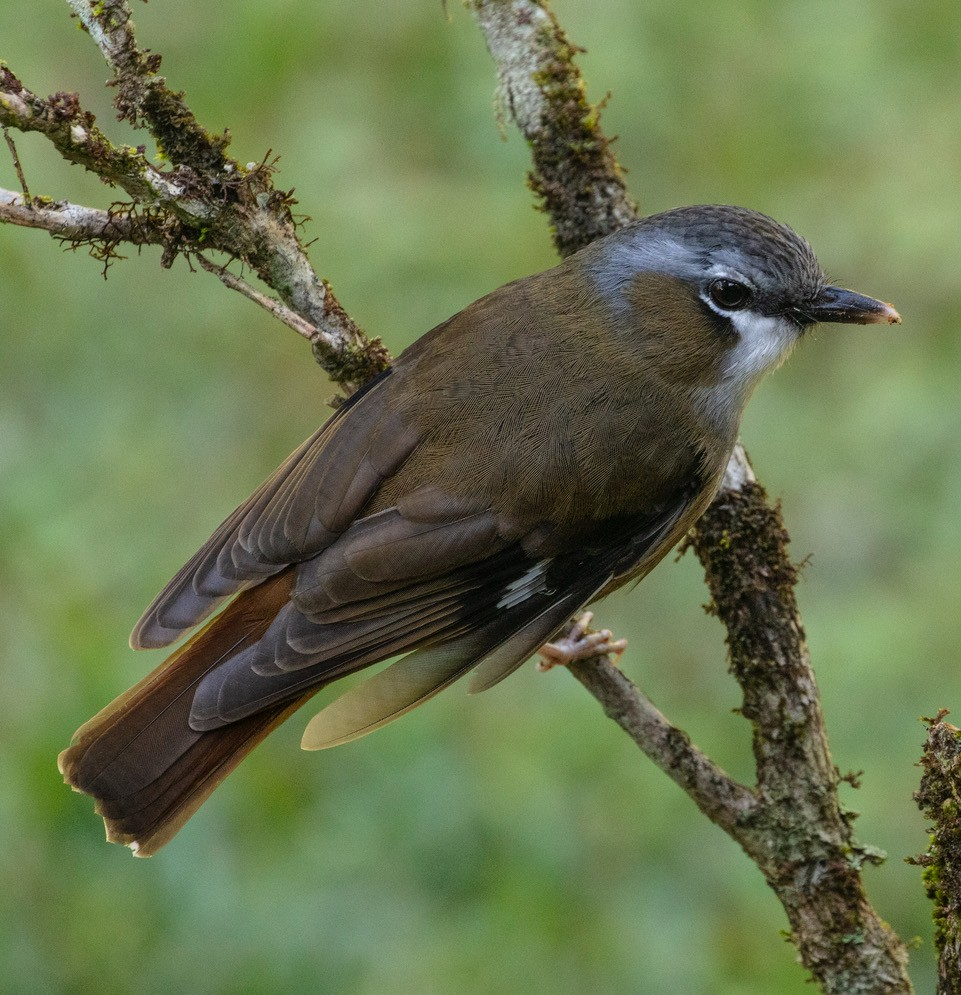
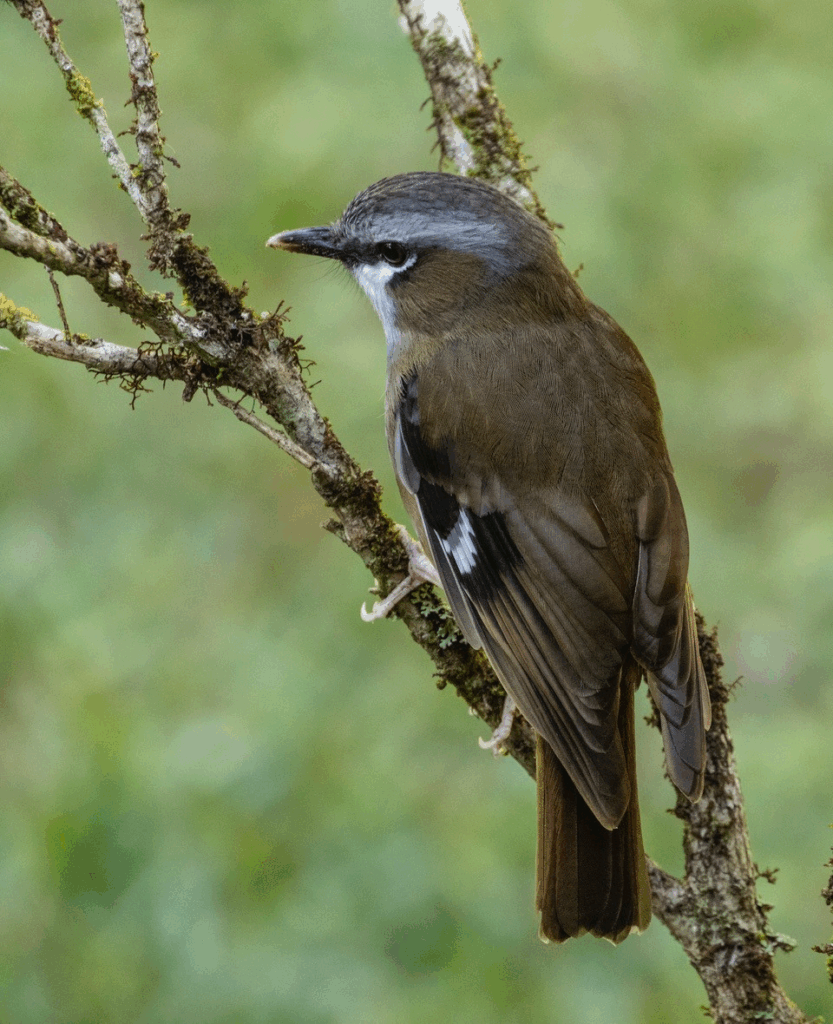
The e-Bird website describes the Pale-Yellow Robin as “a rotund little robin, olive above, with gray head, yellow underparts, and white around the base of the bill”. 

Our picture illustrates its common feeding behaviour: “Perching on low branches and on the side of tree trunks, from which it drops to the ground to capture prey”— in this case a nice fat worm on the gravel near the Village Green toilets..

Pale-Yellow Robins are very similar in appearance to Eastern Yellow Robins but Pale-yellows are smaller than Eastern Yellows (12 cm in length as opposed to 15) and have morewhite around the beak and throat. The Eastern Yellows have black legs, more vibrant yellow plumage and a longer tail. 

There are two sub-species of Pale-Yellow Robin. The nominate and southern race is Tregellasia capito and the northern race is distinguished by addition of a sub-species name nana — latin for dwarf. 

The northern sub-species is found from near Cooktown to Paluma and the southern ones are found between Barrington Tops in NSW to the Mary River in Queensland. 

Pale yellow Robins are sedentary and favour rainforests and dense eucalypt forests, particularly where lawyer vine is found. 

They use the prickly lawyer vine (Calamus muelleri) as nesting material and as a nest site. The nest may be anywhere up to 10 m above the ground, though often much lower. Breeding season is July to December with one, or sometimes two, broods. A clutch of 2 oval eggs, measuring 20 by 15 millimetres (0.79 in × 0.59 in), is laid. They are pale green, splotched with brownish marks. 

Smith Crescent has a great variety of rainforest species, some regulars and others occasional. Jan Cooke saw a Yellow Breasted Boat bill there last week and a few years back a Rhodesian birder got good shots of a Paradise Kingfisher well above its usual altitude. .

Photograph by Peter Cooke.
Text assembled by PC from various plagiarised sources.

Community Meetings and BBQ now scheduled for April 12th.

Prior to the meetings below the PDCA will provide a BBQ lunch at noon, April 12th at the Community Hall

A community meeting to review our experiences during & after the February extreme weather event will now be held on Saturday, 12th of April, commencing at 1 pm in the Paluma Community Hall. The objective is to record lessons learnt for the future, discuss known problems & see what we can do to improve how we manage such events. All members of the community are encouraged to attend. See agenda here.

If you are unable to attend but would like to have a specific issue included for discussion, feel free to contact Charlie Allen, Peter Cooke, Anneshka Brown or Jamie Oliver to let them know.

There will also be a regular meeting of the PDCA Council at 3pm, after the community meeting. This PDCA meeting will cover various ongoing items (see agenda below). While these meetings have traditionally been considered as business meetings attended only by the elected members of the Council/Executive, we welcome any residents to attend and to raise any items that they would like the PDCA to consider in addition to what is already on the agenda. Here is the proposed agenda.

What a Poser!

Peter and Violet were heading down to Ingham yesterday when they came across a Boyd’s Forest Dragon (Lophosaurus boydii) in the middle of the road out near Graham Pope’s place.

The dragon wasn’t bothered by being the subject of an intense photo session, first by Peter and Violet, and after that by Jan and me when we got out there after a call from Peter and Violet.

It remained motionless even when we got down to take close-ups from only about 30cm away.

Adult male dragons are about 48cm and females around 42cm but this one was around 30-35cm and probably a juvenile.

L. boydii is restricted to rainforests and their margins in the wet tropics, from just north of Townsville to near Cooktown. It is found in both upland and lowland rainforest, and is often seen around Lake Eacham and Lake Barrine.

Unlike most other lizards, Boyd’s forest dragon does not bask in the sun, instead letting its body temperature fluctuate with air temperature thermoconforming rather than thermoregulating.

Boyd’s forest dragon spends the majority of its time perched on the trunks of trees, usually at around head height, although daily movements can exceed 100 m (330 ft) on the ground.  After being motionless for maybe half an hour, it took a nudge with a stick to encourage it to get off the road. When it moved, it moved very fast, semi upright with front legs off the ground and back legs pedalling like crazy.

Thanks to Peter, Violet and Wikipedia.

Photos and text submitted by Peter Cooke

A visit from the limbless snake-toothed skink

Early this week a curious reptile turned up at the “top border gate” blocking the range road. It parked up on the bitumen while many photos were taken.

Three ecologists/herpetologists were consulted and all agreed this is a healthy and happy specimen of Coeranoscincus frontalis — aka the limbless snake-toothed skink.

It currently sits within the Coeranoscincus genus but ecologist Nic Gambold believes it may be on the way to getting a genus of its own. Amongst the professionals taxonomy and peer review moves slowly but carefully.

Michelle Bird’s herpetologist mate Greg Calvert commented that it’s a rare day he ever sees one of these and the good news is that after being listed as a threatened species for many years it has now been reclassified as “least concern”.

Jamie Oliver found one here in 2023 and posted pictures and a story on Paluma.org.

C. frontalis is a Wet Tropic Species, but other members of the Coeranoscincus genus are found much further south.

C. frontalis at around 29cm (nose to vent) is the longest species in the genus. Our visitor was probably between 30-35cm overall, so quite a big one.

C. frontalis hangs out in the rainforest under logs and leaf litter and worms are a favorite food. I guess the reference to snake-toothed means it’s well equipped for this task.

Unlike a number of other legless lizards which have visible vestigial legs, C. frontalis has no sign of legs.

Eventually, the specimen at the range gate decided to move on but just couldn’t get any traction on the wet bitumen and needed a lift into the verge. It then quickly headed back to the privacy of the rainforest, but not before revealing the strong orange/yellow underbelly and other attractive markings.

Story and pics by Peter Cooke,
with thanks to Nic Gambold, Laurie Ross and Greg Calvert.