What’s Blooming at Paluma – Giant Climbing Orchid

A spray of flowers – Giant Climbing Orchid

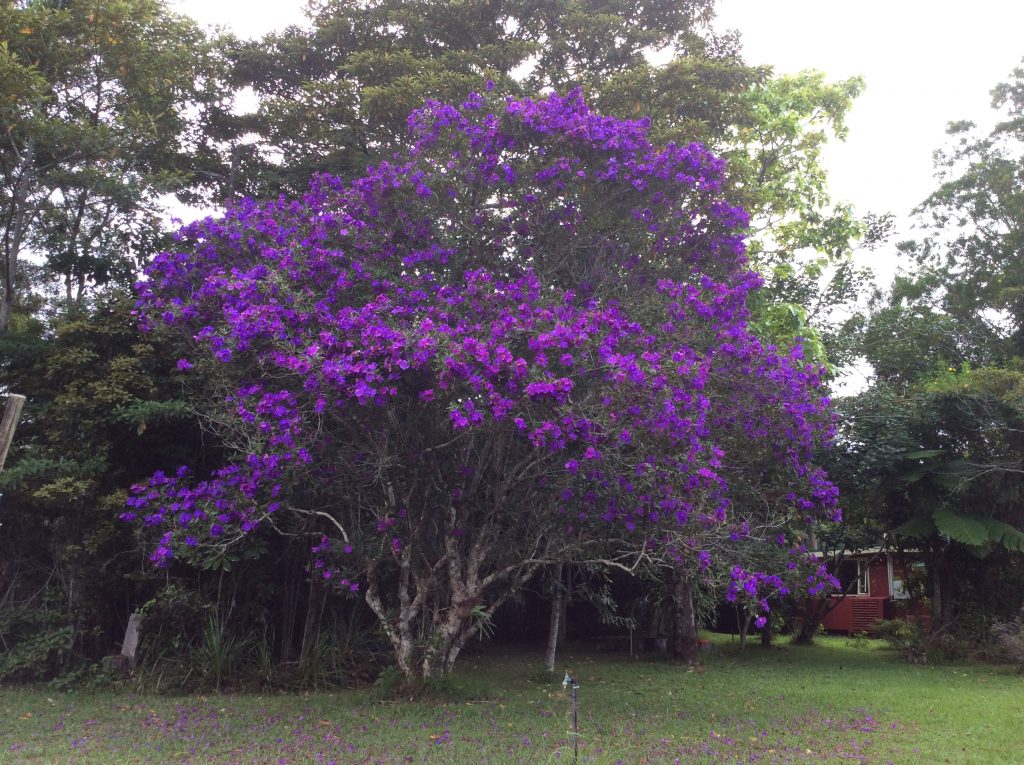
As mentioned by Michele a couple of days ago, there is currently a rather spectacular orchid flowering on the H-Track. It is the Giant Climbing Orchid (Pseudovanilla foliata) Apart from its beautiful flowers (in copious quantity), this orchid is also special in that it has no leaves. It is one of several species of saprophytic orchid that derives its food from rotting wood rather than from photosynthesis. This particular species is not often seen around Paluma since it spends most of its life as an inconspicuous tangle of stems climbing up dead trees – it flowers only briefly. Once the logs and dead trees that it feeds off have fully rotted away it dies off. Wilfred Karnoll informs me that after cyclone Yasi these orchids made a brief appearance in a few locations along the walking tracks near the village.

Flowers are produced in great numbers for a limited period. they have a faint but pleasant scent.
The roots penetrate rotting wood

While this orchid has green stems and may be able to make a small amount of food for itself, it is unlikely to able to grow and produce masses of flowers on this energy source alone. Most saprophytic orchid lack any green colour, and thus do not need (and cannot use) sunlight to obtain food. One group of these orchids has completely forsaken sunlight and spends its entire life, growing, flowering and fruiting underground – never seeing the light of day!

Technically saprophytic orchids do not directly feed off decaying wood and vegetation, but derive their food from a close symbiotic relationship with fungi that do all the hard work of breaking down the fairly indigestible wood and then provide it directly to the roots of the orchid. Whether this is a mutualistic relationship (with both obtaining benefit from the exchange) or a parasitic one (with the fungi being robbed of fuel it would prefer to use for its own growth) is not fully understood. So far, research on this matter appears to have failed to show any clear benefit to the fungi.

After reading a bit more about orchids on the web I discovered that the relationship between fungi and orchids is widespread and devilishly complex. Virtually all orchids rely on fungi for seed germination. Orchids produce seeds that are microscopic in size (they make up for this by producing prodigious numbers in each seed capsule). These seeds are so small that they do not have the energy reserves that all other seeds use to fuel the cell division needed for germination and subsequent growth of the first green leaves that will manufacture new fuel from photosynthesis. These tiny seeds rely entirely on fungi for that germination energy. Some orchids have been shown to have an ongoing obligate relationship with fungi, while others shrug off this reliance once fully developed. A further twist in the orchid-fungi story occurs in some species, where the fungi that the orchid derives its food from, is itself deriving its fuel from the roots of certain tree species. Thus we have sunlight being turned into food high up in the forest canopy and then being transferred down to the forest floor, into fungi and then into the saprophytic orchid!

Text and Photos by Jamie Oliver

Paluma Tropical BBQ and new Hall lights mark the start of the Christmas season

On Saturday we had very good attendance at our Tropical BBQ including a couple from Townsville who happened to be up for the weekend. There was a variety of salad, and deserts and plenty of meat to go round. Les the barman made sure there was plenty of social lubricant available to add to the enjoyment of the evening. Photographic evidence of the event is unfortunately scarce. Yours truly was too busy catching up with people and providing his usual inept services as a relief barman and totally forgot to take pictures. We did manage to get a shot of the last of the crowd at the end of the evening.

This year, for the first time, the exterior of the hall and the gazebo were decorated with Christmas lights that definitely provided a festive look to the area that could be seen from the Mt Spec Rd as well as Smith Crescent. Many thanks to the Townsville City Council’s “Christmas Together ” initiative which provided funds for the purchase of the external lights as well as eskies to ensure we could keep our meat and drinks cool.

New Christmas lights provided a festive look to the Community Hall courtesy of the Townsville City Council.

Whats Fruiting in Paluma this December? – Coral Mushrooms

Michele recently documented some plants that are flowering around Paluma late in the dry Season. One would normally not think of looking out for mushrooms at this time of year, with the forest floor about as dry as it ever gets, and most fungi either totally absent or, in the case of bracket fungi, persisting as dried-out colourless husks clinging to logs and tree trunks. However there is one group of fungi whose fruiting body (what we call a mushroom) make a regular occurrence at this time of year and they are really quite spectacular in their shape. They are called coral fungi (most of them in the genus Ramaria), and as a coral biologist I can attest that they bear a striking resemblance to true corals.

Ramaria sp

I have seen two fine specimens of coral fungi in the last few weeks. One on the track to Witt’s lookout (above), and the other at the cutting outside the gate to 28 Mt Spec Road. They are probably gone now but there should be others coming up over the month around the village and adjacent tracks.

Ramaria sp

Coral fungi, despite there impressive appearance have not been well documented in Australia. According to the Qld Mycological Society, there are only 19 described species of Ramaria in Australia, but “… it is quite possible that the total number of species of Ramaria found to occur in Australia will be over 100.” None of the 18 recognised species in Queensland looks similar to the ones in the photos here so it is quite possible that these specimens are are an undescribed species (or tw0)!

Text and photos by Jamie Oliver

Roy’s Nature Notes Re-visited

We all mourned the passing of Roy Mackay this year. He made a major contribution to Village life, and is perhaps best remembered for his regular articles in Turkey Talk under the banner of “Nature Notes”. These articles contained a wealth of information on the comings and goings of local plants and animals, but also wandered into philosophical musings and historical anecdotes. While its possible to use the online Turkey Talk archive to look up past Nature Notes articles, I thought it would be useful to compile all of them into a single document that can be perused at ones leisure or used to look up accounts of particular species or events. After a few stops and starts during the year, this compilation is now completed and available in our Documents Library in the Nature section.

The compilation lists all nature-related articles published by Roy from 2011 up til the end of 2018. Some of the early contributions had different titles, but the majority used the familiar “Nature Notes” banner.

I enjoyed putting this booklet together and reading through all the past contributions. I learned a lot and got to feel I knew Roy better as a result. I hope you will take a moment to look through it. There is a subject index, but if you are reading the pdf file on your computer, you can use the Find function (Ctl-F) to look for occurrences of any word

Happy Browsing!

Jamie Oliver

Night shift at the Paluma bird-feeder

Late last Friday night when I went to turn out the lights before bed I noticed some movement in our bird feeder and realised that we had a nocturnal thief chowing down on some leftover mashed dates. I have often noticed distinct non-bird droppings in the feeder when cleaning out the dish and had suspected a native rat was the culprit; and I was right. Here it is looking quite at home and not at all concerned about my iPhone sticking out the louvre window at him.

Its nice to see one of our native mammals as they are not easily spotted unless you get out at night with a spotlight in your garden or on the tracks, where bandicoots and pademelons are regulars.

Short video of our nocturnal visitor

While this is clearly a rat, I am not at all confident what species it is. However the possibilities are not that large. To my understanding there are basically 3 species of native rat that are common in the rainforest around Paluma (and no non-native ones thank goodness). The white-tailed rat that wreaks havoc with local garbage bins can be eliminated based on size and tail colour. The video above shows that tail is uniform and brownish grey, and it’s not nearly big enough for a white-tailed rat. That leaves the Bush Rat (Rattus fuscipes) or the Fawn-footed Melomys (Melomys cervinipes). My guess is that this is the Fawn-footed Melomys. The Bush Rat tends not to climb as much as the Melomys (its a bit tricky getting up to our feeder) and it also has a fairly distinctive pattern of circular ridges on its tail (see photo below of a Bush Rat) that I could not see in the albeit soft focused video. Perhaps someone can offer a more knowledgeable identification?

The Bush Rat has a distinctive pattern of circular ridges on its tail as can be seen on this individual seen at our house last year.

Text and photos by Jamie Oliver

PDCA Matters

Changes to the PDCA Executive Committee.

Recently Michele Bird resigned from the position of PDCA Secretary due to work commitments. Michele did a fantastic job in this role and put many hours into ensuring our meetings were recorded accurately and promptly. She was also an effective and thoughtful voice in many of our discussions on important issues affecting Paluma. Many thanks Michele!

Michele has also been a prominent and prolific contributor (and co-editor) to our new website. I am delighted that she has indicated that she will continue in this role.

Fortunately, we have been able to find a highly capable new Secretary in Anne Bruyeres. Ann has a long association with Paluma and I am sure she will be a great addition to the Executive Committee. Welcome Anne!

The updated list of PDCA Executive members can be found here

Jamie Oliver

A record of accomplishments

Our numbers for paid up membership this year are a bit down compared to previous years, and we hope that this is more a matter of forgetfulness than a lack of support for the PDCA and its efforts on behalf of the Paluma community. However the Executive Committee also felt it would be worth documenting the various efforts and achievements of the PDCA in recent years. It turned out to be a fairly impressive list and we would like to share that with all of you, and also let you know what our priorities are for the next 12 months or so. Hopefully this list will help reassure paid members that their dues are a worthwhile investment into ensuring we maintain Paluma and a fantastic place to live or to retreat to on weekends and holidays. We also hope that those of you who have forgotten to join this year will be motivated to do so – you will be receiving email reminders shortly! Or you can click here to download a renewal form.

If you have any thoughts or ideas on how the PDCA can better contribute to the Community, or what our priorities should be, please don’t hesitate to contact any of the executive by email, or phone. Or you can add a comment to this post and start an open conversation.

PDCA Achievements/Activities over the last several years

Lobbying local and state government to achieve more favourable policies or better facilities around Paluma

  • Strongly opposed proposal to re-open Paluma Dam for motorized boats
  • Extended campaign to improve quality of drinking water in Paluma
  • Joint meeting with TCC and Transport & Main Roads to discuss need for more coordinated clearing of roadside vegetation, effective management of road closures
  • Holding various community meeting to discuss important issues and to communicate to local government
  • Key outcomes include:
    • Council decided not to pursue the opening of the dam for motorboats
    • Sealing of initial part of Hussey Road
    • More timely maintenance of Paluma Dam road potholes and erosion ditches
    • Paluma Water issues and new water treatment plant -– resulted in commissioning of a new $300,000 water treatment facility in 2018
    • Agreement with TMR to include significant upgrades to the Range Road in the next budget for major road works
    • Installation of rubbish bins at Crystal Ck. Picnic Ground and additional bins in the Village Green – TCC liaison.
    • Repair of Loop Rd. retaining wall by TCC
    • TCC funded free Wi Fi facility at hall/Village Green
    • Liaison with TCC re design and equipment choice for new playground and moving the footprint out of the PDCA lease area.
    • TCC installation of a new technology sewerage system at public toilets in Village Green- PDCA campaigning to overcome leakage issues.
    • Re-siting of the public playground to ensure it was not on PDCA leased land, thus avoiding a liability issue
    • TCC resurfacing of bitumen road from village to Dam turn-off

Successful applications for funding for new facilities

  • New Telstra mobile phone tower – 2018
  • Contributions for funding of the new Community Hall extension obtained from Qld Gaming Commission ((Through the Paluma Rural Fire Brigade)
  • Grant for the establishment of the Paluma History Display
  • Grant for Replacement of hall chairs and gallery fittings.

Activities that improve village facilities or enhance community coherence amongst residents or provide important target activities for visitors

  • Contribution of $23,000 from PDCA fund raising activities towards cost of hall extension from past PDCA
  • Various social evenings/meals throughout the year
  • Quarterly publication of “Turkey Talk”
  • Paluma Garden Competition
  • Regular Sunday markets and BBQ
  • Paluma History Display most Tuesdays
  • Making the hall available for external hire by relevant groups
  • Assisting with successful signature events such as the annual Paluma Push and Dam Good Run
  • Establishment of the “Trees in Memory” grove on the village green, together with memorial stone
  • Signage for the Andreé Griffin Track and official launch
  • Bruce Plant Memorial function at the Community Hall and the Plant Memorial stone installation and Service. Assisted by a RAAF grant and donations
  • Art Exhibitions promoting local and district artists
  • Liaison with National Parks re refurbishment of Crystal Ck. Picnic area and McClelland Lookout facilities and maintenance of existing walking tracks
  • Promoting Paluma through regular posts on Paluma.org and providing additional resources through our members only pages
  • Organizing working bees to help maintain the Community Hall and surrounding grounds
  • Installation of the PDCA Honour Board in the Community Hall

Future Plans

With continued support from PDCA memberships and community volunteers, the PDCA hopes to achieve even more in the next 1-2 years. Current projects in various stages of conceptual development include:

  • Enhancement of roadside verges with plantings of appropriate species that showcase Paluma’s unique climate
  • Creation of new garden beds and hedges around the Community Hall
  • Development of enhanced signage and interpretation along local walking tracks
  • Construction of a walking loop and viewing platforms along around the village weir to highlight the various flora and fauna (including platypus, water dragons, rainbow fish and key flowering plants)
  • Development of a new annual or biennial event(s) that incorporates elements of previous events such as the Paluma Rainforest Festival, Ephemera in the Mist and Paluma Art Exhibition etc.

A Game of Bowers

While Michele has described the efforts of our local Satin Bowerbirds in attracting a love interest, in the surrounding forest another Bowerbird, the Golden Bowerbird (Prionodura newtoniana), is also busy constructing bowers that are the largest of the all the Australian bowerbirds, and they are made by the smallest species. Despite its diminutive size, the Golden Bowerbird creates twin towers of twigs that can be up to 3m tall. It decorates them with lichen and pale cream flowers and places a horizontal stick between the base of the towers to serve as a display perch.

Golden Bowerbird at his bower

The bower. The perch is the small stick just visible near the bottom. Note that this picture was taken a week after the previous shot and the lichen ornamentation has been shifted by the male.
The male often perches in a nearby tree looking out for females or other marauding males

It takes a fair bit of work to make these bowers and it turns out that other males (including young males still experimenting at bower-building) are prone to stealing material and ornaments from other bowers to build their own. Immature males sometimes build small bowers close to a more established structure in the hope that they can distract a female over to its more humble edifice while the dominant male is away foraging or stealing from other bowers. If a mature bower-owning bird dies, his bower is usually taken over by another bird in matter of days. One recent study used game theory to determine at what point the pay-off from raiding other birds bowers exceeded the risk of abandoning a bower to other marauding males (distance between bowers was a key factor). The competition and intrigue is worthy of a Game of Thrones plot-line.

An immature male Golden Bowerbird discretely approaching the bower
Immature male at the bower just before being attacked by the resident male

Last week, while photographing one of our local birds, I observed a small dull bird flitting ever closer to the bower through some dense foliage. I thought it might be a female, but I was able to get a shot of it as it took off from a branch just behind the bower and this clearly showed the yellow tinges to the wing that are diagnostic of an immature male. This immature male then went straight to the perch between the two towers of the bower and began inspecting the ornamentation. In a flash the mature male bower owner dived down and the two birds tumbled off into the ground foliage behind the bower in a flurry of feathers and screeches that lasted several seconds before the birds flew off in different directions. The younger bird was not seen again, but I can’t help but feel it is out there somewhere awaiting another chance to steal the throne and the females.

.

.

.

A small single towered bower made by an immature male less that 15m from the established bower

Don Battersby is our local bird-whisperer -actually it’s more of a shout, but the birds certainly come flocking to his call. When I told him about my observations he regaled me with a complete history of this particular bower, which has occupied at least 4 different positions over the last decade or so, having been abandoned due to damage by tree-falls or in response to over-enthusiastic bird photographers. He was also kind enough to show me a small satellite bower near the site where I had witnessed the altercation. This might well have been built by the immature male that I had seen.

Don knows where virtually all the bowers, and some of the nests are. He is exceptionally generous with his time and is known nationally and internationally amongst “birdos” as the person to visit if you want to get good views and photographs of our rainforest birds. Thanks Don!

Text and photos by Jamie Oliver

Marauding Gangs Invade Paluma

Over the last few weeks, increasing numbers of Pied Currawongs, Strepera graculina, have arrived in Paluma. The onomatopoeic name currawong reflects the liquid, ringing tone of their call, heard all day throughout the village.

Pied Currawong

The currawong is a large, (42-50 cm long), handsome, black and white bird, with yellow eyes and a lilting, liquid warbling call. But do not be beguiled by the good looks and melodious carolling. Beneath the beauty lies a rapacious nature. Currawongs plunder the nests and feast on the chicks of other birds. The cruel beak says it all.

Currawongs are similar in appearance to magpies and butcher birds, and were once known as crow shrikes or bell magpies. They are found throughout eastern Australia from North Queensland to Victoria in diverse habitats including woodlands, coastal to alpine forests, rain-forests, scrublands and farmlands. They often form large flocks and are seasonally nomadic, ranging over large distances. In the breeding season, from July to January they are mostly seen alone, in pairs or in small family groups.
They tend to move into Paluma from the west as the weather becomes cooler. Sometimes a flock of fifty and more will move into the area. Today, I disturbed a gang of seven or eight on the roadside plotting their next raid.

Pied currawongs’ diet includes small lizards, insects, mice, caterpillars and berries. They also take large numbers of small and young birds. Larger prey, up to the size of a young possum can be taken and birds will sometimes hunt as a group. Prey may be stored in a tree fork or crack to be eaten later. It has been reported that pied currawongs eat more vertebrate material during the spring breeding season than they do during autumn and winter when berries are available. A pair may kill about 40 broods of small birds (up to 2 kg) to raise one brood of their own.

Raising young is a joint effort. Both sexes gather the material, sticks, grass and other soft vegetation, for the bowl-shaped nest which the female builds high in a tree fork. She incubates the eggs while he feeds her. The male supplies food to the female for the first week after the chicks hatch and she feeds them. Incubation time is 21 days and there are usually three chicks.

The dishes and trays of fruit put out by residents for the honey-eaters, rifle birds and other small birds have become fair game for the currawongs who swoop in, terrorising the other birds and taking all the food. They seem to be afraid of humans however and fly off as soon one appears. Perhaps they have a collective memory of being shot at or stoned by people! It was amusing, and surprising to see therefore, two rainbow lorikeets at my bird-feeder yesterday driving off a currawong. The attack was quite vicious with lots of pecking and screeching until the bigger bird retreated.

It will be no surprise to know that pied currawongs are not on the endangered species list: on the contrary, their numbers are increasing. They have adapted well to living in urban areas and their growing numbers have been implicated in the decline of smaller bird species.

Some information sourced from Google entries from Australian Museum and Birdlife

Text by Colwyn Campbell; Photos by Brian O’Leary

Rainforest Tree of the Month, June 2019 – McIntyre’s Boxwood

Fallen fruit on the H-track
Fruit with seed still attached

Beginning around the middle of last month (May) some of the tracks around the village had patches of colourful but strangely shaped fruit on the ground. These flattened orange to yellow fruit often have a single seed stuck in the middle. While most rainforest trees are difficult to distinguish based solely on the trunk or leaves, their fruit and flowers can often be distinctive and render them easily identified. Such is the case with McIntyre’s Boxwood (Xanthophyllum octandrum). The best example I have found (although it may now be finished fruiting) is on the H-track just uphill (towards Lennox Crescent) from the old mining test pit and creek lookout. Two mature trees stand near the track (on the left as you face uphill).

MacIntyre’s Boxwood is endemic (i.e restricted to) Queensland, occurring in rainforests from Cape York to the central Qld coast1. Flowering occurs in early summer but the flowers are fairly inconspicuous. The fruit are round, marble-sized and green to pale yellow. When ripe they split open (dehisce) while still attached to the tree to reveal a dark seed attached to the now flattened internal yellow flesh. At this stage the fruit are fairly conspicuous on the tree, and even more so on the dark leaf litter of the forest floor once they have fallen.

Two mature trees on the H-track. The trunk is relatively smooth with no buttress.
Ripe fruit are just discernible in the canopy of the two trees

The fruit is eaten by Cassowaries. The trees are slow growing and large specimens are likely to be very old. The timber has been used commercially and was commonly used to make wooden rulers.

1trin.org.au

Text and photos by Jamie Oliver