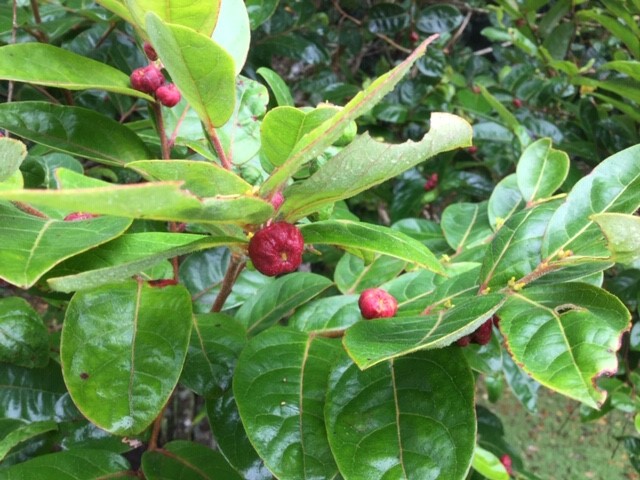
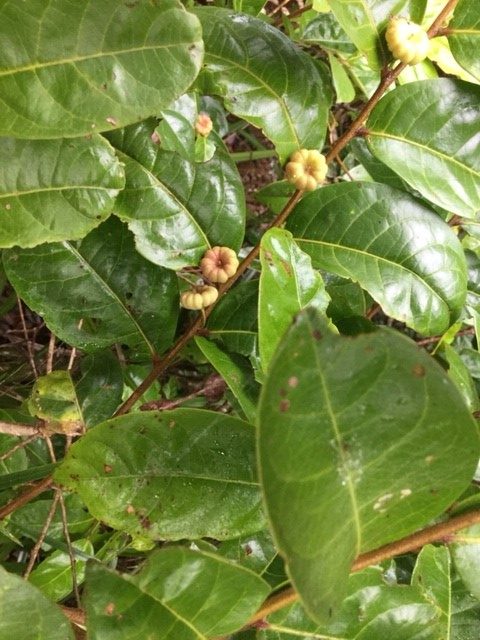
The Atherton Fig (Ficus leptoclada) is one of 15 species of sandpaper fig in Australia. These figs are non-stranglers and have (to varying degrees) rough sandpapery leaves. Unlike the strangler figs, they are dioecious (having separate sexes).
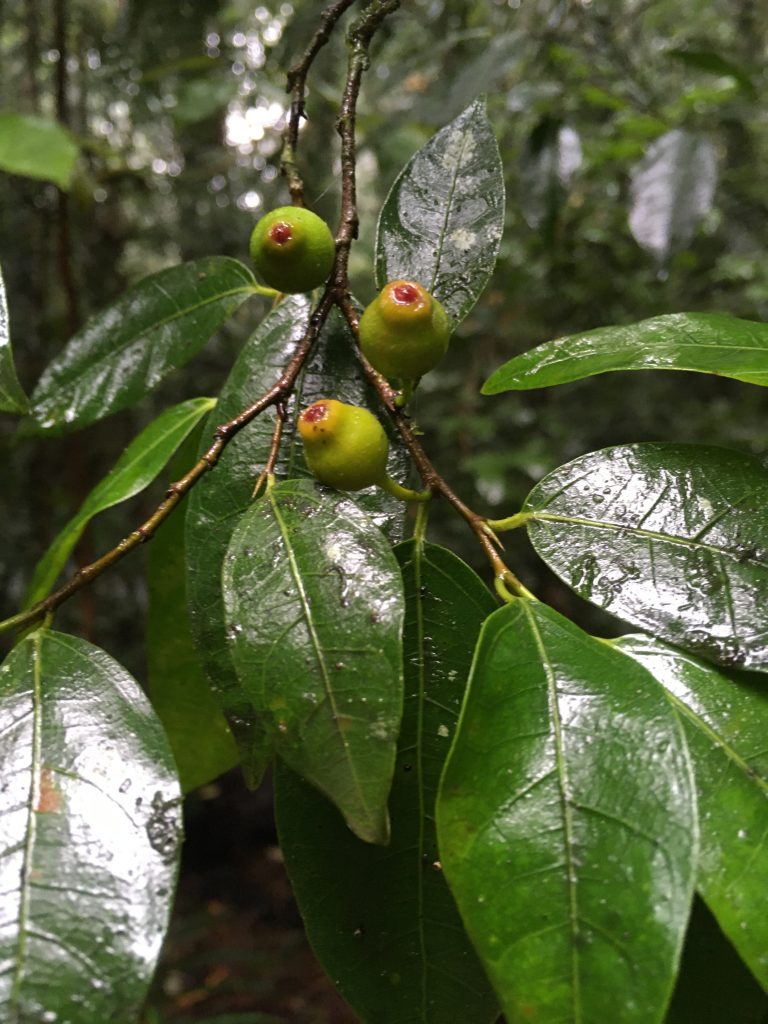
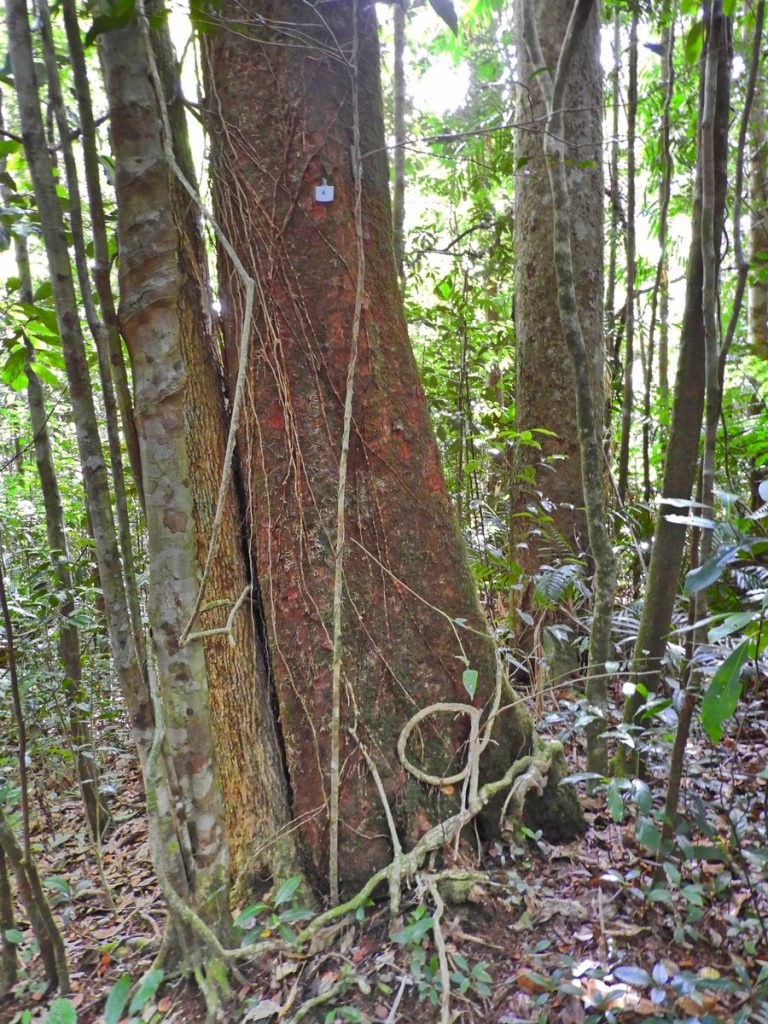
Atherton Figs are endemic to northern Queensland rainforests up to an altitude of 1,000m. They are common on road sides or in regrowth areas where they grow as relatively small trees (up to 15m) with slender trunks. The leaves are eliptical to narrowly ovate and about 8-12 cm long with a raspy feel to the lips (yup – you are supposed to “kiss” the leaves to assist in identification!).
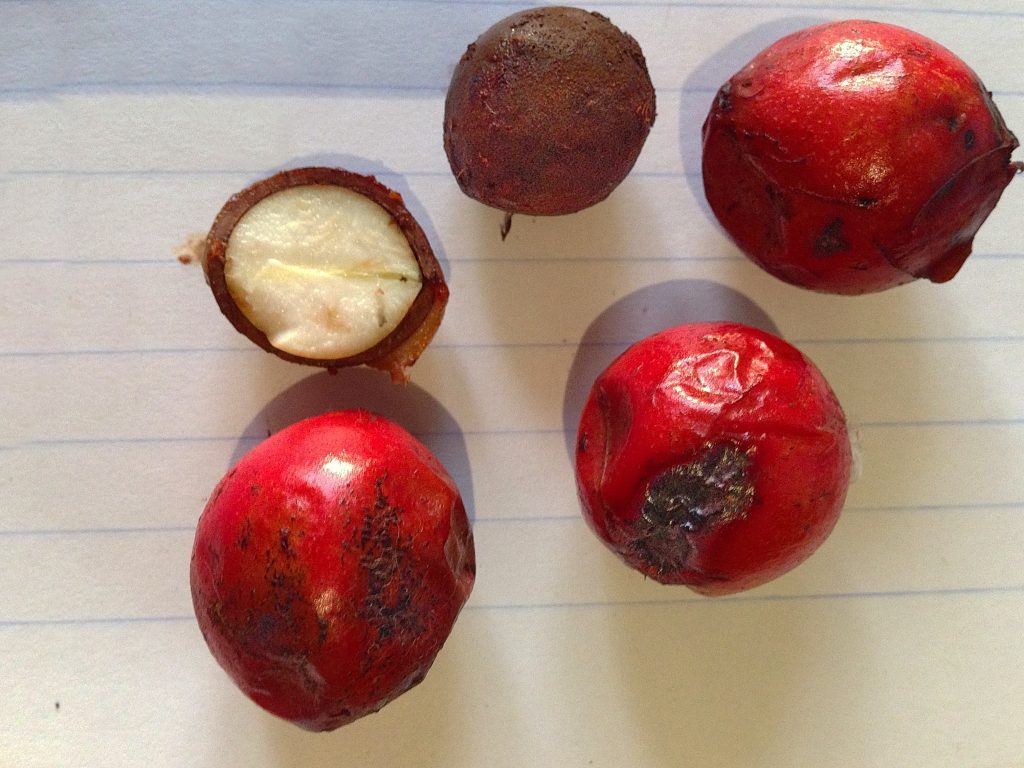
When in fruit, trees can be spectacularly laden in small brightly coloured fruit. Ripening figs show attractive shadings of yellow to orange-red and are born both on branchlets and on the main trunk or limbs. When ripe they are more uniformly red/purple and are up to 2cm in diameter.

The figs are eaten by fruit pigeons and the double-eyed fig parrot.
There is a lovely example of an Atherton Fig that is currently in fruit at the first small clearing about 100m down the walking track from McClelland’s lookout to Witt’s lookout. Look for coloured fruit on the ground. The tree has a narow trunk just behind a larger tree at the edge of the clearling looking back to McClelland’s lookout.
I have previously mentioned the close relationship between figs and the specialised wasp species that they rely on to pollinate their flowers. If you are interest in joining me in a deeper dive into the evolutionary biology of this relationship keep reading below (it might get a bit technical).
Text and photos by Jamie Oliver
https://apps.lucidcentral.org/rainforest/text/entities/ficus_leptoclada.htm
Figs and Fig-wasps: an evolutionary arms race that may never end
Figs are not actually fruit (which develop from the ovary of a single flower) but rather an enclosed cluster of flowers (synconium). Since there are a variety of insects and other animals that enjoy munching on flowers, seeds and fruit, it makes some sense to enclose all your flowers in a tough leathery pouch, but then the problem is how to ensure polination of your flowers. Figs do this through associations with a family of wasps that specialize only on laying their eggs in the ovaries of figs. The relationship is highly specific: one fig-wasp species for each species of fig.
The basic sequence of polination and wasp reproduction is as follows. The female wasps are just small enought to enter the fig body through a small hole. In the process they lose their wings and antennae and will not subsequently be able to leave the fig. Once inside they lay their eggs in as many female flowers as possible and then die. The eggs then hatch out into male and female wasps. The males never leave the fig but spend their lives searching (and fighting other males) for newly hatched females to mate with. The last act of a male is to chew its way to the outside, making a large exit hole that allows new females to leave the fig. On their way out, the females collect pollen from male flowers, and then seek out new figs to lay their eggs in.
Wasps are notorious parasites and the fig wasps are no exception. Their main interest in the relationship is to produce as many offspring as possible by laying eggs in the ovaries of female flowers, where the larvae develop by eating the developing fig seeds and surrounding tissue. The destruction of any developing seeds is clearly not in the best interests of the fig, so the relationship is a tense one: the fig just wants to use the wasp to tranport pollen from the male flowers to the female flowers (in a different fig), while the wasps, given a chance, would lay their eggs in all or most of the ovaries of female flowers, rendering them (and potentiallly the whole tree) sterile in the process. Thus while each species is dependent on the other, they are both trying to gain the upper hand with the evolution of traits that maximise the advantage on both sides. In effect this is an evolutionary “arms race”.
In hermaphroditic figs, where the separate male and female flowers reside in the same fig body, the solution that has evolved in the fig species is to make some of the female flowers inaccessible by hiding them deep under the inner surface of the fig where the wasp’s ovipositor can’t reach, while letting the wasp parasitise the other flowers so as to ensure some wasps are allowed to develop. This compromise lets some of the fig flowers develop fully mature seeds, but many are sacrificed to allow wasps to developed. The wasp on the other hand has lower than optimal reproduction since it can’t parasitse every female flower. This has turned into a relatively stable stand-off between the competing interests of the two species. However ….
In dioecious species (thought to have evolved from hermaphroditic speces) there are trees with figs that are all male, and other trees that are all female. In these species the balance may have shifted a bit in favour of the figs. In this case the male trees have male flowers but also female flowers that are sterile (the figs are more accurately described as “functionally” male). As per the above sequence, female wasps enter male figs and lay their eggs in the sterile female flowers. The offspring hatch out and the new fertilised females collect pollen from the fully functional male flowers as they exit the fig to find other fruit to parasitise.
The twist here is that the female fig trees have fruit (with only fully fertile female flowers) that are equally attractive to the female wasps (they are drawn in by a specific odour emited by the fig) but the ovaries in these female flowers are completely inaccessible to the wasp. So female wasps that end up entering a female fig wander around inside polinating the female flowers but never managing to parasitise any flowers before they die. This arrangement suits these fig species well since it can invest as much energy as it wants into the development of female flowers and seeds and only sacrifice a smaller amount of energy into the production of sterile female flowers in the male figs.
Since a small amount of pollen can fertilise a large number of female flowers there are often many more female figs compared to male. The female figs don’t get parasitised so the result is a high reproductive output for the figs. But if the majority of figs in any location are female ones, then the wasps lose out since most of the female wasps will end up in female figs and never reproduce. The fig species only needs to produce enough male figs to ensure adequate pollen production and sufficient wasp production to ensure the pollen is duly transported to all the female figs. At this point if you have been following the story you may (like me) think that its starting to look like the fig is “farming” wasps for the purpose of polination! Perhaps future evolution will see wasps being more and more like a managed speces. But since evolution is based on the accumulation of chance events, perhaps wasps will evolve countermeasures that enable it to parasitise female fig flowers, or avoid them in favour of male figs ….. and the “arms race” will continue.
Jamie Oliver
Further Reading:
https://www2.palomar.edu/users/warmstrong/dawkins.htm#dioecy
https://link.springer.com/article/10.1007/BF01975678
https://onlinelibrary.wiley.com/doi/10.1034/j.1600-0706.2003.12212.x
https://onlinelibrary.wiley.com/doi/pdf/10.1046/j.1420-9101.1995.8030301.x