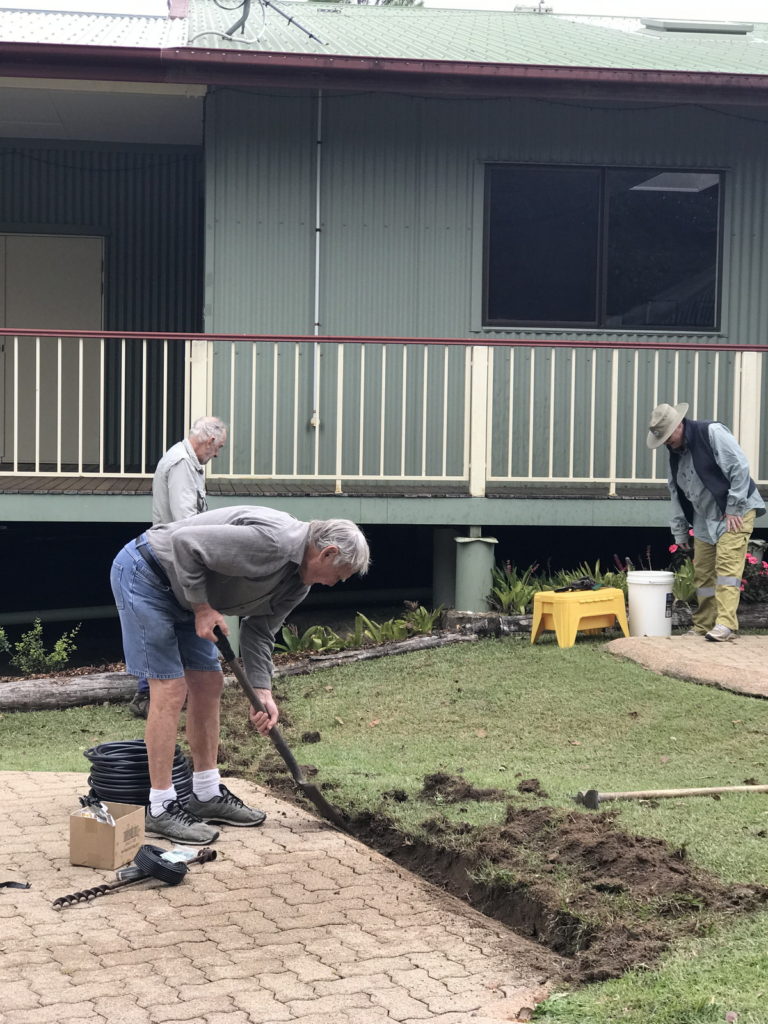
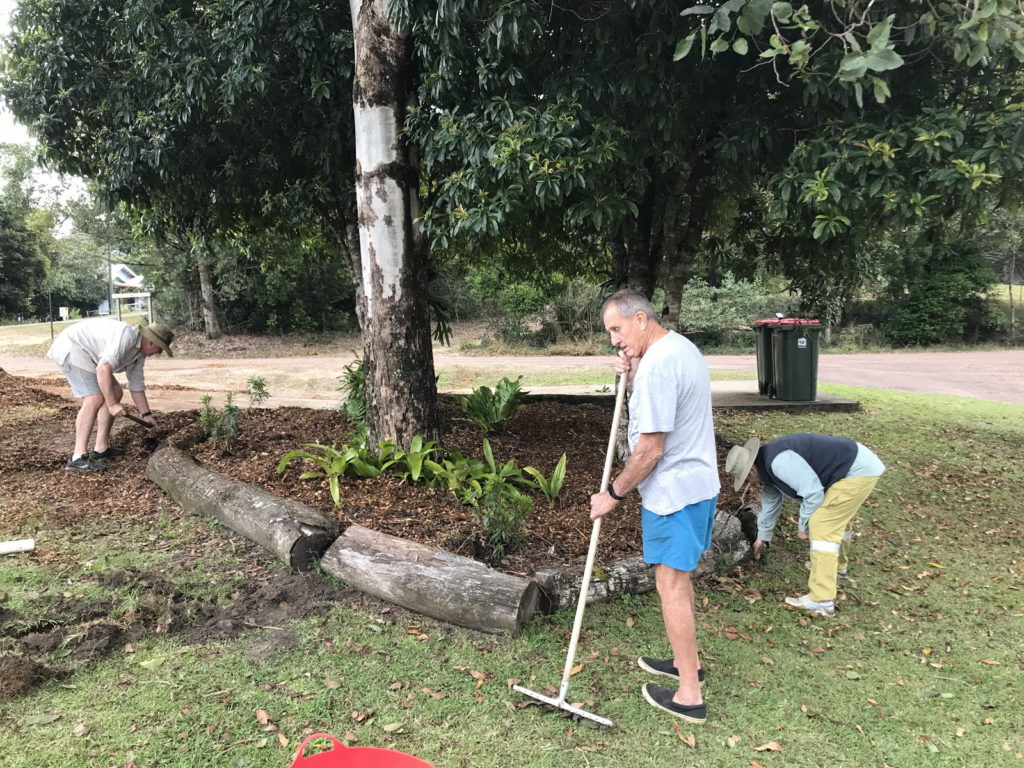
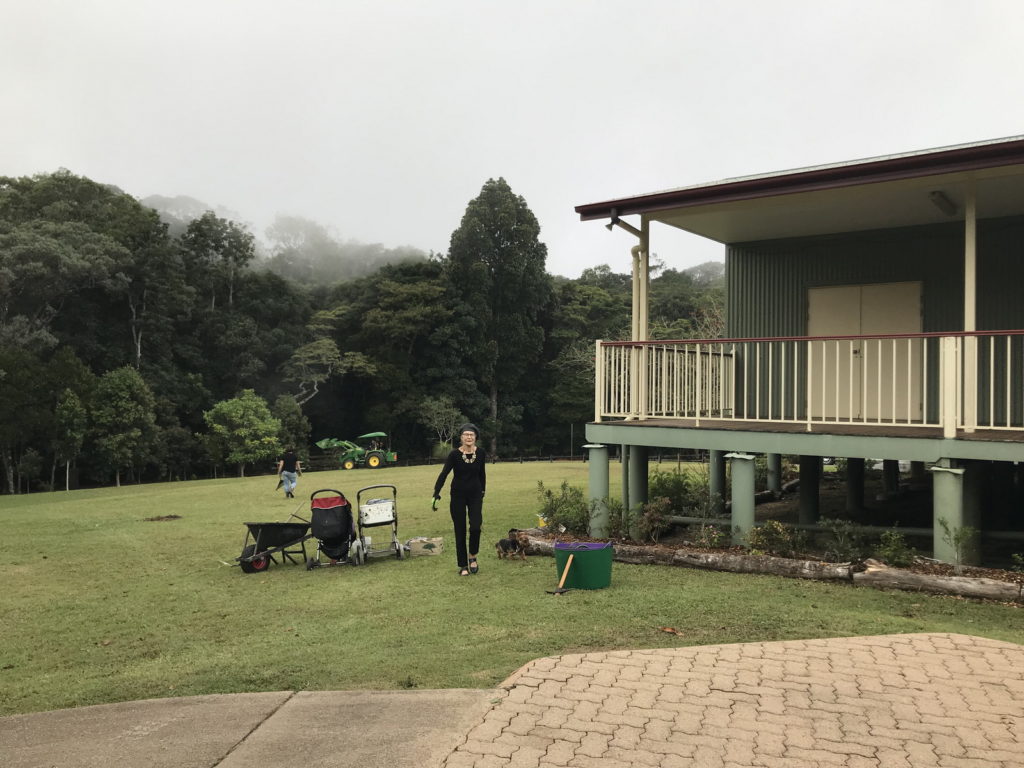
Last Saturday (July 31st) there was a great turnout of locals to the gardening working bee at the Community Hall. Graham Pope brought his mini-tractor along and quickly ensured that the huge pile of mulch near the kiosk was distributed among the Trees of Memory and along the freshly weeded garden beds around the Community Hall. With over a dozen pairs of hands, the mulching was quickly finished and we then got to work digging trenches for a new irrigation system for the garden beds. Using a hose and a piece of conduit to create a channel under one of the concrete paths resulted in a few muddy hands and trousers but we soon got the piping laid and the earth and turf replaced into the trenches. While all this was going on some of the group carried out a bit of vegetation trimming along the road.
As soon as the work was complete it was time for the Paluma Push Thankyou Drinks and BBQ hosted by Paluma RFS. This was a great success, although it’s hard to fail when the drinks and food are free!
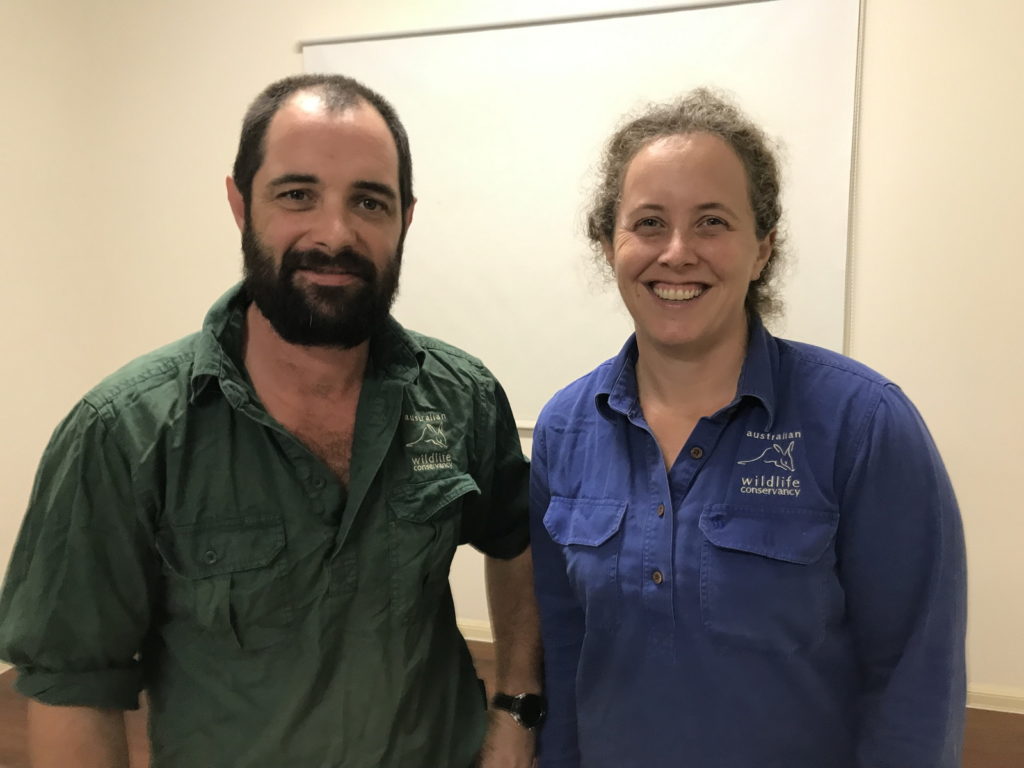
Before everyone got down to eating we were very fortunate to have Felicity and Josh from the Mt Zero -Taravale Sanctuary gave a very informative talk on the great work being done by the Wildlife Nature Conservancy just down the road from Paluma. The new $1.5 million project to build a predator-free safe-haven for the endangered northern bettong was a highlight of the talk. Judging by the number of questions flying during and after the talk it was clear that their work generated a lot of interest and possibly some new volunteers to help out.
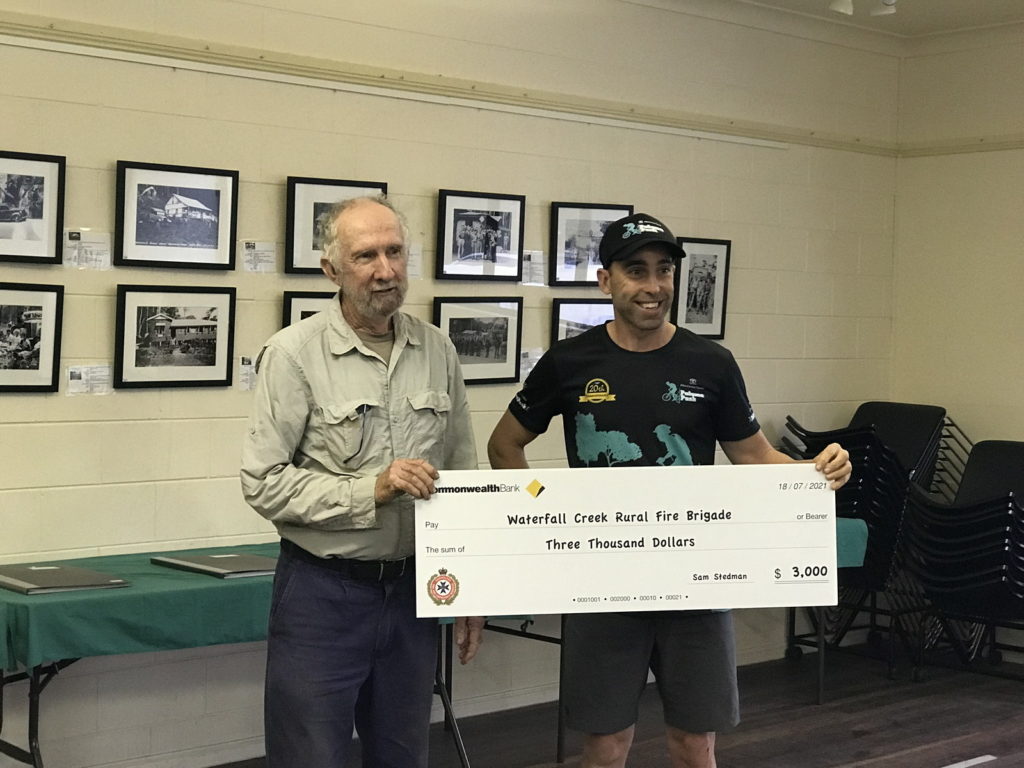
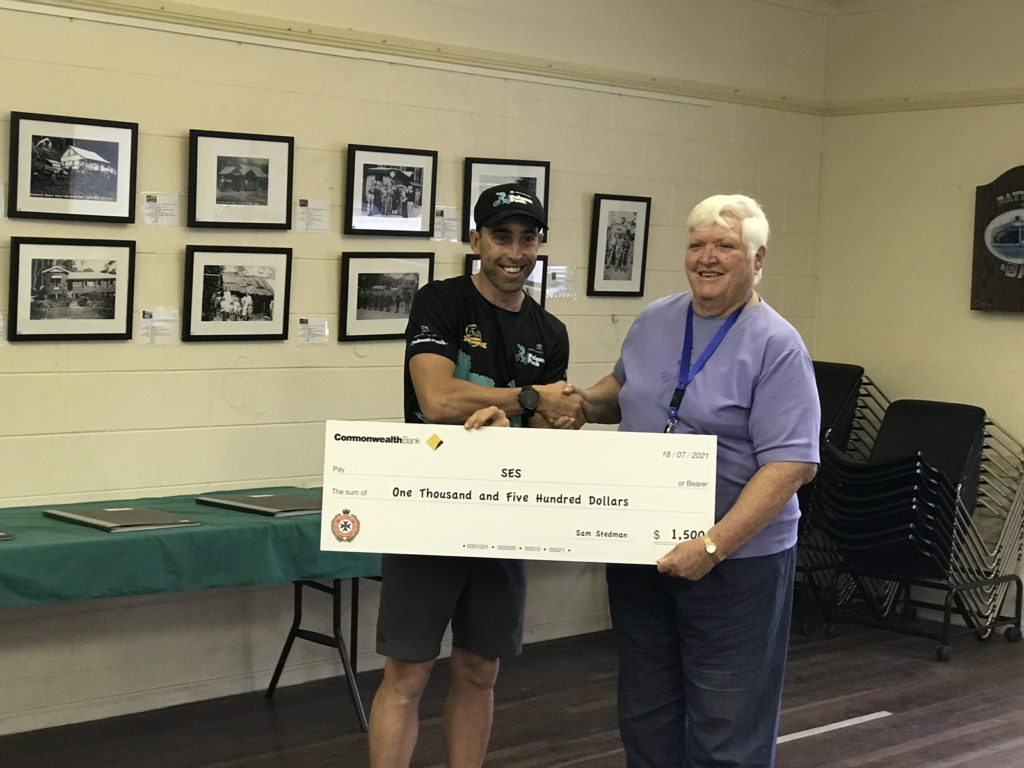
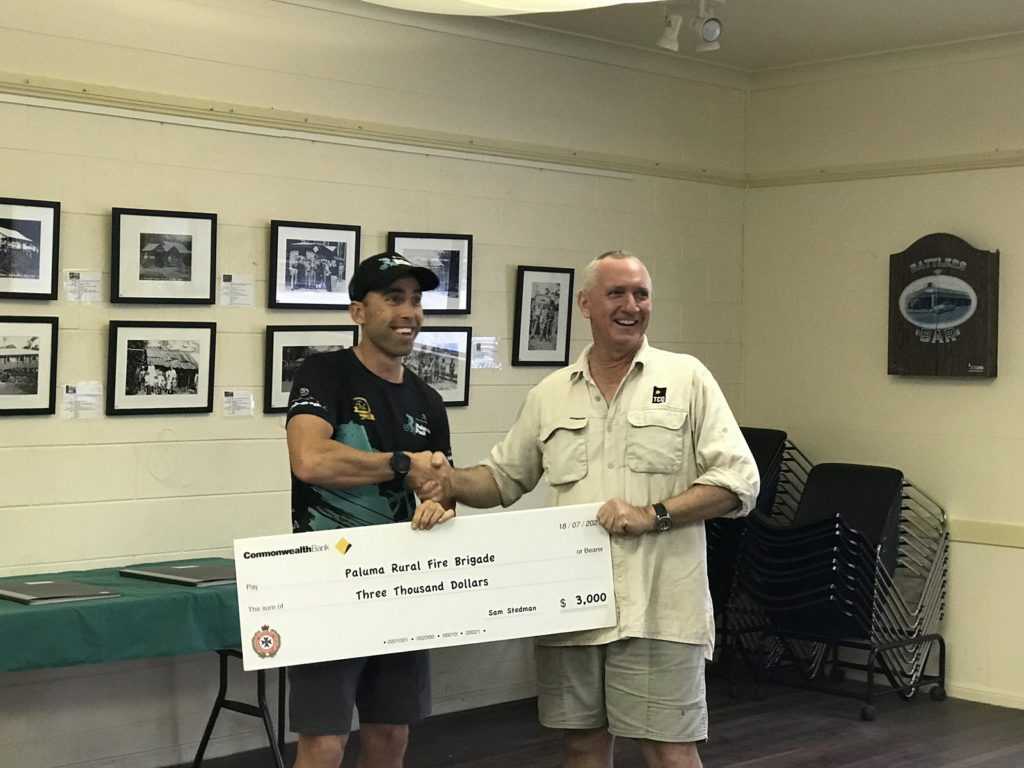
After the meal, Sam Stedman from Outerlimits gave a brief talk on the outstanding success of this year’s Paluma Push and highlighting near-record number of participants, the quality of the challenging tracks, and the funds raised for our local SES and Rural Fire Services. He presented substantial cheques (both in size and dollars) to the two RFS branches and the SES, and expressed his gratitude to all the volunteers who helped to make this year’s push such a success.
Paluma is one of the wettest places in north Queensland (see post from 2019) and most residents take an active interest in annual, if not monthly or daily rainfall records around the village. After many years of faithfully recording official daily rainfalls at the Ivy Cottage, Ian Marshall is no longer able to fulfil this volunteer role. Many thanks to Ian and Sandy for performing this important and valued service to Paluma.
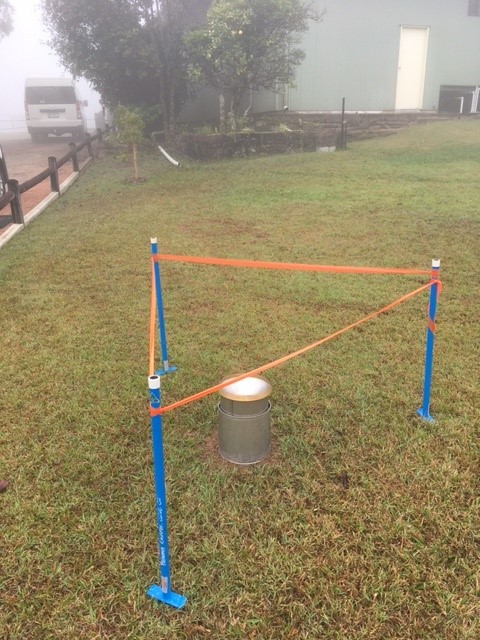
The Bureau of Meteorology (BOM) originally decided to close the official Ivy Cottage rainfall station after they received notice that observations were no longer able to be provided. However, after repeated representations from several Paluma residents, the BOM has agreed to relocate the rain gauge to the village green while keeping the old “station identification” so that a continuous record going back to 1969 is maintained.
Our new rain gauge on the Village Green
The Paluma Environmental Education Centre (PEEC) has agreed that Barry Smith will officially take on responsibility for recording daily rainfall from our new gauge during normal workdays. On weekends Colwyn Campbell has agreed to take the readings. Thanks to both of them for agreeing to take this on!
There will still occasionally be times (especially over the summer holidays) when neither Barry nor Colwyn will be available to take readings. We are therefore seeking additional “backup volunteers” who are willing to be called when needed. If you are interested in helping us keep a continuous official rainfall record for Paluma please contact Jamie. He will draw up a list of residents who can be called on when needed.
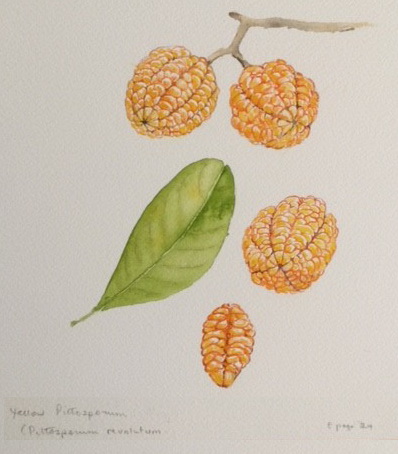
Yellow Pittosporum (Pittosporum revolutum) is also known as Hairy Pittosporum, Brisbane Laurel and Lemon-fruit Pittosporum, the tree is a member of the family Pittosporaceae. World-wide there are up to 200 species of Pittosporum; 16 species within Australia with six occurring in Tropical Queensland.
The name derives from pitys (pine or resin) and spora (seed), referring to the sticky seeds. Revolutum derives from revolutus, (rolled back) referring to the leaf margin.
Yellow Pittosporum usually remains a shrub, growing to around 3 metres but occasionally will grow to a small tree. There are separate male and female plants. Yellow Pittosporum occurs naturally from Queensland to Victoria in rainforests as well as in wet sclerophyll country at altitudes up to 1100 metres. It is an attractive shrub, eye-catching when bearing its bright orange or yellow fruit.
Yellow Pittosporum leaves are simple, alternate or opposite; they have wavy edges and are clustered towards the ends of branches, making them appear whorled. Leaf size can be 50 -220 mm x 15 – 70 mm. The upper side is slightly hairy but the underside is covered with dense, rusty hairs. Small scale-leaves are usually present. Lateral veins on the leaf curve well inside the lateral margin, forming distinct loops. Small white or brown lenticels (small raised, corky areas) are usually visible on the twigs.
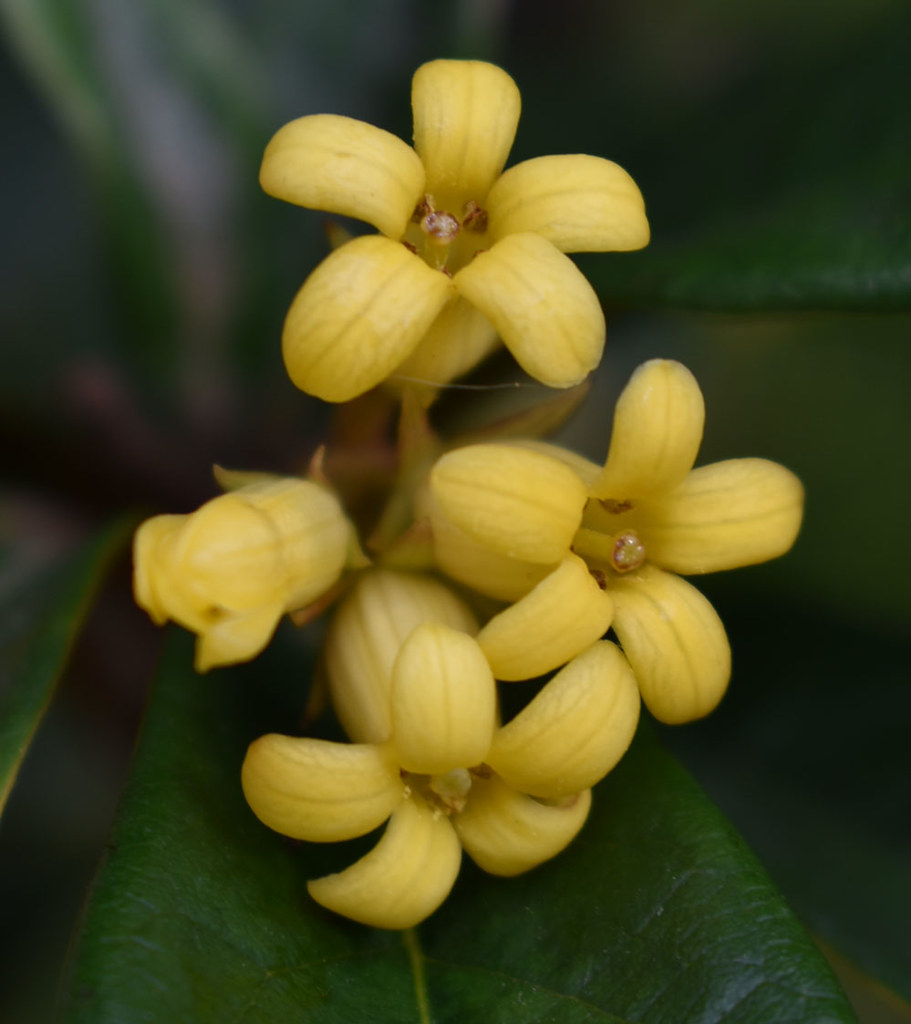
Fragrant, yellow flowers are carried on axillary or terminal umbels or racemes during August to October. They are partly tubular, opening to five petals. The calyx can be green, yellow, red, purple or brown.
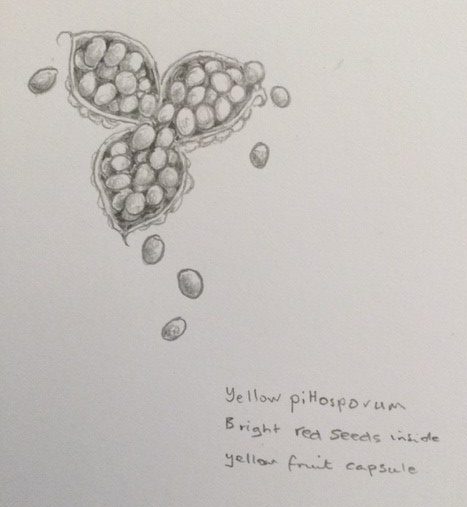
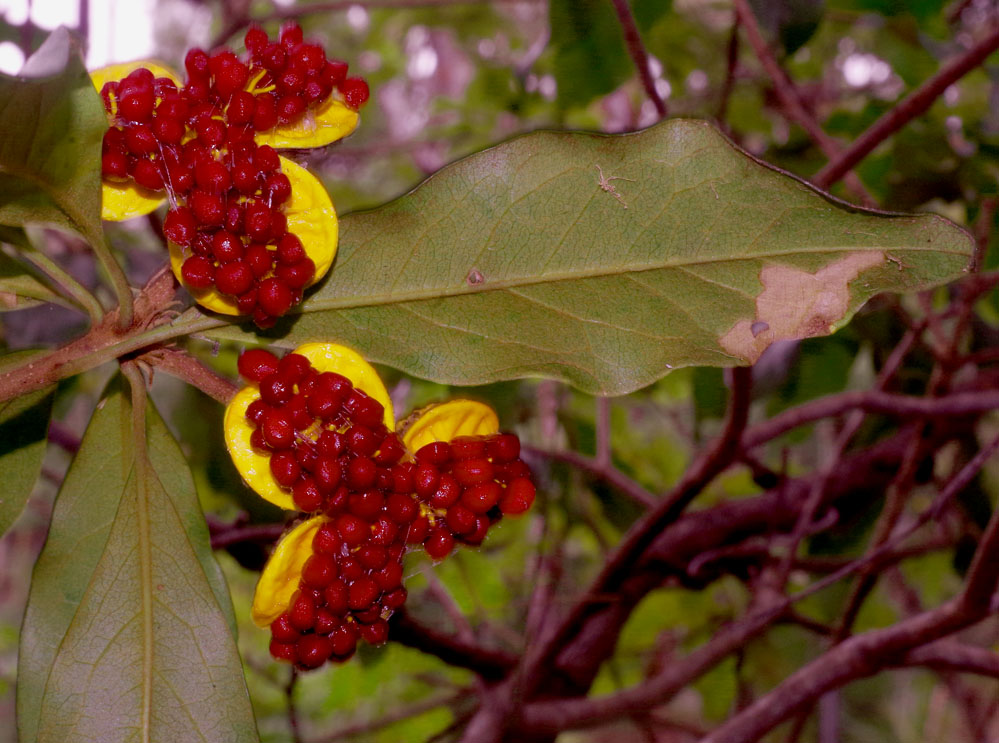
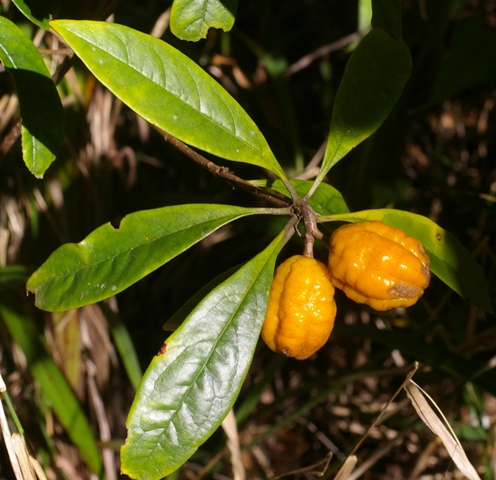
The yellow to orange fruit capsules appear from April to July. The capsules are warty or lumpy surfaced, about 12-25 mm x 11-21 mm in size and may be two or three valved. These carry 20 to 76 red, sticky seeds.
The seeds are eaten by Satin Bower-birds and Figbirds while the flowers attract bees, butterflies and other insects. Although the seeds are bitter it is known that they were eaten by Aborigines. Uses for the plant range from hedges and screening, erosion control (it germinates readily and is fast-growing), and for fragrant oils.
Fruit, Seeds and Flowers of Pittosporum revolutum (photos by Russel Cumming on Flickr.com)
Around Paluma, I have found the Yellow Pittosporum growing in the re-vegetation area just outside the village and among the plants along the roadsides. Flowering could be any time now, and there may be some late fruit clinging to the branches, so keep a lookout for this attractive plant.
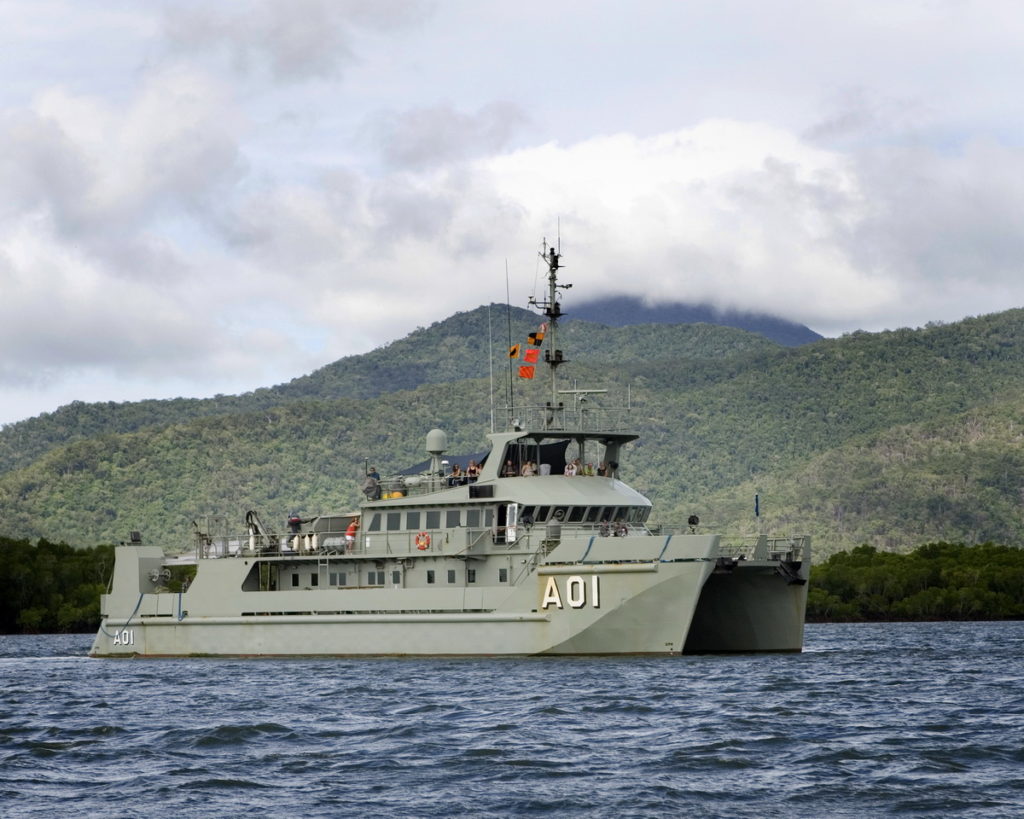
On Saturday, August 7th, Paluma will host a “Freedom of Entry Parade” to celebrate the decommissioning of the HMAS Paluma (IV), a Navy hydrographic survey vessel that is (indirectly) the source from which our village got its name.
The original Paluma in ca 1890
Paluma IV ca 2010
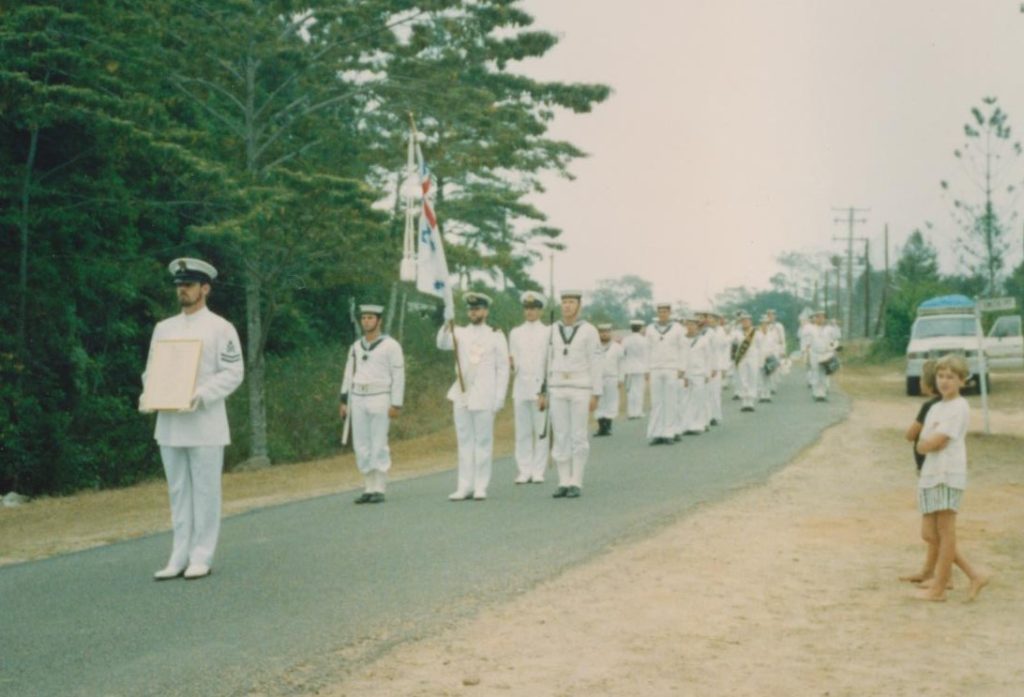
When the vessel was originally commissioned in 1989 it was granted “freedom of the city” of Thuringowa at Paluma. This included an official ceremony in which armed navy officers marched into Paluma, where challenged by Police and, on producing an official scroll that authorised their entry, were formally granted permission to continue marching through the village. Following other formalities and speeches, refreshments were served and there was a cricket match between the Navy and villagers that was handily won by the village!
Some three decades later the HMAS is now to be decommissioned and the Navy has suggested that one final march through city would be a fitting part of its final days in service. It promises to be quite a spectacle!
The ceremony and parade will be similar to the one in 1989 and all residents are invited to attend as spectators. The event will start at 11am. Food and refreshment will be provided afterwards at the Community Hall.
The original vessel that Paluma was named after was a gunboat built in 1884 in response to a perceived threat to the colony of Queensland from the Russians. Upon its arrival in 1885 its defence capabilities were considered redundant and it was converted into a hydrographic survey vessel. During its early surveys, it named the northern extension of Hervey Range as the Paluma Range. Our village was subsequently named after the mountain range it is embedded in. There have been four vessels bearing the name Paluma. The most recent is the HMAS Paluma (IV)
For a more detailed and highly readable account of the history of all the Paluma vessels, Linda Venn’s book on “Paluma, the first 80 years” has a section dedicated to this topic. You can read this section here.
The Paluma Rural Fire Brigade would like to thank all volunteers who helped during the Paluma Push by hosting a BBQ and drinks at the Community Hall on Saturday July 31, at 4pm.
This year’s Push was a great success due, in no small part, to the wonderful effort of the many volunteers who help to man checkpoints and attend to various logistical tasks leading up to the event. We hope you will be able to come along for a drink and a feed as a token of our appreciation.
There is a huge pile of garden mulch at the Community Centre which we would like to move onto garden beds and other more useful areas. Also, a bit of weeding and planting in the garden bed wouldn’t go astray. So if you would like to help out, we are planning a working bee the Saturday after next, from 2pm to 4pm.
If you would like to help out in beautifying our Village Green and Community Hall surrounds please come along.
This will be followed by a BBQ hosted by the Paluma Rural Fire Brigade to thank all volunteers who helped out during the Paluma Push.
Don’t forget to come along to the Bush Dance at the Community Hall this Saturday afternoon. There will be a sausage sizzle starting at 12pm and the music will start up at 1 pm. Bring a gold coin donation in lieu of admission and extra cash for food and drinks.
Wilfried is having his septic tank pumped out next Wednesday morning. If you would like yours done at the same time and share the costs, please contact Wilfried direct on 0447 822 626.
It is with sorrow we report the passing on Saturday, of Bill White after a courageous battle with an aggressive form of cancer.
Bill was the former owner of No 8 Mount Spec Road and was a regular weekend visitor. It was always a pleasure to be in his company, enjoying his good humour and interesting anecdotes. He will be sadly missed by his many friends in and around the village.
Our condolences and loving thoughts go out to Carol and the family.
The species name “glomulifer” refers to the flowers and derives from glomulus (little ball) and -fer (bearing). Turpentines can refer to any member of the genus Syncarpia, which is a member of the Myrtaceae family
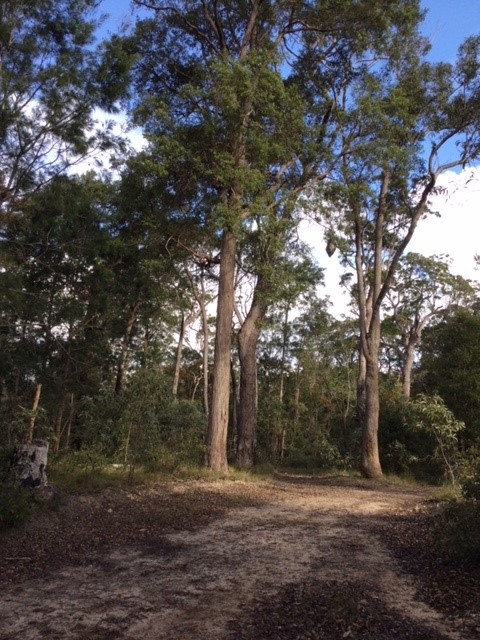
There are three Syncarpia species all of which are endemic to Australia. S. glomulifera is the most widespread as is simply referred to as Turpentine, while the other two, S. hillii (Satinay or Fraser Island Turpentine, and S. verecunda (Red Turpentine) have more limited distributions. The habitat most commonly associated with Turpentine is a transitional forest between rainforest and wet sclerophyll forest and woodland, in altitudes between 40 to 1100 metres. It is found from the Big Table-land near Cooktown to southern NSW. It grows as an emergent tree among other popular timber trees such as grey ironbark, tallow-wood, brush box, grey gum, red ironbark, mountain mahogany, spotted gum and various rainforest trees. Here, Turpentine can be seen in the vicinity of the rose gum forest west of Paluma.
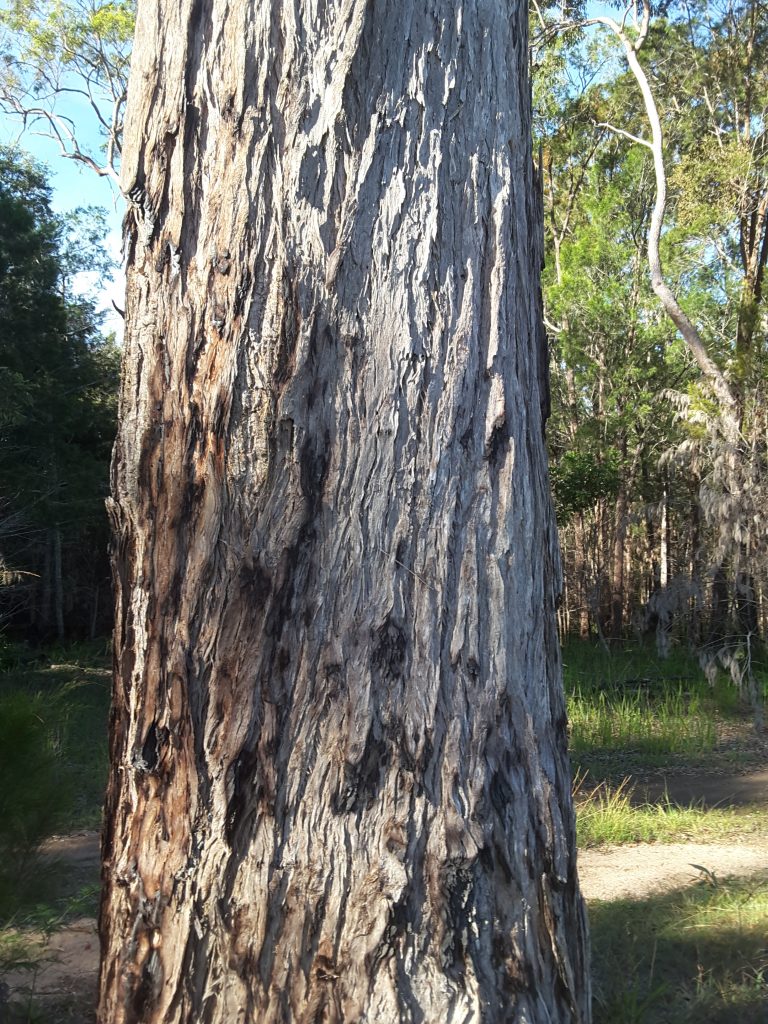
Tall and straight trunked, Turpentine is a vigorous grower and can reach a height of 25 to 60 metres in tropical areas. The trunk can attain a diameter of 1.5 metres. Its bark is coarse, fibrous and deeply furrowed; new twigs are hairy. It is also a long-lived tree and some specimens are said to have reached 300 years.
The elliptic leaves are simple, opposite or whorled. 30 – 110 x 14 – 45 mm in size. The upper side is glabrous or minutely hairy while the under-surface is covered in white hair, with brownish oil dots visible with a lens. The leaves are mid green, red when young, with wavy margins. They are aromatic when crushed and this aroma reminded early settlers of turpentine, hence the common name.
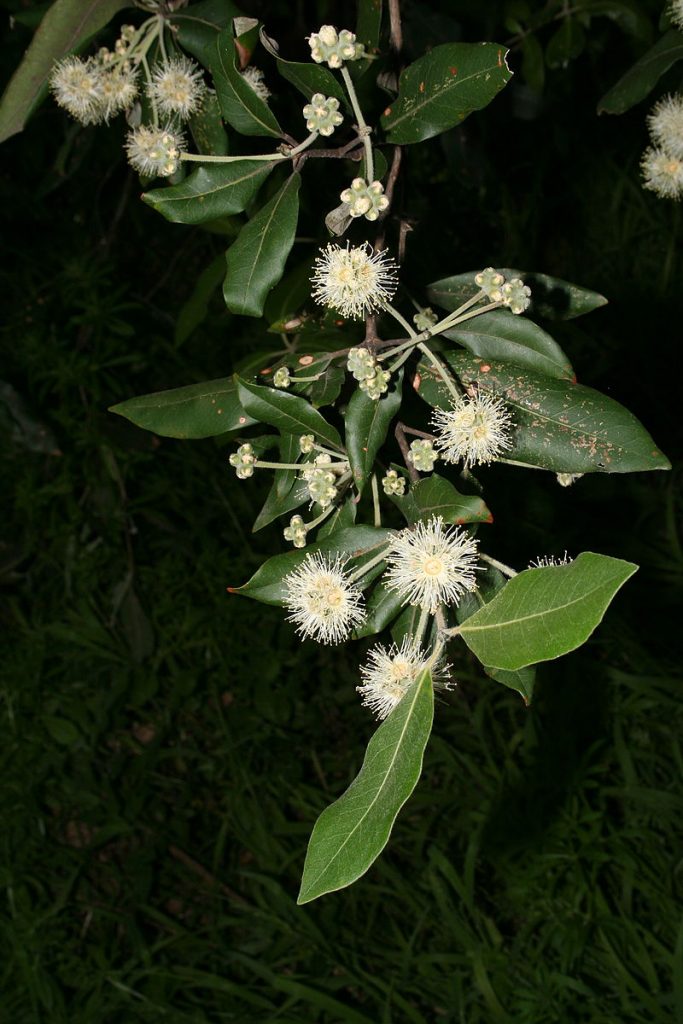
Syncarpia glomifera flowers photo by Casliber CC by SA 3.0
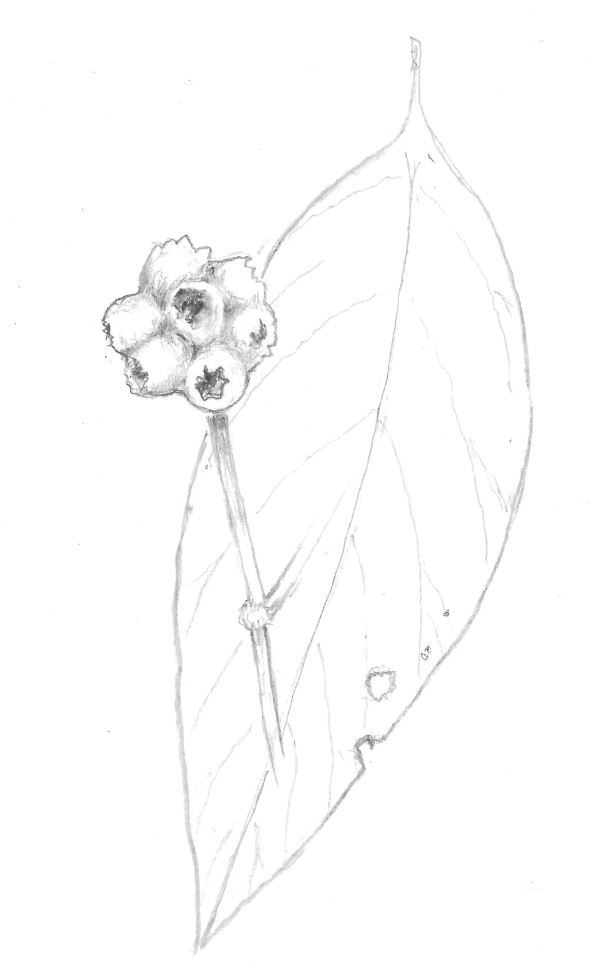
Syncarpia seed capsule (about the size of a marble)
Flowering occurs from August to February. The fragrant flowers are clustered in axillary or terminal heads. The flower has four or five white or cream petals and fine filamentous white or cream stamens, similar in appearance to many Australian native flowers. They are very popular with pollinators like European honey bees, native bees, grey flying fox, little red flying fox and birds such as lorikeets.
Fruiting occurs between November and July. The grey or brown fruit is an aggregate capsule 10 – 12 mm long and 12 – 22 mm wide. There are usually seven valves containing numerous orange/brown seeds about 2 mm long.
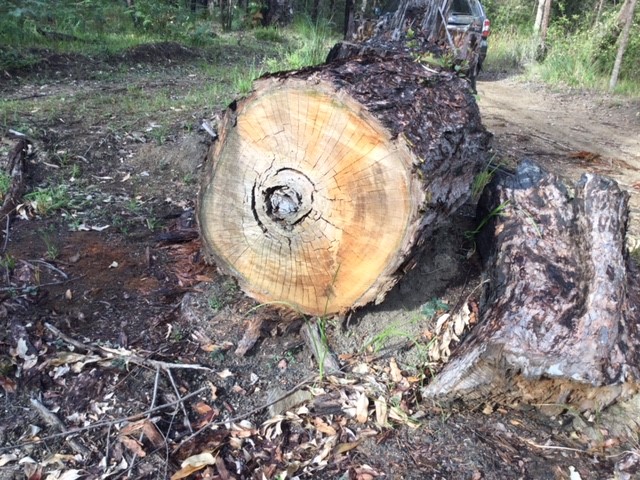
Turpentine was much sought after as a hardwood with its reddish-brown colour ranging to a deep chocolate brown and its coarse even texture with a straight grain. It is an excellent timber for dance floors. It is also used in the construction of plywood, laminated beams, bench tops, joinery and parquetry, boat building and wine casks. Because the timber is fire resistant and highly resistant to termites, marine invertebrates and borers, it was much in demand for piers and building foundations. During the War years, Archie Taylor cut two turpentine logs over 100 ft long (one was 128 ft) for an American Radar station. It took several days to get the logs down the Range to Moongoobulla.
The area around Paluma was heavily logged, especially during the War-time years. So much so, that there are not even any relict trees known on the H Track or surrounding area. There are however, several fine living specimens in the vicinity of Hussey Road and around the Blackfriars district. Around Taravale there are many young trees.
Although the IUCN Red List status of this species is the lowest category (Least Concern), in NSW, the Turpentine-Ironbark forest of the Sydney Basin Bioregion is now listed as endangered or critically endangered in the Threatened Special Species Conservation Act, NSW, 1995 as are all the communities with which the Turpentine-Ironbark forest vegetation intergrades. The Commonwealth also lists the Community as critically endangered under the Environmental Protection and Biodiversity Conservation Act, (Commonwealth) 1999. The fate of these trees is an example of how easily and quickly human activity can change an environment and the habitats of many insects, birds and animals.
Turpentine trees have been introduced into Hawaii, Africa, New Zealand, and the Cook Islands and the species is considered an invasive weed in most of these areas.
For detailed information on the timber industry around Paluma, I recommend Linda Venn’s book ‘Paluma: the First Eighty Years 1870’s to 1950’s.’
Next time you drive out to the rose gum forest, see if you can identify the turpentine among the gums, stringy barks she-oaks and other trees.
Text and photos (unless indicated) by Colwyn Campbell