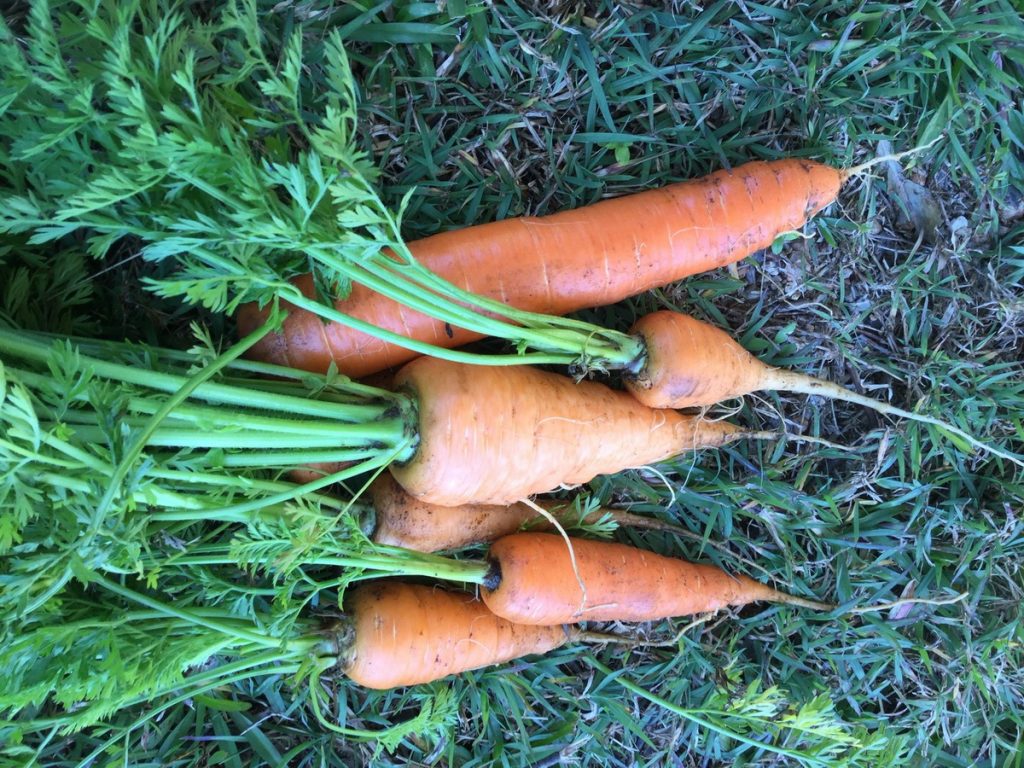
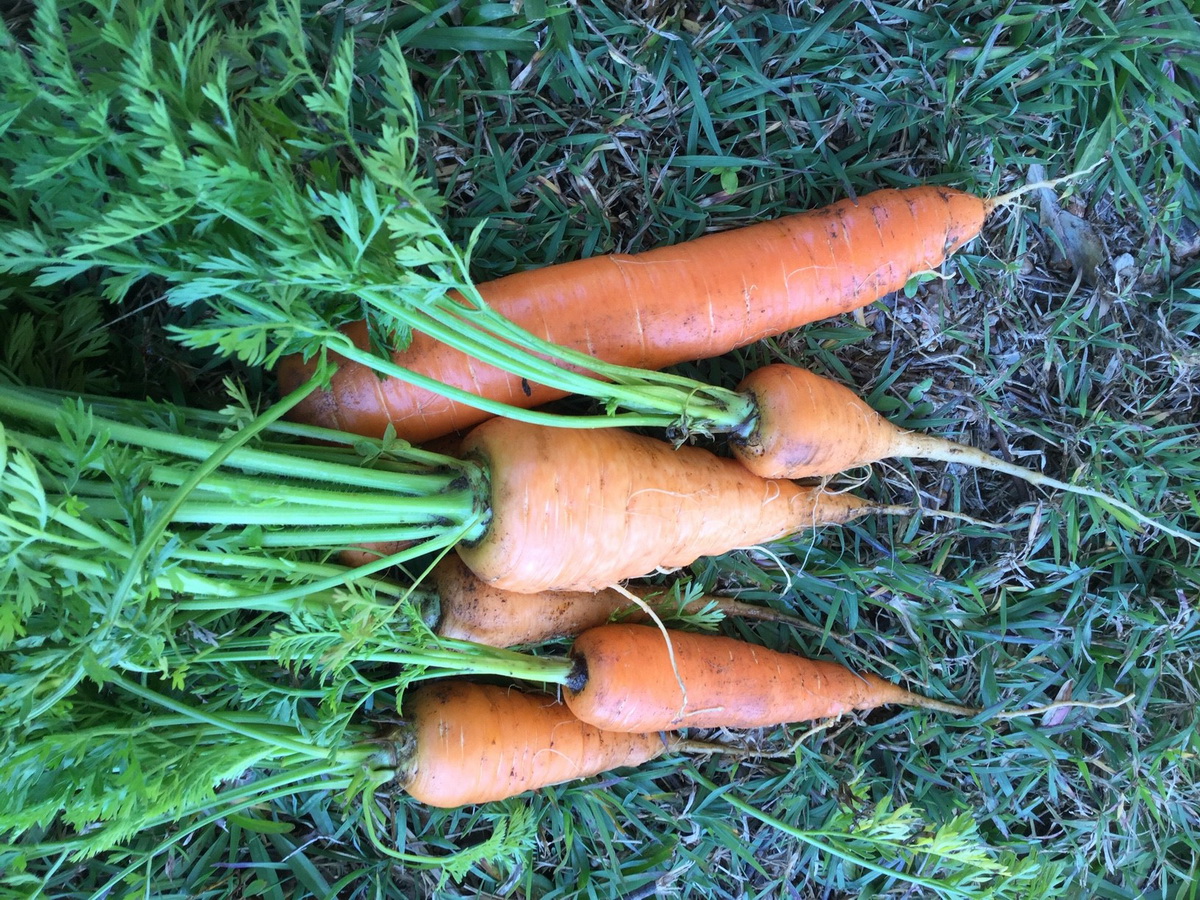
Throughout the year, Paluma is blessed with colourful plants, photos of which are regularly posted on the website. Such is the focus on gorgeous blooms that the humble food gardens tend to be overlooked. They are due for some well-deserved attention, particularly as growing fruit and vegetables in Paluma is a real challenge.
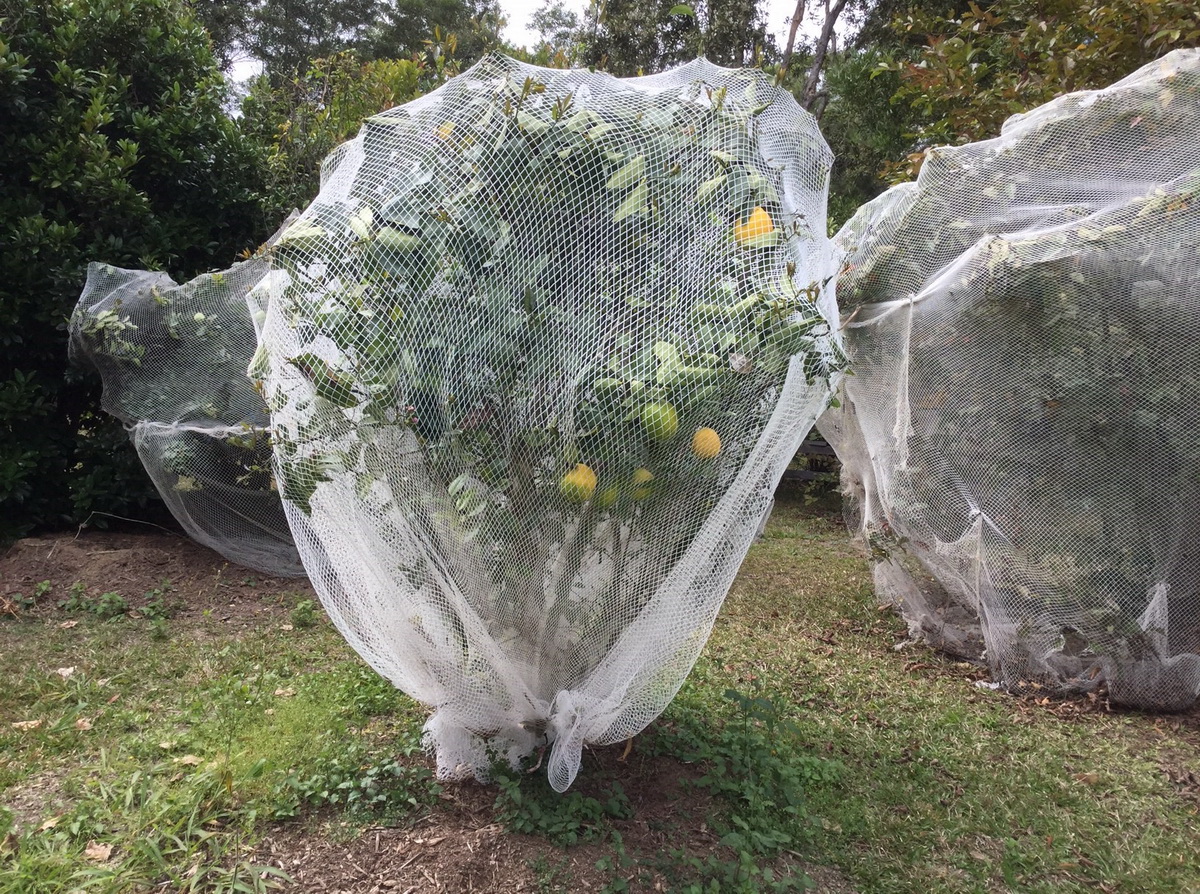
The climate can be unkind at times but the wild-life presents the major obstacle to successful food gardening. Bush rats and White-tailed rats eat stone fruits, such as plums and peaches long before the fruit is ripe. Cockatoos savage citrus crops and at night, wallabies emerge from the forest and feast on any new green leaf within reach; citrus, gardenia, rose and hibiscus are favourites along with potted herbs. Bandicoots burrow deep beneath plants, birds steal the chillies but the worst predator within the village is the Brush Turkey. Two or three of these can, in only a few minutes, lay waste to an entire bed of vegetables: nothing is spared; pots are up-ended and their contents eaten and they rival rats in their plunder of pumpkin and choko vines. Out on the rural blocks, feral pigs make unwelcome forays, at times pushing through flimsy fences and devouring everything from bananas to sweet potatoes.
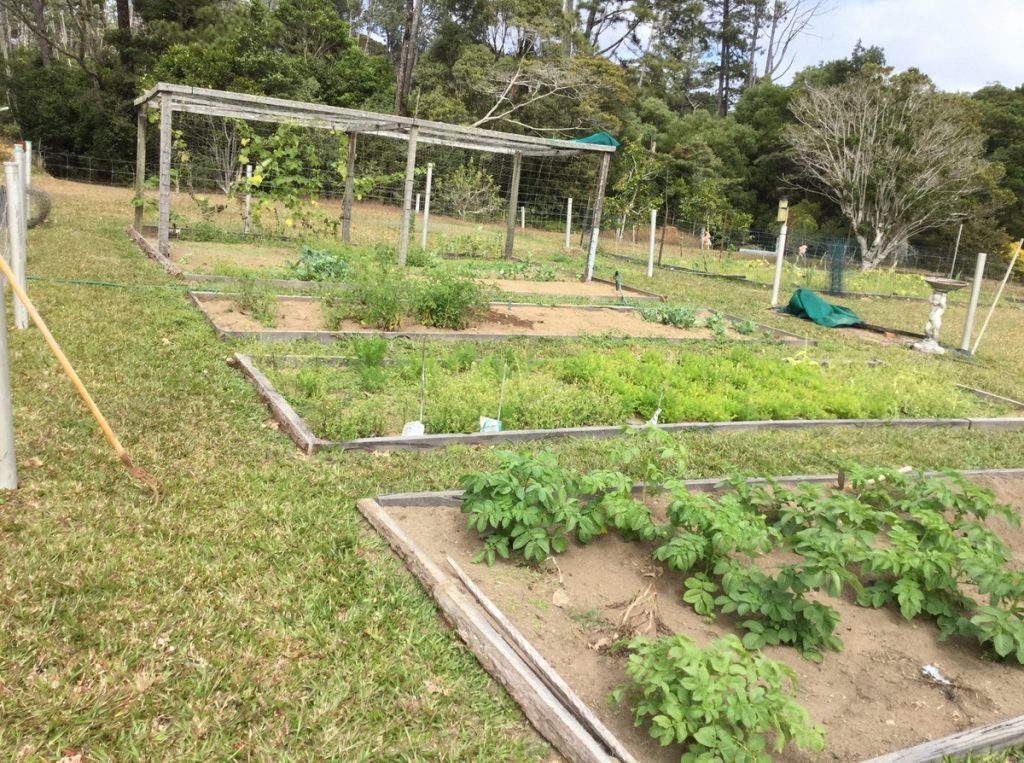
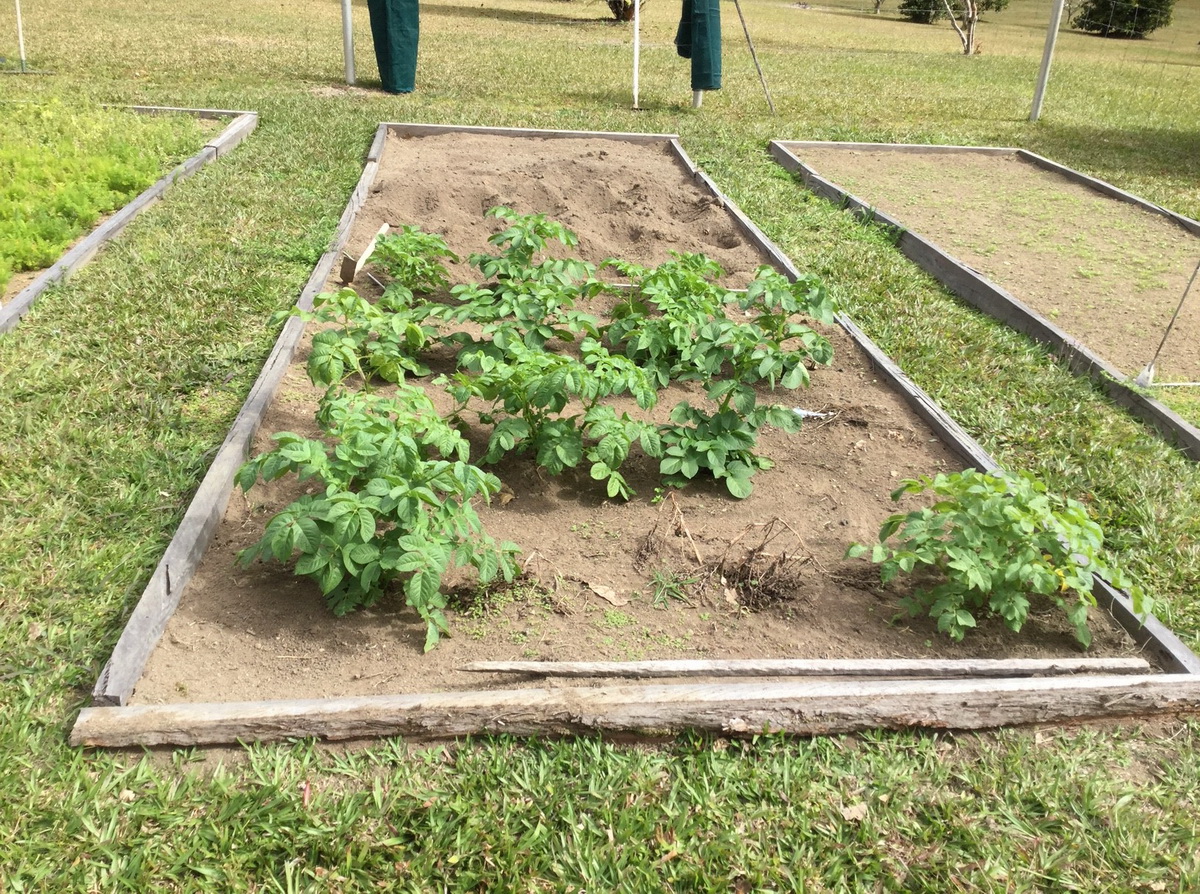
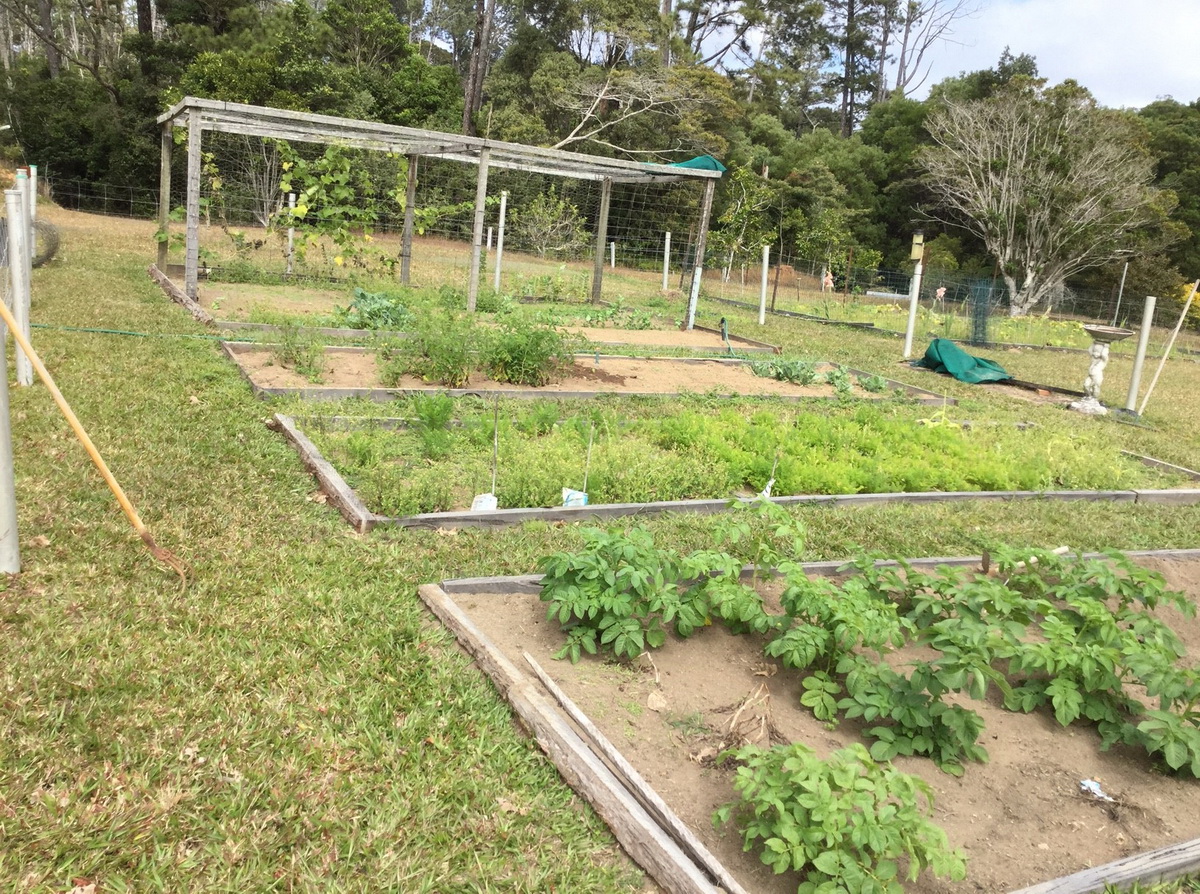
So, it is with awe and admiration that I see several Paluma residents refuse to be defeated and have productive gardens that would make a professional market gardener or orchardist envious. What are some of the secrets of their success? Location, (a position with enough sunlight throughout the day) and pest-proofing are vital.
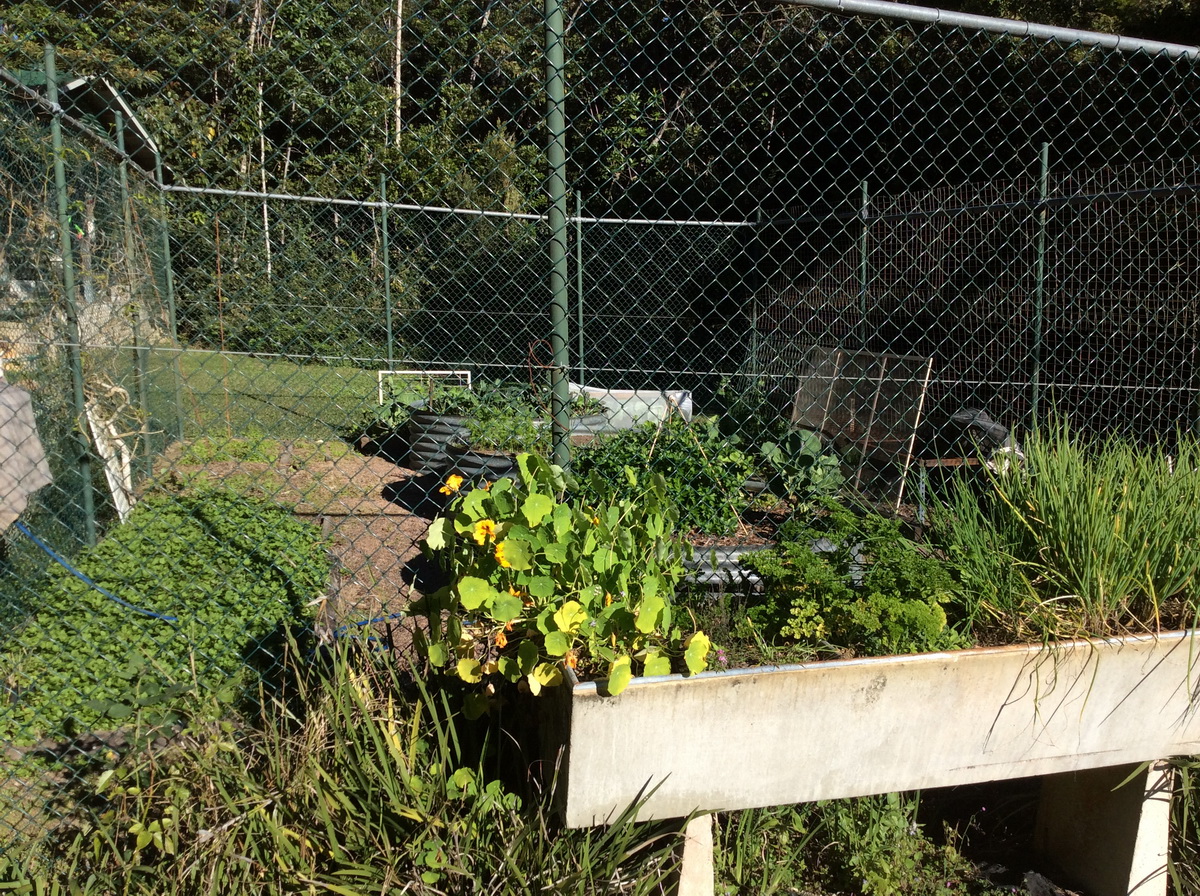
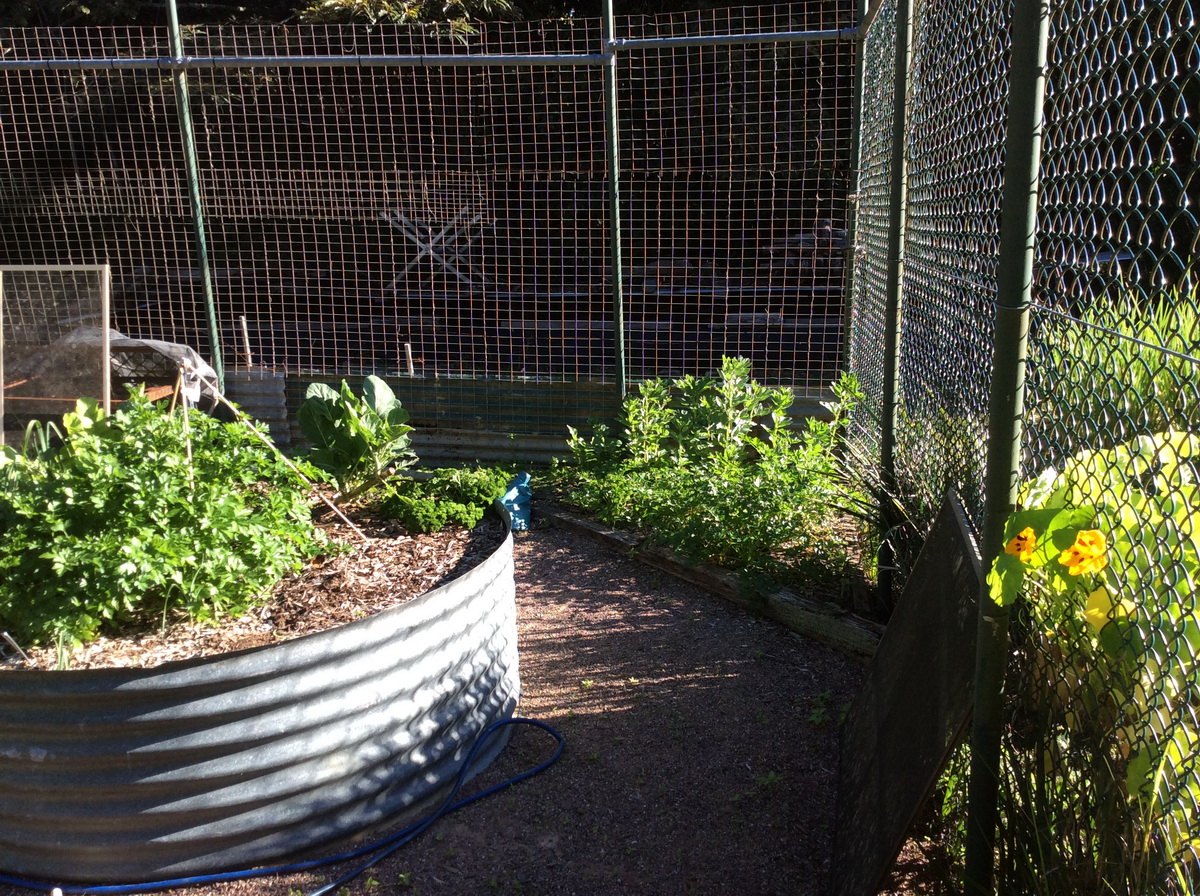
On the rural blocks most gardens are securely fenced, some are also roofed with wire mesh.
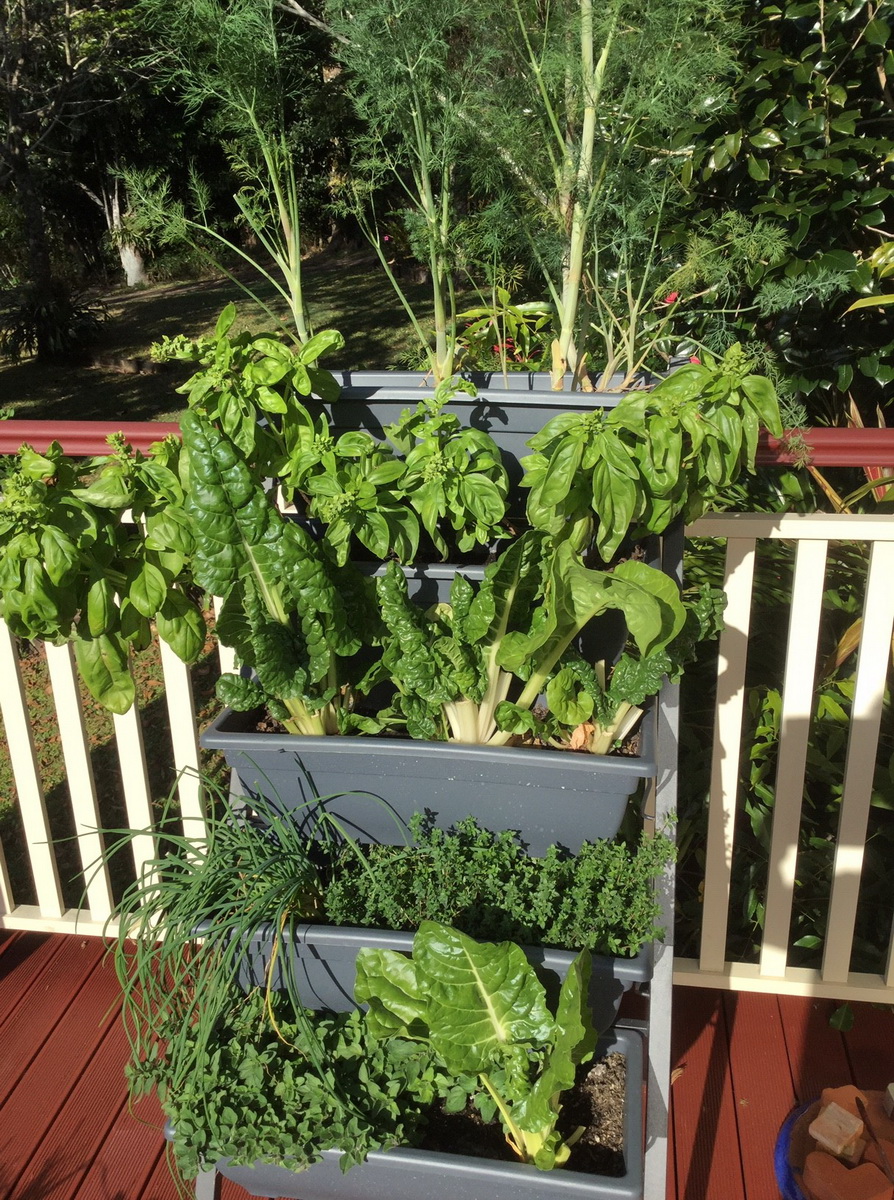
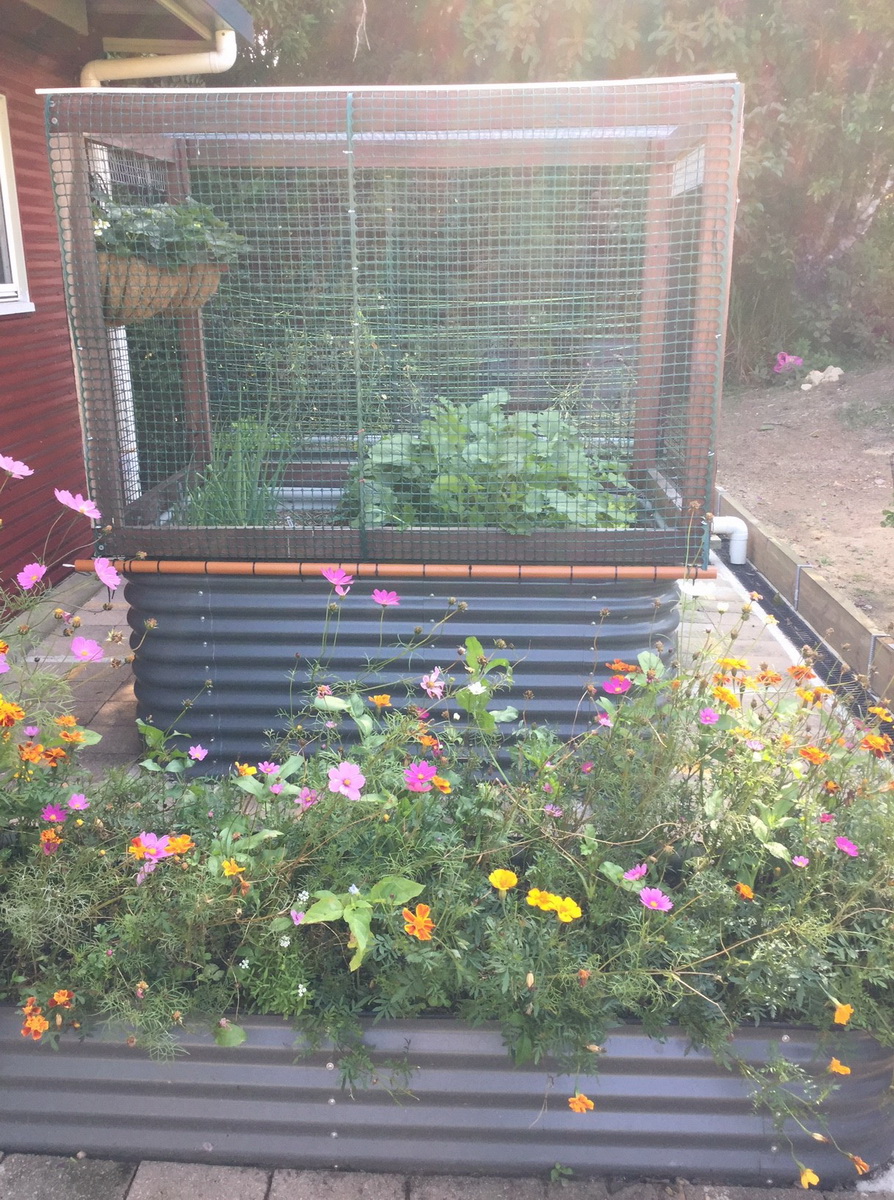
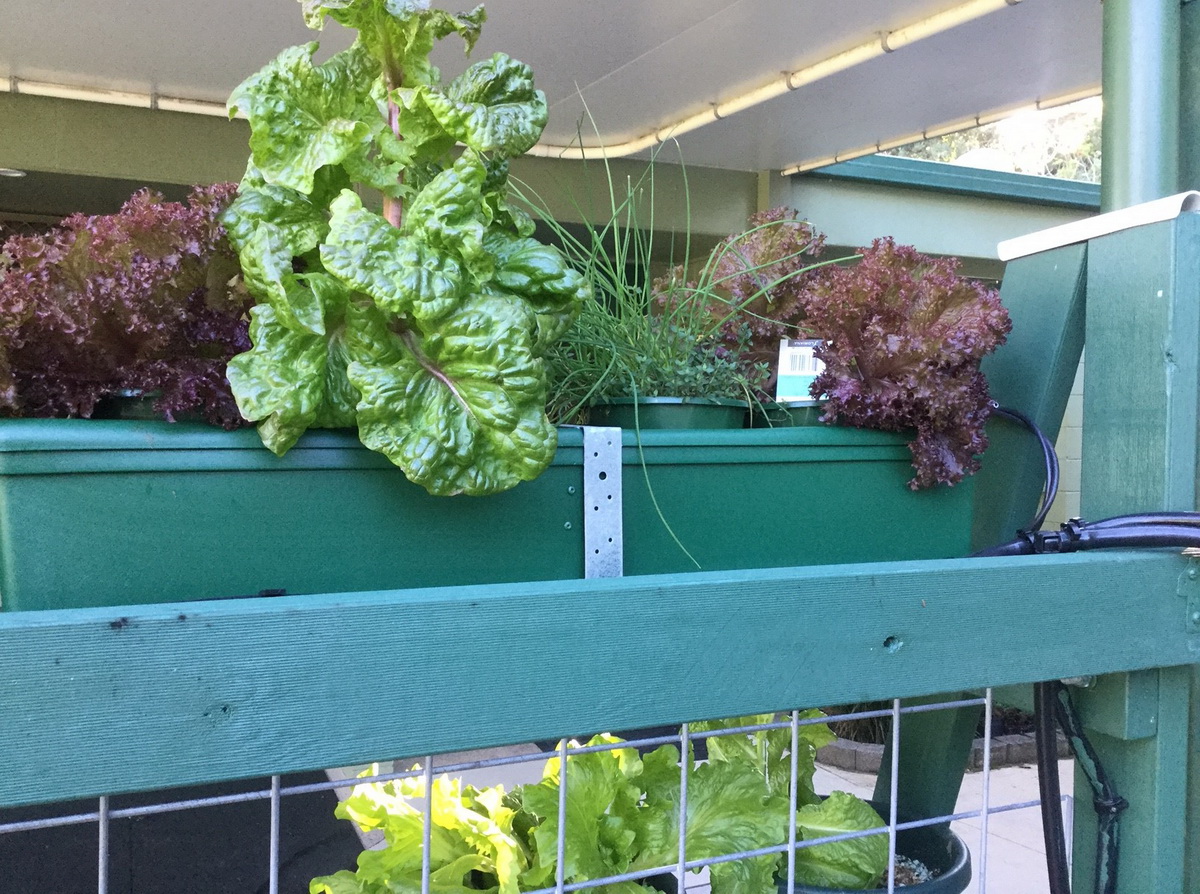
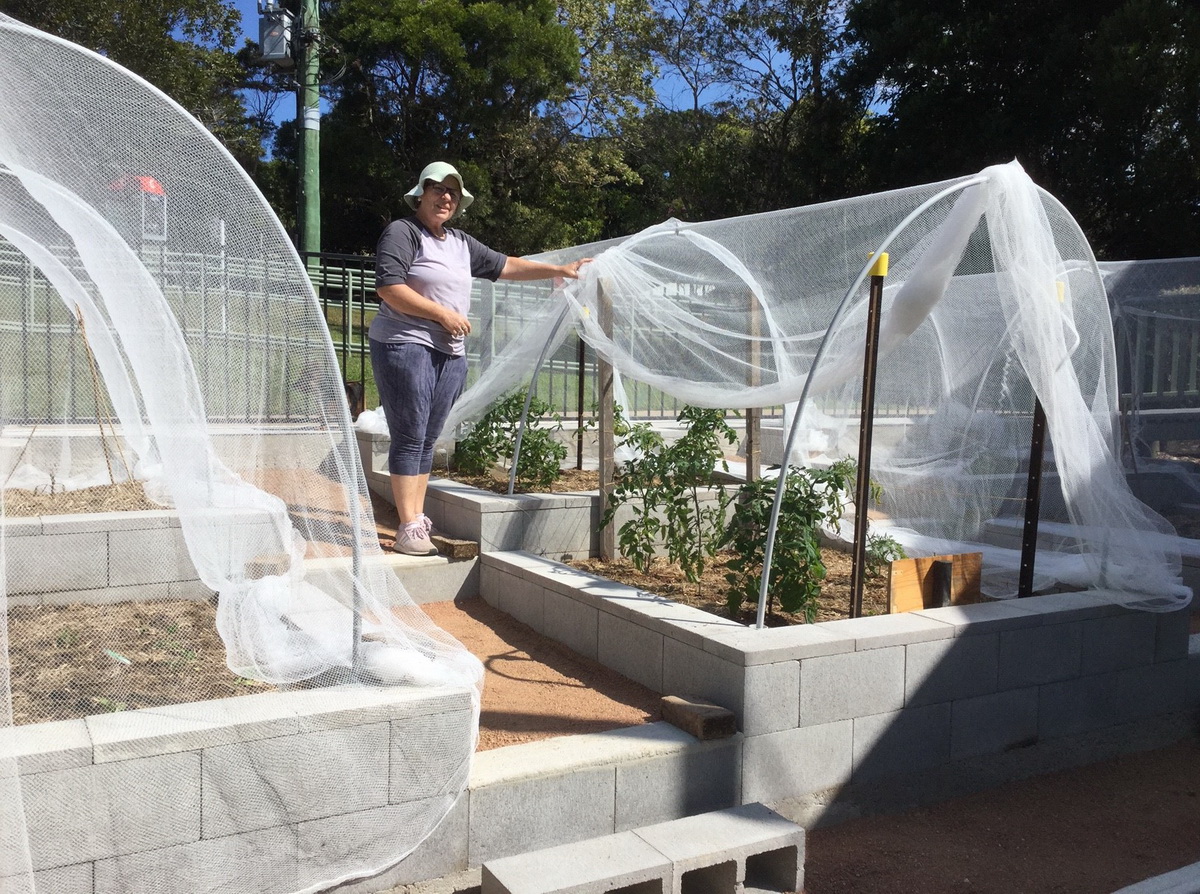
In the village various strategies are employed. Some gardens are in raised beds with a bird-mesh structure above, which can be opened to give access for weeding and harvesting. Other kitchen gardens are in purpose-built boxes suspended from veranda rails – excellent for restricted spaces.
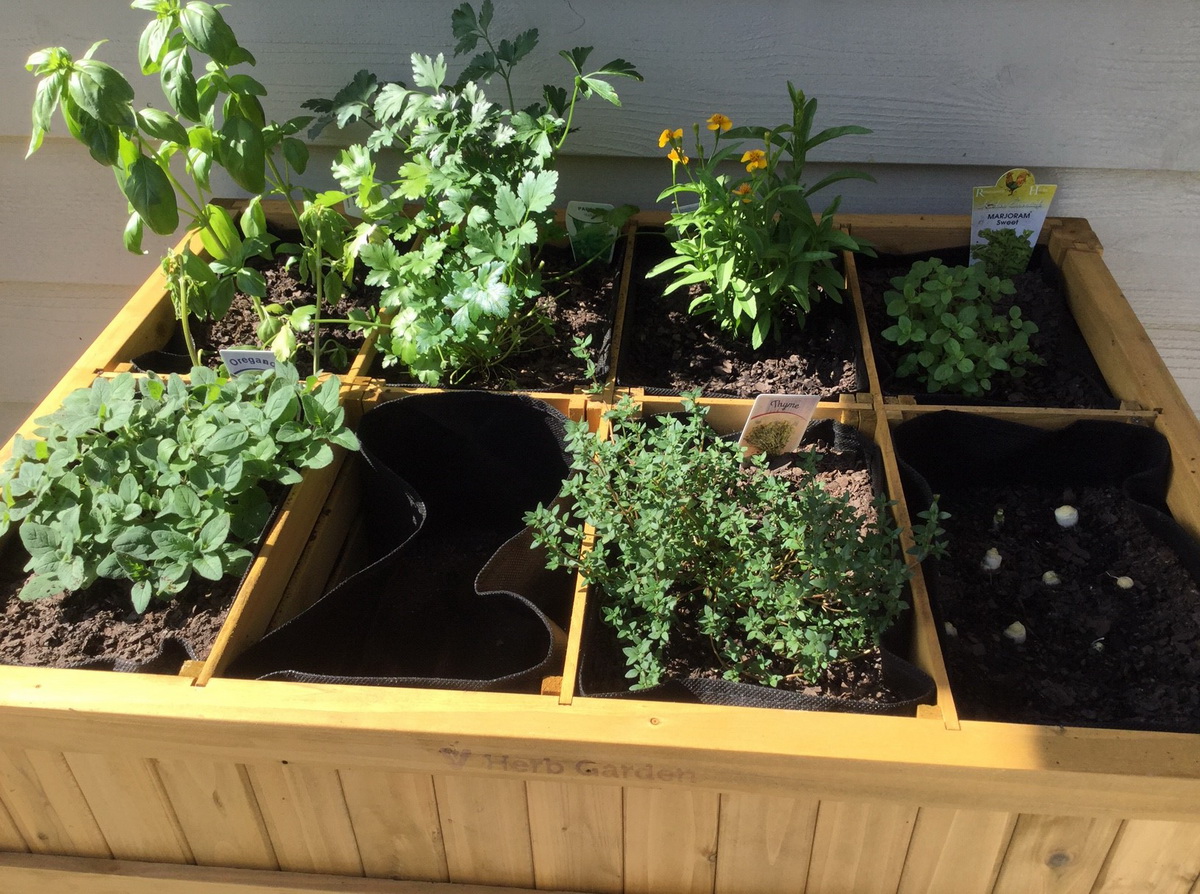
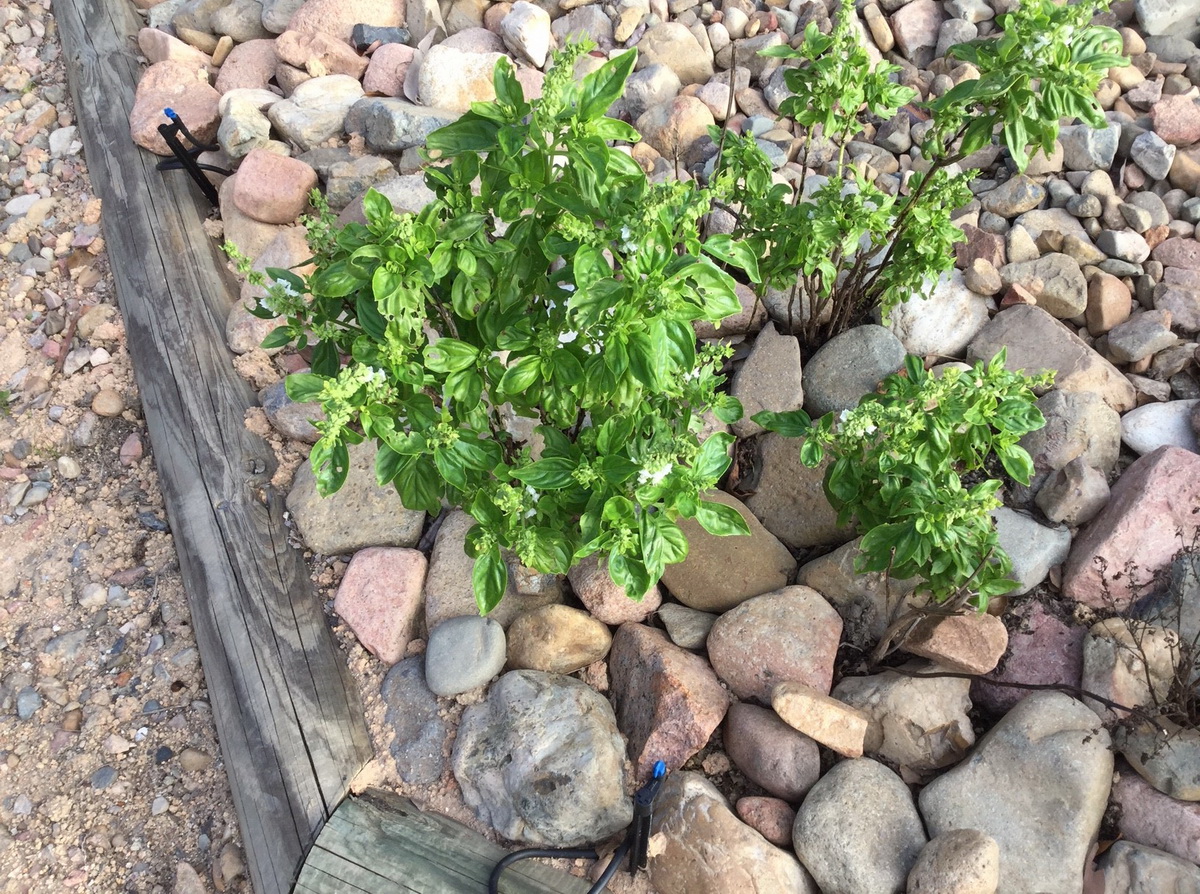
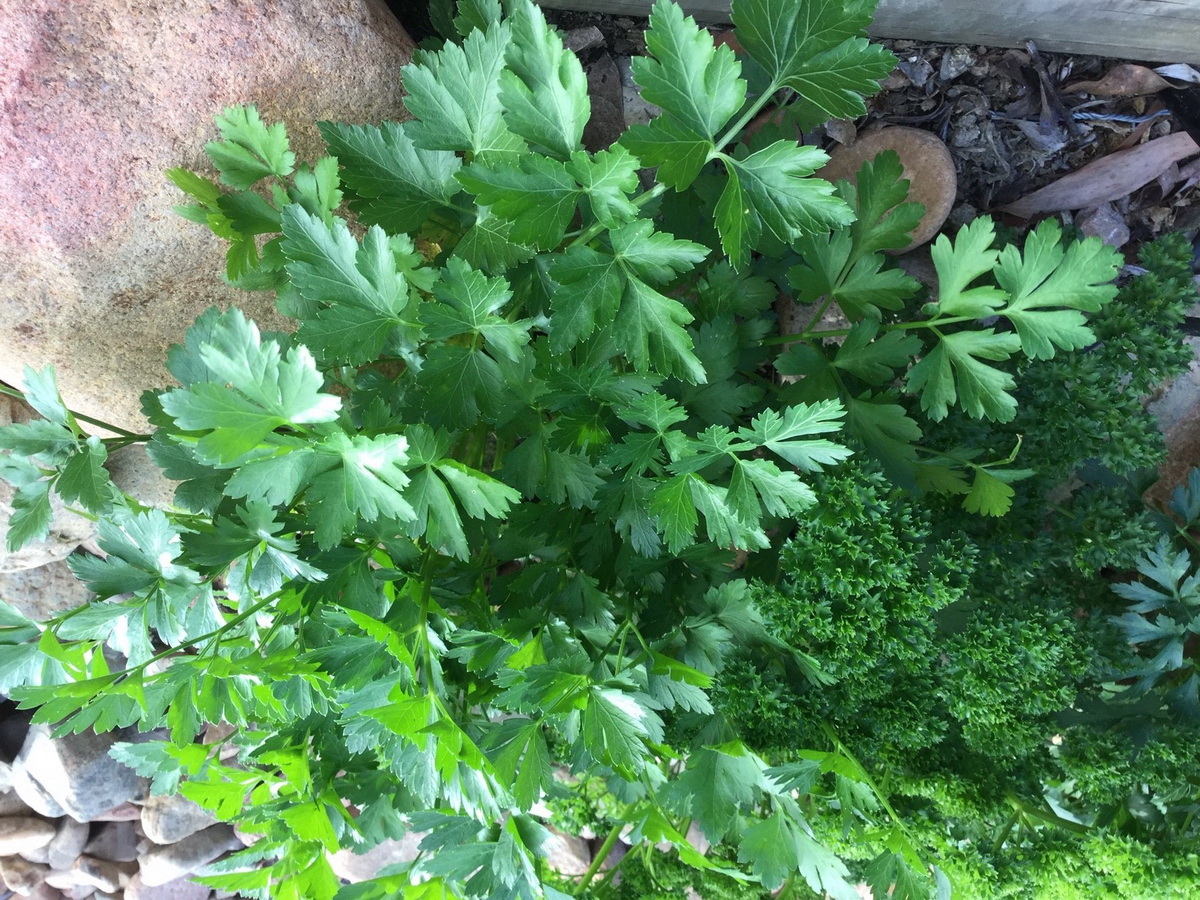
Jennie Robinson’s herb box garden contains basil, parsley, oregano And several other herbs.
Jan and Peter have given their ‘caged’ plants extra protection by planting insect repelling flowers nearby.
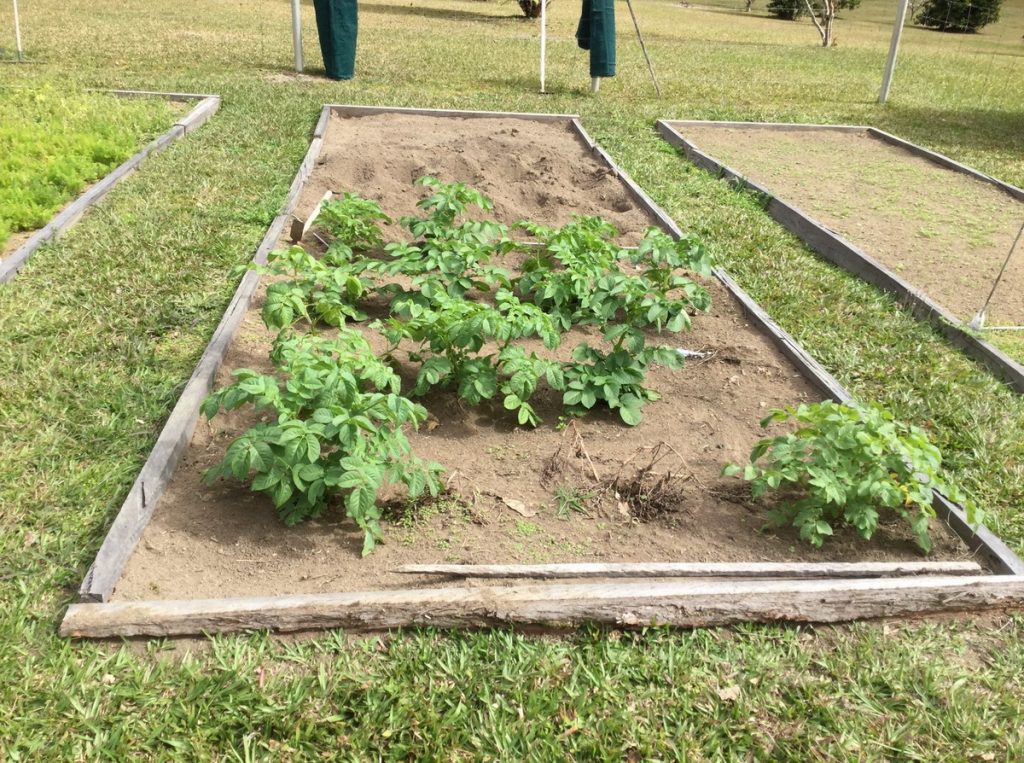
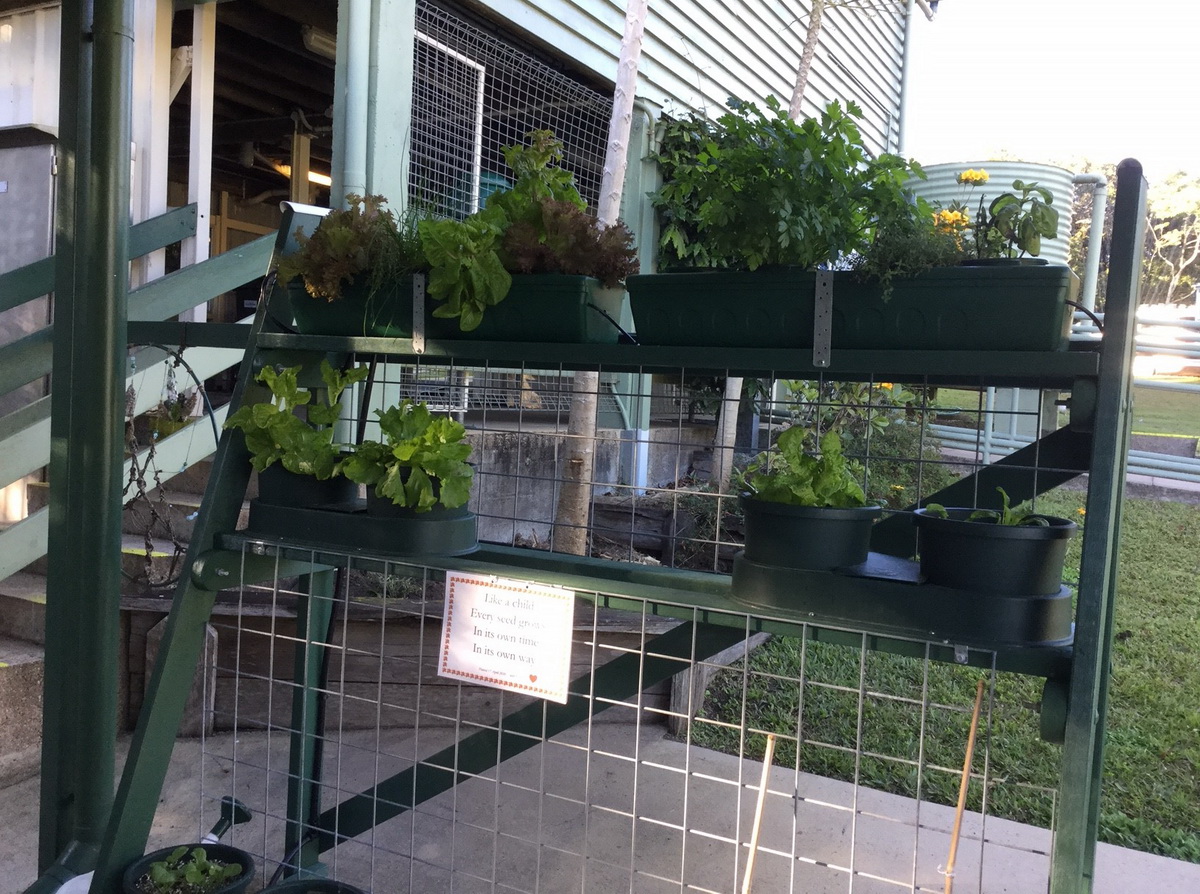
Barry and Chris at the Paluma Environmental Education Centre, have established hydroponic gardens with healthy crops of lettuce varieties, tomatoes, beans, radish and a range of herbs. The tubs containing the plants are set on a vertical framework, making them fairly inaccessible to turkeys. A conventional vegetable garden has also been established at the school with the plots protected by bird-mesh covered arches.
So far turkeys have not discovered the hydroponic plants but the other garden has not escaped attention; a net inadvertently left open gave a young male turkey his chance to explore.
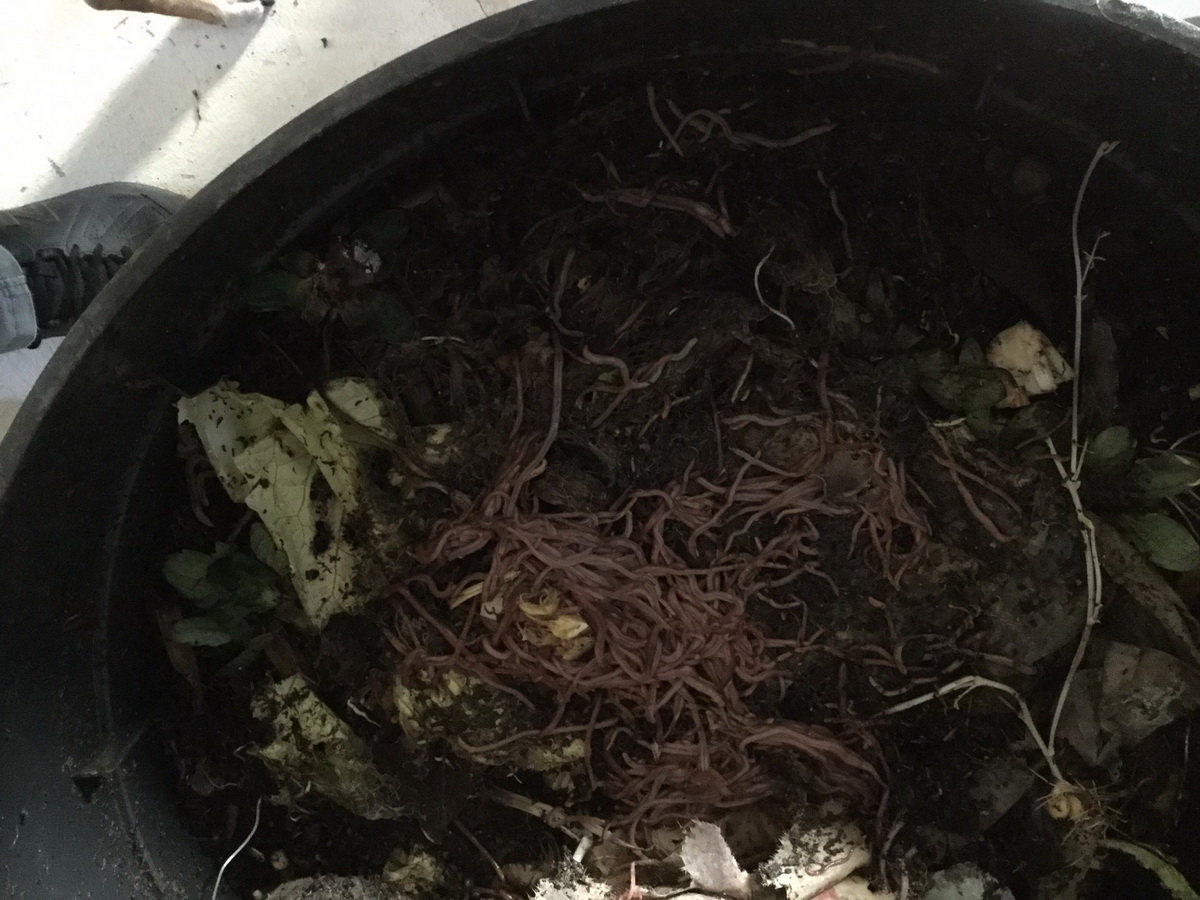
So, with location and protection taken care of, the secret of success in producing strong, healthy food plants, apart from having green thumbs, and a passion for gardening, is ascribed to the fertiliser used. Fertilising with liquid and casts from a worm farm seems to be a winner. The popularity of worm farms is growing with several gardeners now raising these helpful little pets.
Lynda’s worm farm
While commercial products work well, traditional natural fertilisers such as goat and cow manure are highly regarded.
Hats off to all these determined gardeners. You are inspirational! This article will be followed up with regular updates of what fruit has ripened and what vegetables are being harvested.
Paluma gardens are in a continuous state of change with a regular cycle of blooming and fruiting that makes each visit up to a the village a new experience. A walk along the village road can be a process of discovery of new blooms never before seen, or the emergence en masse of old favourites, or a re-aquaintance with an uncommon plant not seen for some time.
Although we continue to publish individual posts on interesting plants that are blooming in Paluma gardens, we have not, generally, created new posts for flowers that we have highlighted in previous months or years even, if they are currently in full bloom. Over time this is leading to there being fewer new things to write about in our “What’s Blooming?” section.
It seems a shame not to share our delight in seeing old favourites come into bloom during certain months, or to share a quickly taken picture of a particularly striking plant or flower that we don’t have the time or enough supplementary information to create a dedicated post. Consequently, we have started a new series which is a simple collection of photos from Paluma gardens highlighting what is in bloom during each month, and what interesting plants we have discovered.
We also invite residents with an interest in photography to send us their best photos from their gardens or from around the village for inclusion in the monthly collection.
Below is a slide show for June 202o. You can access slideshows for previous months on the Paluma through the seasons page on our website.
Enjoy the show…..
Jamie and Michele
Paluma in July 2020
Click on the image below to start the slide show… it will start automatically after a few seconds
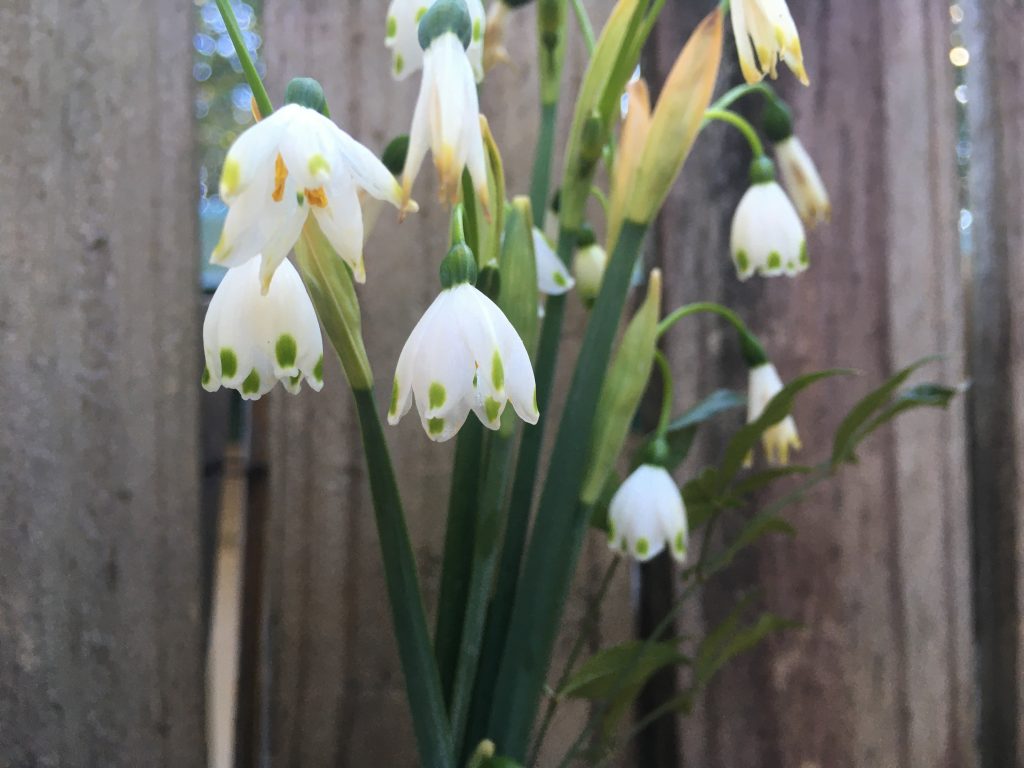
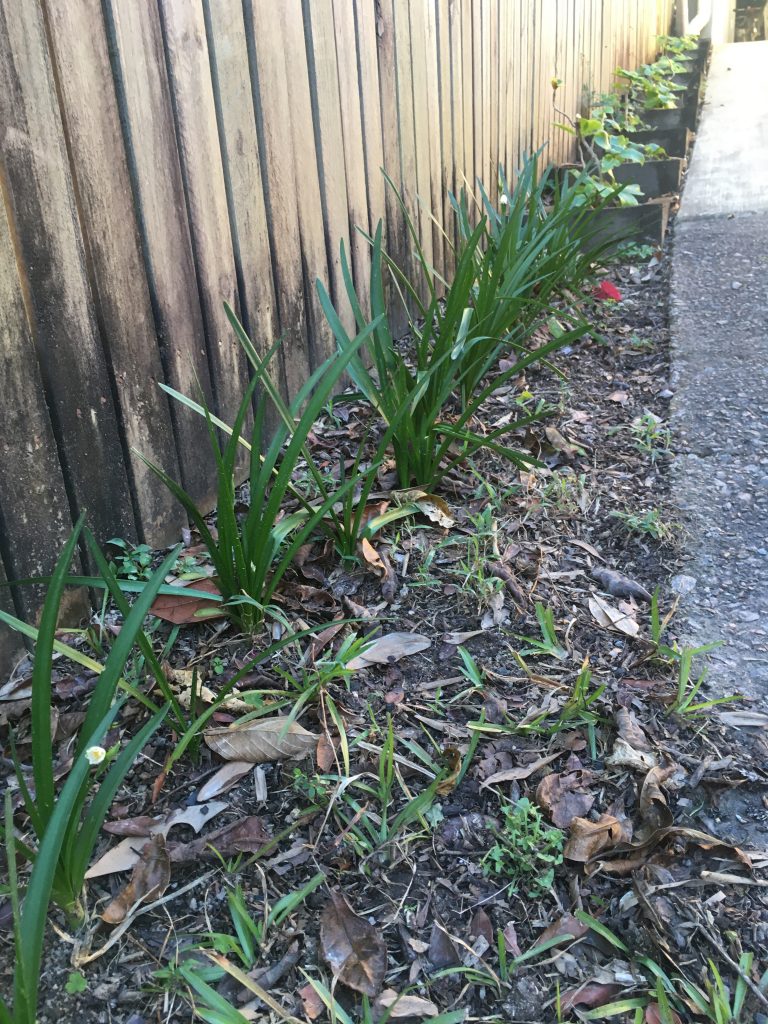
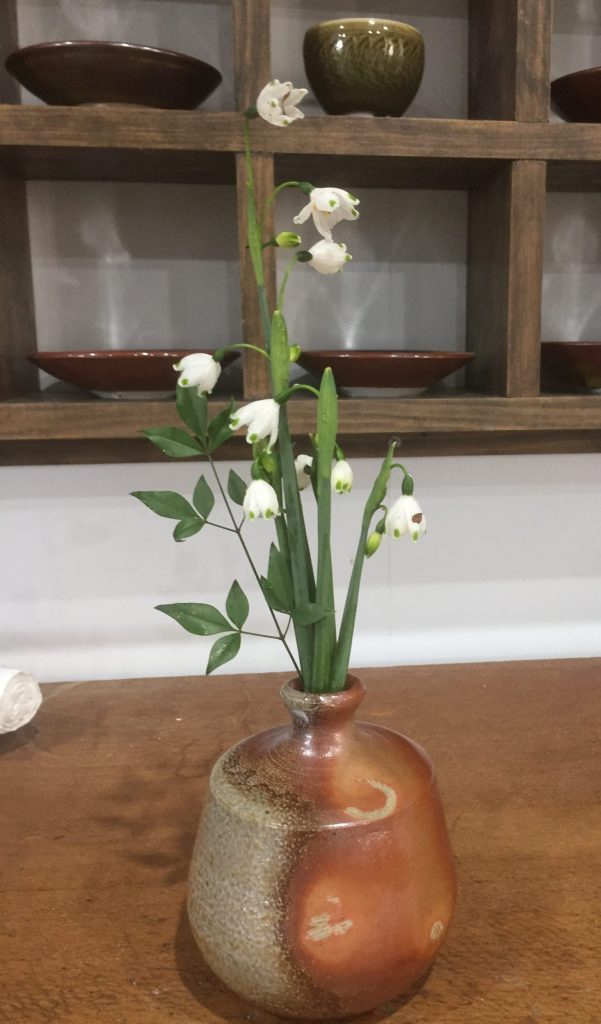
Its been a pretty cold winter so far in Paluma and the flowers in our gardens are showing it. The weather app on my phone indicates that temperatures have been well below 10°C with a few nights below 5°C. Jonquils and Tulips are two of the cold loving flowers that can be seen growing and occasionally flowering in Paluma, but Len Cook has made me aware that we can grow another bulb normally found in southern climes –Leucojum sp or “Snowflakes”.
Len has had a steadily growing clump of these for several years that he recently replanted them as a row along his fence and they have produced sprays of gorgeous white flowers. They are often misnamed “Snow Drops”, which are nearly identical, but Snowflakes can easily be distinguised by the small green dots near the end of each of the 6 petals. They are more tolerant of warm conditions compared to Snow Drops (Galanthus sp), but both are sufficiently cold tolerant to be seen poking out of the spring snow in full flower in temperate regions.
Snowflakes are native to central and southern Europe but have become naturalised in North America and Australia)
Photo by Len Cook
Len’s snowflakes appear to be the Spring Snowflake (Leucojum vernum). The other species found in southern gardens is the larger Summer Snowflake (Leucojum aestivum).
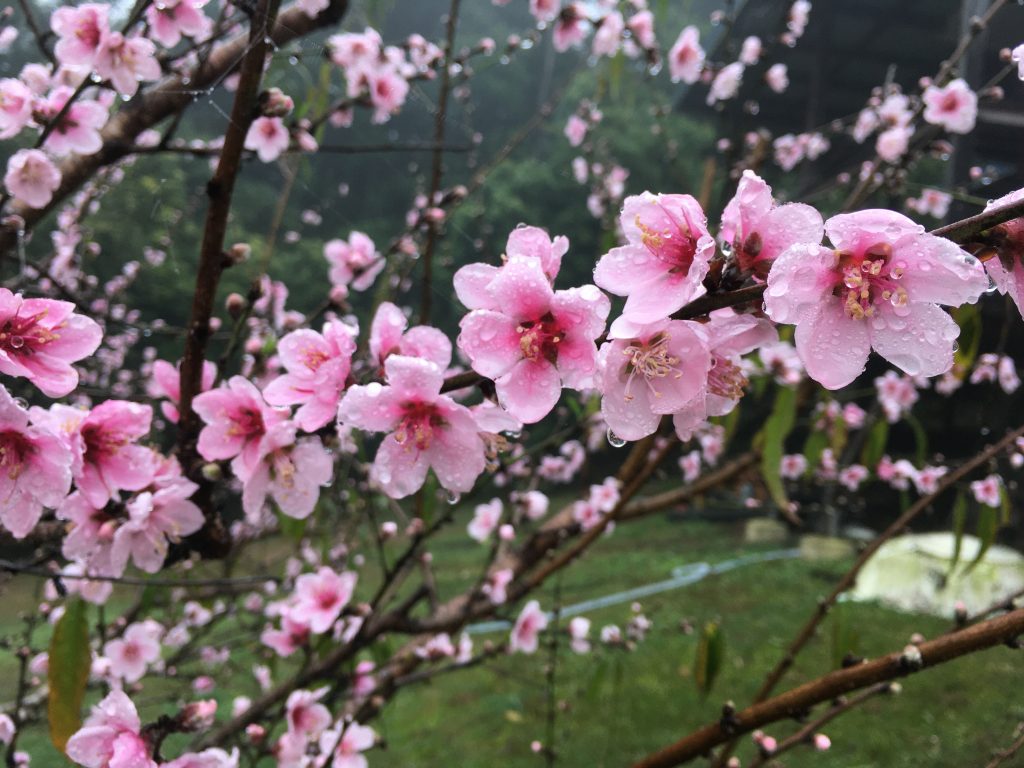
In addition to temperate bulbs, Paluma is also able to grow stone fruit in the form of “tropical” peaches which, despite their name, require at least a short period of cold weather to flower and bear fruit. There at least 3 residences which have flowering peach trees in Paluma at present. While the beautiful pink flowers are a delightful addition to any garden I am told that birds and native rats benefit the most from any fruit that are produced. However I gather one resident has been able to harvest enough to make peach jam one year.
I have chosen Davidson’s Plum (Davidsonia pruriens) as the July Rainforest Tree of the Month because my attention was drawn to this tree by the abundant litter of large, purple fallen fruit on the ground beneath a tree near the Paluma Environmental Education Centre’s fire pit. Investigating, I saw that the tree was well laden with bunches of fruit, some ripe and ready to fall while small green fruits were also strewn along the branches. It was early in June when I saw the fruit but fruiting can occur at any time of year.
Although it is a rainforest tree, Davidson’s Plum is not endemic to Paluma. It grows to about 18 metres high and is found from sea level to altitudes of up to 1095 metres from near the Big Table-land near Cooktown to Cardwell. There are three species of this genus endemic to Australia, one occurring in Tropical North Queensland.
The name Davidsonia, named after a pioneer sugar-cane grower, J E Davidson is ironic given that so much of the lower level rainforest where this tree occurs, has been lost to cane-fields. Pruriens, means itching or stinging and applies to Davidson’s Plum because there are irritant hairs on leaves and young fruit.
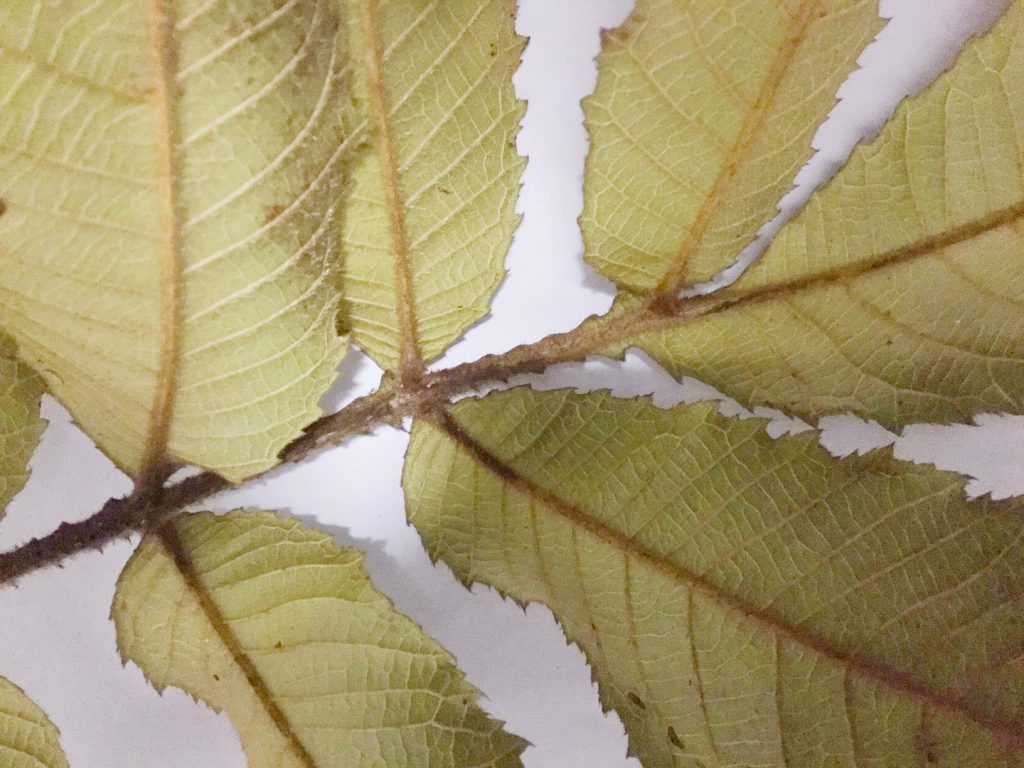
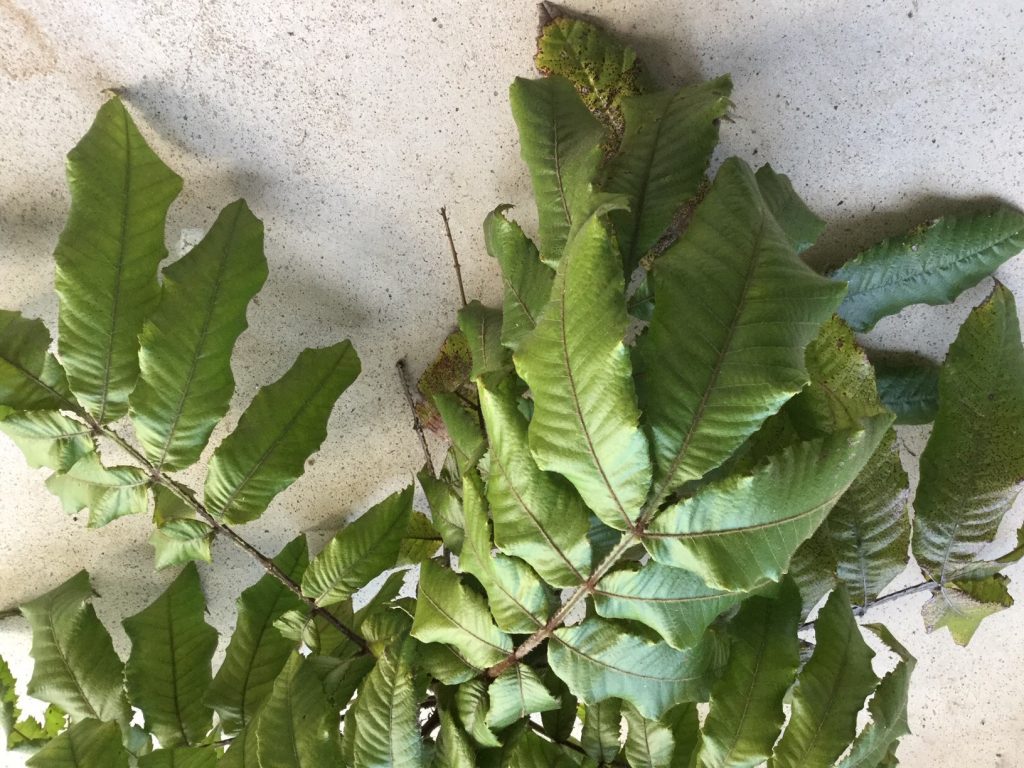
The large, hairy compound leaves of this tree are distinctive with deeply serrated edges to the leaflets and little leaf-like protrusions between the leaflets. Both sides of the leaf are covered with fine hairs.
Flowering can occur at any time. Flowers are tiny, with no petals but have four or five green or pink sepals. The grow in panicles (bunches) from leaf axils or are cauliflorous (along the trunk) or ramiflorous (on the branches).
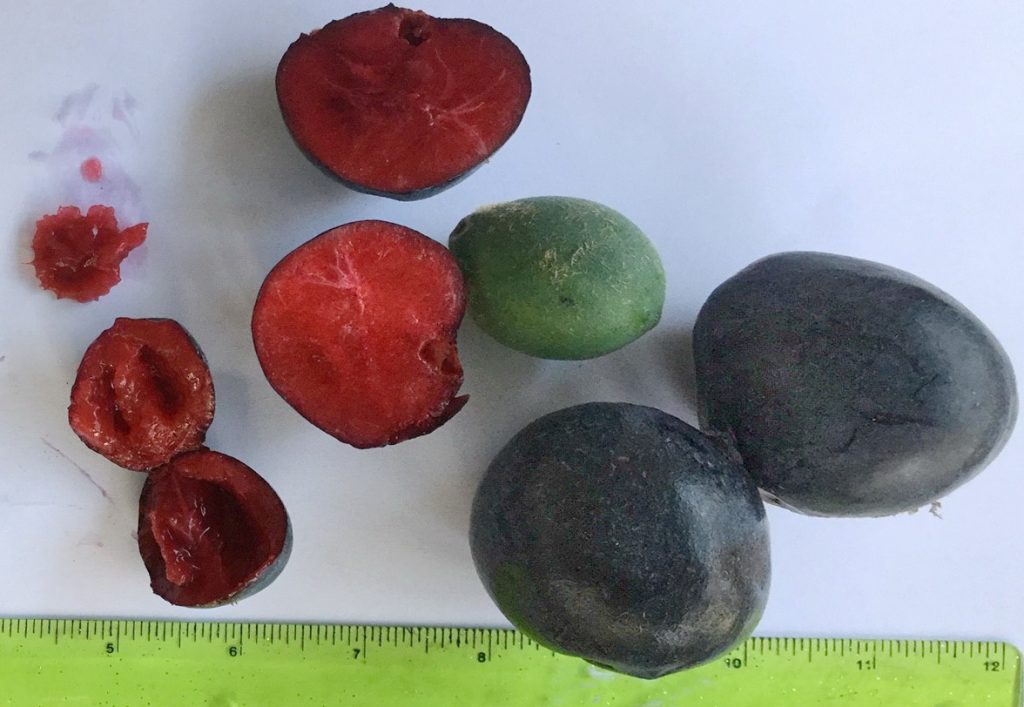
The fruit is a drupe, (fleshy), with two seeds The developing green fruit is well covered in fine hairs which can cause considerable irritation and itching. Ripe fruit is roughly oval to round, about five centimetres long, and is dark purple to almost black with a fine powdery, whitish bloom on the surface. The flesh is dark pink. Of the two seeds, usually only one is fertile. The fruit is highly acidic, too tart to eat raw, although it was eaten by Aboriginal people, but It can be made into a delicious wine, jam or jelly. Cassowaries, Sulphur-crested Cockatoos and Double-eyed Fig-parrots eat the fruit.
A good example of the Davidson’s Plum can be seen at the forest edge behind Paluma Environmental Education Centre, near the fire pit.
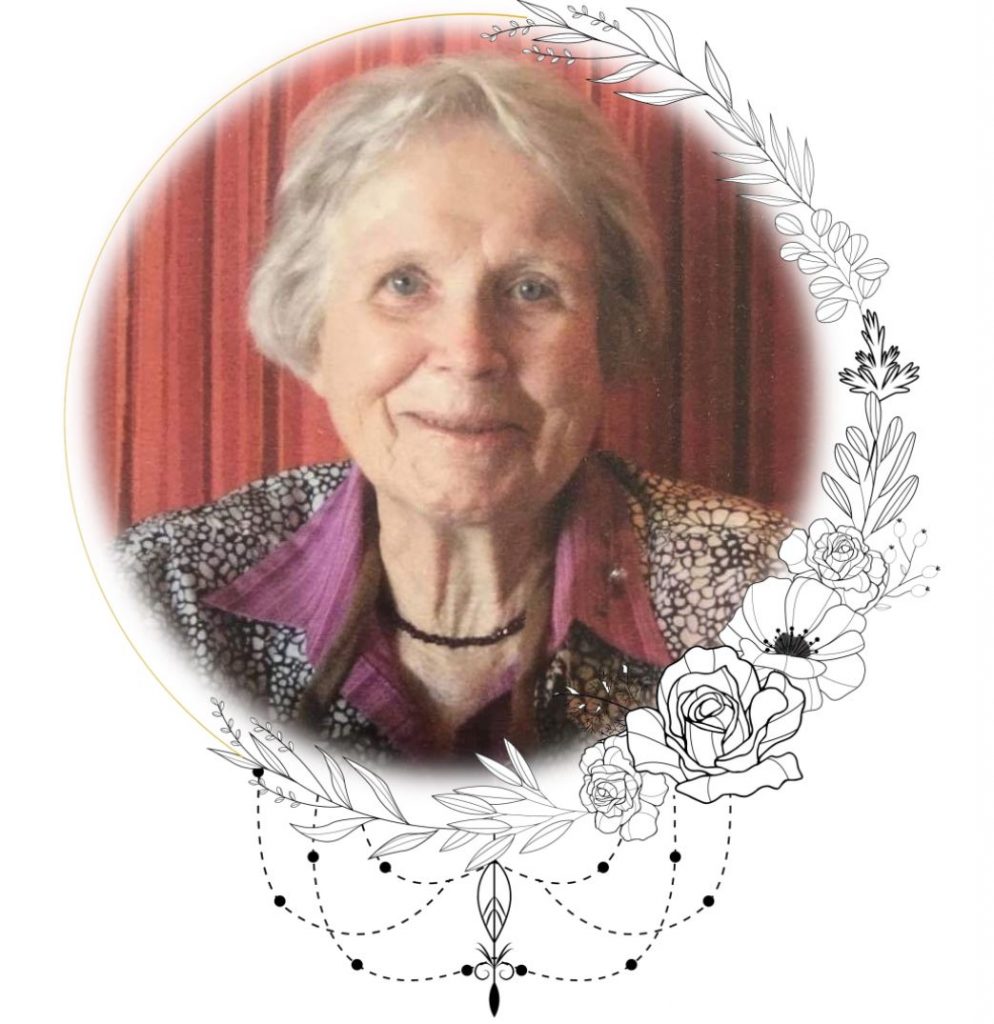
Sue Rimington passed away in May this year. She and her husband (Dr. Ron Rimington) owned the house opposite the old police station, which they built around 1984 using the same local builder (John Grail) who built Nick and Glenda Van Rynswood’s house. The Rimington family used to come up to relax on weekends occasionally and to enjoy the cooler weather. They loved nature and gardening. Dr. Rimington’s association with Paluma possibly began with his Army Reserves service in the 60’s -70’s exercising in Paluma area.
Sue was a gentle, quietly spoken lady who dearly loved flowers and gardening. Her interest in flowers got her involved in fund raising charity events and became a key person in the flower fantasies these fundraising events required. After Ron’s death in 1998, Sue moved to Brisbane.
The Rimingtons were members of the Paluma Progress Association and well known in the Community. Their daughter and husband (Robyne and David Maguire) owned a block of land at the end of Hussey Road opposite Browne’s property . Doc as we called him used to go out there and plant cardamom and they had some fruit trees.
One story I was told was that Doc one day went out on the block to pick a box fruit, stopping to go home for lunch. On returning he found the fruit out of the boxes onto ground. He was quite puzzled by this but did not have to wait long before out came the culprit – a cassowary.
Sue’s early life was spent in the suburb of Camberwell in Melbourne and then Camperdown Victoria where her father was in a furniture business. She went to primary and early secondary school in Camperdown before going to boarding school at Methodist Ladies College in Melbourne for her senior years.
Sue’s career was in nursing at the Royal Melbourne Hospital. Melbourne was where she met and married her husband Ron and from here they both moved to Townsville so Ron could take up a medical position at the Townsville General Hospital. Townsville is where they based their next 50 years. They had three children, Scott, Robyne and Mignonne.
Sue had many interests too numerous to mention but a couple come to mind one being how she started a home decorating business and her logo was a large snail with the wording “Is your home getting on your back”. The other one was later in life turning to painting and developed a style which seemed to be an extension of her real flair for colour.
She spent her last 20 years in Brisbane surrounded by a large and loving family whom she adored. Her grandchildren and great grandchild have many wonderful memories to pass onto their children in the future.
I gathered some of this information from family and what I knew myself of Ron and Sue as Ron was my boss at the Commonwealth Pathology Laboratory and James and I became very close friends with them over many years.
After delays and uncertainties resulting from COVID-19 the Paluma Push for 2020 is now confirmed and scheduled for October 11.
Visit the Paluma Push website for more information and bookings.
This year the event is being coordinated by Outer Limits Adventure, and Sam Stedman is keen to tap into the dedicated volunteers from Paluma who have manned the checkpoints in previous years. So please put this important date in your calendar if you would like to help out. More information will follow in due course.
Kelly Davis was a good friend of Dorothy’s and mine. His cheerful, friendly, generous nature was infectious.
We had many wonderful holidays and fun times together; trekking, skiing, fishing, golfing, and playing snooker, all of that Kelly excelled at, leaving me in his wake despite my baulking and razzing.
Kelly’s extensive knowledge of fauna and flora enlightened and enthused our interest in the natural wonderland around Paluma.
Strong physically and in character, Kelly approached all difficulties pragmatically, applying his many skills and practical knowledge to problem solving, and generously helping others with advice and assistance when required. Building many verandas in Paluma, including ours, Kelly started “veranda envy” in Paluma.
At Paluma Dorothy and I will sit at our “Kelly made” beautiful red stringy bark table on our “Kelly made” veranda and sadly, but fondly reflect the wonderful, inspiring impact Kelly has had on our lives.
Kelvin John “Kelly” Davis 6 May 1945 to 5 June 2020
It is with sorrow that we report the passing of long time Paluma resident, Kelly Davis. He died on 5th June after battling an aggressive illness.
Kelly was an active member of the Paluma community, generous with his help and expertise in many areas, from repairing a broken rocking chair to building a veranda, clearing fallen trees and debris from properties after cyclone damage, to helping dig a garden bed. He was tireless in his assistance to Len at the annual Anagama kiln firing: cutting and stacking timber for the fire and helping to monitor the kiln temperature for the four or five days of the operation. In everything he did, Kelly was attentive and thorough. There are very few gardens that do not have bulbs donated from Kelly’s garden and many of us benefitted from the produce from his very successful fruit and vegetable plots.
Before coming to Paluma Kelly had lived in Mount Isa where he was employed by Mt Isa Mines and worked as a powder monkey, deep underground. He and his family moved to Forest Beach where Kelly worked on line maintenance for Victoria Sugar Mill in Ingham.
Kelly came to Paluma in 1987, where with his then wife Carol, he owned and operated the very popular Ivy Cottage tea room. The business was sold in 1989 to Ann and Andy Bishop. Kelly worked in a variety of roles for Townsville City Council and then for National Parks until his retirement.
Retirement did not slow him down however: he just spent more time helping people with various projects, and indulging in his passions for gardening, traveling, wood-turning, (many will have seen his beautiful wooden bowls), and fossicking. Kelly also had an interest in quality wines and over the years built quite a collection, stored in the cellar he built beneath his house.
Kelly was a keen traveller, always interested in other countries and other cultures and learning about their history. As well as travelling extensively within Australia, his many travels included voyages to Antarctica and the Arctic Circle, Europe, USA, the Scandinavian countries and most recently France, in late 2019.
The Paluma community will greatly miss Kelly. Our condolences go to Kelly’s family and to Elizabeth and Marilyn in the loss of a person so dear to them all.
Vines (as well as woody lianas) are a common and defining feature of tropical rainforests. Because they rely on rapid overgrowth of other plants for support, they are most frequently found in disturbed areas where there is ample light for rapid growth.
Vines and climbers share a growth form but (like animals that swim or fly) belong to many different and unrelated groups. They use a variety of methods to grow up from the forest floor and into the light near the canopy without having to invest in growing their own heavy and rigid trunks. Some climbers use thorns that catch on to adjacent leaves and branches, others use tendrils to clasp or twine around other plants, and others use modified roots to cling on to tree trunks.
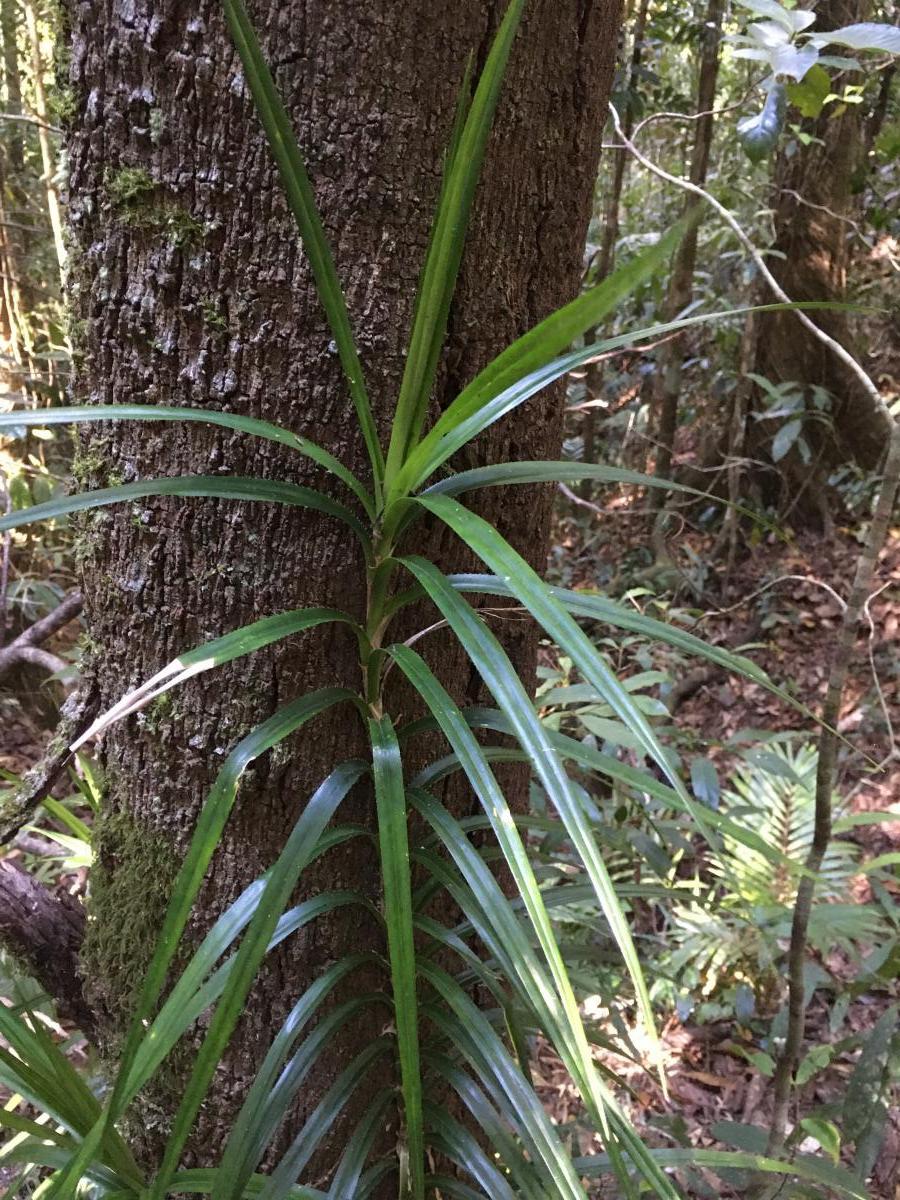
1. Climbing Pandan (Freycinetia excelsa)
The climbing pandan is a very common leafy climber found growing up trees in the rainforest and is easy to see along Paluma walking tracks. It is related to the large Pandanus palm-like trees seen in open forests along the coast. Leaves are narrow and pointed with fine teeth along the margin near the base. Some stems can also be found growing along the ground near the base of their host tree.
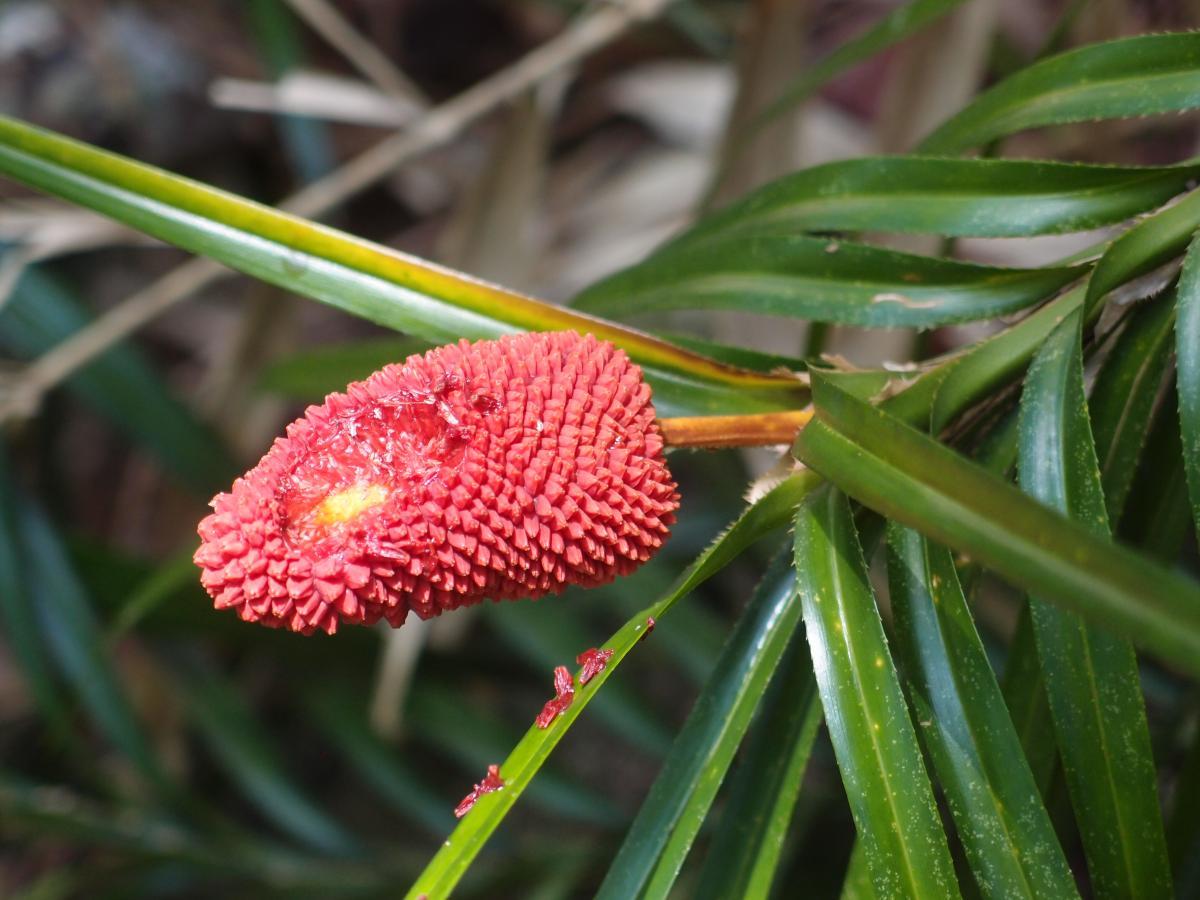
Fruit are rarely seen but are red to orange elongate clusters of seeds. Flowers are surrounded by orange leaf-like bracts.
A second species of Freycinetia (F. scandens) also occurs around Paluma. It can be distinguished by its much broader leaves, which have a more uniform length.
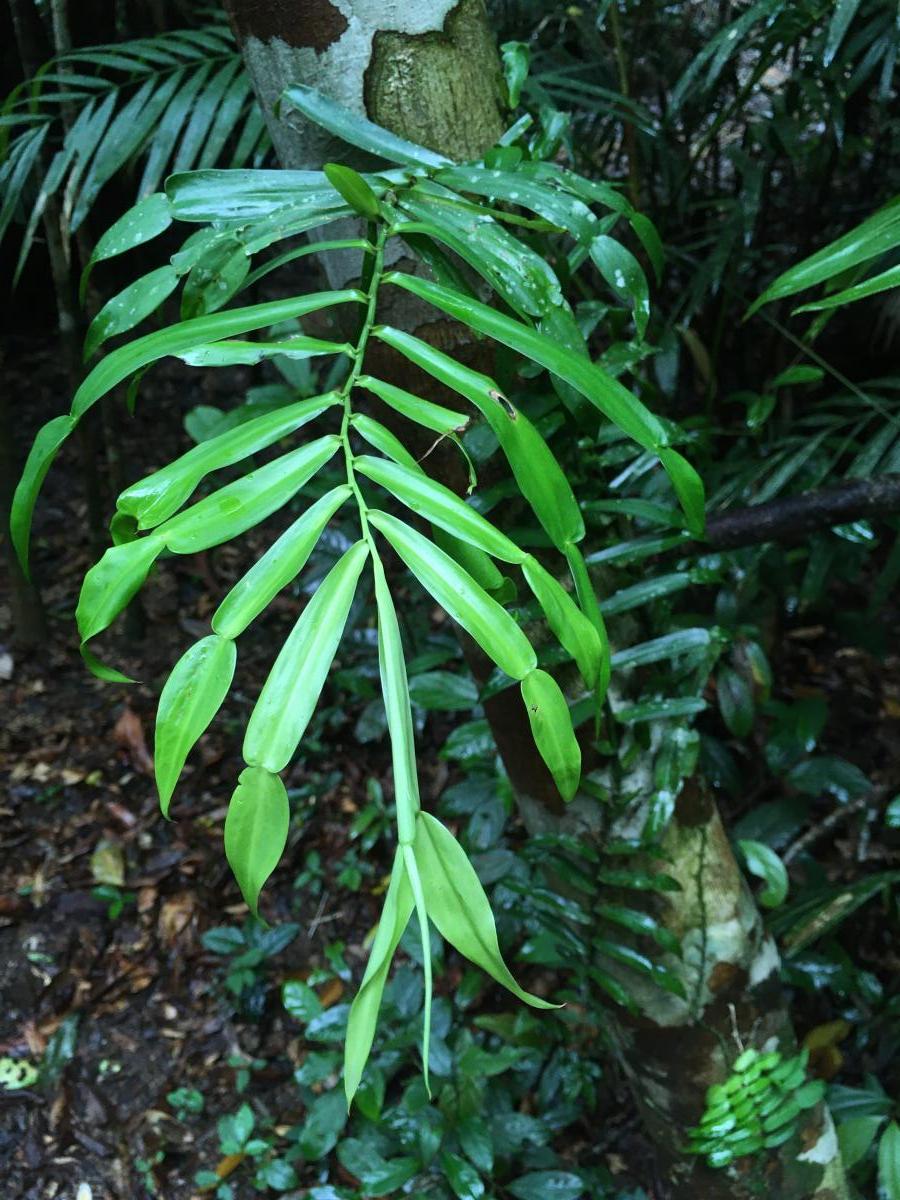
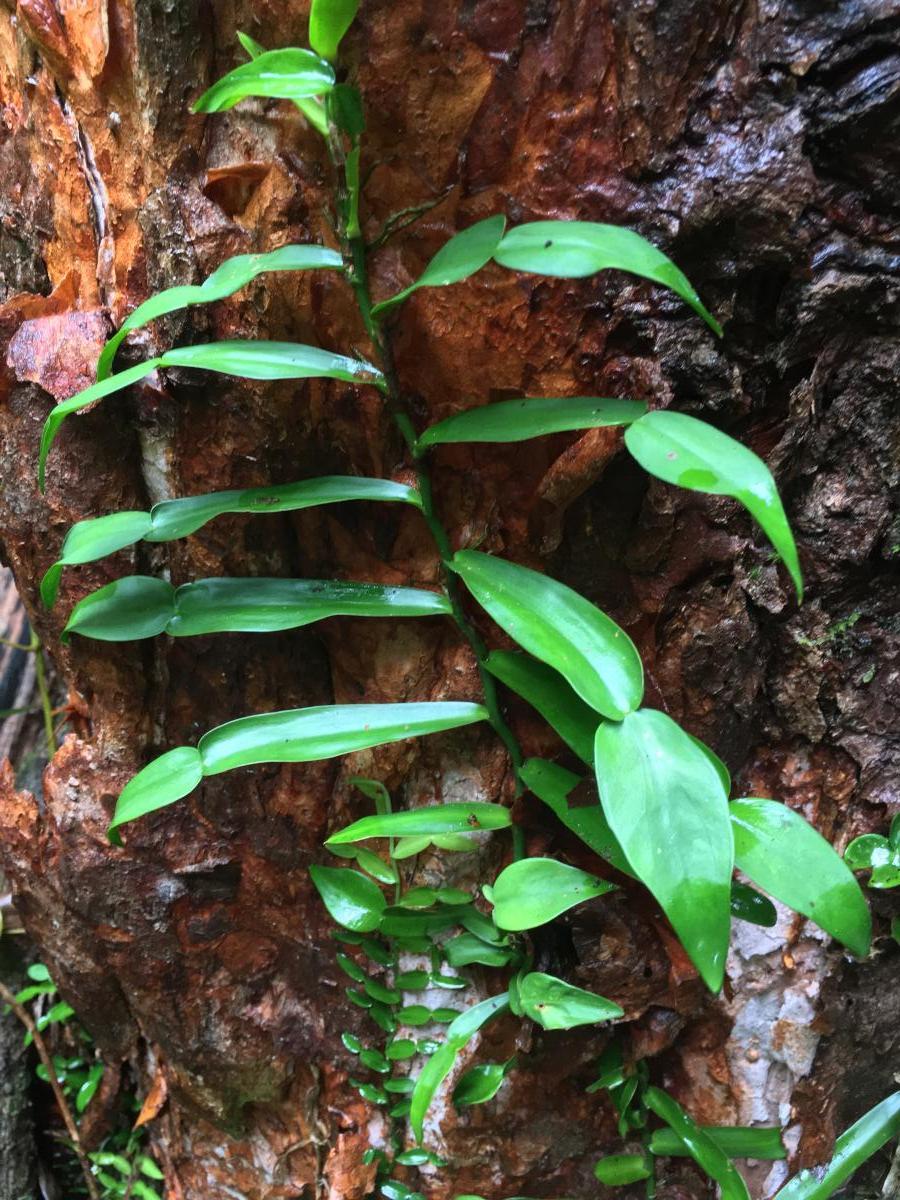
2. Pothos or Candle Vine (Pothos longipes)
Pothos is another very common climbing plant found growing up tree trunks along the village tracks. The distinctive leaves provide the inspiration for its other common name – candle vine. The leaves have a constriction near the apex, with the remaining apical leaf portion shaped a bit like a flame. No other climber has this leaf shape. Pothos are another very common climbing plant found growing up tree trunks along the village tracks.
The leaves get progressively bigger as plant grows and change from upright and pressed against the tree trunk to long pendulous and downward-pointing. Larger stems can also be found growing along the ground near the bases of trees.
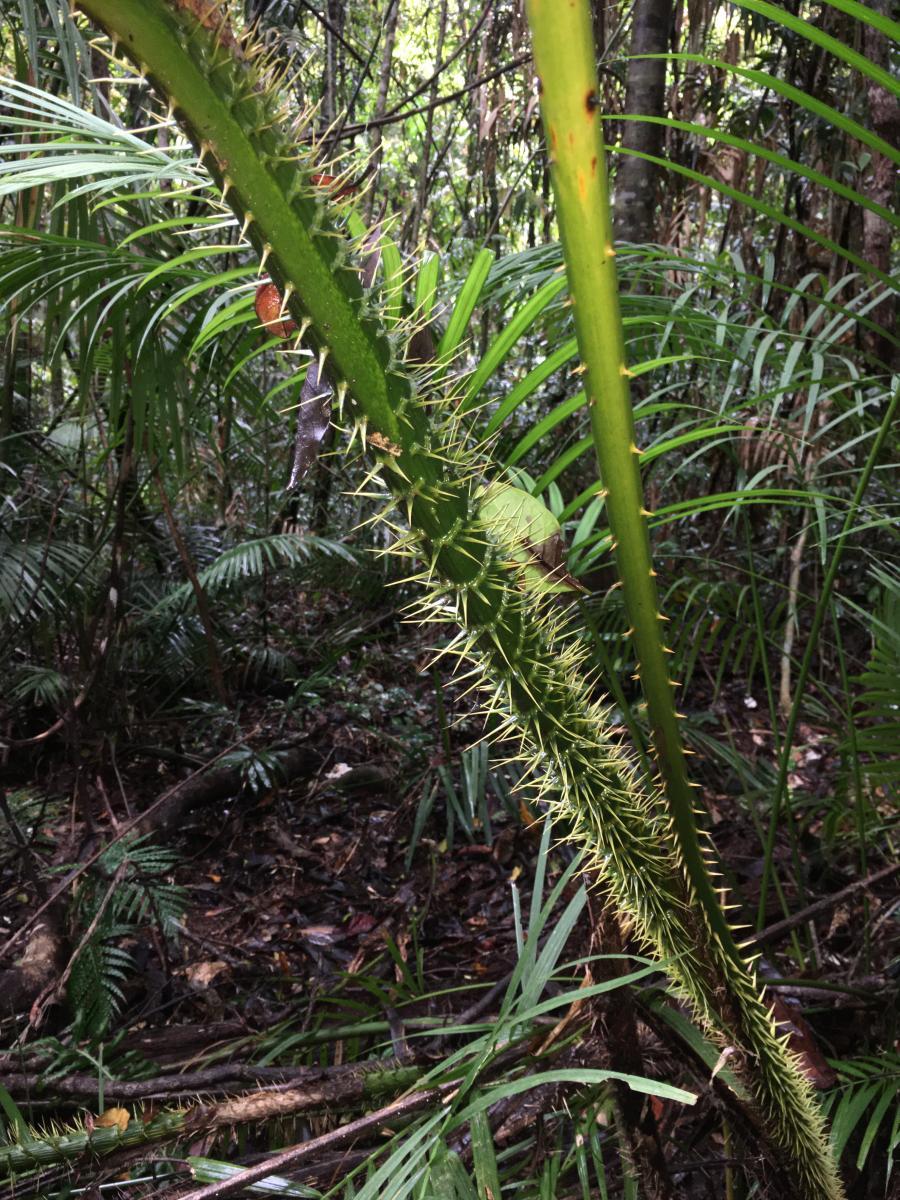
3. Yellow Lawyer Cane (Calamus moti)
This is one of a group of climbing palms variously referred to as Lawyer Vine, Wait-a-while, or rattan. They are most frequently found in forest openings and gaps caused by fallen trees or cyclones.
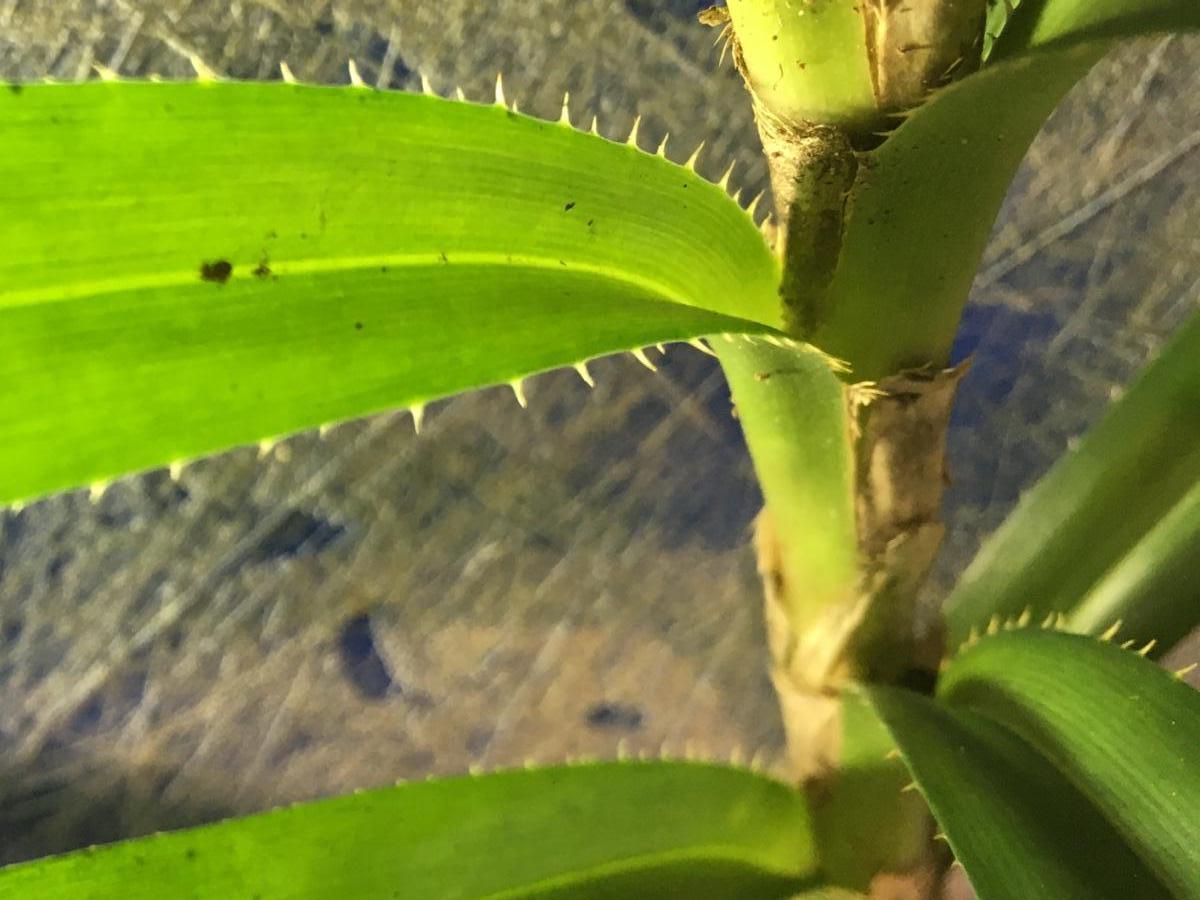
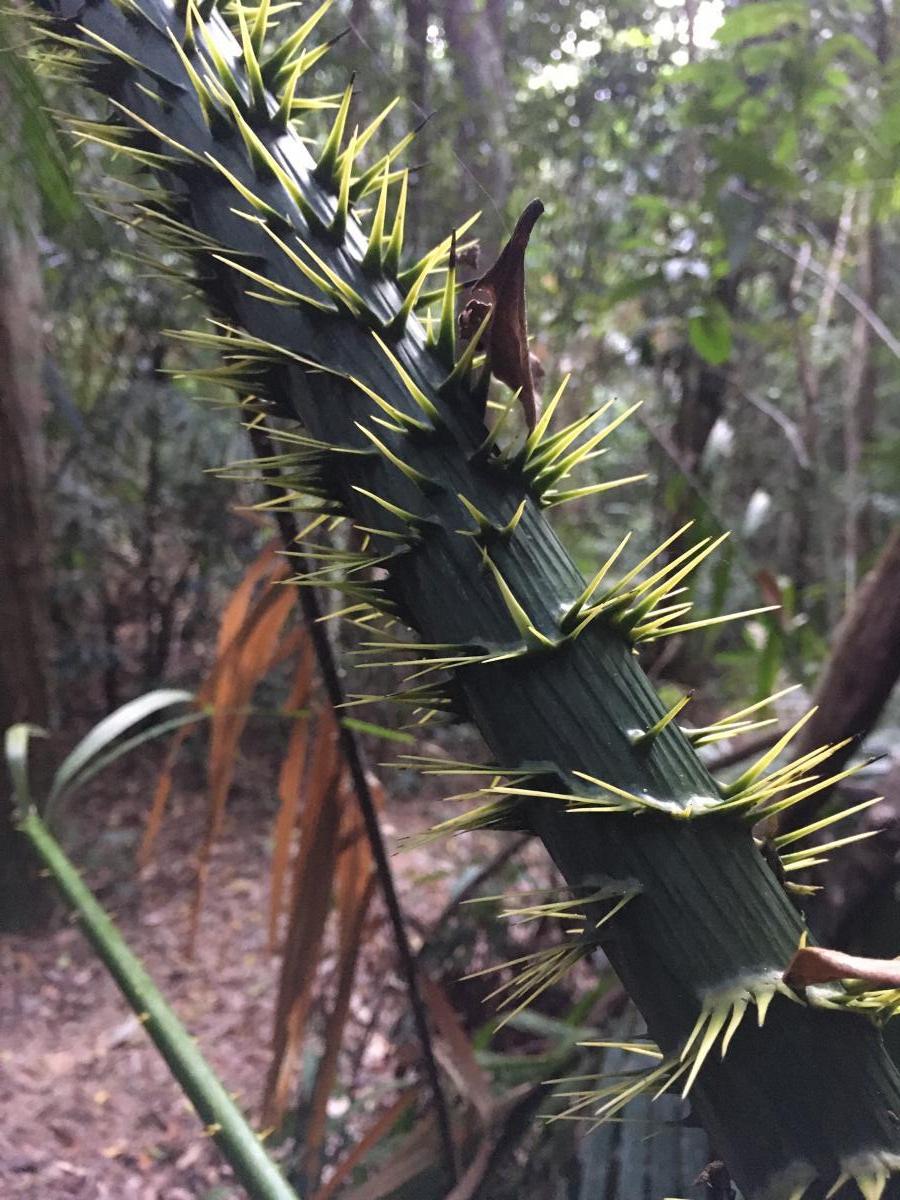
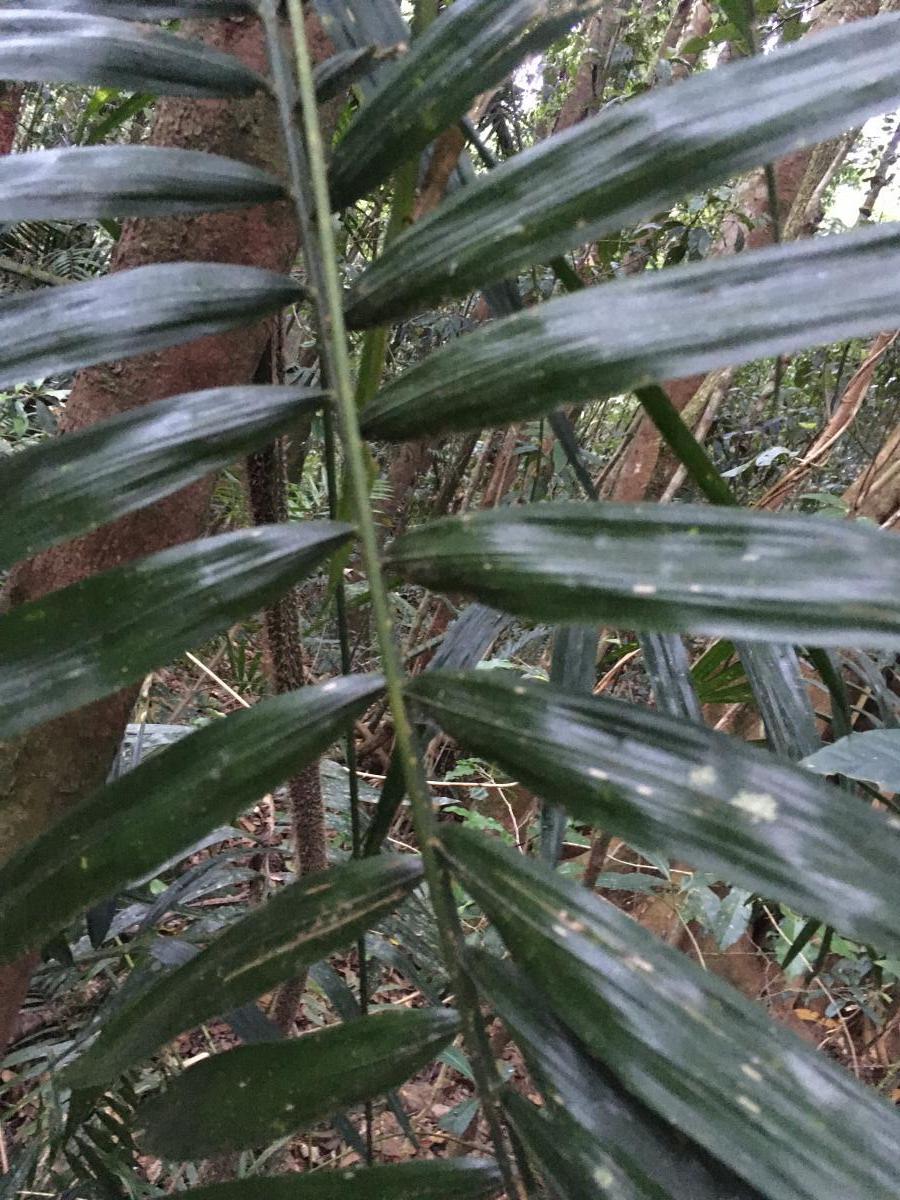
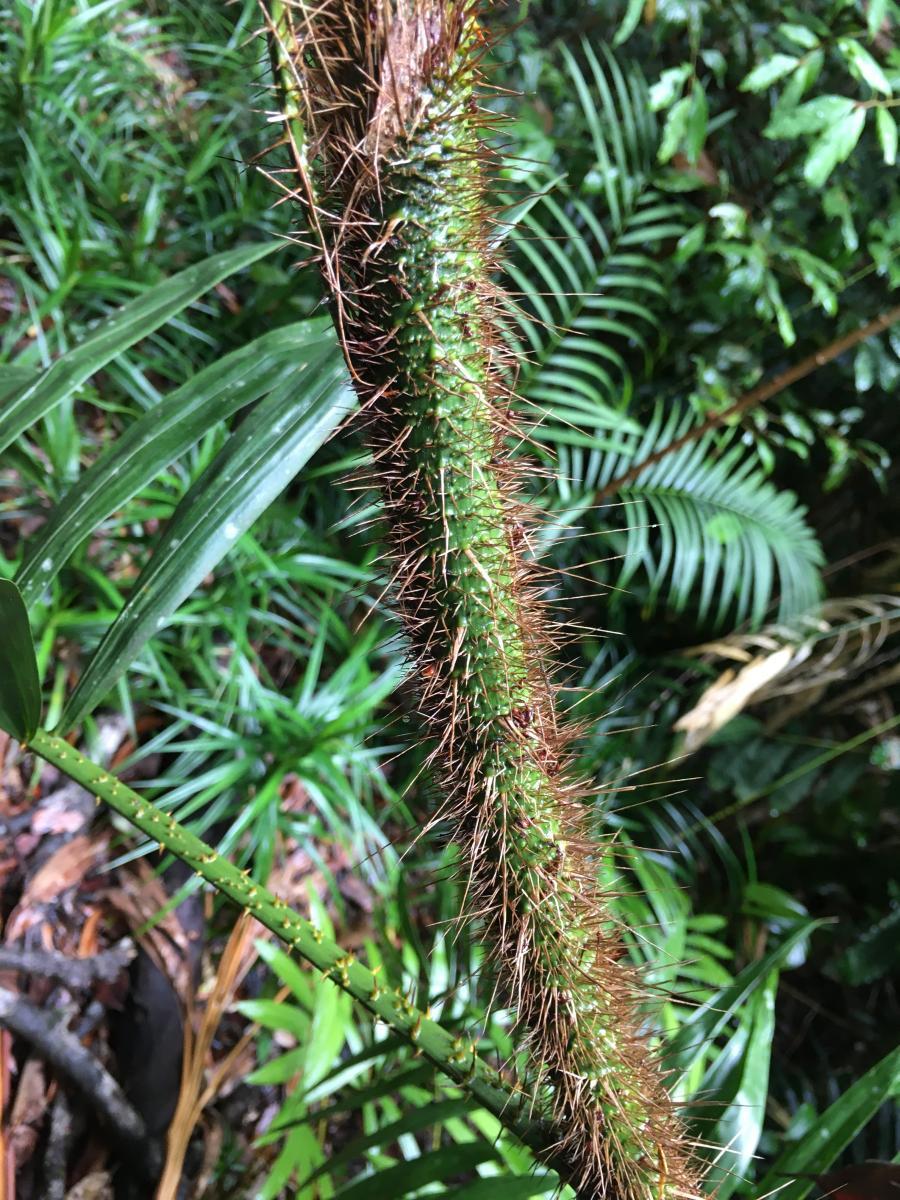
Several species of lawyer vine or wait-awhile can be found around Paluma. The most readily identified is the Yellow Lawyer Cane with its distinctive, robust, yellowish spines arranged in diagonal spiral rows along the cane stems below the leaves. The canes are often noticeably thicker than in other species.
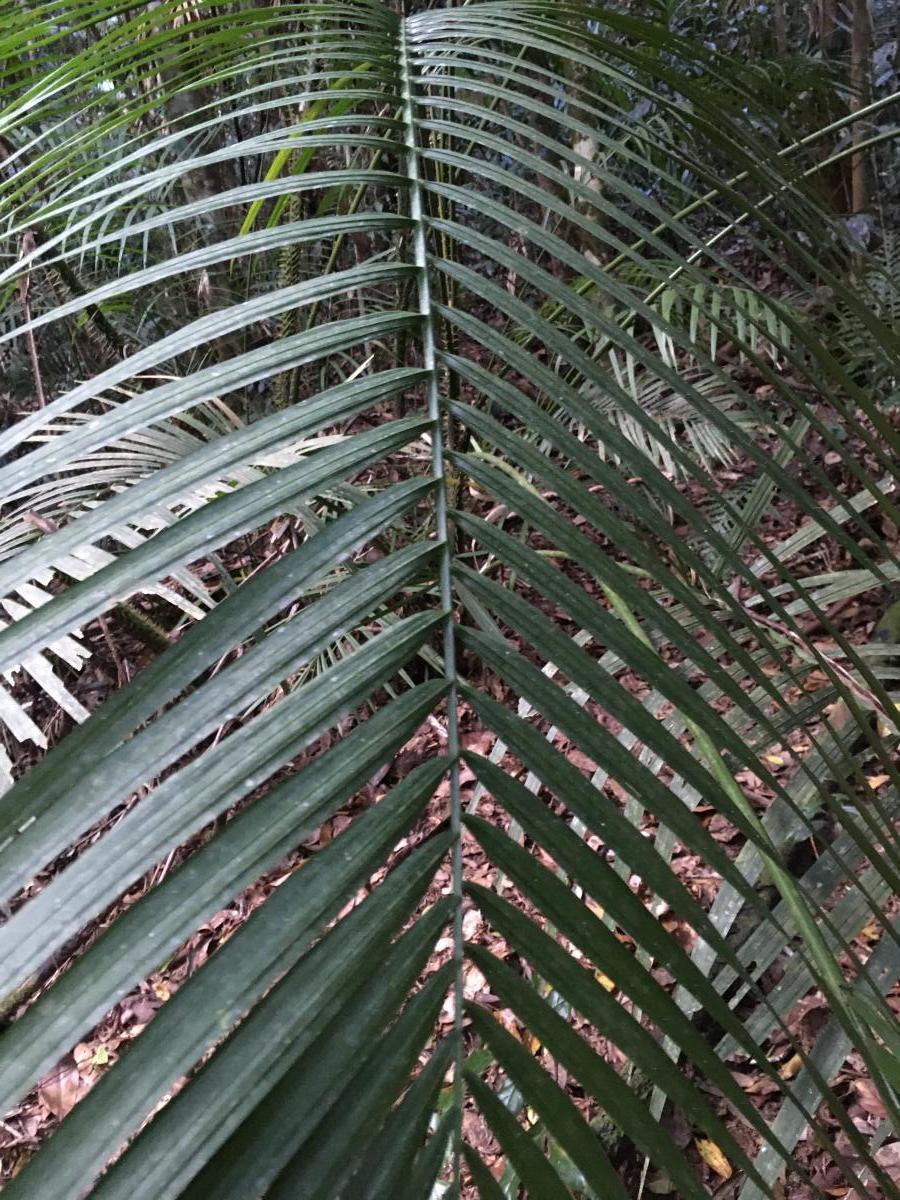
The other common species along the tracks is the Hairy Mary (Calamus australis), which has finer brown spines and a frond with broader leaflets.
Hairy Mary (Calamus australis
All species have palm-like leaves and spines growing from a sheath that covers the stem (cane). They also all have tendrils with vicious hooks emerging from the leaf bases. These tendrils hook on to adjacent trees which provide the support needed to climb up to the forest canopy. In older plants the lower part of the cane loses its leaves and spines and becomes a tangle of smooth flexible canes winding along the ground and up into the trees. In this form they clearly reveal rattan cane – the material that is widely used to make cane furniture.
4. White Supple Jack (Ripogonum album)
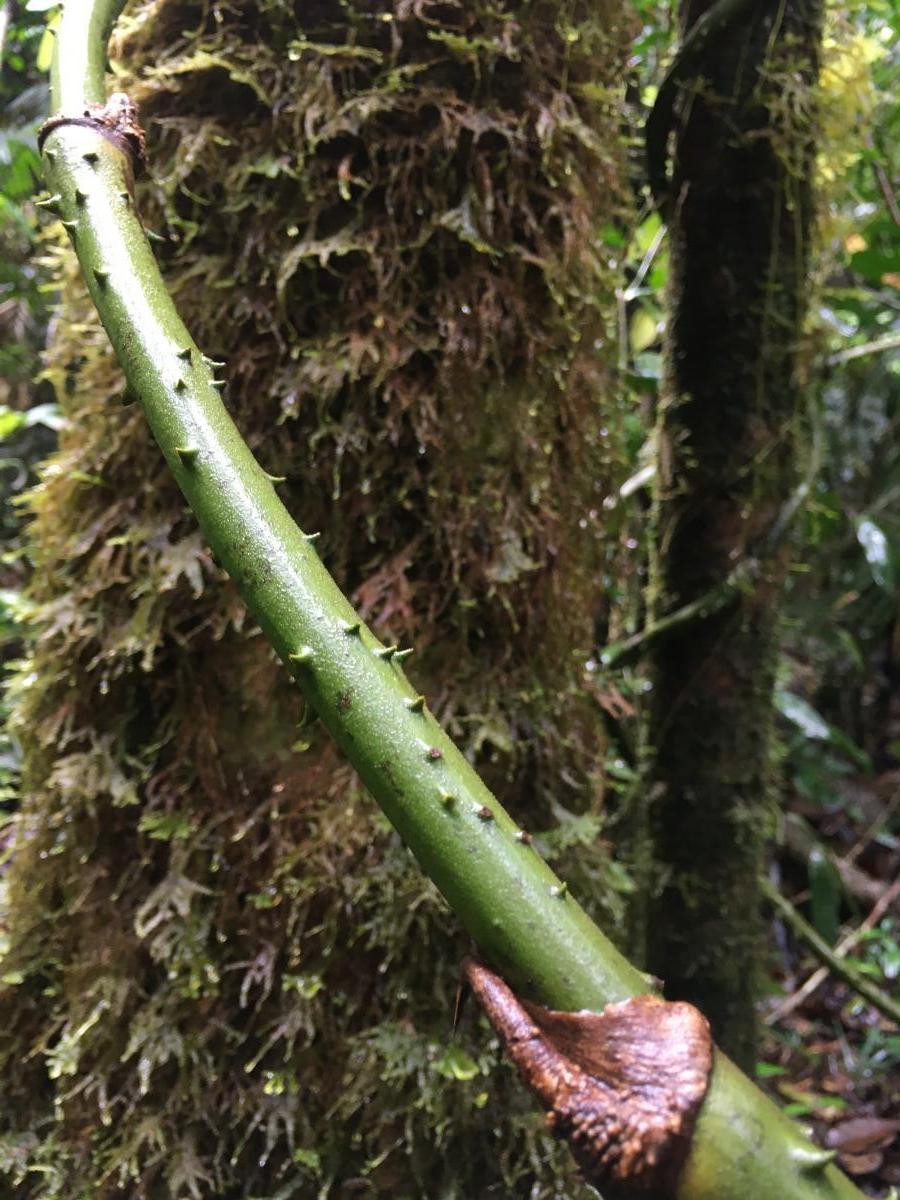
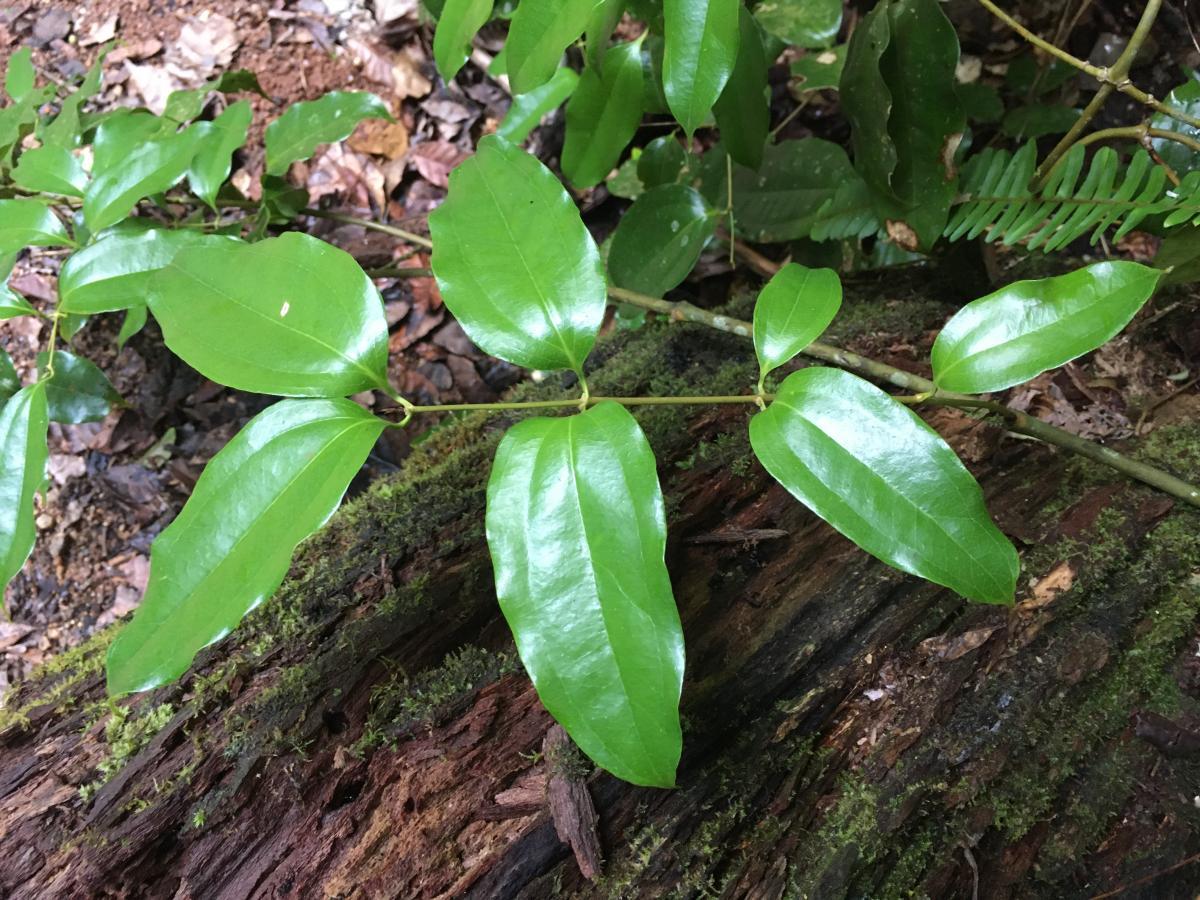
While this common vine has large bright green leaves, it is most easily identified by the leafless matt-green stems with irregular curved green spines that wind their way through the foliage at eye-level. The stems can be up to 3cm in diameter.
They are more common in areas that have been opened up to the light by a tree fall or along the margins of the rainforest around the village where there is ample light. There are some good examples of this vine along Lennox Crescent opposite the Paluma Pottery, and around the edge of the adjacent car park. Ripogonum has small white flowers and globular red fruit.
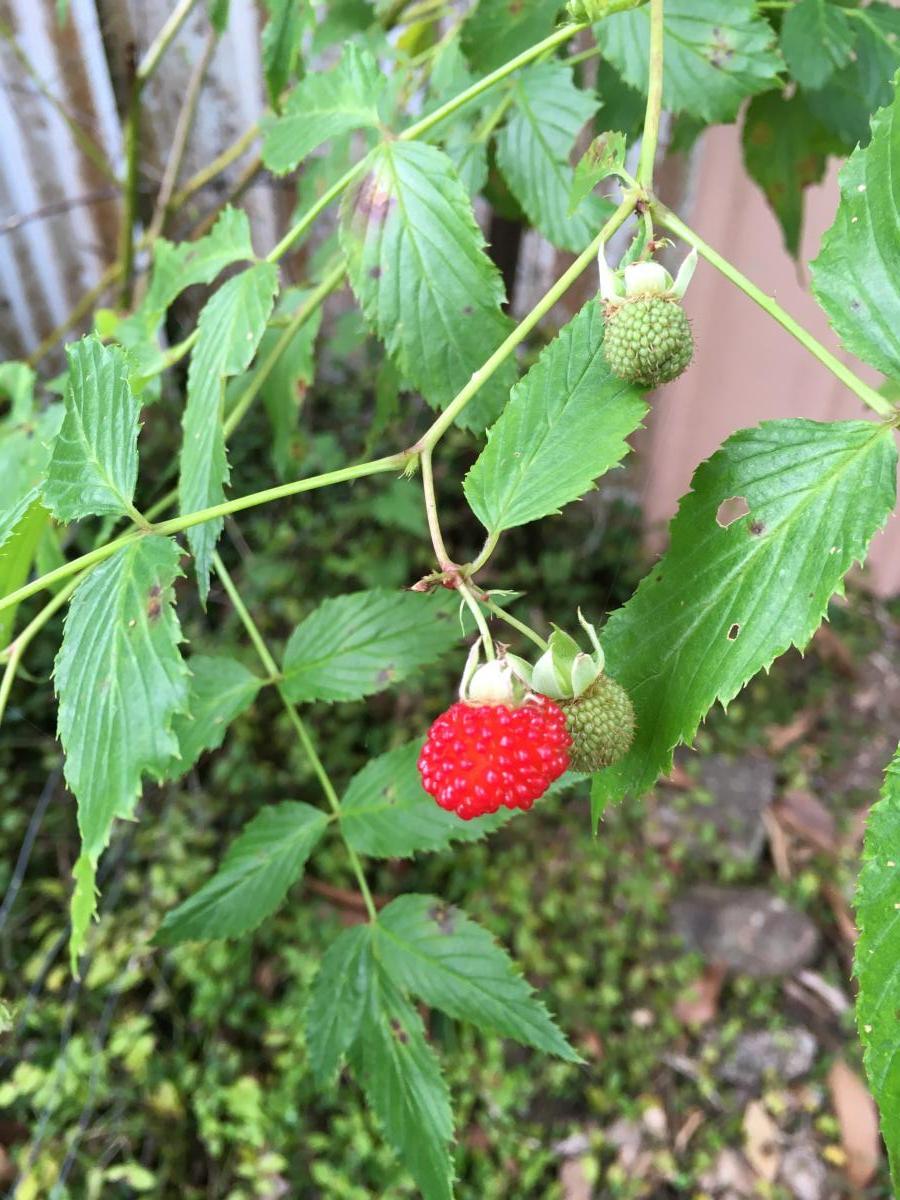
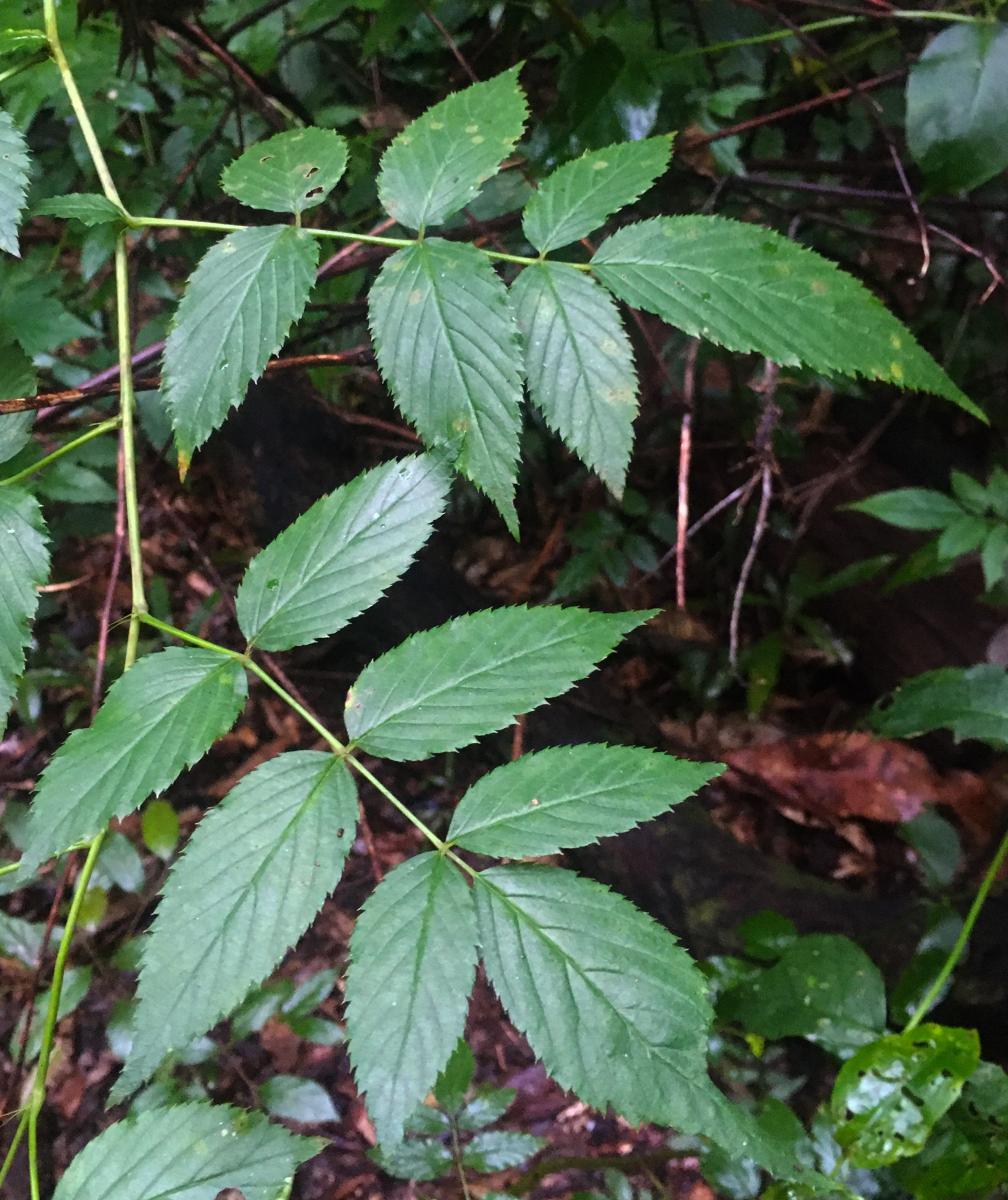
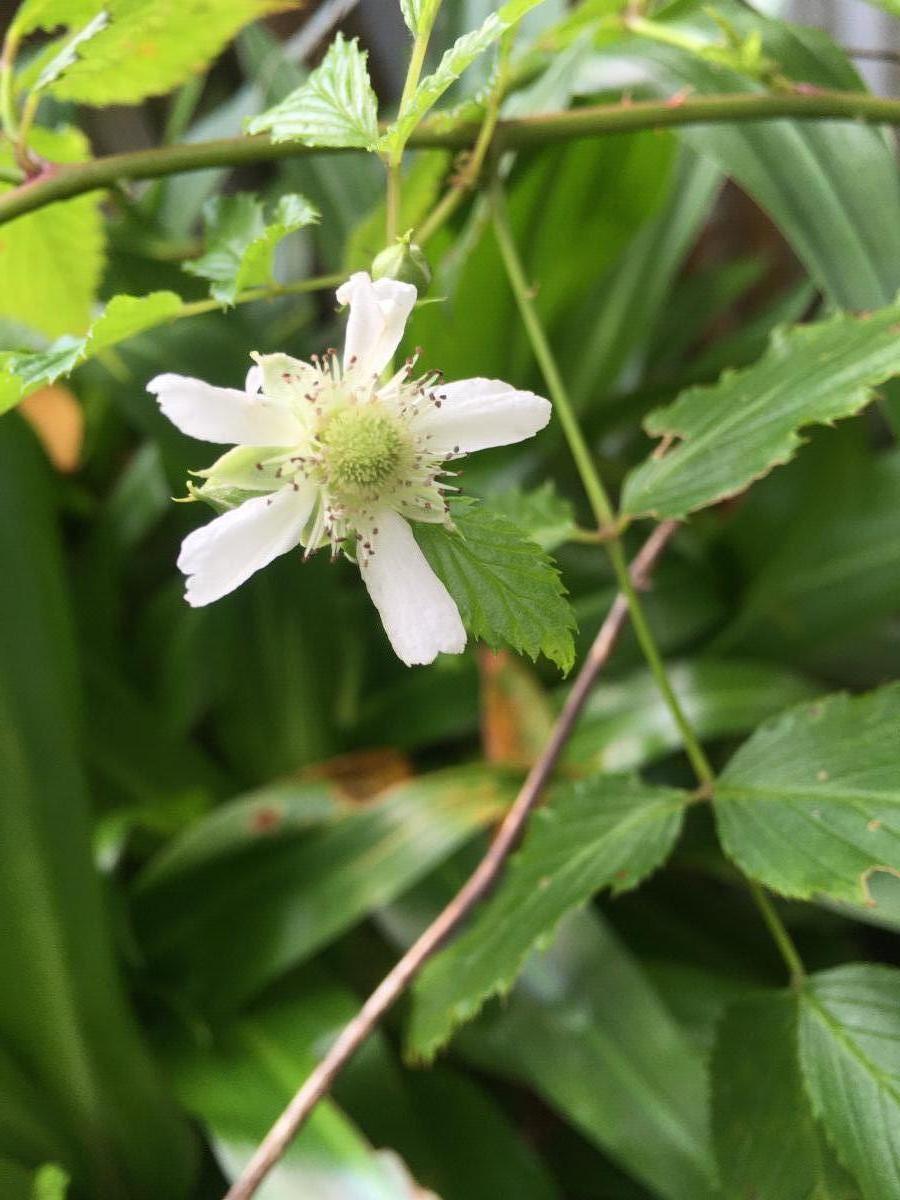
5. Atherton Raspberry (Rubus probus)
Atherton Raspberry fruit
This rambling climber favours open areas and can be found in rainforest openings and at the start of the H-track on Whalley Crescent. There is another patch on the other side of the H-Track near the old fenced-off miner’s test pit and viewpoint over the adjacent creek. It usually grows no more than a few metres high and tends to lean over adjacent plants rather than growing up tree trunks towards the canopy.
R. probus has compound ovate leaves with 5-9 leaflets and the stems have widely-spaced fine thorns that are exceedingly sharp. The fruit looks like a small commercial raspberry.
There are 3 other species of native raspberry which can occur around Paluma and one of these (R. queenslandicus) is very similar, with slightly narrower and more pointed leaves. Based on leaf width, most of the raspberry patches around the village appear to be R. probus, but it’s possible that some are R. queenslandicus. To be perfectly safe when casually encountering a raspberry around Paluma you can have a bet each way and refer to it as Rubus probus/queenslandica. The fruit of both species is edible
A recent discussion with friends about a very large tree in their garden which was to have a limb lopped off, has prompted me to feature the species Flindersia as Rainforest Tree of the Month. The limb of the tree in question hung dangerously over the roof of their house. My friends understood this tree to be Australian Teak, Flindersia australis, but I questioned this as it did not quite match the characteristics of Flindersia australis.
The seed capsule collected from my friends’ tree, was still green and had a bumpy surface rather than the characteristic spiny surfaced, five valved seed capsules of the Flindersia australis. Nor did the leaflets of the compound leaves, being slightly curved, match the elliptic shape of those of Flindersiaaustralis. The distribution of this tree is in rainforest from near Proserpine to northern NSW, at altitudes up to 750 metres. So, I feel that more likely candidates for my friends’ tree would be Flindersia acuminata, Flindersiabrayleana, Flindersia bourjotiana or Flindersia pimenteliana, all of which are endemic to Paluma.
There are seventeen species of Flindersia world-wide; growing in New Caledonia, New Guinea, Malesia and Australia. Fifteen species are endemic to Australia. The species is named after Matthew Flinders (1774-1814), the renowned navigator and cartographer who led the voyage of ‘The Investigator’ on which the British botanist, Robert Brown, collected many Australian plants. Flindersias are members of the Rutaceae family.
Flindersia australis, also known as Teak, Australian Teak and Crows Ash,can grow to a height of 40 metres on rich, volcanic rainforest soil. It is somewhat smaller elsewhere. Sprays of tiny white flowers appear from August to February with the spiny seed capsules forming from March to January. Unlike most other Flindersia species, these segments do not separate into individual portions. The 35-50mm seeds are flattish and winged at the apex. The timber is in demand for general building, flooring and fencing. It has a high oil content and is readily flammable.
Seed Capsule of Flindersia australis
Flindersia pimenteliana is also known as Maple Silkwood, Rose Silkwood and Mountain Silkwood. This majestic tree grows to 30 metres high and may be buttressed. It occurs from Mt Finnegan near Cooktown to Paluma and also is found in New Guinea. The leaves, like other Flindersias, are compound but the leaflets taper to a narrow point. The flowers are similar in size to the inflorescence of the other Flindersia species but are red to purple. They appear from November to March and are difficult to see high in the canopy. The fruiting capsule, 55 – 115 mm long, is green to brown with five spiny valves. These split and release about 20 flat, winged seeds about 45-50mm long, from July to December.
Flindersia pimenteliana seed capsules
Sulphur-crested cockatoos eat the seeds.
The timber of this tree was once used to make barrels and very decorative cabinet timber. Although young plants grow readily, they are not an economic tree to grow in plantations due to their spreading structure. Leaf material has been found to be active against some tumours.
There are several fine examples of Flindersia pimenteliana to be seen around the village. The easiest to find is in the stand of trees in the area between the tree ferns and the road cutting opposite the Rainforest Inn, (the kitchen end near the entrance to the motel units). Some still attached, green seed capsules hang just above eye level. Other trees can be seen at the end of Smith Crescent, at Number 20 and at the fence-line between Numbers 15 and 17 Mount Spec Road.
Flindersia schottiana is another tree which could possibly be found in the Paluma area as its distribution range is from Cape York to Port Macquarie at altitudes up to 1300 metres. This tree is also known as Silver Ash, Bumpy Ash, Floppy-leaf Ash and Cudgerie. A majestic tree, growing to 45 metres, it is rarely buttressed. The trunk features large bumps where old branches have been detached, hence its common name, Bumpy Ash. The tree has compound leaves with 7 to 9 leaflets, 50 to 260mm long. The upper-side of the leaves is mildly hairy with dense, fine hairs on the under-side. The tiny white or cream flowers are fragrant, appearing from August to December and in May. The five-valved fruit capsules are spiny, 80-130mm and release about 30 flat winged seeds from December to April. Flindersia schottiana is a pioneer tree, often found in regrowth areas and rainforest margins.
Flindersia acuminata, also known as Silver Maple, Silver Silkwood, White Silkwood and Ice-wood, occurs at altitudes up to 1200 metres in rainforests between the Windsor Tableland and Paluma. The tree can grow to a height of 40 metres and may be buttressed. The elliptic leaflets of the compound leaves are from 50 to 150 mm long, slightly curved, and tapering to a point. Fragrant white or cream flowers grow in terminal or axillary panicles from November to January. They are tiny, with five petals and are only about 3 mm in size. The fruit capsules, appearing from June to March are green to brown, 90 to 150 mm long and have five spiny valves which split to release flat, papery winged seeds, 65 to 80 mm.
Flindersia bourjotiana, also known as Queensland Silver Ash, Silver Ash and White Ash. The distribution of this tree is in rainforests from McIvor River near Cooktown to the Paluma Range at altitudes up to 1200 metres. The tree grows to about 35 metres and may be buttressed. The leaves are compound, with 3 to 9 elliptic leaflets, from 50 to 190 mm long. The underside of leaves can be slightly hairy. The tiny, (5-9mm), fragrant flowers can be white, cream or green and grow in terminal or axillary panicles, or sprays. Flowering occurs between April and January. Fruit capsules can be up to 150 mm long with five spiny valves which split to release several flat, winged seeds, 30-70 mm long. Sulphur-crested cockatoos and giant white-tailed rats eat the seeds.
Flindersia brayleana, is also known as Queensland Maple, Maple Silkwood and Red Beech. A tree growing to 35 metres, its distribution is from the Windsor Table-land to Mount Halifax near Townsville, at altitudes up to 1150 metres. The compound leaves have slightly curved leaflets, tending toward an ovate/elliptic shape and ranging from 60 to 210 mm in length. Tiny fragrant white flowers with five petals 3mm in size grow in terminal or axillary panicles from November to January. They are difficult to see high in the canopy. The fruit capsules, are 60 to 100 mm long, and have bumps rather than spines on the surface. They split into five valves, or segments, and release several winged seeds. Flindersia brayleana was once a common tree in rich, red, volcanic soils on the Table-land and on Mount Spec however, high demand for its exceptionally beautiful pink timber has caused it to become scarce. During World War 2, the timber was sought for use in aircraft production, such as in the manufacture of propellers and for ply-wood used in the Mosquito bomber aircraft. The timber was also used in rifle stocks and for beautiful decorated stocks in sporting rifles and shotguns. Boxes, barrels and window frames were also made from this timber. The timber can cause dermatitis.




.jpg?bwg=1592033141)