What’s Flowering on the Range Road?

On the way up the range road yesterday, Peter and Jan Cooke saw several examples of one of our truly spectacular native flowers, the Native Rosella or Marsh Mallow, Abelmoschatus moschatus tuberosus. The flowers look very much like a Hibiscus (they share the same plant family) and only last for a day or so. They favour drier coastal areas so you will probably not see them around the village. But they are certainly worth looking out for as you drive to Paluma.

Photo by Peter Cooke

The plant grows along the ground or can be partially upright. It dies back to an underground tuber in the dry season. The tubers, as well as the leaves and seeds are edible and were eaten by local aborigines.

Whats Flowering in Paluma? Mistletoe

Mistletoes are a group of parasitic plants belonging to the Order Santalales. Australia has a high diversity of mistletoes (over 85 species) with the majority in the family Loranthaceae.

Mistletoe (Amylotheca dictyophleba) in the cutting on Mt Spec Road

When we think of parasites we often envisage small or microscopic animals that can make you sick, or even kill you, but this way of living (where one organism harms another by using it for nourishment or other vital need) is widespread in all branches of life. In vascular plants parasitism has evolved at least 12 times, with the mistletoe form having evolved 5 separate times within the Order Santalales.

Mistletoes are considered to be obligate hemiparasites because they cannot grow independently of their host plant (the relationship is obligatory) and because they still have their own leaves that can provide a significant proportion of their energy needs through photosynthesis (hemi=half). A spectacular mistletoe in Western Australia looks more like a tree (it parasitises roots rather than tree branches) and is said to be the largest parasite in the world.

Paluma hosts several mistletoe species and one, with beautifully shaped and gaudily coloured flowers is currently in bloom along the roadsides of the village. Its scientific name is a bit of a tongue-twister: Amylotheca subumbellata and it, unfortunately, doesn’t have a common name other than the generic “Mistletoe”. A. subumbellata has a restricted distribution (northeast Qld) with the majority of records from the Paluma region. Its clusters of small torpedo-shaped flowers with orange/red bases and yellow-green tips are very distinctive. Its leaves are also very distinctive, being narrow, strap-shaped and grey-green. One related and more widespread species that is also common around the village is the Bush Mistletoe (Amylotheca dictyophleba) has almost identical flowers, but its leaves are glossy green and ovate. It has very similar flowers (around the village they are more uniformly red), but they differ markedly from A. subumbellata in the shape and colour of their leaves, which are oval glossy green.

The name mistletoe is thought to be derived from two Anglo-Saxon words: “mist or mistel” meaning dung; and “tan” meaning twig. This “dung on a twig” name is quite apt. Mistletoe fruit is a favourite food for the mistletoe bird (a common Paluma resident) but the seed in the fruit is surrounded by a very sticky substance that resists digestion. When a mistletoe bird sits on a branch and tries to defecate, the sticky mass containing the seed just hangs off the birds rear end forcing the bird to wipe its bottom on the branch or twig. The seed is now exactly where it needs to be in order to germinate and infest a new host tree. David Attenborough came to Australia years ago to film this process and the result is a delightful sequence, well worth watching here.

The best places to see both of the mistletoe species discussed here are in the trees on the north side of the road cutting from 27-21 Mt Spec Road, and on either side of the road opposite the High Ropes Course.

Text and photos by Jamie Oliver

Cleaner position at PEEC

CLEANER

Permanent Part-Time 9.75 hours per week 

Paluma Environmental Education Centre

Ref : PEEC 2021-01

Position based at the Centre at 53 Mount Spec Road, Paluma, 4816

Application package available from the Business Manager, phone 07 4772 9555 or 4750 8528.

Successful applicant will be required to hold a current suitability card (Blue Card) from Blue Card Services before they commence work. 

The prospective employee is responsible for the cost of the Blue Card Check and the subsequent issue of the suitability card.  Please check the Blue Card Services website for current fees.

The successful applicant will also be required to undertake a Criminal History Check prior to commencement.

Successful applicant may be subject to a probationary period

Applications close 4:00pm Friday,  19 February 2021

Community Centre Garden Beds now completed

On Sunday, with the enthusiastic help of several volunteers, the project to enhance the appearance of our Community Centre with new garden beds and a selection of native plants provided by the Townsville City Council was finally completed. Last year saw the construction of some the garden beds using black wattle logs sourced from Ann Bruyeres’ property, and the sourcing of a large selection of native plants courtesy of a grant from the Council. Ann played a key role in selecting the plants and getting them up to Paluma, where we kept them in a well-watered location until we could finish preparing the remaining garden beds and find a suitable time after the rains had set in to undertake the planting-out.

Anne provided much needed guidance in assigning a suitable spot for each plant, while the rest of us (Colin, Jill, Don, Michele and Jamie) dug the holes. Even now, the Centre and surrounds look much improved, and with a continued good wet season the plants will all take hold and begin to fourish and further transform the site. It’s good to have some pictures from the start so that we can record the changes as the plants grow over the next 5-10 years.

Thanks again to Megan Taylor (TCC) and Councilor Margie Ryder for their support in getting the plants for this project.

The finished product

Rainforest Tree of the Month, January 2021 – Atherton Fig

The Atherton Fig (Ficus leptoclada) is one of 15 species of sandpaper fig in Australia. These figs are non-stranglers and have (to varying degrees) rough sandpapery leaves. Unlike the strangler figs, they are dioecious (having separate sexes).

Atherton Figs are endemic to northern Queensland rainforests up to an altitude of 1,000m. They are common on road sides or in regrowth areas where they grow as relatively small trees (up to 15m) with slender trunks. The leaves are eliptical to narrowly ovate and about 8-12 cm long with a raspy feel to the lips (yup – you are supposed to “kiss” the leaves to assist in identification!).

This Atherton Fig on the track to Witt’s lookout is the smaller tree with brighter green leaves to the right of the large trunked tree

When in fruit, trees can be spectacularly laden in small brightly coloured fruit. Ripening figs show attractive shadings of yellow to orange-red and are born both on branchlets and on the main trunk or limbs. When ripe they are more uniformly red/purple and are up to 2cm in diameter.

The figs are eaten by fruit pigeons and the double-eyed fig parrot.

There is a lovely example of an Atherton Fig that is currently in fruit at the first small clearing about 100m down the walking track from McClelland’s lookout to Witt’s lookout. Look for coloured fruit on the ground. The tree has a narow trunk just behind a larger tree at the edge of the clearling looking back to McClelland’s lookout.

I have previously mentioned the close relationship between figs and the specialised wasp species that they rely on to pollinate their flowers. If you are interest in joining me in a deeper dive into the evolutionary biology of this relationship keep reading below (it might get a bit technical).

Text and photos by Jamie Oliver

https://apps.lucidcentral.org/rainforest/text/entities/ficus_leptoclada.htm


Figs and Fig-wasps: an evolutionary arms race that may never end

Figs are not actually fruit (which develop from the ovary of a single flower) but rather an enclosed cluster of flowers (synconium). Since there are a variety of insects and other animals that enjoy munching on flowers, seeds and fruit, it makes some sense to enclose all your flowers in a tough leathery pouch, but then the problem is how to ensure polination of your flowers. Figs do this through associations with a family of wasps that specialize only on laying their eggs in the ovaries of figs. The relationship is highly specific: one fig-wasp species for each species of fig.

The basic sequence of polination and wasp reproduction is as follows. The female wasps are just small enought to enter the fig body through a small hole. In the process they lose their wings and antennae and will not subsequently be able to leave the fig. Once inside they lay their eggs in as many female flowers as possible and then die. The eggs then hatch out into male and female wasps. The males never leave the fig but spend their lives searching (and fighting other males) for newly hatched females to mate with. The last act of a male is to chew its way to the outside, making a large exit hole that allows new females to leave the fig. On their way out, the females collect pollen from male flowers, and then seek out new figs to lay their eggs in.

Wasps are notorious parasites and the fig wasps are no exception. Their main interest in the relationship is to produce as many offspring as possible by laying eggs in the ovaries of female flowers, where the larvae develop by eating the developing fig seeds and surrounding tissue. The destruction of any developing seeds is clearly not in the best interests of the fig, so the relationship is a tense one: the fig just wants to use the wasp to tranport pollen from the male flowers to the female flowers (in a different fig), while the wasps, given a chance, would lay their eggs in all or most of the ovaries of female flowers, rendering them (and potentiallly the whole tree) sterile in the process. Thus while each species is dependent on the other, they are both trying to gain the upper hand with the evolution of traits that maximise the advantage on both sides. In effect this is an evolutionary “arms race”.

In hermaphroditic figs, where the separate male and female flowers reside in the same fig body, the solution that has evolved in the fig species is to make some of the female flowers inaccessible by hiding them deep under the inner surface of the fig where the wasp’s ovipositor can’t reach, while letting the wasp parasitise the other flowers so as to ensure some wasps are allowed to develop. This compromise lets some of the fig flowers develop fully mature seeds, but many are sacrificed to allow wasps to developed. The wasp on the other hand has lower than optimal reproduction since it can’t parasitse every female flower. This has turned into a relatively stable stand-off between the competing interests of the two species. However ….

In dioecious species (thought to have evolved from hermaphroditic speces) there are trees with figs that are all male, and other trees that are all female. In these species the balance may have shifted a bit in favour of the figs. In this case the male trees have male flowers but also female flowers that are sterile (the figs are more accurately described as “functionally” male). As per the above sequence, female wasps enter male figs and lay their eggs in the sterile female flowers. The offspring hatch out and the new fertilised females collect pollen from the fully functional male flowers as they exit the fig to find other fruit to parasitise.

The twist here is that the female fig trees have fruit (with only fully fertile female flowers) that are equally attractive to the female wasps (they are drawn in by a specific odour emited by the fig) but the ovaries in these female flowers are completely inaccessible to the wasp. So female wasps that end up entering a female fig wander around inside polinating the female flowers but never managing to parasitise any flowers before they die. This arrangement suits these fig species well since it can invest as much energy as it wants into the development of female flowers and seeds and only sacrifice a smaller amount of energy into the production of sterile female flowers in the male figs.

Since a small amount of pollen can fertilise a large number of female flowers there are often many more female figs compared to male. The female figs don’t get parasitised so the result is a high reproductive output for the figs. But if the majority of figs in any location are female ones, then the wasps lose out since most of the female wasps will end up in female figs and never reproduce. The fig species only needs to produce enough male figs to ensure adequate pollen production and sufficient wasp production to ensure the pollen is duly transported to all the female figs. At this point if you have been following the story you may (like me) think that its starting to look like the fig is “farming” wasps for the purpose of polination! Perhaps future evolution will see wasps being more and more like a managed speces. But since evolution is based on the accumulation of chance events, perhaps wasps will evolve countermeasures that enable it to parasitise female fig flowers, or avoid them in favour of male figs ….. and the “arms race” will continue.

Jamie Oliver


Further Reading:

https://www2.palomar.edu/users/warmstrong/dawkins.htm#dioecy
https://link.springer.com/article/10.1007/BF01975678
https://onlinelibrary.wiley.com/doi/10.1034/j.1600-0706.2003.12212.x
https://onlinelibrary.wiley.com/doi/pdf/10.1046/j.1420-9101.1995.8030301.x

Cyclone Season Preparation for 2021

Memories of the 2019 February inundation and the subsequent isolation of Paluma and communities to the west will be with us for years. These memories should prompt all of us living in the area to consider carefully how we prepare for this wet season.

The best way to start this years’ preparation is to visit the Queensland Government website www.getready.qld.gov.au. The site addresses preparation for a range of disasters that could affect Queensland. Cyclone, storm damage & fires are the most relevant to our area.  It also lists a number of disaster related apps. Another useful website is www.disaster.townsville.qld.gov.au

Cyclones & extreme rainfall events

The get ready website suggests being prepared for 3 days of self-sufficiency. This may be adequate for the lowlands, but could easily prove inadequate for Paluma to Hidden Valley communities.  If a high category cyclone crosses the coast anywhere near Townsville, Paluma to Hidden Valley problems are likely to be well down government priority lists, if they are not life threatening.

Plan for the worst – what if.

  1. All access roads to the area closed for seven (?) plus days
  2. Prolonged loss of the electricity grid supply.
  3. Eventual loss of landline, mobile phone & internet communication due to loss of power to the Telstra site.
  4. Damage to Townsville Water infrastructure resulting in unreliable water supply.
  5. Structural damage to your private residences forcing evacuation to temporary accommodation.

If you work through the three steps of the Have a Plan section of the get ready website you should be covered for most things. However they don’t mention backup generators & standby gas cooking equipment or the associated fuel & gas.

For anyone without internet access the following checklist covers some of the things to consider.

Clearing around you residence to remove anything with the potential of becoming an airborne projectile.

Insurance – Check currency & adequacy.

Basic supplies

  1. Enough food for the whole household including pets. If you have no generator backup for your refrigerator then stick mainly to non-perishable food. (dried or tinned)
  2. Adequate supplies of prescription medication plus cold & flu tablets, pain killers etc.
  3. Toiletries.
  4. Adequate clothing for everyone for the duration.
  5. Extra bed linen & towels.
  6. Sturdy gloves.
  7. Wet weather gear.
  8. Allow 3 litres of bottled water per person per day. Alternatively a small rainwater tank with water purification tablets from chemist/camping stores. Without power electrical appliances will not be able to boil water for safety.
  9. Important documents & a backup hard drive.
  10. Up to date first aid kit.
  11. Adequate generator fuel & gas for backup cooking equipment. Those on solar off grid systems should consider how much fuel they may need if the solar array is damaged.
  12. Spare batteries for torches/radios.
  13. Sturdy waterproof containers for food, clothes, medication, phones etc.

Communications

  1. The Telstra site has a backup generator but when the fuel runs out Telstra will be unable to refuel if access roads to Paluma are closed. There are also likely to be batteries in the Telstra building. So the phones & internet may continue to work for some time after a power failure & then shut down. Suggest it wise to make any important phone calls or emails as soon as possible after the event.

Hopefully the Townsville City Council & Telstra will be able to come to some agreement where TCC staff resident in Paluma can refuel the Telstra genset if necessary.

  • For landline phones a non 240v phone is best.
  • Have an alternate way of charging mobile phones & tablets without mains power.
  • Will your mobile phone work at the Star Valley or McClelland’s’ lookouts.
  • Battery radio.

Equipment

  1. Generator –tested/serviced.
  2. Backup gas cooking equipment (BBQ) if you only have an electric stove.
  3. Alternative lighting.

Evacuating your house due structural damage.

Extra things that should be considered for an evacuation kit include bedding (sleeping bags, inflatable mattresses & pillows), reading material & games, cash.

Rental properties.  If you have any form of rental property in the area, consider the need to advise potential tenants of the risk of isolation after extreme weather events.

If you are not going to be in the Paluma area.

  1.  Ensure anyone occupying your house is aware of the above suggestions.
  2. Clean out your fridge & freezer
  3. Consider supplying a neighbour with a key & your contact details so they can access your property to check for damage & report to you.

Charlie Allen
Mt Spec SES

Paluma hosts a nightly light-show in the forest

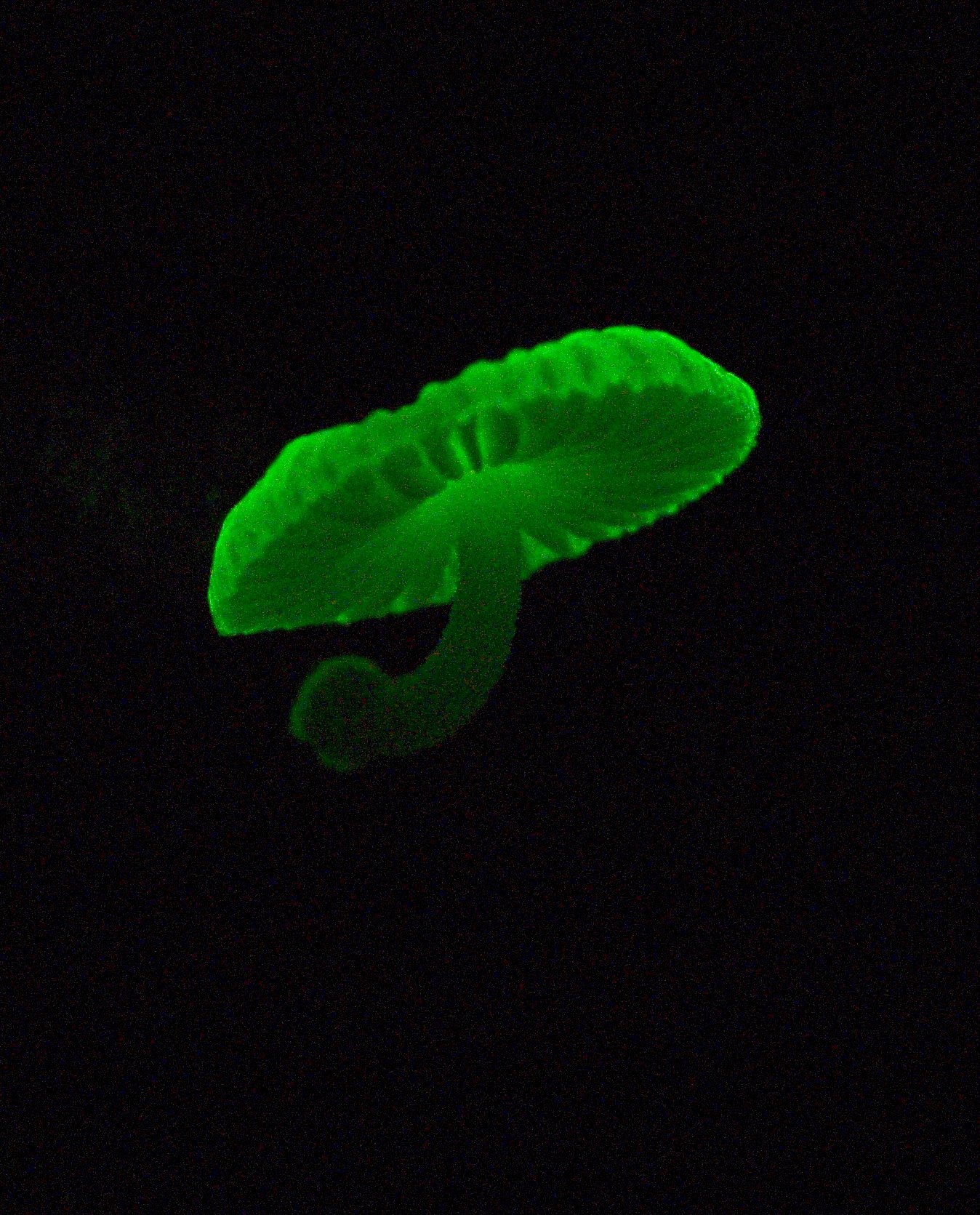
Although New Year’s eve in Paluma (like many other places in Australia) lacked a fireworks light-show, there is currently an nightly light-show to be seen along the rainforest tracks thanks to the bioluminescent fungi that are currently emerging with the rains. This display may not last too long, but with the rains predicted to persist for another week at least, you stand a good chance of seeing some of these remarkable little mushrooms if you wander down the H-track or the Rainforest track after dark.

In previous years I have occasionally gone out on wet nights during the summer and, after waiting in the dark for my eyes to adjust, could see faint ghostly glows scattered along the forest floor. But when turning my torch back on there was nothing to see. Even when I located the source of the glow, it was just a wet leaf or branch. I have always assumed that this was luminous fungal mycelia (the almost invisible network of threads that represent the bulk of the organism), but until last year I had never seen any actual mushrooms glowing in the dark. I only saw a couple back then so this year the family and friends went out on two nights to see if we could see them again. On the first night we went around the H-Track and on New Year’s eve Juanita and I went down the Rainforest Track. On both occasions we saw 5-10 clumps of tiny brightly glowing mushrooms on small twigs and along dead sections of lawyer vine.

Mycena clorophos; photo by Juanita Poletto

These were many times brighter than the glow from the mycelia seen on other occasions. Unfortunately I did not have by big camera with me to attempt to photograph the bioluminescence (it requires exposures of over a minute to get a good image) and we only got pictures of the mushrooms illuminated by our torches. But there are many pictures of this species on the web, such as the one below, that provide an idea of what can be seen.

Mycena chlorophos http://bit.ly/2LTOcLw

While there are several species of mushroom that bioluminesce, these ones appear to be Mycena chlorophos, a widespread species found in sub-tropical Asia, Indonesia, Japan and Brazil. The caps can be much larger than the 3-8mm diameter ones seen so far in Paluma.

Reseach on a different species of bioluminescent mushroom suggest that this trait has evolved to enhance the dispersal of spores by insects attracted to the glow.

Text by Jamie Oliver, Photo by Juanita Poletto

Monty’s return for Christmas Dinner

Last Christmas a amethystine python dubbed “Monty” with a very large lump was seen on the rainforest track. Well his assumed penchant for Christmas turkey seems to be confirmed with a recent sighting of a very similar python with a very similar turkey-sized lump opposite the High Ropes course.

Carla Oliver and friends were heading down the mountain on the afternoon of New Year’s eve when they saw Monty crossing the road.

It would be great if this were indeed the same python as last year, especially since these large slow moving reptiles (especially after a big meal) can be very vulnerable to being run over when crossing the road. Let’s hope this becomes an annual sighting!

Photo/Video by Carla Oliver; Text by Jamie Oliver

Rainforest Tree of the Month, December 2020 – Black Pine

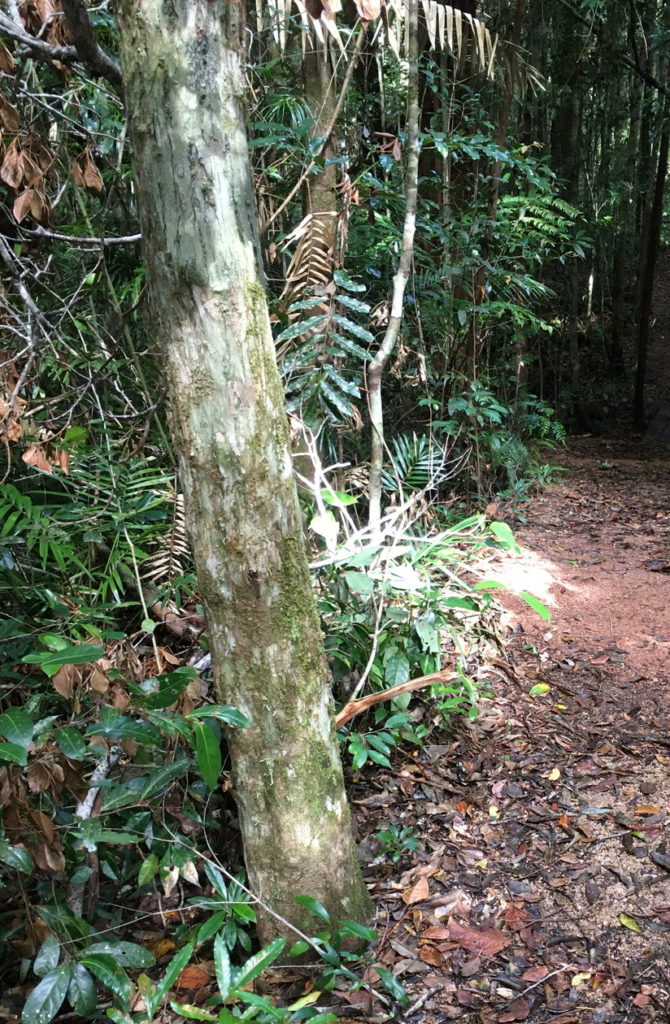
It seems appropriate that during this month of Christmas we feature an evergreen conifer as our tree of the month. The Black Pine (Prumnopitys amara). This species is widely distributed in north-east Queensland as well as New Guinea and Indonesia. It can grow to 60m and has a frequently dark to blackish trunk with scattered cracks. Mature leaves are long and narrow with a distinct groove along the mid-vein on the upper surface. The species name “amara” is from the latin word for bitter and refers to the fact that the leaves, if chewed, are initially sweet tasting but then turn bitter.

Prumnopitys amara leaves (Botanic Gardens, Sydney)
Photo by Peter Woodard; Creative Commons CC BY-SA 4.0

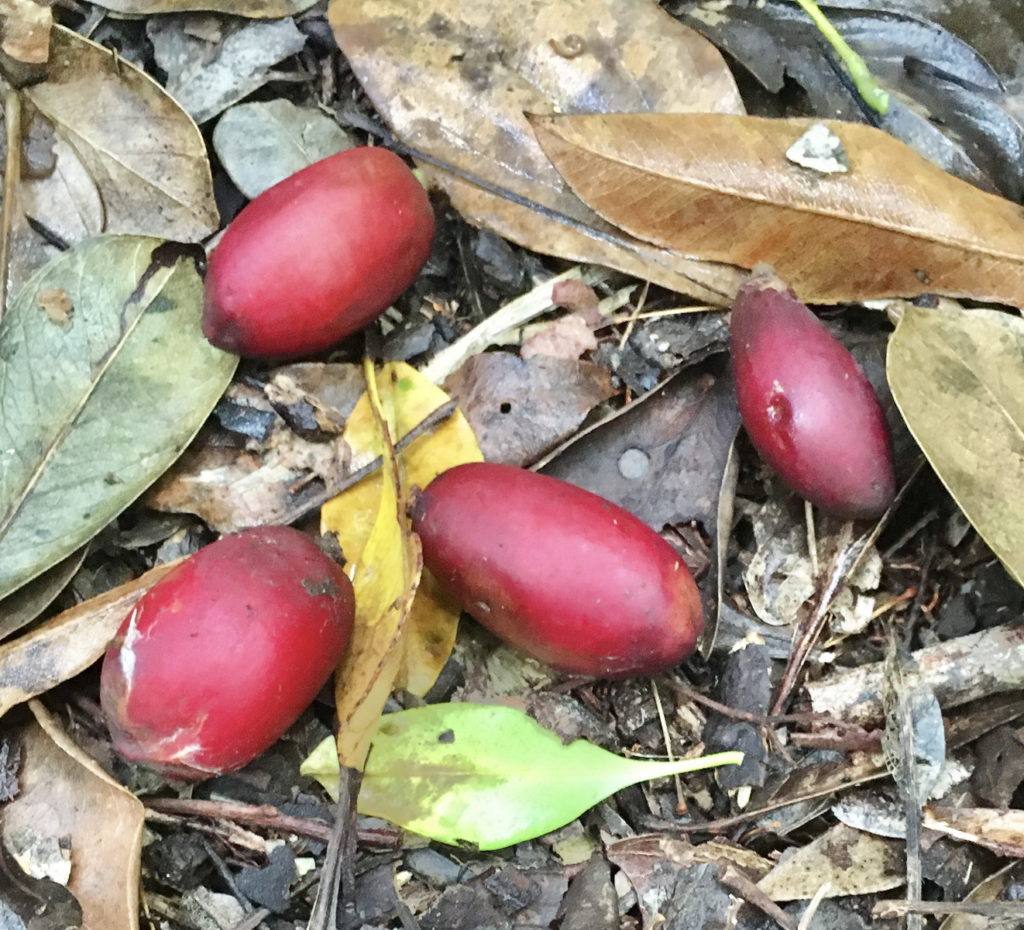
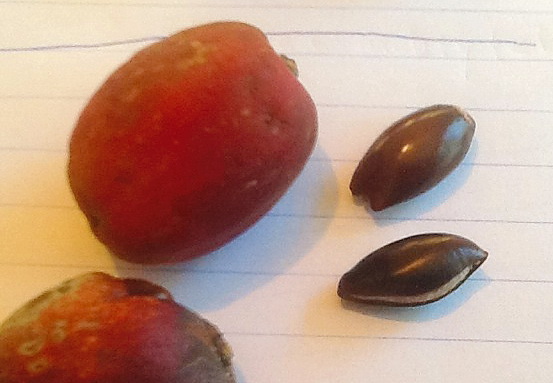
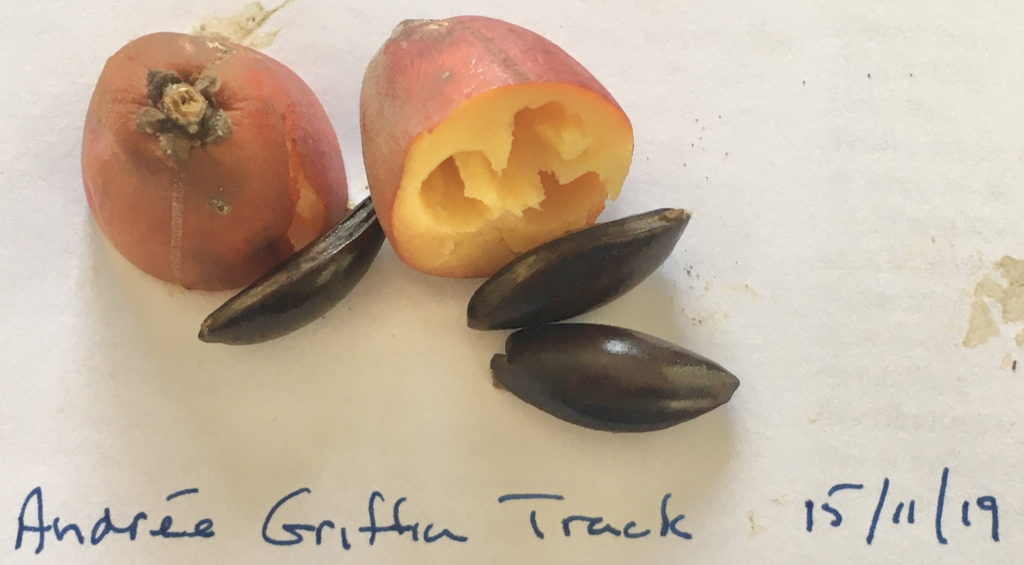
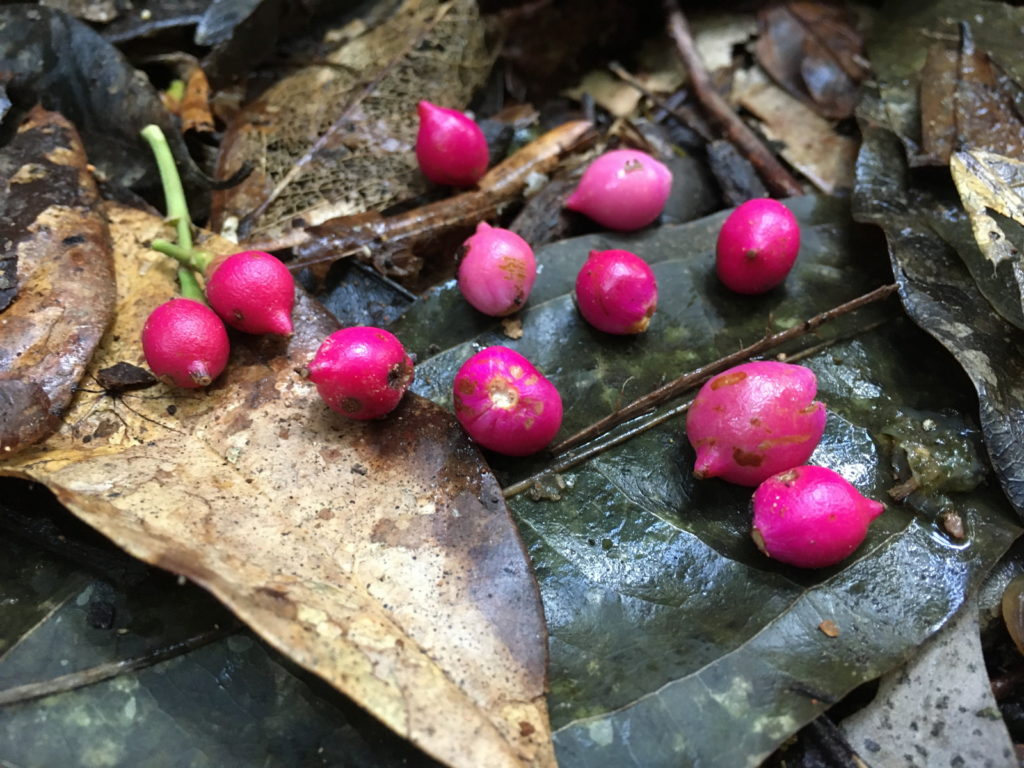
None of these features are easy to distinguish in the field, but luckily the fruit are very easily recognised scattered on the ground along walking tracks. They are bright red and globular (20-25mm wide) with a shallow flesh around a hard gloubular seed. Fruit can be found on the forest floor from December to February. They are eaten by Cassowaries, and several species of rainforest rat.

Prumnopitys amara fruit collected behand Paluma Dam, February 2016

Black Pine nuts are one of about four species of rainforest seeds regularly that were used (and relied on) on by rainforest aborigines as a source of carbohydrates. While some of the seeds required lengthy preparation to leach out toxins and bitter chemicals, Black Pine seeds, could simply be collected and cooked for thiry minutes in a grond oven and then cracked open to reveal the tasty kernels which were then pulverised between two stones.

The timber from the Black Pine is used in New Guinea and Indonesia for general building purposes as well as funiture including butter churns.

Other conifers around Paluma

Conifers belong to a group of seed-bearing plants (including Cycads and Ginkos) in which the seed is not enclosed in and ovary (Gymnosperms – meaning naked seed). The seeds of conifers (Pines and relatives) are borne within cones. Australia has several conifers that are endemic (found only in Australia) and one which is considered to be a “living fossil” (Wollemi Pine).

The Black Pine is one of only a few naturally occurring rainforest conifers in the Paluma region. Two others that can be potentially (but not commonly) seen are “Plum Pines” or Podocarps (Podocarpus grayae and Podocarpus elatus). Both are called Brown Pine and both are endemic to Australia. While not strictly a rainforest pine the Hoop Pine (Araucaria cunninghami) can also be seen naturally on the slopes down to the coast along the range road, and there are several large specimens that have been planted out around the village. It is not restricted to rainforests, and is common around the rocky coast of Magnetic Island.

There are other species of native pine that don’t naturally occur in Paluma but that have been planted out around the village. These include a small Bunya Pine (Araucaria bidwilli) around the first corner of Smith Crescent and a Kauri pine (probably Agathis microstachya*) behind the Paluma Environmental Education Centre. Two small potted native “Christmas trees” adjacent to the the Community hall include one conifer naturally found only in the mountains west of Mossman (Mt Spurgeon pine, Prumnopitys ladei) and a variety of casuarina (not a conifer) called the Daintree Pine (Gymnostroma australianum).

Text and photos (unless indicated) by Jamie Oliver

*Note: the Kauri pine behind PEEC is, on closer inspection, most likely to be Agathis robusta. It is distinguised by its smooth bark with thin flakes. – Jamie

Rainforest Tree of the Month, November 2020 – Washing-board Tree

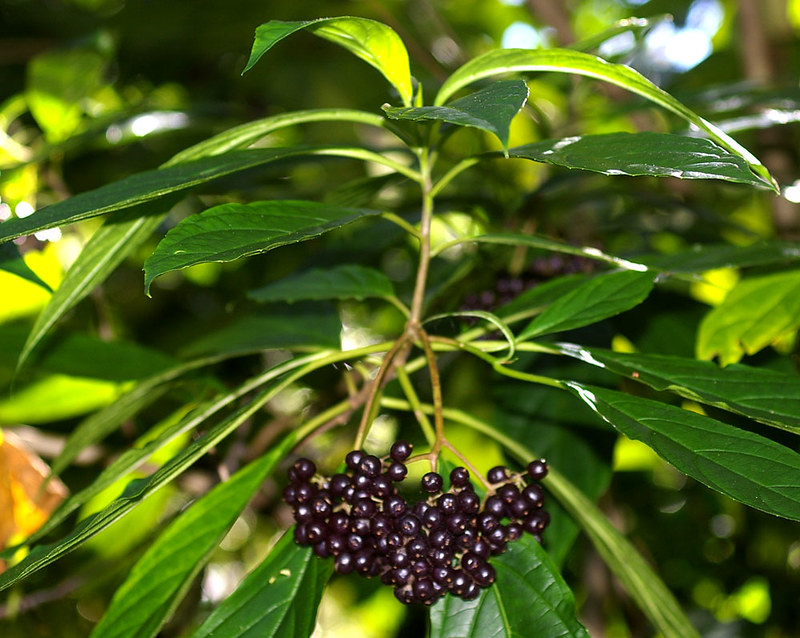
The washing-board tree (Cryptocarya corrugata) belongs to the Laurel family (Lauracea). There are over 300 species in the genus Cryptocarya, most of which inhabit cloud covered rainforests. This particular species is endemic to central and northern Queensland upland rainforests.

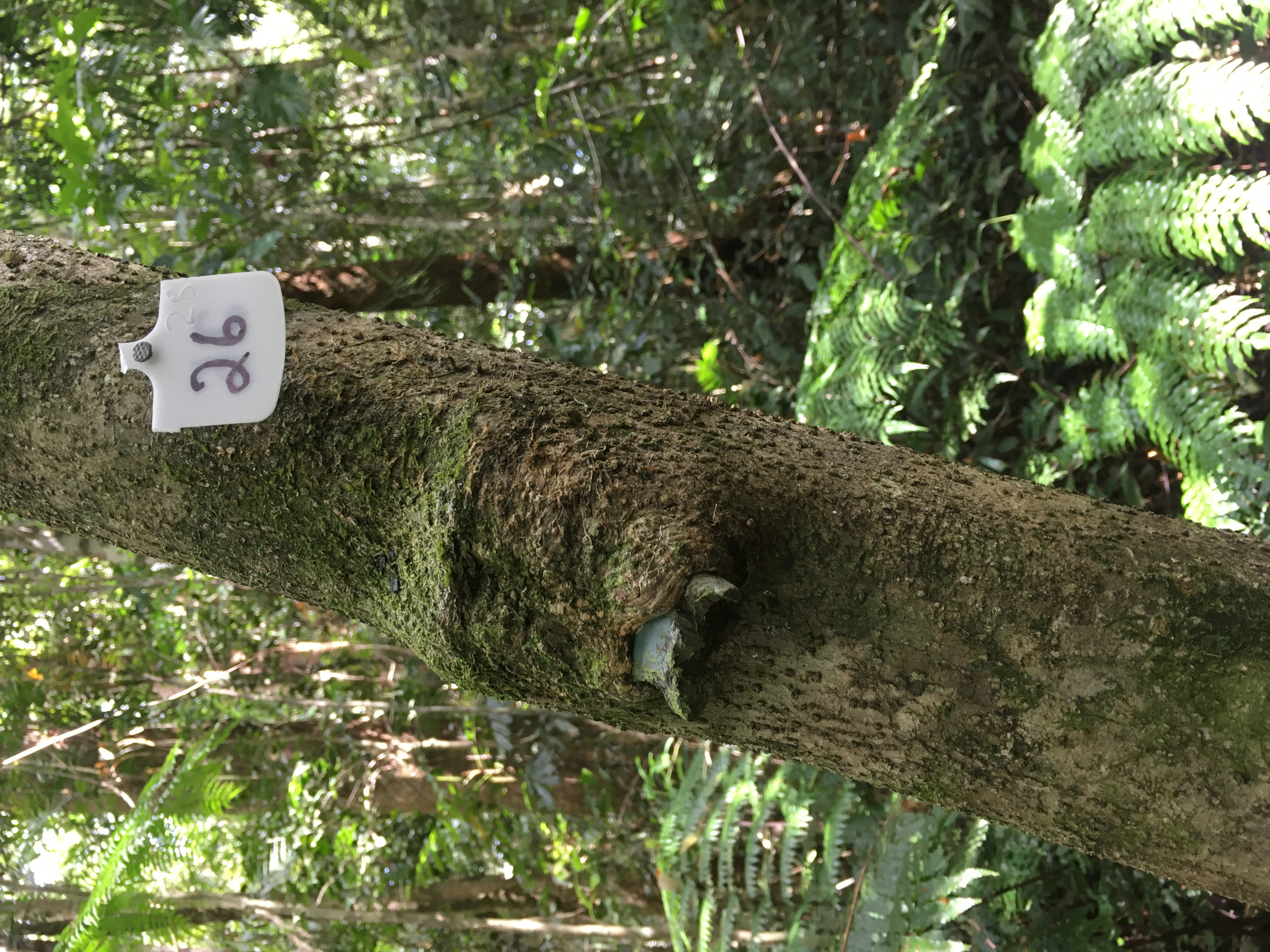
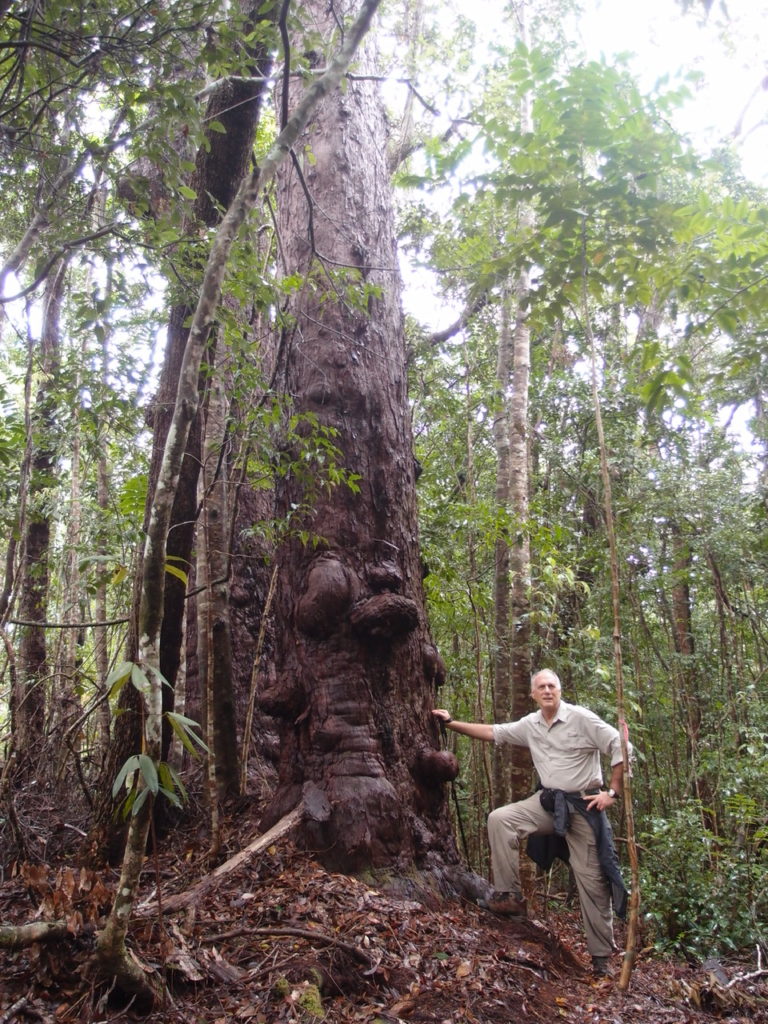
On close inspection the tree has distinctive red flakey bark and conspicuous fist to saucer-sized dimples along its trunk where the bark has flaked off. The sap-wood has a corrugataed surface, but this is largely masked by the outer bark.

Cryptocarya corrugata (Washingboard Tree) on the H-track. This is one of the recently retagged trees that are part of the upcooming revised Guide to Trees of the H-Track (Photo by Will Cairns)

The washing-board tree can grow up to 35m tall and occasionally has a butressed trunk. The cut bark and outer wood (a blaze) smells like sugar cane, but with alternative common names such as Bull’s Breath and Acid Wood this smell be a matter of personal perception.

The twigs and new leaves are covered in twisted brown hairs, while the older leaves become hairless (glabrous) with age

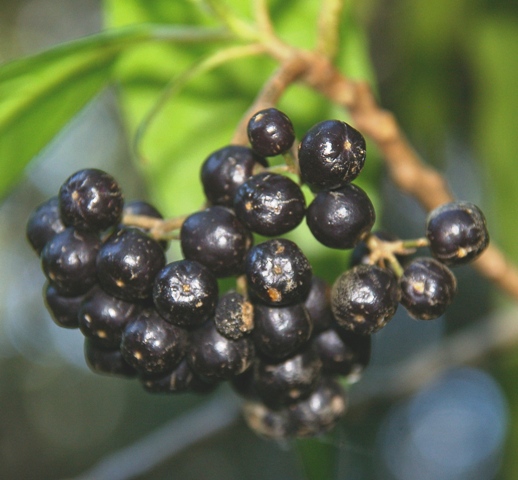
The fruit of the Washing-board tree are also distinctive. They are large ( 15-22mm high x 22-34mm wide) and broad or bilobed with a smooth to shiny purple-black outer surface. Flowering occurs in December, with mature fruit developing the following September. The fruit are eaten by cassowaries and fruit doves.

Cryptocarya corrugata fruit (Photo by Russel Cumming on Flickr)

The wood of the washing board tree is infrequently used for general purpose timber under the name “Corduory Laurel.

You can find a tagged specimen (#4) of this species near the beginning of the H-Track (starting at Whalley Cr) on the right hand side of the track. This tree is part of a Guide to the Trees of the H-Track which is currently being revised with new text and new white tags.

Text by Jamie Oliver