Rainforest Biodiversity: 5 easy species Part 10 – Insects and Spiders

by Jamie Oliver

Insects & Spiders

Insects and spiders belong to the Arthropod phylum (Euarthopoda), which encompasses invertebrates with a hard exoskeleton, segmented bodies and paired jointed appendages. Crustaceans, centipedes, millipedes and many other lesser known insect-like invertebrates are also Arthropods. Paluma has a very high diversity of arthropod species, but many are either difficult to find or, once found, very hard to identify.  The following species are quite common around Paluma:

1.    Ulysses Butterfly (Papilio ulysses)

This is one of the most recognisable butterflies in north Queensland and an iconic resident of our tropical rainforests. The brilliant iridescent blue upper surface of its wings makes it highly visible in open sunny areas, and it is commonly seen foraging around the village. This large (~14cm) butterfly is a member of the swallowtail family (Papilionidae) and can be found in New Guinea and surrounding islands as well as in NE Australia. The underwings are not nearly as colourful with black and grey-brown patterning and orange-brown spots along the margin of the hindwing. Males and female are very similar in appearance but the female can often be recognised by the small blue crescents at the bottom of the hindwings.  The favoured host plant for the Ulysses is Melicope species (Euodias or Corkwoods).

Photo by Bernard Dupont   (CC by SA)

2.    Australian Rhinoceros Beetle (Xylotrupes australicus)

This very distinctive and large (up to 6cm) beetle has two large horns (upper and lower) with forked ends. Horns only occur on males. The females are similar in size but without horns.

Rhinoceros beetles are harmless but can make a hissing noise when threatened and their claws are sharp enough to grip tightly to (but not injure) a finger or hand. The horns are used by males to fight each other during the breeding season. In Thailand they are kept as pets and for gambling over beetle fights.

Male
Larva – Photo by Jeff Wright, Queensland Museum, Copyright
Female -Photo by L. Shyamal, CC BY-SA

Adult beetles feed on bark. The larvae burrow into and eat leaf litter and rotting wood and are often found in mulch or old compost piles in Paluma gardens. They can take up to two years to reach full size, by which time they can fill the palm of your hand.

Despite their armoured and heavy appearance Rhinoceros Beetles have fully functional wings under their carapace and are strong flyers. Males are nocturnal and attracted to light. The Australian Rhinoceros Beetle occurs in moist forests in eastern Australia and the Northern Territory. It has previously been referred to as Xylotrupes gideon or Xylotrupes ulysses, but current thinking is that these species do not occur in Australia and that our Rhinoceros beetle (X. australicus) is a separate species.

3.    Cairns Birdwing (Ornithoptera euphorion)

The Cairns Birdwing is another iconic (and endemic) butterfly of the Queensland tropics, occurring in rainforests from Cooktown to Mackay. It is the largest endemic butterfly in Australia (its almost identical cousin, the northern or New Guinea Birdwing is the largest Australian butterfly).

Male Cairns Birdwings can have wingspans up to 12.5cm, and have brilliant green, black and yellow wings. The larger females (15cm wingspan) have similar markings but in shades of grey and white.  Both sexes have bright yellow abdomens with a blotch of red on the side of the thorax. In gardens, adults are attracted to Lantana, Hibiscus and Bouganvillea flowers. Around Paluma they also feed on Agapanthus and the red Pagoda plant.

The main food plants of the larvae are Aristolochia acuminata (sometimes called by its synonym A. tagala)in lcoastal areasbelow 500 m and Pararistolochia deltantha in upland forests including Paluma. Mature larvae can be as thick and long as your thumb. If disturbed, they extrude distinctive reddish horns (osmeterium)  that  produce a fetid terpene compound to deter predators.

4.    Golden Orb Spider (Nephila pilipes)

The Golden Orb spiders (genus Nephila) are a group of large web building spiders that have grey abdomens and swollen and often yellow leg joints. The silk of the webs is distinctly yellow and surprisingly strong. In some South Pacific islands the silk is formed into a ball by local fishers and used as a sticky lure to entangle the serrated beaks of garfish.

In Paluma the common species is Nephila pilipes, and it can be seen in forest clearings and in gardens around the village. Despite their daunting size the bite of this spider is not dangerous. It captures and eats a variety of insects and the occasional small lizard that gets caught in the web. Very small birds have been recorded (very rarely) in Nephila webs, but it is highly unlikely that they would be fed on.

Two other spiders can frequently be seen sharing the web of the large female Nephila. The first is a small brown spider the size of a fingernail. This is actually the male Nephila, which can be distinguished by the enlarged brown palps near the mouth and shaped a bit like boxing gloves. Males of many orb-building spiders live a precarious existence, driven by an attraction to the much larger females, who must be suitably seduced by a complex pattern of plucks to the web before they are safe to approach for mating purposes. If the seduction fails, or wears off too soon, the hapless males are likely to be devoured by the target of their attraction.

male Nephila pilipes on female
Argyrodes antipodianus (Photo by Scott W. Gavins CC by NC)

The second spider often found on Nephila webs has a tiny silver teardrop body and belongs to the genus Argyrodes (most likely Argyrodes antipodianus). These spiders act as “kleptoparasites” stealing smaller food items from the larger spider’s web, or even from its mouth. To avoid being eaten by Nephila it builds a separate web intertwining its host’s, thus avoiding attention from its movements in search of prey to steal.


5.    Jungle Huntsman Spider (Heteropoda jugulans)

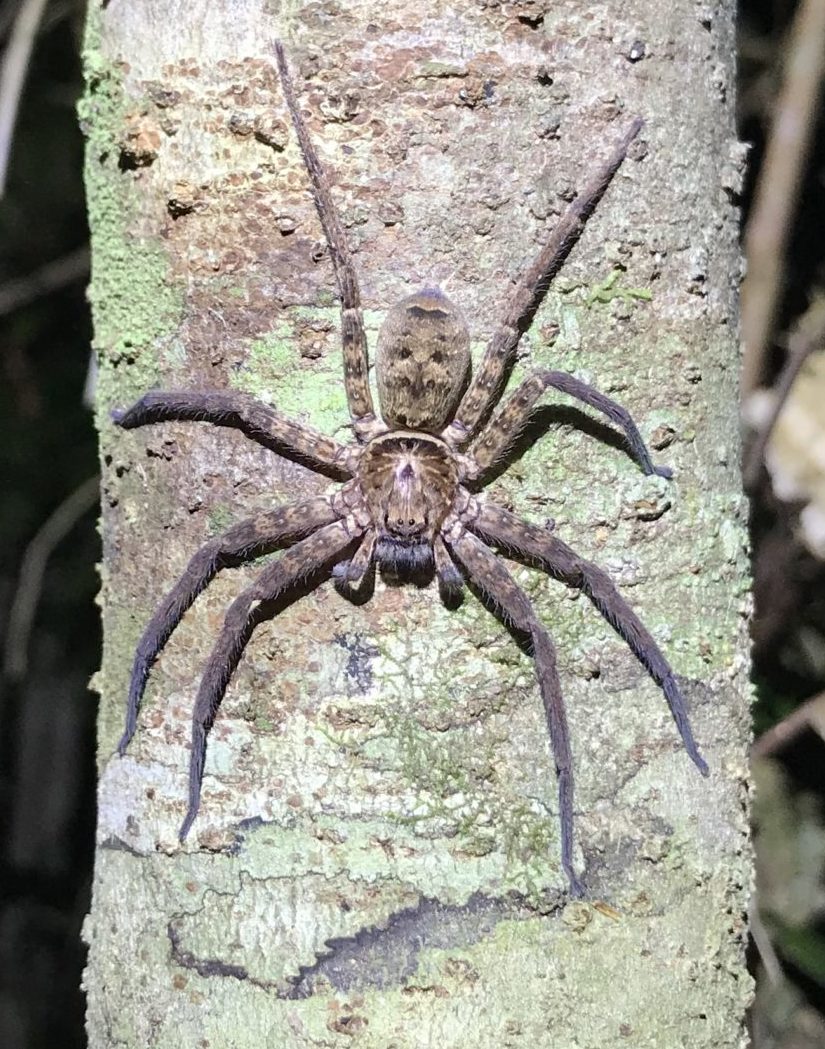
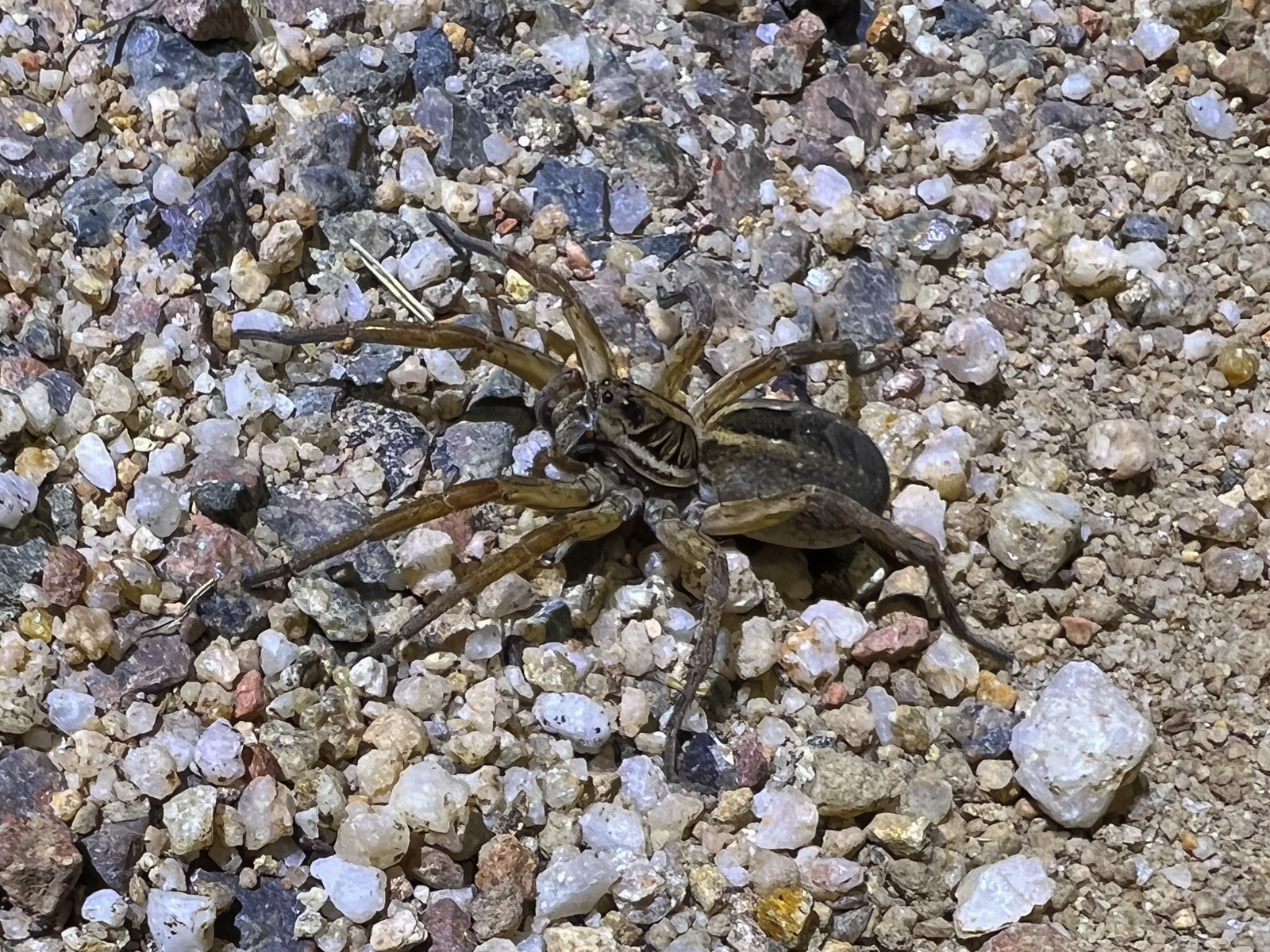
The jungle (or brown) huntsman spider is another large, long-legged spider that is commonly seen in and around houses and sheds in the village. Its long legs (longer in front) are often held in a crab-like pose. This spider does not build a nest, but hunts at night chasing small insects, which it kills with a bite to the neck from its curved fangs. Although capable of biting humans, the bite produces only local pain and redness for less than an hour.  They tend to be timid animals and will quickly flee if approached. During the day they will hide under the flaking bark of trees or in the cracks and corners of walls or behind pictures in houses.

Photo by Michele Bird (probably Heteropoda jugulans)

Rainforest Tree of the Month, April 2021 – Fuzzy Lemon Aspen

The Fuzzy Lemon Aspen (Acronychia vestita) is endemic to northeast Queensland occurring in upland wet sclerophyll forests and rainforest margins or disturbed areas from Kuranda to Paluma. It is generally a shrub to small tree but can grow up to 20m. The ovoid deep green leaves are simple with obvious lateral veins running at an angle from the mid-vein and then looping up before reaching the leaf margin.

Flowering occurs from February-March and the fruit develop as globular fruit with a lumpy wrinked surface that turns from green to white or yellow when ripe.

photo (c) kerrycoleman, some rights reserved (CC BY-NC)

This is not a particularly common tree around Paluma but there is a good example on the edge of Potters Park off Lennox Crescent that is currently bearing numerous developing fruit that should turn yellow in the next month or so.

Fuzzy Lemon Aspen at Potters Park on Lennox Crescent

The fruit are eaten by Cassowaries, Wompoo Fruit Doves and the Musky Rat-kangaroo. The leaves are one of several species eaten by the larvae of the Ulysses Butterfly.

Several other species of Acronychia including the Lemon Aspen (Acronychia acidula) are edible and used as a garnish or flavouring in drinks and chutney. A. vestita is noted as being edible in the original Rainforest Fruits book by Cooper & Cooper (1994) but I could not find any other references to edibility.

Text and photos (unless indicated) by Jamie Oliver

Anicca exhibition opening a great success

On Friday evening the exhibition of new artwork by our local artist Colwyn Campbell was opened by Sue Tilly and Ross McLennan at the Drill Hall in Townsville.
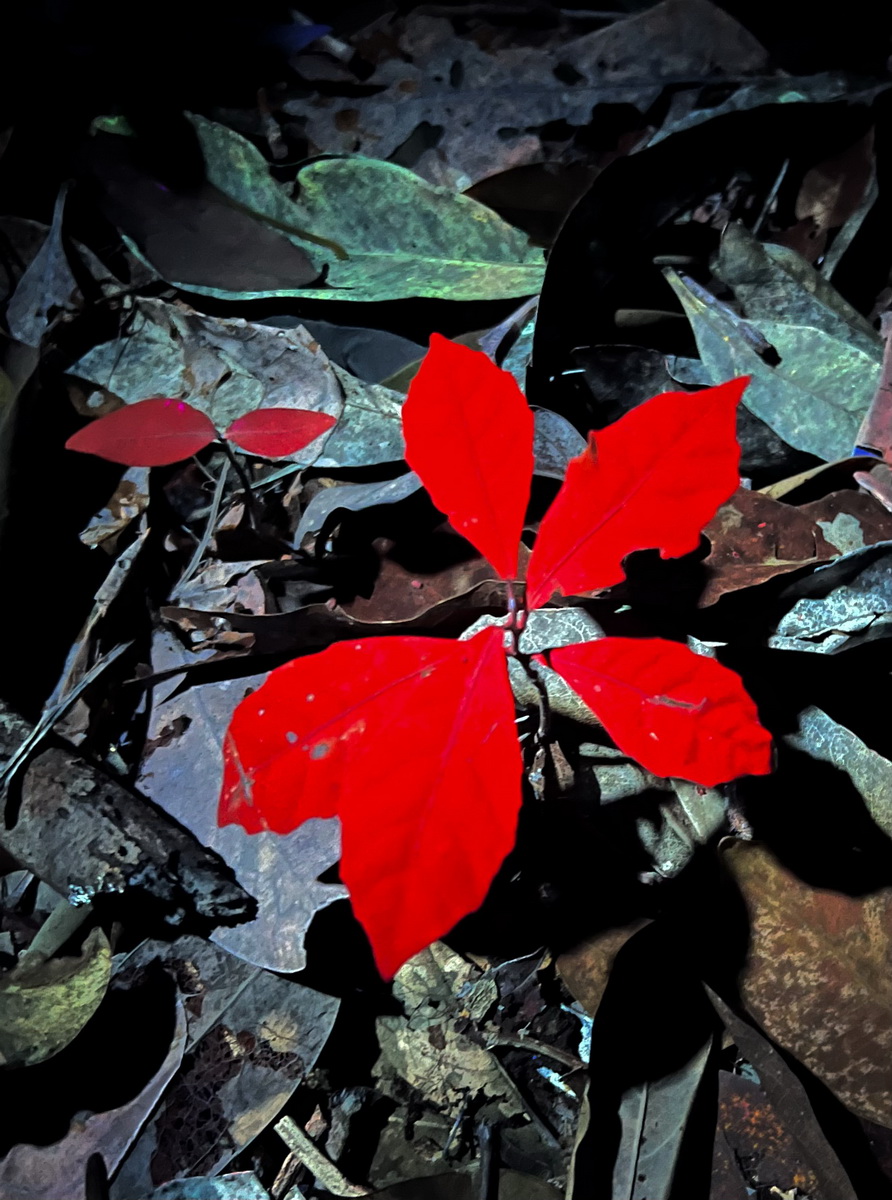
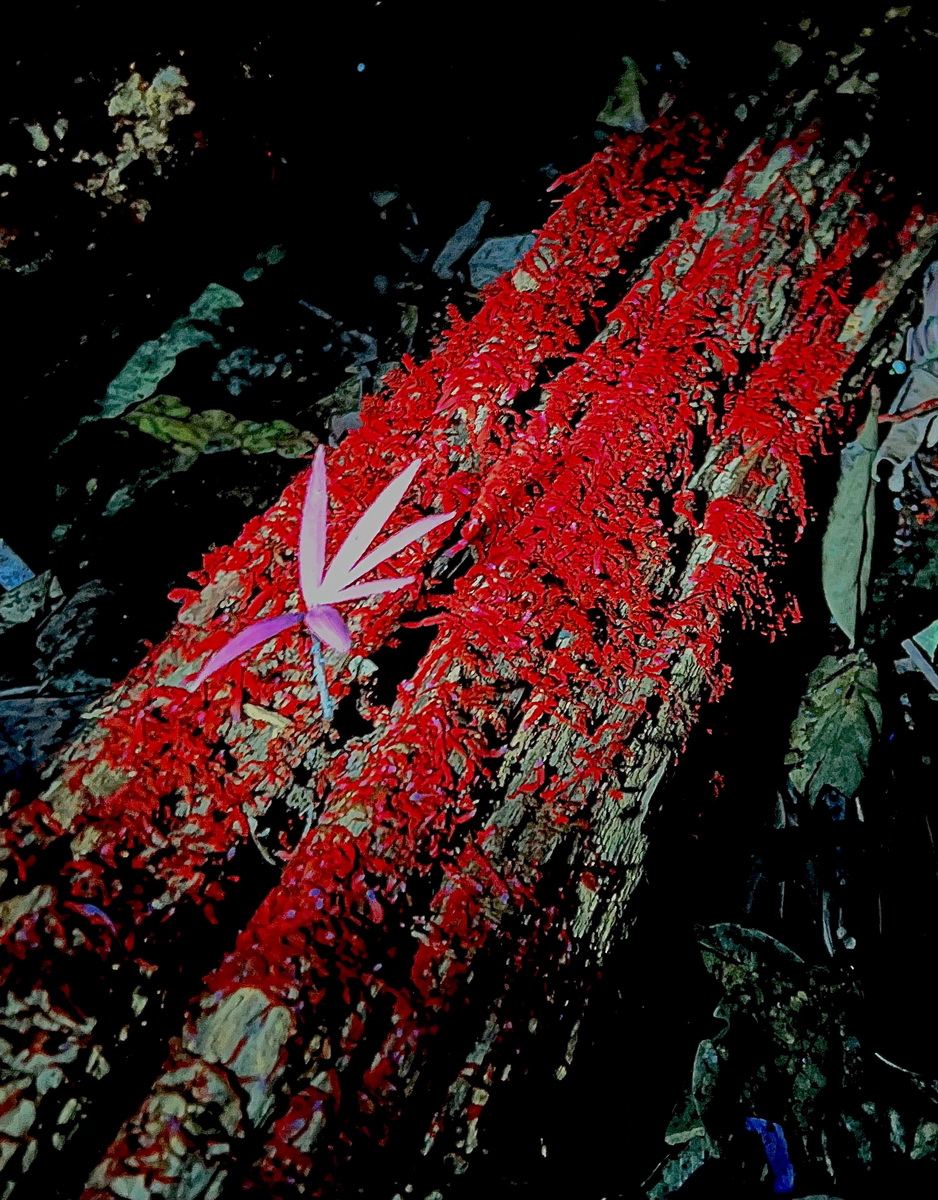
The event was well attended and dominated by Paluma residents who not only admired the stunning pieces on display but also purchased several of them.

The Buddhist concept of Anicca (impermanence) clearly pervaded the artwork. The detailed depiction of fallen leaves and other organisms associated with decay and recycling of life, combined with the repetitive colourful patterns resulted in images that were (to me at least) both abstract and yet highly realistic.

Congratulations to Colwyn on the success of the exhibition, which will remain open until May 20th.

Text by Jamie Oliver, photos by Juanita Poletto

Rainforest Tree of the Month, March 2021 – Dalrymple Beech (Gmelina dalrympleana)

Gmelina dalyrympleana is a rainforest tree found in northeast Qld and Cape York as well as New Guinea. There are several species in this genus and most of them can be found in the wet tropics and share the common names White Beech, or Grey Teak). With its lovely pink flowers bright red fruit this species ranks as one of the more attractive in the genus.

This tree is currently in fruit around Paluma and the bright red, oblong cherry-sized fruit are unmistakeable at several spots along the H-Track. The fruit might be mistaken for a Satin Ash at first glance but its seed capsule, which is bound tightly to the flesh of the fruit, is small and woody. The small pink flowers are occasional seen scattered on the ground on or next to the H-Track.

The fruit is eaten by fruit pigeons. The tree can grow to 40m yields a course, but durable timber used for planks and floors. It is cultivated as an ornamental tree in Queensland and NSW.

Text and photos (unless indicated) by Jamie Oliver

Mighty Hercules from Mt Spec Road

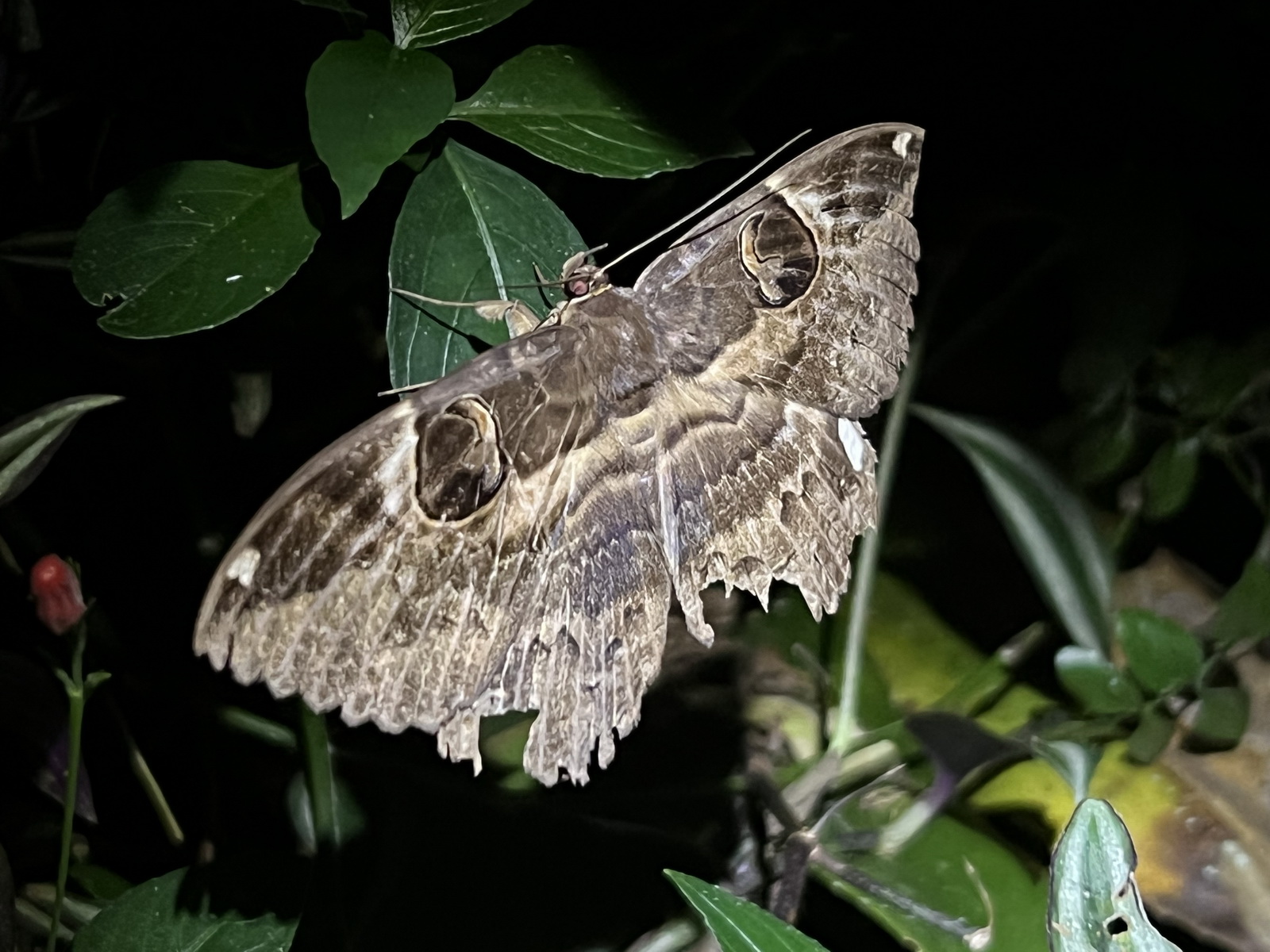
Came out on the verandah in downtown Paluma this morning to find a giant of the jungle sitting quietly on the deck furniture. 

Male (we think) Hercules moth (Coscinocera hercules) 240mm wingtip to wingtip, 180mm overall length. … that’s very big for a male as Wildlife of Tropical Northern Queensland lists maximum size for the larger female as 225mm. 

Wildlife of Tropical Northern Queensland  and Guide to Australian Moths say range is Cape York south to Ingham — so the southerly extent of the range is a bit understated in both books.

The females have the largest wing area of any moth in the world. 

The leaves of the medium sized rainforest tree Bleeding Heart (Homalanthus novoguineensis) is said to be the favorite food of the Hercules caterpillars. 

We have a Bleeding Heart which is trying to climb onto our deck.

The leaves are being well munched and we did find a caterpillar there after we spotted the moth. However, it didn’t look like the Hercules caterpillars from the books. 

Jamie Oliver has come across this caterpillar before and was able to provide an ID —  Iscadia inexacta (Walker). Iscadia and Hercules share a preference for Bleeding Heart. 

According to the Butterfly House website Iscadia has a great party trick — “The caterpillar pupates in a papery cocoon covered in bits of chewed leaf. The pupa is famous for being able to produce sounds when disturbed, by rubbing projections on the abdominal skin against the hind surface of the cocoon.”

Hercules also has a surprising twist of biology — the adult moths don’t eat, they survive on food stores from when they were caterpillars, says the Australian Butterfly Sanctuary website. The adults live for only 10-14 days which they devote to finding a mate. The mating game is initiated by the female which emits a pheromone that can attract male suitors from over 2km away. 

The caterpillars grow up to 12cm in length and are dotted with yellow spikes. Such a huge caterpillar makes sense when we consider how large the moth itself is.

The largest ever Hercules Moth had a wingspan of 36cm, says the Australian Butterfly Sanctuary website. 

Text and photos by Peter Cooke

Paluma Rural Fire Brigade – AGM – March 20, 4pm

The Annual General Meeting of the Paluma Rural fire Brigade will be held on Saturday, 20th March 2021 at the Community Hall. All members are encouraged to attend, and anyone interested in joining or serving on the Committee are also warmly invited. If you have any questions about the PRFB or what’s involved in joining as a Volunteer, please contact Len Cook.

Rainforest Tree of the Month, February 2021 – Syzygium australe

This attractive rainforest tree, a member of the Myrtaceae family, has many common names, including, brush cherry, scrub cherry, creek lilly-pilly, creek satin-ash and watergum.  It grows mostly along water courses in rainforests and gallery forests at altitudes up to 1300 metres.

Worldwide, there are more than 1000 species of Syzygium ranging across PNG, the Pacific islands, Malaysia, SE Asia, India, Africa and Australia.  Australia has 57 species, with 47 of them in tropical Queensland.  Some species, easily recognisable are Paperbark satin-ash (Syzygium paparaceum with its purple fruit; Powder-puff lilly-pilly, (Syzygium wilsonii), with small purple fruit and a sub-species noted for its large magenta powder-puff flowers and lush creamy white fruit.

It is easy to understand how various Syzygium species, along with many other native Australian flowers, inspired May Gibbs to create her delightful bush babies.  Who could forget the movie magnate’s daughter, Lilly Pilly with her skirt, beret and muff made of lilly-pilly berries.

Although Syzygium australe can grow to 35 metres with a trunk diameter of 60 cm, it is a popular plant in ornamental gardens as it can be shaped and pruned into hedges. It is a fast-growing tree and can grow 2 metres in a year.

The ovate leaves are simple, opposite and approximately 30×100 x 10-40 mm.  Young leaves are bronze, turning to a deep, glossy green as they mature. They form dense foliage on this shapely tree.

Flowering can occur at any time of year.  Flowers are clustered in axillary or terminal racemes. They are tiny, with white petals and numerous white stamens which give the flowers the appearance of delicate powder-puffs.  Flowering can be sparse, hiding amongst the leaves, or abundant, giving a dense cover of white.  Flowers are followed by a profusion of red fruit – berries.  These are 14-23 mm long with one or two seeds surrounded by crisp flesh similar to apple in texture. The fruit is edible, although can be tart.  It makes excellent jam and can be used as a base and flavouring for jellies, cakes and wine.

Some species of Syzygium were previously classified in the genus Acmena and others in the genus Eugenia.  The species known formerly as Eugenia Australis is now regarded as two separate species: Syzygium australe and Syzygium paniculatum.

There are many examples of Syzygium australe in Paluma.  A very old tree which usually bears fruit in profusion is outside No 75 Mount Spec Road, another, is outside the High Ropes course. Two more may be seen outside No 17 Mount Spec Road.

Text and photos (unless indicated) by Colwyn Campbell