Rainforest Tree of the Month, January 2019 – Quandong

QUANDONG    

Elaeocarpus grandis, synonymous with Elaeocarpus angustifolius

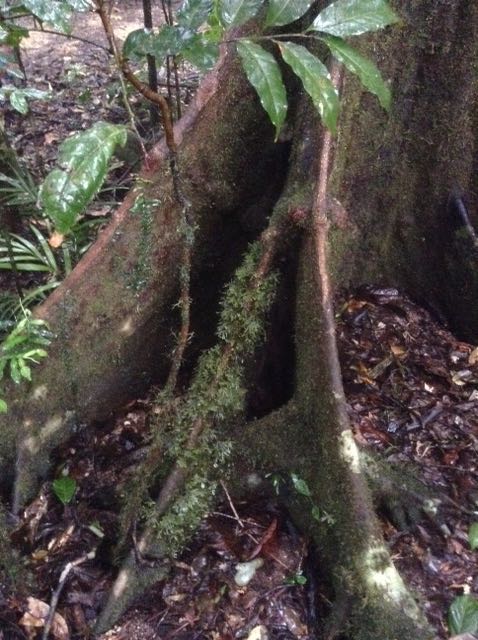
Most of you will be familiar with the Quandong’s moss-covered buttressed roots projecting out from the forest onto the edges of walking tracks.  Many of these magnificent trees may be seen in the Paluma rainforest with some especially good specimens along the Witt’s Lookout track.  The Quandong, a tree emblematic of tropical rainforest is also known as Blue Quandong, Silver Quandong, Blueberry Ash and Blueberry Fig.

A pioneering tree, the Quandong can grow to five or six metres high in just a few years, eventually reaching a height of up to 35 metres.  A strong identifying feature are the buttresses with vertically flat, visible roots, so large in some instances that they are capable of sheltering a cassowary. Moss usually covers the trunk and roots so it is difficult to readily see the nature of the bark, but the cut timber is hard and white and highly regarded as a cabinet timber.
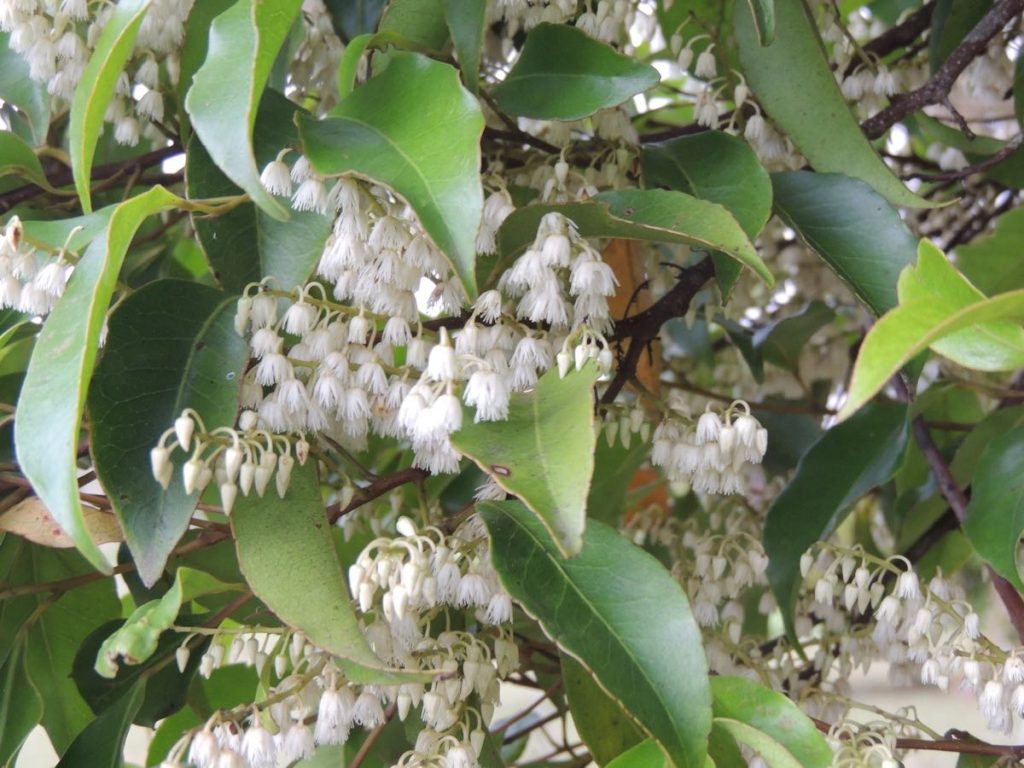
Flowering occurs between October and March, the softly fragranced flowers, growing in racemes from axils or on branches are usually high in the tree and difficult to see.  They can be green, white or cream with tiny petals about 5 mm long. 
Fruiting can occur at any month. You can sometimes find the blue to purple fruit lying among the fallen leaves on the rainforest tracks. Their colour is often enhanced with a metallic sheen. The fruit is a drupe (fleshy with one or more seeds inside) and can be anything from the size of a small grape to that of a golf ball.  The fruit is edible and has a higher Vitamin C content than oranges.  It is best eaten when slightly over-ripe or it can taste bitter. It can be used in jams or pickles. Many bird species eat the fruit which is also eaten by Bush Rats, Spectacled Flying Foxes and Musky Rat Kangaroos.

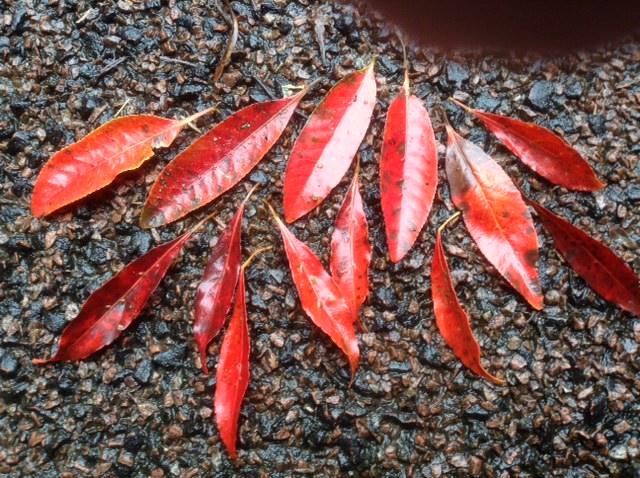
The leaves of the Quandong are glossy and about 80 to 150 mm long.  As it ages the leaf turns a bright red before dropping. Many can be seen at any time along the walking tracks.
The Quandong was highly valued by rainforest Aboriginal people. The fruit was recognised for its medicinal properties and as a food source.  They would also make an edible paste from the ripe fruit. Shields were made from the large buttress roots.

Look for these spectacular trees next time you take a walk along one of the rainforest tracks.

Text & Photos by Colwyn Campbell
Shape Shifting Survivors – Slime Moulds

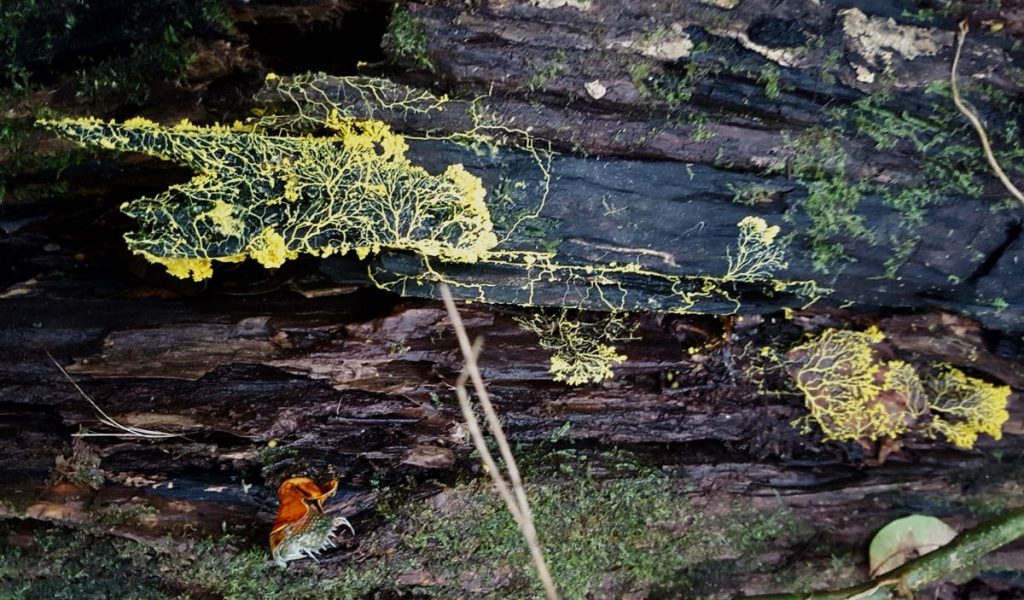
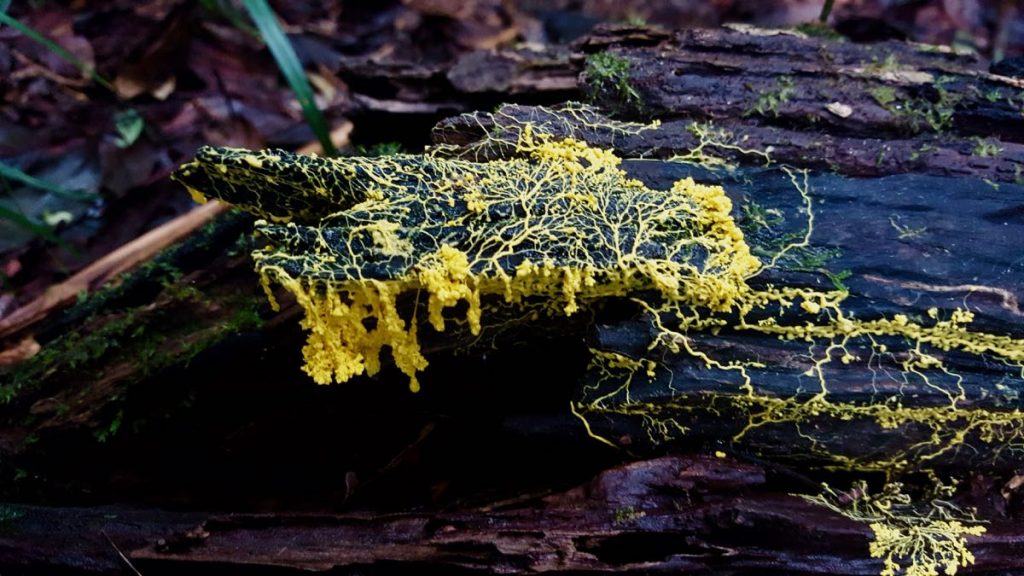
On New Year’s morning, there were a few million animals hanging out together on a decaying log on the forest floor on ‘H Track’, doing their thing. This is a Slime Mould, and most likely to be Physarum polycephalum, the Many Headed Slime Mould, and some of the things they do are quite funky.

Slime moulds are thought to be approximately 600 million years old, although some think they could be as old as a billion. They arrived on land as soon as there was land, making them hundreds of millions of years older than other animals or plants. So, okay, they have been around for a long time, but what are they?

Slime moulds are Protists, or single celled organisms, which like moist, humid, dark environments, such as the rainforest floor.  They favour rotting and decaying vegetation, where they feed on micro-organisms, including fungi, algae and bacteria.  A single slime mould cell, in favourable conditions exists as an Amoeba, basically a nucleous surrounded by cell fluid, contained within a membrane.  Amoeba travel by moving this fluid within the flexible cell membrane in a process known as cytoplasmic streaming, which is handy when you need to hunt down your prey, before engulfing it with your body. But what about when food is scarce, and too difficult to find when you’re a microscopic bag of fluid?

Slime moulds form a plasmodium, which is the part of the life cycle shown in the photo.  Huge numbers of single celled amoebae find each other in the environment using chemical signals, and join together, losing individual cell membranes to form a complex organism.  This organism is also able to move to search for food, which it surrounds, before secreting enzymes to digest it.  This is also the primary reproductive stage for slime moulds; if food runs out, conditions become too dry or receive too much light, the plasmodium begins to make spores. This is the stage the photographs show, with the bumpy bits (the many heads of our slime mould) containing the spores.  

The spores are able to survive unfavourable environmental conditions for long periods of time.  When conditions improve, the spores rupture, producing a single cell amoeba.  However, if things get too wet, this amoeba is able to rapidly transform into a flagellated organism (a flagellum is a long, whip-like structure which helps the animal move in water, similar to swimming).  This shape is also reversible when conditions are not quite so wet, and being an amoeba is more convenient.

But you don’t get to be nearly a billion years old without having a few more tricks up your sleeve.  If life becomes uncomfortable at the plasmodium stage, the organism can become dormant, and it can survive like this for many years.  Amoeba can also transform into cysts to survive when conditions are unfavourable.  It’s kind of like being able to go into suspended animation whenever it’s too hot, too dry or too bright.  Amoeba can also fuse with other single amoeba to form a reproductive organism, or a single amoeba can reproduce by just splitting.  Plasmodia can also fragment or enter another dormant phase called a spherule which can survive indefinitely.  So, Slime Moulds have lots of options, including shape shifting, mind (and body) melding and suspended animation to enable them to survive in this unpredictable and changeable world.  And that’s why they’ve been around so long!

These amazing creatures have fascinated scientists, and provided many opportunities for research.  They are easy to culture in laboratories, and provide a model organism to study amoeboid movement, cell motility, and other anatomical and physiological processes. The real surprise however is that slime moulds also provide opportunity for behavioural research.  They have been observed finding food in mazes and forming networks between food sources to provide efficient nutrient transport that rivals our own transport design systems. These adaptable and resilient organisms will probably be around for the next billion years!

Text & Photos by Sarah Swan

Vale John Tubman

It is with great sadness that the PDCA Executive Committee posts the following notice as received from James Jackson today (21 January 2019).

RE: The Passing of John Tubman

 As most would know, John has been fighting an aggressive form of cancer for over two years. He was admitted to TGH early last week (14th) with complications arising from the condition and despite intense treatment and care failed to recover.

John passed away about 11.00 am on Friday 18th with family by his side. It will take quite some time for Junita and John’s siblings and family to reach acceptance of his passing, but all have been buoyed by, and are very grateful for the kind words, thoughts and condolences offered from many of John’s friends and colleagues.

A service for John will be held at Morley’s Funeral Home commencing at 1.00pm this Friday January 25th.  Notice to appear in Townsville Bulletin on Wednesday 23rd.

On behalf of Junita and John’s Family, I would like to convey their appreciation for your kind messages and thoughts of sympathy.

James Jackson

Fascinating Fungi

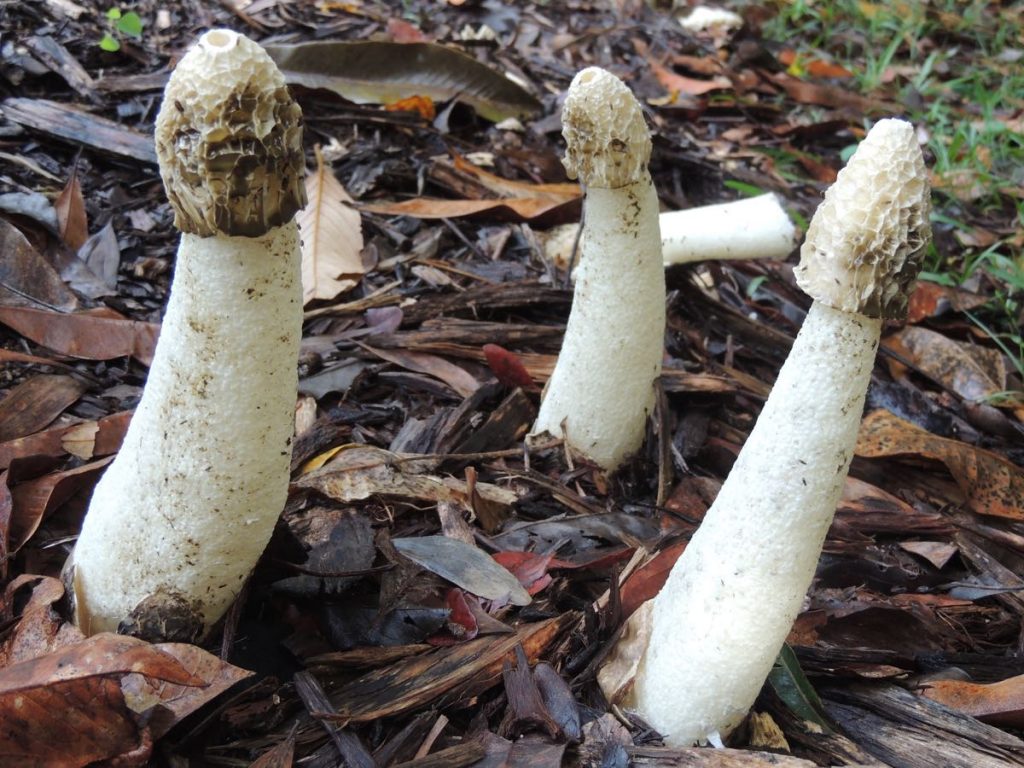
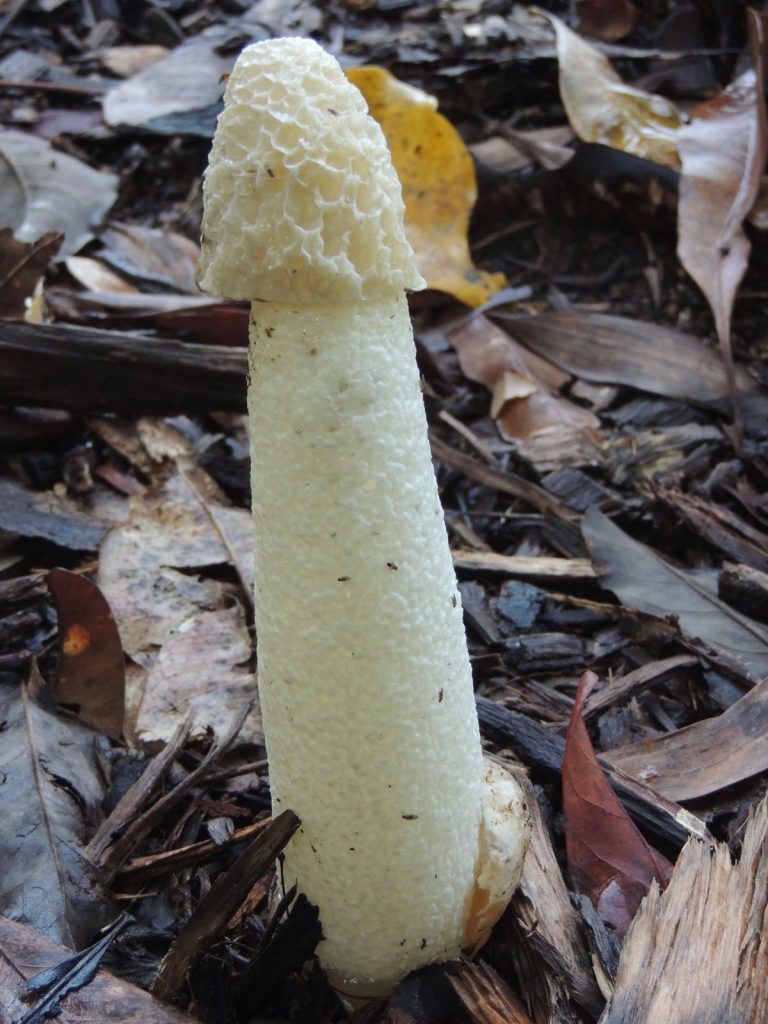
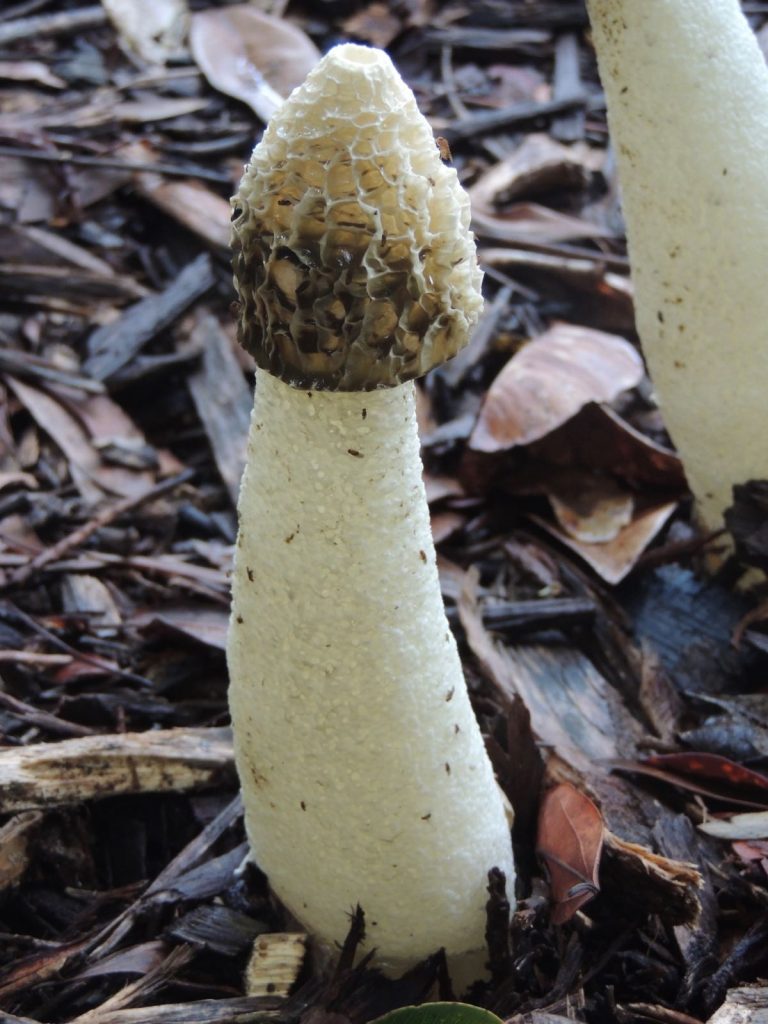
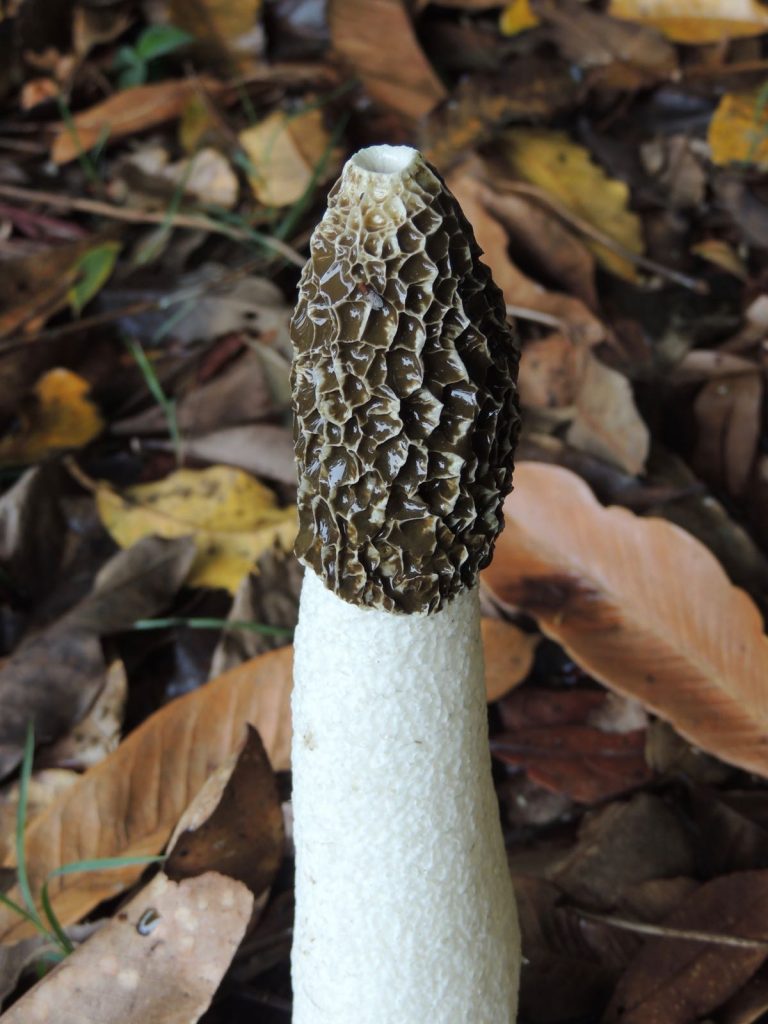
Anyone visiting the Village Green in recent days will have noticed the amazing fungi that has sprung from the ground in the wood-chip mulch at the Trees In Memory. This fungi is commonly known as ‘Stinkhorn Fungi’ – distinctive for both its foul odour and phallic shape when mature.

Stinkhorn fungi are widespread throughout Europe and North America having been introduced into Australia. My research would suggest the specimens at the Village Green are the species Phallus impudicus. Stinkhorns occur in moist habitats rich in wood debris, such as the forest floor and gardens. This would explain why they are growing so happily in the wood chips at the Village Green.

The fungi emerges from an egg-shaped fruiting body in the ground. The fruiting structure (stalk) grows tall, up to 25cm, and it is white with a slimy white to brownish conical head. The head tends to darken in colour as the fungi matures. The head exudes a gelatinous slime which contains the spores. Insects such as flies are attracted by the foul smell of this spore-laden slime. Unlike many other fungi, the spores of stinkhorns are not distributed in the air, but by their insect visitors.

Make a point of visiting the Village Green in the near future to check out these amazing fungi. They may not last long, so don’t miss out on these fascinating and very smelly phallic fungi!

Text & Photos by Michele Bird

Don’s Party

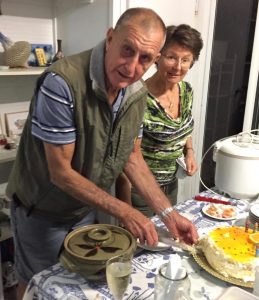
One of Paluma’s most popular and well-loved residents, Don Battersby will celebrate his 69th birthday this week. To mark the occasion, Colwyn Campbell hosted a birthday party for Don on Saturday night (19th January) at her residence. The house and verandas were bursting at the seams with the event well-attended by many of Don’s long-time friends and his Paluma family. As usual, there was food aplenty with an array of Indian-inspired dishes and other cuisine, as well as a tropical passionfruit birthday cake. There was good food, great company, many laughs and the usual warm community spirit that exists uniquely in our village of Paluma.

Happy Birthday Don from all your friends and family at Paluma!

Don Battersby with his birthday cake!

Monty’s Christmas Dinner

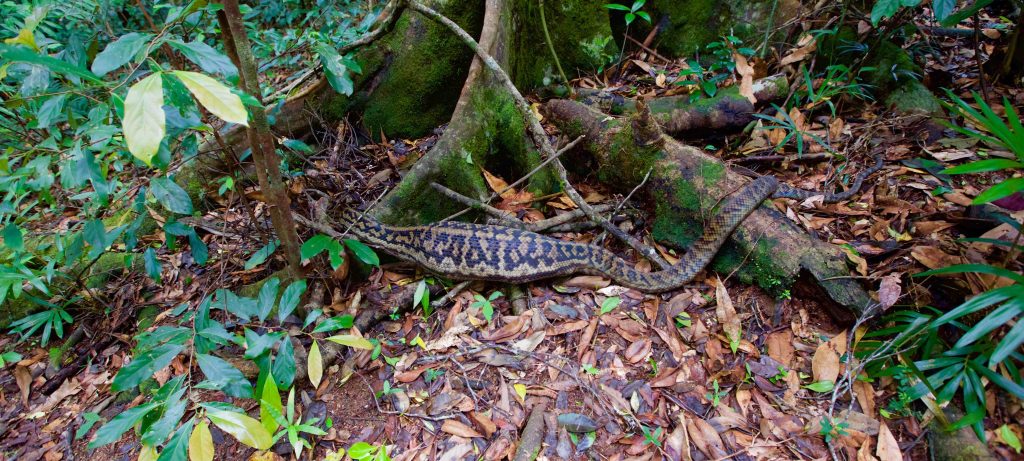
Walkers on the short ‘Paluma Rainforest Walk’ opposite the Community Hall last week came across a legless Paluma resident slowly heading home after a large Christmas feast in the village. 

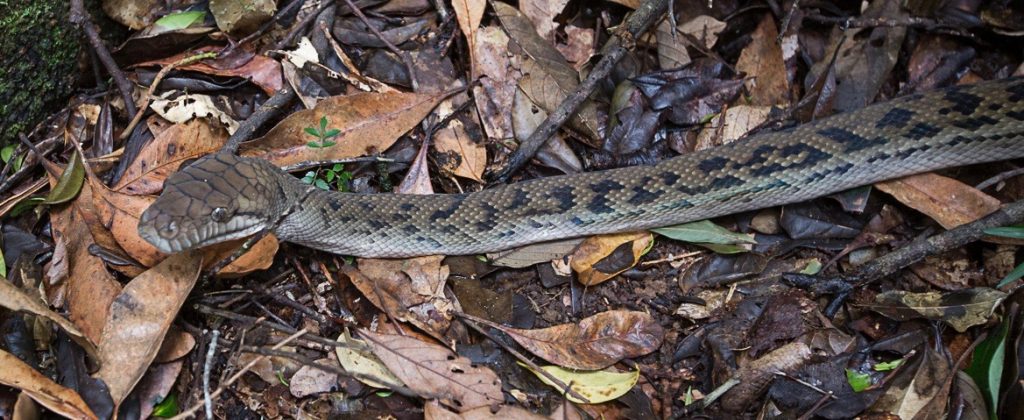
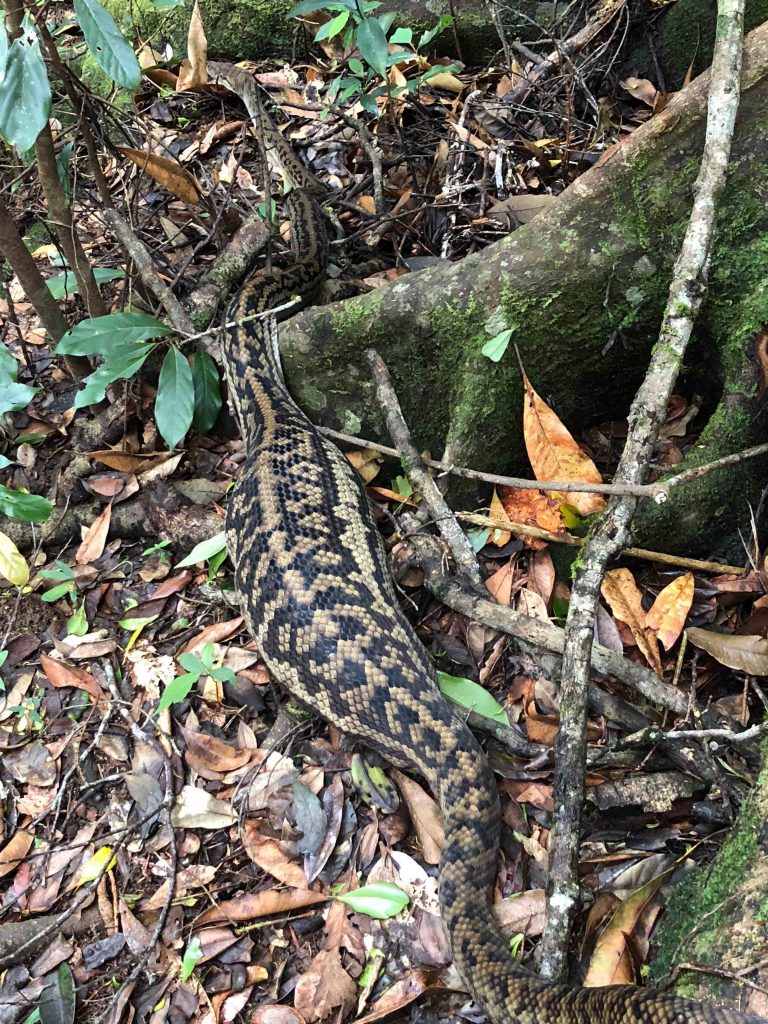
When this sizeable amethystine python (Morelia amethistina, aka scrub pythonwas first noticed the Saturday before Christmas not far from the start of the walking track (off Mount Spec Road) it had already finished Christmas dinner. By the size and shape of the bulge in its belly it seems most likely the festive feed was an unwary scrub turkey (Alectura lathami). It wasn’t until well after Christmas on the Thursday that the 3 metre-plus serpent slithered down the slope and stopped for a breather just beside the track.

The amethystine python is one of the six largest snakes in the world, as measured either by length or weight, and is the largest native snake in Australia and Papua New Guinea. It can be found throughout Indonesia, Papua New Guinea and Australia. The largest known recorded specimen was 8.5 metres in length. The scrub python is non-venomous, but comes with with an  awesome set of fangs and very quick reflexes.

It’s not unusual to find a scrub python stretched out across the road in and around the village of Paluma, enjoying the warmth of the bitumen and other times just on its way somewhere at its own slow pace. So motorists please take care!. If you can’t drive around, pull up and have a good look at one of the jungle’s most outstanding creatures while it crosses the road. 

Text & Photos by Peter & Jan Cooke


Seasons Greetings

Seasons Greetings

The Paluma & District Community Association (PDCA) Executive Committee would like to wish all Members and Paluma residents (past and present) a very happy, safe and enjoyable festive season.

We look forward to working with you in 2019 for the benefit of our special village in the mist at Paluma.

Warm Regards  from Jamie Oliver, Wilfred Karnoll, Colwyn Campbell, Lynn Hyland, Michele Bird and Juanita Poletto.

The (Much Maligned) Brush Turkey of Paluma

Brush Turkey       (Alectura lathami)

 It is time tribute was paid to the much maligned Brush Turkey, the scourge of Paluma gardeners. It is just as much a member of the local birdlife as the Riflebird, Catbird and Satin Bowerbird, and deserves to be acknowledged as such. Yet so often, visitors to Paluma do not give the turkey a second glance so intent are they in spotting the rarer birds.  On the other hand, some have mistaken the turkey’s identity and proudly report having seen a cassowary!

In spite of the curses bestowed on the turkey as he or she rummages through the garden, uprooting precious plants and redistributing carefully laid mulch, I suspect most people hold a sneaking affection for them.  I find them rather endearing. When I moved to Paluma, I inherited three who roosted in a tree in my back garden.  They waited each day at the back steps for breakfast scraps calling with their funny grunting clucks as they followed me to the edge of the forest where I put their food scraps out. Turkeys still have breakfast with me and are usually close by when I work in the garden.

Brush turkeys are expert foragers and are always on the look out for food on the forest floor.

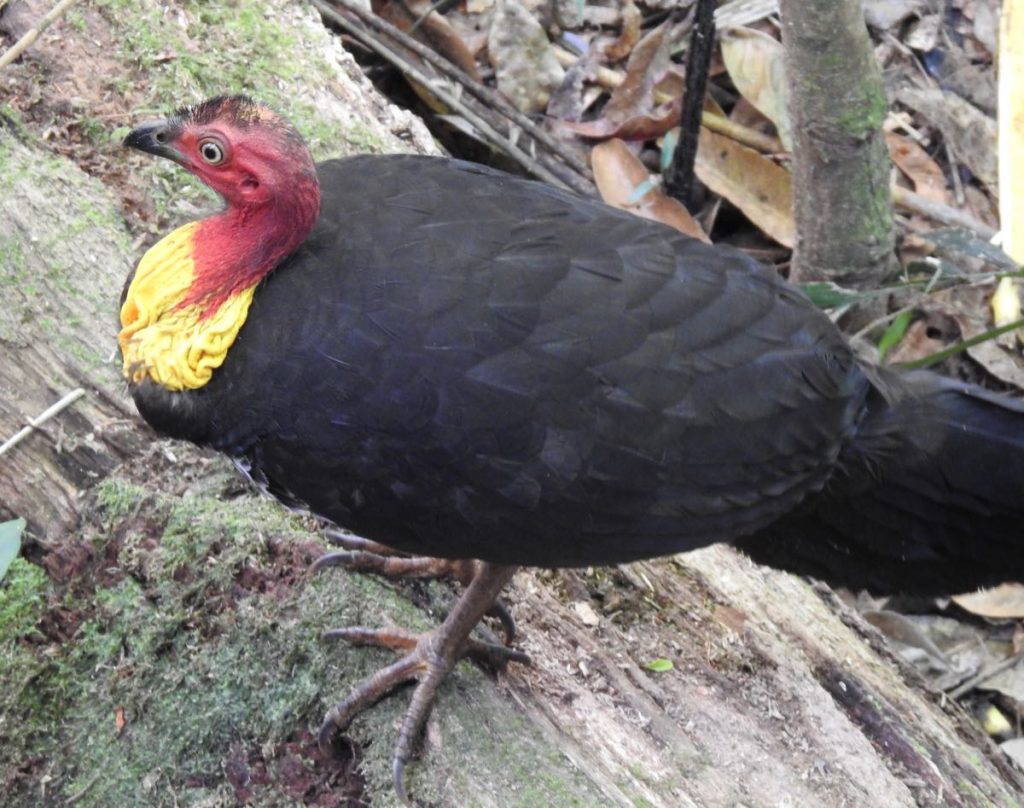
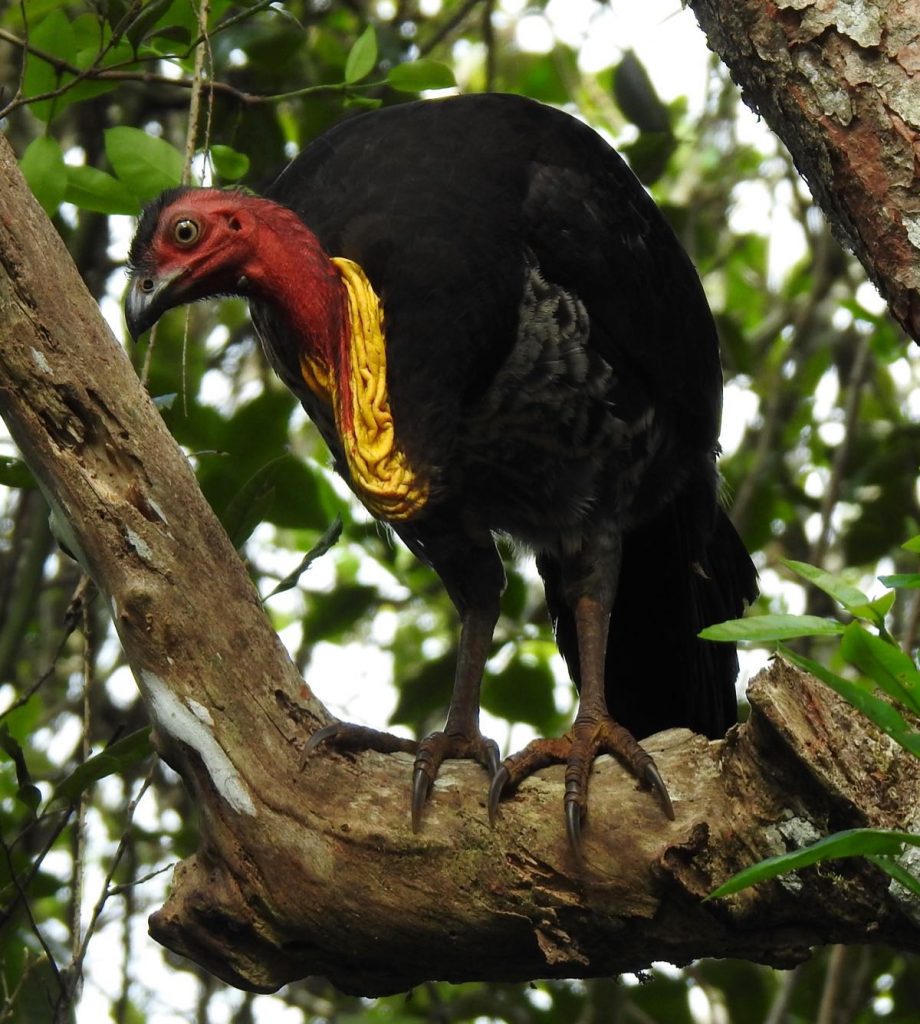
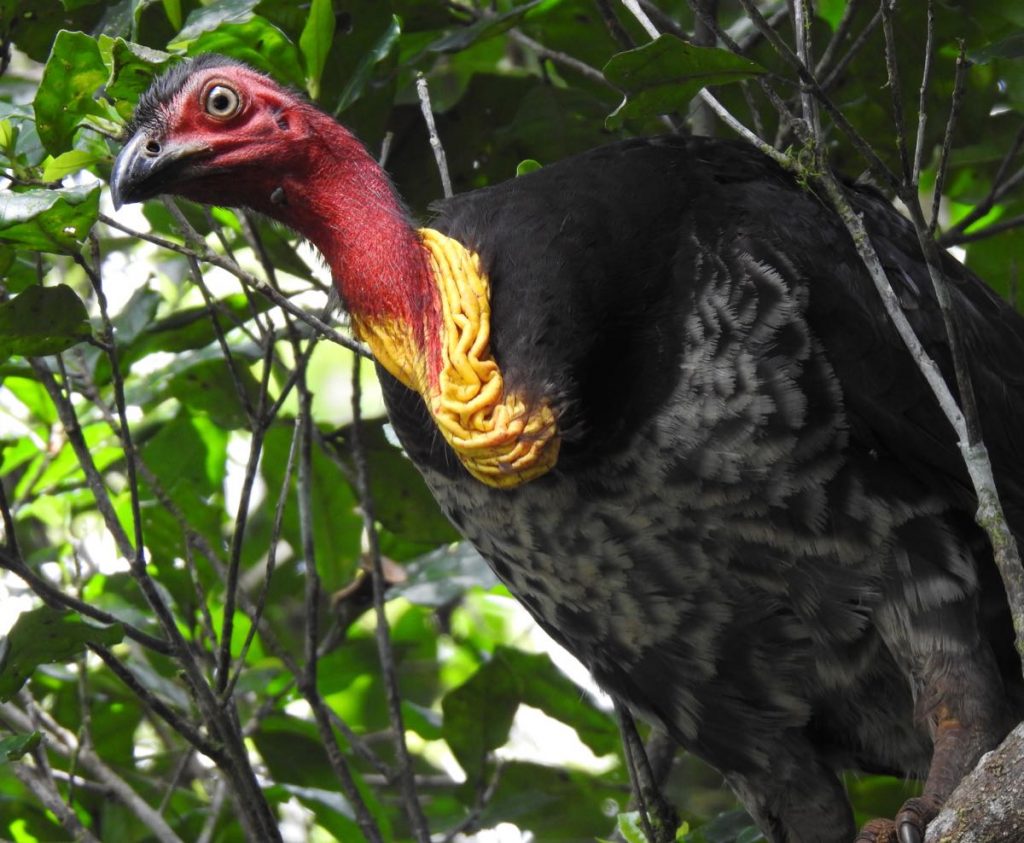
At present the male turkeys are still dressed in the magnificent courtship plumage which they donned during spring when they felt the first pangs of love in the air, with bright yellow wattles hanging in fat coils from their crimson necks.  So take a moment to admire them as they strut their stuff through the village. They have been working tirelessly for many weeks, raking leaves, throwing aside sticks and twigs, to build nesting mounds which can cover an area of around two metres square and be up to a metre and a half high.

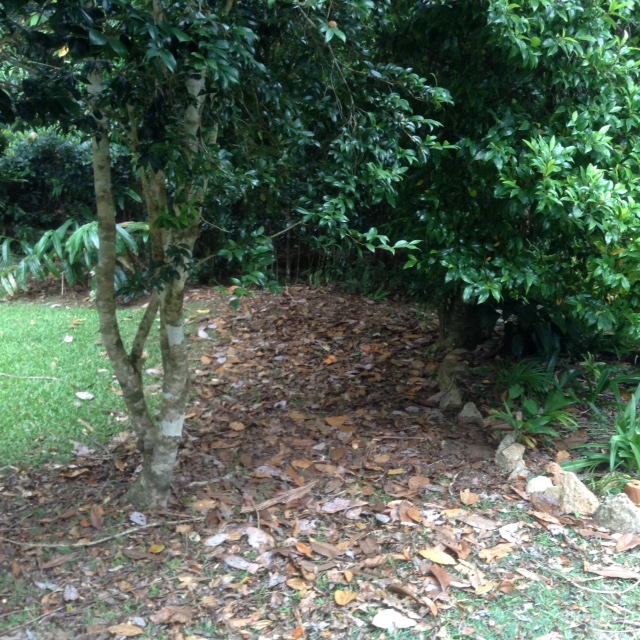
Turkey mound building commences……

Their big feet, (Brush Turkeys are Megapodes – meaning ‘big feet’), are useful tools for raking leaves for their nesting mounds and for foraging for food amongst the leaf litter on the forest floor and in our gardens.


A male turkey with his large yellow ‘wattle’ and look at those big feet!

The mound completed, the male has to entice females to lay eggs in it; several hens will oblige – with eggs not necessarily fertilized by the builder of the mound. The hen’s job done, off she goes. She provides no parental care other than providing eggs with particularly rich yolk which can feed the chick after it has hatched. The male turkey will satisfy himself that the eggs are deeply buried in the mound.

The decomposition of the leaves and mulch with which the mounds are constructed provide the heat required to incubate the eggs. He keeps watch, turning the mulch to maintain a constant temperature until the chicks are ready to hatch, (after about 50 days), then off he will go, his job also done.

After the chick hatches it rests for several hours absorbing nutrients from the yolk reserve.  During this time its plumage dries and its lungs fill with air. Then it has to work its way out of the mound, an effort that takes on average, 40 hours. It will rest frequently, making a small cavity around itself which allows it to breathe. Once out of the mound, always during daylight hours, the chick has to fend for itself, making its way quickly to the shelter of shrubbery or vine thickets before dark to avoid predators such as dingoes, owls, pythons, carnivorous marsupials and feral cats. The chicks know instinctively to feed on grubs and insects in the leaf litter.

New chicks with their fluffy brown feathers and weighing only about 150 grams, are seldom seen: partly because they gain black feathers at only a few weeks old, partly because they stay concealed within the forest until they are near adult size, (at around 8 months old), but mainly because so many of them do not survive the first few months, falling victim to predators.  A hen can lay up to 24 eggs in a season but sadly, of every 200 eggs laid only one will reach adulthood.

So; Salute the Brush Turkey – a battler and survivor.

For more reading, an excellent article on the Brush Turkey written by Dr Ann Goth may be found in Nature Australia (Spring 2005, Volume 28, Number 6).

Article by Colwyn Campbell & Turkey Photos by Michele Bird

Last Social for 2018 – Tropical BBQ

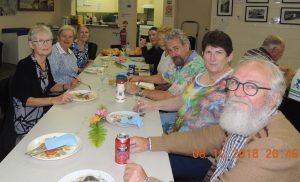
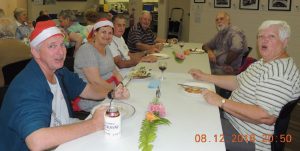
Last Saturday night (8 December) the annual Tropical Xmas BBQ was held at the Community Hall to close out the Paluma Social calendar for 2018. Up to 20 residents attended the event, with a few people coming and going over the course of the evening.

A sumptuous feast consisting of  BBQ meats and an array of salads and sweets was enjoyed by all. The ‘BBQ-er’ for the evening was Ross Hyne, closely supervised by ‘Mr. BBQ’ himself, Don Battersby. As usual, the Bar and Beverages were expertly dispensed by Les Hyland.

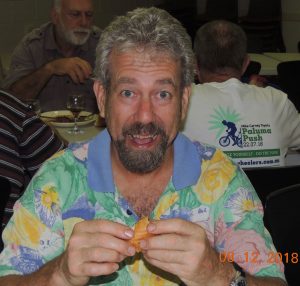
The ‘dish of the night’ was awarded to Jennie Robinson for her very special and unique recipe for ‘sweet but salty’ berry dessert cake! The encouragement award goes to Jim for his very special ‘do-it-yourself cucumber and egg salad’.

It was great to see many people embracing the ‘Tropical’ theme with their colourful shirts and other attire.  We were lucky enough to have two of Santa’s Elves attend as well (Ross & Sonya).

As with all Paluma Social Events, many of us ate too much food, drank a little too much wine and laughed a lot! A happy and fun-filled Paluma time was enjoyed by all.  Merry Xmas!