The Department of Transport and Main Roads has notified us that it will be conducting surveying works on Mount Spec Road, approximately mid-February through to early March. These works include full lane closures, likely from 9am to 3pm.
For further information contact:
Megan
Customer and Stakeholder Management (Northern) | North Queensland Region Program Delivery And Operations | Infrastructure Management & Delivery Division | Department of Transport and Main Roads Floor 6 | Townsville Government Office Building | 445 Flinders Street | Townsville Qld 4810 PO Box 1089 | Townsville Qld 4810 P: 1800 625 648 | F: (07) 4421 8711 E: engagement.northern@tmr.qld.gov.au W: www.tmr.qld.gov.au
A long-time resident of both Paluma and Hidden Valley, Manuel Larrinaga, died on 10th May 2018, aged 69 years, after 3 months of acute cancer illness.
Manuel was born a Basque, within the spanish Francoist fascist State in 1949, into a family of long-established farmers just outside Guernica in the Basque Country, the site of the 26 April 1937 infamous Hitler/ Franco atrocity during the Spanish Civil War. (The subject of Picasso’s famous painting entitled “ Guernika” of the same year – see Wikipedia).
Manuel was one of 11 children, some of whom still live on the family farm, including Luciano, his elder brother with whom he fled to Australia, as a refugee, aged 16, to escape forced conscription into Franco’s army, which was yet another attempt by the The Fascist Dictator to suppress the Basque Culture which has a feisty independent democratic tradition going back several centuries!
Franco’s death in 1975 was marked in Guernica with great joy. Manuel, who covertly returned to Guernica for the expected occasion, would often recount how free refreshments flowed like water for days in Guernica in celebration of the Fascist Dictator’s demise, such was the not – forgotten Basque revulsion over his crimes. (google “ Guernika”)
Manuel himself passionately hated Franco, accusing him of thwarting his plans to become a Vet! Instead Manuel followed a life of very hard labour in the cane fields of NQ and construction work in Mt Isa and elsewhere in NQ from age 16 until he died 53 years later.
Manuel was a member of a cane- cutting gang established by Luciano in Ingham. He had to harden up from a wanna- be Vet student and despite weeping every night for two years from the painful consequences of manual cane cutting he became a very tough man excelling in Boxing and being a renowned hard manual worker , as well as a spell as a Pub bouncer keeping order among the thirsty cane cutters. Ingham Police dubbed him “The Bullfighter” while others called him “The Basque Terrorist”, titles Manuel proudly proclaimed!
The reality was that Manuel was a bit of a “softie” when it came to helping the less- fortunate. He also had strong views about injustice .
In 1976 he worked for Simon Carves Ltd in Mt. Isa in a multi-national gang constructing the famous smelter Smoke Stack during which time he was the macho man riding the crane loads as a rigger to the top of the stack as it rose to its 270 Metre height. His stories of pranks and escapades without safety harnesses on high were blood chilling and often led to acute anxiety attacks amongst the Health & Safety ground staff.
In 1978 he met Judy, his life partner of nearly 40 years and they ultimately moved to live firstly at Hidden Valley and subsequently to the Republic of Hussey Road where Manuel constructed a large “Yurt” for Judy (a large Decagon house of stringy bark slabs cut by Manuel) which he subsequently re-erected at Hidden Valley, near the Furber Homestead, after adding two wings…it is an impressive example of Australian Bush architecture which will some day end up in a glossy coffee table book on vernacular buildings of OZ.
Indeed, Many of his structures can be seen around our District. Manuel was an artiste with a chain saw and he could perform miracles with his “Skyhook” chain block and his trusty shovel severely worn down by the digging of numerous postholes over many years! Manuel produced a number of stringy bark slab tables which are memorials to his skill and labours in the forests around Paluma- Blackfriars – Mt Zero as a timber cutter and Mill worker with Mr. R. Brookes esq. (who can forget their red hair dye period?)
Manuel’s legacy is around us for all to see…including the Andree Griffin Walking Track sign and the “Trees in Memory ” slab both voluntarily erected by him.
No story about Manuel’s life is complete without mentioning his valiant attempts to conquer the English language! He could construct alleged English sentences and adapt words so that they were but a shadow of their intended meaning but still understandable with a little prodding, poking and requests for repetition from those of us who could not understand a single word of the truly ancient Basque Language. (Please note : not Spanish!)
Indeed, it has been suggested that Manuel communicated in Basque with an Australian accent! a very endearing aspect of his personality and perfectly understandable when one considers that his English language academy was the cane paddocks of Ingham where the tutors spoke only Basque, Spanish, Italian , Sicilian , Serbian , Croat and Irish!
His persona of a tough hard- working battler remain in the memories of those who knew him, especially the super-critical working people of The Valley who were in awe of his prodigious work ethic and physical toughness.
May his memory be long respected in this District as one of those many oppressed refugees who have made a huge contribution to our present day Australian Culture .
It is with sorrow that we report the passing of former Paluma resident, Jean Garrett on Christmas Day, 2019 after a long illness.
Jean had a long association with Paluma, visiting the village regularly from the time she was a teenager, coming on a motor cycle with her then boyfriend, Graham. They married in Perth, when Jean was 16, returning to Townsville soon after, and had a long and happy marriage.
Jean supported her husband’s enthusiasm for Speedway Side-car racing and over many years they travelled to many destinations to speedway meetings around the country with their children. They were a popular couple around the speedway, with many long-term friends.
Jean was a very capable woman with numerous other interests, especially within the Arts. She and Graham owned The Palms Art Gallery in Townsville, from which they also ran a framing business. Jean had a fine collection of porcelain, sculpture and prints. Jean was also a keen gardener. An absorbing interest was jewellery-making, at which she was very talented, creating unique and lovely pieces in her studio at their home. Jean’sjewellery was in demand at craft shops and markets.
Graham and Jean bought Mist Haven units from Cec and Lois Carpenter, and later the brick house in Lennox Crescent where Jean and Graham lived until Graham’s death in 2008. Jean was devastated by his death but remained here for several years. However, with declining health and missing Graham deeply, she sold the house and moved to Patterson in NSW to be nearer to her children and grand-children. Here, she quickly made friends and helped regularly in an art and craft shop until failing health forced her to retire.
Jean is remembered very fondly by her friends in Paluma and our sympathy is extended to her family in their sad loss.
A celebration of the lives of Graham and Jean and spreading of their mingled ashes, will be held by the family on 6th June in Paluma, where Graham and Jean had been so happy.
This post focuses on animals that either travel together by choice, or are obvious at the same time of year.
Both our
Eastern/ Golden Water Skinks and Red-bellied Black Snakes breed in the northern
“Spring” – or as soon as the weather warms up. In 2019, warm weather was early,
so both species have now given birth to their young. When I say “given birth”,
both the EW/G skink and the RBBS are live-bearers. They do not lay eggs as most
other reptiles do. Their young are born in membranous sacs, like that inside
the hard outer shell of a boiled hen’s egg, and not as tough as the usual
leathery reptile egg covering. Red-bellied black snakes have a pregnancy of
four to five months after mating and give birth to between 5 and 18 young
measuring around 28cm in total length. This is the same length as an adult
Eastern Water skink. These skinks also mate in Spring and give birth to about
nine young in Summer. Their young are much smaller than 28cm, and a favourite
food of the Red-bellied Black Snake.
So, if you
see pregnant Eastern/ Golden Water Skinks (obviously broad across the beam)
basking in the sun, or baby skinks, be mentally prepared to see some young
Red-bellied Black Snakes. Fortunately, they are a shy snake and will generally only
deliver a serious bite under severe molestation, still often delivering
a “dry bite”. Your best option is to leave them alone.
The
Australian Museum regards the Red-Bellied Black Snake as probably the least
dangerous elapid snake in Australia for its size. Despite the number of bites
received every year, very few human deaths have resulted. Most death records
date from early times when the snake’s identity was often unconfirmed. Many
bite victims experience only mild or negligible symptoms, however a number also
end up hospitalized. The health risks to children and pets are greater, due to
their smaller size. As individual reactions to envenomation can vary, all
suspected bites should be treated as serious and medical attention sought as
soon as possible.
Another set
of fellow travellers, by choice this time, are the White-rumped Swiftlets and
White-throated Needletails, small flocks of which have been seen hawking for
insects together above the forest canopy. Apparently, they sense changes in
barometric pressure and fly in front of approaching storm fronts. The Swiftlet
is resident in Australia, while the Needletail breeds in northern Asia and
flies south each year, reaching northern Australia early October. The
Needletail stay for the Wet, then flies “home” in March.
Another
pair of fellow-travelling species are the Figbirds and Olive-backed Oriole
(which looks similar to an immature Figbird). Our rusty fig is in full fruit,
so we have Figbirds visiting. Only a very small flock so far this year, but they
are accompanied by at least one Oriole – more often heard than seen.
One of the funniest, and short-lived pairings, was that of an immature Pied Currawong and a family flock of Crimson Rosellas. The Currawong only arrived in numbers locally in the mid-1980s and a few have remained as permanent residents. However, I have never seen a breeding pair with a chick until this year. They are obviously breeding here as well now. Initially grey and white in colour, the young Currawong is now looking more “adult”. Its parents obviously thought their job was done, because after a couple of weeks of feeding their whinging offspring, they abandoned it to its own devices. In desperation, the young Currawong attached itself to a group of Crimson Rosellas, unusual considering that Currawongs will take nestlings of all sorts of species as food. Bill watched a Crimson Rosella stare down the young Pied Currawong, then bounce over and give it a severe peck! We haven’t seen the Currawong hanging around with the Rosellas since.
Colwyn recently posted her observations on the first crops of mushrooms “popping up” around the village. Over the last few weeks even more have been springing up around the forest walking tracks and many of them are delightfully photogenic although they can be frustratingly difficult to identify. Here is a collection from the last month that Andi Cairns and I have seen out on the tracks. The identifications are made with a fair degree of confidence (and a large measure of hubris) but we would welcome any comments on our identification efforts.
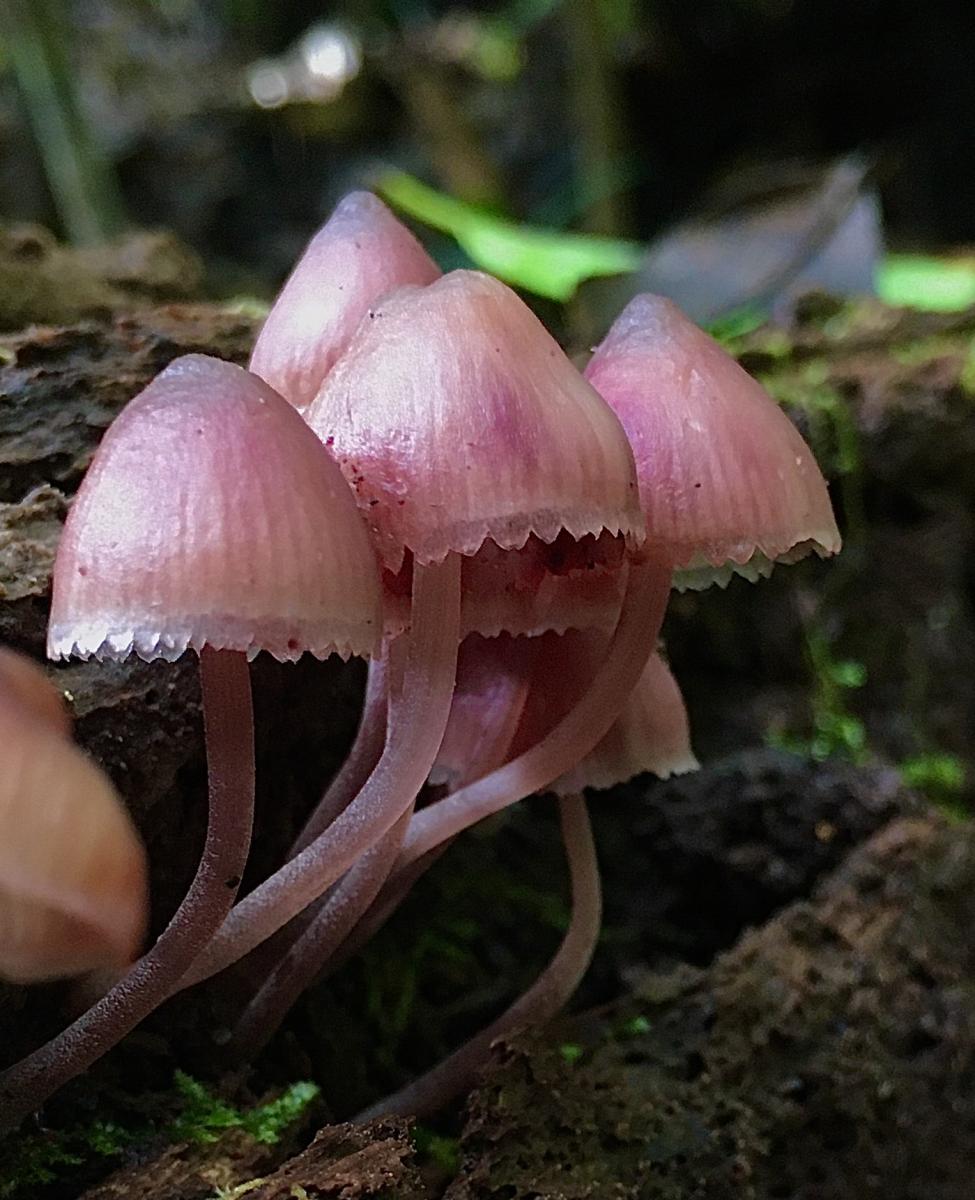
Mycena haematopus – Bleeding Fairy Helmet
This gorgeous mushroom gets its somewhat macabre common name from the fact that it will ooze a red/purple juice if squeezed or cut (especially at the base of the stem). If the name puts you off you can always opt for its alternative common name: Burgundydrop Bonnet. It is widespread and common in Europe, North America and also recorded in SE Asia and Australia.
Photo by Jamie Oliver
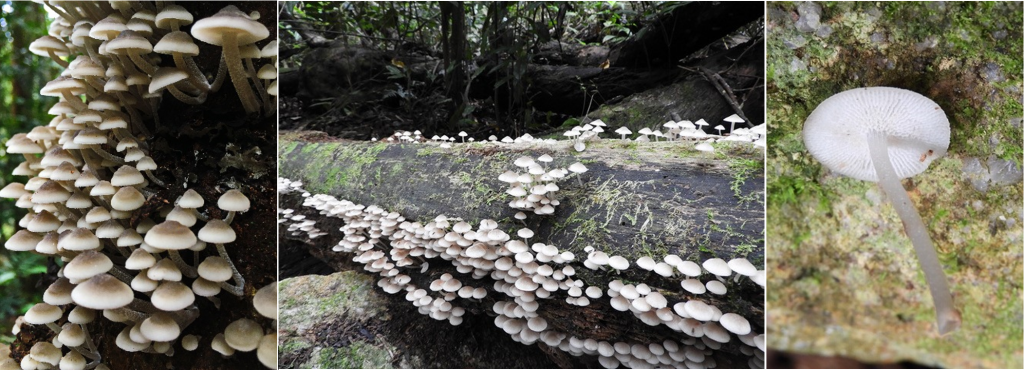
Filoboletus manipularis – no common name
Depending on which reference you use this delightful
clumping mushroom, frequently found on
logs and trees, can be named Filoboletus, Favolaschia or Mycena. It differs
from other clumping fungi on trees in that it has a reticulate pattern of pores
under that cap instead of linear gills.
Photos by Jamie Oliver (left) & Will Cairns (center, right )
Wikipedia claims that it is bioluminescent but the specimen shown on the tree trunk did not show this trait (the mushrooms were rotting by the time I (JO) went back to check.
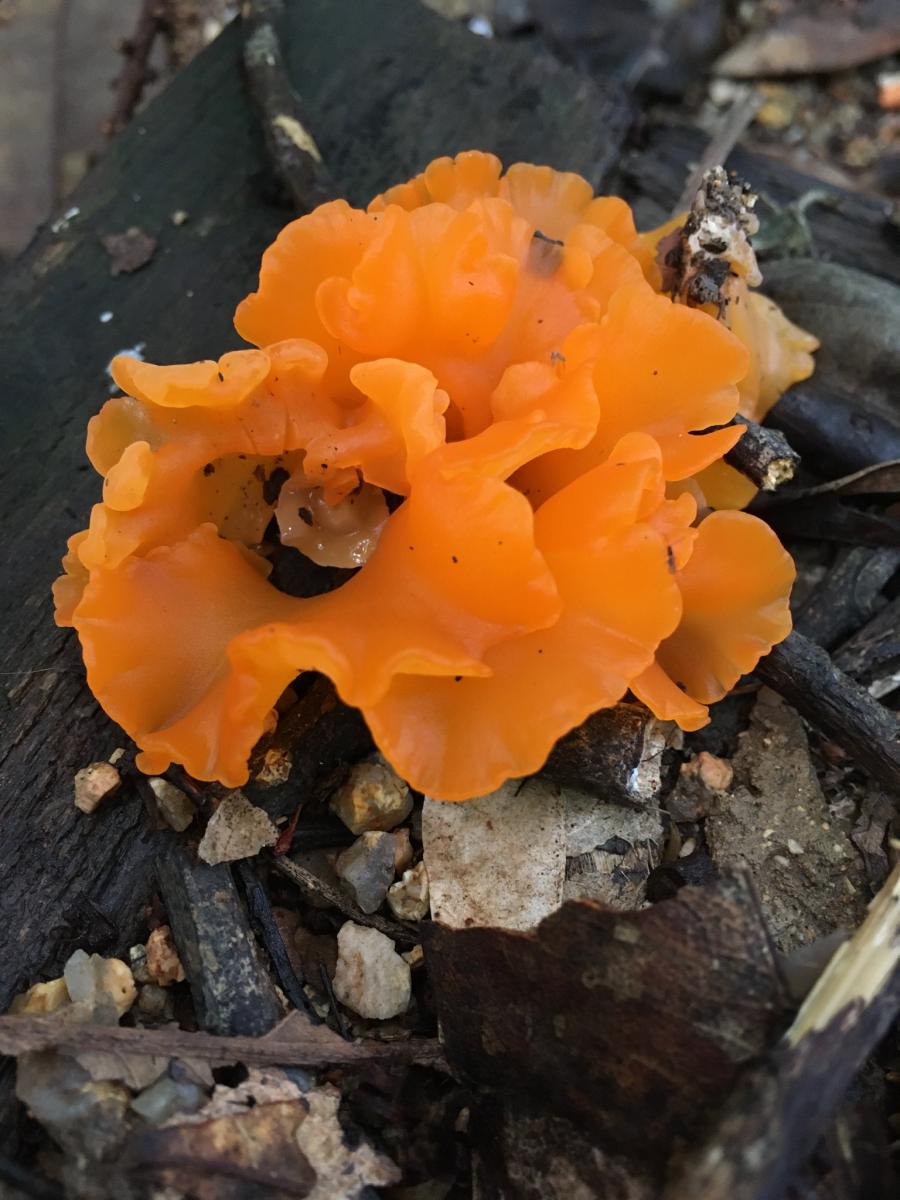
Dacryopinax spathularia – Fan-shaped Jelly Fungus
This is a beautiful and common fungus which can be found as small yellow/orange blades poking out of cracks in dead wood or as larger convoluted fans. It will even grow on polyester rugs, so you might just find it in your house if we ever get a proper wet season here in Paluma!
Photo by Jamie Oliver
Wikipedia states that this species is edible and is a component of the Asian vegetarian dish called Buddha’s Delight. But PLEASE DO NOT EAT this unless you independently confirm its identity
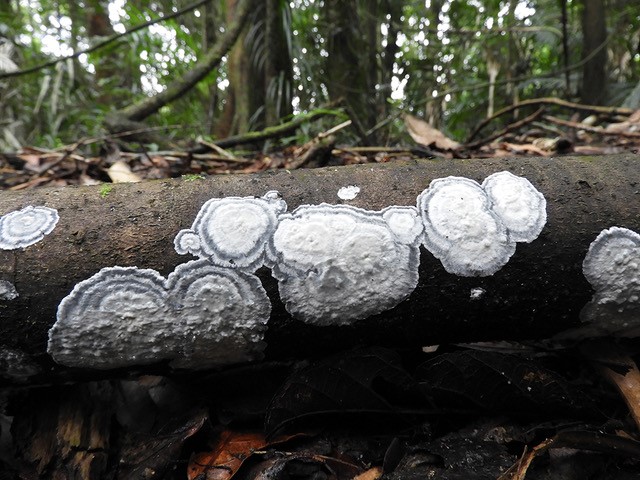
Crust Fungi, or Corticoid Fungi
These are not often mentioned in books or online and are a diverse group of fungi with superficially similar form (encrusting) but which can belong to any of 18 different taxonomic orders. On consultation with an expert colleague of one of us (AC), Dr Sapphire McMullan-Fisher, “ This is a skin, patch or Corticoid fungus, which are super-tricky [to identify] and we don’t have many experts in Australasia. Microscopic characters are likely needed [to confirm identification].” To the untrained eye this one could easily be taken for a lichen, so confirming that it is actually a type of mushroom is some progress.
Photo by Will Cairns
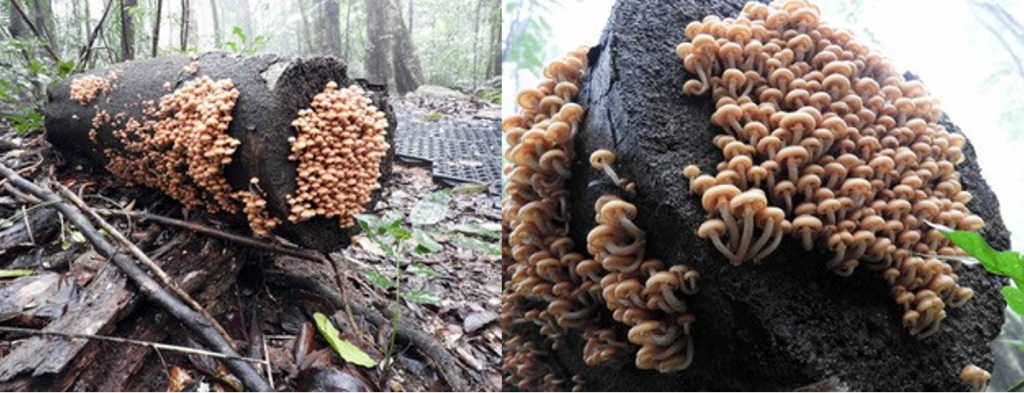
Galerina patagonica – no common name
A beautiful clumping mushroom that grows on rotting logs, it belongs to a group with highly toxic species that unfortunately bear a strong resemblance to some hallucinogenic Psilocybin mushrooms. So if you are looking for an alternate view of reality – beware.
Photos by Will Cairns
This species has not been formally recorded in north Queensland before, although there are some photos on Flickr that were taken in Cairns that are identified as C. patagonica.
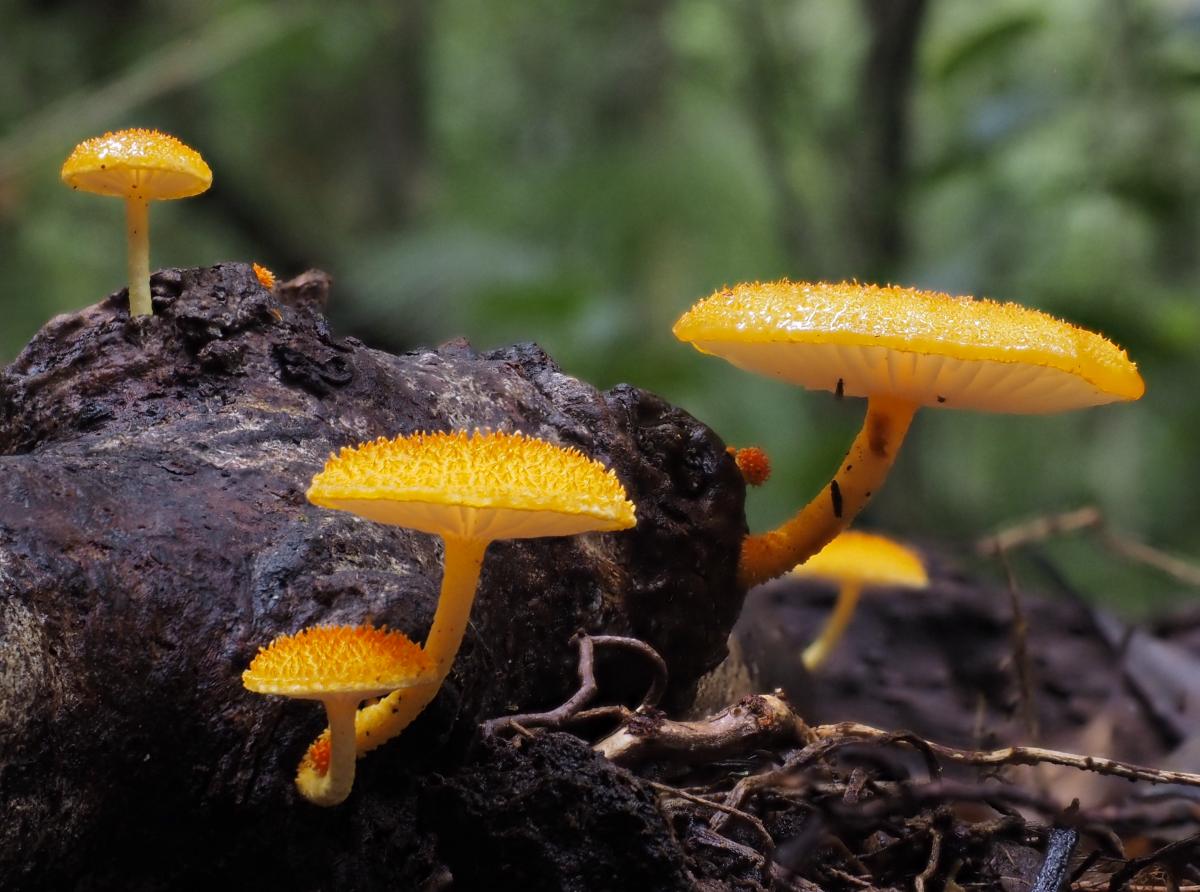
Cyptotrama asprata (Golden Scruffy Collybia)
This distinctive and beautiful orange mushroom can be found along the H-track as well as other local tracks. It grows on dead wood and is found worldwide in the tropics.
Photo by Jamie Oliver
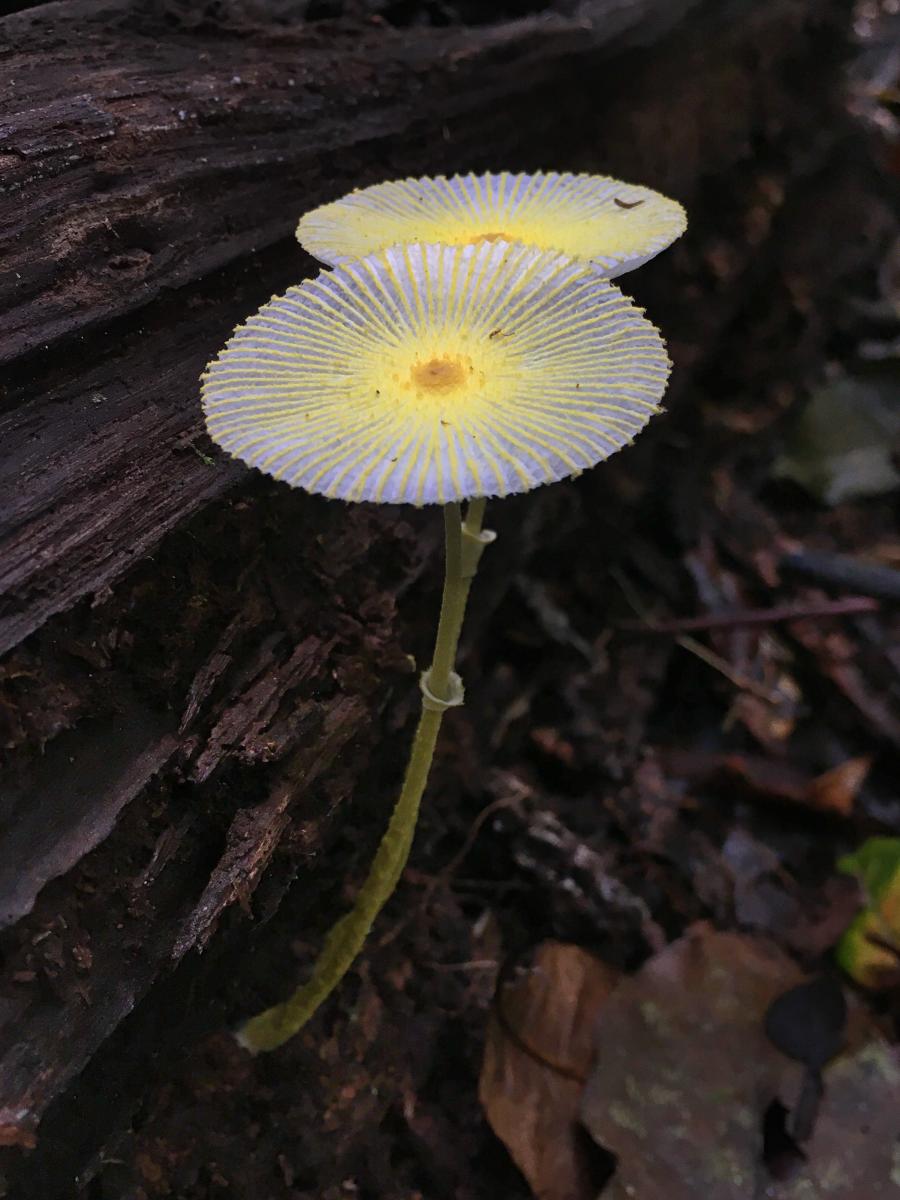
Leucocoprinus fragilissimus (Fragile Dapperling)
This dainty (and fragile) mushroom starts off with a rounded convex cup that becomes flat then slightly convex with age. It is quite common on local forest tracks. Even a gentle touch is likely to damage the cap. It is found on all continents.
Photo by Jamie Oliver
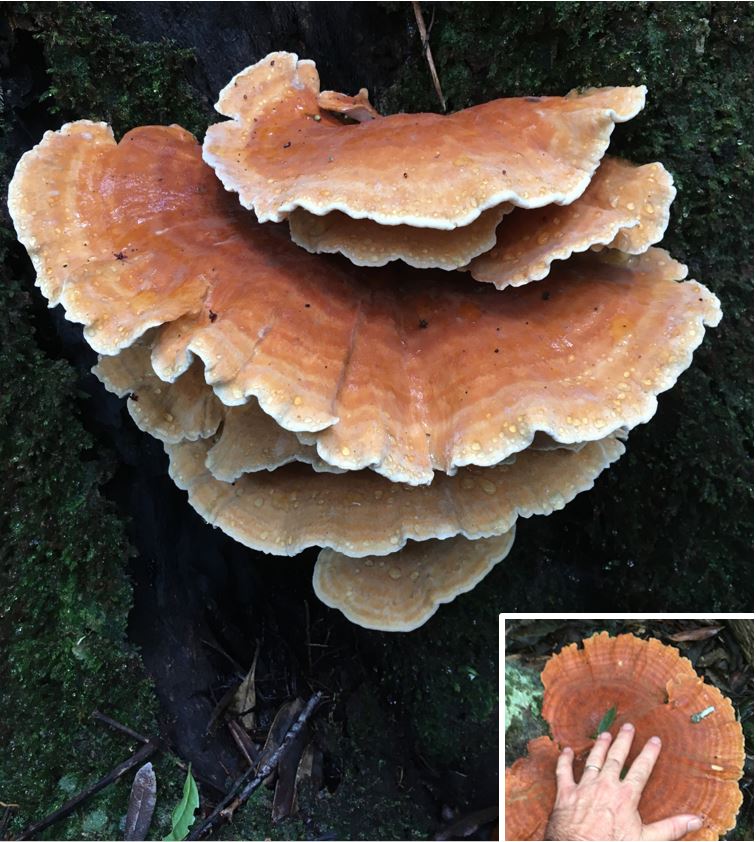
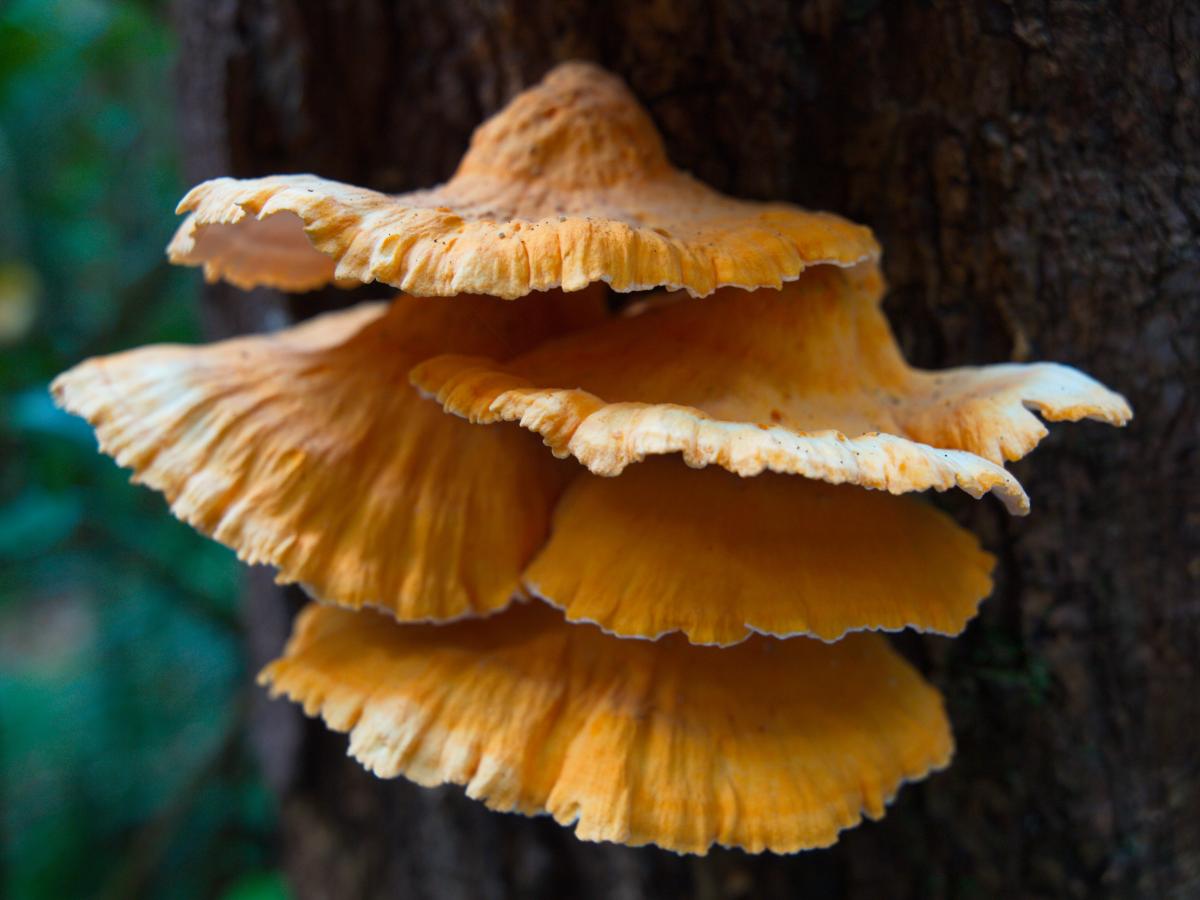
Laetiporus sp – Shelf fungi
I was impressed by the size and colouration of this shelf fungi on the Andreé Griffin Track. I am not certain of the species but it is a member of the Polyporace which includes a variety of shelf and bracket fungi.
Photo by Jamie Oliver
Another smaller species of Laetiporus (L. sulphureus) is yellow to brilliant orange and is likely to be seen around the tracks as the wet season progresses (I have seen it once this year but did not photograph it). Despite its distinctive colour, which would provide good material for a common name, L. sulphureus is called Chicken of the Woods, apparently because, like many unfamiliar foods, it “tastes like chicken”. However there are reports that it can cause tummy ache, so I suggest you stick to real poultry unless you really know your mushrooms.
Photo by Jamie Oliver (taken on the H-Track in 2014)
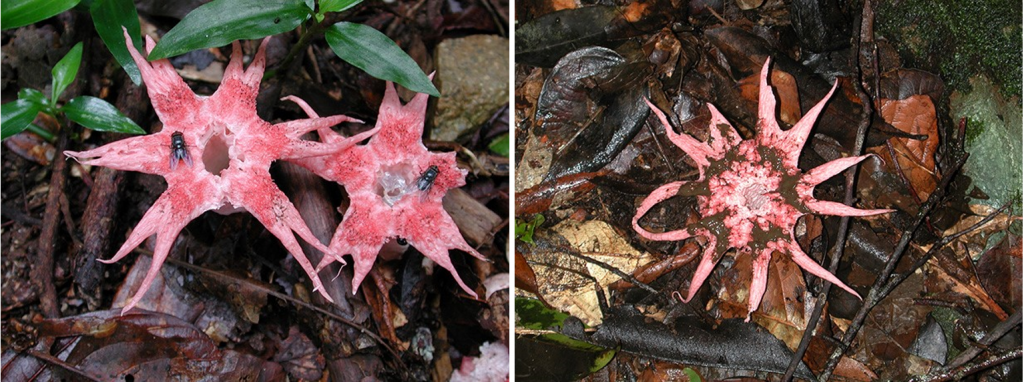
While we are showing photos of fungi that, while not seen by us this year, have been recorded in the past, this stunning Anemone stinkhorn (Aseroe rubra) was seen by Will and Andi in 2004 along the track to Witts Lookout.
Photos by Andi Cairns
Be on the lookout for these and other marvellous mushrooms as you stroll along our local tracks.
Text by Jamie Oliver and Andi Cairns; photos as per captions
Further Reading
Some references for those who would like to try their own identifications, or just learn more about Australian Mushrooms:
Fuhrer, B, (2004). A Field Guide to the Fungi of
Australia. (now out of print, but might be in
some libraries)
Young, T & Smith, K (2004). A Field Guide to
the Fungi of Australia. UNSW Press
Facebook
identification sites prefer a photo of the under-surface of the mushroom cap
and (if possible) a spore print (this may be too much information!). It is also
a good idea not to touch fungi with bare hands — it’s better to use a
disposable glove or tissue to turn over a mushroom cap, and always wash hands
after touching fungi.
By 2:31pm on the afternoon of 9th
December 1931, Main Roads Brisbane office was in receipt of the following
telegram, sent from Main Roads Townsville:
ATTEMPTED HOLDUP
MOUNT SPEC THIS MORNING BETWEEN MOONGOBULLA AND JOB FULLSTOP KILLORAN VERY
CLIGHTLY WOUNDED HEAD FULLSTOP PAY INTACT FULLSTOP POLICE HAS MATTER IN HAND
The Police responded in force, joining “a
number of civilians….mostly walking about with guns”. (Brisbane Courier,
Wednesday 30th December 1931, p. 9) Main Roads Commission
Overseer, Wilfred Hector McClelland, had called for volunteers. In fact,
Constable O’Briennoted in his March 1932 report to the Townsville
Police District (West End Station) that “about 30 men from Mt. Spec relief
works…joined in the search, which commenced at about 12:30pm and terminated at
dusk on the 9th Dec. and a further search was made the next day”. (Copy
of Police correspondence No. 162/32, dated 22nd March 1932, held in
Main Roads Archives, Brisbane) The large party of volunteers was joined by
ten Police employees. Sergeant McDonald, Constable Rynne and “A Tracker” came
down from Ingham. The police contingent from Townsville was led by Detective
Senior Sergeant O’Driscoll and consisted of Detective Gooch, Plain Clothes
Constable Raetz, Acting Sergeant Miners, Constable Howard, and “A Tracker”. Constable
O’Brien provided local knowledge of “the country in the vicinity of the
hold-up…[as it]…was thickly timbered and fairly soft.” (Brisbane Courier,
Wednesday 30th December 1931, p. 9)
Edmonds was remanded to appear before Mr.
Geo. A Cameron, Police Magistrate, on Friday morning 18th December.
Sub-Inspector Blackmore applied for a further remand. Mr. G. V. Roberts, of
Roberts, Leu and North, appeared for the accused, offering no objection to the
request for more time on behalf of the Police. Roberts did request “that the
time be made convenient for the defendant, who resided on the Ingham line”. (Townsville
Daily Bulletin, Saturday, 19th December 1931, p.6). The
magistrate extended bail to noon on Thursday 24th December.
Obviously, time got away in court on Christmas Eve, for Edmonds’ next
appearance was remanded again to Monday 28th December.
Detective Constable Gooch was first to give
evidence. Gooch had “proceeded to Mount Spec and viewed the site of the
hold-up…[where]…he saw an uprooted tree about 14 feet long and about six inches
thick, also a number of freshly cut bushes, about 14 yards from the road, built
up in the shape of a barricade.” The following morning, Gooch and other
police went to Edmonds’ residence at Ollera Gorge, where they found him in
company of Edward Gill, James Tier, and William Searle. When asked if he had
any guns, Edmonds laughed and replied, “Sure, I have got rifles and
ammunition here”, handing over rifles, a single-barrelled shotgun belonging
“to a lady friend in Townsville” and the Colt revolver. Gooch took
possession of a dirty white coat and a shirt, which Edmonds claimed belonged to
his father, and pair of blue dungaree trousers and another shirt which Edmonds
said he was wearing the previous day. Gooch saw other police searching a car
parked in the shed, from where they retrieved a dirty white handkerchief that Edmonds
admitted was his. The police party then proceeded to Tealby’s farm and saw the
mare which Edmonds said he’d been riding. From Tealby’s, they went back to the
scene of the hold-up, where Gooch told Edmonds that the trackers had followed
the tracks of a horse in a gully for about 130 yards, then on to the gate at
Tealby’s. (Telegraph, Brisbane, Monday 28th December 1931, p. 1.)
The Sydney Sun newspaper of the same
datedetailed some “sensational evidence” under the banner “MOVIE
METHODS Prisoner Dressed Up at Crime Scene”. Constable O’Brien recounted
how he’d exclaimed “That’s Charlie Edmonds” on the day of the hold-up.
Edmonds had told O’Brien on the day of the hold-up that O’Brien was mistaken.
Despite protests from the defendant’s counsel, Edmonds had agreed “without
hesitation” to a “dress rehearsal” and “donned a suit found in
his hut and walked from the spot where the shots had been fired”. Evidence
was also given that “hoof-marks near the scene were, after measurement,
provided identical with those of Edmond’s mare.”(Sun, Sydney, Monday 28th
December 1931, p. 9)
No other potential suspects were identified
or paraded in the manner detailed above. Neither the driver Harry Stewart nor
the paymaster Michael Killoran were asked to identify Edmonds as the “bandit”.
Identification rested on the word of Constable O’Brien alone. (Townsville
Daily Bulletin, Tuesday 29th December 1931, p. 5) The case was
adjourned to the following day.
Charles Henry Edmonds was a well-known horseman, stockman and drover aged 34. He currently lived at Ollera Gorge. Charles was a widower with one child who lived in Aitkenvale, Townsville, where Charles was well-known, having been in Townsville for about ten years. He had never been in trouble with the Police before. Despite this, Charles was detained on Thursday night, 36 hours after the attempted robbery. He was brought to Townsville on Friday afternoon, presumably by rail, as the highway did not exist at that time. Charles’ mare was also brought to Townsville Friday night, as evidence. In Townsville, Charles was formally arrested on two charges.
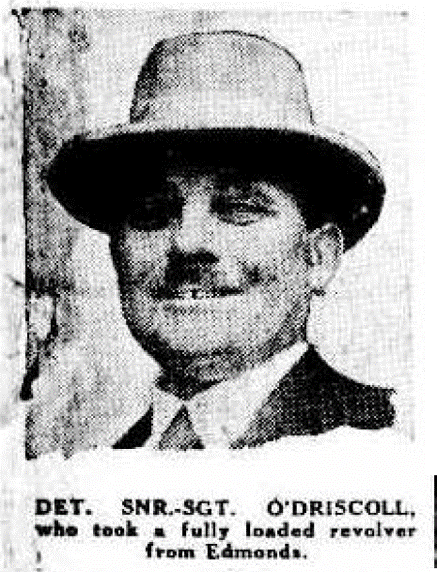
Charles’ first court appearance was on Saturday morning, 12th December 1931. All the newspaper reports (often reprinted verbatim across Brisbane, regional Queensland and in other states) mention that Charles’ “appearance in the Police Court this morning drew a big crowd”. (Sunday Mail, 13 December 1931, p. 4) The Brisbane Truth of the same day carried the headline “BANDITRY CHARGE” above a photograph of Detective Senior-Sergeant O’Driscoll, who was wearing a very spivvy hat. (Truth, 13 December 1931, p. 15). The Brisbane Daily Standard of the following day carried the headline “THE BOOTY WAS BIG”. Not talking about anyone’s derriere here, but the amount the ‘bandit’ had attempted to get away with – £391 19s 5d!
The first charge was settled that day and
related to Charles being in possession of an unlicensed Colt revolver.
Sub-Inspector Blackmore gave evidence that when questioned at his house near
Rollingstone, the defendant had handed the revolver to Detective O’Driscoll. It
was in his pack saddlebag and was fully loaded in all six chambers. Charles
pleaded guilty to possession of the unlicensed revolver. He had enquired of a
Constable Crunkhorn regarding a licence but had left on a droving job before
actually applying for one. Charles’ defence counsel, Mr. T. M. Barry, noted
that a droving job warranted the carrying of a firearm. Barry also said that
the defendant “was a man of high reputation, having been employed as a cattle
buyer and drover by prominent firms”. (Sunday Mail, 13 December 1931, p. 4) Acting
Police Magistrate W. E. McKenzie imposed the minimum fine of £10 in default
three months imprisonment.
On the more
serious charge, of attempting to steal while armed with a shotgun
the sum of £391 19s 5d from the Main Roads Commission
(previously Main Roads Board) Paymaster, Michael Killoran, Charles Henry
Edmonds was remanded for a week on a self surety of £100 and
another of £100 (or two of £50). Police Prosecutor Sub-Inspector Blackmore did
not oppose bail. Reports of Charles’ next court appearance on Saturday 19th
December on the attempted robbery charge were eagerly awaited.
The construction of the Mount Spec
Road as a Great Depression unemployment relief project is well-known and is one
of several reasons that the Road was given State heritage listing on 10th November 2008. Surveying of the road began
in 1928-1929 and was completed in early 1931 as construction commenced. During the five years it took to build a
trafficable track to within a kilometre of the newly
gazetted township of Paluma (possibly ‘Windy Corner’), unemployed men worked on
short-term rotations under the supervision of a small permanent staff from the
Main Roads Board (later Commission). As far as I
can ascertain, there were four main camps along the length of the road, with many smaller camps in between, adjacent to specific
parts of the project like an arched culvert. While
construction obviously started at the bottom of the range near the railway
station at Moongabulla, it leap-frogged these
smaller, time-consuming projects. The masonry arch bridge at Little Crystal Creek, for example, took months to complete,
with access to works above the gorge via a
temporary timber bridge.
When I had the pleasure several
times of meeting and interviewing Linda McClelland, she detailed some memories of each of the four
major camps. By the time the road reached Cloudy Clearing (Paluma), Wilfred and Linda McClelland had five children
living in tents or later, a ‘tent house’ located
where 31 Lennox Crescent is today. If you ever visit Mount Isa, one such tent
house is preserved there as a heritage building.
Linda McClelland remembered each
main camp for the significant events that took place there. Camp No. 1 was roughly near the
old ‘quarry’ at the very bottom of the range itself. Camp No 1 had a payroll hold-up!
On Wednesday 9 December 1931, Pay
Clerk Michael Killoran and driver Harry Stewart drove the Model T Ford utility from the
camp to Moongabulla railway siding, where they collected the payroll and its police escort Constable Len O’Brien. As the men
working on the road were about to be stood down
for the Christmas season, the payroll was almost four hundred pounds (£391 19s
5d). In the Great Depression, this was a
considerable sum of money, and all in cash.
On their journey back towards Camp No. 1 at the base of the range, they found the track blocked by a felled tree. This was in an area of ti-tree swamp that Linda called ‘Boggy Hollow’. Without knowing exactly where ‘Boggy Hollow’ was, I lean towards it being the patch of ti-trees opposite the Ponderosa Road intersection. I shall let the Townsville Daily Bulletin, 10 December 1931 tell the beginning of the story.
The party
got out…to remove the obstacle and just as they were about to do so, a voice called on them, “Put up your hands.” The party then looked
around to see where the strange voice had come
from, and observed a man partly concealed behind some rocks and bushes, with a shot gun pointed at them. As they demurred in
complying with his peremptory demand, he fired
two shots at them in their direction. One of the pellets struck Mr. Killoran
just above the temple, but no injury resulted. The
offender then made off into the bush, but Constable
O’Brien fired some shots at the retreating figure without effect.
The group made a day of it, stopping at little Crystal Creek to sketch the only functional stone arch bridge in Queensland, and then visiting Len Cook in Paluma. Its great that Len is continuing to encourage artists working with various media to come up to the village and enjoy the mountain air, although today was not a good example of our normally cool temperatures!
A sample of one of the sketches by Alison McDonald is shown here. More examples of the results of their visit can be seen on their facebook page.
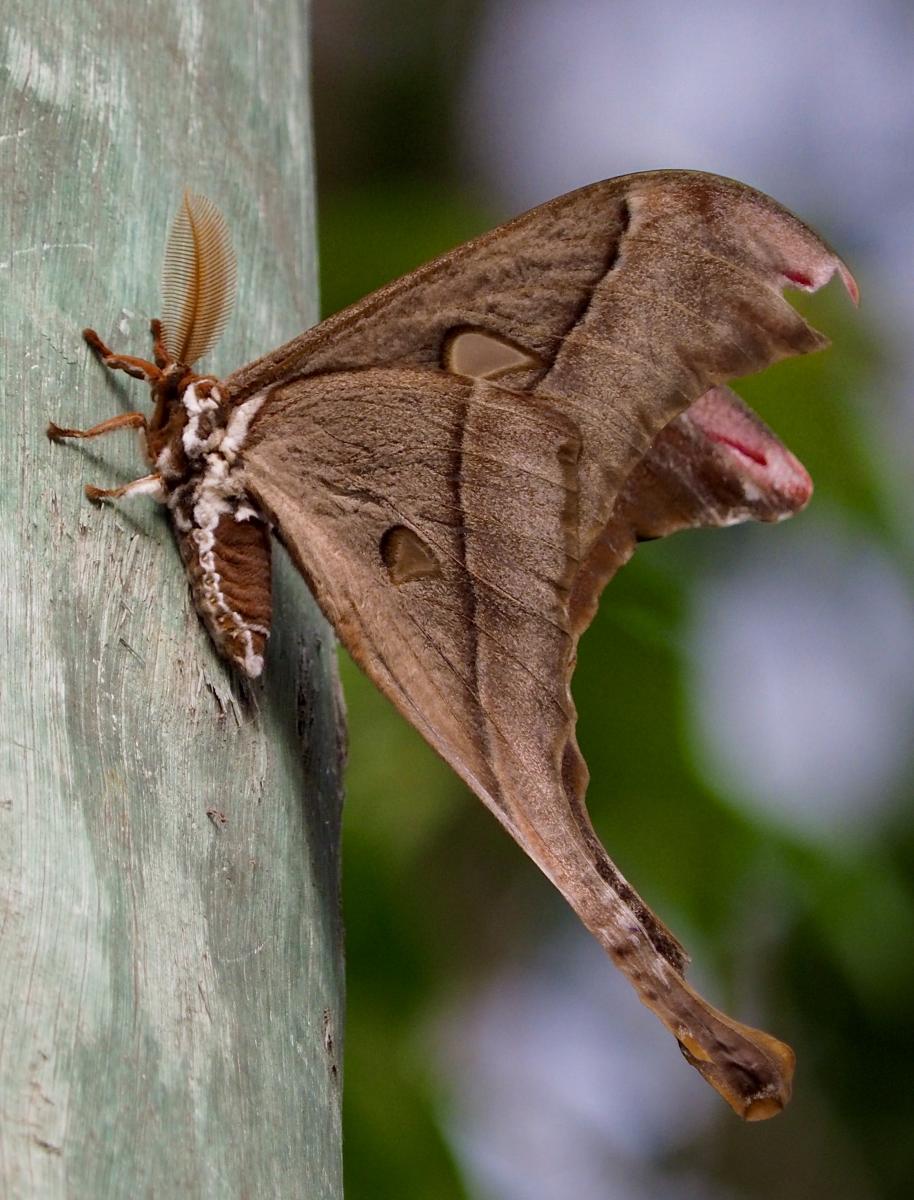
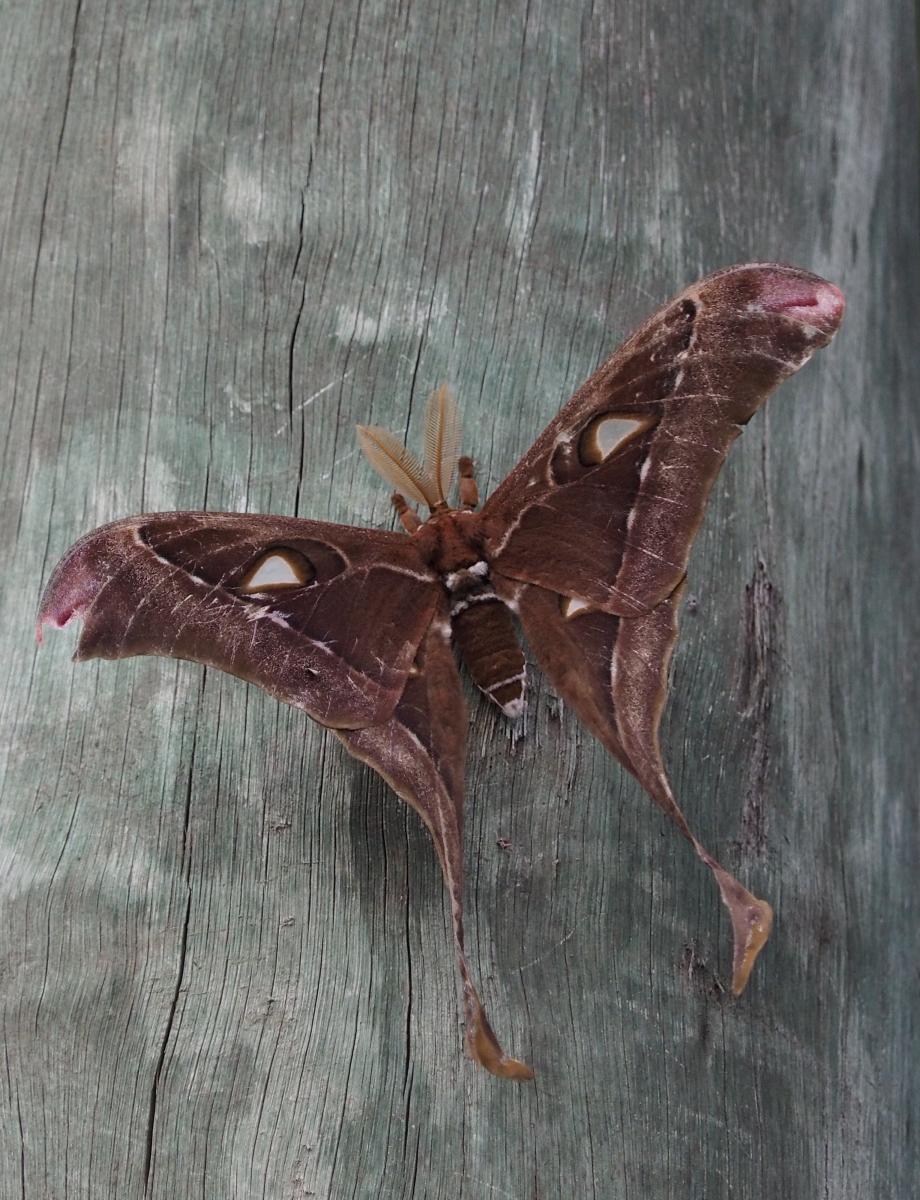
This afternoon I was wandering down my driveway, coffee in hand, to feed the fish in my pond when I noticed a small group of birdwatchers at the end of the driveway excitedly pointing up and and raising their binoculars to look at what I thought must be one of Paluma’s many special birds. The ladies who, judging from their T-shirts, were all members of Birdlife Townsville beckoned to me and pointed to the nearby telephone pole where, halfway up, was a magnificent male Hercules Moth. This is one of Paluma’s truly iconic wildlife species and while it has been seen around the village in previous years it is not very common and has been on my wish list to see for the last 30 years. I quickly went back up to the house and came down with my camera and telephoto lens and was able to capture some quite decent shots .
The Hercules Moth (Coscinocera hercules) is the largest moth in Australia (and possibly the world) with a wingspan of around 27cm in females. In terms of wing area (300cm2) it ranks as the world’s largest insect. The largest recorded specimen, from Innisfail, had a wing span of 36cm! The species occurs only in tropical Queensland and New Guinea.
The larvae of this moth are voracious eaters, preferring the leaves of the Bleeding Heart tree (Homalanthus) and the Cheese Tree (Glochidion), both of which are common around Paluma. The larvae get pretty big too (12cm) after gorging themselves for about 3 months. They then retreat into a cocoon where they can stay for up to 2 years before emerging.
The adult moths do not have functional mouth parts and thus cannot feed, spending their short adult lives (2-8 days) searching out mates and laying eggs The males are remarkably adept at finding females. Like other moths, the male has very large feathery antennae that are incredibly sensitive receptors for the very specific chemical (pheromone) released by the female. While I doubt that any experiments have been done on the Hercules moth, male silk moths are able to find a female up to 4.5km away and others species are said to be able to detect a single molecule of pheromone.
All told, it is a pretty impressive animal. My thanks to the ladies from Birdlife Townsville for showing it to me. They made my day!