ANZAC Commemoration, Past Pandemics and Covid-19 – Lest We Forget

Article Contributed by Michael Drew in the lead-up to very different ANZAC Day commemorations in Australia in April 2020.

The human experience of war and pandemics/epidemics are oddly similar in that they each require, of necessity, social isolation and lockdown together with stringent disease control measures.

Most Australians under 50 have no first-hand experience of pandemic disease, but are now having to come to grips with what earlier generations learnt about self-preservation.

In the  period 1880 to 1940, North Queensland was blighted by an endemic mosquito-borne malaria parasite (not virus). Observations by the Cairns-based, German Emigre, Dr Edward Albert Koch, hypothesised that the Anopheles Farauti mosquito was the vector of the often fatal disease, long before scientific research confirmed mosquitos as the culprit, rather than the ‘miasma’ of swamps, (which is why the large swamps behind the Townsville Strand were not drained and built on until the 1900s).

In the late 1800’s Dr Koch set up a screened isolation ward at Cairns Hospital which prevented malaria infected patients from spreading the disease….sound familiar? This of course caused much angst among residents who feared the worst for their loved ones who could, (and did) die without the benefit of clergy or family being present. Thus, it became a personal and economic tragedy with many home remedies being touted as the cure! (eg. the ‘kerosene bath’, favoured by my grandfather, but not enjoyed by my father).   (See Wikipedia Listing: Edward Albert Koch 1843-1901). 

105 years ago, 8000 young Australians died at Gallipoli and in the isolation wards of field hospitals on Lemnos and in Egypt, with many deaths being caused by rampant viral and bacterial  disease. The survivors went on to The Somme, Ypres & Villiers Brettoneux where again diseases required isolation, lockdown and vigorous hygiene regimes to control cholera, typhoid, dysentery, gastro and pneumonia spread by fleas, flies and rats. (It’s a wonder the bubonic plague didn’t come back!).

Again, many died tragically away from their loved-ones in Australia, their last hours spent being comforted by the Australian Army Nurses, who were famous for their care of young mortally-ill Diggers ….sound familiar?

Indeed for decades afterwards “ Base” Hospitals in Australia were run on strict military lines as a consequence of their success in combatting diseases in the era of no anti-biotic drugs, which were only developed for the D-Day Landings in June 1944.

The returning Diggers in 1918-19 brought with them the deadly pandemic, so-called  “Spanish flu”, which is estimated to have killed between 17 million and 50 million persons world wide (more than the Great War total casualties!)

In Australia, the Nation went into lockdown and with isolation procedures eerily similar to those currently in legal force for COVID-19. Public wearing of face masks was the norm.

The economic effects were tragically enormous given that 60,000 young Australians (including young female nurses) had lost their lives in the conflict and twice that number were permanently disabled, both physically and mentally. These casualties set against a total population of 4.5 million meant that Australia was  economically trashed and the lack of young men to father the next generation caused an urgent immigration program which recruited British, Irish and southern Europeans in the early 1920s, thereby changing forever the Australian cultural mix. The flu pandemic added to the death toll of young people who were particularly vulnerable to this virus. (COVID-19 affects 40% of under 40s today, exploding the myth that it is an elderly person’s disease).

In the 1930’s the “horror of parents” pandemic, Poliomyelitis Virus, commenced to ravage young Australians and continued until the mid-1950s when Dr Jonas Salk (USA) produced a very effective vaccine to the huge relief of parents world wide.

In the North, the early 1930’s efforts at treatment of Polio by Chiropractor Ernst Kjellberg at his large-scale Millaa Millaa “ tent hospital” produced very good results which caused him to establish polio treatment centres in Cairns, 11 Sturt St Townsville and The Avenue, Hermit Park. 

Sister Kenny was his famous disciple who treated a young Joh Bjelke-Petersen who suffered lifelong effects of polio.  (See Sister Kenny Park next to the Tobruk Pool on the Strand, Townsville).

Panic-stricken parents (mine included) frantically isolated their children from families who were struck down (and locked down) by this capricious, deadly, paralysis disease which saw many die or be consigned to massive “ iron lung “ machines installed in hospitals. These were the ventilators of the day….sound familiar? 

The economic cost of polio is still with us today as the loss of earning power of many victims affected their subsequent families’ standard of living.

Any history of North Queensland epidemics should include the horrible deaths of many 1930’s cane cutters who contracted a leptospirosis infection, known as Weil’s Disease, which was ultimately discovered, by scientific observation, to originate in rat’s urine as, in those days, rats and their snake pursuers, were in plague proportions in the North’s cane paddocks. A very major cane cutter strike occurred in 1934 after the bosses refused to act. This caused huge economic damage to the fledgling cane industry. The problem was eventually solved by an observant medico who recommended burning the cane before cutting…problem solved with the crack of a match!.If only COVID-19 was so amenable to a good hot burn!.  (These days …no cane cutters, therefore no burn!) 

The greatest pestilence is war. 

Anzac Day is an opportunity to reflect on the sacrifices of those who have died in serving the Nation’s interests even though for many observants the causes of the conflicts are, sadly, shrouded in the fogs of elapsed time. For example, who knows the reason why Australia joined in a European War in which the English Monarch was the first cousin of the opposing  German Kaiser, who was allowed to go into post war exile in Holland after an estimated 6 million persons died on both sides of the conflict.

In Paluma we have our own history of a budding life and intellect cut short in the death of 23 year old Flight Sgt Bruce Plant, a son of our District, who rose from the status of a Mess attendant at Garbutt Base to a Fighter Pilot at Amberley and a Canadian-trained Lancaster Pilot in the very short time of 18 months! He had matriculated at CBC Townsville 5 years earlier and would have been in the cream of the post-war achievers had he survived the deadly bombing raids over Germany in September 1943 as part of RAAF 460 SQN based at Binbrook,UK.

He suffered the ultimate isolation from his wife and young child, John, whom he never held.

We should also reflect on the fate of the 20,000 men of the 8th Australian Division, 2nd A.I.F, who were captured by the Japanese in Singapore in 1941 and forced to perform slave labour building the Burma Railway until 1945. Notwithstanding the heroic medical efforts of Colonel “Weary” Dunlop, the starvation diet, contagious “jungle” viruses, bacterial infections, cholera, typhoid, beri beri, dysentery, gastro and festering ulcers resulted in one in three Australians dying as a P.O.W. away from their loved-ones and family.

It is also apposite to think of the 30,000 men of the famed 7th and 9th Australian Divisions who left Australia in 1940 for Tobruk, El Alamein and the Sinai Desert and thence to Papua New Guinea to relieve the Militia (CMF- Army Reserve) on the Kokoda Track and to repulse and eventually defeat the Japanese at Milne Bay, Buna, Sanananda and Gona, as well as sea assaults in Borneo on well entrenched fanatical Japanese troops. These men were isolated from their families for years and suffered the exhausting privations of the soldier on a diet of tinned Spam (which would make a goat throw up!)

They suffered all manner of infectious diseases and stomach cancers which for many led to life-long illness, including not well understood “war neuroses”.

On the home front in North Queensland 1940-45, there was social isolation and lockdown of two different types.

Firstly, the civilian population of the North suffered “panic virus” and largely fled south when the triumphant Japanese captured Fortress Singapore, attacked Pearl Harbour destroying many naval vessels and then bombed Darwin 22 times, killing many civilians, and subsequently bombed Townsville from their New Guinea north coast air bases. Those who remained felt very isolated in the face of a notoriously vicious enemy.

Many families were split up with some “essential” workers remaining for civil defence and troops food supply services. Hospitals could not cater for civilian surgical cases necessitating a long rail journey to Rockhampton or Brisbane….sound familiar? 

Secondly, the North’s largely Italian farming families suffered as a result of  “knee jerk virus”, which  manifested itself after some far off bureaucrats decided that the majority of northern Italian males should be interned down south and leave their womenfolk and young children behind to tend the farm and fend for themselves. Talk about social distancing! Talk about gross economic loss and damage! All on the unproven assumption they must all have been supporters of Mussolini! This great injustice has never been properly addressed.

Two little Biloela girls on Christmas Island………. sound familiar?

In 1940, John Curtin, in a famous speech, devoted the entire resources of the Commonwealth of Australia to the prosecution of the War against the enemy….sound familiar?

In 1942-44 the North became an enormous military complex for Australian and US forces of all types, land, air and sea. Our own village became the site for an early warning radar array for Townsville which was guarded and manned by US Troops with explosive charges set to bring down McClelland’s Bluff, according to the late Tom Connor. Later, Paluma would be requisitioned  as a RAAF Rehabilitation Unit  – a far more jolly use if one has regard for the hall photos of the inmates of “Hotel Australia”. Isolation was relaxed and rehab was designed to serve the future post-war economic needs of the inmates….sound familiar?  (eg. “the road out the other side”). 

Having regard for the above events of Northern history, any grizzling about not being not able to visit boutiques and coffee shops and to be seen there snuggled up to the glitterati, the cognoscenti and perhaps, the illuminati, seems petty and stupid, when we consider the hardships endured by the past five generations of Australians in times of trouble, strife and pandemics.

As with all calamitous times, this pandemic will pass as did the others referred to above. Our safety and its duration and its economic damage are entirely a matter for us complying with the science-based medical advice. 

Do the time now and reap the early rewards of flattening the curve lower than a run-over cane toad! 

As well as commemorating war’s casualties on 25 April each year we should remember the strength of our nation’s underlying resources and wealth (our Commonwealth), as well as the seemingly bottomless well of scientific and managerial expertise devoted to putting the Country back on track. 

Airlines come and go creating short-term economic chaos.

If one thing we have learned from this pandemic it’s that most business/social travel, air or otherwise can be successfully replaced with online technology …..and as a result…. the Earth will Zoom ahead!
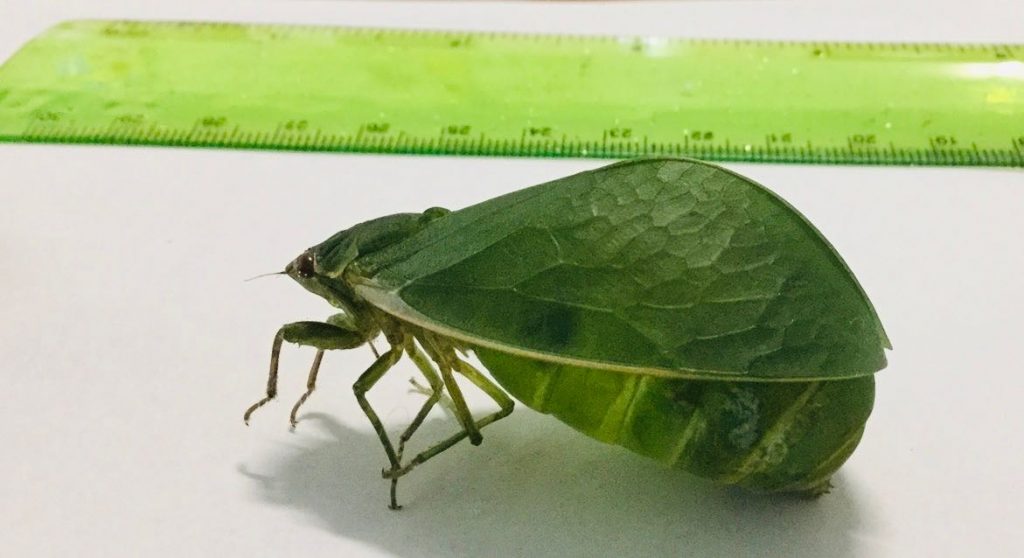
What Katydid…?

Katydids, also known as bush crickets, belong to the Tettigoniidae Family and are closely related to grasshoppers.  Around the world, apart from Antarctica, there are 6400 species known, of which 900 live in Australia.

This little critter is a Leafy Katydid that I found hanging on my bedroom curtains. It is the biggest katydid I have seen and I thought it may be unusual, however after consulting Google, I discovered that 6 cm is a normal adult size for this species, Paracaedicia serrata.  Their life span is a year or less, with most being eaten by birds and small mammals before they reach adulthood.  However in the tropics, some can live longer.

The wings are green and leaflike with a fine yellow streak along the edge.  The hind legs are finely serrated.  Leafy katydids inhabit rainforests and feed on leaves, grass, flower petals and sometimes fruit and aphids.  When disturbed, they will remain motionless and can barely be distinguished from the surrounding leaves.

Eggs, looking like tiny seeds, are laid along the edges of leaves or along stems and when hatched, the nymphs will go through 5 successive moults before reaching maturity.  The stridulous mating call is achieved by rubbing the front wings together. 

So, next time you are gardening, see if you can find one of these cleverly camouflaged critters.

Text & Photo by Colwyn Campbell

I’ve Got Worms…..!

Over the years my garage has provided a refuge and habitat for a diversity of critters, some welcome and some not-so-welcome. Regular visitors have included leaf-tail geckos, eastern water skinks, rodents of all shapes, sizes and dispositions, as well as an occasional red-bellied black snake.

Just lately I have noticed that earthworms are visiting, mostly at night. Not only I have seen worms of many sizes, but evidence of their nightly forays are left in silvery tracks and trails across the garage floor.

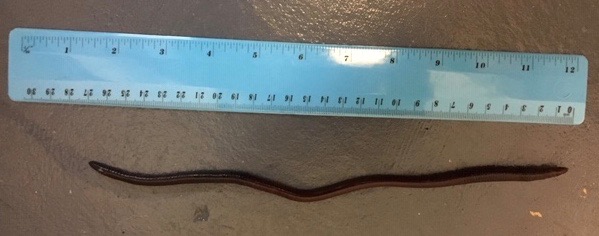
The mother of all worms visited last night! The photograph below shows this specimen is a giant. The ruler in the photo is a standard 30 cm or 12 inch ruler. So, she measures at least 27 cm in length. I tried to measure her girth, but she was way too wriggly to hold and measure at the same time. I estimate she was about 1.5 cm round the body.

Late evening I decided to relocate this worm to a leafy, secluded spot in the garden, hoping that she would find a safe place to settle in before the family flock of chortling Chowchillas arrived as usual to forage the next morning!

Text & Photo by Michele Bird

TMR Range Road Update – Notice of Road Closures

The Department of Transport and Main Roads would like to advise that pavement repair works will shortly occur on Mount Spec Road on the Paluma Range. Works to be completed include the removal of damaged pavement and back filling with new bitumen and surface seal.

Please see work details below.

Mount Spec Road pavement repair works 

Work duration: Monday 20 April to Thursday 30 April

Workdays: Monday to Friday (excluding Saturday 25 April and Monday 27 April 2020) 

Work hours: 6:30am to 5:30pm (road closure 9am to 4pm – long delays)

Impact on motorists:

  • A road closure of Mount Spec Road will be in place between the hours of 9am and 4pm to undertake the removal of old pavement and backfill new road pavement in the most expedient and efficient manner.
  • Motorists who travel along Mount Spec Road between the hours of 9am and 4pm can expect long delays of up to 3 hours
  • Stop/go traffic controllers will be on-site at either end of the works zone to direct traffic through the works zone. 
  • Maximum wait time for motorists on Mount Spec Road from the hours of 6:30am – 9am and 4pm – 5:30pm is 15 minutes. 
  • A 40km/hr speed limit will be maintained along Mount Spec Road throughout the duration of the works.

Road users are advised to plan their journey ahead of time around the road closures to avoid long delays and travel times. Residents are encouraged to contact TMR on the details below should they have any further enquiries about the road works.

TMR would like to thank the local community and businesses in advance for their patience during these works. 

Kind Regards

Meghan

Customer and Stakeholder Management (Northern) | North Queensland Region
Program Delivery And Operations | Infrastructure Management & Delivery Division |

Department of Transport and Main Roads

Floor 6 | Townsville Government Office Building | 445 Flinders Street | Townsville Qld 4810
PO Box 1089 | Townsville Qld 4810
P: 1800 625 648 | F: (07) 4421 8711
E: engagement.northern@tmr.qld.gov.au
W: www.tmr.qld.gov.au

Outcomes of the PDCA Annual General Meeting

The PDCA AGM was held last month (March 13) in conjunction with a well attended BBQ lunch. This year we decided to change the date away from Easter and to offer residents a free BBQ lunch prior to the meeting. We received some positive feedback on this initiative and were delighted to easily exceed the number of attendees required for a quorum (although this may also have been due to Wilfred’s door to door encouragement earlier in the morning).

The official minutes of the meeting will be completed soon, but if you are interested in reading the President’s Annual report, or the History Project report, they are both available in our Documents section on the website.

All current PDCA Executive Committee Members were elected for another year.

Many thanks to all those who attended and contributed to the meeting.

PDCA Executive Committee Members for 2020-21

NamePositionemailph
Ross MurrayPresidentrossmurray23@gmail.com0438 015 342
Anneshka Brown1st Vice Presidentpaluma.shale104@passmail.net0437509063
Helen GodeSecretaryhdgode@hotmail.com0497 327 644
Wilfred KarnollTreasurerwilfred.suzanne@bigpond.com0447 822 626
Rhett HarrisonCommittee MemberRhettH83@hotmail.com0438 782 053
Jamie OliverCommittee MemberJ.K.Oliver@outlook.com0408 710030
Ross HyneEx Officio (RFS)ross.hyne@ergon.com0427 447 415
Charlie AllenEx Officio (SES)c-t-a@activ8.net.au0487 840 197

Community Hall Garden beds begin to take shape

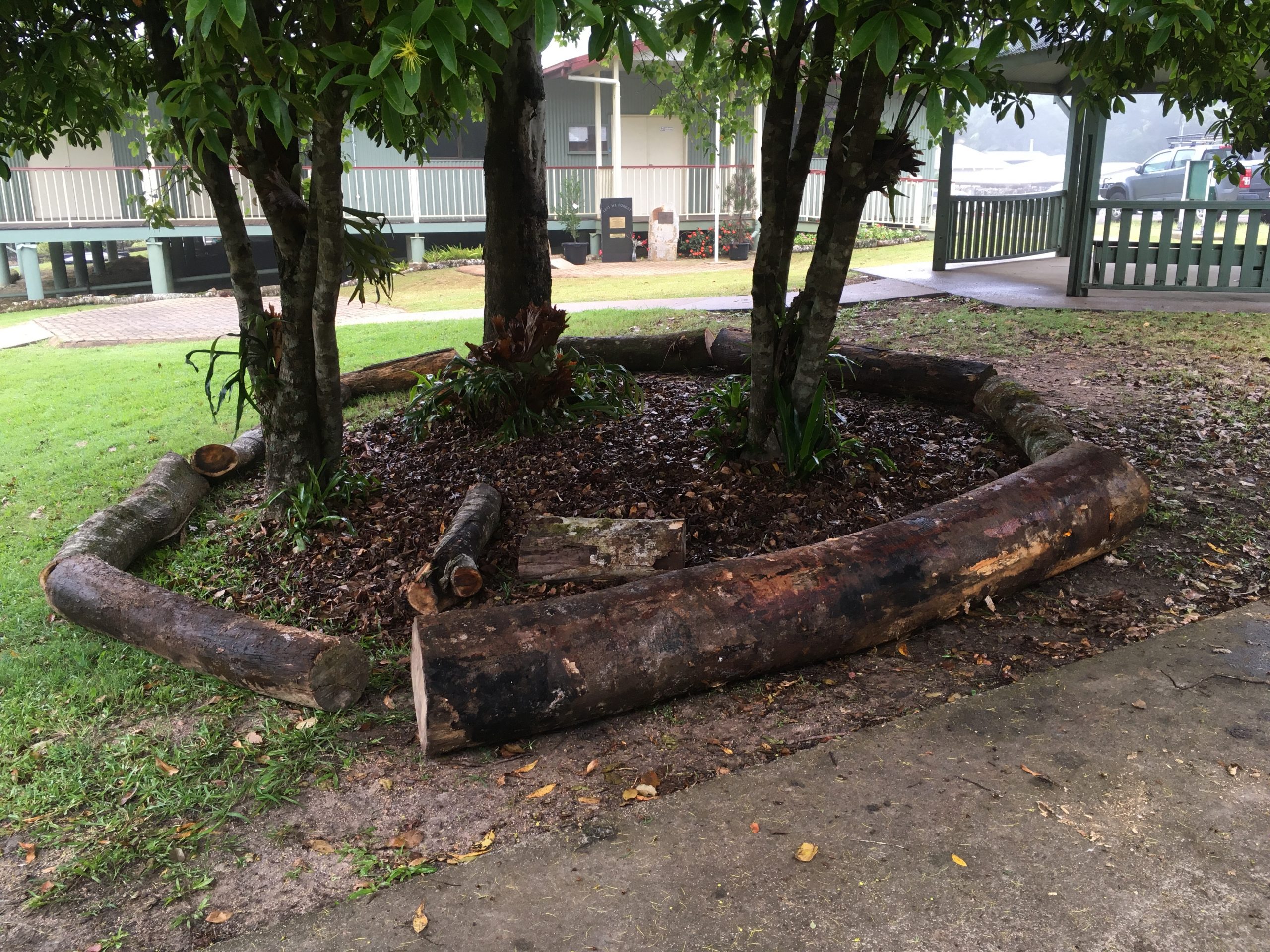
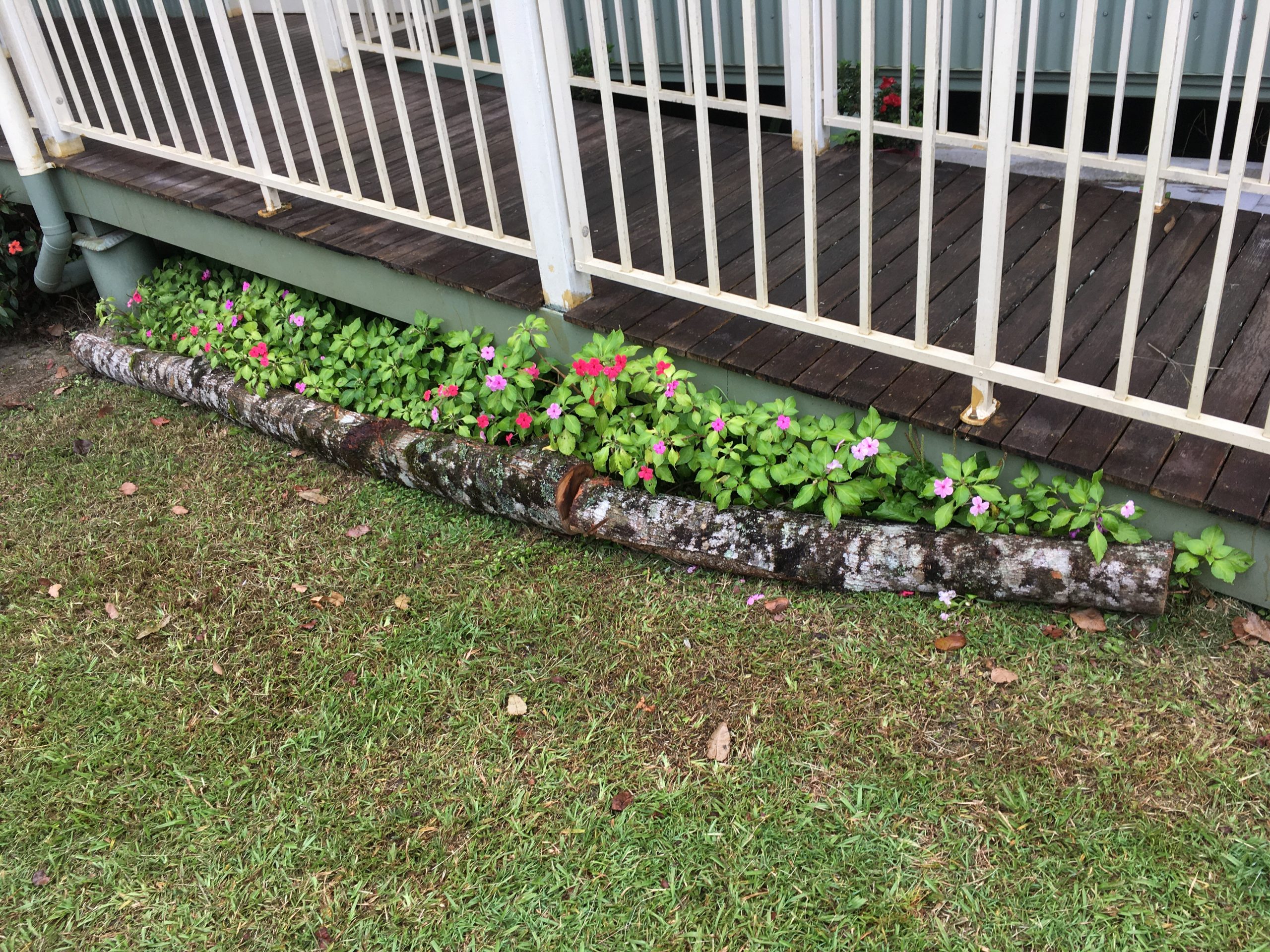
Following a meeting in March on the establishment of gardens beds we now have a working group of residents who have made themselves available to help out with this new community project. The Townsville City Council has agreed to donate up to $900 worth of native plants to assist in the project.

After our first meeting a general plan of where beds would be located was agreed on and Graham Malpas immediately cleared out the rear side beds. It turns out there are some quite nice plants along that side but they were masked by a lot of weedy growth.

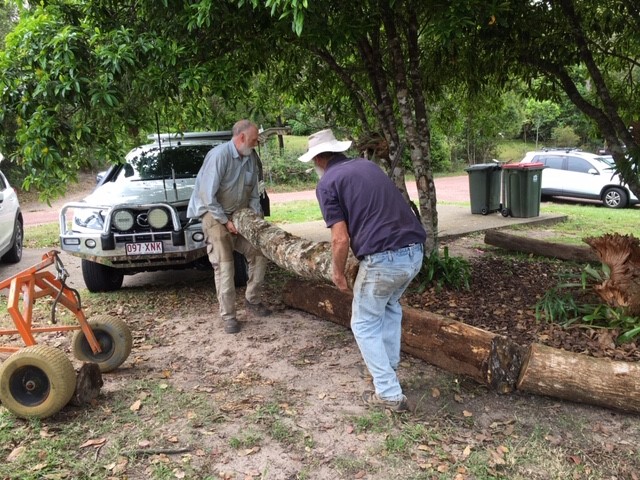
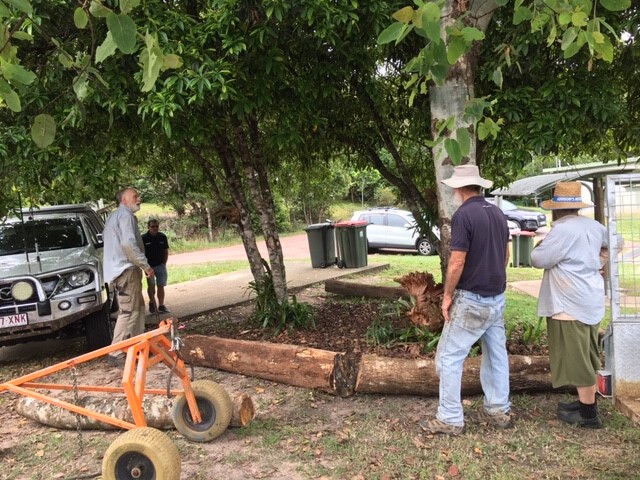
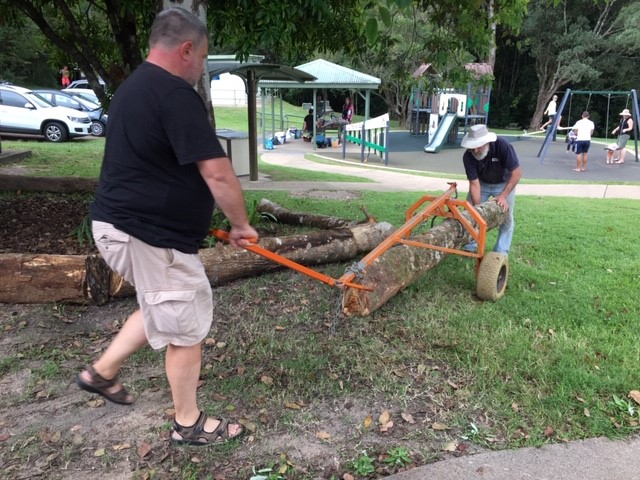
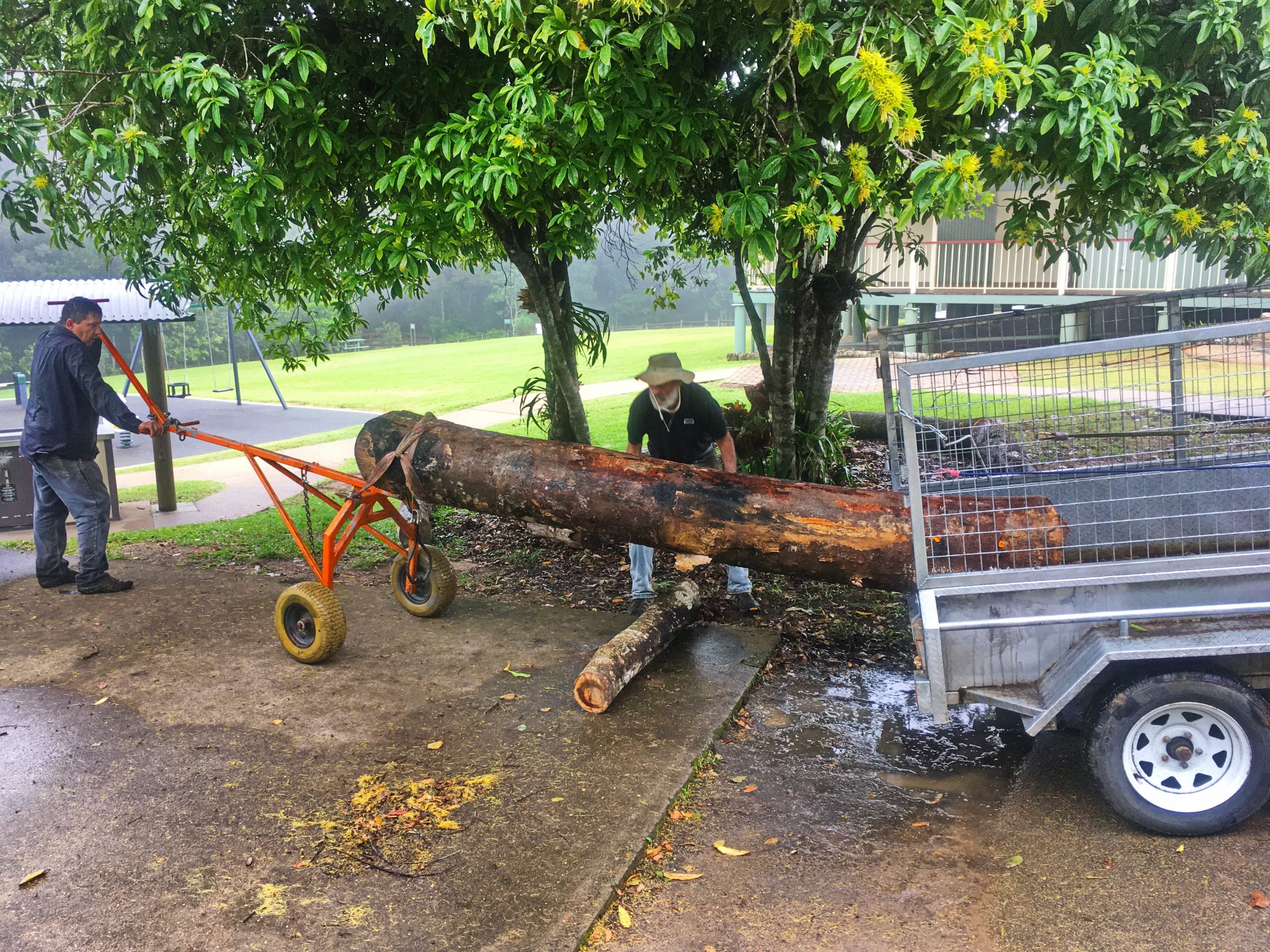
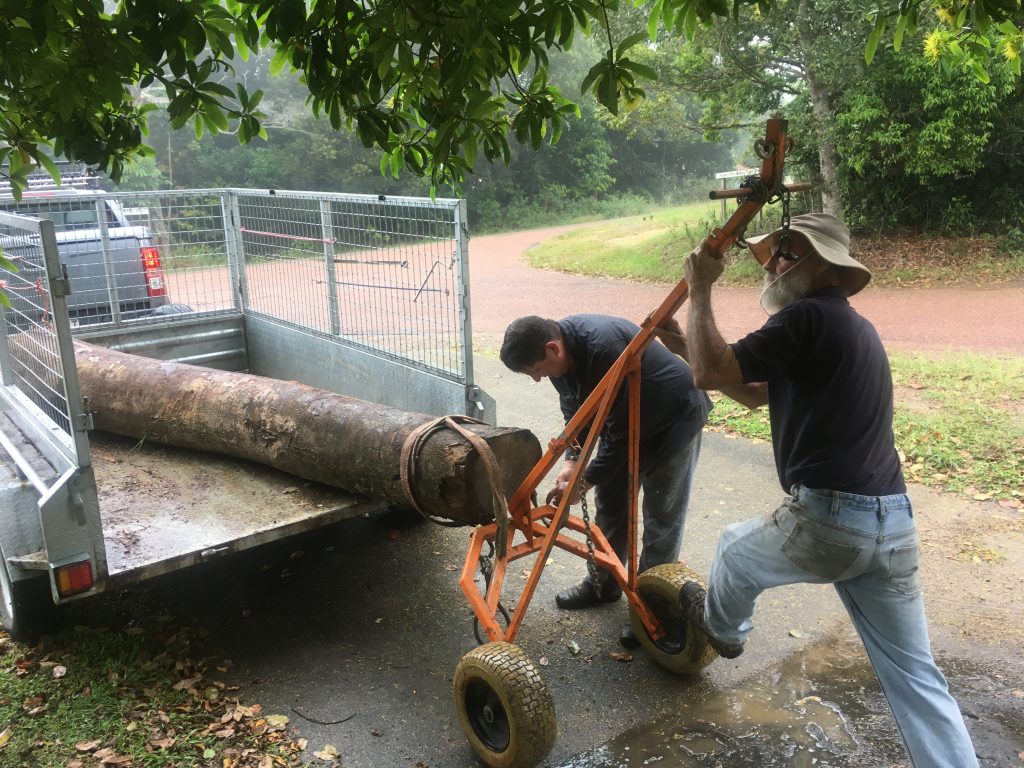
Following the PDCA Annual General Meeting some “muscle” was requisitioned to help collect some surplus logs from Anne Bruyeres block to the Hall to serve as garden borders. Colin Meads and Jamie Oliver, with assistance from Don Battersby, took two trailer loads of logs over to the hall where placement was overseen by Jill Meads and Anne. It all looked like so much fun that we even attracted a member of the public who was up with his family for a lunch at the picnic tables, volunteer to lend us a hand.

Tony Bligh’s ingenious creation, the “log dolly’, was invaluable in collecting and moving the logs, but one big one that we wanted as a feature piece was just too big to handle. However with the addition of a little brain to Colins’s and Jamie’s brawn, Tony showed us how it could be done.

The next step is to get a couple of truck-loads of topsoil to build up the new garden beds. The Townsville City Council (via Councillor Margie Ryder) has agreed to provide this, but with the new restrictions caused by COVID 19 the delivery has been postponed indefinitely.

Once the restrictions on gatherings has been lifted we will organize our third working bee to start planting! In the mean time Jamie has plans to lay out some irrigation hosing so that the beds can be provided with water during the dry season.

Paluma History Stories: ‘Robbery Under Arms’ – Part Nineteen

by Linda Venn

Click here for a list of key characters in this story

A Local Mystery – We will never know who the bandit was

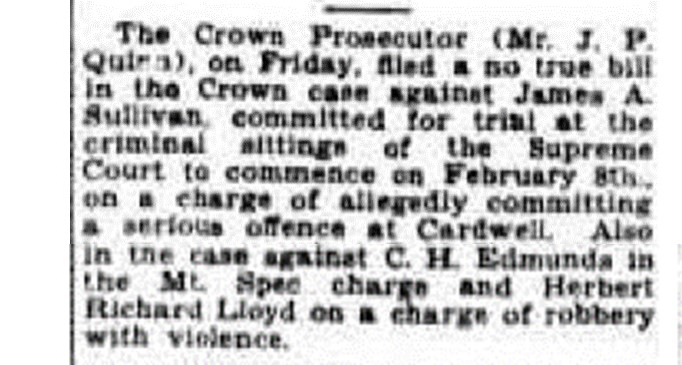
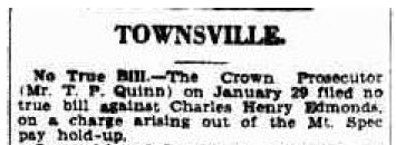
On January 8th 1932, Police Magistrate Geoffrey A. Cameron had committed Charles Henry Edmonds to stand trial in the first sittings of the Supreme Court for the year, scheduled to take place on 8th February. The case was handed to the Crown Prosecutor, Mr. T. P. Quinn, to prosecute in the Supreme Court. I have found only two small notices, one in the Townsville Daily Bulletin and the other in the Brisbane Courier, both published on Saturday 30th January 1932, that give us the ending to this tale.

Townsville Daily Bulletin, 30 Jan, 1932, p.15
Brisbane Courier, 30th January 1932, p. 15

So, what does this mean for Charlie Edmonds? A “No True Bill” is more properly known as nolle prosequi, the legal term for the Crown Prosecutor deciding not to proceed any further with the indictment. The decision not to proceed any further can be made by the prosecution at almost any stage of the trial, but particularly if the defence is successful on a voir dire (pre-trial application).

There are two possibilities here – either George Roberts was successful in convincing the Crown Prosecutor that the chances of securing a guilty verdict from a jury did not warrant proceeding further, or the Crown Prosecutor came to that conclusion himself upon review of the evidence.

For Charles Henry Edmonds, this meant the charges were dropped. Did he do it? Was there more than one bandit? We will probably never know.

Charges against Edmonds for the Mt. Spec hold-up apparently constituted his first ever brush with the law. Was it his last? Now, that’s another story………

Paluma History Stories: ‘Robbery Under Arms’ – Part Eighteen

by Linda Venn

Click here for a list of key characters in this story

Evidence concluded; Edmonds committed for trial in the Supreme Court, Friday 8th January 1932

William Ashman was the last witness to take the stand. He was also a Main Roads Commission employee at Mt. Spec. Ashman

stated he had known defendant (Edmonds) about six months. On December 9 he was instructed by his employers to help in the search for a. bandit. He asked O’Brien for a description of the man, and was told a tall thin man, with a shirt hanging over his trousers and was also wearing a dirty cloth over his face, and wore no hat.

At the scene of the hold-up. They searched the locality in which the bandit was said to have escaped. It was suggested that they might recover the bandit’s body, as it was thought the bandit may have been hit. When he and Murray set out on horses from Tealby’s they were instructed to search for tracks.

On the following morning they went with the police party to continue following the tracks that had been found the previous afternoon. During the search the trackers had an argument as to the Identity of the track.

O’Brien never told him that Edmonds was the man.

Sub-Inspector Blackmore made his final cross-examination. Ashman’s responses were:

He (Ashman) did not know that O’Brien returned to the scene of the hold-up before he returned again to organise a search party, and O’Brien did not show him a hat before the party left for the scene of the hold-up, although O’Brien showed It to them next day.

They only searched for about 200 yards before they left for Tealby’s. When they rode up to Edmonds’ carrying a .303 rifle the latter asked them if he defendant (Edmonds) could not shoot all the wallabies around the country, whereupon they told him they were looking for a bushranger.

As far as he knew, Murray took the old road to Tealby’s and Murray pointed out to him next day where he had ridden. He (Ashman) did not assist the police In following the tracks up to Tealby’s gate. (Townsville Daily Bulletin, Saturday 9th January 1932, p. 7.)

This concluded the case.

Mr. Roberts:

“contended there was not a prima facie case made out. His Worship was entitled to make a conviction, but if he were convicted would a Jury find him guilty. He considered they would not.

The only evidence against the defendant was the evidence of Constable O’Brien, which was given in a very unsatisfactory manner, and which should be disregarded, because O’Brien said he immediately identified the man, but his actions did not warrant this. His was the only evidence that Edmonds was the bandit, and yet It took three days for the police to arrest defendant, and O’Brien never at any time suggested to Edmonds that he was the man. He considered that Edmonds was entitled to be discharged.

Police Magistrate Mr. Geoffrey A. Cameron disagreed.

His Worship stated that there was conflicting evidence between theparties, but he thought there was a very strong prima facie case made out.

They had to take the evidence of Gill, who stated that it took an of Gill, who stated that it took an hour for a horse to go two miles. If all his evidence was like that, then it was not worth the paper it was written on. No one would own a horse- that could not even walk two miles in an hour. (Author’s emphasis)

He thereupon committed defendant to stand his trial at the next criminal sittings of the Supreme Court at Townsville on February 8.

Ball of £100, and one surety of £100 was allowed. (Townsville Daily Bulletin, Saturday 9th January 1932, p. 7.)

The point His Worship made about the slow-walking horse was valid if Gill had been talking about the distance between the scene of the hold-up and Edmonds’ hut, riding the quickest way past Tealby’s. However, it is more likely that Gill was referring to the time taken to ride from the scene of the hold-up back to Edmonds’ hut following the boundary. The difference between the two routes was considerable and would affect the times Gill gave to the Court of when he had seen Edmonds, thus also affecting Edmonds’ alibi. (Author’s emphasis)

The Cairns Post of the same date expands on the exchange between George Roberts and Geoffrey Cameron, P.M. Roberts lodged a plea of Not Guilty. He

“again submitted that a prima facie case had not been made out, expressing the opinion that no jury could or would find him guilty. The only evidence to convict defendant was that of Constable O’Brien and that was unsatisfactory. With Constable O’Brien recognising him, it took three days to arrest him, and it was not even suggested that it was the man until they had a partial dress rehearsal – partial, because they did not put, a handkerchief on.

The Magistrate said that he had the evidence of the constable and other facts and defendant’s arrival on a sweating horse. There was a conflict of evidence between the parties, but a strong prima facie case had been made out. Gill said it would take a horse an hour to canter four miles, and if all his evidence was like that it was not worth the paper it was written on. (Author’s emphasis)

Then the bullocky Murray, came along and in his evidence…….

‘Well, I need not discuss it,’ said the P.M. ‘A prima facie case has been made out, and defendant is committed to stand trial at the next criminal sittings of the Supreme Court, Townsville, on February 8.’” (Cairns Post, Saturday 9th January 1932, p. 5.)

So, had Gill been referring to the shorter route (two miles, as reported in the Bulletin), or the longer route (four miles, as reported in the Cairns Post). Was the Magistrate confused, and did it make any difference to the validity of the rest of Gill’s evidence?

Paluma History Stories: ‘Robbery Under Arms’ – Part Seventeen

by Linda Venn

Click here for a list of key characters in this story

Evidence concluded; Edmonds committed for trial in the Supreme Court, Friday 8th January 1932.

On Friday 8th January 1932, evidence concluded with that of Thomas Murray and Arthur Ashman. Many regional newspaper reports provide no mention of their evidence e.g. Toowoomba Chronicle and Darling Downs Gazette, Saturday 9th January 1932, p. 6; Telegraph, Brisbane, Friday 8th January 1932, p. 2 – article repeated in the Telegraph, Saturday 9th January 1932, p. 2; Cairns Post, Saturday 9th January 1932, p. 5.)

The Brisbane Truth provides a brief summary of their evidence for the defence. Murray was a labourer, resident in the district. Ashman was an employee of the Main Roads Board. Their evidence was given

“in detail, regarding Constable O’Brien’s request for assistance in tracking the bushranger.

The description of the bandit, which the constable supplied to them was that of a tall, thin man wearing a dirty white shirt over the outside of his trousers, with a dirty piece of cloth over his face, and no hat on.

Both stated that O’Brien never at any time mentioned that Edmonds was the man concerned in the hold-up.” (Truth, Brisbane, Sunday 10th January 1932, p. 9.)

Once again, the Bulletin satisfies local interest with a detailed coverage. Both Murray and Ashman had been in the party of MRC employees involved in the initial search on the afternoon of the hold-up. Thomas Murray was a labourer employed on the Mt. Spec Road. He had been a local resident “for a number of years.” The report of Murray’s evidence continues:

On December 9 he saw Constable O’Brien at the office at Mt Spec road, who told him that there had been a hold-up, and asked witness’ assistance. O’Brien gave a description of the man. Saying he was a tall thin man and was wearing a dirty white shirt pulled down over his trousers, and that he was not wearing a hat. Witness then left for the scene of the hold-up on his own. O’Brien asked him if he could get a horse, which he considered he could get at Tealby’s. They then left, witness riding across country to Tealby’s, arriving there about the same time as the lorry.

That afternoon at O’Brien’s request, he (Murray) and a man named Ashby went searching the locality, calling- at Edmonds’ place during the day. The latter offered his assistance, but he (Murray) did not communicate this to O’Brien. O’Brien never suggested to him that Edmonds was the man.

On Thursday morning he met a party of police at the scene of the hold-up, and they told htm to search for tracks. The trackers found the tracks of a horse, and they asked witness if he rode through this certain spot in the gully, and he replied in the affirmative. They requested him to ride his horse again through the gully, and he did so. (Townsville Daily Bulletin, Saturday 9th January 1932, p. 7.)

Once again, we can only surmise the actual questions posed by Sub-Inspector Blackmore in his cross-examination of Murray. The Bulletin report continues:

O’Brien would be lying if he said he did not describe the bandit, nor did he ask witness to search round far any strangers in that locality. He (Murray) also went to Gill’s place, after calling at Edmonds and Tealby’s. Edmonds and Tear were the only persons at the former’s hut, where he told them they were looking for a bushranger. He remained at Edmonds about an hour, although he had only known defendant a few months. Gill was quite surprised when he heard of the hold-up.

He (Murray) rode a chestnut horse with medium size hoofs when he set out from Mt. Spec.

O’Brien did not tell witness not to go to Edmonds’ place, nor did he tell O’Brien on the following morning that he had not been to Edmonds’ hut. (Townsville Daily Bulletin, Saturday 9th January 1932, p. 7.)

Rainforest Biodiversity: 5 easy species Part 4 – Fungi

By Jamie Oliver

Fungi are an amazingly diverse group that includes not only mushrooms, coral, bracket, stinkhorn, and jelly fungi (to mention but a few), but also yeasts, moulds, and an assortment of nasty parasitic organisms that prey on both plants and animals. There is also a range of fungi that specialise in symbiotic relationships with other organisms e.g., lichens (fungus + alga + other micro-organisms), and mycorrhizae that are an important symbiont with the roots of many Australian trees. There are about 13,000 species of fungi formally named and recorded in Australia, although estimates put the real number  closer to 250,000, including 5,000 species of mushrooms (of which only 5% have been named)1

Note: Many of us enjoy the edible mushroom which we usually purchase from the supermarket. There are other edible Australian wild fungi but we do not recommend that you try any of the fungi mentioned below or indeed any that you might find around Paluma – they are likely to be toxic and can cause serious harm!

Fungus identification often requires experience and technical skills, but there is a reasonable number that are so visually distinctive that almost no skills other than a good eye are needed to make an identification. The following 5 easy species are very distinctive, and at least during the wet season, they are fairly common along Paluma’s tracks.


1. Cyptotrama asprata (Golden Scruffy Collybia)

This distinctive and beautiful orange mushroom can be found along the H-track as well as other local tracks. The colour and prickly-looking surface of the cap are diagnostic. It grows in small groups on dead wood on the forest floor and is found worldwide in the tropics.


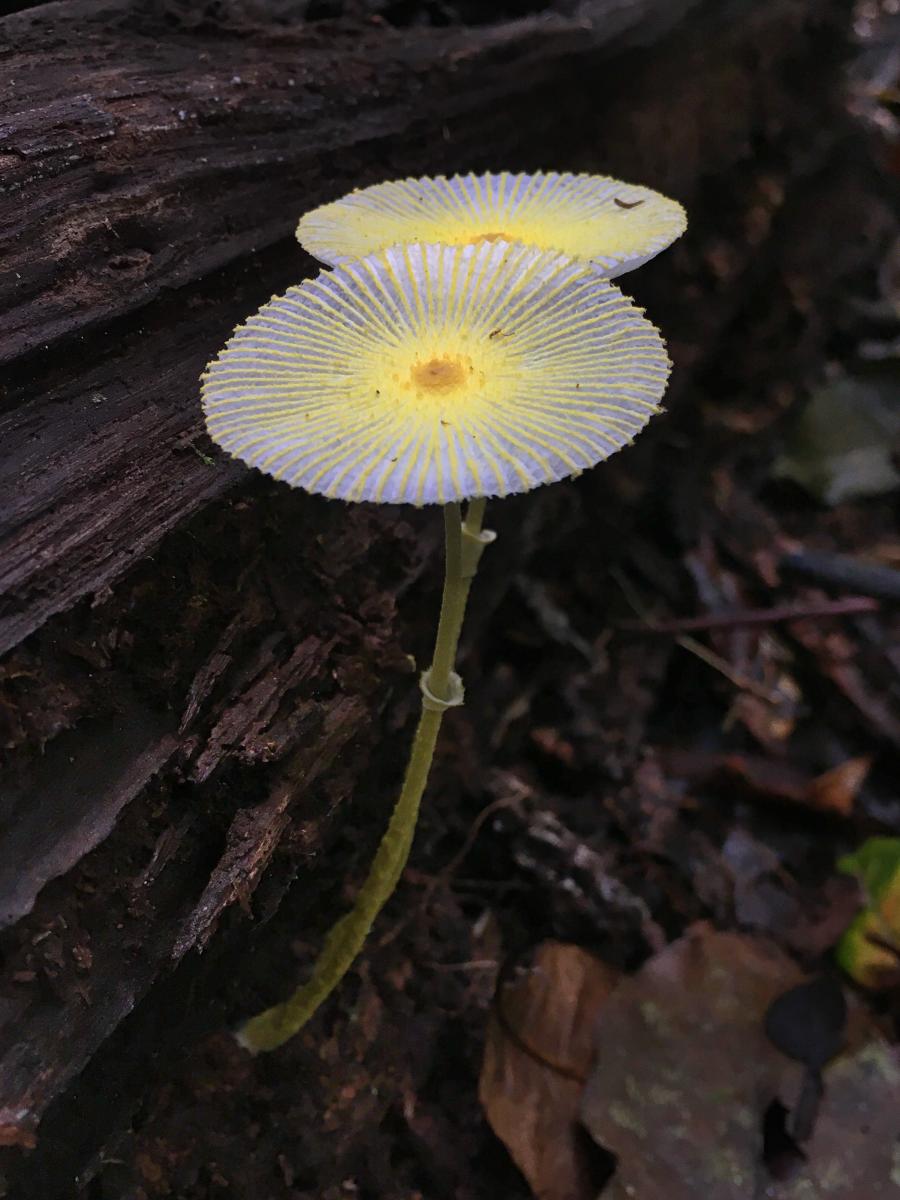
2.    Leucocoprinus fragilissimus (Fragile Dapperling)

This dainty (and fragile) mushroom starts off with a rounded bell-shaped cap that becomes flat then slightly convex with age. The cap is generally cream coloured with varying degrees of yellow in the centre. It is quite common on local forest tracks. Even a gentle touch is likely to damage the cap. It is found on all continents.


3.    Filoboletus manipularis – Soldier Pore Fungus

This common wet-season mushroom forms large clumps on both living tree trunks and old fallen logs. It has a pale brown central cap surrounded by pale cream to white, with a white speckled stem. It differs from other clumping fungi on trees in that it has distinctive reticulate pattern of pores under that cap instead of linear gills.  Some strains of this mushroom are bioluminescent; however, this does not seem to be true of the ones around Paluma.


4.    Stereum ostrea – Golden Curtain Crust

This fungus is commonly found on fallen logs. When still growing and the weather is damp, they form deep orange concave fans that grow out and up from a narrow base that remains attached to the log. The lower surface of the thin fan is smooth while the upper surface often displays concentric rings that vary in shade. In older specimens that are starting to dry the colours change to rings of grey, brown and green. Eventually they completely dry out and become papery crusts that crumble away. The fan can sometimes split radially as it grows. Individuals can occur singly or cover the length of large logs.


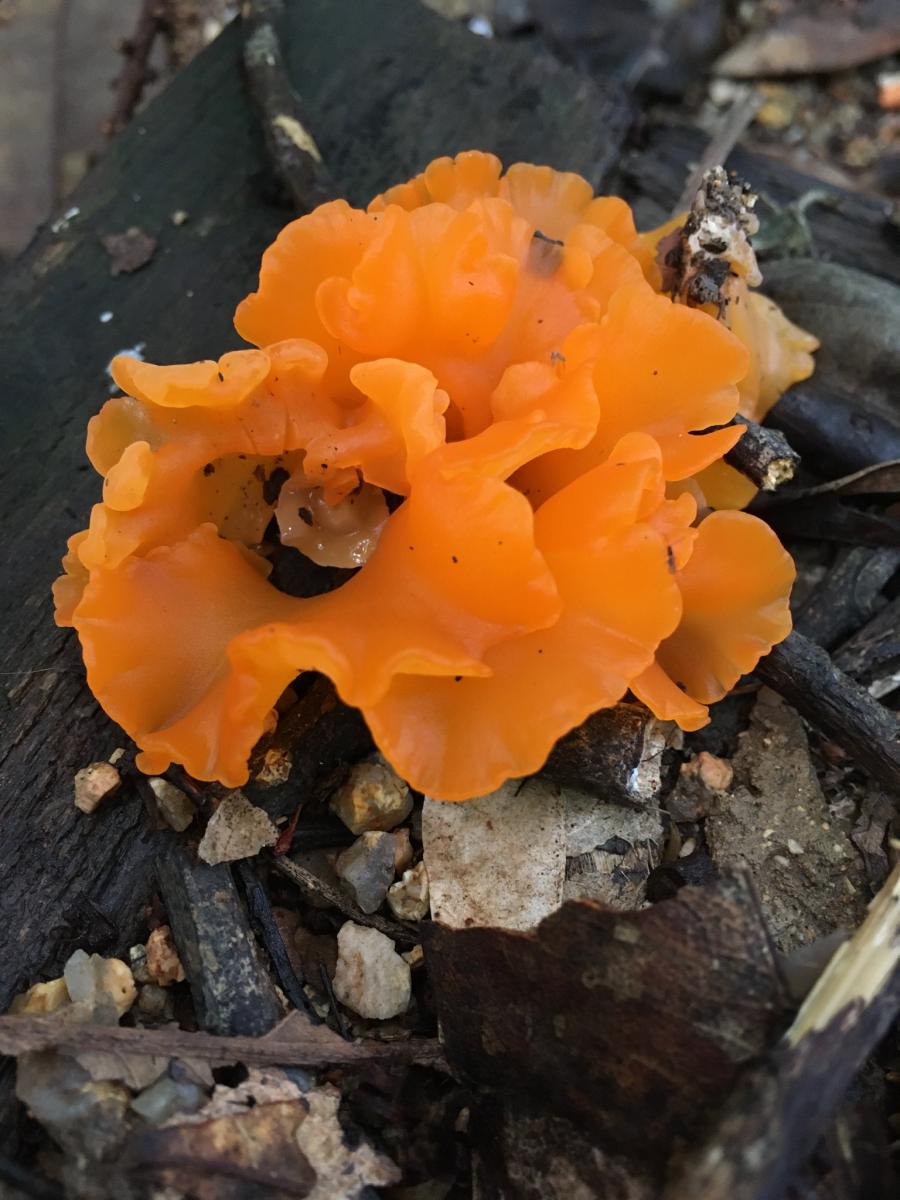
5.    Dacryopinax spathularia – Fan-shaped Jelly Fungus

This is a beautiful and common fungus that can be found as small yellow/orange blades poking out of cracks in dead wood or as larger convoluted fans. It has a rubbery texture and often grows in clusters following grooves in old lumber. It may even be found on the wooden exterior walls of local buildings.