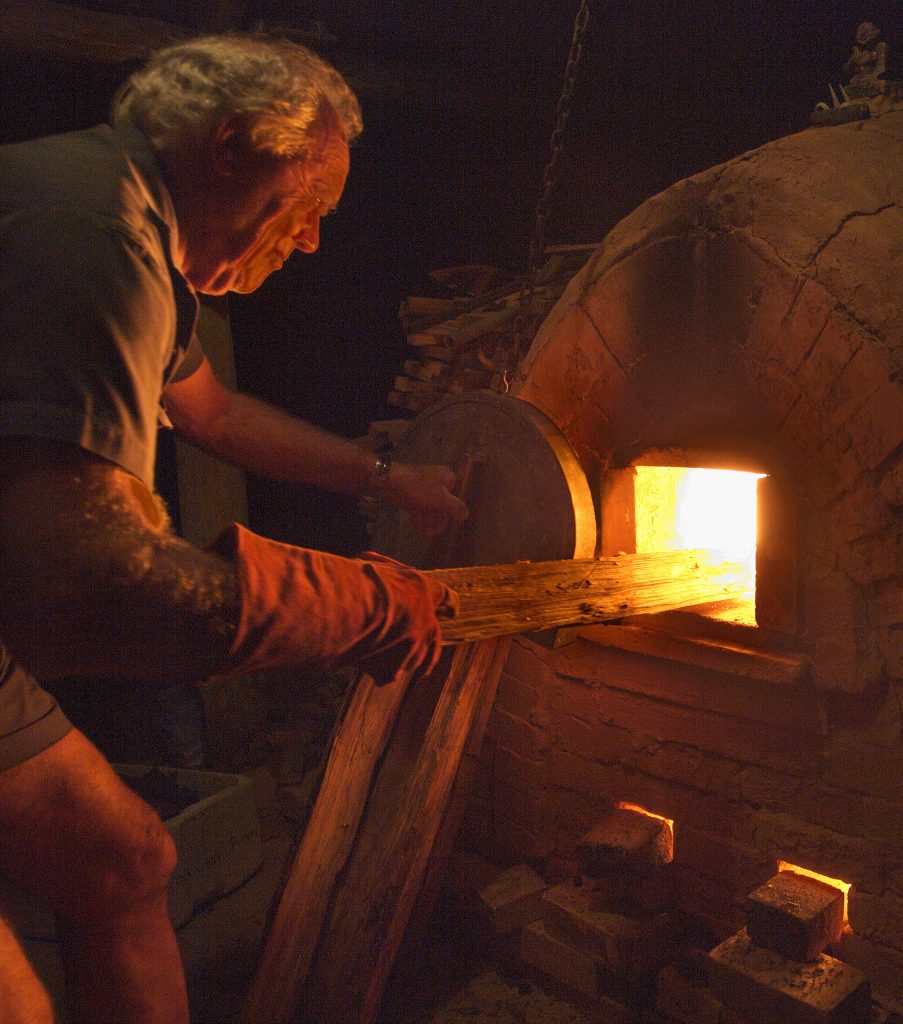
It is with great sorrow that we report the passing of Kelly Davis, a long-time Paluma resident and active member of the community. Kelly passed away last Friday night. Kelly’s long association with Paluma, and the various roles and friendships he established here warrant a more detailed tribute. My most recent memories of Kelly come from recent Anagama firings at Len Cook’s kiln where he spend nightly vigils stoking the furnace and monitoring firing temperatures. But there is much more to tell about this man, so please email me (j.k.oliver@outlook.com) if you have any other information or anecdotes so that his contributions can be fully acknowledged in a separate post.
The Department of Transport and Main Roads would like to advise that pavement repair works will occur on Mount Spec Road on the Paluma Range on Thursday 4 June 2020 from 12pm to 5pm. These works will include spray sealing on previously repaired sections of the road.
Impact on motorists:
Mount Spec Road will be reduced to a single lane at the sections where repairs are taking place.
Motorists who travel along Mount Spec Road between the hours of 12pm and 5pm can expect short delays of five minutes.
Stop/go traffic controllers will be on-site at either end of the works to direct traffic through the works zone.
A 40km/hr speed limit will be maintained along Mount Spec Road throughout the duration of the works.
TMR would like to thank the local community and businesses in advance for their patience during these works. Residents are encouraged to contact TMR on the details below should they have any further enquiries about the road works.
Kind Regards
Meghan
Customer and Stakeholder Management (Northern) | North Queensland Region Program Delivery And Operations | Infrastructure Management & Delivery Division |
Department of Transport and Main Roads
Floor 6 | Townsville Government Office Building | 445 Flinders Street | Townsville Qld 4810 PO Box 1089 | Townsville Qld 4810 P: 1800 625 648 | F: (07) 4421 8711 E: engagement.northern@tmr.qld.gov.au W: www.tmr.qld.gov.au
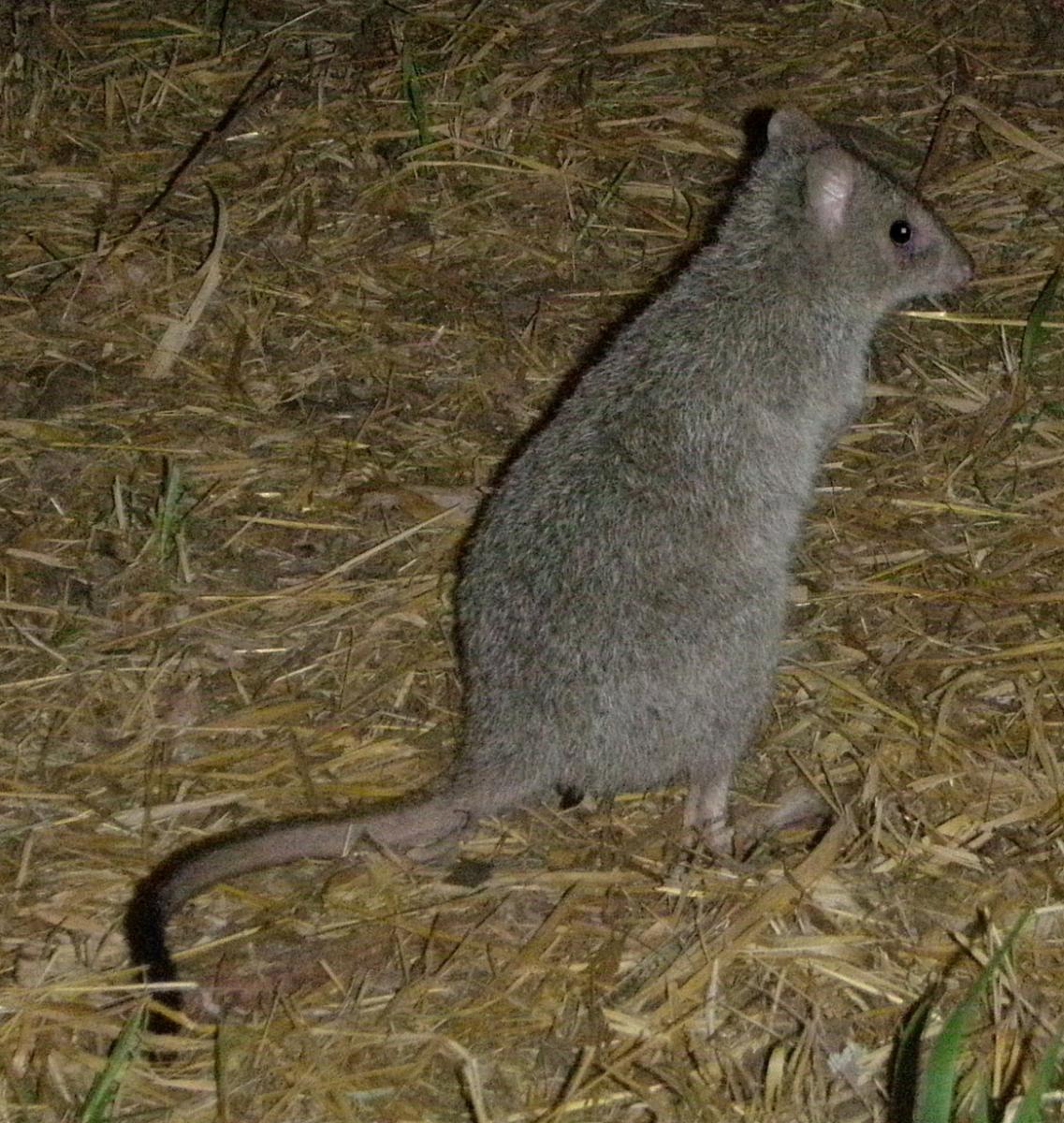
Following up on a comment from Michael Drew on theEucalyptus grandis Tree of the Month article, I am reprinting an article from the August 2017 issue of Turkey Talk on the Bettong and its role in the health of Eucalyptus forests.
To remove any ambiguity regarding the identity of our local truffle-eater, the northern bettong (Bettongia tropica), I altered title of the original article from Potoroo to Bettong. Potoroos, close relatives of the Bettong, are only found in the SE Australia & Tasmania.
Of course it’s possible that the Republic of Hussey Road has its own endemic but undescribed species of Potoroo (Potorous husseyensis ??)
Jamie
[Bettongs] of Hussey Road are more than cute critters.
‘Truffles’ conjures up the ‘black gold’ now being produced in WA, Vic, NSW and Tas. However, there are also native truffles, mostly found under litter, which are eaten by small marsupials. These truffles are the fruit bodies of fungi which have probably evolved to fruit underground due to drying climatic conditions in Australia over 35myo. They are vitally important in a 3 way association -tree- truffle-marsupial.
More is becoming known about the importance of mycorrhiza in the soil in which fungi mycelia are attached to tree roots. It is a symbiotic relationship where the fungus receives sugars from the tree and the tree gets chemicals such as phosphorus from the fungus. Since the 1980s studies have shown a third component in the system that is the marsupials. To survive it needs small marsupials such as potaroos and bettongs to dig up the truffles and eat them.
Truffles contain a mass of spores and tissues with a distinctive smell to attract animals and also provide them with food. Spores pass through the animal and can be dispersed to a new location
Since many of our small animals such as potaroos and bettongs are endangered species, it is vital that this relationship is better known. Eucalypts are one of our native plants which are very reliant on truffles. It has been estimated that they and many other native trees derive up to 75% of their metabolic needs from this type of ectomycorrhizal association. If these marsupials disappear, one vital component in the ecosystem will be lost.
Other ectomycorrhizal fungi may occur in an ecosystem as well so it doesn’t mean the whole system will collapse. But in Australia there are many ecosystems which are less healthy and resistant than before.
Orchids are the most diverse of all the flowering plant families with around 25,000 species world-wide and around 1,600 in Australia. They can be terrestrial or grow on rocks (lithophytic), or on other plants such as trees (epiphytic), or on rotten logs. While some have large, showy flowers, many can be small, inconspicuous plants with tiny delicate flowers of various hues.
While there are several orchids that can be found around the Paluma village and surrounding tracks, their scientific names are currently in a state of flux, with 4 of the ‘5 easy species’ listed here having had their names changed by one group of scientists, but contested by another! Here we will use the names published by the Atlas of Living Australia, but if you use the very good online key to Tropical Rainforest Orchids, you will need to be aware of the alternative scientific name given after the “=” sign).
Remember that it is illegal to collect any orchids from the wild. Several species have suffered from serious decline due to unscrupulous collectors.
1. Christmas Orchid (Calanthe australasica)
This is one of the most common and easily recognized species around Paluma. It is a terrestrial orchid with large pleated leaves. As its name suggests, it flowers around Christmas time (October – February) with a rather showy mass of white flowers on one or more stems. Under the shady canopy of the closed rainforest these orchid plants occur at irregular intervals, but in more open areas on the edge of the forest they can spread to form substantial patches. There are good examples of this orchid along all the village tracks.
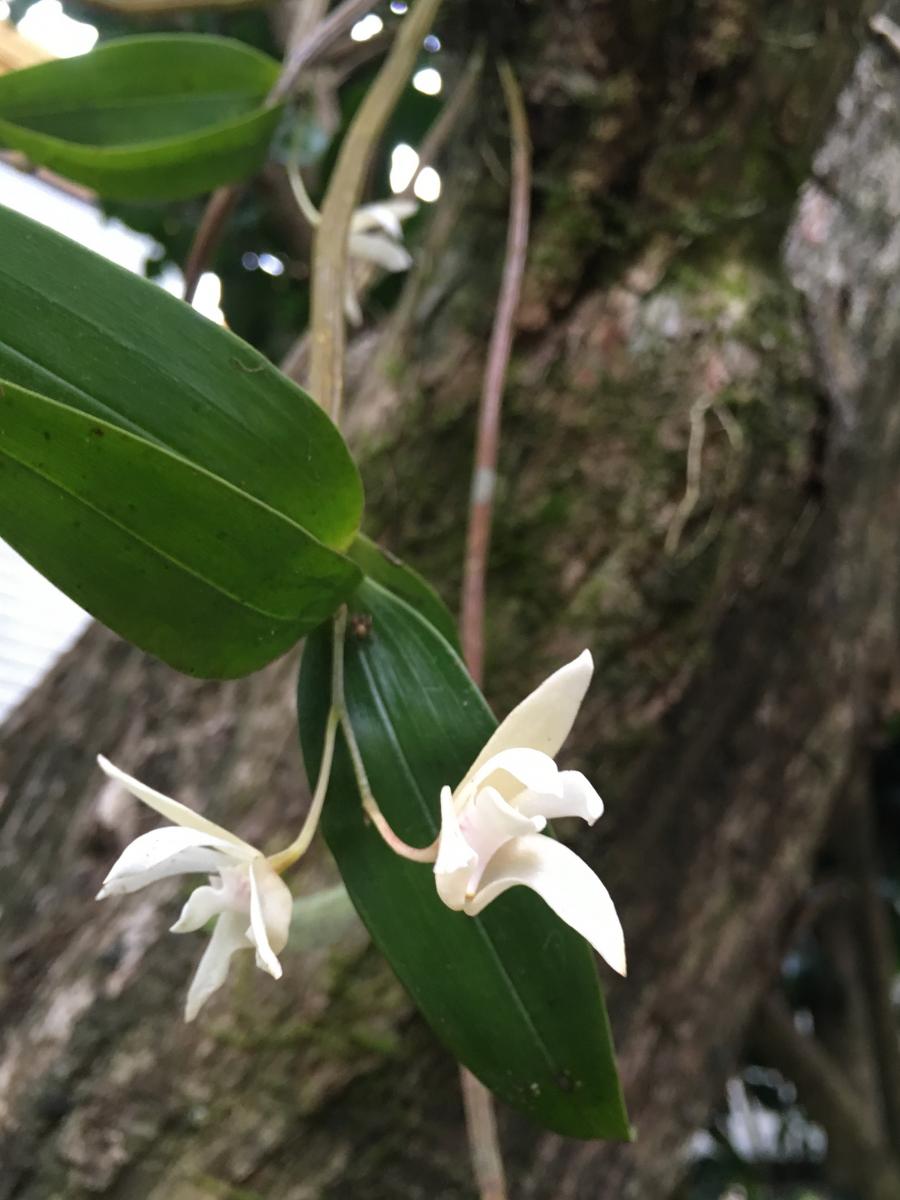
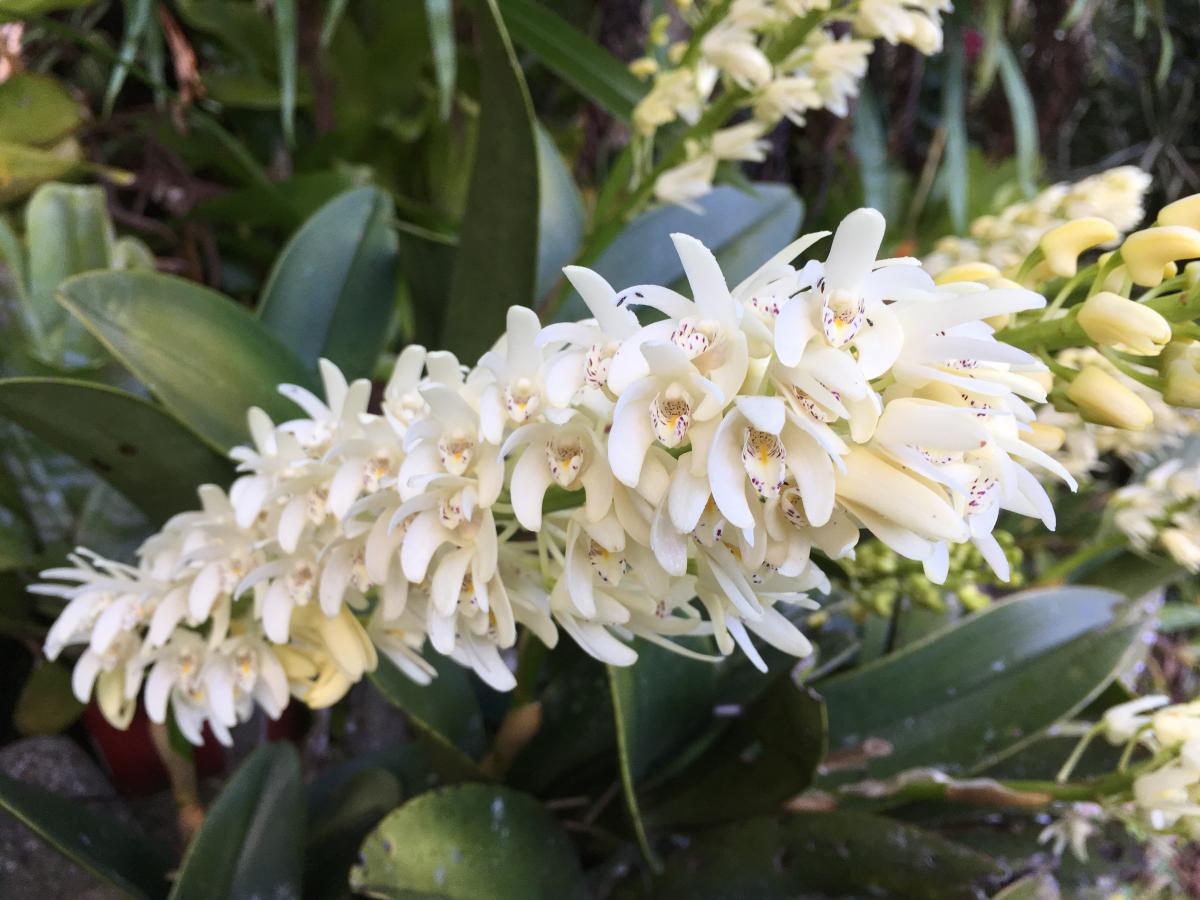
This is the most common of the epiphytic orchids that can be seen on the upper trunks and limbs of trees along the village tracks. You can also find it at ground level on the limbs of recently fallen trees or on large rock outcrops. It can be identified from the cluster of distinctive pencil-thin, often grooved canes with a few (max. 6) leaves near the tip. It can also be found on rocks. The white to pale yellow flowers are small (around the size of a 5 or 10 cent coin) and appear from July to October. There are several good examples of this orchid along the H-Track and in several open areas around the village. This species is restricted to high altitude rainforests and sheltered areas of wet forests from above 700 m from Paluma to the Tablelands.
3. Rock Orchid (Dendrobium speciosum = Thelychiton jonesii var. bancroftianum)
This is a well-known and widely distributed lithophytic and epiphytic orchid with large bulbous stems (pseudobulbs) topped by large leathery leaves. It is common in many Paluma gardens where it can form massive clumps. Large clumps of this orchid can be found on rocky outcrops in full sun along tracks around the Paluma Dam (Lake Paluma), but along tracks around Paluma village it forms smaller, less conspicuous clusters, usually high up on trees. Flowers mostly vary from white to creamy yellow and appear from September to November.
There is another species recorded from this area which looks nearly identical (Dendrobium jonesii = Thelychiton jonesii var. jonesii) and can only be distinguished by its slightly smaller flowers and earlier flowering period (September-November). Some taxonomists have lumped both into a single species, so it might be safer to call any of these orchids Dendrobium speciosum/jonesii and leave the final determination to be resolved by the experts!
This native north Queensland orchid is quite common but often overlooked due to its small size. It has a creeping rhizome that grows up trees or rocks and produces regularly-spaced, small, globular, green pseudobulbs (8-15 mm), each with a small, sturdy, green leaf up to 70mm. It produces bunches of up to 8 small (50mm), white to cream or greenish flowers from September to December.
In areas at the edge of clearings or on fallen trees it can be found near the ground but otherwise it is higher up in the forest canopy where the light is stronger. It can be found around many of the public areas in the village.
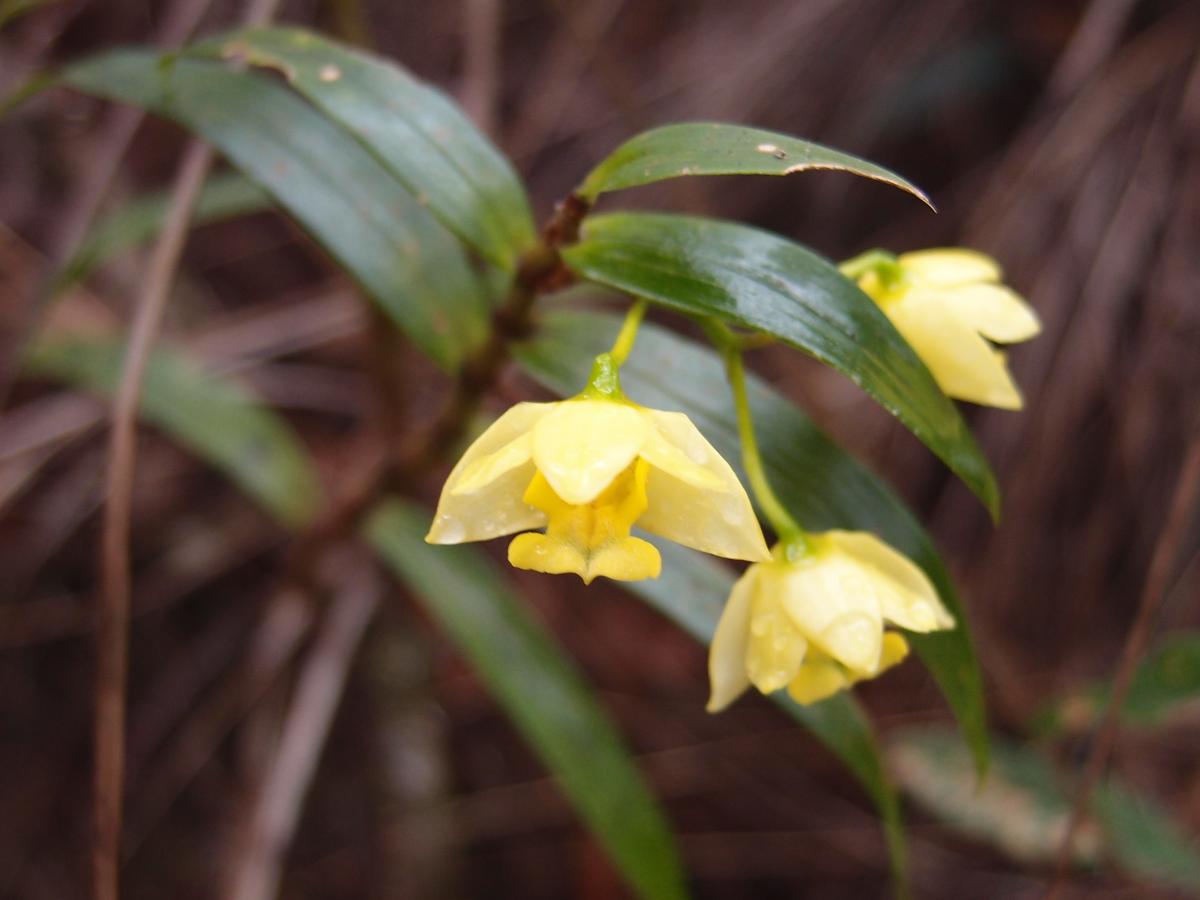
This beautiful small epiphytic or lithophytic orchid can be found in open forest near the edges of rainforest or on tree branches overhanging open sunlit streams. In favourable conditions it can form dense patches.
It has slender cane-like stems that look a bit like Dendrobium adae (see above) but they are more spaced out along a creeping rhizome rather than occurring in bunches. It also produces leaves along a greater portion of the stem. The perfumed flowers are bright yellow, appearing from July to November.
We have previously posted articles on the wide variety of Camellias growing in Paluma gardens and the fact that our cool mountain climate provides an ideal environment for these more temperate plants. If you peruse the gardening sections of the Paluma.org website you will find photographs of the many varieties and flower shapes, sizes and colours amongst the village gardens.
Coming from Central Victoria I have always loved Camellias and they hold special sentimental value for me. I grew up gardening with my grandparents amongst the Camellias. When I moved to Paluma four years ago and discovered they thrived in local gardens I set about planting several new Camellias at No. 13, adding to those already planted by Andy and Ann Bishop.
About 12 months ago whilst browsing the Bunnings garden shop (something I am known to do on the odd occasion!) I came across a new variety of Camellia – ‘Volunteer’. This new variety was named to commemorate the International Year of Volunteers in 2001 in New Zealand. Incidentally, the International Week of Volunteers has just passed and was celebrated in May.
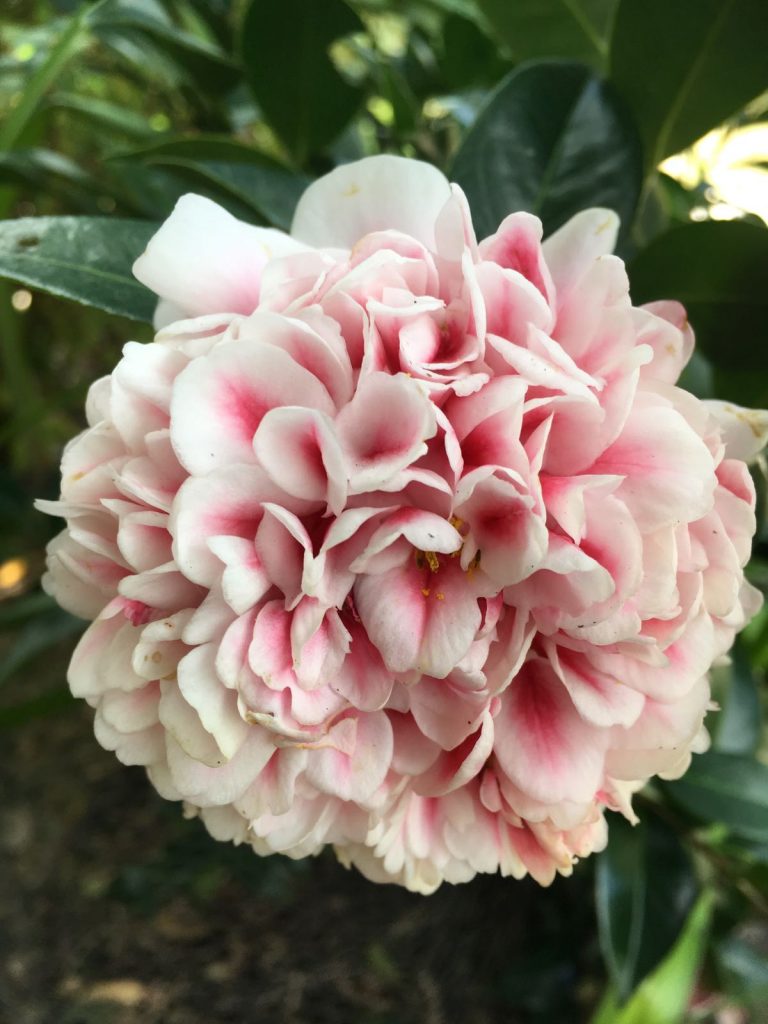
Anyway, back to Bunnings…..After some deliberation (for about 5 seconds) I purchased a Camellia ‘Volunteer’ and I squeezed it in amongst the plethora of plants in what I call my ‘chaotic cottage garden’. Well, the ‘Volunteer’ has thrived and is just over a metre in height. Throughout the month of May it has produced numerous blooms and they are quite spectacular. The flowers are quite large, deeply ruffled and variegated – they begin as a deep rich pink with white edges and fade to lighter shades of pink as they age.
Camellia ‘Volunteer’ is said to grow some 2m in height and 1.5m in width. It is a medium to dense upright shrub which is low maintenance. It produces multiple blooms over a long flowering period from May to September.
I can thoroughly recommend this Camellia as a beautiful addition to your Paluma garden. I was also thinking that this is an appropriate plant to grow in our little village, since the spirit of community and volunteering thrives here! I wonder if I could find some room for another one…….?
Macleay’s Honeyeaters are pretty fearless little creatures.
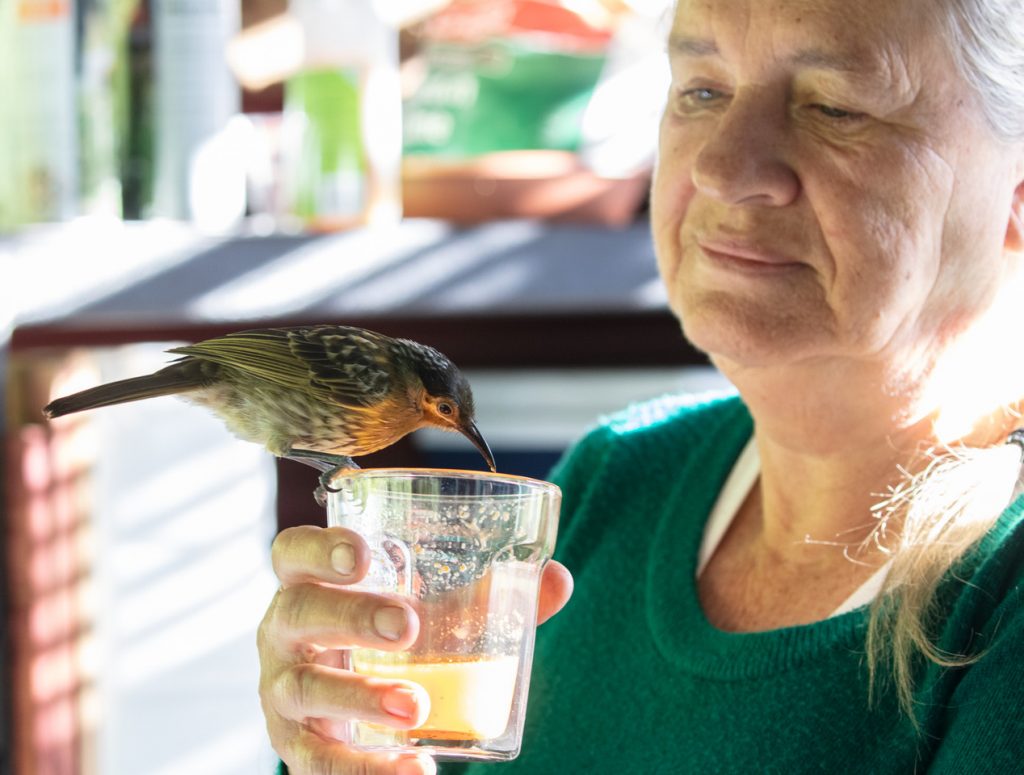
As Jan Cooke stepped onto the deck today to enjoy a morning juice, suddenly she was ‘breakfast bombed’ by one of the cheeky Macleay’s Honeyeaters who pretty much dominate the fruit station. Such is life in downtown Paluma!
Thankfully the scrub turkeys aren’t as bold……..!
Jan Cooke with her very friendly Macleay’s Honeyeater. What’s for breakfast?
The wet weather always brings birds and a few bush creatures to shelter and seek food on my back deck. For the last two mornings birds in greater numbers than usual have come in, ravenously emptying the food dish then sitting huddled together, wet and bedraggled along the railing. Even a brush turkey, much to my chagrin, joined the throng. Lord Victoria (the senior Rifle-bird) was first in, just on daylight clinging to the back door and screeching for attention. He was joined by a junior male and a female; a Catbird (who didn’t stay with the mob); two female Bower-birds; about a dozen Macleay’s honey-eaters, who fly into the kitchen if, in an unguarded moment, I leave the screen door open, and a mob of noisy Lorikeets who squabbled and jockeyed for position all morning.
A not so welcome guest was a huntsman spider, fortunately not a big one, who moved into my bathroom but the most unwelcome guests over the past three weeks were rats. Bush rats have invaded the laundry while White-tailed rats have patrolled the laundry and decks, creating havoc. An Antechinus made it to the kitchen and I dread the day when a White-tailed Rat discovers it can enter the house with no effort at all by using the dog-flap.
Every night for the past three weeks I have set mesh traps and almost every morning had a captive to take to the release site at the forest edge. First was a White-tailed rat who did considerable damage in the laundry before he was trapped. Then, for five days in succession I took Bush Rats to the release site. Next was a young White-tailed rat. There was a lull for two days then two bush-rats and an Antechinus went to the release spot. Yesterday, a very big White-tailed rat was captured – so big he totally filled and could not move within the trap. In another small trap two bush rats were caught. To my horror, one rat had begun eating the other. Is this cannibalism a symptom of stress? Is this behaviour rare?
A young rat probably a white-tailed rat) awaiting “transportation for stealing bread” !
Again, this morning I took a Bush Rat out to the release site. I wonder if any other residents are experiencing unusual numbers of visiting rats.
I am beginning to feel that I need a Pied Piper in Paluma.
Eucalyptus grandis, known as the rose gum, is a tall tree with a smooth pale trunk and a skirt of rough bark around the base extending up several metres. It occurs in wet sclerophyll forests from the Daintree to around Newcastle and favours coasts and lower slopes in areas of rich soil and high rainfall. Stands dominated by the Rose Gum are frequently found adjacent to rainforests. In Paluma the best examples can be found near the Taravale turnoff along the Hidden Valley Road. My family call this area the Valley of the Giants and it’s an apt name. There are also several lovely specimens along Benham’s Road from the dam spillway onward. The rose gum does not usually germinate or mature in established rainforest habitat, but it’s not unusual to come across one that is a remnant from a wet sclerophyll forest that has been encroached by rainforest during periods of high rainfall and low bushfire frequency. There is a huge but now half broken specimen like this on the way to Birthday Creek Falls1.
A stand of rose gums with white trunks near the Taravale turnoff on the Hidden Valley Road
There is a lot of interest worldwide in “big trees” and lots of competition for bragging rights for various categories. More that one website dedicates itself to this obsession, including the National Register of Big Trees, which lists the biggest trees of each Australian species. The rose gum is one of the largest trees in Australia. It commonly exceeds 50m in height, and the current record for this species is 86m. It is currently considered to be the tallest species in Queensland with a tree in the Conondale National Park called Big Bob measured at 72m in height. By comparison, the tallest tree species in Australia is the mountain ash (Eucalyptus regnans) with an individual called Centurion (>100m) classed as the tallest tree in Australia and the tallest hardwood tree in the world.
Eucalyptus grandis is very fast growing under ideal conditions and can reach up to 7m in its first year. It is a popular plantation tree inside and outside Australia for its timber and pulp. Timber applications include general construction hard wood, flooring, furniture. The leaves of the rose gum are eaten by koalas, which can also be found occasionally around the Taravale/Mt Zero area.
Text and photos by Jamie Oliver
1 look for a clearing and locked gate on the left about halfway to Birthday Creek Falls and go down this old logging road for about 200m. The tree is on the left.
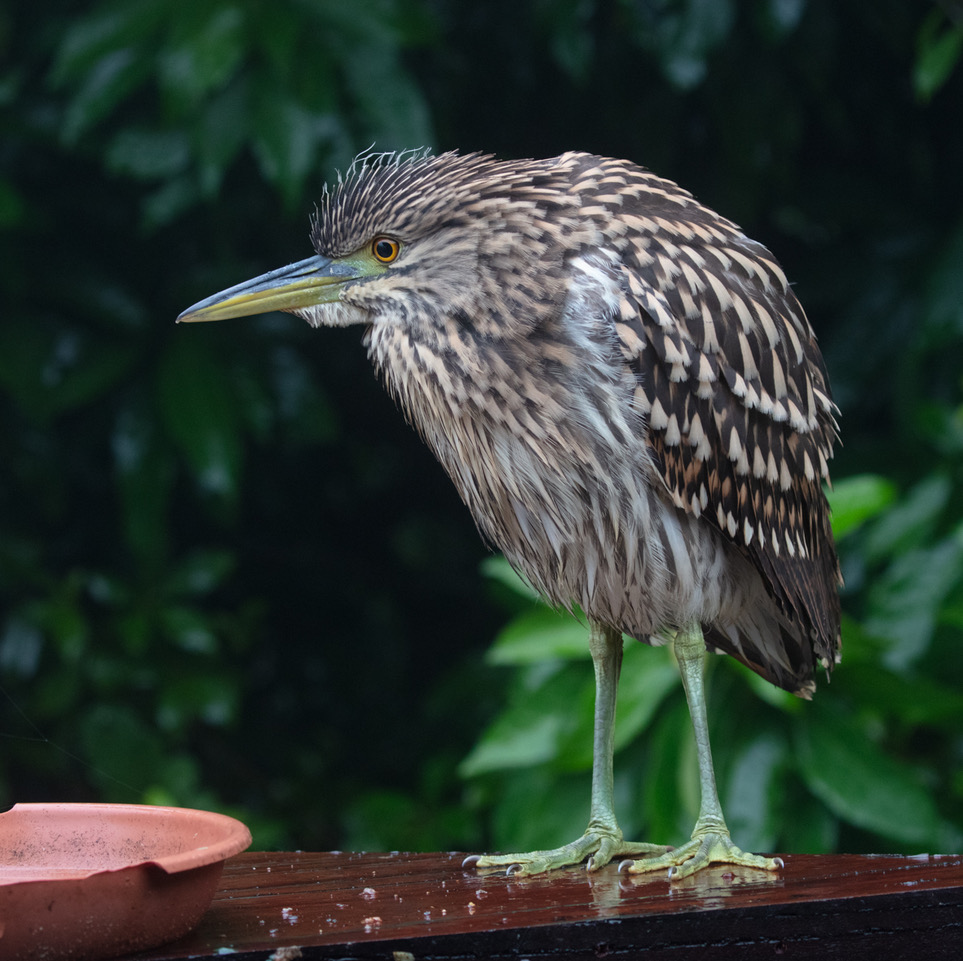
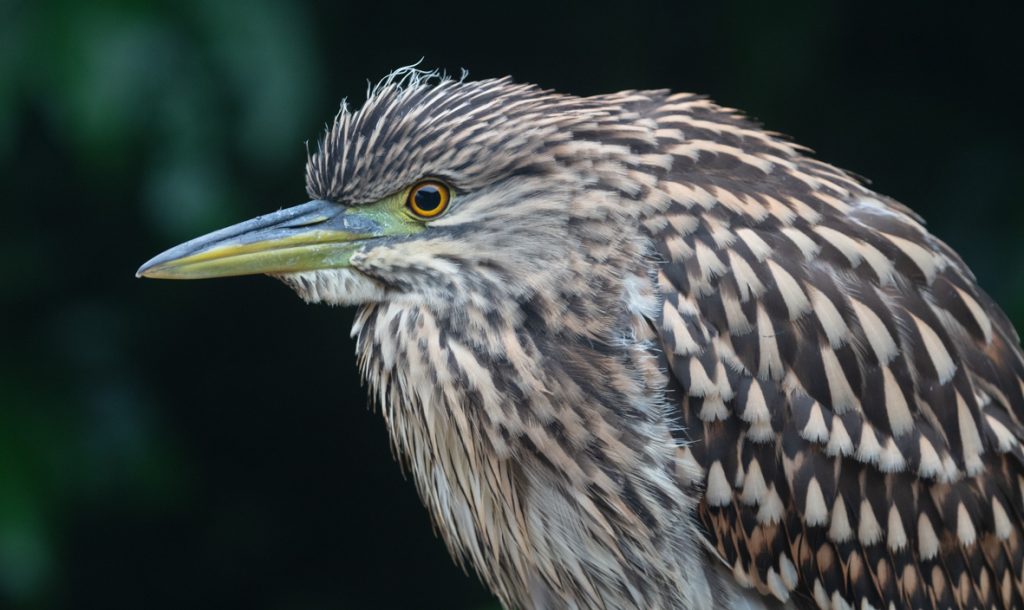
A surprise visitor to our verandah in downtown Paluma this morning……a juvenile Nankeen Night Heron. Something different from the usual mob of rifle birds, catbirds and honeyeaters looking to see if we had put any fruit out for them. The ‘NNH’ moved with all the speed of a tired cuscus on the verandah rail when it wasn’t standing stock still. A very naive youngster who didn’t see us as a threat at all and let me approach to within a couple of metres without any sign of alarm. Didn’t mind me taking 100 shots in the low morning light (1/25 @ f8 ISO 1250 on Canon 5DSR). He/she was there at break of day and was still standing looking like it wanted to come inside out of the rain when I sent this post at 0900. Now all I have to do is sort through 100 photos and decide which few to keep!






.jpg?bwg=1590822431)