Bird (Mis)behaviour – Pale Yellow Robin

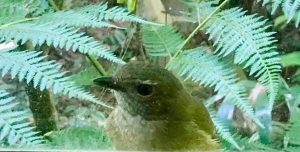
For some months now we have had a Pale Yellow Robin resident close to our house on the five acre blocks.  He [or very possibly, she]  perches in the Murraya tree close to our kitchen window and mounts an attack on the window pane on the left hand side from our perspective looking out.  His claws land on the glass and he drops down onto the lintel at the base of the window. He usually pauses for a few seconds before repeating the attack two panes to the right and again usually pauses looking quizzically at you if you happen to be at the sink, totally unfazed by the sight of humans.  He then proceeds to circle the house, usually anti-clockwise but not invariably so, attacking windows randomly before returning to the tree and repeating the antics over and over for maybe an hour or more before going off duty for a period. We think he must be eating during this gap as he has an annoying habit of leaving a calling card on or below the windows in the kitchen.

More recently he has discovered that the car has mirrors and he is fascinated by the second bird and spits at the reflection in the mirror and leaves copious deposits on the curve above the door handle which have to be washed off frequently to avoid damage to the paintwork. You may deduce that we are a bit cheesed off with this behaviour and have taken to thwarting the car attacks with our car cover which is pretty successful as he can’t even get at the windows. He still looks for the now covered car windows but has more or less given them up as a lost cause.

But he still does the house daily – we don’t know if our presence engenders his behaviour as we can’t see what happens when we are not there ! He is extremely hard to photograph but the photograph below is at the kitchen window by the sink. 
Text & Photo by Les Hyland
Bird of the Month – Satin Bowerbird

The satin bowerbird is common at Paluma and quite easy to spot around many of the village gardens and along the numerous walking tracks.

The population of satin bowerbirds at Paluma is quite unique in that it is reported to be an isolated population in the Wet Tropics of North Queensland.

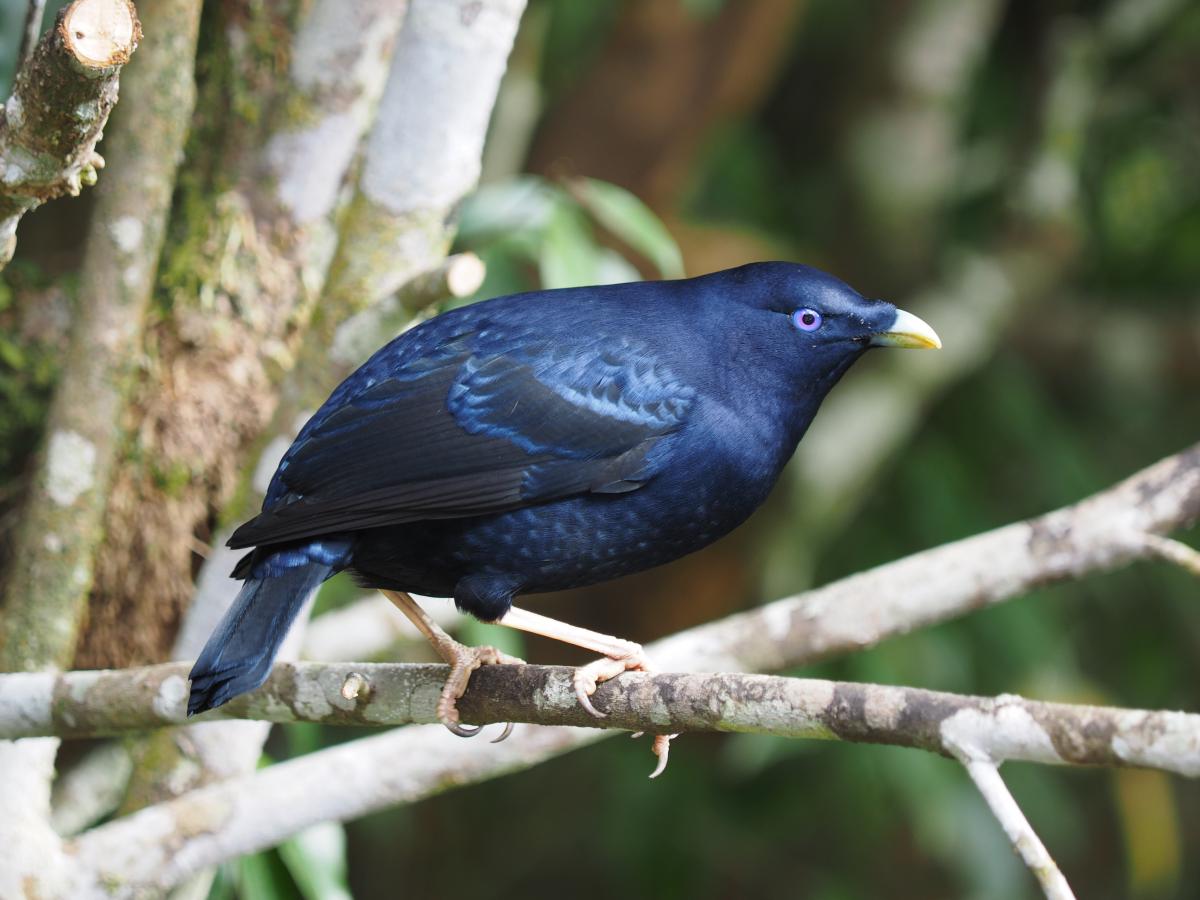
The male birds are black in colour, but the rich dark gloss of their feathers gives the birds an almost metallic sheen, so that they appear to be a deep shiny blue colour. They are quite breathtaking to see in the varying shades of light in the rainforest.


Satin Bowerbird male (top) and female (bottom). Photos by Jamie Oliver

The female birds are green and brown in colour, but with a distinctive scalloped pattern down the body. Both male and female birds have striking blue eyes.

If these birds are not spectacular enough, like most bowerbirds they have a very complex courtship behaviour that involves the male birds building elaborately woven stick structures, or ‘bowers’.


The intention of the bower is to lure females for mating. The female birds will visit the bowers and based on their inspection, will then choose which male they will allow to mate with them.

Male satin bowerbirds go to great lengths to decorate their bower with shiny and coloured objects to impress the ladies. As the males mature they favour blue objects in particular.

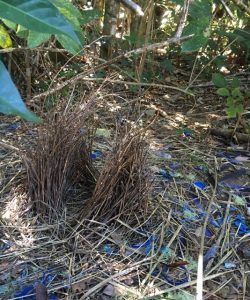
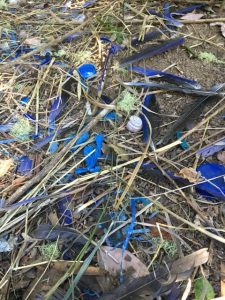
Satin Bowerbird bower. Photos by Michele Bird

Some lucky Paluma locals have a resident satin bowerbird and bower in their garden, or on their bush block. The bower here was recently sighted in the Hussey Road area.

This bower is decorated with an array of natural objects. This bird has collected blue bird feathers (probably from a crimson rosella), land snails, brightly coloured pebbles and bright-green moss or lichen. However, the majority of the items are non-natural materials including fragments of plastic, surveyor’s tape, pieces of tarpaulin, pegs, bottle lids, the rings from milk bottles and pieces of aluminium foil.

To me, this bower shows how remarkably innovative and adaptive these birds are to the modern world, in sourcing and using a vast array of treasured blue finds. But, it also shows that even in a small village such as Paluma, which is nestled on the very margins of the Wet Tropics World Heritage Area, the birds are able to find a great deal of plastic material. For me it serves as a timely reminder that we could all do a little bit better in managing our waste and taking care of our environment and native fauna.

Text by Michele Bird