Posts

Bird (Mis)behaviour – Pale Yellow Robin

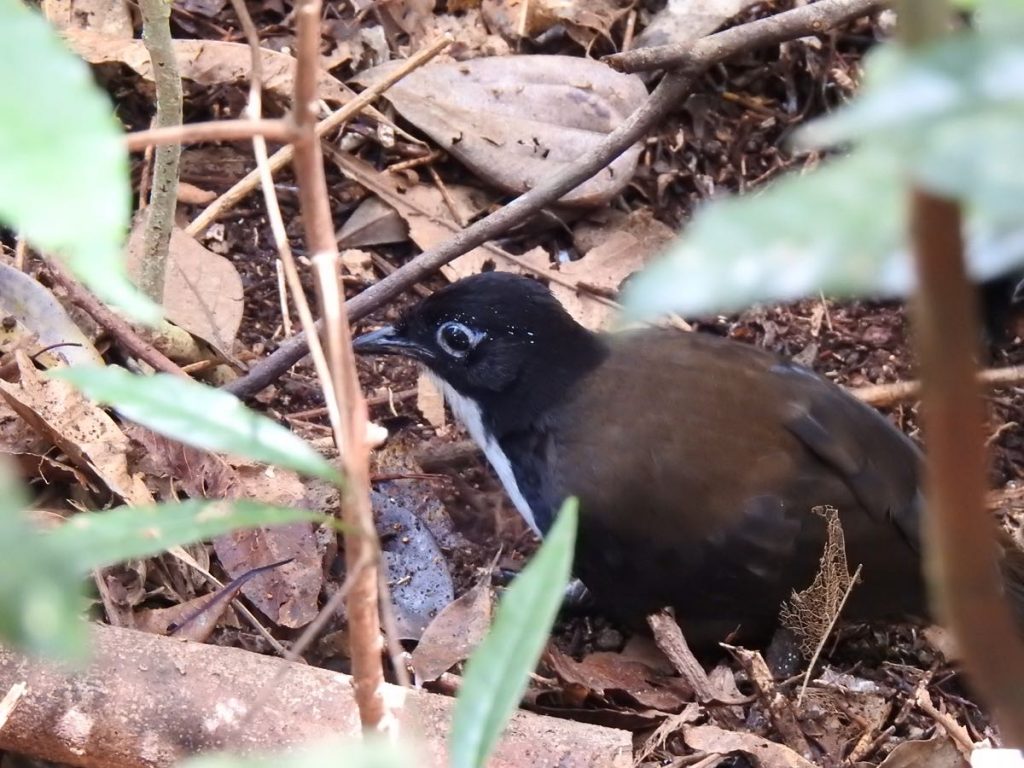
For some months now we have had a Pale Yellow Robin resident close to our house on the five acre blocks.  He [or very possibly, she]  perches in the Murraya tree close to our kitchen window and mounts an attack on the window pane on the left hand side from our perspective looking out.  His claws land on the glass and he drops down onto the lintel at the base of the window. He usually pauses for a few seconds before repeating the attack two panes to the right and again usually pauses looking quizzically at you if you happen to be at the sink, totally unfazed by the sight of humans.  He then proceeds to circle the house, usually anti-clockwise but not invariably so, attacking windows randomly before returning to the tree and repeating the antics over and over for maybe an hour or more before going off duty for a period. We think he must be eating during this gap as he has an annoying habit of leaving a calling card on or below the windows in the kitchen.

More recently he has discovered that the car has mirrors and he is fascinated by the second bird and spits at the reflection in the mirror and leaves copious deposits on the curve above the door handle which have to be washed off frequently to avoid damage to the paintwork. You may deduce that we are a bit cheesed off with this behaviour and have taken to thwarting the car attacks with our car cover which is pretty successful as he can’t even get at the windows. He still looks for the now covered car windows but has more or less given them up as a lost cause.

But he still does the house daily – we don’t know if our presence engenders his behaviour as we can’t see what happens when we are not there ! He is extremely hard to photograph but the photograph below is at the kitchen window by the sink. 

Text & Photo by Les Hyland

Remembrance Day, Sunday 11 November

LEST WE FORGET 

REMEMBRANCE DAY SUNDAY 11 NOVEMBER

Remembrance Day Gathering, 11 AM on Sunday 11 November 2018 at the Paluma Community Hall.

Please meet at the Community Hall at approximately 10.45 AM in preparation for the raising of the flag and a minute of silence at 11 AM to commemorate Remembrance Day.

ALL PALUMA RESIDENTS AND VISITORS WELCOME

What’s Flowering In Paluma, Late October – Tree Waratah and Snow In Summer

Flowering Trees – Tree Waratah and Snow In Summer

Paluma gardens never cease to surprise and delight with the variety of spectacular blooms to be found here. In the garden of No. 15 Mount Spec Road, the brilliant red flowers of a Tree Waratah flame in the crown of this tall, slender tree. Higher than the house roof, the flowers can be easily missed unless you are scanning the tree-tops for birds.

Native to the North Queensland rainforest, the Tree Waratah and its natural habitat on the Atherton Tableland, have largely disappeared there due to clearing for grazing and agriculture. The tree is known for its beautiful pink timber.

Formerly known as Oreocallis wickhamii, it has undergone a name change and is now classified as genus Alloxylon in reference to its unique timber. There are two species within the Queensland tropical rainforest – Alloxylon flamelleum, (which I suspect is the species flowering in the Paluma garden), and Alloxylon wickhamii. The common names for these trees are Queensland Waratah, Pink Silky Oak and Red Silky Oak for A. flamelleum and Tree Waratah, Satin Silky Oak and Pink Silky Oak for A. wickhamii. All very confusing to a non-botanist: so much easier to identify it as ‘Tree Waratah’.

Take a short walk from Mount Spec Road along Lennox Crescent to the Townsville City Council Water Depot. Look up the driveway to see, rising behind the buildings and tower, a magnificent Melaleuca tree, its crown completely covered in dense white bloom. It gives the impression of being heavily snow-laden. This tree is Melaleuca linariifolia and not surprisingly, one of its common names is ‘Snow in Summer’.

This small evergreen tree grows to a height of 6m to 10m. It is from the myrtle family and is endemic to New South Wales and Queensland. This particular specimen was planted in the early 1990’s (in 1993 or 1994) by long-time Paluma resident Kelly Davis. The trunk of this tree has thick sheets of papery bark.  The flowers are a major attractant for bees, butterflies and birds.Unfortunately, the spectacular display of the ‘Snow in Summer’ will not last long; already some of the blooms are browning in the tropical heat.

Text by Colwyn Campbell & Photos by Michele Bird

Jungle Huntsman Spider

Jungle Huntsman (Heteropoda jugulans)

One of the many benefits of residing in the village of Paluma is that we are living close to nature. Encounters with the local wildlife are common for those of us living with the rainforest and the Wet Tropics World Heritage Area literally at our back door. On my house verandah there are numerous spiders, of varying sizes and species, happy to cohabit with me. My favourite spider is a rather large, hairy-legged huntsman that I call ‘Harry’.

‘Harry the Jungle Huntsman’

‘Harry the Huntsman’ lives in the kindling box by the back door. He takes refuge in the kindling box by day, but by night he stalks the verandah and house walls looking for prey. His favourite past time is to sit by the back door at night and jump towards me when I least expect it.

‘Harry’ is a Jungle Huntsman which are fast moving rainforest spiders (don’t I know it!). They are long-legged and mostly grey to brown in colour. They can grow to a body length of 30mm (Harry is approaching this size). Jungle Huntsman feed on a range of invertebrates including moths, crickets, cockroaches, flies and other spiders. Jungle Huntsman are covered in fine sensory hairs which are very sensitive to air movement. This helps them to detect the movement of prey and also the approach of predators.

These spiders lay eggs which are encased in a flat white silk egg sac. The female spider stays with the egg sac until the spiderlings hatch. The eggs hatch in 30 to 60 days (depending on the temperature) and several hundred spiderlings can emerge from one egg sac. (If ‘Harry’ is actually a ‘Harriet’ then I may have many more Jungle Huntsman on the verandah in the future).

Jungle Huntsman grow by shedding their exoskeleton, or moulting.  The life span of most Huntsman species is 2 to 3 years. These spiders are non-venomous. Their predators include birds, geckoes and large wasps.

Text & Photo by Michele Bird
What’s Flowering In Paluma – Dendrobium Orchid

Dendrobium Species (King Orchid or Oak Orchid)

There is a spectacular orchid blooming at Paluma at present and it can be seen clinging to trees in many village gardens and high up in the canopy in rainforest trees surrounding the village. Most locals refer to it by a common name, the King Orchid. This beautiful orchid has thick green leathery leaves and showy flowers which are produced in long racemes on long stems. Each stem can have over 100 small flowers which range in colour from white to creamy yellow. The flowers have a sweet fragrance and usually appear from September to October.

As amateur botanists we have tried in vain to identify this orchid to species level. We suggest that it might be a variety of Dendrobium speciosum which grows over a vast area of Australia from Gippsland in Victoria to Cooktown in North Queensland. Dendrobium speciosum is described as a very variable orchid, forming a species complex. It can be found across a range of habitats in eastern Australia including rainforest and open forest, from sea level to mountain tops.


On the other hand, this orchid might well be Dendrobium jonesii. This species has a remarkably similar flower to D. speciosum and although it can grow at sea level, it tends to occur most commonly in upland rainforest in the moist mountain ranges. It is described as being locally abundant in tropical Queensland from Mount Elliot near Townsville to Cape York Peninsula.

If anyone can enlighten us as to the species of this beautiful Paluma orchid we would welcome your feedback.

Whatever the species, it is a special orchid and very worthy of our admiration wherever it grows – in local gardens or high in the rainforest canopy. The flowers tend to be short-lived only lasting a week or so. Make sure you check out this orchid before flowering ends, otherwise you will have to wait until next year!

Text & Photos by Michele Bird & Colwyn Campbell. 


Paluma Dinner under the stars

Outer Limits would like to invite you to a community dinner on Saturday, 27th October at the Adventure Centre.  Starting  5pm

The Deadline for confirming your presence coming up soon. Please RSVP before October 25th:

info@outerlimitsadventure.com.au  ph 0421 484 211

Catering by the Feel Good Foodie. $15 per person/ BYO drinks


Paluma Featured in RACQ Road Ahead Magazine

Paluma has an entry in the latest issue of the RACQ Road Ahead magazine in the “My Town” section.

The article was written by Michael Drew and features information on  what to do, where to eat and our main attractions. Thanks to Michael Drew for composing this article, which is intended to correct the impression in a previous RACQ article that there is little to do in Paluma.  A quick browse of our website should also dispel that notion!

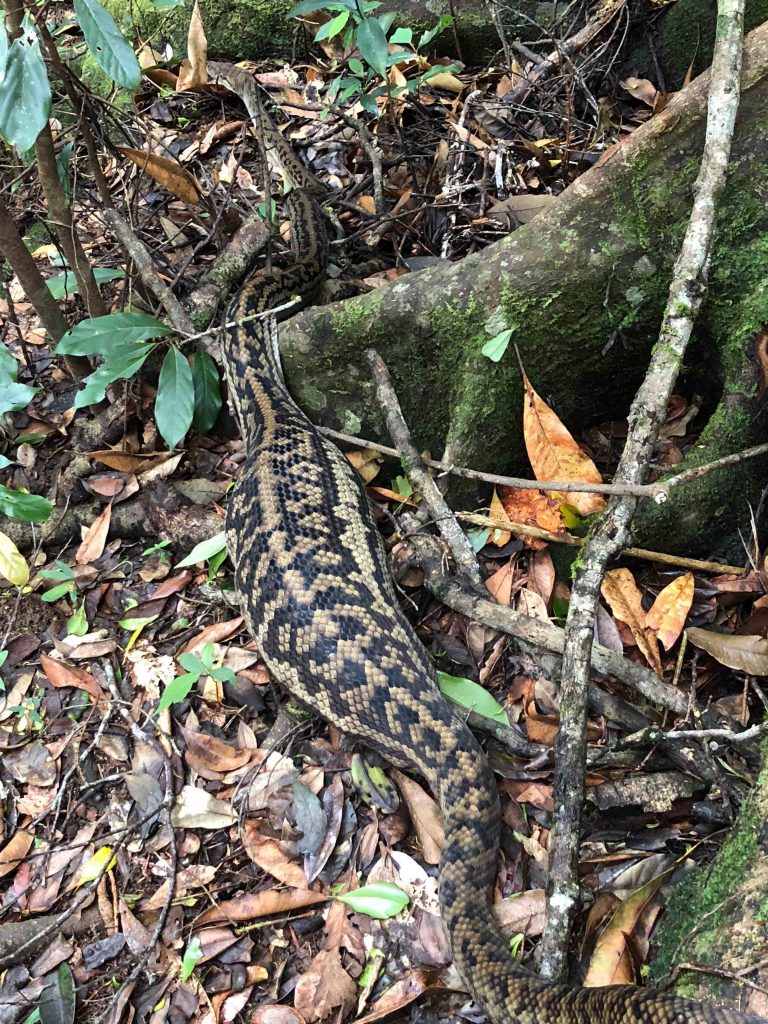
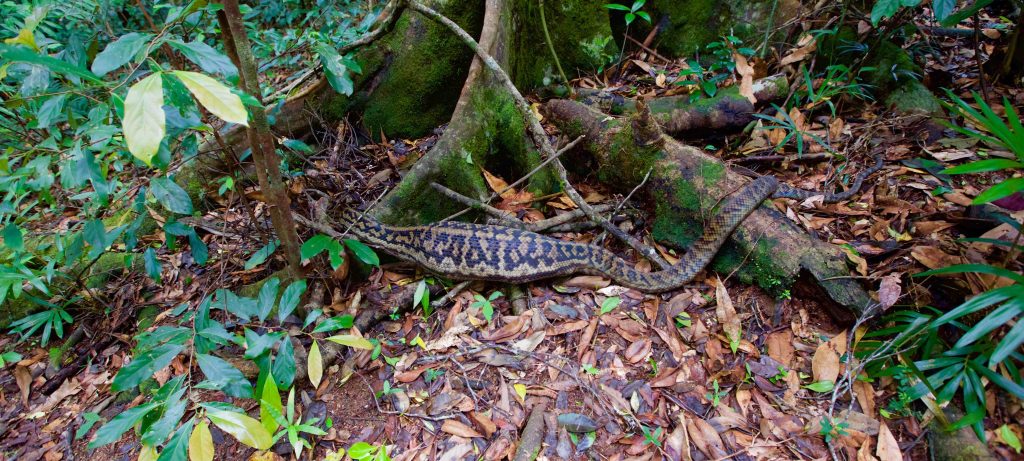
A Walk on the Wild Side – Amethystine Python

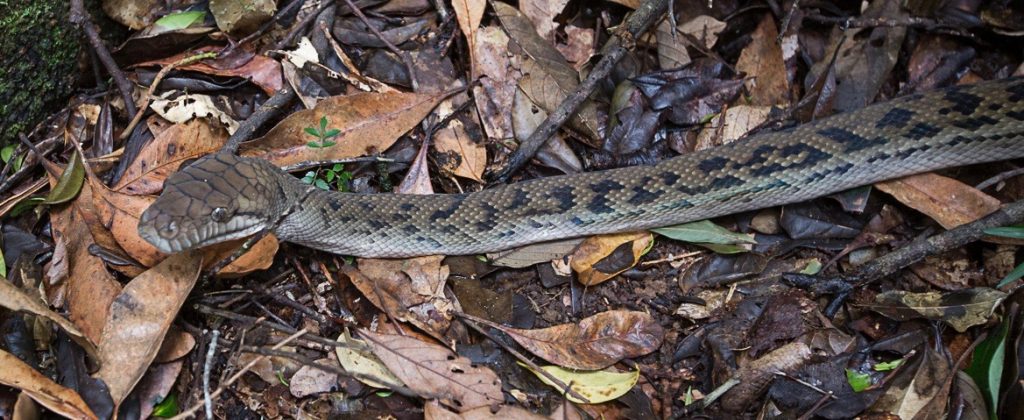
Taking a walk through the village of Paluma and surrounds often leads to encounters with the local wildlife. Last Sunday (21 October) during a stroll through the village on a beautiful sunny morning,  we were lucky enough to come across a superb Amethystine Python (Morelia amethistina).

From a distance, we noticed what appeared to be a rather large tree branch extending onto Mt Spec Road at the eastern end of the cutting. Before long it became obvious that the ‘large branch’ was moving and that it was a  snake that had settled quite comfortably on the road for a spot of sun baking. This sizeable snake extended across the entire width of the road and more. Fearing a vehicle might soon come along, we swiftly encouraged the snake to move off the road and it ascended a nearby tree. It was not too pleased about being disturbed from its lazy Sunday morning warm-up!

The Amethystine Python, or Scrub Python as it is also known, is Australia’s longest snake. The specimen we saw was about 3 metres in length, and probably quite a young snake. Specimens have been recorded at over 8.5  metres in length. These snakes are slender, graceful creatures with stunning markings of fawn to olive-brown, with variegated zig-zag patterning in dark-brown to black. These pythons live in tropical open forest, rainforest and mangrove habitats. They are usually nocturnal, but can sometimes be found during the day, basking in the sun in a forest clearing, or as we found, on the road.

Amethystine pythons are non-venomous and their prey usually includes small birds and mammals, but can include larger animals such as agile wallabies.

After settling in the tree, this very handsome python was happy to pose for a few photographs.


Text & Photos by Colwyn Campbell & Michele Bird

Relics of a Bygone Era

On Friday 12th October, two new arrivals appeared on the lawns adjoining Lennox Crescent and Mount Spec Road.  They emerged from a dense cloud mist which enveloped Paluma that day, like visitors from the mists of time.  The ambience seemed fitting, as these new arrivals are relics of a bygone era; a timber hauler, which was used to haul timber on Mt Spec and a bitumen mixer used in surfacing the Range Road during the 1950’s.  The large, solid steel machines are well preserved and represent the epitome of engineering design and workmanship of their day.

The machines were for many years kept on a property on Spiegelhauer Road until Wilfred Karnoll acquired them and brought them up the Range on a tilt-tray to their new home on Mount Spec Road.  Appropriately, they are sited on the lawns of the former Cavilcade Guest House, which was built in the late 1930’s by Bert and Grace Cavill. The house is a historic landmark building in Paluma, and in its heyday in the 1930’s, accommodated tourists who travelled up the newly constructed road.

The former owner of these machines is Mrs Helen Davies whose late husband operated the timber hauler for dragging logs from the forests in the Paluma area.  The timber hauler is a Campbell bob-tail, No 122, manufactured by A.B. Campbell Engineering in Gloucester, NSW.   It was towed behind a small bulldozer.  A steel rope from the winch on the dozer ran over the pulley on the bob-tail.  By retracting the winch rope the heavy end of the log would be lifted off the ground and dragged out of the scrub to the loading ramps.  The logs would then be loaded onto trucks towing timber jinkers for transport to saw mills or the rail siding at Moongobulla.

The bitumen mixer was originally owned by the Main Roads Commission; its serial number is MRC 2776. There is no marking to indicate its age or the foundry in which it was built.  The machine was used in the surfacing of the Range road in the 1950’s.  Until then the road was unsealed.  The bitumen mixer carried a drum that had two sets of paddles running through it which mixed the liquid hot tar with sand and gravel to produce bitumen for sealing the road.  Unfortunately the engine driving the mixer via two leather belts, is missing.  Possibly it was a Southern Cross engine, one of which may eventually be obtained and set in place.

On the left side of the Range road, (going down) near The Saddle, are two steel tanks which were used to liquefy the tar.  These may be hard to locate, obscured as they are by long grass.

It is satisfying to have in the village these two solid reminders of Paluma’s past.  They complement the photographic history on display in the Community Hall of the industries, the people and the development of this area.

Text and photos by Colwyn Campbell

What’s Flowering In Paluma – Hippeastrum (Amaryllis)

Hippeastrum (Amaryllis family)

A previous post by Colwyn Campbell (27 September) highlighted the commencement of the annual blooming of hippeastrum lilies in many gardens throughout the village. Two weeks on and the hippeastrums are at their very best, bursting into flower in almost every garden. Whether you have one bulb or mass plantings, these beautiful bulbs never disappoint the home gardener.

Hippeastrums belong to the Amaryllis family. They belong to a genus of some 90 species and over 600 hybrids. They are perennial bulbs. The bulbs are usually large and fleshy, producing tall, broad leaves. The large trumpet-shaped flowers come in a vast array of colours, evident in the gardens at Paluma. Hippeastrums are easy to grow. They love warm weather, sunshine or good filtered light.

Just some of the amazing flowers from local gardens are shown in the photos below. Here are our Happy Hippeastrums!


 Text & Photos by Michele Bird