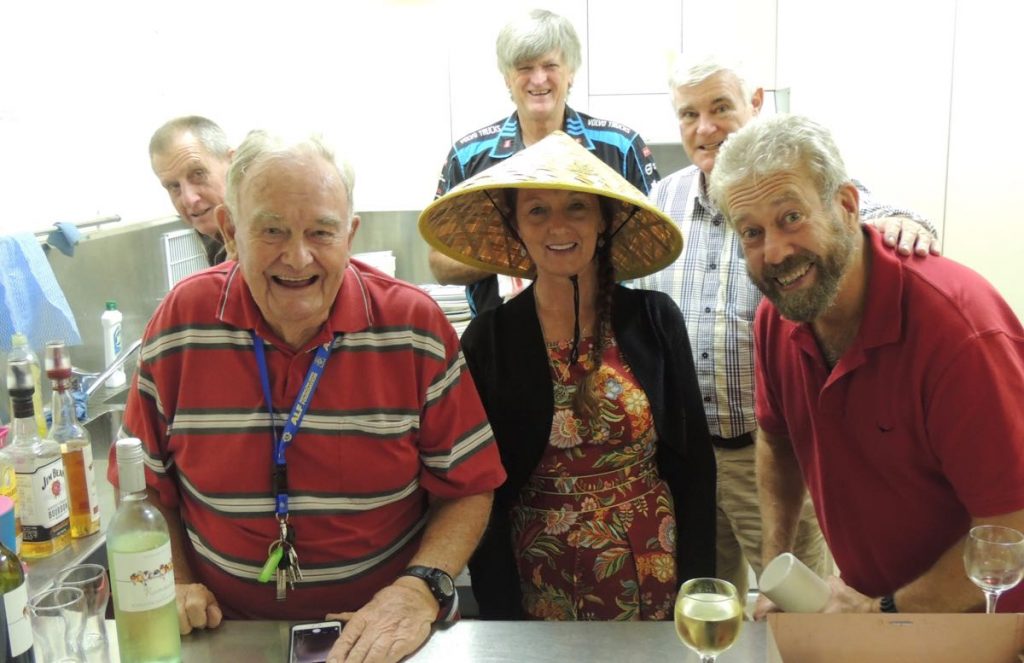
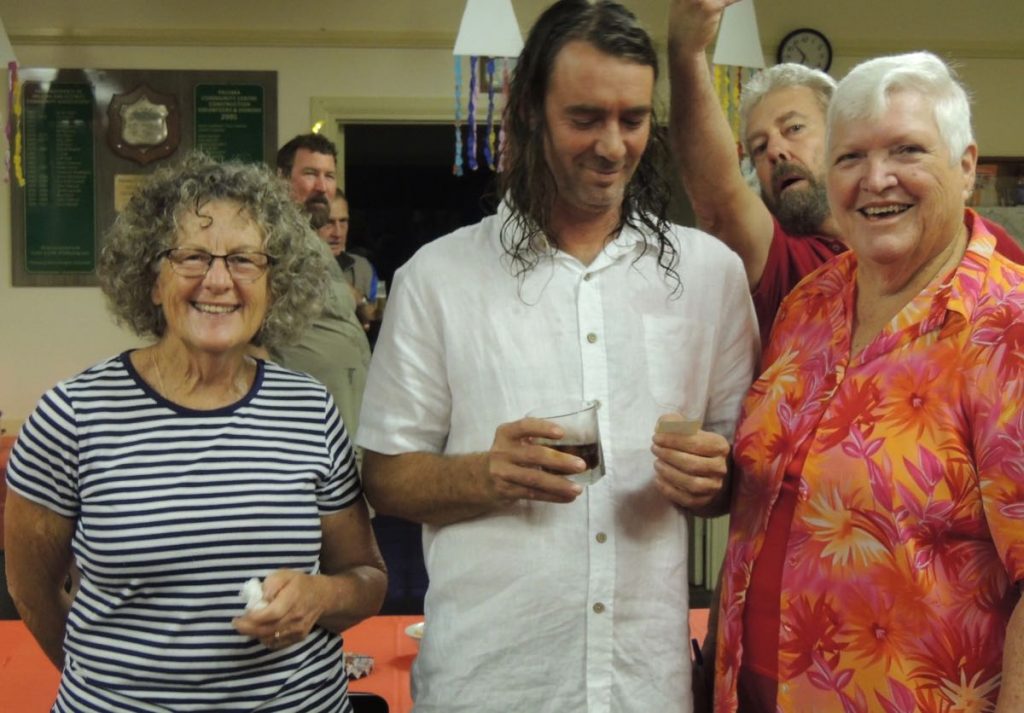
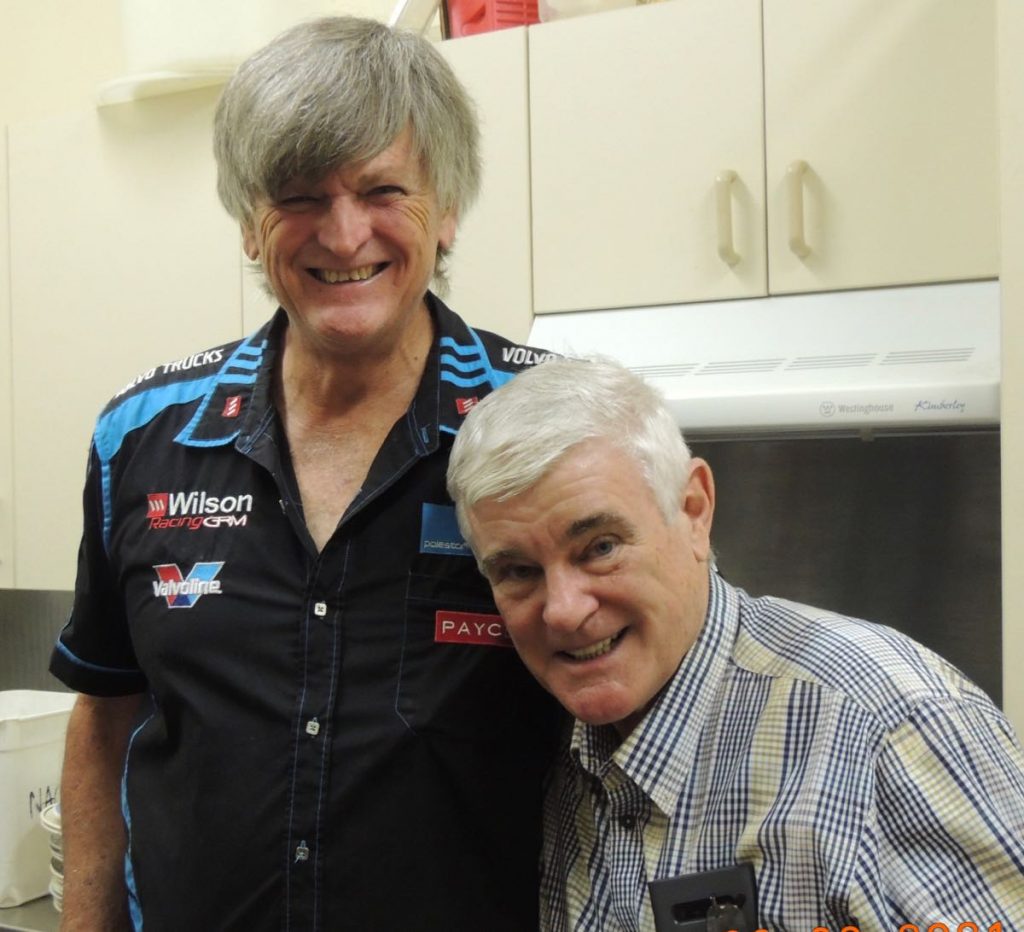
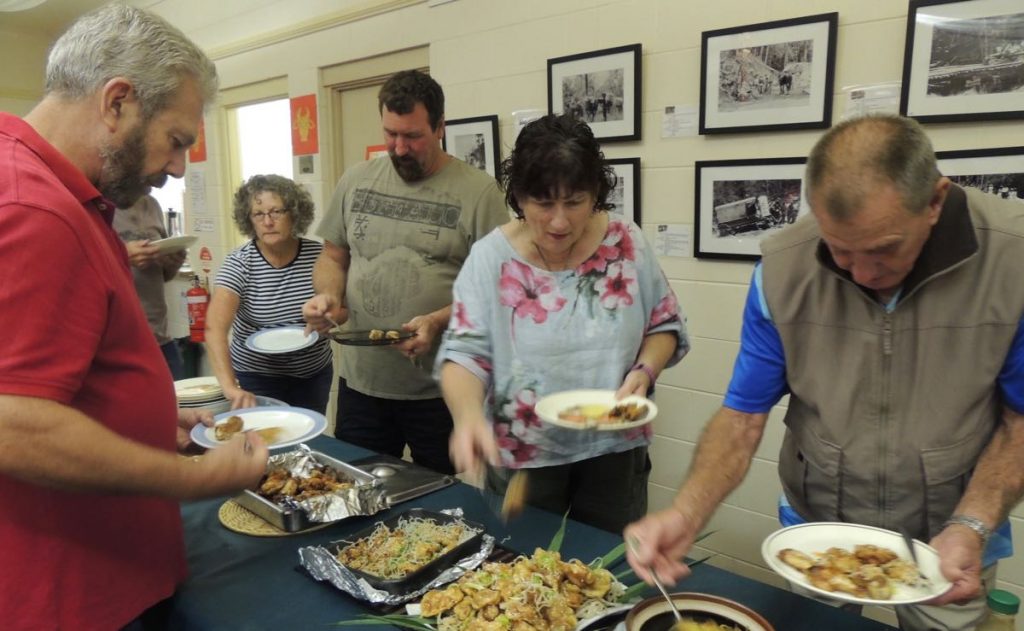
The annual Paluma Push is fast approaching. This is an iconic event for Paluma and every year the Paluma Community supports the Push by providing volunteer assistance throught the local SES and Rural Fire Service. If you have not already volunteered or been contacted about volunteering Len Cook, head of the Paluma RFS, is keen to add volunteers for several check points along the race route. Please contact Len on 0427 708 530 or anagama@activ8.net.au. As a way of thanking volunteers, RFS will be sponsoring a thankyou BBQ to Push volunteers on Sunday after the race.
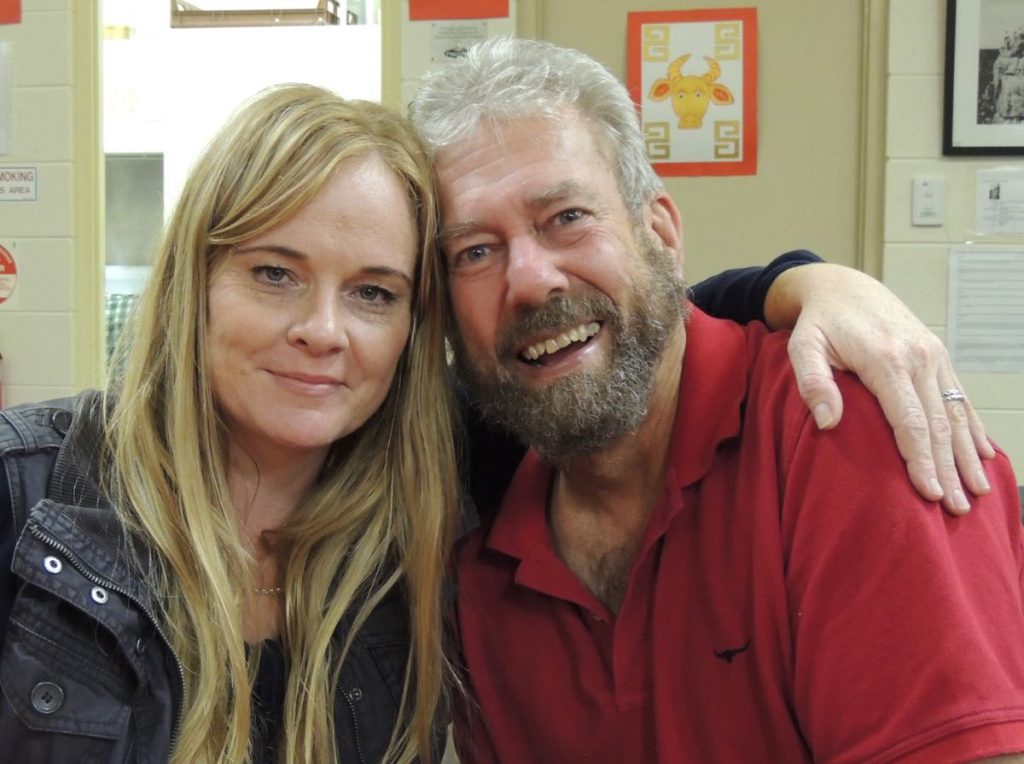
The PDCA would like to welcome to the Paluma community Bobby and Glen Parker who are the new residents at 1976 Mt Spec Road. This property was formerly owned by the Brennan’s and it is one of the 5-acre blocks to the west of the village. Bobby and Glen’s property is situated next-door to Graham and Julie’s place. Graham – who is recovering from a broken pelvis (now locally known as ‘Evel Knievel’) – brought the new neighbours along to the usual ‘C and G’ session (‘Coffee and Gossip’) at the Rainforest Inn last Saturday (26/09/20). Here, they met some of us locals for the first time – hopefully that will not scare them away…….!!.
We extend a warm welcome to Bobby and Glen to our village community and particularly to the 5-acre blocks area. We’re sure that by now they will have realised they have purchased a piece of Paluma paradise.
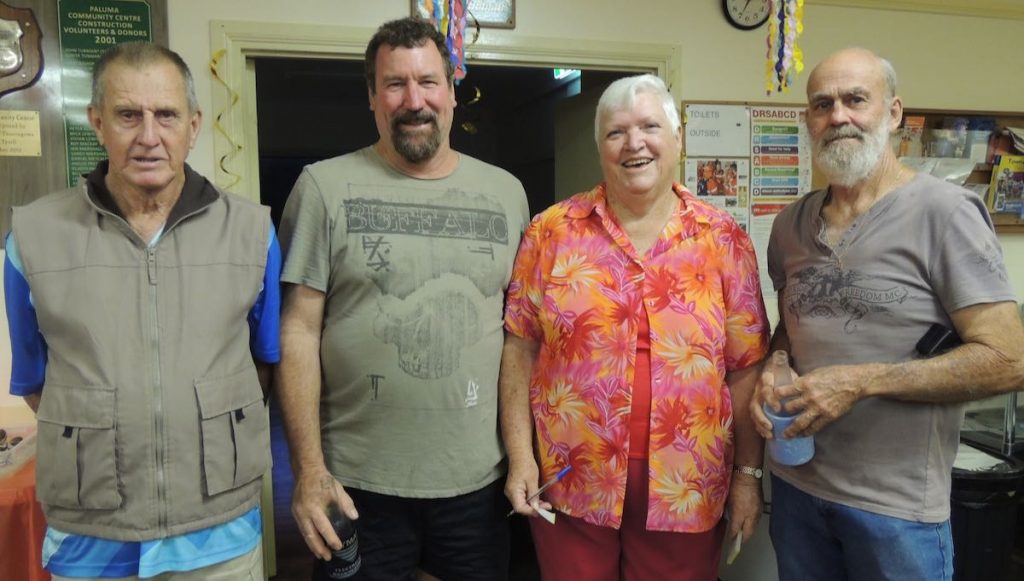
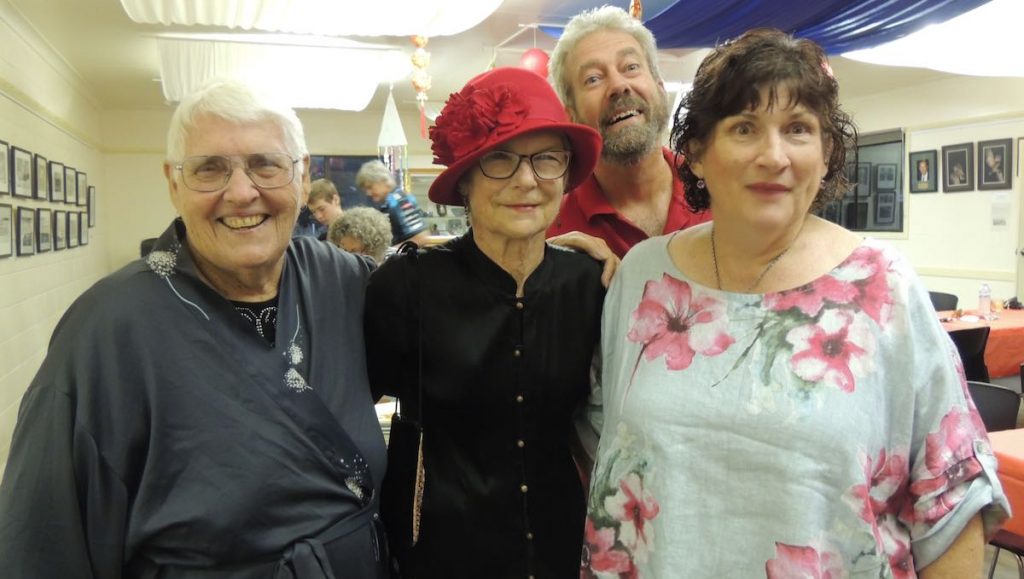
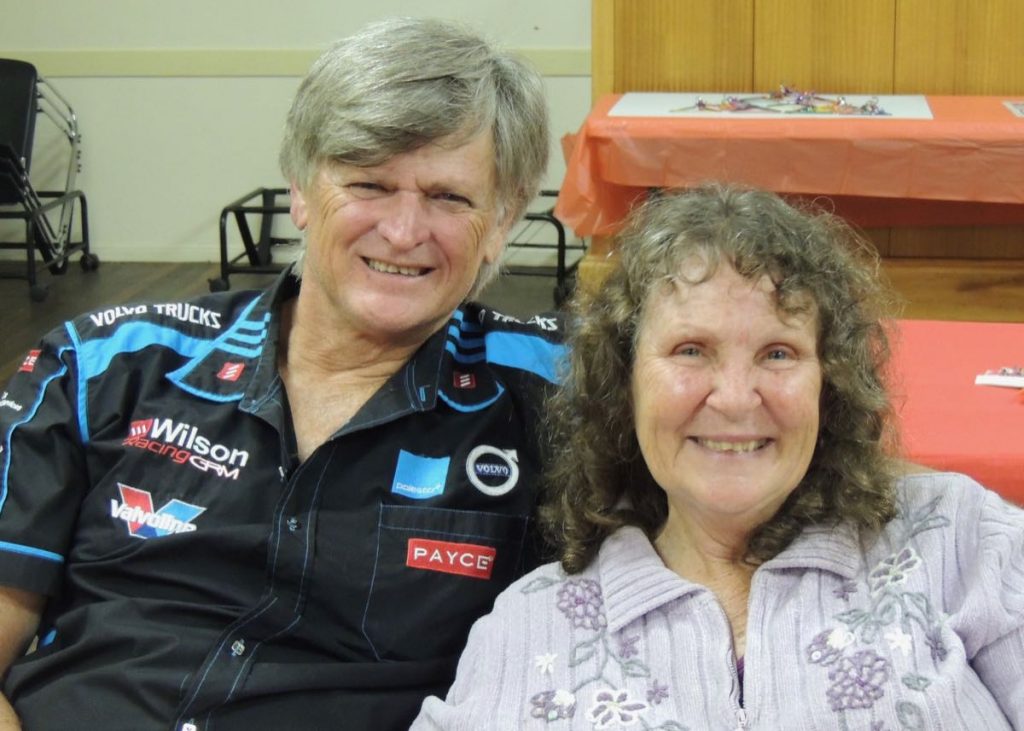
Bobby (left) and Glen (right) meeting their neighbour Lynn Hyland (centre) at the Rainforest Inn.
Photo by Les Hyland. Text by Les Hyland and Michele Bird
Addendum: (Jamie)
While we have focused on Bobbi and Glen since we go to meet them at morning tea last week, we also extend a warm welcome to other recent additions to the Village: Ian and Julia Anderson (14 Mt Spec Rd); Peter Carlin and Karen Knight (3 Lennox Cr); and Dean Stephenson and Judy Foote (54 Mt Spec Rd).
Strangler figs are one of the distinctive features of rainforests. They start life as epiphytes half-way up the forest canopy, germinating from seeds in bird or bat droppings that have landed on a suitable tree branch. The young seedling sends roots sinuously down the trunk of the host tree while growing its branches up towards the forest canopy. As light severely limits the growth rates of tree seedlings on the forest floor, strangler figs gain a huge advantage by starting off life near the canopy courtesy of its host tree. Once the fig’s roots reach the ground they penetrate the soil where the added supply of nutrients and water spurs rapid growth of both the branches and aerial (above-ground) roots, which progessively envelop the host tree.
Typical pattern of root growth over host tree in younger strangler figs
Seedlings can also occasionally germinate on large boulders, cliff faces and even old ruins (e.g. the ruins around Anchor Wat in Cambodia). The height at which the seedling germinates, as well as the orientation of the host dictates how the roots will grow. If a tree with a strangler on it is knocked over into a diagonal growth position, the roots will start to grow vertically directly down to the ground. An impressive example of this diagonal growth with vertical roots can be found on the famous Curtain Fig Tree outside Yungaburra in the Tablelands.
Mature figs often either kill or out-live their host, leaving a hollow core in the network of thick roots that make up the trunk of many mature stranger figs. The cause of host death is not certain and while the name suggests that the roots eventually strangle the host trunk, hosts will also have to compete with the fig for canopy space and nutrients and water in the surrounding soil and this could severly weaken the host tree. However a recent recent study of trees that survived Cyclone Yasi suggests that stranglers may actual help their hosts survive these extreme storms, perhaps by adding structural support to their host in the face of cyclonic winds.
Mature stranger figs reach enourmous size and can dominate the canopy. There are several huge figs at the bottom of Bambaroo track (unknown species) which can be seen on the satellite view of Google Earth and have canopies exceeding 50m in diameter. The largest tree in the world (in terms of area covered) is a Banyan fig (also a strangler) that covers a massive 4 acres.
Ficus watkinsiana on the Paluma Rainforest Track
Figs belong the Family Morace, and the group known as stranglers (starting off as epiphytes on a host tree or rock) belong to the subsection Urostigma. There are around 1,000 species of Ficus worldwide and Australian rainforests host about 40 species. Of these, 18 are stranglers.
Ficus watkinsiana is one of several species of strangler figs that occur around Paluma. A good example can be found on the Paluma “Rainforest Track” opposite Smith Crescent. This specimen has a dedicated platform in front of it, including an extension that allow photographers to step back so that they can get most of the tree in a photo.
Leaves and Fruit from Ficus watkinsiana on the Rainforest Track
Ficus obliqua fruit
Identification of figs is not easy and professional taxonomists may even resort to electron microscope imagery to detect minute differences in the strucuture of the fruit to confirm identification. However, based on distribution records, leaf size and fruit shape/size I am pretty confident that this one is indeed F. watkinsiana. Other species of strangler that have been identified on the H-track are F. destruens and F. obliqua. F. destruens has similar leaves but the fruit, while similar in shape are significantly smaller than F. watkinsiana. Along the H-track, starting from the JCU house, there are two specimens of F. destruens labelled with white tags (numbers 2 and 7). F. obliqua can be identified from its small globular organge coloured fruit. There is a specimen about 20m from the first right hand bend of the H-track starting from Lennox Crescent on the left side of the track.
Old stranger figs are enormous! Their canopies extend over huge areas, and their aerial roots can be over a metre wide. Top left: Curtain Fig Tree Ficus virens) at Yungaburra. Top right: a huge Ficus species at the bottom of Bambaroo track whose canopy (~52m diam) is easily seen on Google Earth satellite view (photo by Sam Stedman). Bottom: the aptly named Ficus religiosa at Ta Prohm ruin near Anchor Wat, Cambodia.
While strangler figs have a fascinating growth habit, all figs also exhibit amazing and bizarre reproductive characteristics that would require a separate post to describe in full. One fact worth noting is that almost every species of fig is dependent on a single species of tiny wasp for pollination! A scary fact since all it would take is the extinction of one species of insect to wipe out an entire species of majestic fig trees! We usually think of insects as ubiquitous and prolific, but a recent scientific global survey found that 40% of all insect species are declining and that a third are endangered.
For our local Ficus watkinsiana the polinating wasp is Pleistodontes nigriventris. You may never see one ( I couldn’t find a picture of it on the web) but you would certainly know if it went extinct!
Text and photos (unless indicated) by Jamie Oliver
Paluma has had a number of major power outages in the last month or so as Ergon Energy carries out major maintenance on the system, including replacement of several power poles. According to Ergon, all residents should receive a notice my mail of any upcoming outages, but for some reason not everyone seems to have received these for the outage that occurred this past Thursday.
Linda Venn has shared a way of getting automatic emails of upcoming outages that will provide an additional means of notification:
“Ergon cannot manage to work around our twice-weekly mail deliveries and they are only bound to give us four days’ notice. If we are not getting notices in time, or if we are not getting them at all, apparently it is not Ergon’s fault, but Australia Post’s. There may be some truth in that, but this is an unwinnable argument. Far better to set up an email contact, similar to that we now have with Main Roads.
Unfortunately, this cannot be done online. You have to phone 13 22 96 and press a lot of buttons before you get to speak to a real person. Give them your street address and your email address and request that they email you with the details for setting up an email contact. My email to set this up arrived within 5 minutes of my phone call and all I had to do is reply. Now I await my email of notification of future outages.”
We have previously featured some of the temperate and cool climate plants that can successfully be grown on the mountain top at Paluma village. One such success story is Colwyn Campbell’s Wisteria which has burst into full flower with the advent of Spring.
Colwyn planted her Wisteria about six years ago. It was a small plant produced from a cutting grown by Len Cook. Colwyn says that for several years the plant did very little and struggled to grow. Then about three years ago it started to gain vigour and to produce healthy foliage. Colwyn trained it to grow on a wire trellis along one side of her carport. When it flowered for the first time about three years ago, the blooms were rather small and few in number. Last year it produced a few more blooms.
This Spring the Wisteria is most impressive with a mass of lavender to violet coloured flowers in long pendulous sprays. The flowers have a strong sweet perfume and you can literally smell the Wisteria in the air as you walk along Mt Spec Road towards Colwyn’s house.
Most Wisteria varieties are native to Japan and China. Wisteria’s are a deciduous woody climber and can be vigorous if not kept pruned. They are adaptable to many climates and soil types, but they do not like to be waterlogged. They prefer to grow in full sun and they require protection from strong winds. The flowers appear on the bare wood of the plant and after flowering the new light-green foliage appears. Some parts of the Wisteria plant are considered toxic as they contain saponins. They should not be ingested and if handled, it’s a good idea to wash your hands thoroughly.
Leslie Hyland was the guest of honour last Saturday at a morning tea held at the Rainforest Inn at Paluma. Leslie was presented with a Certificate from Townsville City Council in acknowledgement of his short listing for the Senior of the Year Award 2020.
Councillor Margie Ryder and the State Member for Hinchinbrook Nick Dametto attended the event to present Leslie with his Certificate. Margie Ryder provided an account of Les’ vast achievements and contributions to the village of Paluma over the past 30 years. Many of Les’ Paluma friends and neighbours joined Margie and Nick in paying recognition to Les. Margie Ryder provided a delicious cake, expertly decorated (by herself!) in honour of the occasion.
Congratulations Les, this recognition is well deserved and we look forward to your next 20 years of dedicated service to our community!!!
Nick Dametto and Margie Ryder presenting Les Hyland with his certificate.Margie Ryder and Les Hyland.Les Hyland doing the honours in cutting his celebration cake.Look at that cake. Nice decorating Margie!Lynn and Les Hyland – their contribution to Paluma is the very definition of community spirit, dedication and generosity.
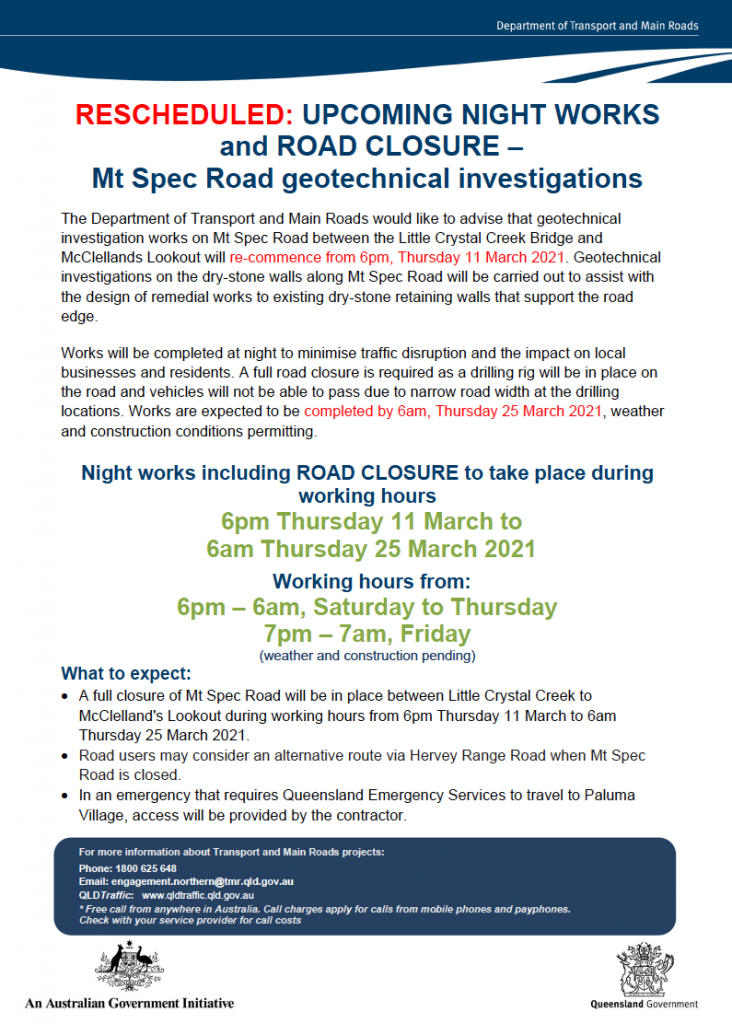
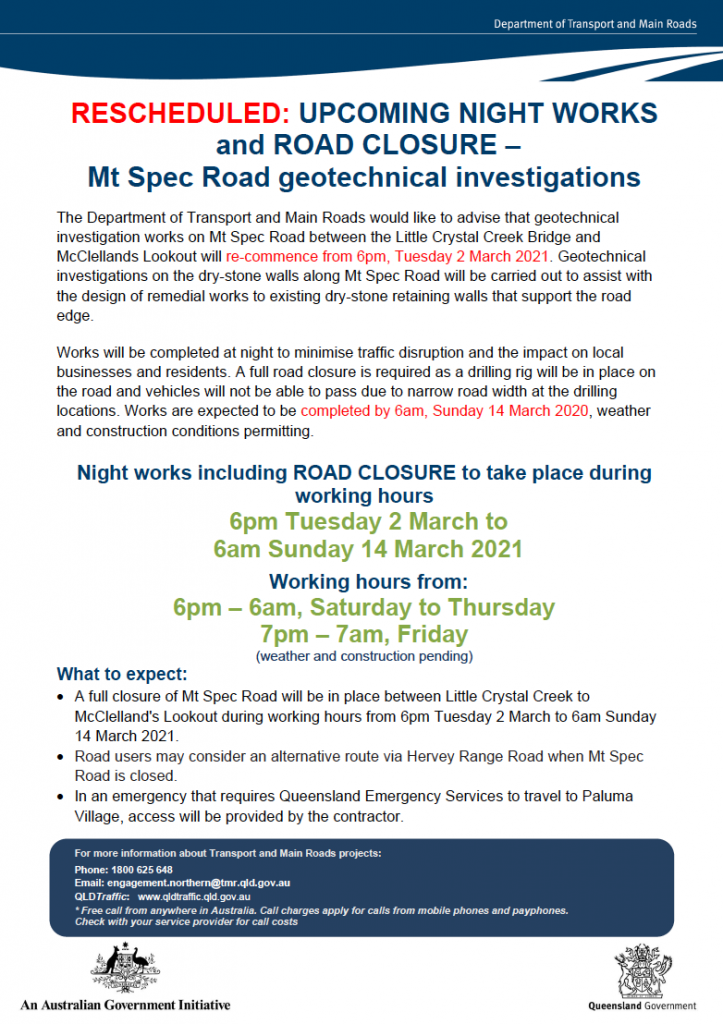
Please be advised that the full road closure of Mt Spec Road will now commence on Tuesday 15 September 2020 from 6pm, not Monday 14 September as previously advised.
Mt Spec Road will be open for all road users on Monday 14 September 2020.
For those that have registered, TMR SMS alerts regarding the Mt Spec Road closure will commence from next Tuesday 15 September 2020 at 4pm.
Please do not hesitate to contact TMR’s Customer and Stakeholder Engagement team on the details below for further information.
Customer and Stakeholder Management (Northern) | North Queensland Region Program Delivery And Operations | Infrastructure Management & Delivery Division |
Department of Transport and Main Roads
Floor 6 | Townsville Government Office Building | 445 Flinders Street | Townsville Qld 4810 PO Box 1089 | Townsville Qld 4810 P: 1800 625 648 | F: (07) 4421 8725 E: engagement.northern@tmr.qld.gov.au W: www.tmr.qld.gov.au
Notice to residents Mt Spec Road reconstruction works
Would you like to receive updates via SMS about Mt Spec Road closures?The Department of Transport and Main Roads (TMR) will commence reconstruction works on Mt Spec Road, between Little Crystal Creek bridge and McLellands Lookout, from next week – Monday 14 September 2020.
To enable crews to safely and efficiently complete works at a number of locations, Mt Spec Road will be closed to all traffic each night from 6pm to 6am, Saturday to Thursday, and from 7pm to 6am on Fridays. Works are expected to continue until December 2020.
TMR will send SMSs to subscribed stakeholders for the first few weeks of works to ensure residents are reminded of the road closures and can plan their travel accordingly.
Townsville City Council has announced that the next kerbside collection of bulk rubbish has been postponed to Monday 28th September. Currently only 2 residences have registered for this service and the Council is asking for the word to be passed around concerning this new date, and the need to register if you wish to have your rubbish picked up.
People can submit a booking enquiry at townsville.qld.gov.au Generally they want some idea of what the rubbish is and how much – presumeably to decide which truck to send! There are some items that can’t be collected, these are detailed on the website.
As previously reported, Les Hyland was nominated to be the Townsville City Council “Senior of the Year” for 2020. While he did not win the award, he was included in the short list. This Saturday (Sept 12) our local Councilor, Margie Ryder, will come up the range to make a presentation to Les in recognition of his shortlisting. The event will be at the Rainforest Inn at 11am. Please come along to help celebrate the achievements (and stamina!) of our now-famous senior member of the Village.