It is with sorrow we report the passing on Saturday, of Bill White after a courageous battle with an aggressive form of cancer.
Bill was the former owner of No 8 Mount Spec Road and was a regular weekend visitor. It was always a pleasure to be in his company, enjoying his good humour and interesting anecdotes. He will be sadly missed by his many friends in and around the village.
Our condolences and loving thoughts go out to Carol and the family.
The species name “glomulifer” refers to the flowers and derives from glomulus (little ball) and -fer (bearing). Turpentines can refer to any member of the genus Syncarpia, which is a member of the Myrtaceae family
There are three Syncarpia species all of which are endemic to Australia. S. glomulifera is the most widespread as is simply referred to as Turpentine, while the other two, S. hillii (Satinay or Fraser Island Turpentine, and S. verecunda (Red Turpentine) have more limited distributions. The habitat most commonly associated with Turpentine is a transitional forest between rainforest and wet sclerophyll forest and woodland, in altitudes between 40 to 1100 metres. It is found from the Big Table-land near Cooktown to southern NSW. It grows as an emergent tree among other popular timber trees such as grey ironbark, tallow-wood, brush box, grey gum, red ironbark, mountain mahogany, spotted gum and various rainforest trees. Here, Turpentine can be seen in the vicinity of the rose gum forest west of Paluma.
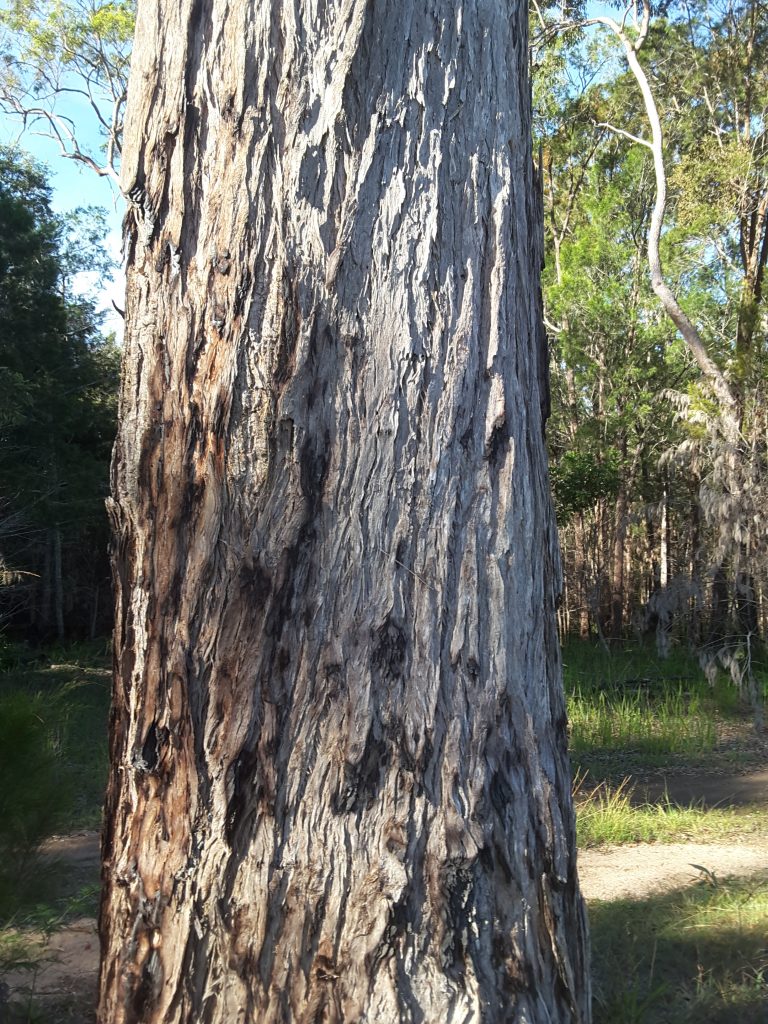
Tall and straight trunked, Turpentine is a vigorous grower and can reach a height of 25 to 60 metres in tropical areas. The trunk can attain a diameter of 1.5 metres. Its bark is coarse, fibrous and deeply furrowed; new twigs are hairy. It is also a long-lived tree and some specimens are said to have reached 300 years.
The elliptic leaves are simple, opposite or whorled. 30 – 110 x 14 – 45 mm in size. The upper side is glabrous or minutely hairy while the under-surface is covered in white hair, with brownish oil dots visible with a lens. The leaves are mid green, red when young, with wavy margins. They are aromatic when crushed and this aroma reminded early settlers of turpentine, hence the common name.
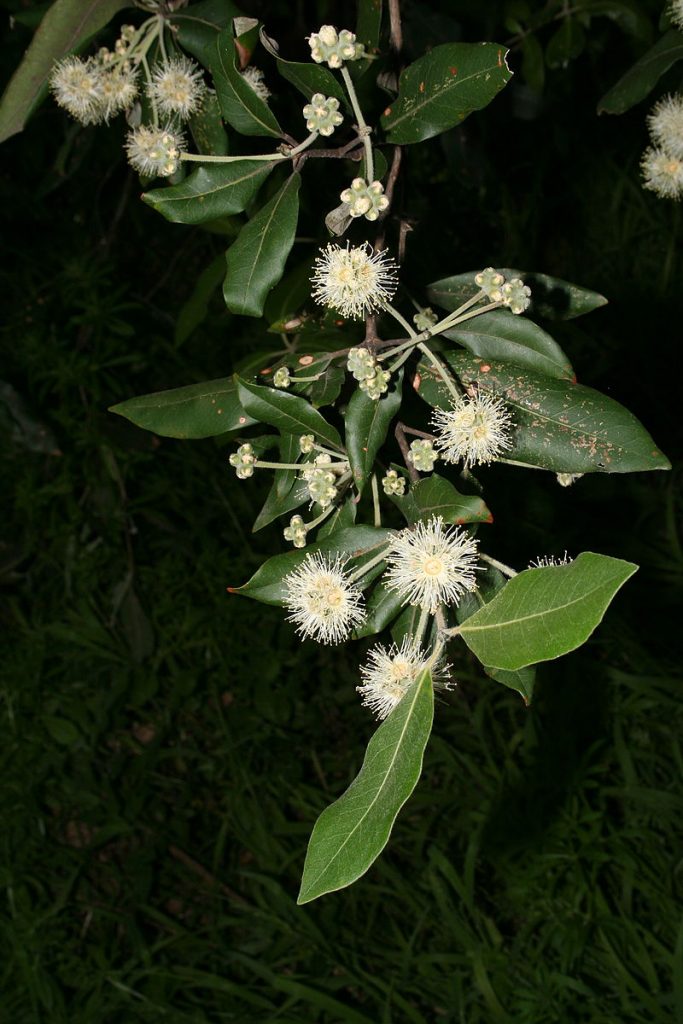
Syncarpia glomifera flowers photo by Casliber CC by SA 3.0
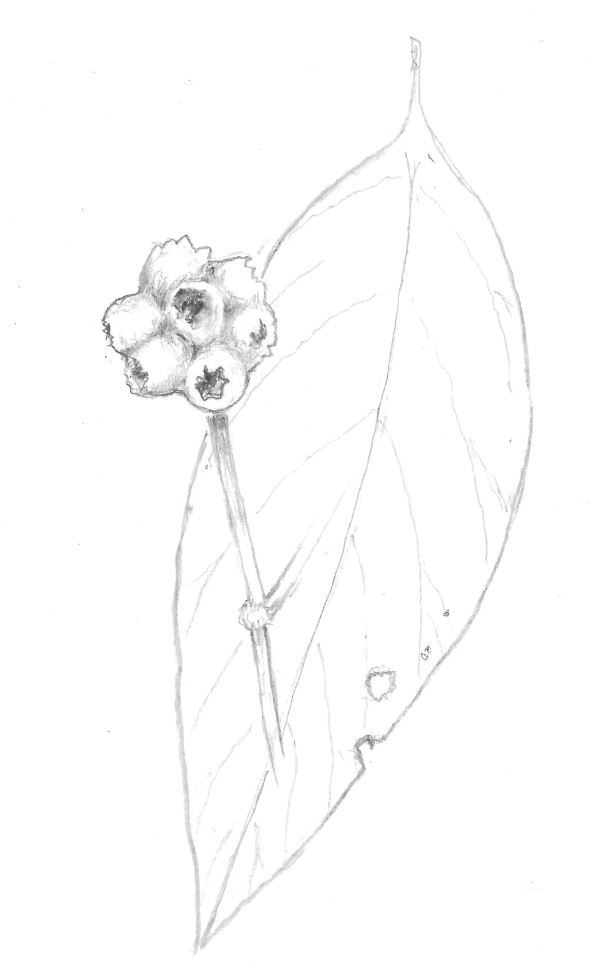
Syncarpia seed capsule (about the size of a marble)
Flowering occurs from August to February. The fragrant flowers are clustered in axillary or terminal heads. The flower has four or five white or cream petals and fine filamentous white or cream stamens, similar in appearance to many Australian native flowers. They are very popular with pollinators like European honey bees, native bees, grey flying fox, little red flying fox and birds such as lorikeets.
Fruiting occurs between November and July. The grey or brown fruit is an aggregate capsule 10 – 12 mm long and 12 – 22 mm wide. There are usually seven valves containing numerous orange/brown seeds about 2 mm long.
Turpentine was much sought after as a hardwood with its reddish-brown colour ranging to a deep chocolate brown and its coarse even texture with a straight grain. It is an excellent timber for dance floors. It is also used in the construction of plywood, laminated beams, bench tops, joinery and parquetry, boat building and wine casks. Because the timber is fire resistant and highly resistant to termites, marine invertebrates and borers, it was much in demand for piers and building foundations. During the War years, Archie Taylor cut two turpentine logs over 100 ft long (one was 128 ft) for an American Radar station. It took several days to get the logs down the Range to Moongoobulla.
The area around Paluma was heavily logged, especially during the War-time years. So much so, that there are not even any relict trees known on the H Track or surrounding area. There are however, several fine living specimens in the vicinity of Hussey Road and around the Blackfriars district. Around Taravale there are many young trees.
Although the IUCN Red List status of this species is the lowest category (Least Concern), in NSW, the Turpentine-Ironbark forest of the Sydney Basin Bioregion is now listed as endangered or critically endangered in the Threatened Special Species Conservation Act, NSW, 1995 as are all the communities with which the Turpentine-Ironbark forest vegetation intergrades. The Commonwealth also lists the Community as critically endangered under the Environmental Protection and Biodiversity Conservation Act, (Commonwealth) 1999. The fate of these trees is an example of how easily and quickly human activity can change an environment and the habitats of many insects, birds and animals.
Turpentine trees have been introduced into Hawaii, Africa, New Zealand, and the Cook Islands and the species is considered an invasive weed in most of these areas.
For detailed information on the timber industry around Paluma, I recommend Linda Venn’s book ‘Paluma: the First Eighty Years 1870’s to 1950’s.’
Next time you drive out to the rose gum forest, see if you can identify the turpentine among the gums, stringy barks she-oaks and other trees.
Text and photos (unless indicated) by Colwyn Campbell
After some fears that the Bush Dance might have to be cancelled this year due to lack of accommodation, we have rescheduled the event to earlier in the afternoon (1-4pm) so that people can come up for the day and still get back to town before dark.
There will be a sausage sizzle before the band starts up (12pm) and the bar in the hall will be open so you will be able to enjoy a drink and a snack while listening to some great bush music or join in the dancing.
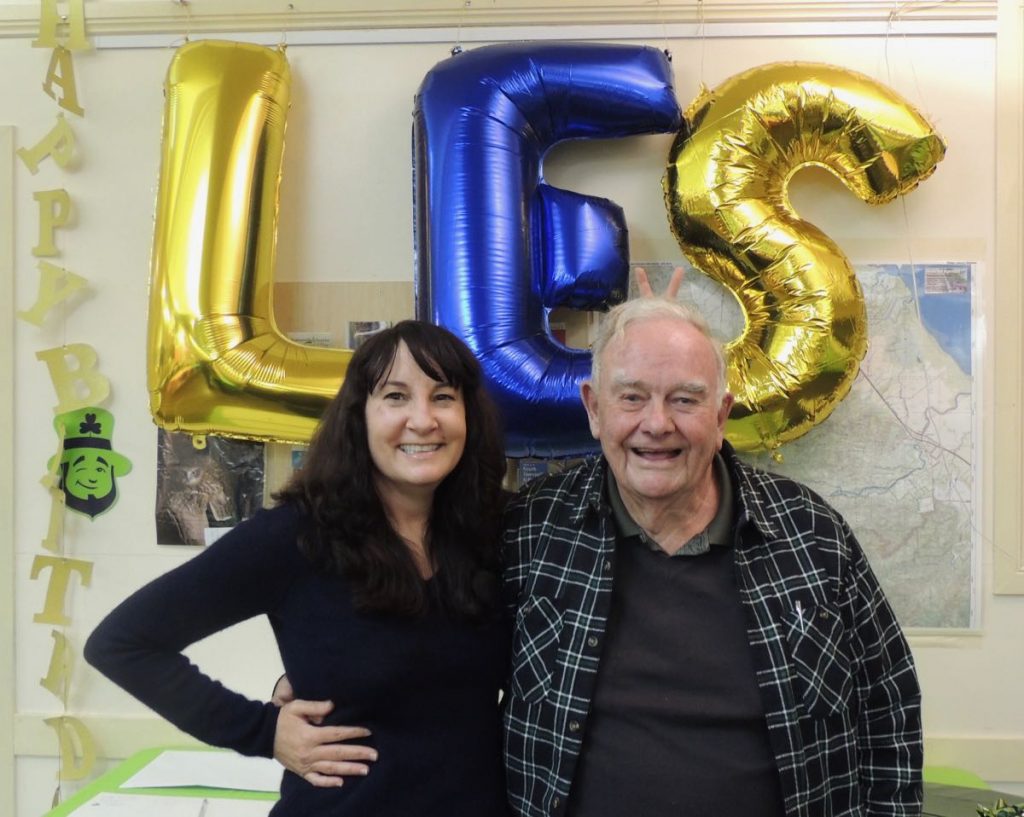
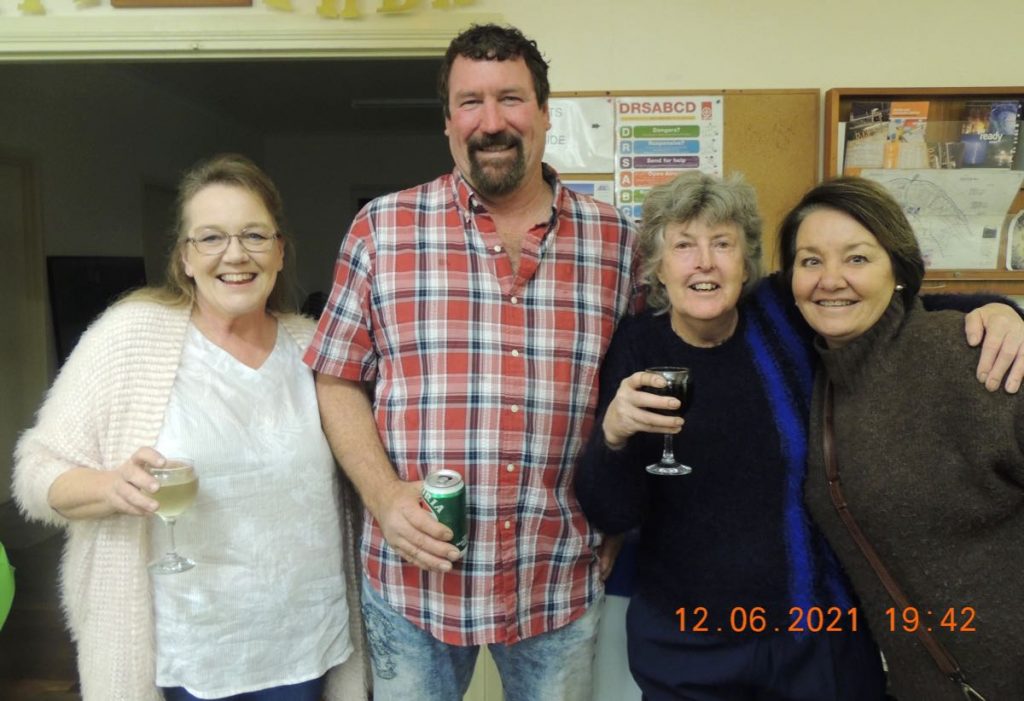
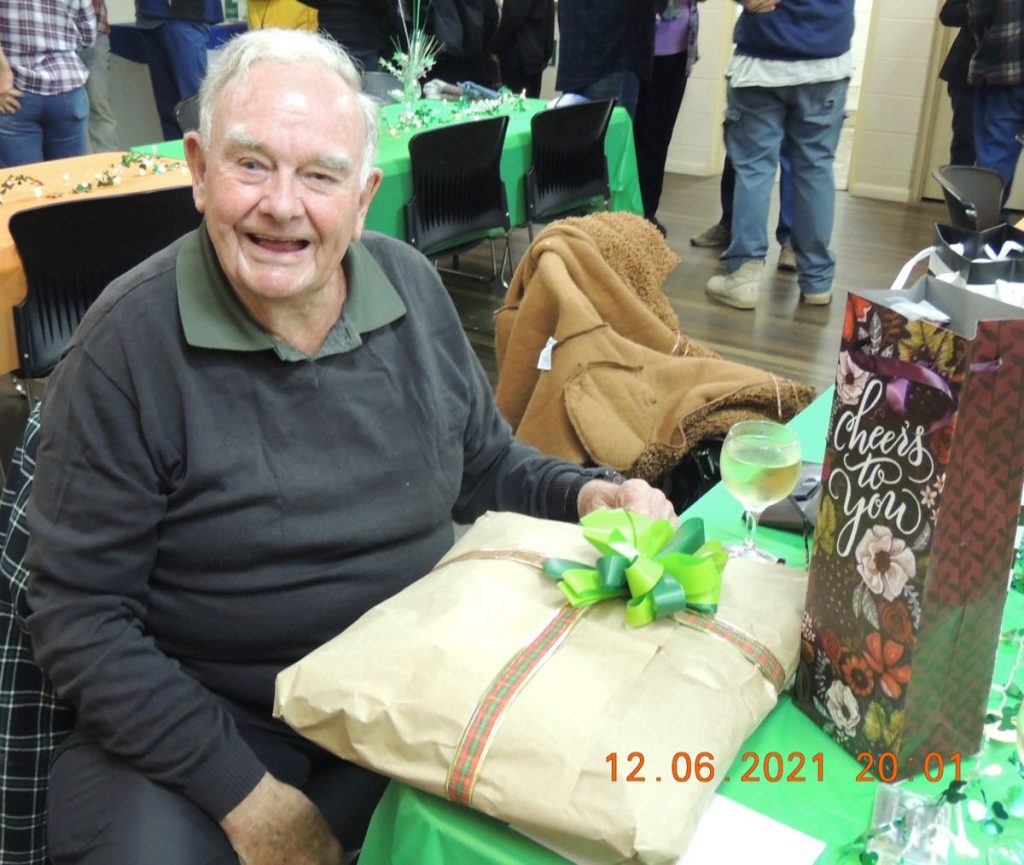
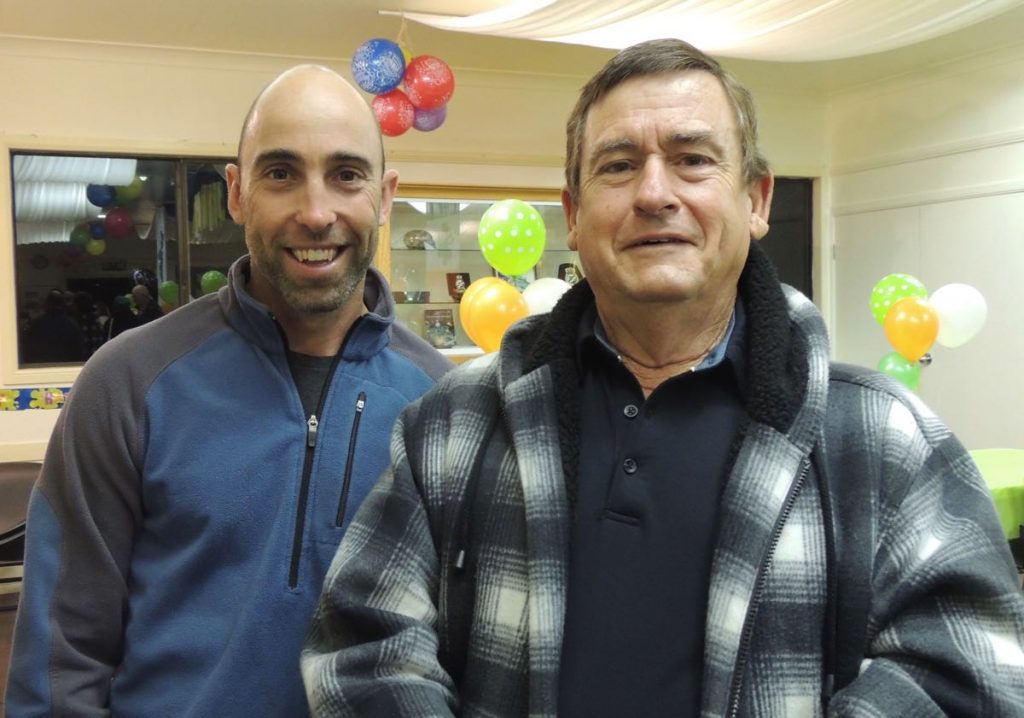
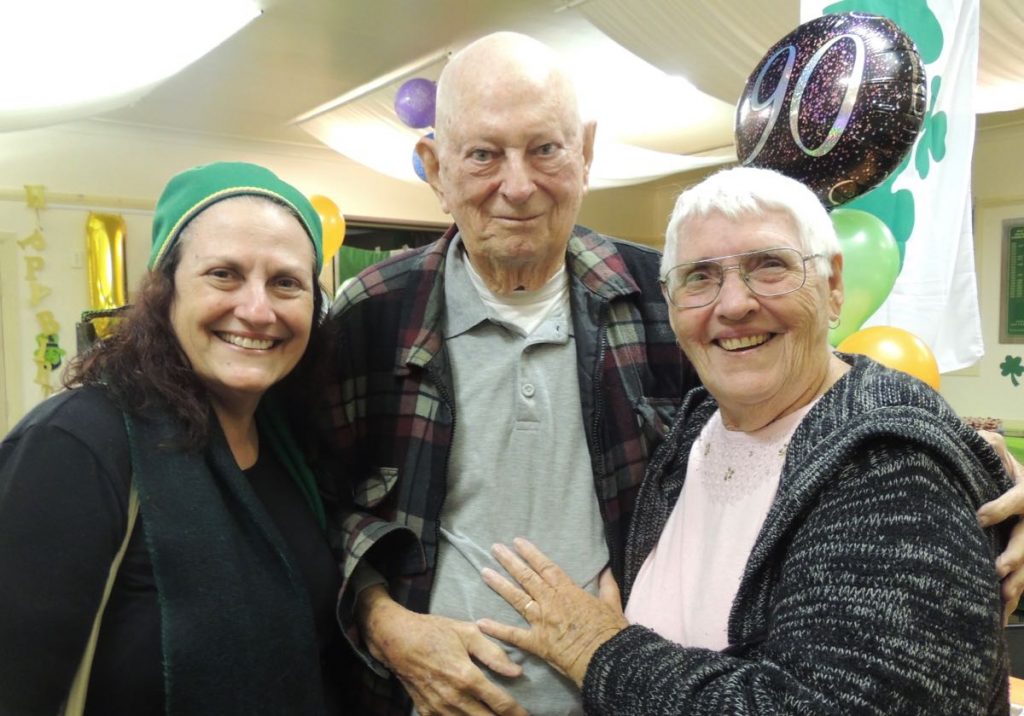
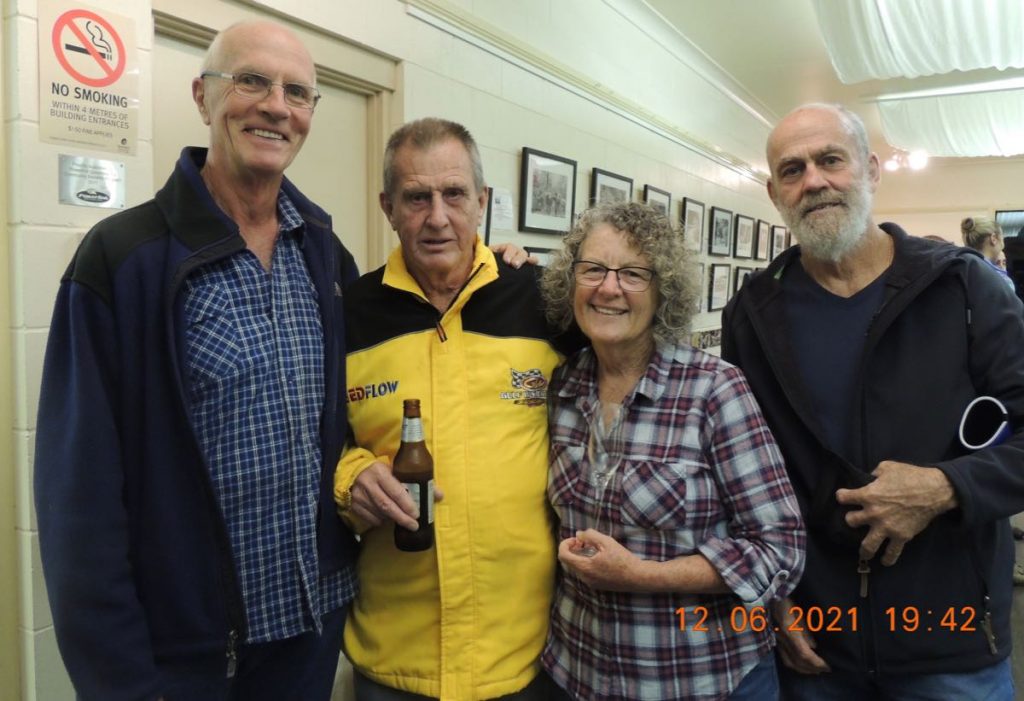
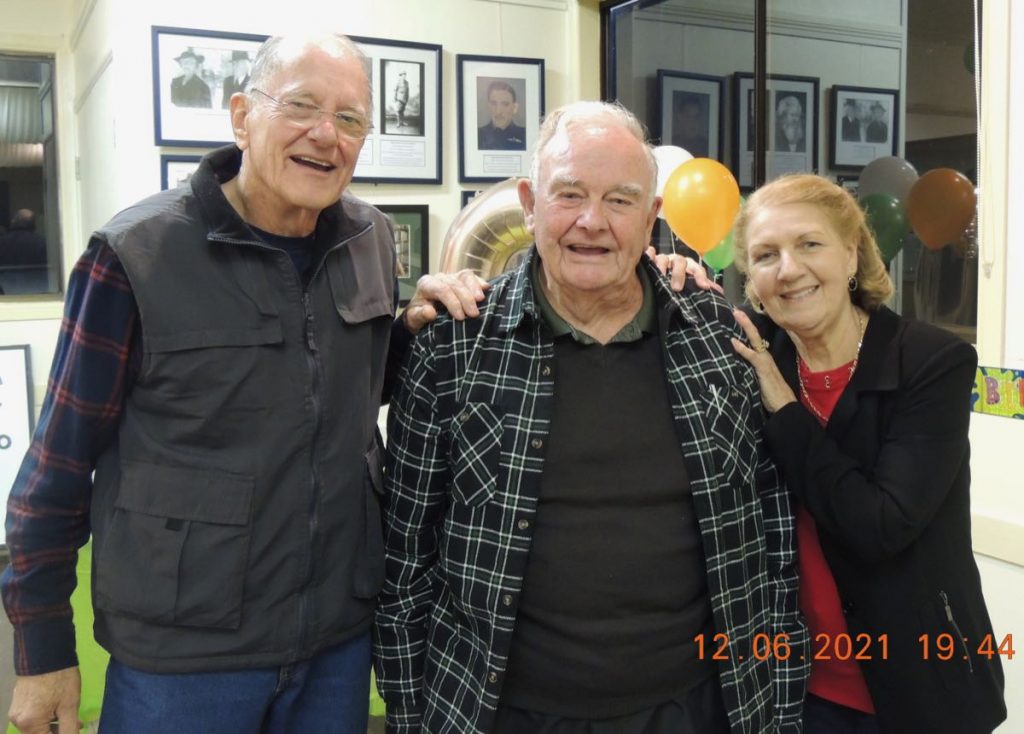
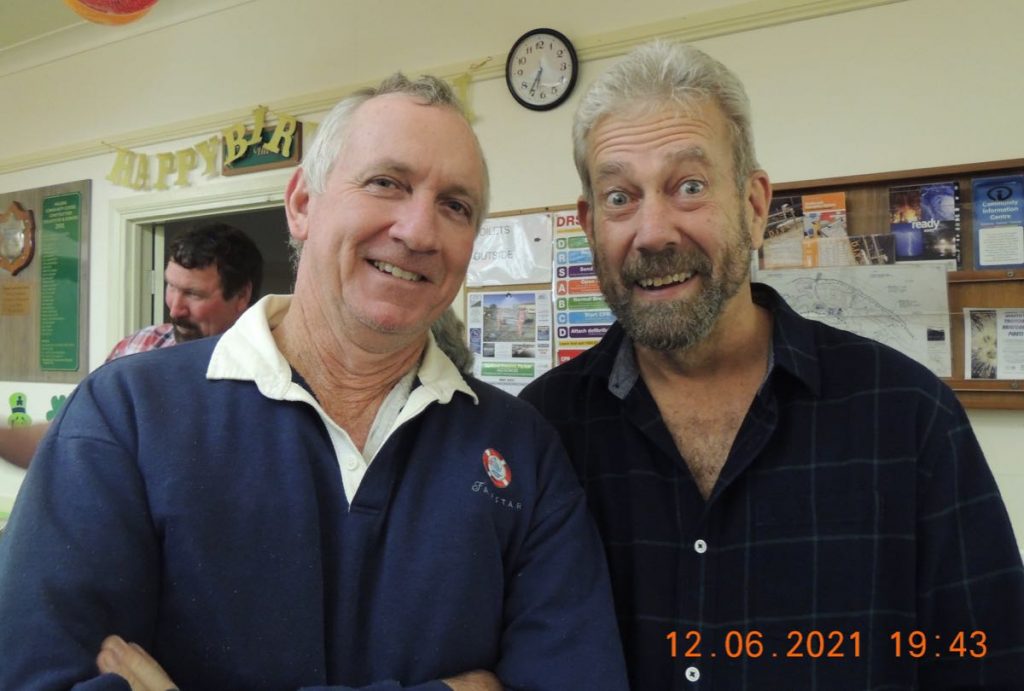
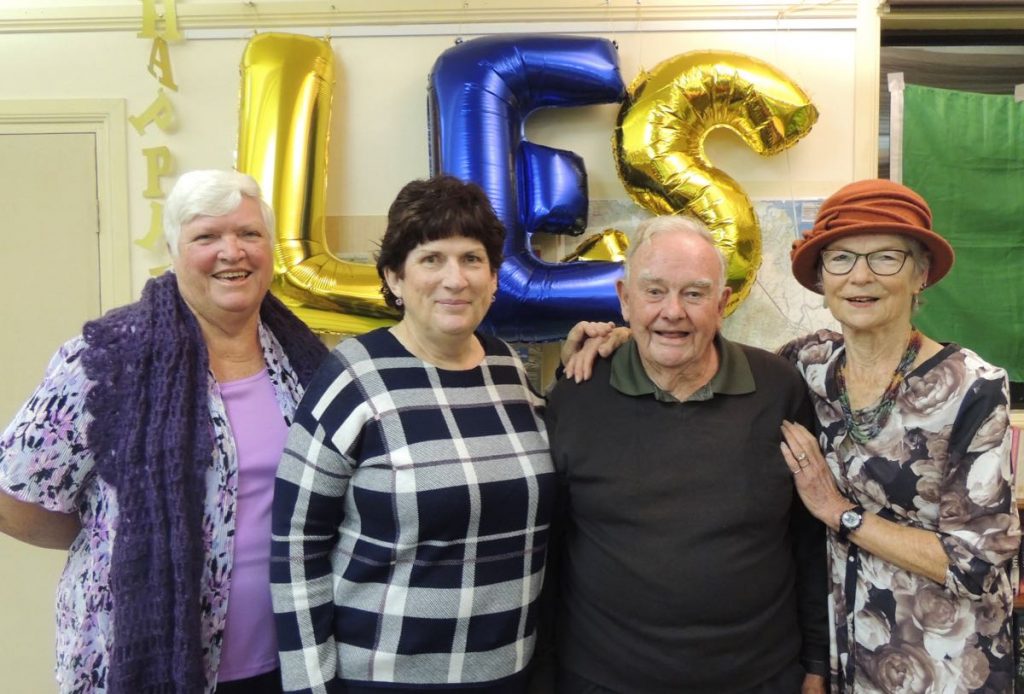
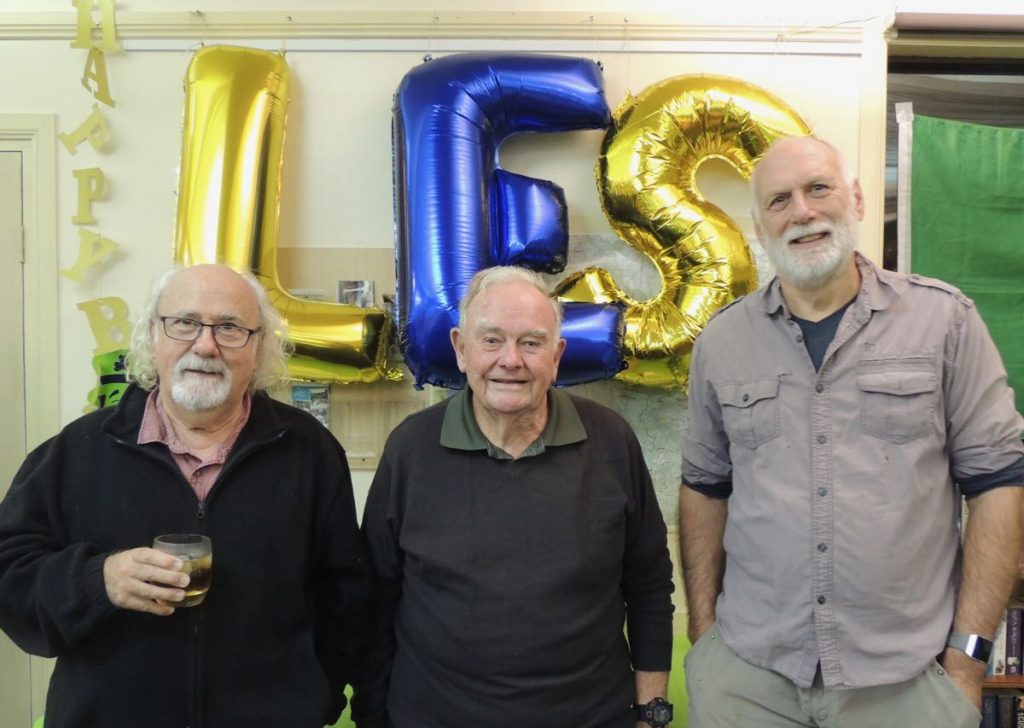
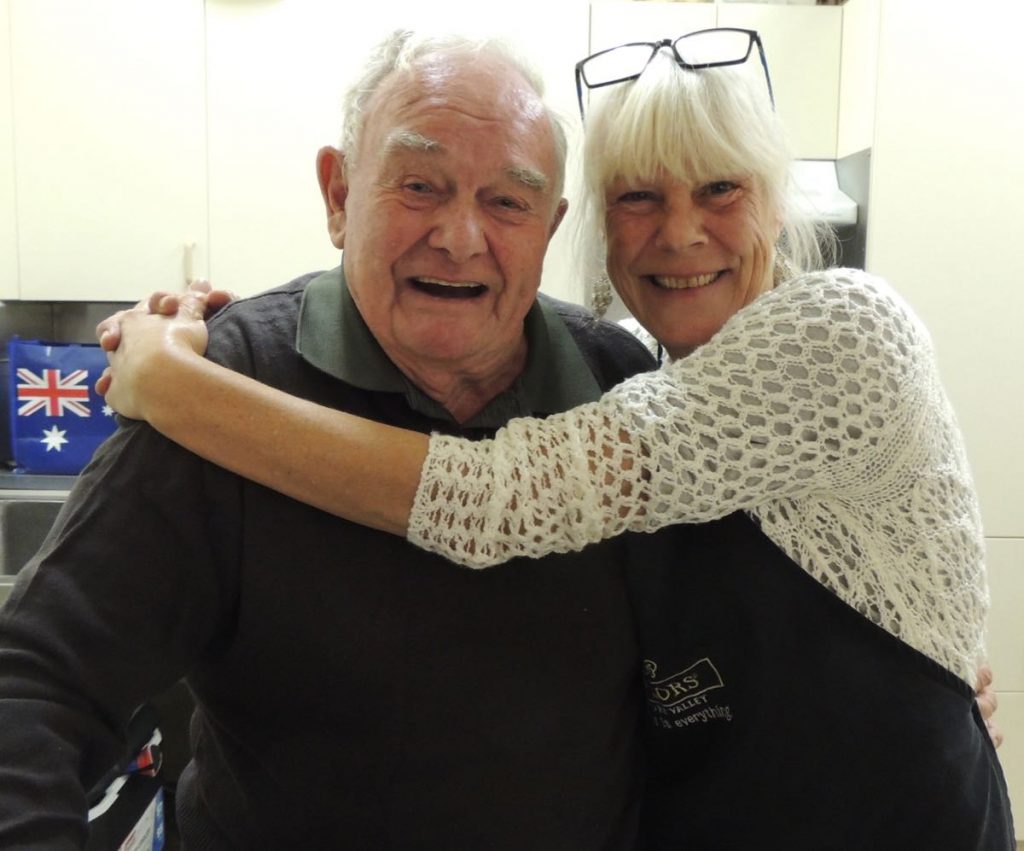
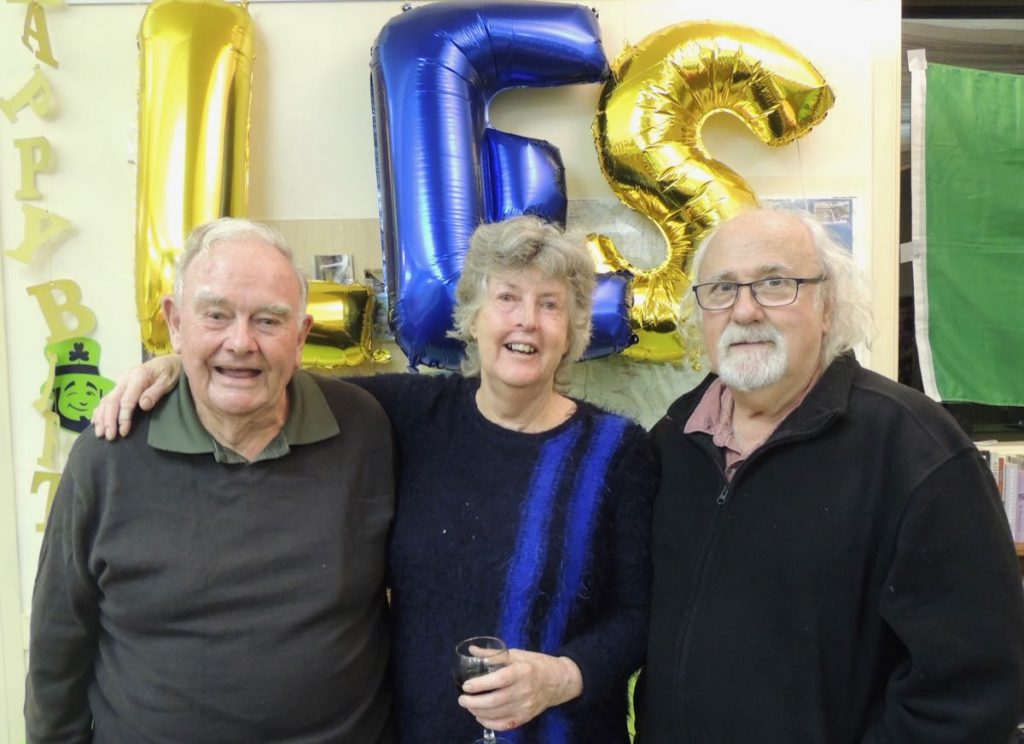
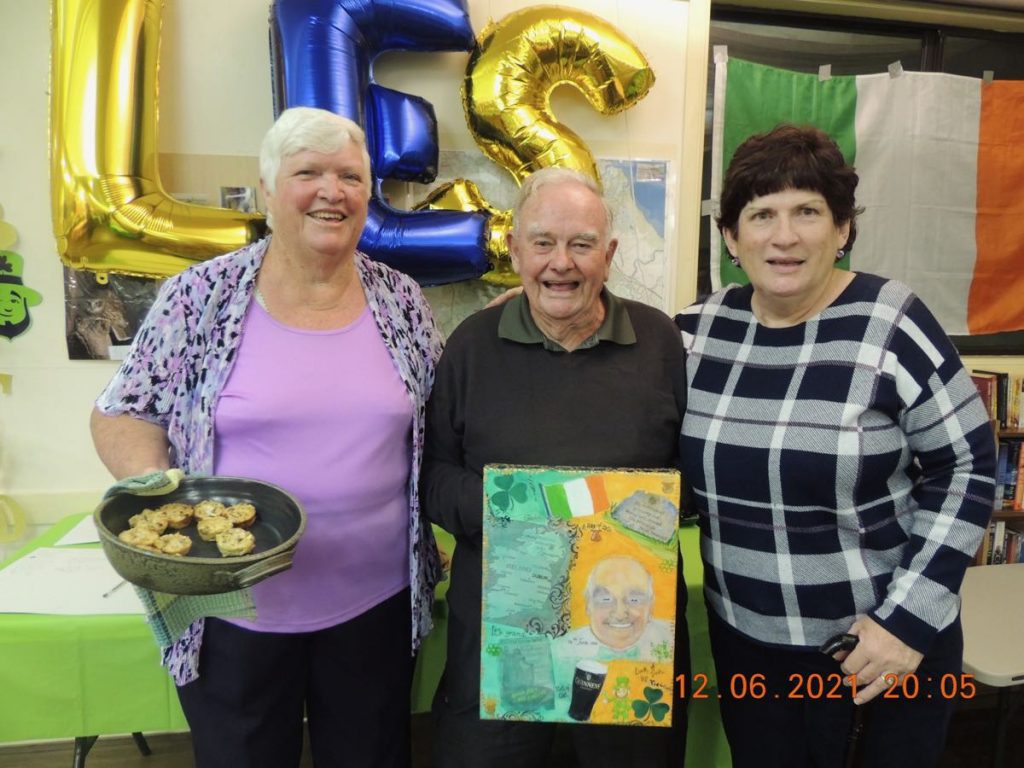
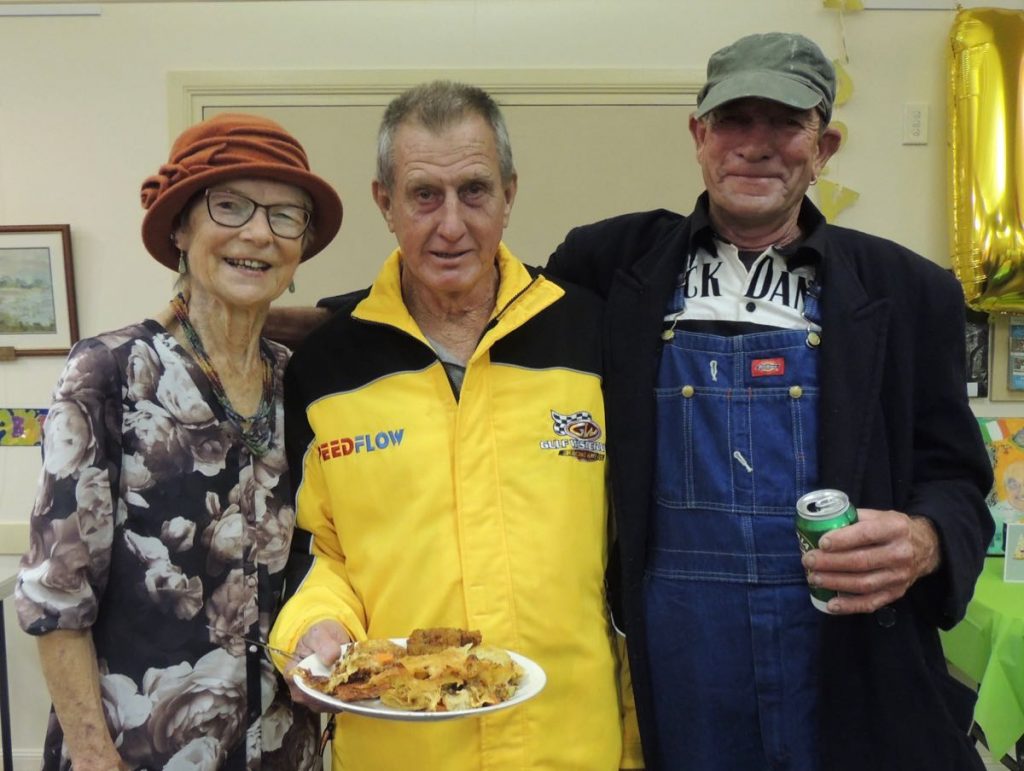
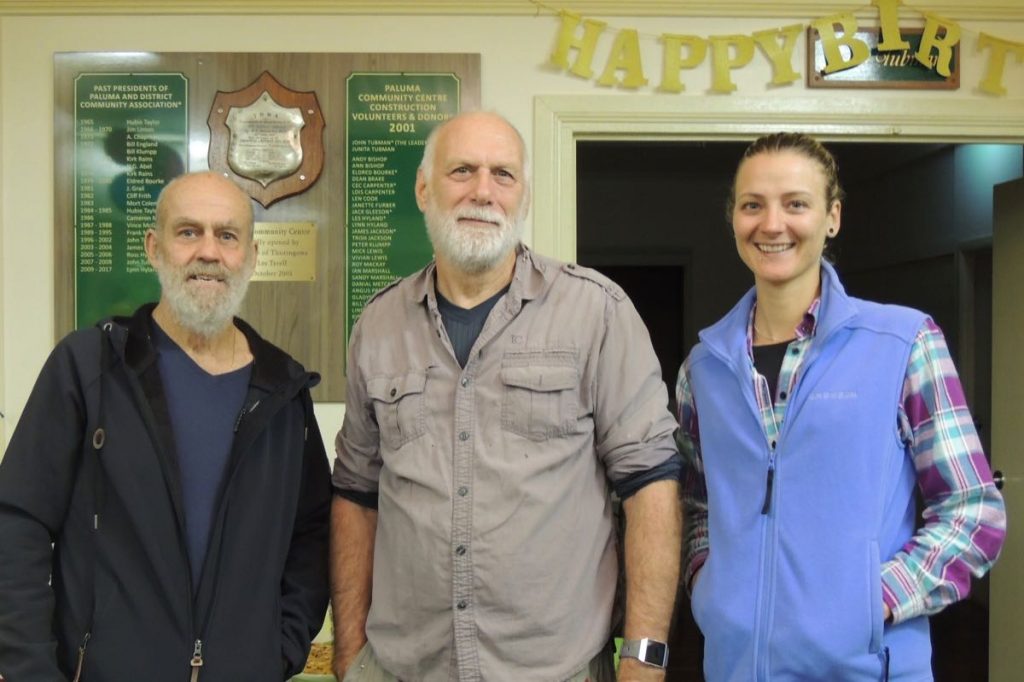
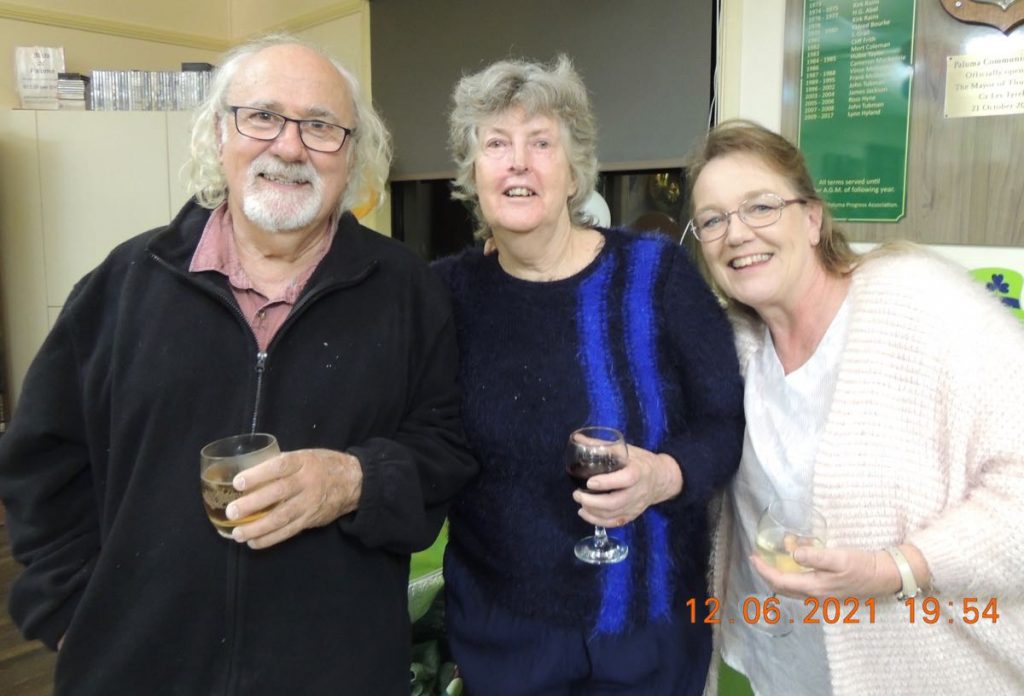
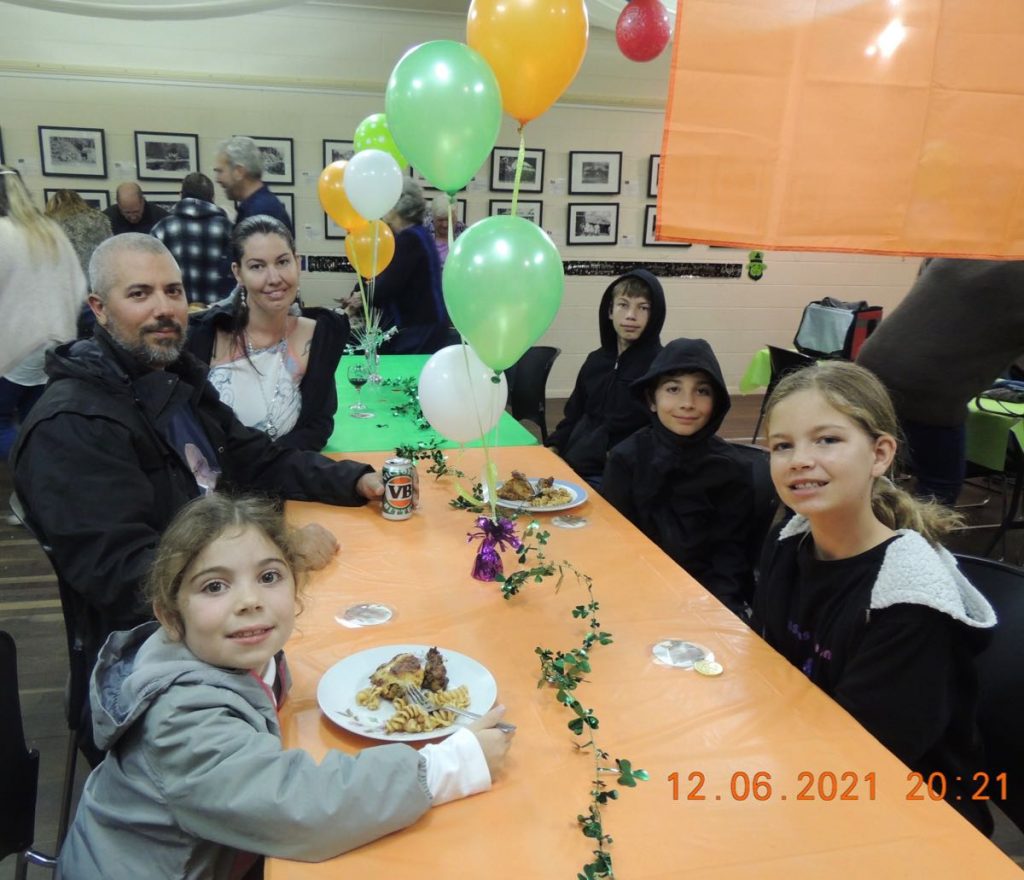
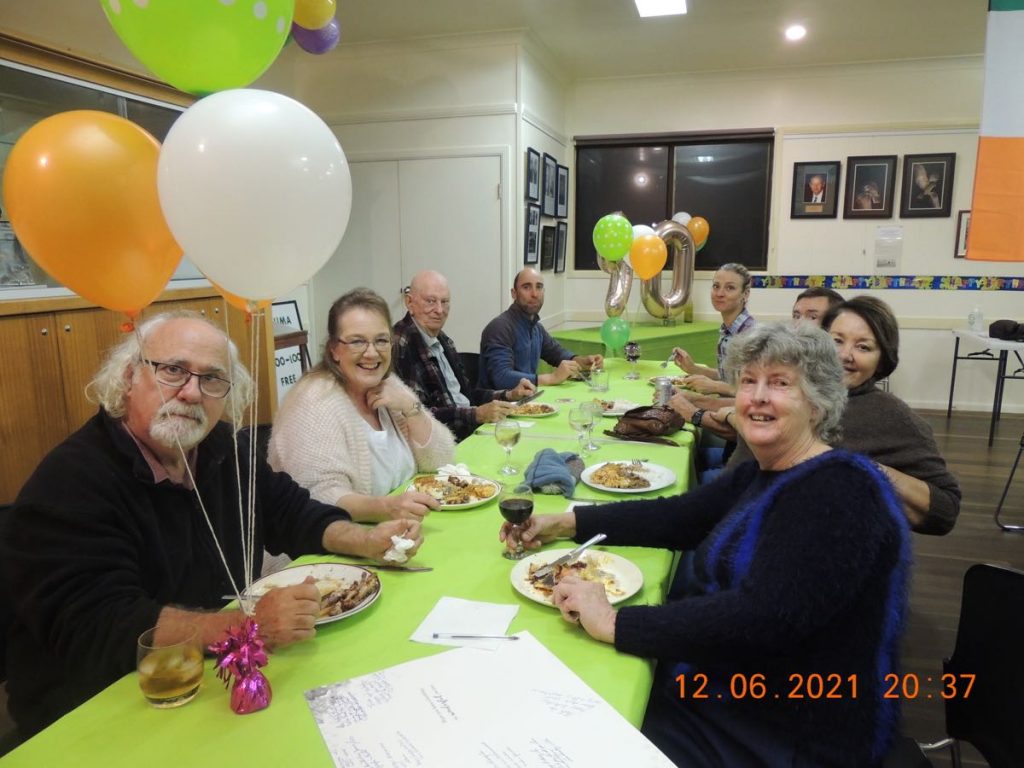
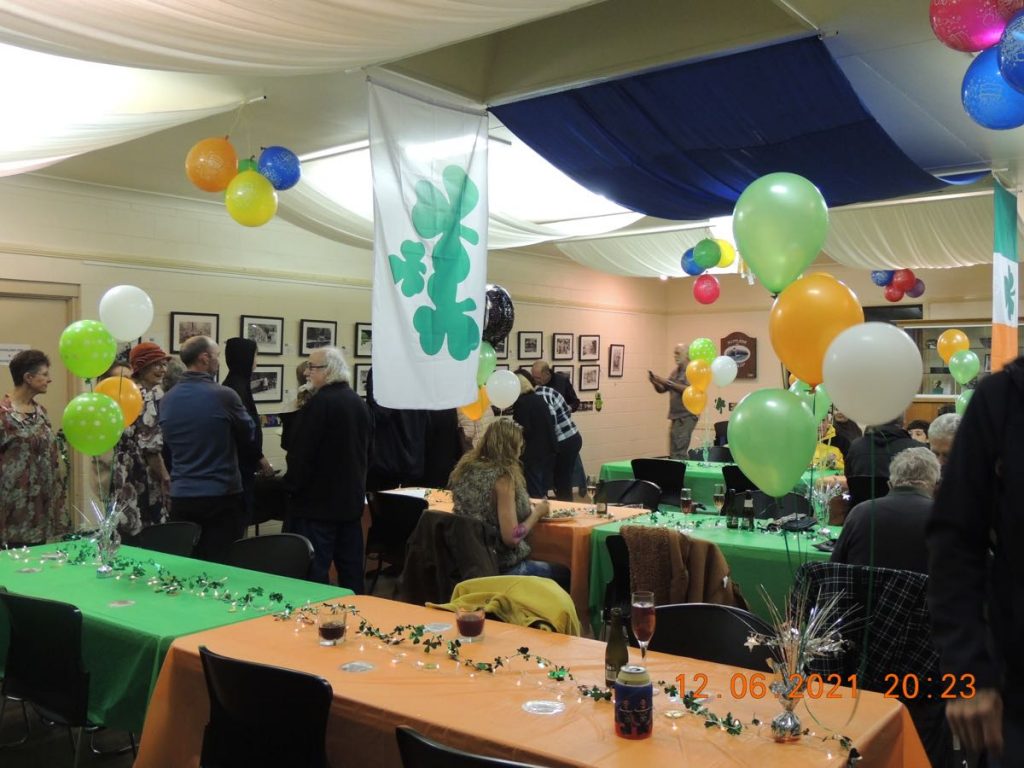
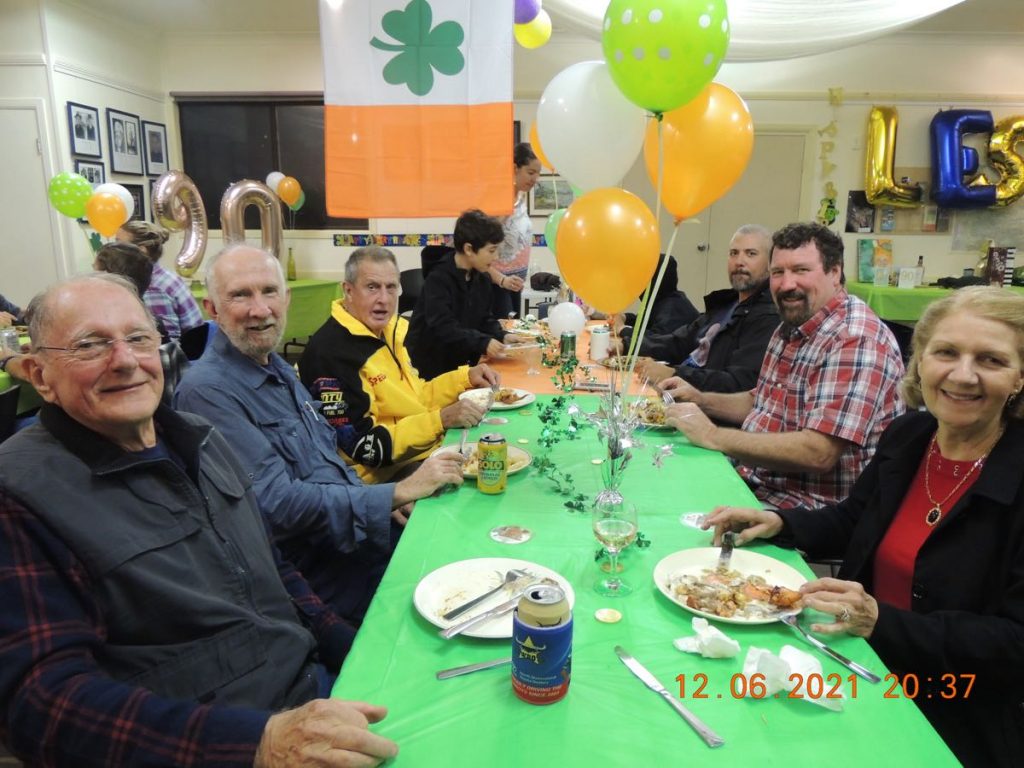
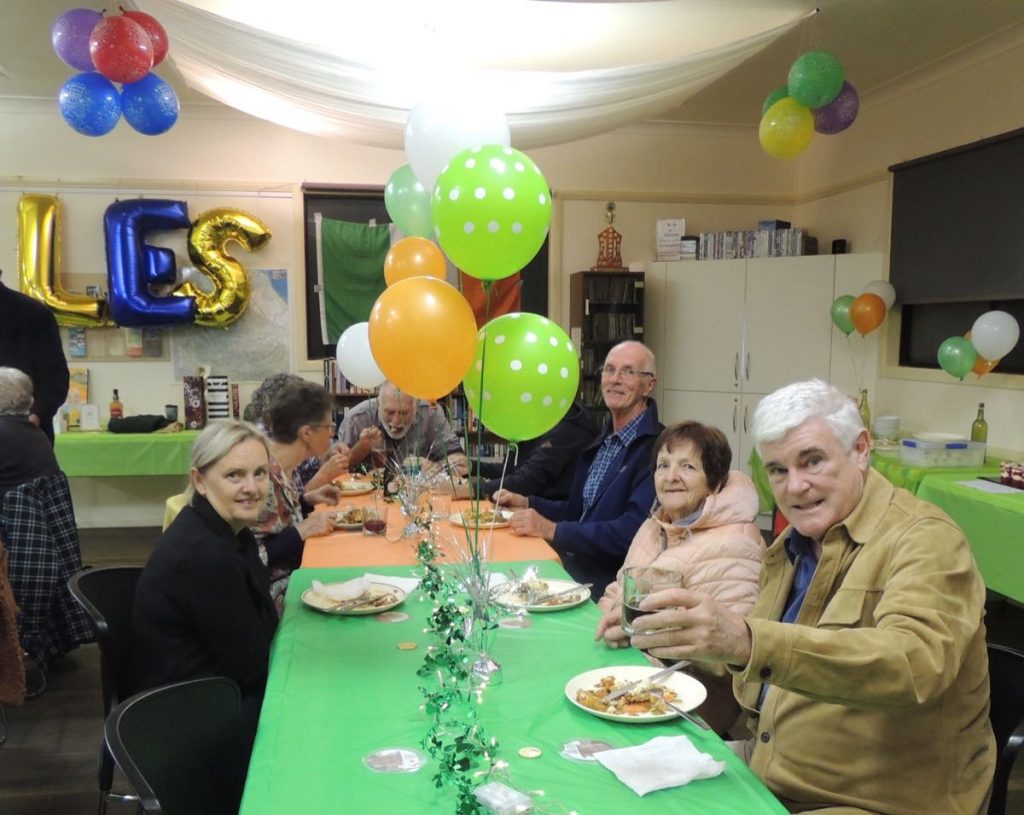
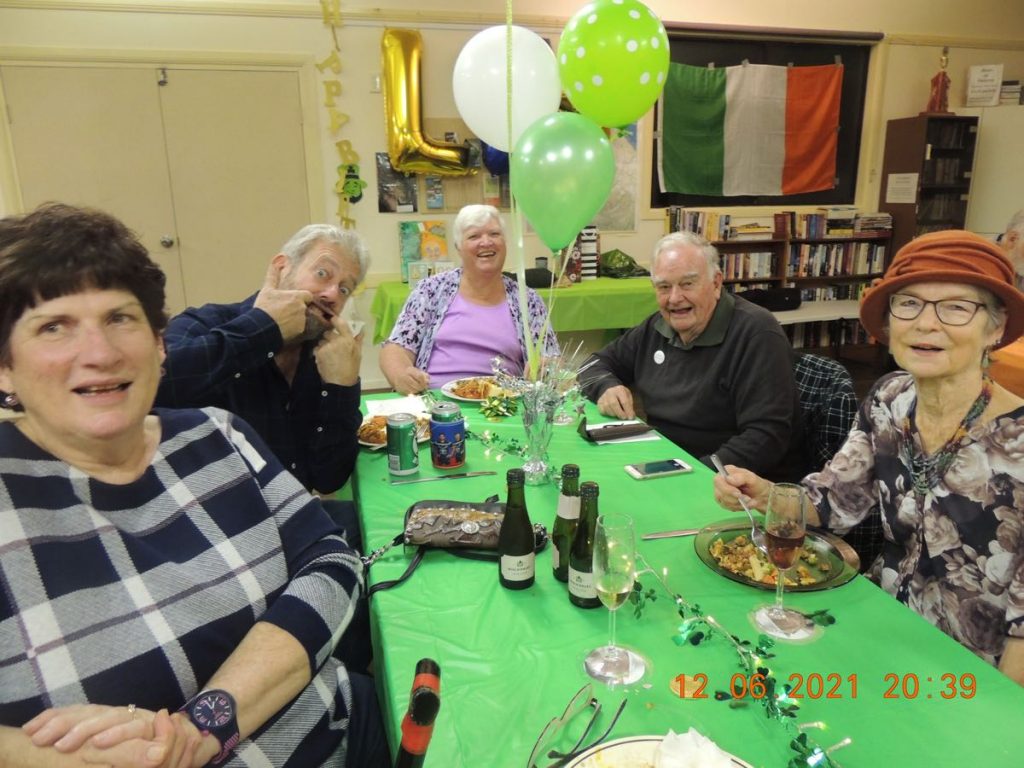
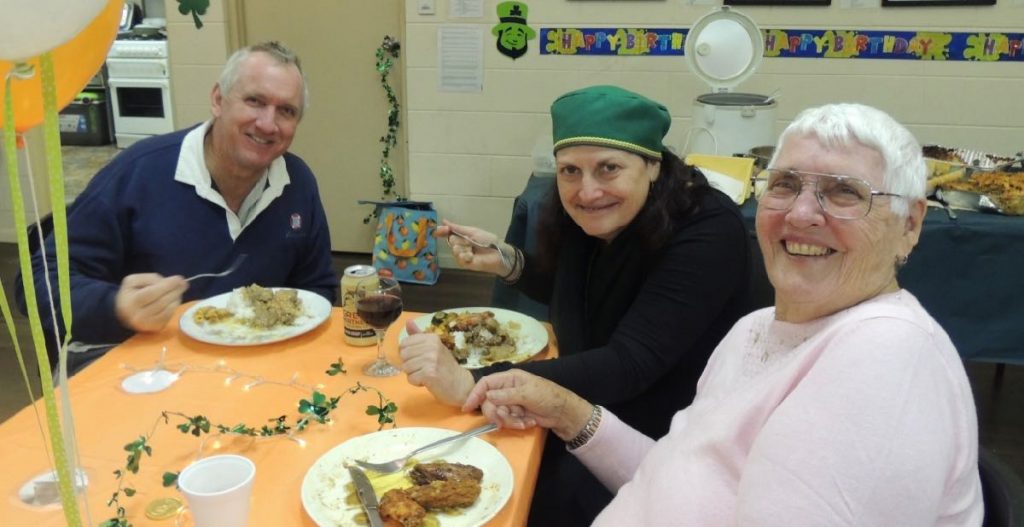
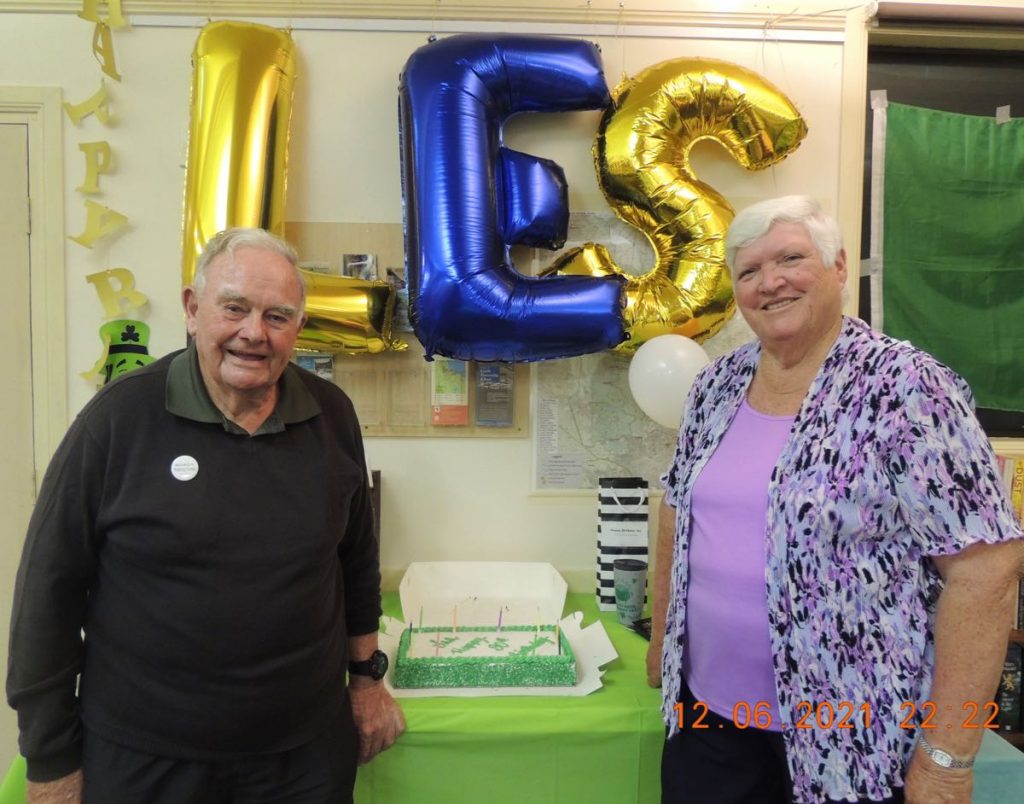
On Saturday night (12/06/2021) Paluma hosted a 90th birthday party for our local living legend – Leslie Hyland. About 40 of Les’ friends and extended (Paluma) family joined him to mark the occasion with dinner and drinks. The Community Hall was transformed into shades of emerald green and orange to honour Les, his Irish heritage and his enormous and ongoing contribution to our village community. The whisky and wine flowed as freely as the lively conversation, before everyone enjoyed an amazing banquet of food to rival any restaurant. As always, Paluma’s cooks were outstanding in producing enough food for a small army. No-one went home hungry, that’s for sure!
Some outstanding presentations were made in honour of Les by Lynn, Peter, Jamie and Anne. Lynn compiled and presented a photo essay of Les’ life from birth to 90. Peter, Jamie and Anne were eloquent in expressing the great respect, appreciation and love we all have for Les Hyland and each gave renditions of the remarkable contribution he has made to the Paluma community over the past 35 years. There were a few Irish jokes, a lot of Irish whisky, good humour and camaraderie. Les received an array of birthday gifts including enough whisky to last him until the next birthday!
Special thanks to all those who contributed to making the occasion a special night for Les including Lynn, Peter, Jamie, Colwyn and Charlie. Lynda was exceptional as always at multi-skilling with her decorating and bar-tending.
Les’ birthday is actually on Monday (14 June) so we all wish him the very best on the day. And just to let you know Les, we are already planning your 100th birthday party!!
Pollia is a large herb often found in disturbed shady areas along some of the walking tracks around the village. It is sometimes called ‘Wandering Jew’, although it is much larger than the weedy Tradescantiafluminensis of the same common name. Both are in the family Commelinaceae.
Photo by Peter Woodard (cropped) Creative Commons)
A terrestrial creeping herb, rooting at the nodes1’, the plant somewhat resembles a Cordyline with an erect stem 50 cm to 2m high and narrow elongate leaves. It has attractive small blue/purple flowers borne at the tip of the plant.
Pollia macrophylla is endemic to Queensland.
There is a large and conspicuous patch near the large buttressed quandong (signposted) on the Witts Lookout track. It is just downhill from the quandong, growing along the old path on the other side of the quandong.
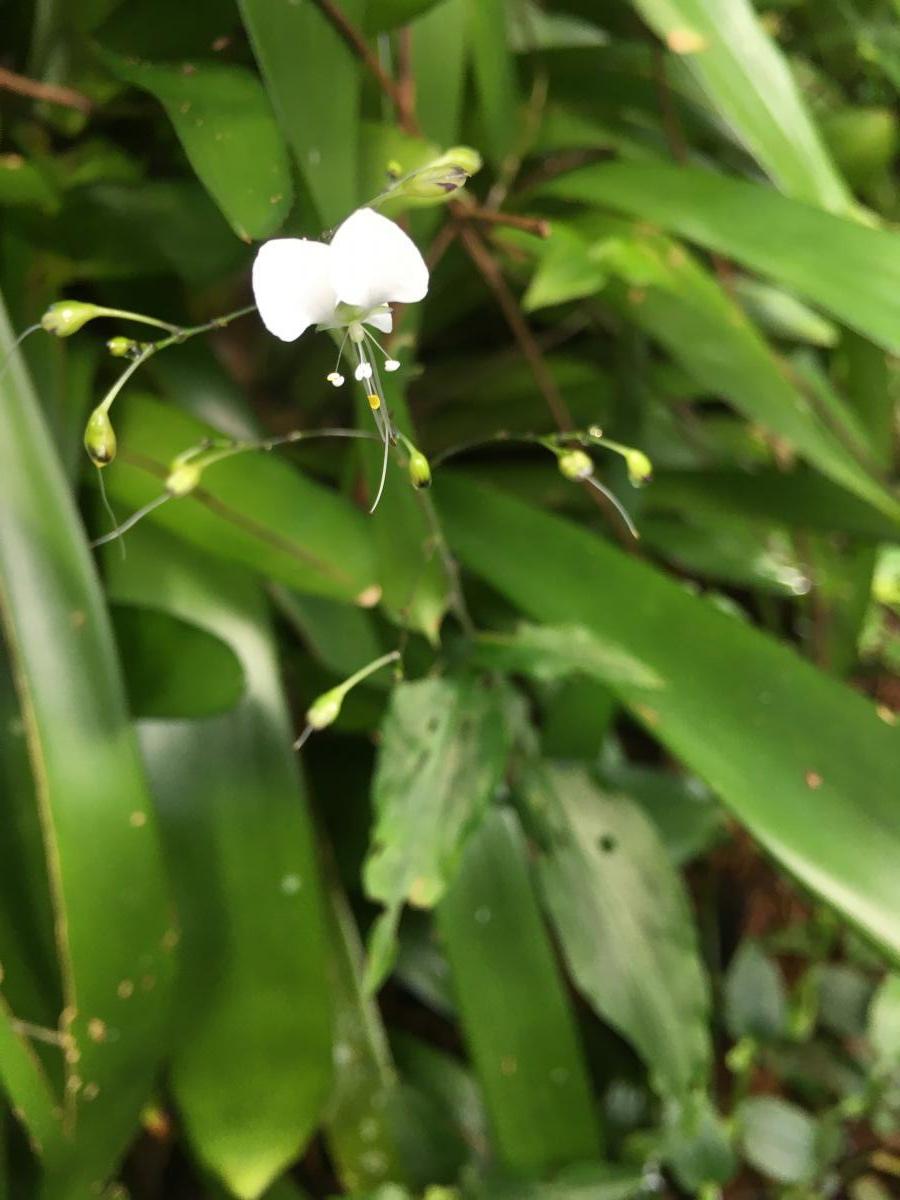
2. Pointed Aneilema (Aneilema acuminatum)
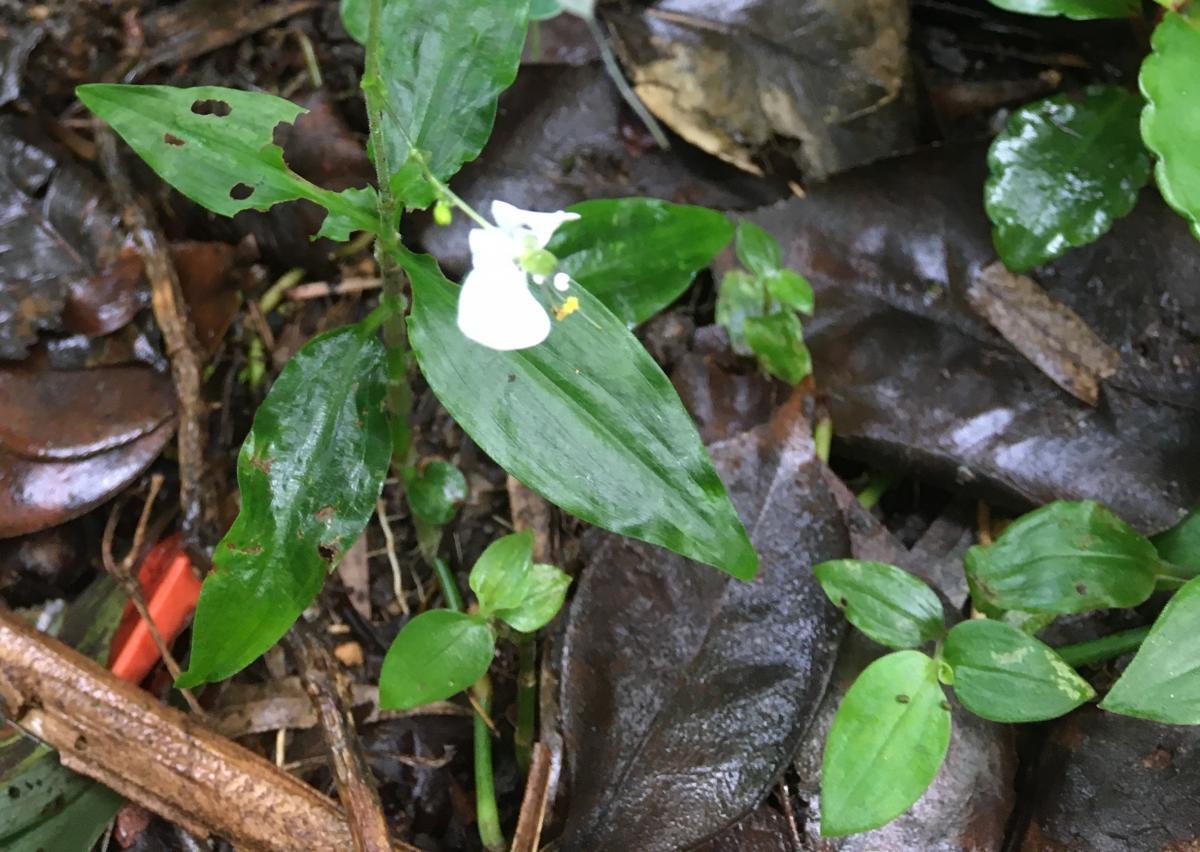
Also a member of the Commelinaceae family, this small creeping native groundcover can be found in shady areas beside rainforest tracks. It has elongate pointed leaves and a lovely delicate flower that is sometimes tinged with purple.
Pointed Aneilema flower. Copyright Russell Cumming on flickr
It is often found in Paluma gardens where it struggles to compete with the similar but aggressive introduced Wandering Jew or Trad (Tradescantia fluminensis) which often takes over large shady patches around the village in the wet season. Some Tradescantia species may cause dermatitis or skin rashes in dogs
Pointed Aneilema. Note the narrow pointed leaf shape compared to the invasive Trad at the bottom right of the image.
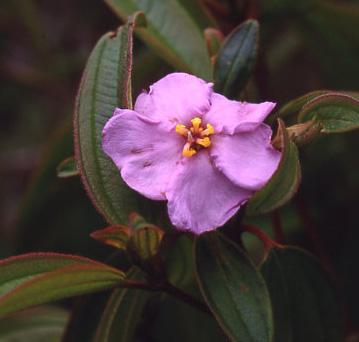
This small shrub is related (and looks very similar) to the showy purple-flowering Tibouchina that is common in gardens throughout the village. Both are in the Melastomataceae family. Melastoma can be found along the main road but also in sunny openings deep in the forest. Its flowers are light mauve/pink in colour and smaller than most Tibouchina flowers. The leaves are covered in fine hairs and have three prominent veins. The plant normally grows to 1-2m.
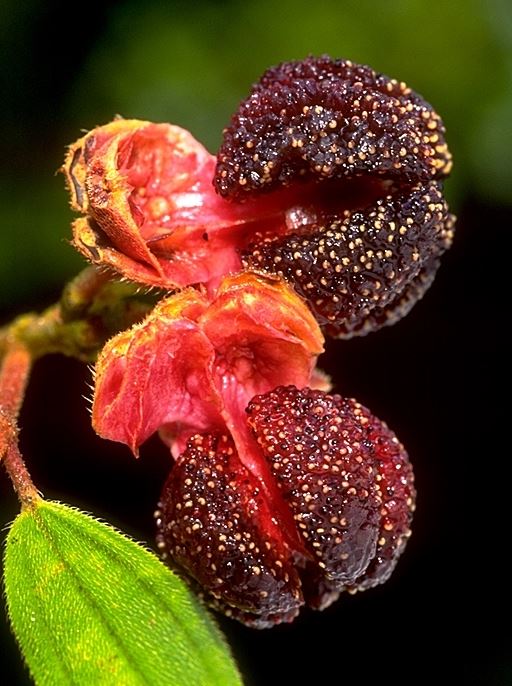
The fruit is red and eaten by double-eyed fig parrots and is apparently edible by humans. Its generic name Melastoma means “black tongue” and one of its other common names is Blue Tongue. Apparently, this is what you can expect if you eat the fruit!
Native Lassiandra can be found across west, northern and eastern Australia in rainforest and other wet areas. It also occurs throughout SE Asia. Some websites and books refer to this species as Melastoma affine, although M. malabathricum subsp. malabathricum is now the accepted name in Australian herbaria.
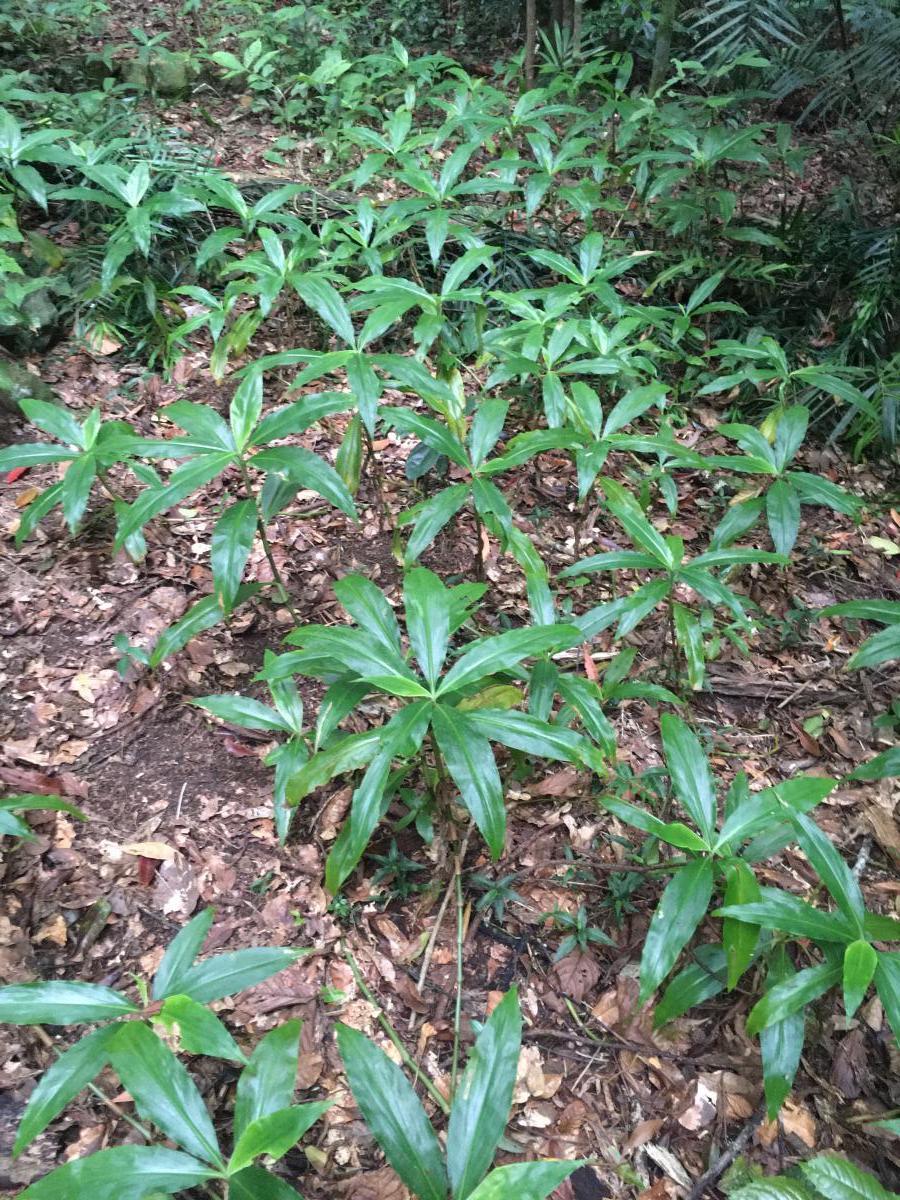
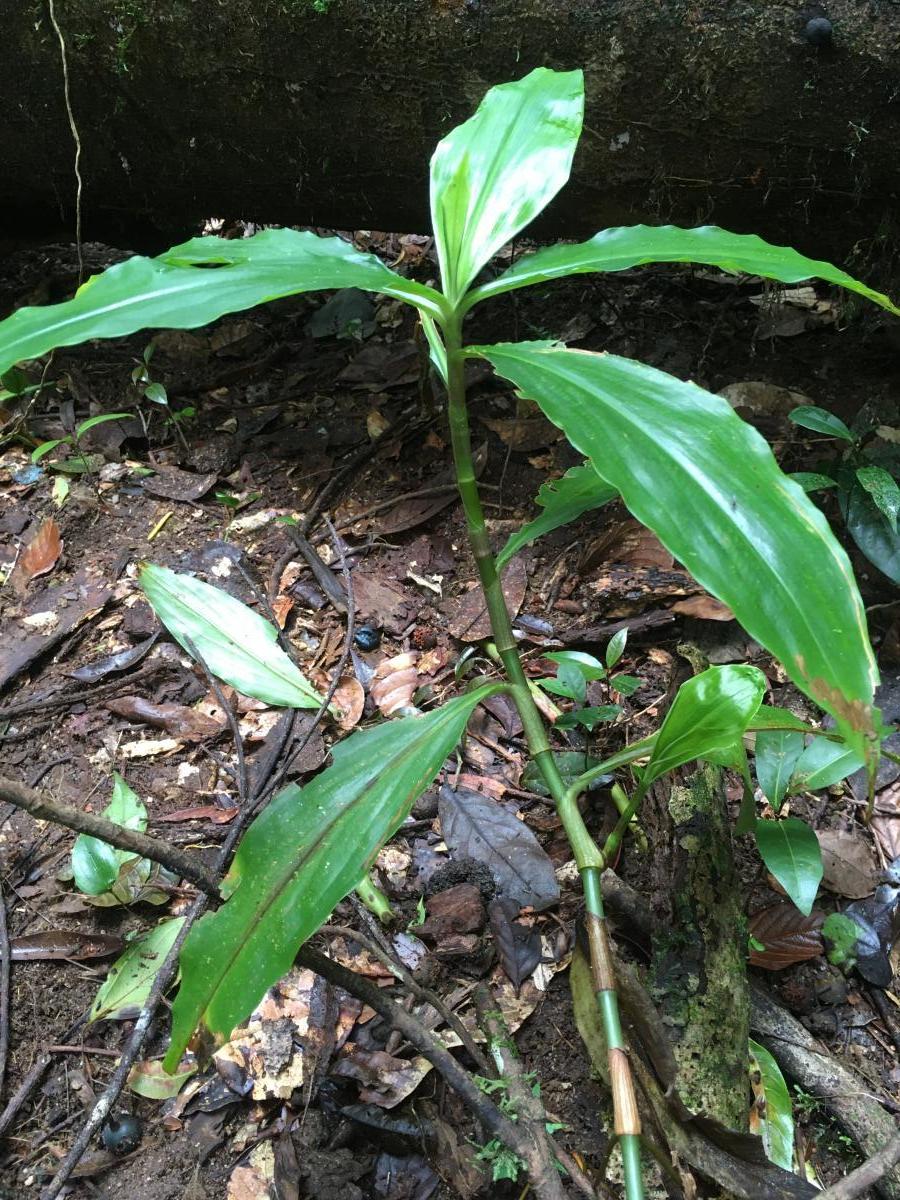
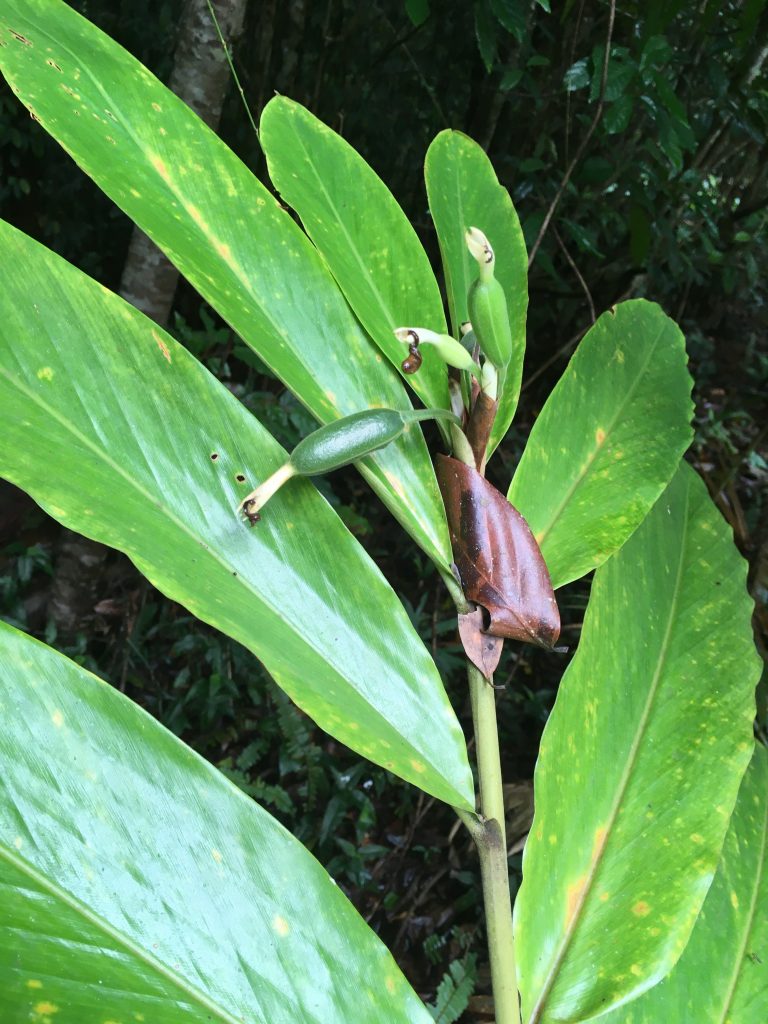
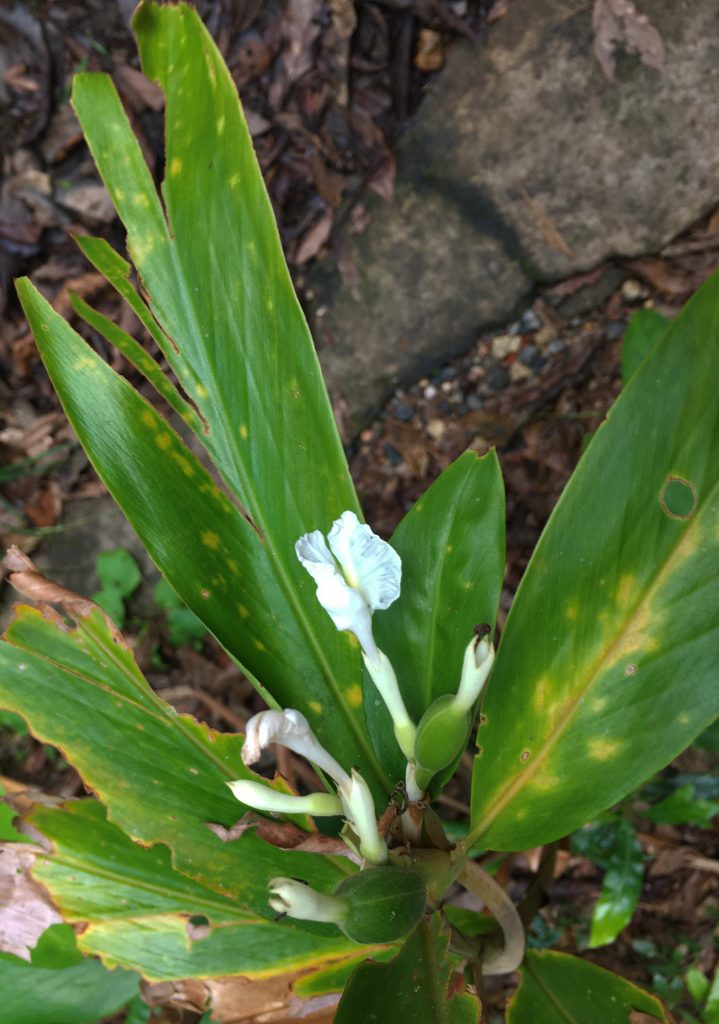
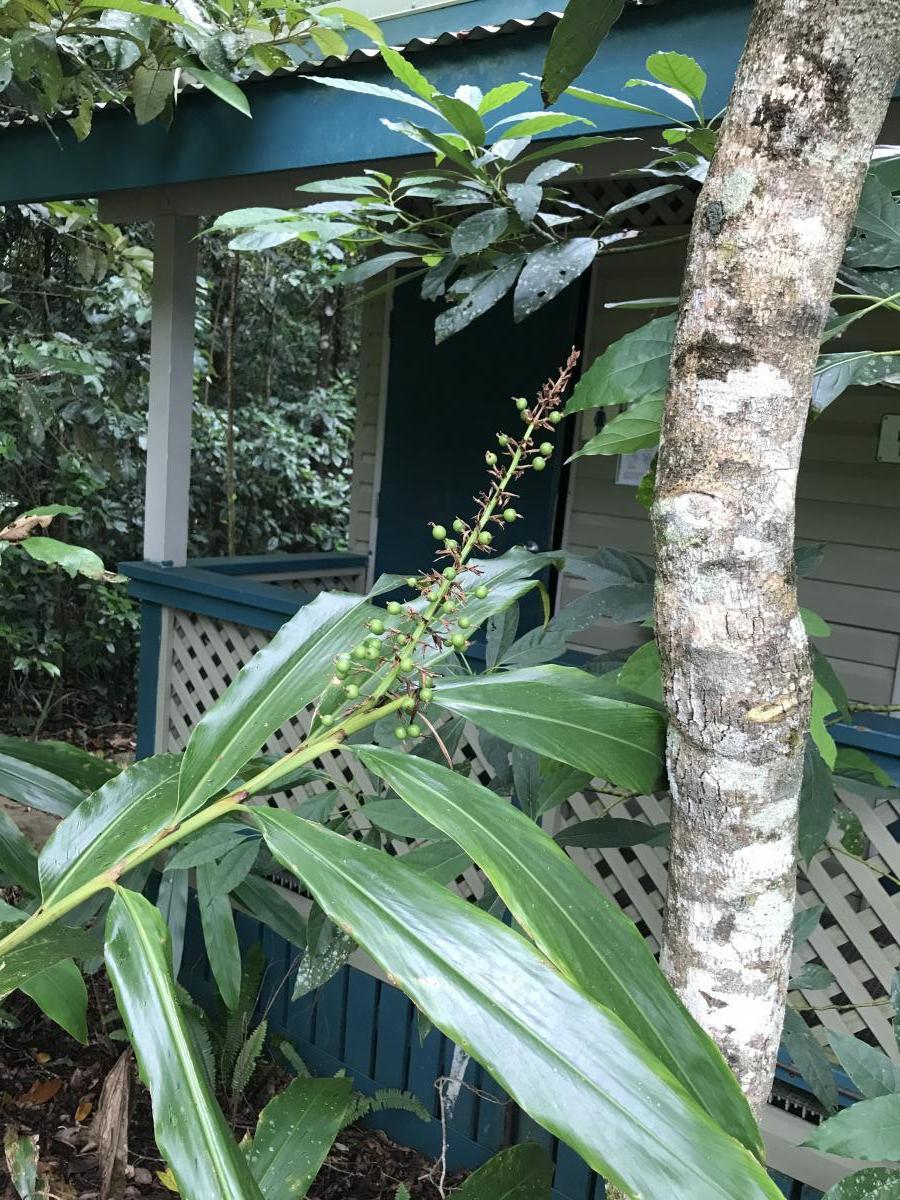
4. Pleated Ginger (Alpinia arctiflora)
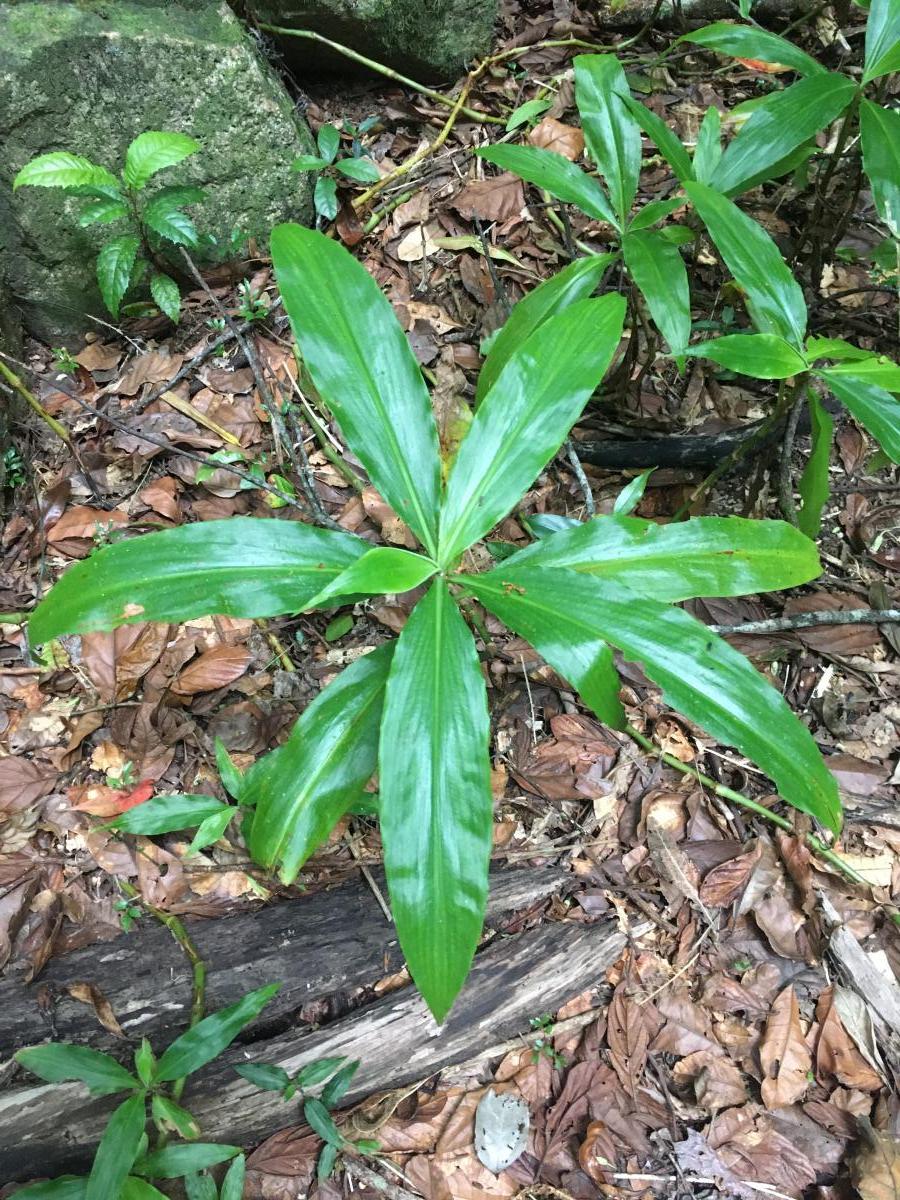
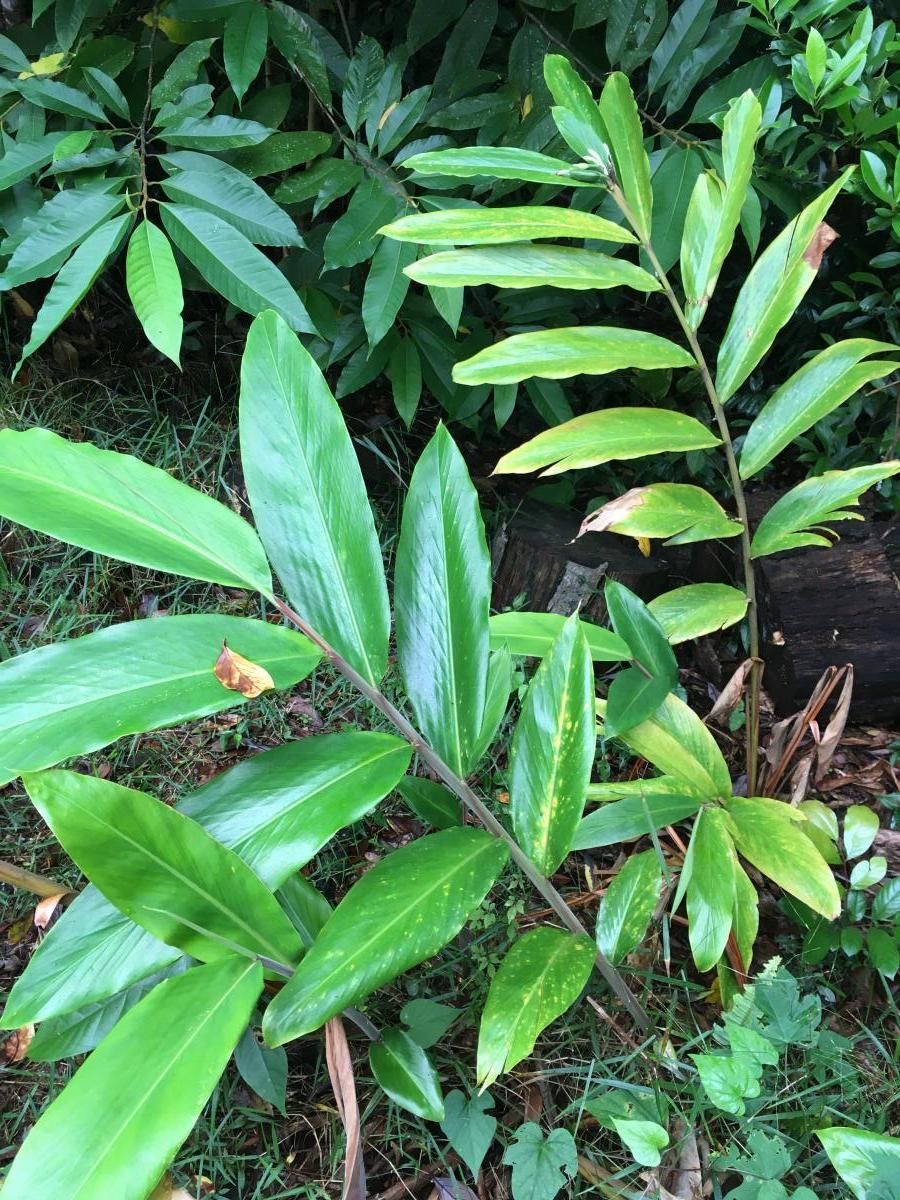
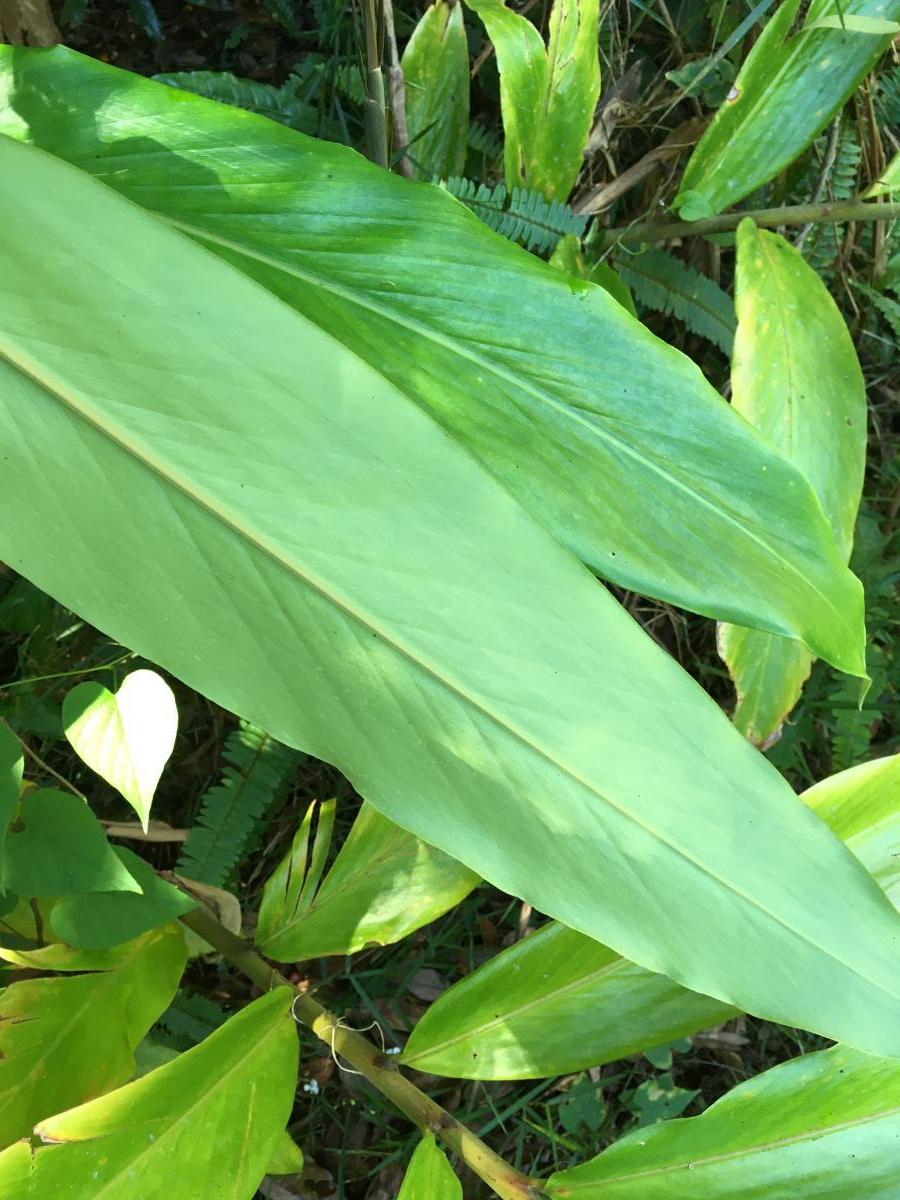
There are several native species of ginger that can be found in disturbed areas of the Wet Tropics. Around Paluma one of the most common is the Pleated Ginger. This species is endemic to northeast Queensland. Gingers have a distinct growth form with the true stem below the soil (rhizome) and a ‘pseudostem’ above, composed of overlapping leaf sheaths. The bright green elongate pointed leaves are distichous – arranged in two alternately vertical rows. The pleated ginger can readily be identified by inspecting and feeling the under-surface of its leaves, which are covered in fine hairs giving it a greyish tinge, and a fine soft felt-like texture. The flowers are small and white and the fruit are elongate and green, turning dark purple when ripe.
Alpinia arctiflora
The Pleated ginger is one of the larger native gingers (2-3m tall). Another common species (also endemic to Australia) is the native ginger (Alpinia caerulea) which grows to around 1-2m, has smooth green under-surface to the leaves and distinct globular fruit on born on short stalks (1-2cm). The fruit is initially green, turning dark blue as it ripens. The fruit of both species are eaten by Cassowaries.
Alpinia caerulea
Don’t be tempted to eat these gingers – ‘edible’ ginger is the rhizome of Zingiber officinale.
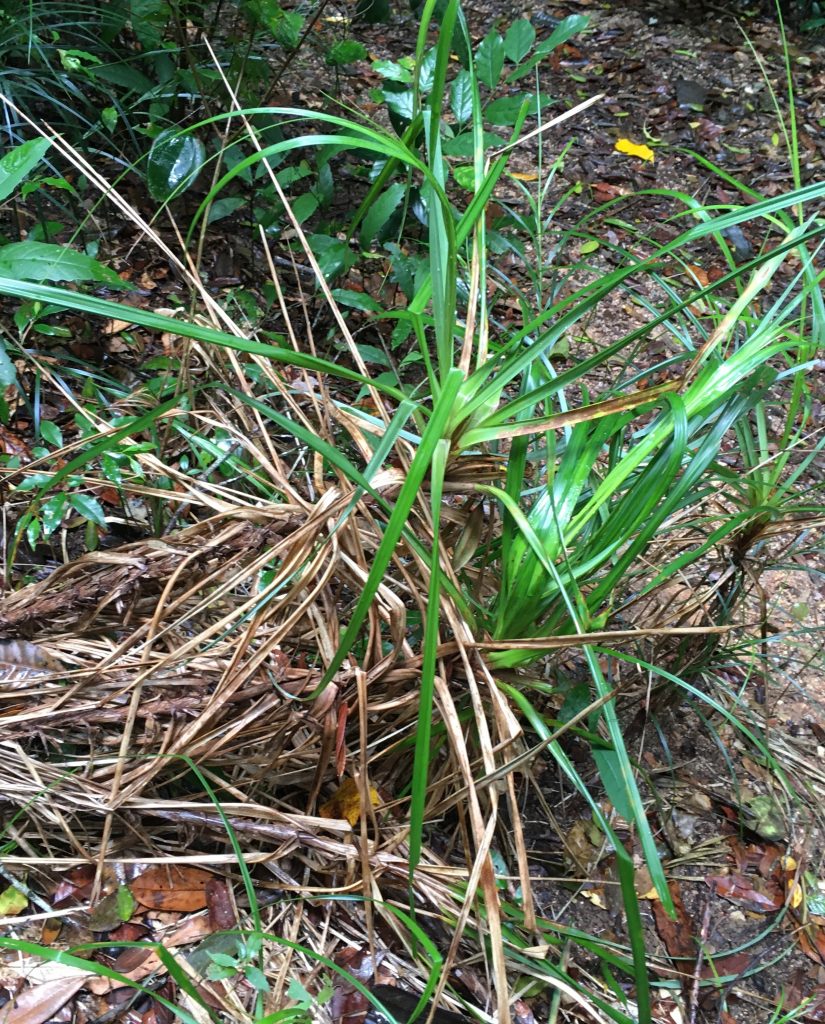
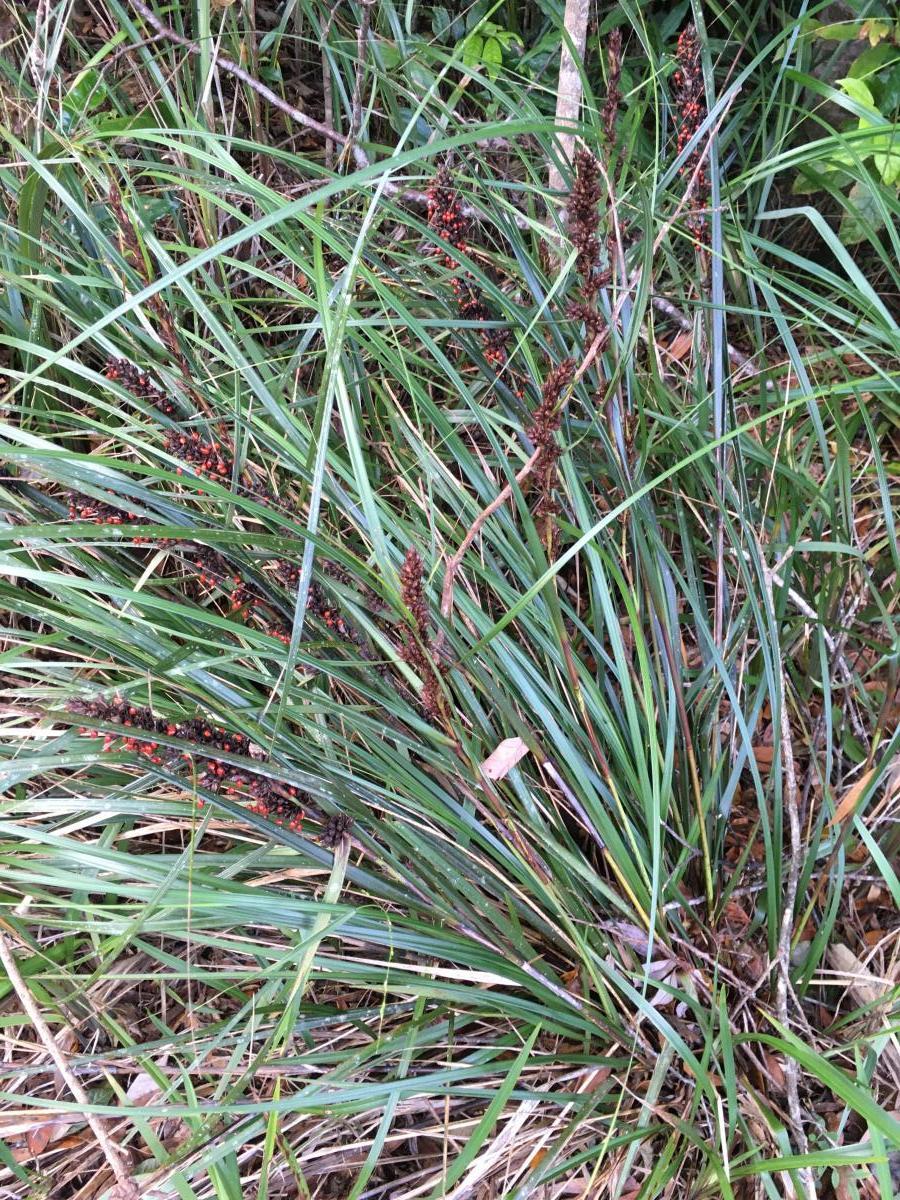
5. Gahnia seiberiana (small-seeded saw-sedge)
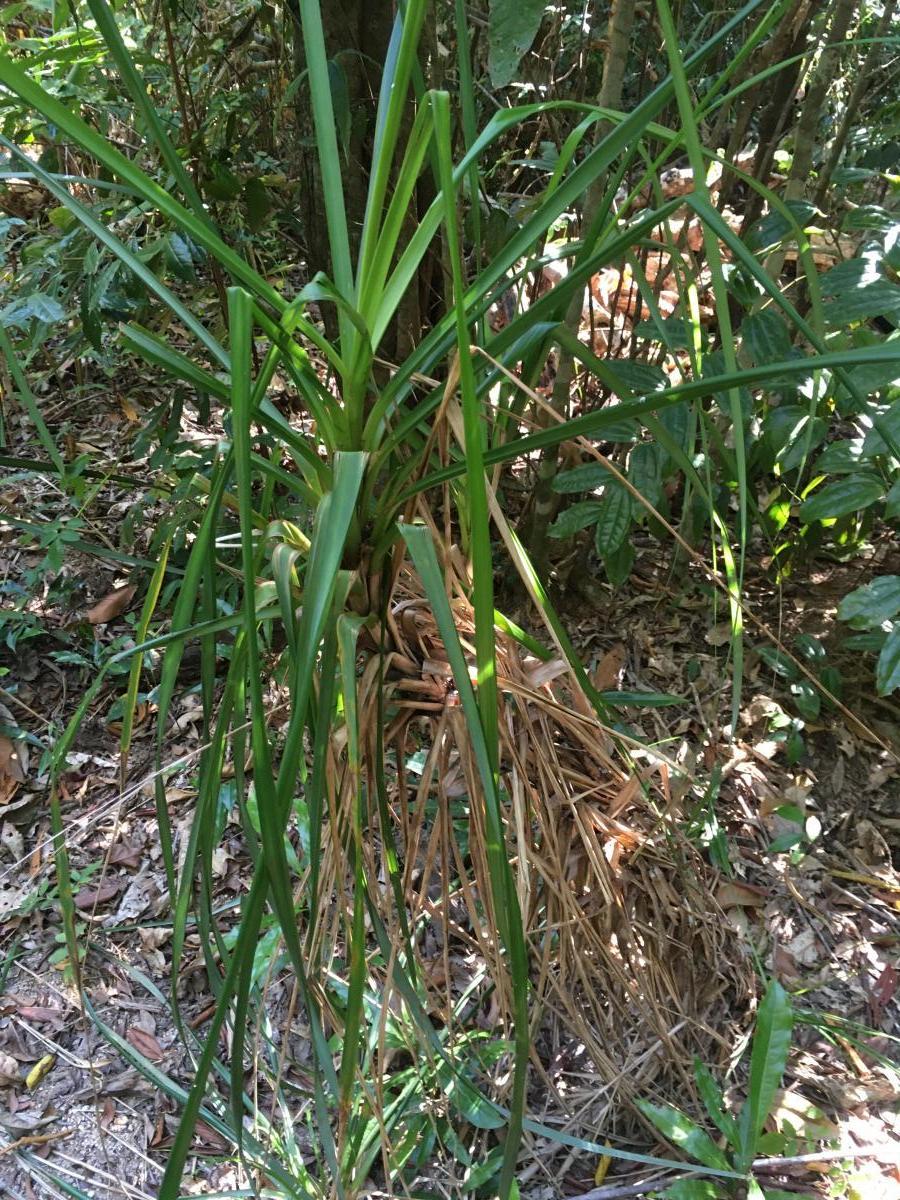
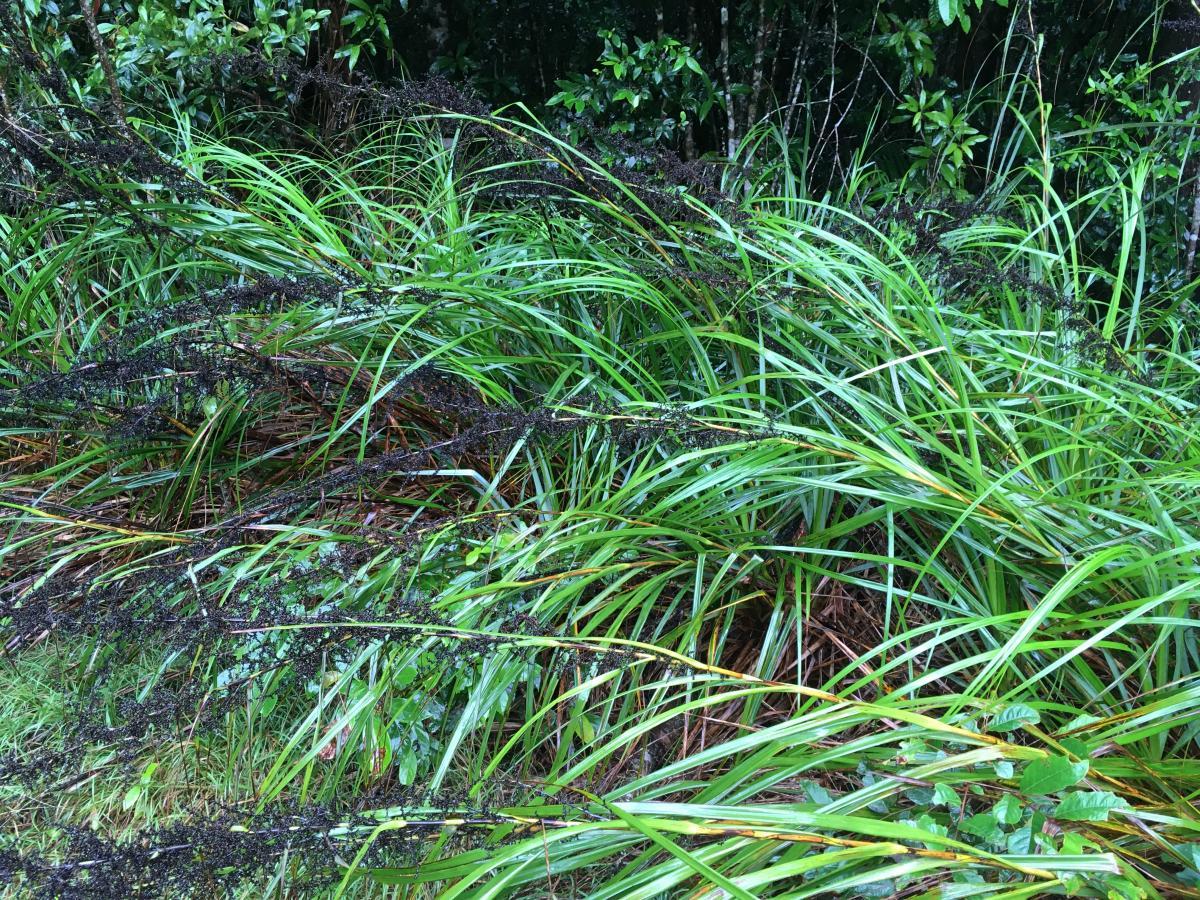
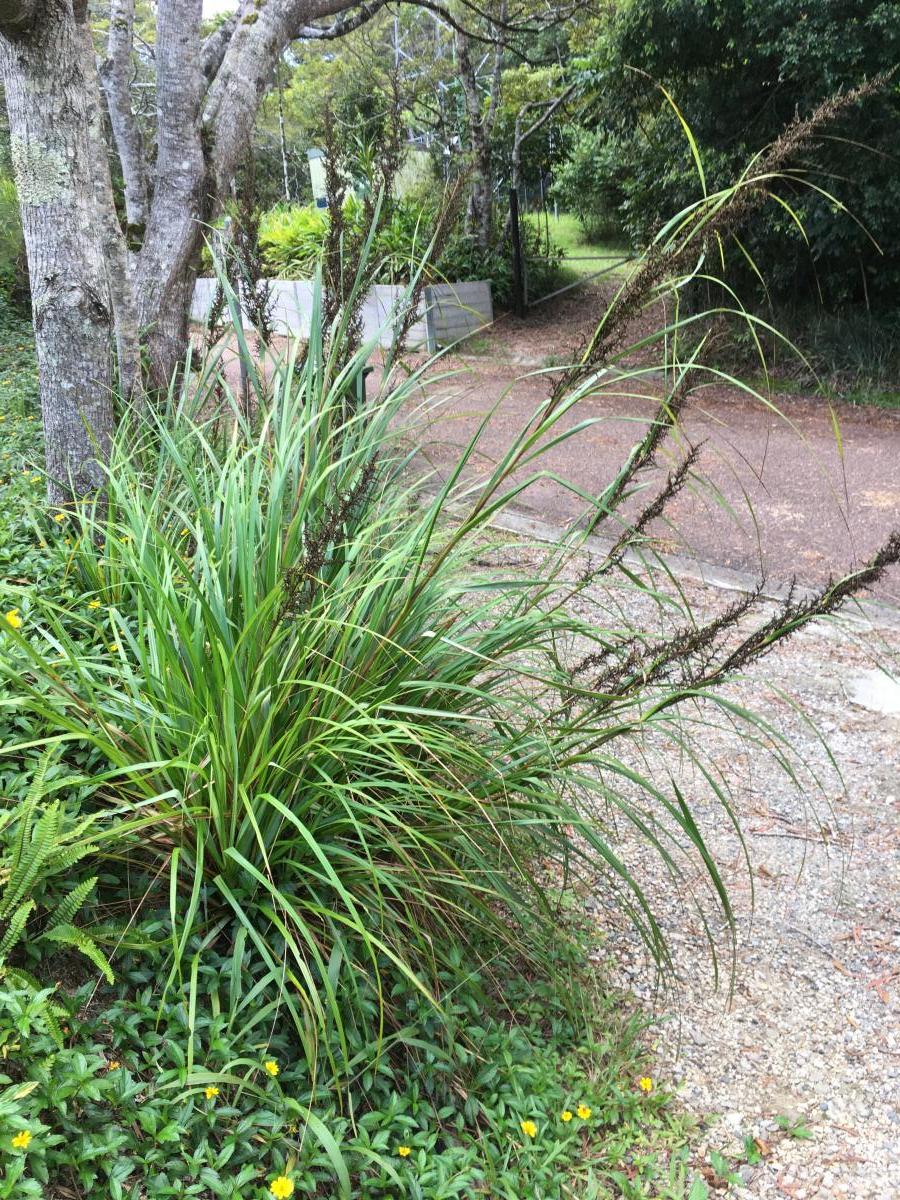
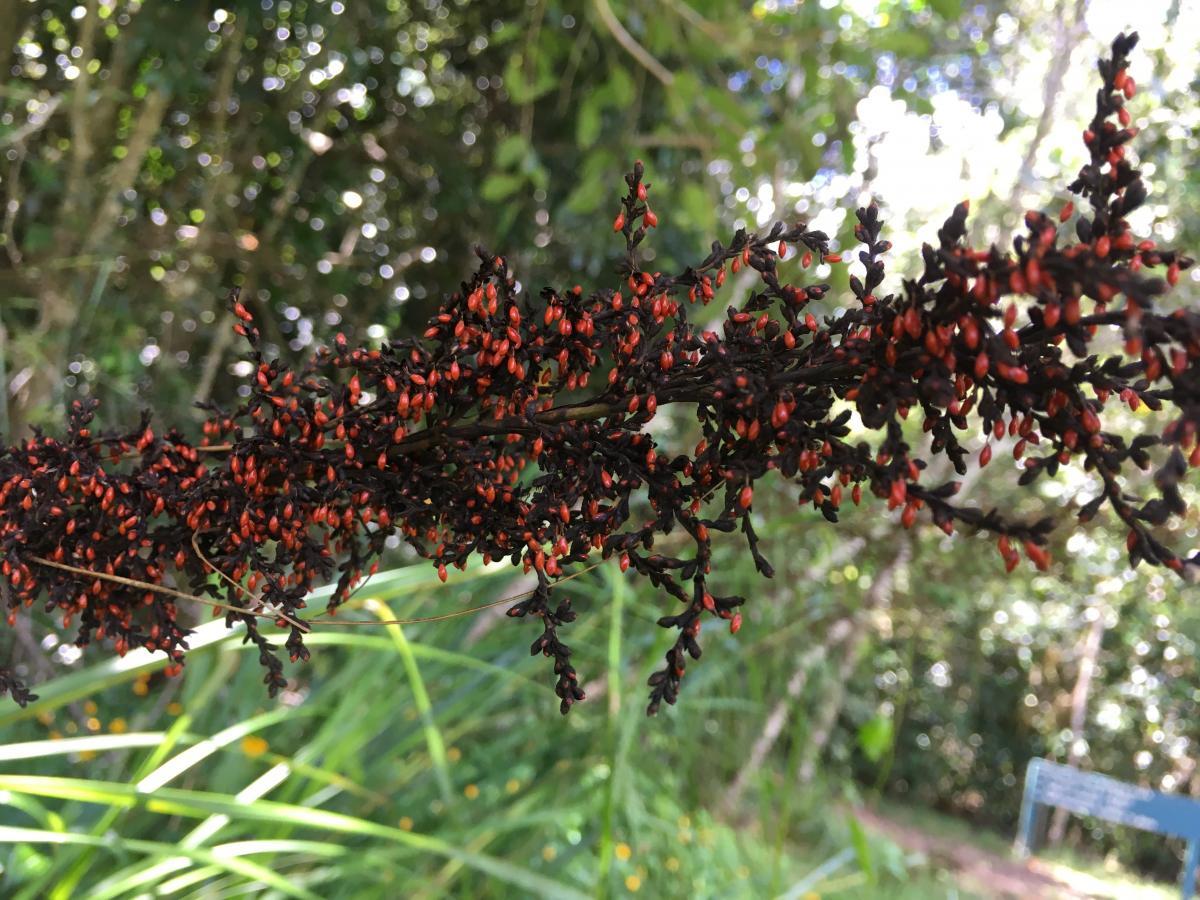
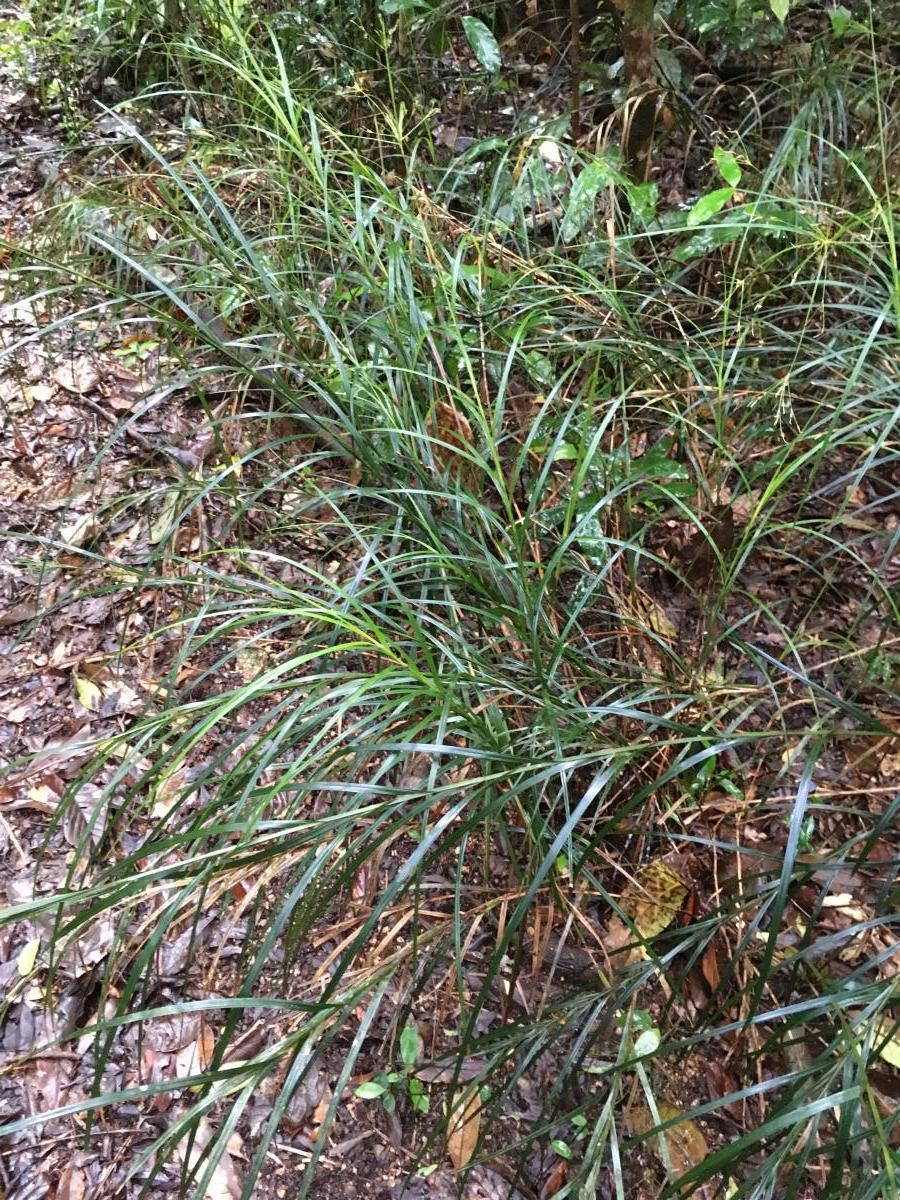
Sedges are related to grasses, but they mostly have solid triangular stems, while grasses have hollow stems except at the nodes. The small-seeded saw-sedge is a very common sight in well-lit areas along the village walking tracks. It has a solid round stem and whorls of robust green leaves and often a skirt of dead leaves at ground level concealing a prostrate stem. In open sunny areas it can form large multi-stemmed tussocks. The leaf margins are serrated and can easily cause a painful cut if dragged across the skin. Under a mostly closed canopy these sedges rarely flower but along the roads or in clearings the flower spikes/seed heads can be seen, rising above the leaves with small (3mm x 1.5mm) reddish brown seeds.
Gahnia seiberiana
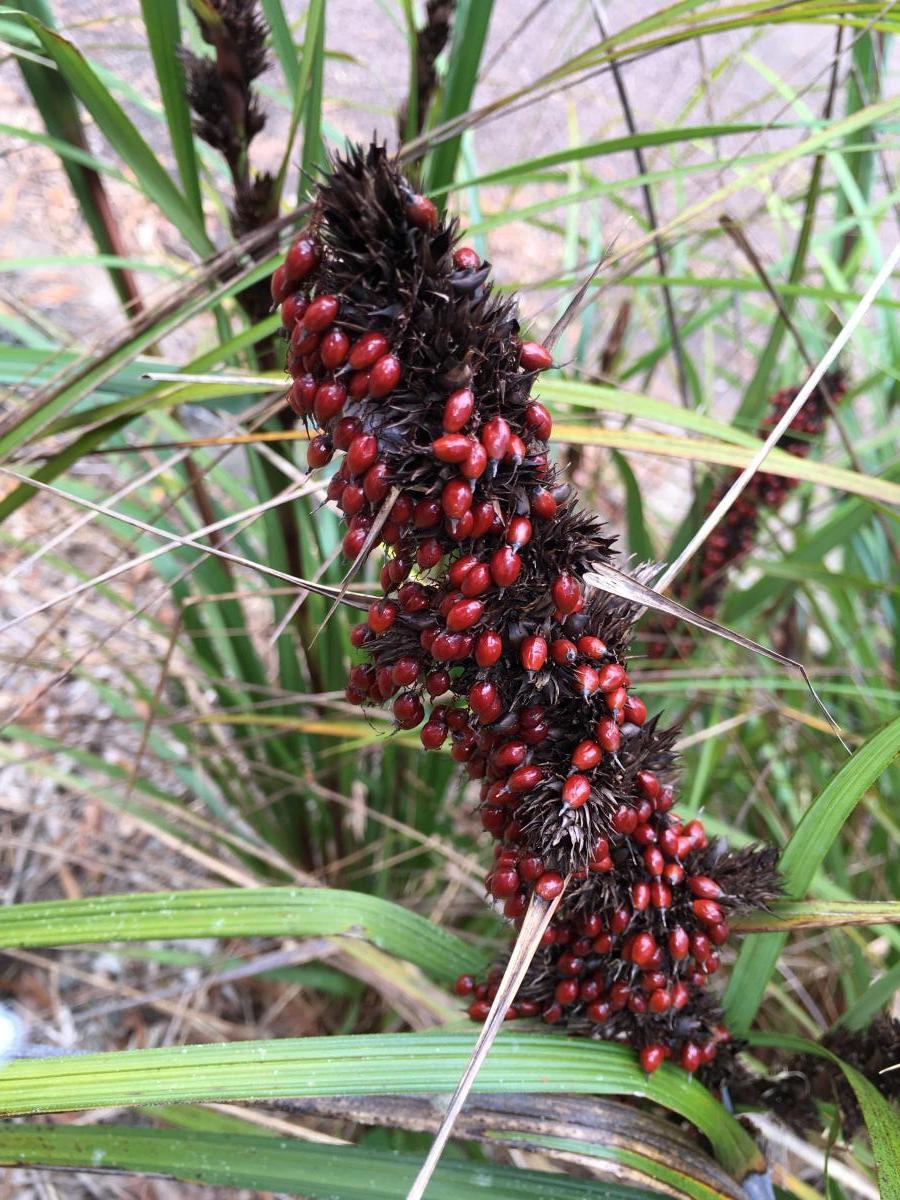
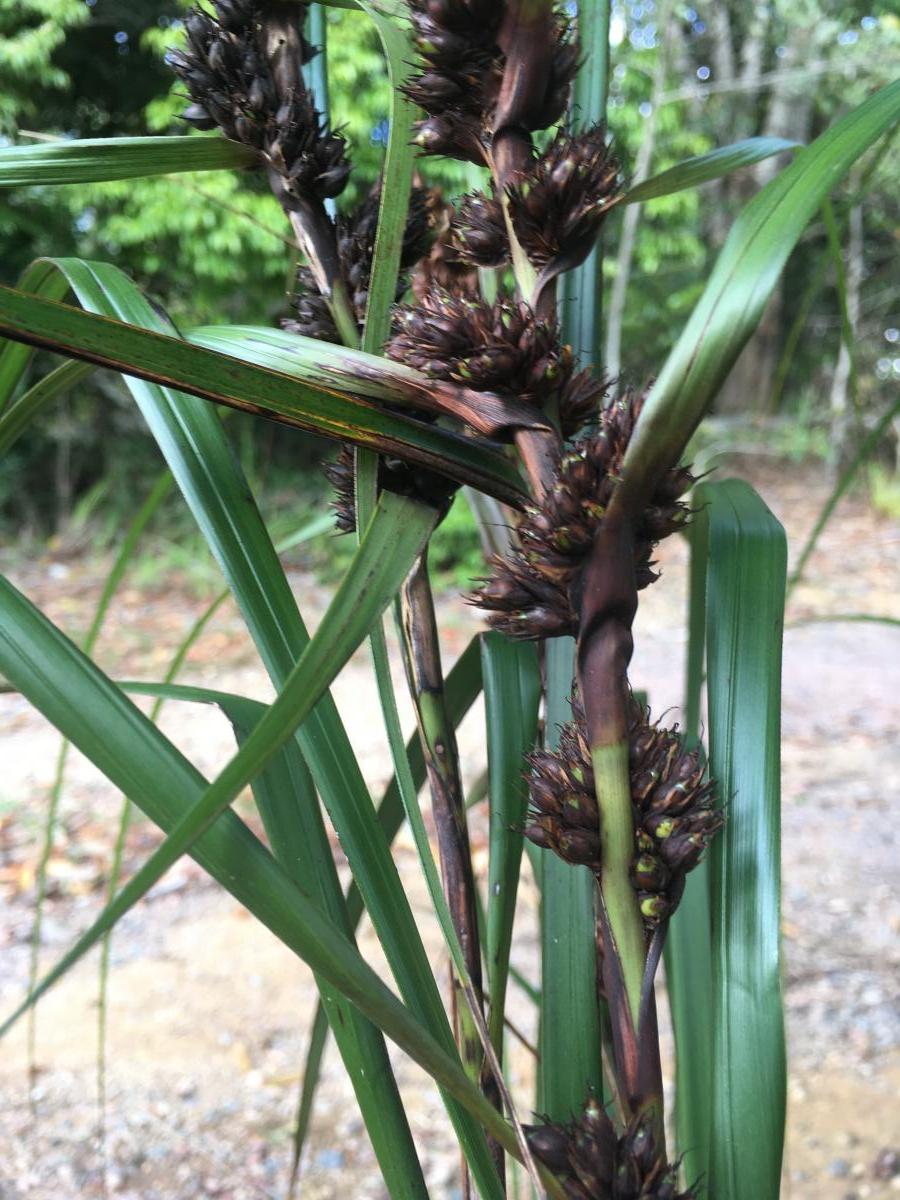
Another round-stemmed sedge with serrated margins that is more common beside the main road through the village is the red-fruited saw-sedge (Gahnia aspera). The leaves are similar, but they tend to be spaced wider along the erect stem, and the flower spike emerges midway up the stem and has much larger bright red seeds.
Gahnia aspera
A further kind of sedge, that is much finer and looks more like long fine grass growing on the sides of walking tracks is Cyperus sp. There are several species and they are not easy to tell apart but the group is easy to identify from its grass-like growth form and its distinctive sharp triangular stem.
A reminder to all that on Saturday 12 June 2021 the village of Paluma will host a 90th Birthday Party for our very own living legend – Sir Leslie Hyland.
Please come along to celebrate this occasion with Les. You are all invited to share your favourite story, tale or anecdote about Les, or to tell an Irish joke or two.
When: Saturday 12 June 2021 at 6.30 pm.
Where: Paluma Community Hall
What to Bring: A dish to share – savoury or sweet, hot or cold.
The Bar will be open for drinks (although we are giving Les a rest on this occasion with a stand-in bar person for the night!).
We look forward to seeing everyone at this very important occasion.
In the spirt of this upcoming event here is an old Irish blessing:-
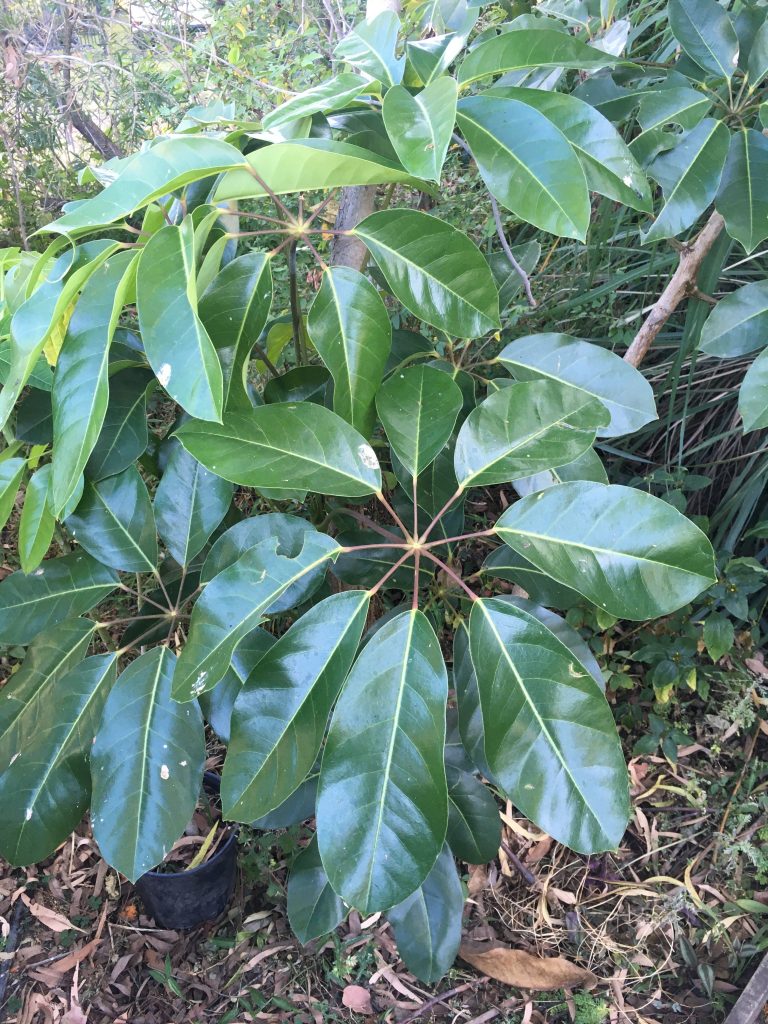
The umbrella tree (Schefflera actinophylla) is native to tropical rainforests in Queensland and the Northern Territory as well as New Guinea and Java. It is an attractive fast-growing evergreen tree that colonises disturbed areas. As a young plant, it can be hemi-epiphytic or lithophytic, growing on and up boulders and the trunks of larger trees. The large elongate leaves are palmately compound, arranged in a circular “umbrella”.
Umbrella tree leaves
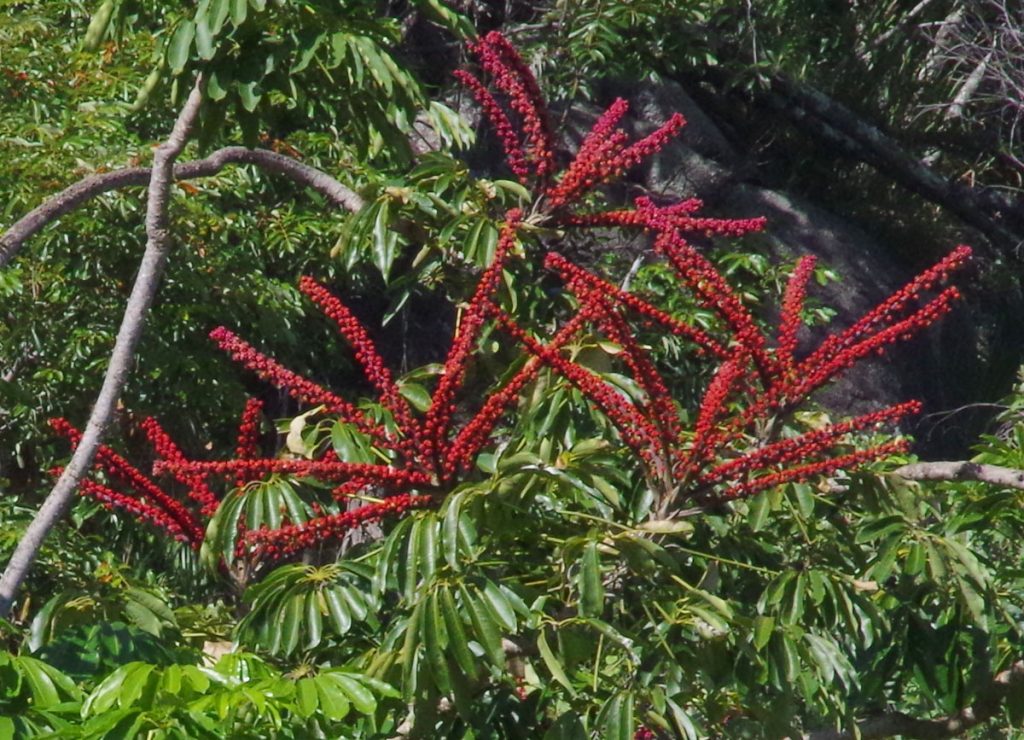
Deep red flowers are borne on long terminal spikes and are copious nectar producers that attract a variety of insects, birds and small mammals. The nectar and fruit can sometimes ferment resulting in mildly intoxicated, rowdy parrots that may occasionally fall out of the tree, too drunk to fly. The leaves are a favourite food of Bennets Tree Kangaroo
Umbrella Tree flowers – photo by Russell Cumming on Flickr
The umbrella tree is a popular house and garden plant in Australia and around the world. It has also been used to create bonsai trees.
Umbrella trees are quite common in gardens around Paluma village and occur occasionally in the forest behind backyards. Naturally occurring trees can most easily be found along the range road and along the creek upstream from the Little Crystal Creek Bridge.
Schefflera actinophylla has become naturalised in many countries. In southern Queensland and parts of NSW (outside its native range) it has been declared an invasive plant invading national parks, remnant bushland, undisturbed forests and reserves.
Dwarf Umbrella Tree (Schefflera arboricola)
A related species, the dwarf umbrella tree (Schefflera arboricola) is also a popular decorative plant in Australia, with at least one specimen prominently growing on the corner of Whalley Cr and Mt Spec Road. It is a native of Taiwan and eastern Asia but is considered is a minor or potential environmental weed in Queensland and north-eastern New South Wales.
Text and photos (unless indicated) by Jamie Oliver
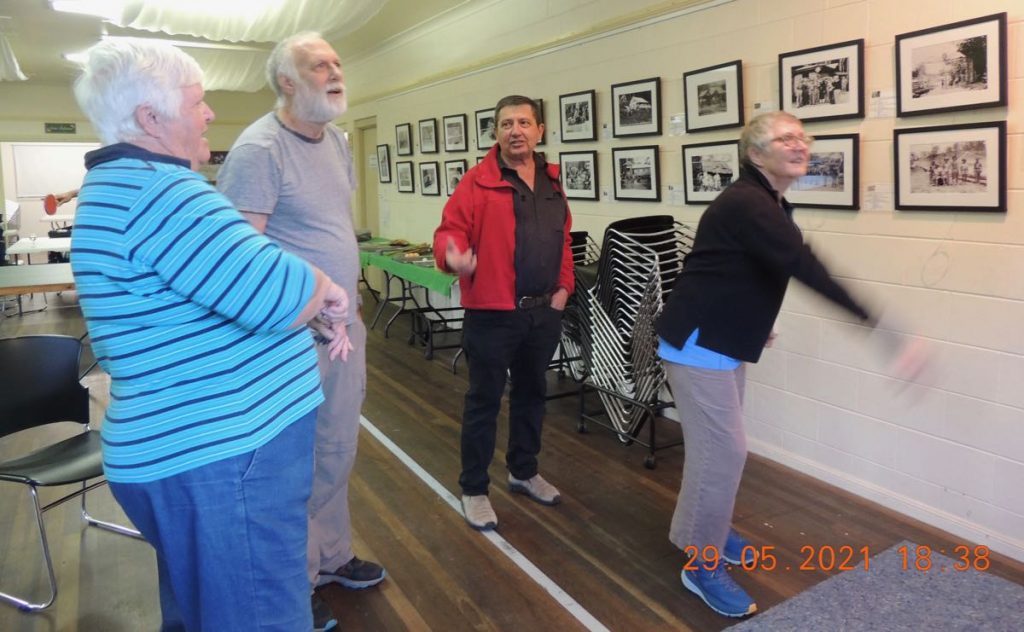
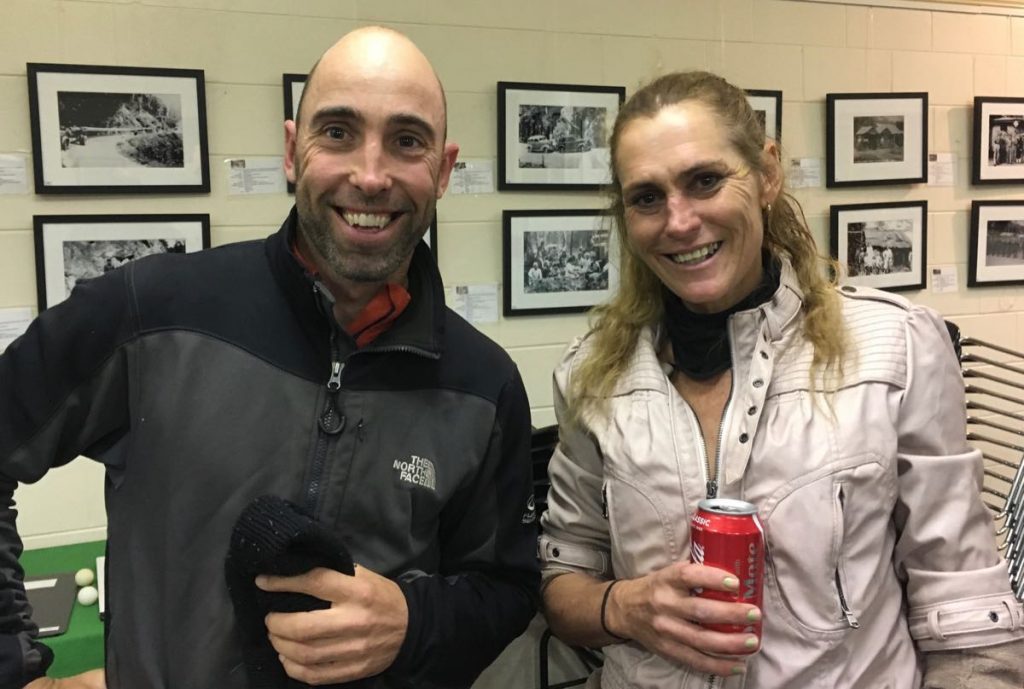
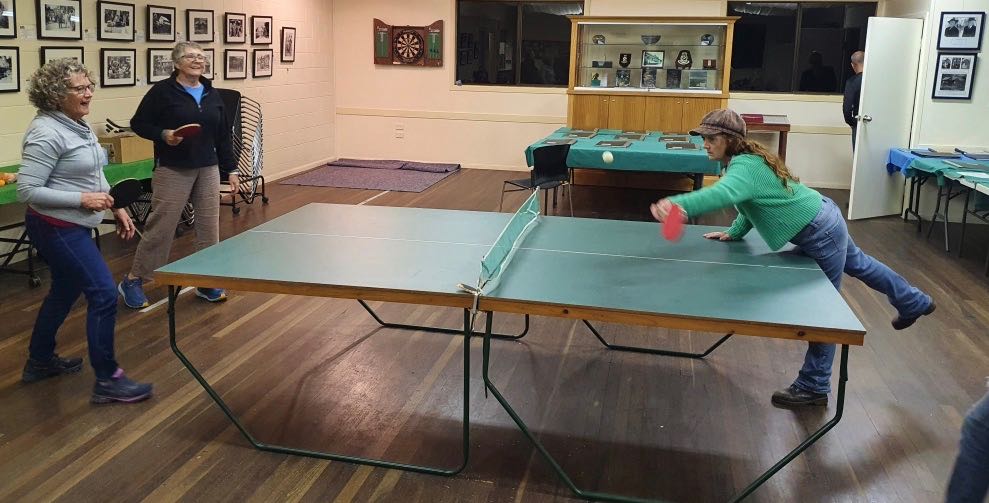
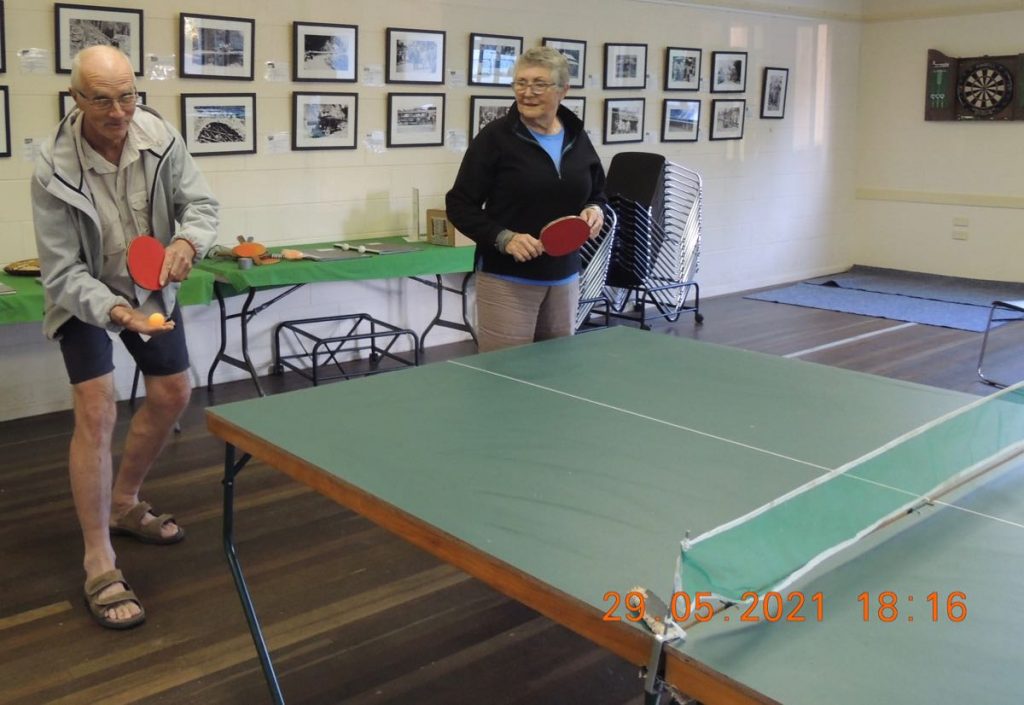
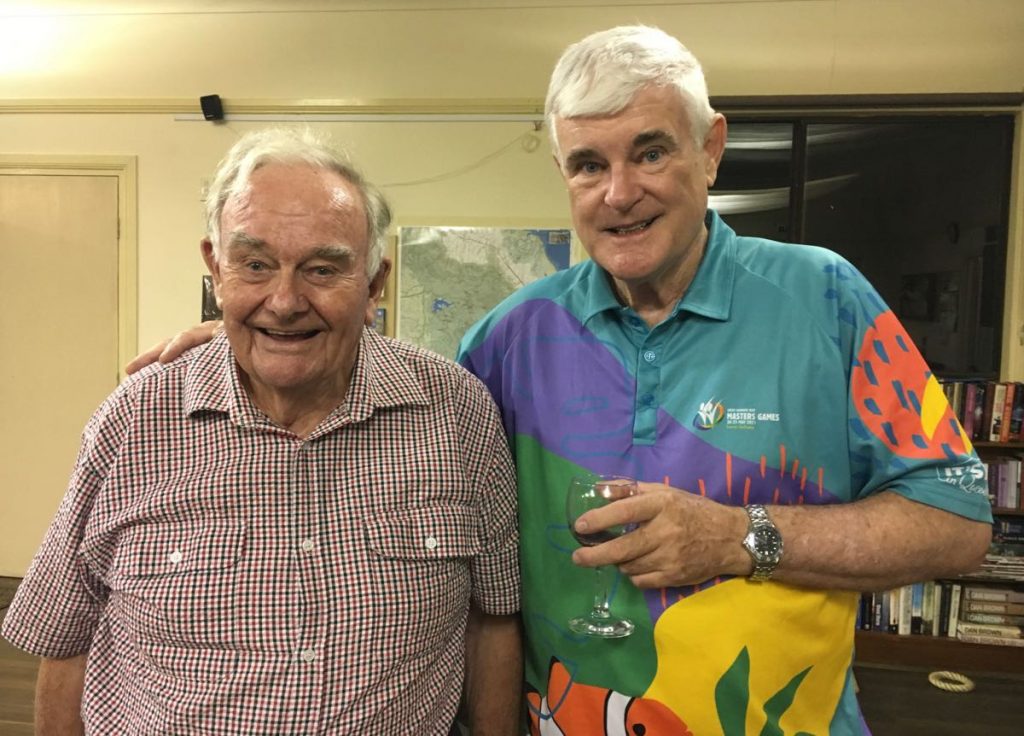
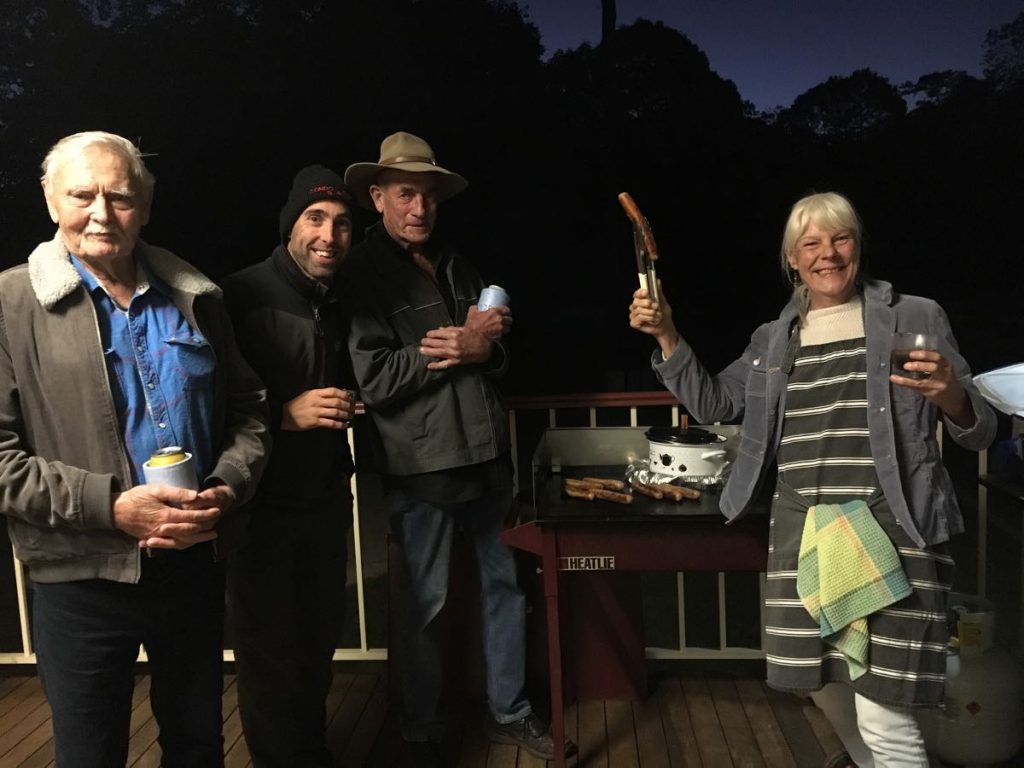
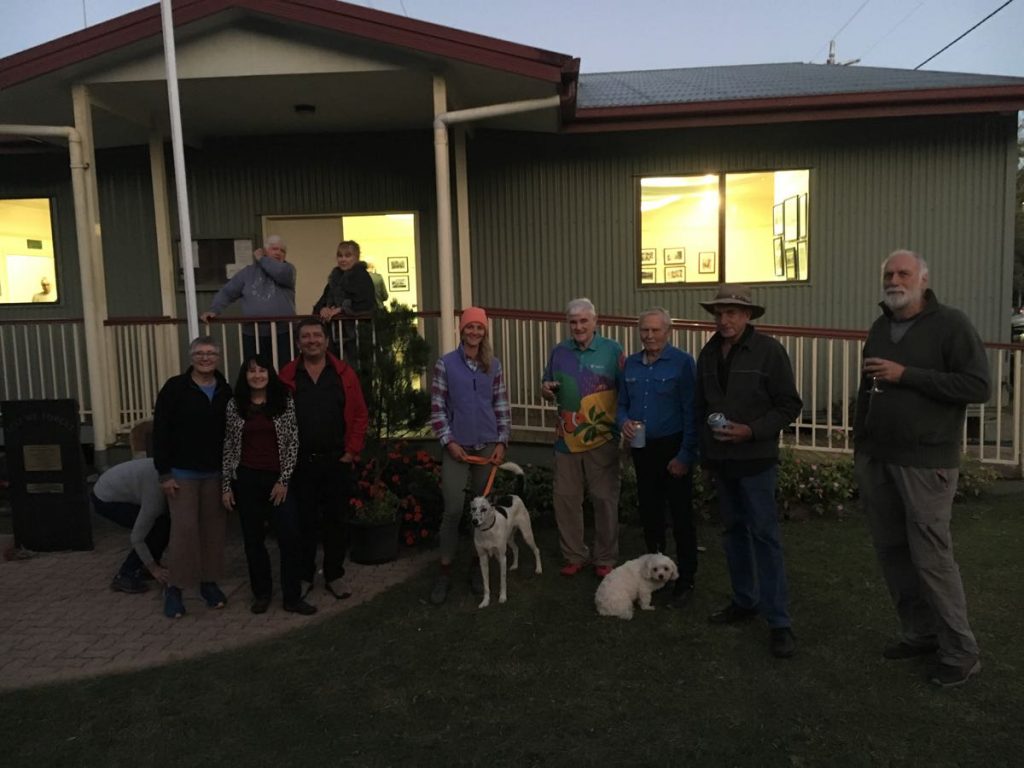
Saturday night (29/05/21) was Games Night at Paluma. A good crowd gathered at the Community Hall from 4 pm to take part in a series of games and sporting activities. Four main teams were formed and they rotated through the various activities including pétanque, darts, table tennis and quoits. The competition was fierce amongst the rival teams – even if the skill level was sometimes questionable. What we lacked in skill, we made up for in enthusiasm!
The Games Night was hosted by Dorothy and Peter Klumpp who provided some excellent coaching tips. Peter did his best to control some rampant cheating amongst the team members. Lynda was in charge of the BBQ, cooking a gourmet sausage sizzle, complete with coleslaw, caramelised onion and sauerkraut. Barman Les was on hand to supply drinks to the thirsty competitors. The overall winning pair on the night were Colwyn and Danno, proving that age, wisdom, charm and cheating are a winning combination!!
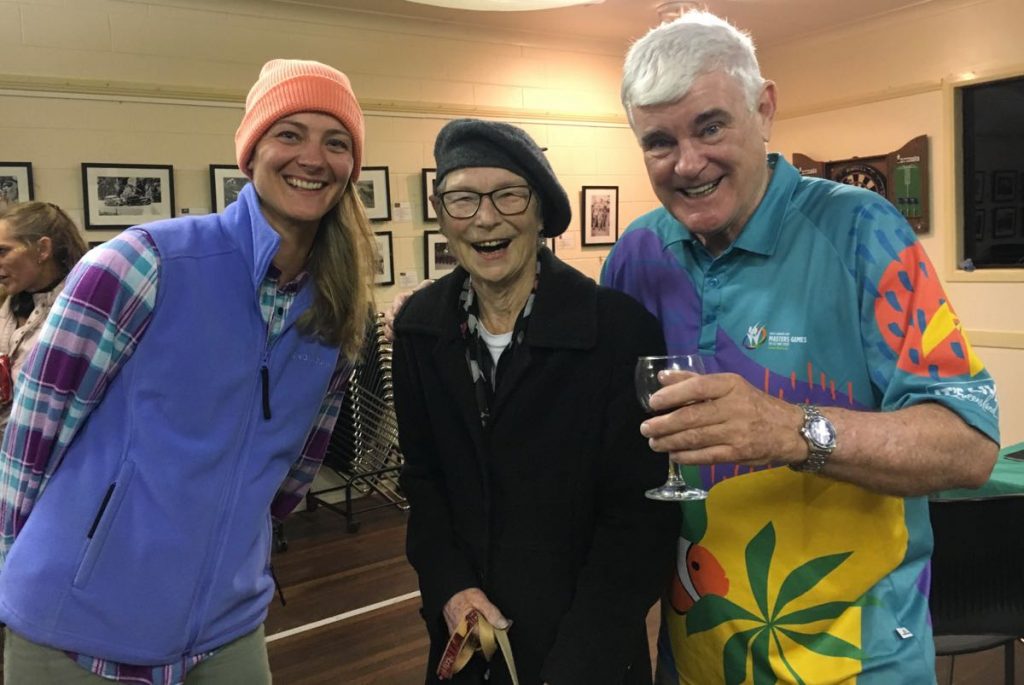
A great deal of fun was had with laughter, cheering and banter echoing from the Community Hall. Special thanks to Peter, Dorothy, Lynda and Les for making the night a great success. And thanks to all those who participated, keeping the spirit of community alive and well in the little village of Paluma.
Let the pictures tell the story!
Text By Michele Bird. Photos by Michele Bird & Peter Klumpp.
Insects and spiders belong to the Arthropod phylum (Euarthopoda), which encompasses invertebrates with a hard exoskeleton, segmented bodies and paired jointed appendages. Crustaceans, centipedes, millipedes and many other lesser known insect-like invertebrates are also Arthropods. Paluma has a very high diversity of arthropod species, but many are either difficult to find or, once found, very hard to identify. The following species are quite common around Paluma:
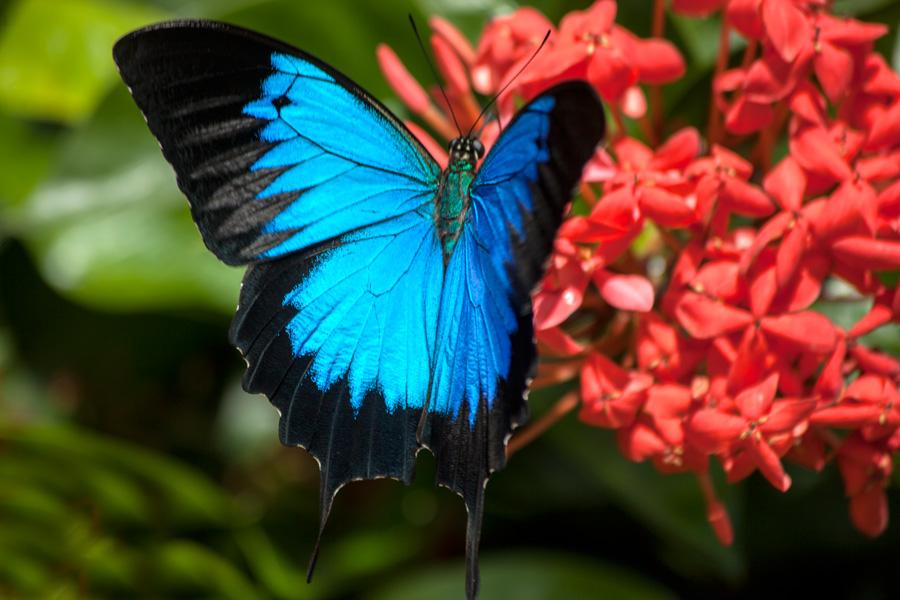
1. Ulysses Butterfly (Papilio ulysses)
This is one of the most recognisable butterflies in north Queensland and an iconic resident of our tropical rainforests. The brilliant iridescent blue upper surface of its wings makes it highly visible in open sunny areas, and it is commonly seen foraging around the village. This large (~14cm) butterfly is a member of the swallowtail family (Papilionidae) and can be found in New Guinea and surrounding islands as well as in NE Australia. The underwings are not nearly as colourful with black and grey-brown patterning and orange-brown spots along the margin of the hindwing. Males and female are very similar in appearance but the female can often be recognised by the small blue crescents at the bottom of the hindwings. The favoured host plant for the Ulysses is Melicope species (Euodias or Corkwoods).
2. Australian Rhinoceros Beetle (Xylotrupes australicus)
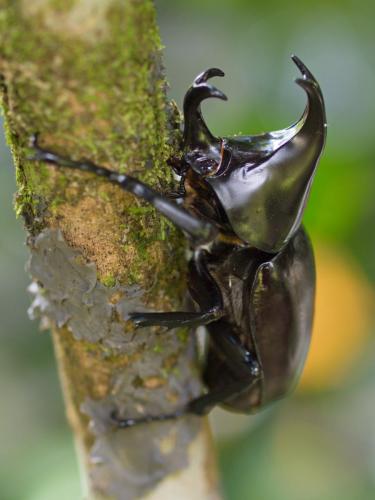
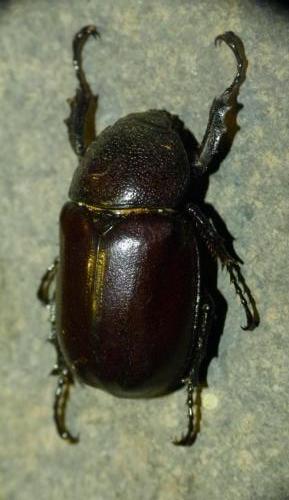
This very distinctive and large (up to 6cm) beetle has two large horns (upper and lower) with forked ends. Horns only occur on males. The females are similar in size but without horns.
Rhinoceros beetles are harmless but can make a hissing noise when threatened and their claws are sharp enough to grip tightly to (but not injure) a finger or hand. The horns are used by males to fight each other during the breeding season. In Thailand they are kept as pets and for gambling over beetle fights.
Male
Larva – Photo by Jeff Wright, Queensland Museum, Copyright
Female -Photo by L. Shyamal, CC BY-SA
Adult beetles feed on bark. The larvae burrow into and eat leaf litter and rotting wood and are often found in mulch or old compost piles in Paluma gardens. They can take up to two years to reach full size, by which time they can fill the palm of your hand.
Despite their armoured and heavy appearance Rhinoceros Beetles have fully functional wings under their carapace and are strong flyers. Males are nocturnal and attracted to light. The Australian Rhinoceros Beetle occurs in moist forests in eastern Australia and the Northern Territory. It has previously been referred to as Xylotrupes gideon or Xylotrupes ulysses, but current thinking is that these species do not occur in Australia and that our Rhinoceros beetle (X. australicus) is a separate species.
3. Cairns Birdwing (Ornithoptera euphorion)
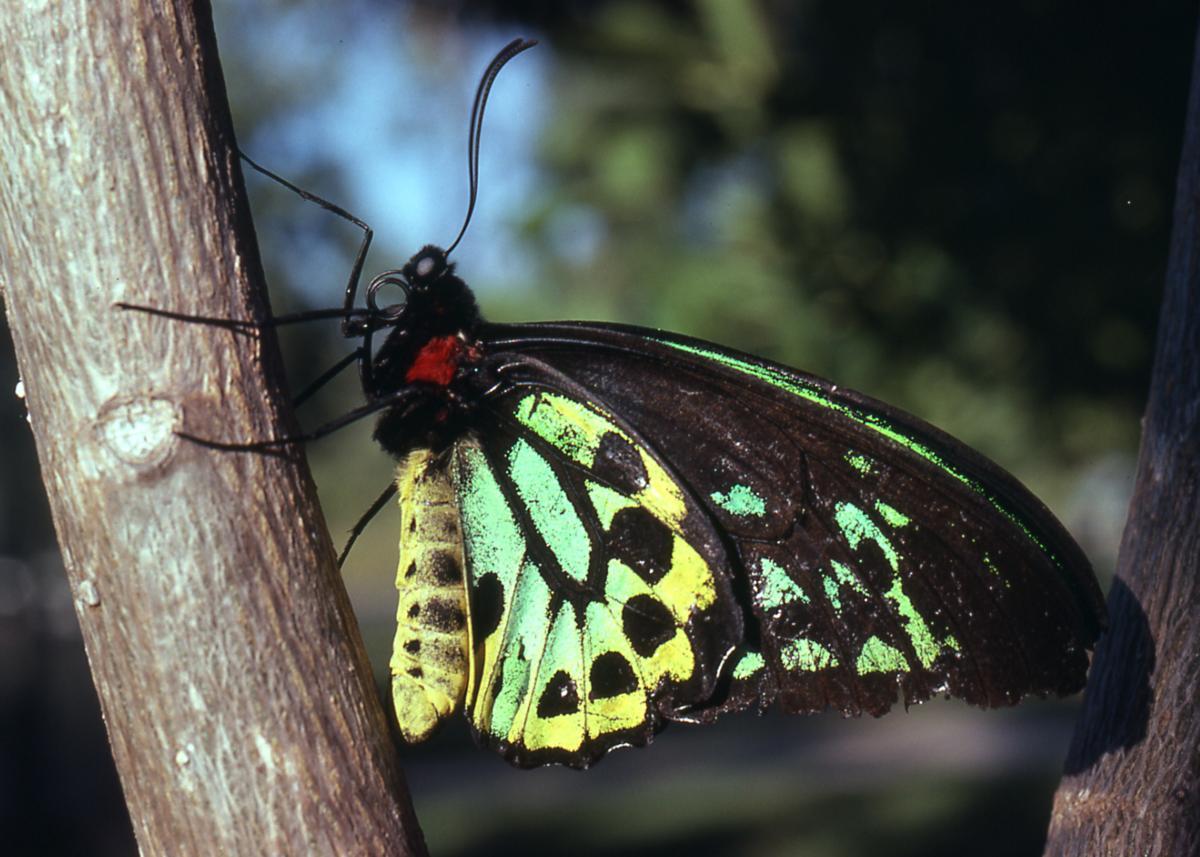
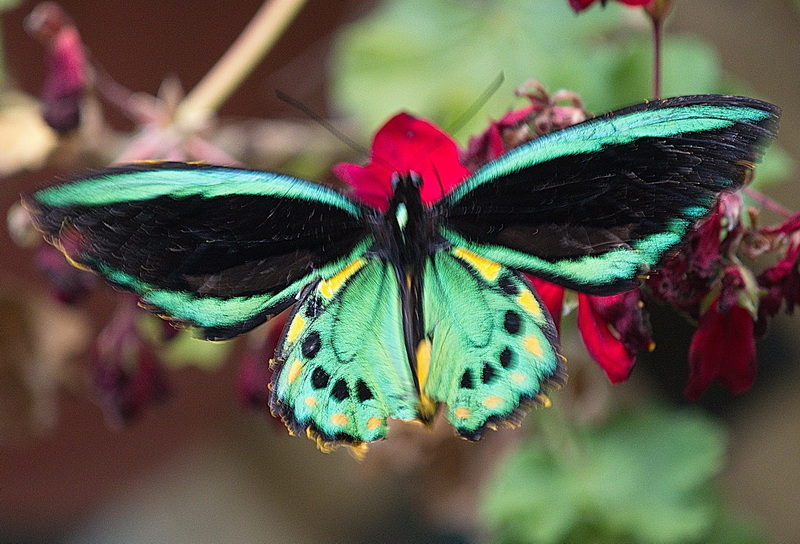
The Cairns Birdwing is another iconic (and endemic) butterfly of the Queensland tropics, occurring in rainforests from Cooktown to Mackay. It is the largest endemic butterfly in Australia (its almost identical cousin, the northern or New Guinea Birdwing is the largest Australian butterfly).
Male Cairns Birdwings can have wingspans up to 12.5cm, and have brilliant green, black and yellow wings. The larger females (15cm wingspan) have similar markings but in shades of grey and white. Both sexes have bright yellow abdomens with a blotch of red on the side of the thorax. In gardens, adults are attracted to Lantana, Hibiscus and Bouganvillea flowers. Around Paluma they also feed on Agapanthus and the red Pagoda plant.
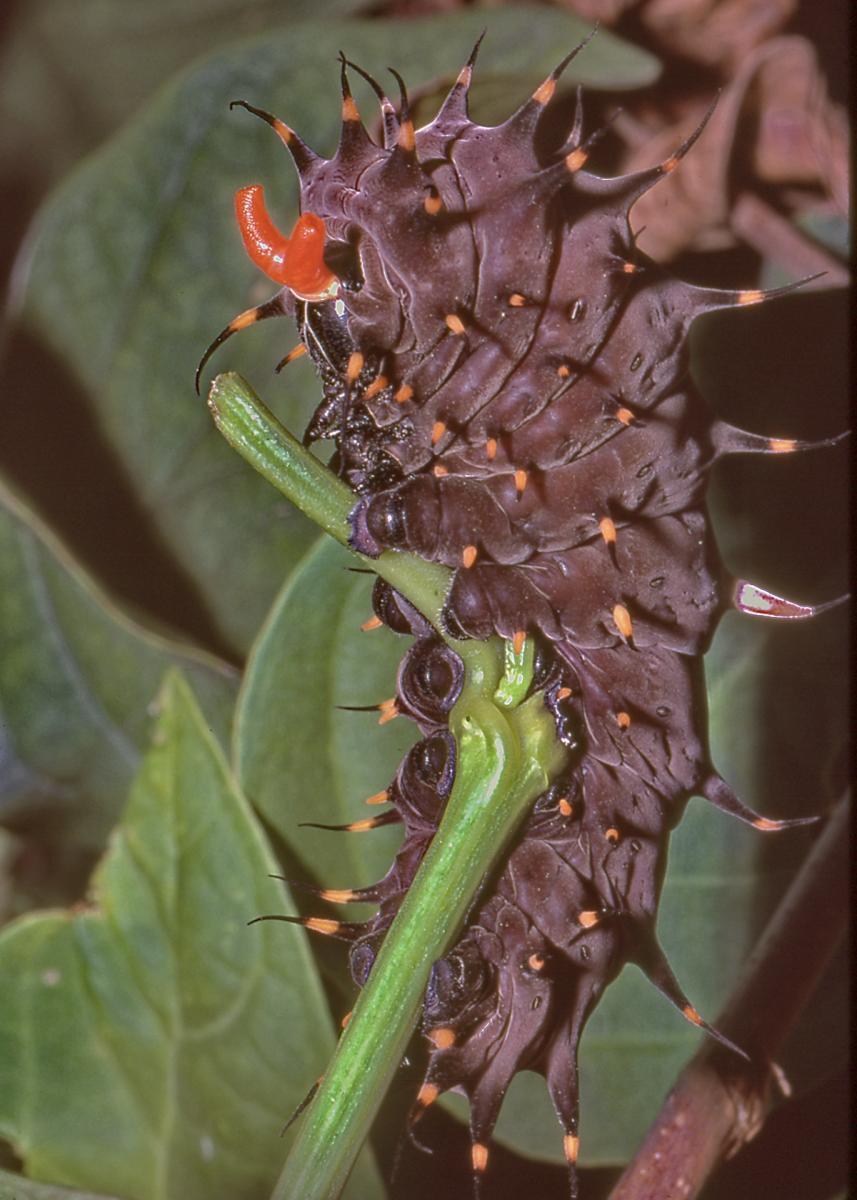
The main food plants of the larvae are Aristolochia acuminata (sometimes called by its synonym A.tagala)in lcoastal areasbelow 500 m and Pararistolochia deltantha in upland forests including Paluma. Mature larvae can be as thick and long as your thumb. If disturbed, they extrude distinctive reddish horns (osmeterium) that produce a fetid terpene compound to deter predators.
4. Golden Orb Spider (Nephila pilipes)
The Golden Orb spiders (genus Nephila) are a group of large web building spiders that have grey abdomens and swollen and often yellow leg joints. The silk of the webs is distinctly yellow and surprisingly strong. In some South Pacific islands the silk is formed into a ball by local fishers and used as a sticky lure to entangle the serrated beaks of garfish.
In Paluma the common species is Nephilapilipes, and it can be seen in forest clearings and in gardens around the village. Despite their daunting size the bite of this spider is not dangerous. It captures and eats a variety of insects and the occasional small lizard that gets caught in the web. Very small birds have been recorded (very rarely) in Nephila webs, but it is highly unlikely that they would be fed on.
Two other spiders can frequently be seen sharing the web of the large female Nephila. The first is a small brown spider the size of a fingernail. This is actually the male Nephila, which can be distinguished by the enlarged brown palps near the mouth and shaped a bit like boxing gloves. Males of many orb-building spiders live a precarious existence, driven by an attraction to the much larger females, who must be suitably seduced by a complex pattern of plucks to the web before they are safe to approach for mating purposes. If the seduction fails, or wears off too soon, the hapless males are likely to be devoured by the target of their attraction.
male Nephila pilipes on female
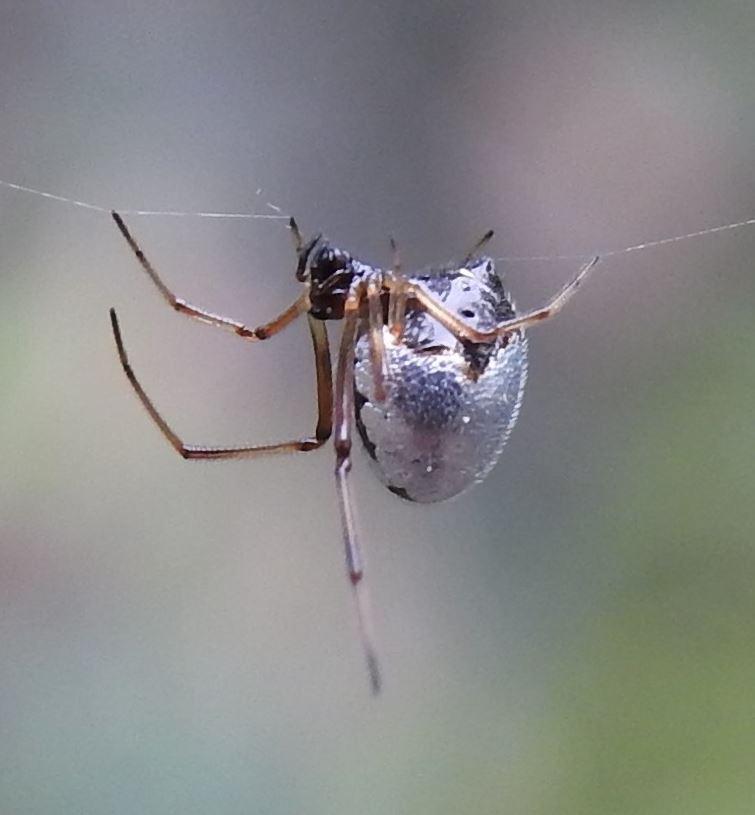
Argyrodes antipodianus (Photo by Scott W. Gavins CC by NC)
The second spider often found on Nephila webs has a tiny silver teardrop body and belongs to the genus Argyrodes (most likely Argyrodes antipodianus). These spiders act as “kleptoparasites” stealing smaller food items from the larger spider’s web, or even from its mouth. To avoid being eaten by Nephila it builds a separate web intertwining its host’s, thus avoiding attention from its movements in search of prey to steal.
5. Jungle Huntsman Spider (Heteropoda jugulans)
The jungle (or brown) huntsman spider is another large, long-legged spider that is commonly seen in and around houses and sheds in the village. Its long legs (longer in front) are often held in a crab-like pose. This spider does not build a nest, but hunts at night chasing small insects, which it kills with a bite to the neck from its curved fangs. Although capable of biting humans, the bite produces only local pain and redness for less than an hour. They tend to be timid animals and will quickly flee if approached. During the day they will hide under the flaking bark of trees or in the cracks and corners of walls or behind pictures in houses.
Photo by Michele Bird (probably Heteropoda jugulans)
GAMES NIGHT at the Community Hall will be held this Saturday 29th May, commencing at 4 pm.
This will be an afternoon/evening of games, sport and most of all FUN to be hosted by none other than Peter (Captain) Klumpp. Come along to join in on a game of social table tennis, darts and pétanque, or all three. You can rotate through the activities and play them all if you wish!
Don’t know how to play? – Don’t worry, you can learn the games on the night. The emphasis is on FUN, LAUGHTER and COMMUNITY.
The Bar will be open for drinks and the PDCA will provide a $2.00 Sausage Sizzle with Lynda at the BBQ.




.jpg?bwg=1614920530)









_(9874865575).jpg?bwg=1616307457)