
In case you have forgotten to book this into your calendar, the annual Bush Dance featuring the band Wattle ‘n’ Gum is next Saturday, June 29 at 7:30pm. And on Sunday (June 30th) we have our Sunday Market and Sausage sizzle.
See you there!

In case you have forgotten to book this into your calendar, the annual Bush Dance featuring the band Wattle ‘n’ Gum is next Saturday, June 29 at 7:30pm. And on Sunday (June 30th) we have our Sunday Market and Sausage sizzle.
See you there!
Over the last few weeks, increasing numbers of Pied Currawongs, Strepera graculina, have arrived in Paluma. The onomatopoeic name currawong reflects the liquid, ringing tone of their call, heard all day throughout the village.

The currawong is a large, (42-50 cm long), handsome, black and white bird, with yellow eyes and a lilting, liquid warbling call. But do not be beguiled by the good looks and melodious carolling. Beneath the beauty lies a rapacious nature. Currawongs plunder the nests and feast on the chicks of other birds. The cruel beak says it all.

Currawongs are similar in appearance to magpies and butcher birds, and were once known as crow shrikes or bell magpies. They are found throughout eastern Australia from North Queensland to Victoria in diverse habitats including woodlands, coastal to alpine forests, rain-forests, scrublands and farmlands. They often form large flocks and are seasonally nomadic, ranging over large distances. In the breeding season, from July to January they are mostly seen alone, in pairs or in small family groups.
They tend to move into Paluma from the west as the weather becomes cooler. Sometimes a flock of fifty and more will move into the area. Today, I disturbed a gang of seven or eight on the roadside plotting their next raid.
Pied currawongs’ diet includes small lizards, insects, mice, caterpillars and berries. They also take large numbers of small and young birds. Larger prey, up to the size of a young possum can be taken and birds will sometimes hunt as a group. Prey may be stored in a tree fork or crack to be eaten later. It has been reported that pied currawongs eat more vertebrate material during the spring breeding season than they do during autumn and winter when berries are available. A pair may kill about 40 broods of small birds (up to 2 kg) to raise one brood of their own.
Raising young is a joint effort. Both sexes gather the material, sticks, grass and other soft vegetation, for the bowl-shaped nest which the female builds high in a tree fork. She incubates the eggs while he feeds her. The male supplies food to the female for the first week after the chicks hatch and she feeds them. Incubation time is 21 days and there are usually three chicks.
The dishes and trays of fruit put out by residents for the honey-eaters, rifle birds and other small birds have become fair game for the currawongs who swoop in, terrorising the other birds and taking all the food. They seem to be afraid of humans however and fly off as soon one appears. Perhaps they have a collective memory of being shot at or stoned by people! It was amusing, and surprising to see therefore, two rainbow lorikeets at my bird-feeder yesterday driving off a currawong. The attack was quite vicious with lots of pecking and screeching until the bigger bird retreated.
It will be no surprise to know that pied currawongs are not on the endangered species list: on the contrary, their numbers are increasing. They have adapted well to living in urban areas and their growing numbers have been implicated in the decline of smaller bird species.
Some information sourced from Google entries from Australian Museum and Birdlife
Text by Colwyn Campbell; Photos by Brian O’Leary

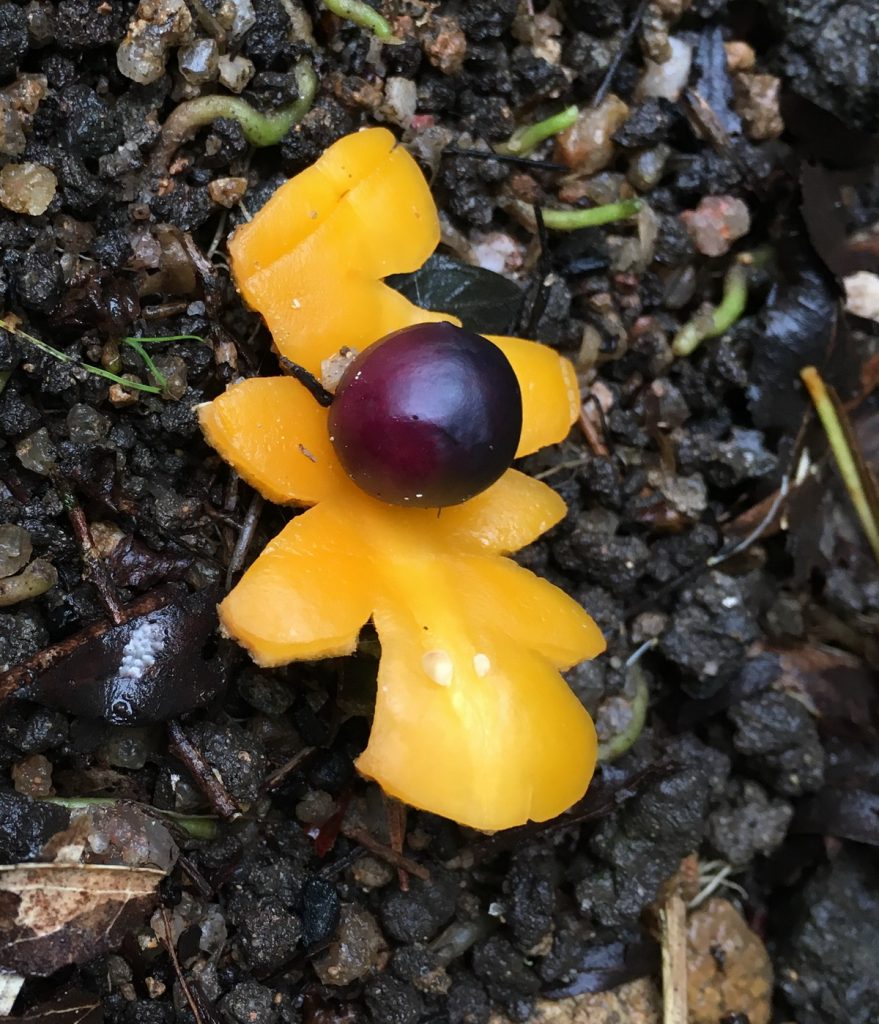
Beginning around the middle of last month (May) some of the tracks around the village had patches of colourful but strangely shaped fruit on the ground. These flattened orange to yellow fruit often have a single seed stuck in the middle. While most rainforest trees are difficult to distinguish based solely on the trunk or leaves, their fruit and flowers can often be distinctive and render them easily identified. Such is the case with McIntyre’s Boxwood (Xanthophyllum octandrum). The best example I have found (although it may now be finished fruiting) is on the H-track just uphill (towards Lennox Crescent) from the old mining test pit and creek lookout. Two mature trees stand near the track (on the left as you face uphill).
MacIntyre’s Boxwood is endemic (i.e restricted to) Queensland, occurring in rainforests from Cape York to the central Qld coast1. Flowering occurs in early summer but the flowers are fairly inconspicuous. The fruit are round, marble-sized and green to pale yellow. When ripe they split open (dehisce) while still attached to the tree to reveal a dark seed attached to the now flattened internal yellow flesh. At this stage the fruit are fairly conspicuous on the tree, and even more so on the dark leaf litter of the forest floor once they have fallen.

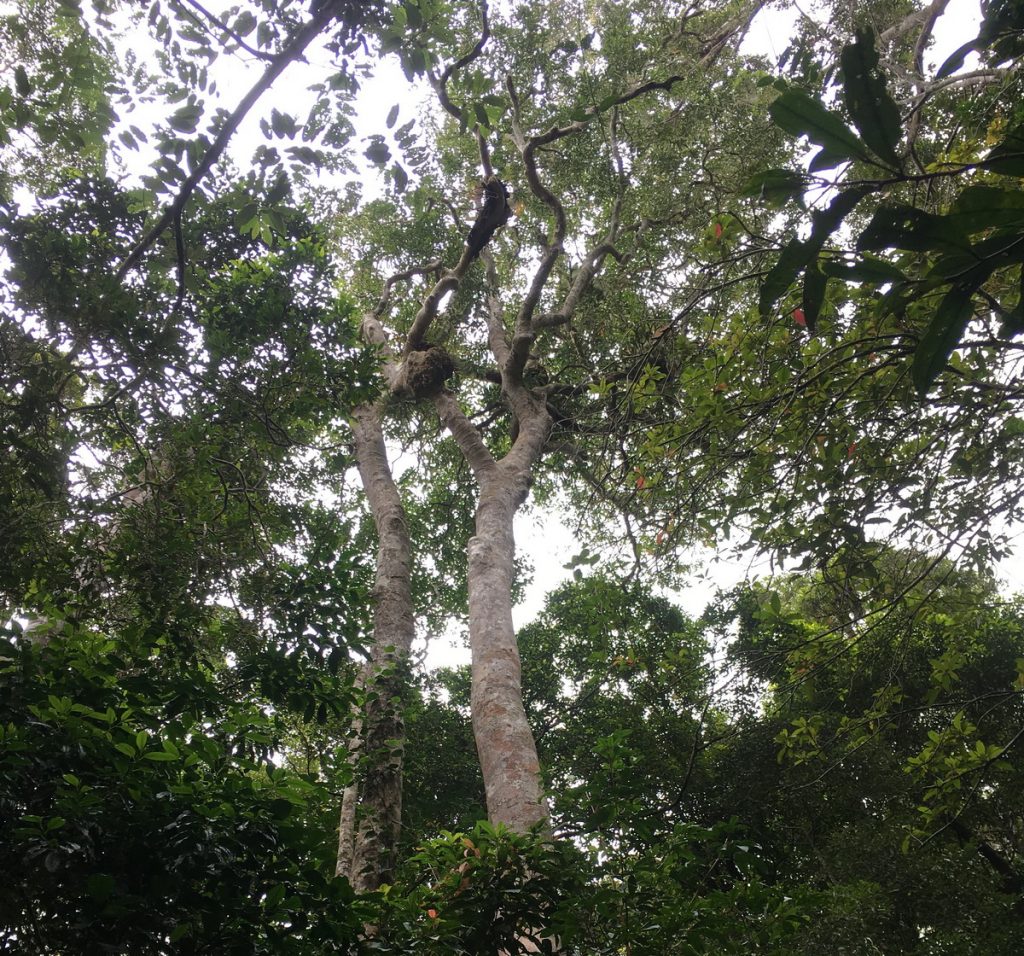
The fruit is eaten by Cassowaries. The trees are slow growing and large specimens are likely to be very old. The timber has been used commercially and was commonly used to make wooden rulers.
Text and photos by Jamie Oliver
While citrus trees around Paluma are full of fruit at present, providing sustenance more to the Cockatoos than human residents, there is also a native rainforest tree/shrub that is currently laden with large round fruit that are beginning to turn yellow or bright orange. From a distance the fruit looks very much like an orange. This is the Native Gardenia or Yellow Mangosteen (Atractocarpus fitzalanii – previously known as Randia fitzalanii1)

Native Gardenia is a native under-story tree in eastern Queensland rainforests. The star-shaped white flowers appear in spring and (unsurprisingly) look at bit like simple gardenia flowers (they share the same family) and have a pleasant perfume.
The fruit is edible and is reported to be good bush tucker2. It can be eaten raw or used in salads, tarts, cakes or other deserts. In fact one author reports that it is one of the few plants that was consumed for is aphrodisiac properties!1 Cassowaries also eat the fruit, but the literature is silent on whether these birds also use it to enhance their reproductive drive. Perhaps you should exercise caution if you see a large male Cassowary with a gleam in its eye when you visit our local grove!
The Native Gardenia is fairly commonly sold in nurseries for its lush foliage and perfumed flowers. The fruit can be quite sweet in some trees but this is quite variable. I confess I have not sampled the fruit but Wilfred had a quick taste of the one at Jourama Falls and found it unremarkable.
Text and photos by Jamie Oliver
Listed below are the social events that the PDCA is organising for the year. The PDCA has decided to add a few new themed nights this year as well as continuing with popular ones from previous years. We hope they will be a success and encourage you to put these dates into your calendar.
Sat 8th June: Soup and Casserole – Country Music night with dress in jeans and check shirt etc.
Sat. 10th August: Dance the Night Away with music suitable dancing and a theme of “Glamour and Glitz”.
Sat. 2nd November: Music from Around the World with International Food as a theme.
Sat. 7th December: Tropical BBQ with Music from the Pacific . BYO meat as usual.
Sat. 14th March 2020: St Patrick’s Irish Night
During this long weekend, the birds at our feeder have become more and more numerous, with Satin Bowerbirds making their first appearance for the year, and Catbirds sneaking in at dawn and dusk. But it is the Rainbow Lorikeets that have dominated the show. Since we first put up our feeder in 1996, I have recorded the same 10 species coming in for a feed (see list below). The species composition may vary at other feeders depending on the food offered (we consistently use dates, softened and mashed up in water). Originally, Lorikeets were almost never at our feeder, but since cyclone Yasi the Rainbow Lorikeets are often a dominant visitor, with the occasional Scaley-breasted Lorikeet thrown into the mix
Yesterday morning and this morning the Rainbow Lorikeets came in numbers I have never seen before. I suspect the entire population of the village was at or around my feeder. The picture below reminds me of the old competition one saw at fairs where you had to guess the number of jellybeans in a large glass jar. I reckon there are 24 in the first photo and 27 in the second (both images have been cropped to include the central mass of birds only). Any other estimates?


Here is my list of birds that I have recorded at my feeder (the last two I try to discourage). I would be interested to hear from other residents who could add to this list. Please also include what type of food you put out.
Jamie Oliver
At its recent meeting, the Townsville City Council endorsed a recommendation from its officers that the opening of Lake Paluma to additional recreational/commercial opportunities will not be contemplated due to its low-key, nature based recreational activities and camping focus. This decision will ensure that the dam remains closed to motorised boating and other commercial activities. This is an excellent outcome. The PDCA has previously communicated to the TCC its strong opposition to any change in the use of the Dam. Margie Ryder, our local Councillor has made our views clear to the Council. We appreciate that her efforts on our behalf have helped to achieve this outcome.
Among the colourful visitors to my garden recently was this beautiful female Orchard Swallowtail Butterfly, (Papilio aegeus). This species is also known as the Large Citrus Butterfly because of the preference of its larvae for feasting on citrus leaves. The butterfly feeds on the nectar of plants, particularly lantana. This one however was resting on a flower-laden choko vine.

The Orchard Swallowtail Butterfly is found in Eastern Australia, ranging from Victoria to Cape York and into PNG. Its usual habitat is lowland rainforest, dry eucalypt woodlands, orchards and suburban gardens so it is not common to see one here in Paluma. The female lays eggs on the underside of leaves of host trees and the eggs hatch a week later. The larvae are patterned in green, brown and a creamy colour and look remarkably like bird droppings: no doubt an excellent camouflage from potential predators.
The female with a wing span of about 105 to 110 mm is slightly larger and more colourful than the male but both attract attention when fluttering through the garden. This butterfly is sometimes considered a pest because of its habit of feeding on citrus leaves in suburban gardens.
Text and photo by Colwyn Campbell
Ever wondered what exactly the PDCA does during the year? I did before I joined the Executive Committee, but found that reading through past President’s reports was a very useful primer on how the PDCA works to improve facilities and services in the village. Several past reports can be found on our website, and I am posting my contribution to this here.
Please contact me (or add a comment) if you have any questions about what has been reported, or if you have any suggestions for what we need to concentrate on this year.
Jamie Oliver
PDCA President’s Report – 2018-19
Over the last year several important milestones have been achieved in Paluma. For each of these the insights, planning and management needed to achieve these outcomes has been the result of the efforts of many people over the course of more than just one year, including all members of the PDCA executive. I think that all Paluma residents should feel very proud of what a small community such as ours can achieve across a range of issues if we work together with a common vision.
Key outcomes for the year that I would particularly like to highlight include:
In addition to these major milestones, the PDCA has also continued to carry or promote our annual program of social, cultural and sporting activities. These include:
Lynn continued to do a fantastic job managing hall bookings this past year. We have attracted a number of interesting groups up to Paluma (Blankets of Love, Buddhist Retreat, Plant Identification course) and this not only helps to enhance our visibility as a great place to hold workshops or retreats, but also continues to make an important financial contribution to the Association.
In addition to the construction of the new Hall extension, the Paluma Community Centre Management Committee (SES, PDCA, PRFS) has reviewed the need for major maintenance of the rest of the building and has arranged for the existing roof to be re-screwed, gutter brackets replaced and new skylights installed. Further maintenance and improvement works such as a covered walkway between the back SES door and the back stairs to the new Hall extension, and the installation of a concrete slab under the hall for a generator, is being planned for this year.
The PDCA spent some time looking at safety issues this year. We held meetings with Transport and Main Roads to discuss the need for upgrades of the range road at several spots and have been informed that efforts will be made to include this work in the next bid for road funding in 2019-20. The PDCA has had several discussions with relevant authorities about speeding in the village and we will continue to lobby for appropriate signage and other realistic measures to make are village roads safer. We have also reviewed arrangements for the location of the Royal Flying Doctor Service kits. It will remain at the Ivy Cottage with Ian Marshall acting as the key contact person. We have also investigated options for access to a defibrillator. Currently there is a defib (currently being serviced) in the Paluma Fire Brigade vehicle, and Michael Drew has arranged for a second unit (in service) to be made available over the Easter weekend in the Hall. To cater for other injuries, Juanita Poletto has organized the placement of a St John’s Ambulance first aid kit (with additional kits for burns and snake bites) in the hall, together with appropriate signage.
Building on the capabilities of our new website, we have undertaken a major revision of the format for Turkey Talk. Given that our web posts now cover over 90% of traditional Turkey Talk content, the newsletter is now circulated as a quarterly digest of new information posted to the Website.
Although the PDCA has accomplished quite a bit during the year, we still have a list of issues and jobs that we started to address but have not reached full completion or resolution. Some of our priorities for next year include:
Jamie Oliver
PDCA President
At the recent PDCA Annual General Meeting the following people were elected:
| President | Jamie Oliver |
| 1st Vice President | Sarah Swan |
| Treasurer | Wilfred Karnoll |
| Secretary | Michele Bird |
| Committee Member | Lynn Hyland |
We welcome Sarah as a new member to the Committee (and to Paluma) and look forward to her contributions and perspectives on how we can ensure Paluma lives up to, and enhances, its reputation as a key destination for locals and interstate/overseas visitors, and as a small patch of paradise for those of us who are residents.
The position of 2nd Vice President is currently vacant (it is an optional position) but we are keen to fill it if there is someone who is interested in getting involved with the PDCA. Please contact Michele or anyone above it you would like further information.
Colwyn Campbell and Juanita Poletto decided not to seek re-election this year in order to concentrate on other work. The meeting thanked both outgoing members for their contributions on the Committee. Colwyn in particular has been on the committee as Vice President or Treasurer. Her calm and considered voice on key matters during Exec meetings will be missed. Colwyn will continue to play a key role in the History Project as well as maintaining her important contributions to the Web site and Turkey Talk (as editor). Juanita was also thanked for her work in securing new first aid kits for the hall and in conducting a review of the Royal Flying Doctor medical kit arrangements (which remains at Ivy Cottage under the stewardship of Ian Marshall).
The full minutes of the AGM and General Meeting will be published shortly in the members section of the website.